The short answer
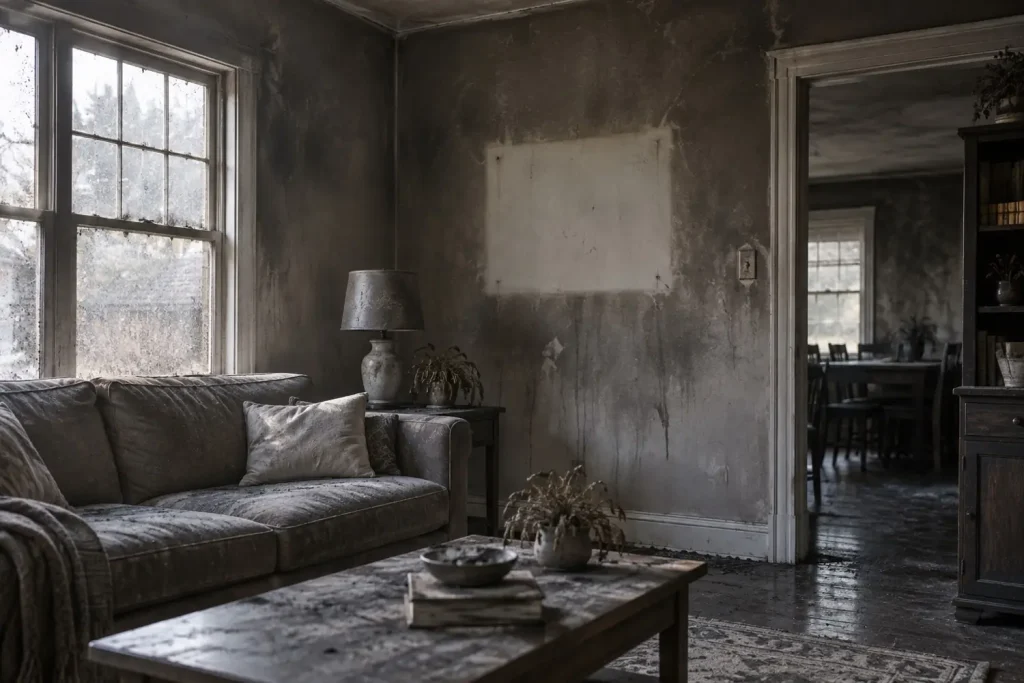
A smoke damage insurance claim is rarely disputed over the burned room. It is disputed over where the damage stops, because smoke travels far beyond the fire through wall cavities and the HVAC system. Residue type decides the cleaning method and therefore the cost, contents frequently exceed the structural scope in both value and labour, and odour is what brings a technically finished job back for an unbilled return visit.
Key takeaways
- The scope boundary is the whole argument. Smoke reaches rooms that never saw flame, and a scope drawn at the fire compartment is almost always too small.
- Four residue types behave differently: dry smoke, wet smoke, protein residue and fuel oil soot. They need different methods and they are not interchangeable.
- Wet smoke from a slow smouldering fire is the hardest and most expensive to clean, while a fast hot fire leaves an easier residue. Protein residue from a cooking fire is nearly invisible and carries a severe odour, which is why those losses get underscoped.
- Contents are their own cost centre: pack-out, item-by-item inventory, off-site cleaning, storage and return.
- Odour is the commercial risk: sealing over residue instead of removing it is the shortcut that produces the callback. Hydroxyl generators can run in occupied space; ozone cannot, and needs the area vacated plus a clearance period.
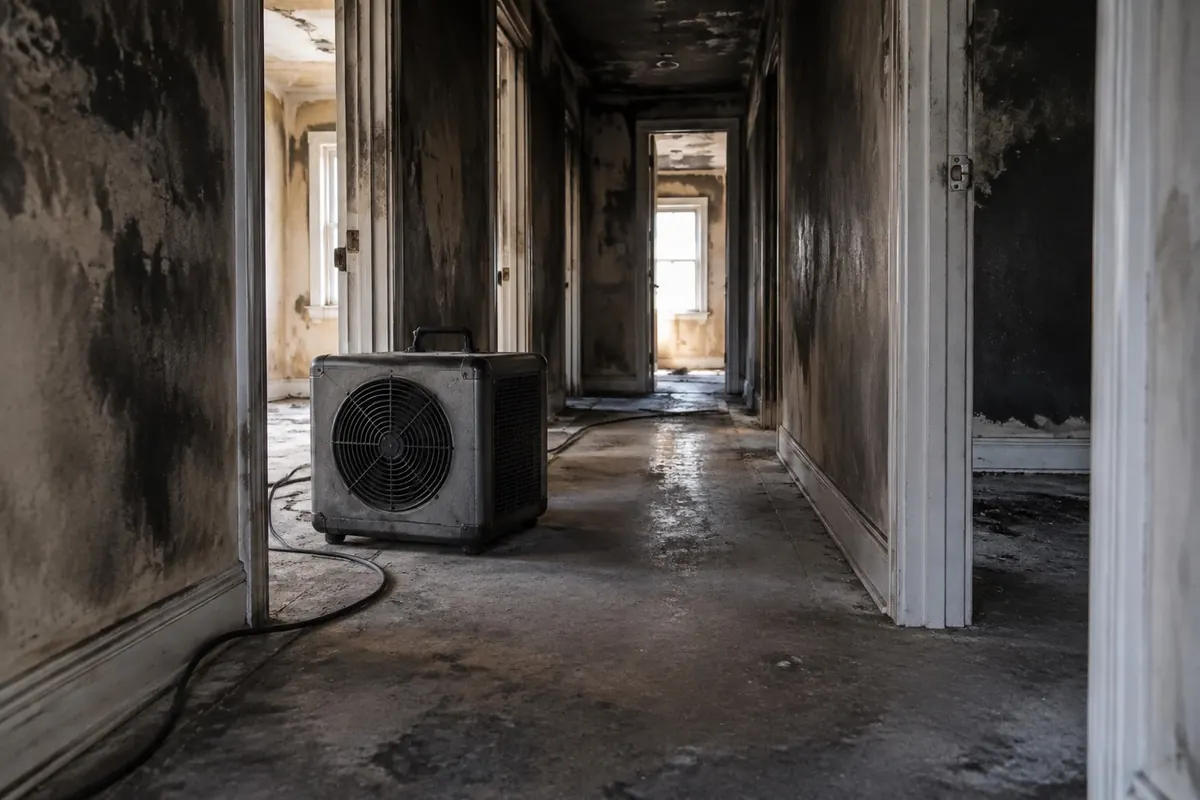
- If the HVAC system ran during or after the fire it distributed residue building-wide, and duct cleaning belongs in the scope.
On this page
- The dispute is about where damage stops
- Residue type drives method and cost
- Cleaning methods, matched to residue
- Contents usually exceed the structure
- Pack-out, storage and the inventory
- Odour is where these jobs are lost
- Hydroxyl against ozone
- The HVAC system is part of the loss
- Cleanable against replace
- Claim mechanics, in order
- The four recurring disputes
- Questions people actually ask
A smoke damage insurance claim behaves unlike any other property claim, because the damaging agent is a gas and a suspended particulate rather than water or impact. It goes where air goes: up a stairwell, along a wall cavity, into a return duct and out of every register in the building. That is why the scope argument is the whole file, and why the evidence has to be collected before anybody cleans anything.
The dispute is about where the damage stops
The burned room is straightforward: everyone agrees it needs rebuilding. The argument is the next twelve rooms, because smoke damage there can be real and nearly invisible at the same time.
| Path smoke takes | Why it reaches rooms that never saw flame |
|---|---|
| Upward through openings | Heat drives smoke up stairwells and service risers, so the floor above a fire is often worse than the floor beside it. |
| Wall and floor cavities | Smoke enters at penetrations around outlets, pipes and light fittings, moves through the cavity, and exits elsewhere. |
| The HVAC return and supply | A running system pulls smoke into the return and distributes it to every supplied room. |
| Cold surfaces | Particulate deposits preferentially on cooler surfaces, so residue appears on exterior walls and window glass rather than uniformly. |
| Under doors | A closed door slows smoke, it does not stop it. |
| Pressure differentials | Extract fans, open windows and stack effect move smoke in surprising directions, including downwards. |
Invisible is not the same as absent
A room can hold enough residue to smell strongly, to corrode metal fittings over months, and to keep resettling on cleaned surfaces, without looking dirty from the doorway. Those residues are frequently acidic, so what could have been cleaned in week one may need replacing by week four. That is the room written out of a scope and back in later at greater cost. Chemical sponge test patches in several rooms, photographed, are how residue gets documented in a form that survives a scope review.
Residue type drives method and cost
Four residue types come up repeatedly, and the difference is not cosmetic. It determines the chemistry, the labour hours per square foot, and whether a surface can be cleaned at all. An estimate that does not name which residue it is priced against cannot be checked.
| Residue type | Fire that makes it | How it behaves | Cleaning difficulty |
|---|---|---|---|
| Dry smoke | Fast, hot, well-ventilated fire burning paper or wood | Fine, dry and powdery. Sits on surfaces rather than bonding, and falls into cracks and cavities | Easiest. Dry methods and vacuuming before any wet work. |
| Wet smoke | Slow, smouldering, oxygen-starved fire, often plastics and rubber | Sticky, thick and smeary. Bonds to surfaces, smears badly if wiped wrongly, strongly pungent | Hardest. Heavy degreasers, more labour, more surfaces replaced rather than cleaned. |
| Protein residue | Kitchen and cooking fires where food or fat burns | Nearly invisible, thin, greasy, yellowing. Coats every surface including ceilings, severe persistent odour | Deceptive. Low visible damage, high labour, odour survives cleaning that looks successful. |
| Fuel oil soot | Furnace puff-back in an oil-fired system | Oily and pervasive, through the whole duct network in seconds | High. Oily binder resists water-based cleaning and the HVAC is always in scope. |
Cleaning methods, matched to residue
Methods are not ranked worst to best. Each suits particular residues and substrates, and the wrong one makes the damage permanent rather than merely unfinished.
| Method | What it suits | What goes wrong if misapplied |
|---|---|---|
| Dry cleaning: vacuuming, dry sponges, compressed air | Dry smoke on porous and painted surfaces, always the first pass | Going straight to wet cleaning turns loose particulate into a smear driven into the substrate. |
| Wet cleaning with detergent or degreaser | Wet smoke and protein residue on washable non-porous surfaces | On porous material it drives residue deeper and can set the stain. |
| Abrasive and media cleaning | Heavy residue on framing and unfinished surfaces after demolition | Removes the surface with the residue, so it is wrong on finished material meant to stay. |
| Ultrasonic cleaning | Hard contents: glassware, metal, ceramics, tools, many toys | Not for soft goods, bonded assemblies, or anything that cannot be wetted. |
| Thermal fogging | Odour counteraction after residue removal, because it follows the paths the smoke took | As a substitute for cleaning it masks temporarily and the odour returns. |
| Sealing and encapsulation | Cleaned framing and substrates where residual odour sits in the material itself | Sealing over uncleaned residue traps the source. The smell finds a way out and the sealer has to come off. |
Contents usually exceed the structure
Owners and sometimes adjusters treat contents as the small half of a fire file. On smoke losses they routinely are not, in value or in labour hours, because every object in an affected room needs its own decision and many need individual handling.
Why contents labour is so much higher than it looks
A wall is one surface with one method. A kitchen is several hundred objects across a dozen substrates, each needing a clean, replace or dispose decision and a record of it. Porous and fibrous items absorb odour into the fibre rather than holding residue on a surface, so textiles, upholstery and mattresses often need specialist laundering and some are uneconomic to treat at all. Food and cosmetics are normally disposed of rather than cleaned.
Pack-out, storage and the inventory
Pack-out means removing contents for off-site cleaning and storage. It exists because cleaning items inside a building that is itself being cleaned and rebuilt does not work, and because off-site facilities hold equipment that cannot travel.
| Cost centre | What it covers | What to watch |
|---|---|---|
| Inventory | Item-by-item listing, photographed and labelled by room, before anything moves | The document you rely on if something goes missing or is written off. Insist it exists and ask for a copy. |
| Pack-out labour and materials | Crating, wrapping, boxing, loading, transport | Billed per hour and per material unit, so room and object counts drive it. |
| Off-site cleaning | Ultrasonic, laundering, specialist treatment of hard and soft goods | Priced per item or category. Ask which items were treated and which were declared not cleanable. |
| Storage | Climate-controlled storage for the rebuild duration | Billed monthly, so a rebuild delay extends it. Track against the loss of use limit. |
| Return and placement | Transport back, unpacking, placing items in the rebuilt space | Often omitted from early estimates then added, reading as a scope increase when it was always going to happen. |
Coverage for contents, pack-out, storage and odour treatment is decided by your policy wording and the facts your insurer establishes, not by a general article. Contents limits, per-category sublimits and the additional living expense limit all operate independently of the dwelling limit. This page describes common practice so you know what to ask. It is not advice on your policy.
Odour is where these jobs are lost
A structure can be visually clean, pass a walkthrough, and fail completely on smell. That failure arrives days or weeks later, after the invoice, and the return visit is normally unbilled. It is the largest commercial risk on a fire file, and almost always caused by one decision: sealing or deodorising before the residue came out.
Odour comes from the residue and from volatile compounds absorbed into porous material, so neutralising the air does nothing about a source that keeps releasing. A sealer over uncleaned framing buys weeks, and when it fails the sealer has to come off before the cleaning can happen, so the shortcut costs more than doing it in order. Those compounds also release faster as temperature and humidity rise, which is why a job signed off in cool weather draws a complaint in the first warm one.
The order that works
- Remove the source. Charred, heavily contaminated and unsalvageable material comes out, along with porous material that cannot be cleaned through.
- Clean every affected surface, with the method matched to the residue, working from the top of each room down.
- Clean the HVAC system if it ran, before any air treatment, because a contaminated duct recontaminates cleaned rooms.
- Treat the remaining absorbed odour with hydroxyl or ozone, chosen on whether the space is occupied.
- Seal only what remains, on cleaned substrates, where odour is genuinely in the material rather than on it.
- Check by nose with the building closed and warm, because cold ventilated buildings smell fine and then do not.
Hydroxyl against ozone
Both destroy odour compounds rather than masking them, and they are not interchangeable, because the occupancy rules differ completely.
| Hydroxyl generator | Ozone generator | |
|---|---|---|
| Occupied space | Can generally run with people and pets present | No. The area must be vacated, pets and plants included. |
| Clearance afterwards | None required as a rule | Required. Ventilate and let the ozone revert before re-entry. |
| Speed | Slower, running alongside the cleaning over days | Faster on a sealed unoccupied space. |
| Material effects | Gentler on sensitive materials | Oxidises rubber, some plastics, artwork and certain textiles, so sensitive items come out first. |
| Typical use | Occupied homes, phased work, soft goods still in place | Vacated structures and sealed chambers, often contents off-site. |
The consequence for a claim is scheduling. With occupants still in the property, ozone is off the table for occupied areas and the odour work runs on a longer hydroxyl timeline. Once they move out ozone becomes available and the timeline shortens, but the additional living expense clock is running instead. Both trade-offs are worth putting to the adjuster rather than discovering later. Our ozone generator guide sets out the EPA, OSHA and CARB rules behind that.
The HVAC system is part of the loss
If the system ran during or after the fire it moved smoke through the whole building and left residue inside ductwork no surface cleaning reaches. Every later cycle redistributes some, which is why cleaned rooms start smelling again.
- Establish whether it ran, during the fire and in the days after. Ask on day one; the answer determines the scope.
- Filter replacement is not duct cleaning. The filter is the cheapest part of the answer and the least of it.
- Inspect, then clean supply and return runs, the air handler, coil and blower. A camera inspection substantiates the line.
- Seal registers during structural cleaning so cleaning one room does not push residue into the ducts and out elsewhere.
- Clean the ducts before air treatment, in that order, or the hydroxyl or ozone work is undone by the first heating cycle.
Cleanable against replace
This is the recurring line-item argument on every fire file, and it is a judgement rather than a rule. Four factors decide it, and documenting them makes the decision defensible either way. Insulation and unsealed cavity material rarely survive, because cleaning inside the material cannot be confirmed.
| Factor | Pushes toward cleaning | Pushes toward replacement |
|---|---|---|
| Substrate | Non-porous and washable: glass, metal, glazed tile, sealed surfaces | Porous: raw timber, insulation, textiles, plasterboard facing. |
| Residue type | Dry smoke sitting loose on the surface | Wet smoke bonded to the substrate, or protein residue in a porous material. |
| Cost comparison | Cleaning labour well below replacement cost | Cleaning labour approaching replacement, common on low-value high-labour items. |
| Verifiability | The result can be inspected and confirmed | Success cannot be confirmed, as with residue inside insulation. |
Claim mechanics, in order
Two duties operate at once in standard property forms: protect the property from further damage, and substantiate the loss. On a fire they conflict for as long as it takes to photograph a room.
- Document before anything is cleaned or discarded. Photograph every room, including ones with no visible damage, plus close shots of test-cleaned patches.
- Get the residue type named in writing in the first report, with the reasoning behind it.
- Build a room-by-room contents inventory before pack-out, photographed and labelled, and keep your own copy.
- Ask whether the HVAC ran and get the answer recorded.
- Document discarded items, photographing thoroughly anything that must go for health reasons. A disposed item with no record is a disputed item.
- Track the loss of use clock against the rebuild programme: storage and displacement both run on it.
- Do not sign a completion for odour until the building has been closed and warm for a period.
The four recurring disputes
Scope arguments on smoke files cluster into four, and each one has a specific piece of evidence that settles it.
| Dispute | What settles it |
|---|---|
| Which rooms are affected | Test cleaning with photographs in every room claimed, including rooms that look clean, plus the smoke-path reasoning. |
| Cleanable against replace | Substrate, residue type, cost comparison, and whether the result can be confirmed, recorded item by item. |
| Whether odour treatment is part of the loss | Smoke odour with no visible residue is still damage. Records of source removal and the sequence followed support the line. |
| Whether HVAC cleaning is in scope | Whether the system ran, plus a camera inspection of the ducts. |
Fire loss and prevention material is published by the US Fire Administration. For how the estimate itself is built, our guide to Xactimate pricing covers line items, unit counts and the overhead and profit argument. Suppression also puts a large volume of water into the building, so our restoration cost guide and our water coverage guide both apply. Our methodology sets out our standing rules.
Questions people actually ask
Is smoke damage covered by insurance if there was no fire in my unit?
Smoke damage from a fire elsewhere in the building is generally treated as damage from a covered peril under standard property forms, and smoke odour with no visible residue is still a legitimate claim. It turns on your policy wording and on establishing the smoke came from the fire, which is why documenting clean-looking rooms matters.
Why is the smoke damage scope bigger than the fire damage?
Because smoke travels through wall cavities, stairwells and the HVAC system into rooms that never saw flame, depositing on cool surfaces throughout the building. On many losses the structural cleaning and contents work outweigh rebuilding the burned area.
What is the difference between wet smoke and dry smoke?
Dry smoke comes from a fast hot fire and is powdery, sitting loose on surfaces, so it cleans more easily. Wet smoke comes from a slow smouldering low-heat fire, often plastics, and is sticky and smeary. It bonds to surfaces, smears if wiped wrongly, and is the most expensive residue to deal with.
Can smoke odour be removed permanently, or does it always come back?
It can be, but only by removing the source first. Odour returns when residue was sealed over or deodorised instead of cleaned out, because the source keeps releasing. The sequence is source removal, surface cleaning, HVAC cleaning, air treatment, then sealing what remains.
Is ozone safe to use while we are living in the house?
No. Ozone treatment requires the area vacated, pets and plants included, then ventilation and a clearance period before re-entry. Hydroxyl generators can generally run in occupied space, which is why they suit phased work with people still in the property. Follow the equipment instructions and applicable safety requirements.
Does the insurance claim cover cleaning the ductwork?
If the system ran during or after the fire it distributed residue through the building, and duct cleaning plus filter replacement is normally a legitimate part of the scope. The evidence is establishing that it ran, plus a camera inspection showing residue inside.
Should I throw away smoke-damaged belongings before the adjuster comes?
No, other than items that must go for health or safety reasons, and photograph those first. A disposed item with no record is a disputed item. Build a room-by-room photographed inventory before anything is packed out, and keep your own copy.
Sources
- US Fire Administration, United States Fire Administration, for fire loss and fire prevention material. Retrieved 23 September 2026.
- Residue classifications, method matching, pack-out cost structure and the hydroxyl against ozone distinctions reflect generally described fire restoration practice. No proprietary method, product or carrier procedure is reproduced and no equipment was tested for this article.
- The distribution chart showing contents, structural, odour and reconstruction shares is ILLUSTRATIVE and schematic, not survey or carrier data and not a quote.
- Coverage statements describe the common pattern in standard US property forms. Carrier wordings differ and the policy governs.
- Ozone occupancy restrictions reflect the general requirement that treatment happens in unoccupied space with a ventilation and clearance period. Manufacturer instructions and safety requirements govern use.
This page is general information about how smoke damage claims are scoped and how restoration methods are chosen. It is not insurance advice, it is not advice on any specific policy, and it creates no expectation of coverage. Read your own policy and speak to your agent or a licensed adviser.