The short answer
A puffback is a delayed ignition inside an oil burner, or rarely a gas burner: unburned fuel collects in the combustion chamber, then lights all at once and blows oily soot out of the appliance and, on a forced-air system, through the ducts to every room. The standard ISO HO-3 homeowners form names puffback inside its smoke peril, subject to the words sudden and accidental.
Key takeaways
- The ISO HO-3 smoke peril names it outright: “the emission or puffback of smoke, soot, fumes or vapors from a boiler, furnace or related equipment.”
- A fuel pump is meant to stop oil within about a second; NORA treats cutoff within 1 second as acceptable and reports field pumps generally within 0.5 seconds.
- Pressing the reset button again and again feeds the chamber; the Beckett 7505 control restricts reset after 3 lockouts for that reason.
- Forced air spreads it furthest, even into closed rooms; a hot water boiler usually spreads less.
- The burner repair and the house cleanup sit under different clauses.
- Keep the failed parts and the technician’s written report. They answer the cause question and preserve subrogation.
On this page
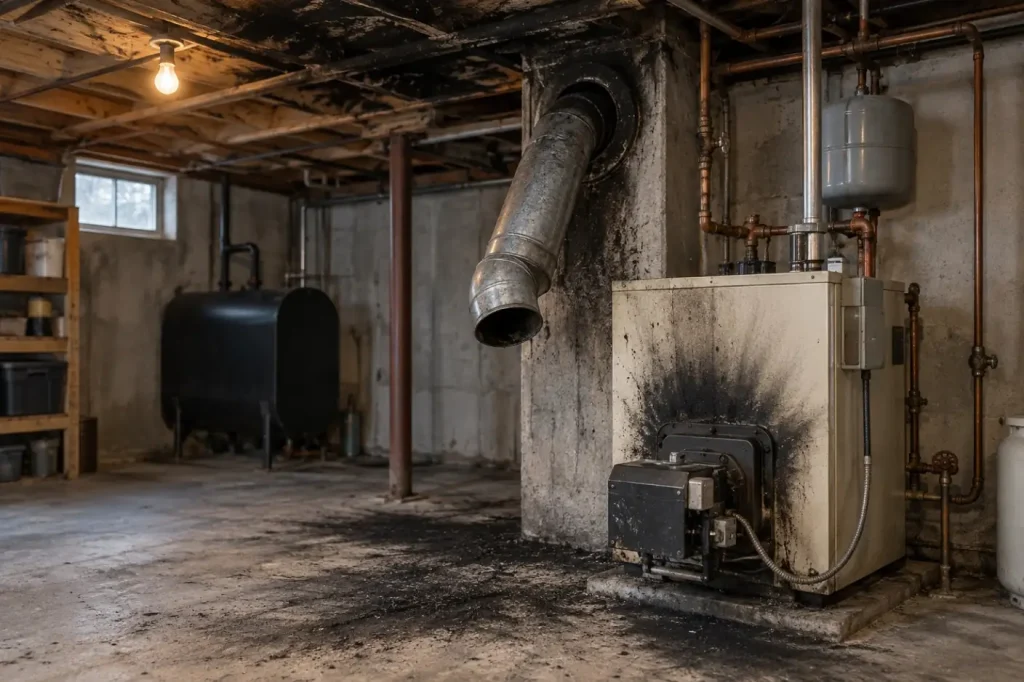
Search the word and half the results are a bird, the black-backed puffback of African woodland. In a house it means something louder. Fire Engineering, writing for firefighters, defines it: “atomized oil is delivered to the combustion chamber but is not immediately ignited” (Fire Engineering). When it does ignite, the burner room and basement can fill with smoke in seconds and the blast can knock the flue pipe down.
This page covers the event, the policy wording and the cleanup. It does not tell anyone what their own policy pays, and it does not cover choosing burner equipment. General smoke cleaning is on our smoke damage repair page and the fire and smoke hub lists the rest.
What you are looking at
The pattern reads outward from the appliance and shows how far it went and whether it was one event or many.
| Where | What you see | What it tells you |
|---|---|---|
| Burner or boiler room | Soot from dark grey to black; flue pipe possibly down (Fire Engineering) | Origin. A dislodged flue pipe keeps the appliance off until it is serviced. |
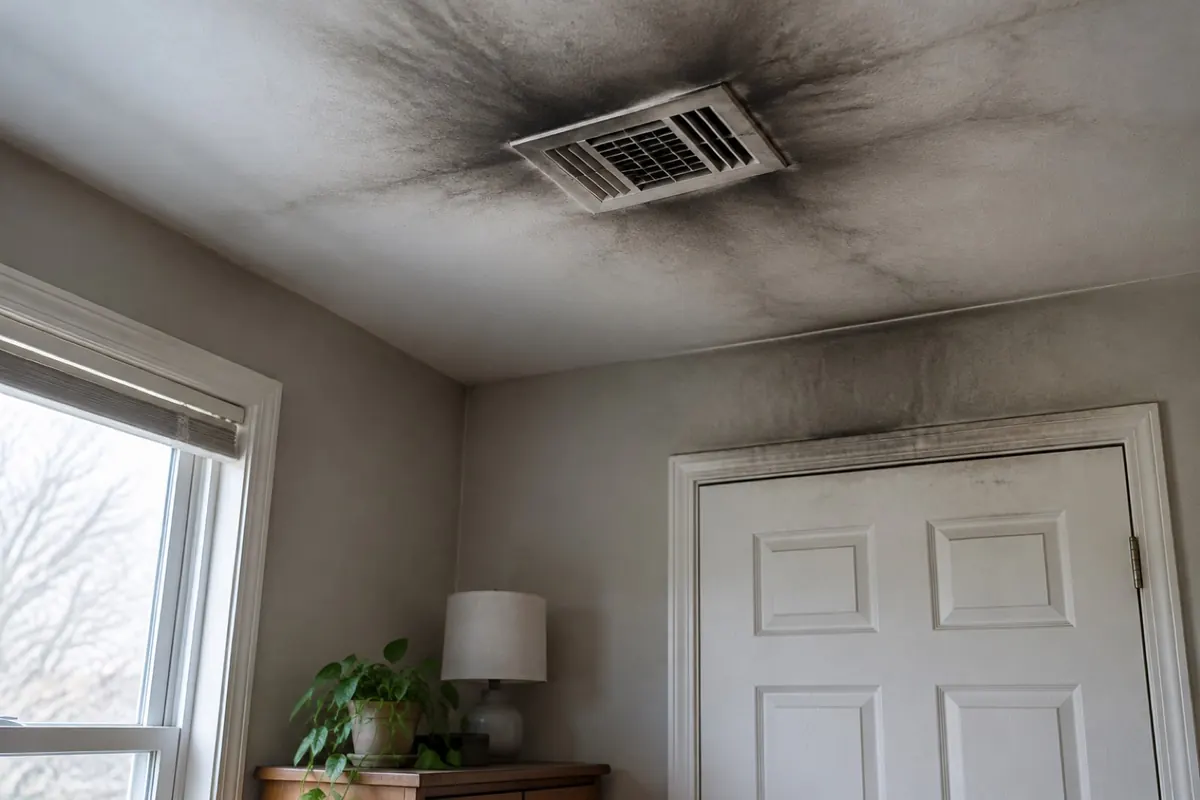
| Supply registers and ducts | Soot pushed into the ductwork (Alpine Intel adjuster guide) | Forced air carried it; every room on the system is in scope. |
| Closets and closed rooms | Soot even behind closed doors (Tuckey) | Ducts bypass doors. Inspect rooms that look untouched. |
| Walls and fabrics | Smoky streaks; fabrics black and sticky (Tuckey) | Oily residue. Wiping wet smears it. |
| Vents, ceilings, baseboards, carpet over time | Gradual build-up from smaller chronic puffbacks (Tuckey) | Not one event. The coverage question changes. |
Puffback or something else?
| Look-alike | How it differs | Where it is covered |
|---|---|---|
| Candle soot | Dry, fine lines on framing and carpet edges, built up over weeks | Candle soot |
| A sooting burner, no single bang | Repeated small events; InspectAPedia says sooty operation is not normal | Service call first; the chronic row above |
| House fire smoke | Char, heat damage and a fire origin | Smoke damage repair |
What happens inside the burner
An oil burner works by pressure. The fuel pump lifts oil, sets the atomizing pressure, typically 100 to 150 psi according to the NORA biodiesel blends report, and provides a “sharp” turn-on and turn-off of flow to the nozzle “to prevent after-drip or injection of fuel under a low pressure, poor atomization condition.” After-drip is oil reaching the chamber with no flame to burn it.
The NORA pump cycling report measured how fast pumps stop the flow after the motor shuts off. NORA set the acceptable range at within 1 second and reports that field pumps generally cut off within 0.5 seconds. The primary control is the other guard. Beckett’s Beckett GeniSys 7505 product sheet lists a 15-second lockout time, the window its sequence allows for ignition before it locks the burner out.
Each reset adds a trial. InspectAPedia says to press a tripped reset once at most, warning that repeated pressing risks “a dangerous puffback explosion when un-burned fuel in the heater finally ignites.” Beckett says that after 3 lockouts the reset becomes restricted “to prevent repetitious resetting by the homeowner.”
Causes, part by part
A puffback is the result, not the fault. Each cause below puts oil in the chamber without a flame or delays the flame.
| Part or condition | How it lets fuel collect | Source |
|---|---|---|
| Dirty or clogged nozzle | Poor spray and poor flame; fuel left unburned | InspectAPedia; Alpine Intel adjuster guide |
| Damaged or misadjusted electrodes, weak transformer | Weak spark, late ignition | InspectAPedia |
| Pump check valve or shutoff seat dirty | Oil keeps flowing after shutdown (after-drip) | InspectAPedia; NORA biodiesel blends report |
| Failed or disconnected solenoid valve | Loses the positive fuel shutoff | InspectAPedia |
| Air in the oil line, supply piping leaks | Compressed air pushes oil out after shutdown | InspectAPedia |
| Oil-soaked chamber liner | Stores unburned oil between cycles | InspectAPedia |
| Dirty fan, poor combustion air | Too little air for a clean flame | InspectAPedia |
| Blocked flue or chimney, cracked heat exchanger | Pressure irregularities; a bird’s nest can block the flue | Fire Engineering; Alpine Intel adjuster guide |
| Repeated resets after failed starts | Each trial adds oil | InspectAPedia; Beckett GeniSys 7505 product sheet |
Gas equipment can puff back too, but InspectAPedia calls it uncommon and the Alpine Intel adjuster guide agrees oil equipment is more susceptible.
Why a puffback reaches every room
On a furnace the air handler sits beside the burner, so the soot enters the ductwork (Alpine Intel adjuster guide) and travels to the whole house, including closets and closed rooms (Tuckey). Tuckey notes a hot water or steam boiler releases less soot and it may not spread as far.
The residue is also unlike candle or dust soot: it carries unburned fuel, which is why fabrics go black and sticky. The Bane-Clene sponge directions scope their dry sponge to dry smoke and soot residues, so on puffback soot a dry pass lifts loose material and degreasing does the rest.
Exposure is regional. The EIA reports about 4.79 million US households used heating oil in winter 2023 to 2024, about 82 percent of them in the Northeast (EIA heating oil data). NORA’s 2026 indoor particulate study puts liquid fuel heating at an estimated 5 million homes and smaller commercial buildings (NORA indoor particulate study).
Puffback insurance: what the standard wording says
This describes the standard ISO form, not any particular policy. Carriers use their own forms and endorsements, so read your policy, contact your state insurance department and talk to a licensed professional.
The ISO HO 00 03 05 11 form is hosted by the Maine Bureau of Insurance. Under Coverage C, personal property, peril 7, Smoke, reads in full: “This peril means sudden and accidental damage from smoke, including the emission or puffback of smoke, soot, fumes or vapors from a boiler, furnace or related equipment. This peril does not include loss caused by smoke from agricultural smudging or industrial operations.”
| Clause | Exact words | Role in a puffback claim |
|---|---|---|
| Coverage A and B insuring line | “We insure against direct physical loss to property described in Coverages A and B.” | The dwelling is open peril, subject to exclusions. |
| Pollutant exclusion | Pollutants include “smoke, vapor, soot, fumes”, unless the release “is itself caused by a Peril Insured Against named under Coverage C.” | Smoke, puffback included, is a named Coverage C peril. |
| Wear and tear; mechanical breakdown | “Wear and tear, marring, deterioration”; “Mechanical breakdown, latent defect, inherent vice” | Points at the burner itself, not the soot in the house. |
| Ensuing loss | “any ensuing loss to property described in Coverages A and B not precluded by any other provision in this policy is covered.” | Why the burner part and the cleanup are argued separately. |
| Sudden and accidental | From the smoke peril above | Chronic small puffbacks invite a gradual-damage argument. |
Smoke claims in general are on our smoke damage insurance claim page, and owners weighing outside help can compare public adjuster fees.
What a puffback claim should document
Most of what an adjuster asks for maps to a duty or clause in the form. The Alpine Intel adjuster guide adds that an objective expert should assess the damage and that a policyholder should never run the tests that establish whether a puffback occurred.
| Record | Why it matters | HO-3 clause it serves |
|---|---|---|
| Date, time and what was heard or seen | Fixes a single event rather than a pattern | Smoke peril: sudden and accidental |
| Burner technician’s written report naming the failed part | Separates cause from cleanup | Wear and tear, mechanical breakdown, ensuing loss |
| Failed parts retained: nozzle, pump, control | Evidence if the carrier pursues a service company | Subrogation: assignment of rights of recovery |
| Service and fuel delivery records | Shows maintenance history and who worked on it | Wear and tear; subrogation |
| Photos before any cleaning, closed rooms included | Shows spread; Tuckey advises photographing heating system and soot | Duty to show the damaged property |
| Contents inventory: quantity, description, value | Contents are often the largest line | Duty to prepare an inventory with actual cash value |
| Receipts for emergency measures | Shutting down, boarding, temporary protection | Duty to protect property; Reasonable Repairs |
| Living expense receipts if the house is unfit | Hotel and meals while cleaning runs | Coverage D, Additional Living Expense |
| Signed, sworn proof of loss when requested | Time limit | Within 60 days after the insurer’s request |
The first 24 hours, in order
- Shut down, shut off, ventilate. Fire Engineering‘s order for firefighters: shut down the burner, shut the fuel supply and ventilate. Stand clear of the burner front.
- Do not keep pressing reset. A further trial can add oil to a wet chamber (InspectAPedia).
- Leave the heating system off. Tuckey advises shutting it off immediately to prevent further damage.
- Call a burner service technician and ask for a written finding. Fire Engineering tells fire officers to order the burner serviced by a licensed oil burner repair service.
- Photograph everything, closed rooms included, before anyone wipes anything.
- Notify the insurer promptly, which the HO-3 lists first among duties after loss.
- Throw out exposed food, as Tuckey advises.
Escalation triggers
- The flue pipe is down or loose: a venting problem (Fire Engineering).
- Soot in closets or rooms with closed doors: the duct system is in scope (Tuckey).
- Fiberglass duct board or lined ducts: the EPA duct cleaning guidance points to NAIMA recommendations for those materials.
- Soot keeps reappearing: chronic puffbacks, and a different coverage conversation.
Puffback cleanup, in order
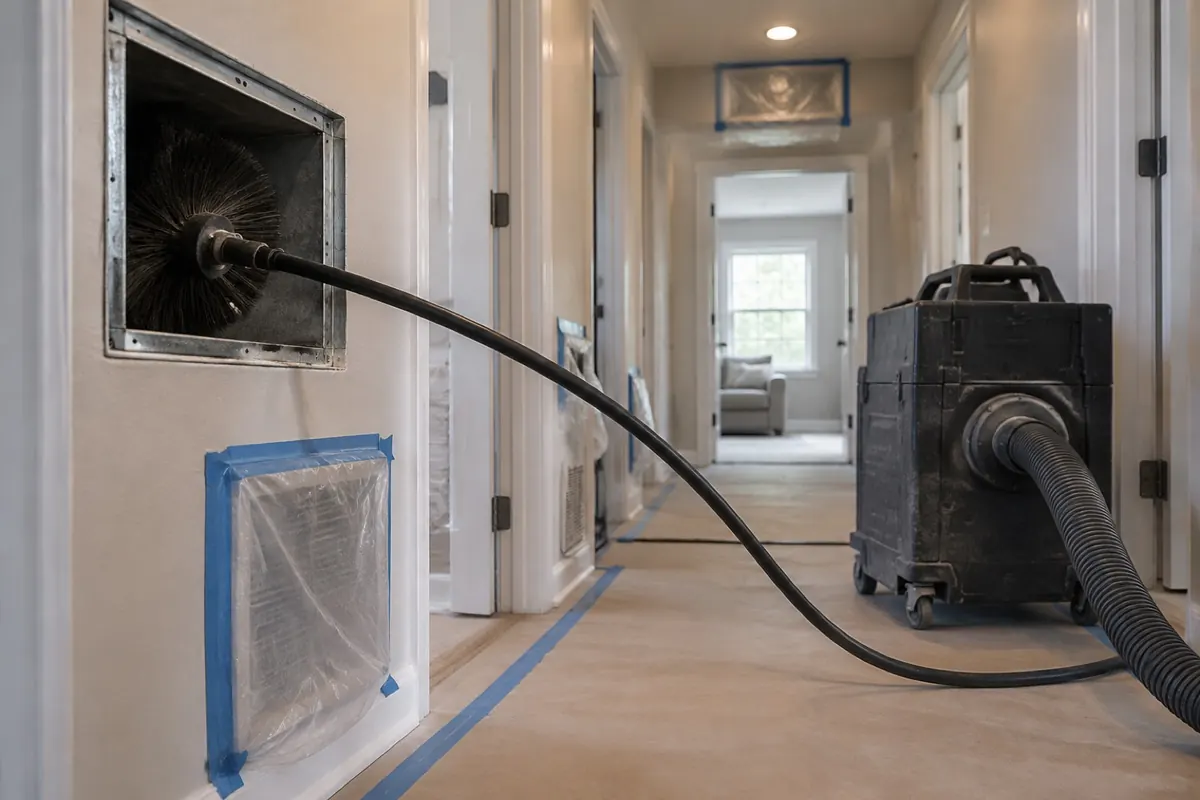
ANSI/IICRC S700 (first edition, 2025) covers assessment, HVAC, contents and documentation. For a puffback one fact sets the order: the ducts delivered the soot and can deliver it again.
| Step | What happens | Why this differs from generic smoke cleanup |
|---|---|---|
| 1. Burner repaired and signed off | Technician fixes the cause before any restart | Generic smoke cleanup starts at the walls; here the source can fire again on the next heating cycle. |
| 2. HVAC system cleaned | Every component, with HEPA or outside-exhausting vacuums, per the EPA duct cleaning guidance | EPA warns one dirty component can recontaminate the whole system. |
| 3. Contents out and inventoried | Pack-out, food discarded, soft goods to cleaning | Oily soot on fabric smears when wiped; handle it once. |
| 4. Ceilings, then walls | Dry pass for loose soot, then degreasing, top down | Dry sponges suit dry residue; oily soot needs a degreasing step candle soot rarely does. |
| 5. Floors, then odour | Carpet and hard floors last, odour treatment after | See smoke smell removal. |
| 6. New filters, registers checked, restart | Run the system and check registers stay clean | Confirms ducts and structure are not trading soot. |
For the air filtration machines used during structure cleaning, see what an air scrubber does.
What the published prices say
Puffback pricing is thin. The EPA duct cleaning guidance puts duct cleaning at $450 to $1,000 per system for ordinary contamination. According to the Prime Restoration price page, which cites Xactimate Q1 2026 Metro Detroit pricing, puffback runs $6,000 to $12,000 for a single room and $12,000 to $22,000 and up for a whole home in Macomb County, Michigan, including pack-out, HVAC cleaning, drywall sealing and repaint; it calls these averages, not a quote. More on air duct cleaning cost.
Prevention: the annual service and the warning signs
The EPA duct cleaning guidance recommends that fuel-burning furnaces be inspected and serviced before each heating season. Tuckey says regular servicing includes cleaning soot out and changing a dirty nozzle, and InspectAPedia says most equipment gives plenty of warning before a serious puffback.
| Warning sign | What the source says | Source |
|---|---|---|
| Sooty operation, soot in the burner room | Sooty burner operation “is not normal” | InspectAPedia; Tuckey |
| Loud start-up | Listed as a puffback warning sign | Tuckey |
| Noise after shut-off | Listed as a puffback warning sign | Tuckey |
| Oil leaks or strange odours | Supply piping leaks can push oil into the chamber | Tuckey; InspectAPedia |
| Repeated lockouts | Reset is restricted after three to stop repeated resetting | Beckett GeniSys 7505 product sheet |
Choosing or replacing burner equipment is an HVAC question outside this page.
For contractors
Scope the duct system and every room it serves, closed rooms included, before writing a room count. Keep the burner finding in the file, because the carrier separates the appliance repair from the ensuing cleanup. Write contents as their own section with the inventory the HO-3 duty requires, and log equipment days per room.
Questions people actually ask
What is a puffback?
A puffback is a delayed ignition in a fuel-fired heating appliance. Fuel reaches the combustion chamber but does not light at once, then ignites in one burst and pushes smoke and soot back out of the burner. Fire Engineering describes it as atomized oil delivered to the chamber but not immediately ignited.
What is a puffback in a furnace?
In a forced-air oil furnace the soot from the burst enters the air handler and ductwork, so it reaches every room on the system, including closets and rooms with closed doors, according to contractor Tuckey. A hot water or steam boiler usually spreads less soot because there are no ducts carrying it.
How do I clean up soot from my furnace?
Shut the burner and fuel off, keep the fan off and have a burner technician fix the cause first. Then clean the duct system, move contents out, and clean ceilings before walls with a dry pass followed by degreasing. Oily puffback soot smears if wiped wet, which is why most cases go to a restoration firm.
Is a puffback covered by homeowners insurance?
The standard ISO HO-3 form names puffback in its smoke peril, which covers sudden and accidental damage from smoke, including puffback of soot from a boiler or furnace. The form excludes wear and tear and mechanical breakdown, which bear on the burner itself. Read your own policy and ask your state insurance department or a licensed professional.
Can a gas furnace have a puffback?
Yes, but it is uncommon. InspectAPedia says puffbacks can occur in gas-fired appliances but are rare, and the Alpine Intel adjuster guide says oil-fired furnaces and boilers are more susceptible. The same rule applies to both: stop the appliance and have it serviced before restarting.
Should I press the reset button after a puffback?
No. InspectAPedia advises pressing a tripped reset once at most and warns that repeated pressing risks a puffback when unburned fuel finally ignites. Beckett’s GeniSys 7505 control restricts reset after three lockouts to stop repeated resetting. After a puffback, leave the reset alone and call a service technician.
Sources
- ISO HO 00 03 05 11 form: ISO Homeowners 3 Special Form, hosted by the Maine Bureau of Insurance. Retrieved 19 October 2026.
- NORA pump cycling report: National Oilheat Research Alliance, posted 2020. Retrieved 19 October 2026.
- NORA biodiesel blends report: NORA, November 2019. Retrieved 19 October 2026.
- NORA indoor particulate study: NORA, 2026. Retrieved 19 October 2026.
- Beckett GeniSys 7505 product sheet: R.W. Beckett Corporation. Retrieved 19 October 2026.
- EPA duct cleaning guidance: US EPA. Retrieved 19 October 2026.
- EIA heating oil data: US Energy Information Administration, updated 13 June 2024. Retrieved 19 October 2026.
- Fire Engineering: Frank C. Montagna, 1 August 2000. Retrieved 19 October 2026.
- InspectAPedia: Daniel Friedman, Oil Burner Puffbacks, undated. Retrieved 19 October 2026.
- Alpine Intel adjuster guide: Alpine Intel, undated. Retrieved 19 October 2026.
- Tuckey: 7 January 2019. Retrieved 19 October 2026.
- Prime Restoration price page: Prime Restoration, Macomb County 2026 averages, undated. Retrieved 19 October 2026.
- Bane-Clene sponge directions: Bane-Clene. Retrieved 19 October 2026.
- ANSI/IICRC S700: IICRC, first edition, 2025. Retrieved 19 October 2026.
- Nothing was tested or inspected for this page; figures are as stated in these sources. See our methodology.
Policy wording is quoted from the standard ISO form and may differ from any issued policy. Not legal or insurance advice.