The short answer
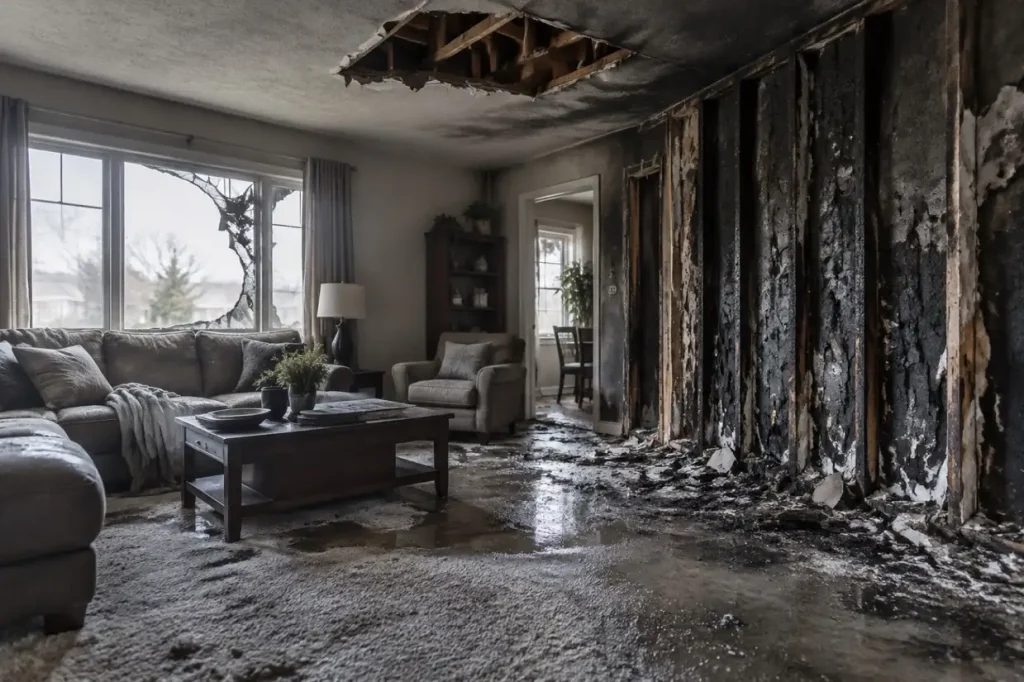
Fire damage is the harm a fire does to a building and its contents through five separate mechanisms: flame that chars and consumes material, heat that weakens material the flames never reach, smoke and soot residue, water and chemicals used to put the fire out, and odour. Which mechanism dominates a room decides what can be saved and how the standard homeowners form sorts the claim.
Key takeaways
- According to USFA, 344,600 residential building fires in 2023 caused $11.27 billion in loss, about $32,694 per fire.
- According to USFA, cooking started 49% of those fires but caused 5% of the loss; careless fires were 9% of fires and 22% of loss.
- The American Wood Council designs with a nominal char rate of 1.5 inches an hour, the full thickness of a 2x stud.
- Damage runs deeper than the black layer: wood is heated about 1.6 inches past the char front after about 20 minutes, per the AWC report.
- Gypsum board is about 21% chemically combined water, which is why drywall holds a fire back and then has to come out, according to the Gypsum Association.
On this page
- What fire damage is
- Where house fires start, and what they cost
- Char and structural loss
- Heat damage past the flames
- Smoke and soot residue
- Water and chemicals from suppression
- Odour
- What can be saved
- Read the damage in this order
- How adjusters sort a fire loss
- For contractors
- Questions people actually ask
What is fire damage?
The USFA After the Fire (FA-46) booklet puts it plainly: a home fire damages property through flames, heat, smoke and water, and things the fire never touched may still be ruined by smoke or soaked by the water used to fight it. The table separates those mechanisms and adds odour.
| Mechanism | What it does | What you see | What decides the outcome |
|---|---|---|---|
| Flame and char | Burns material; wood forms a char layer with no strength | Black, cracked wood; missing material | Char depth against member size |
| Heat | Weakens, warps or calcines material away from the flame | Crumbling drywall, warped fixtures | Temperature reached, not visible burning |
| Smoke and soot | Deposits residue wherever smoke travels | Film, staining, soot webs | Residue type and surface porosity |
| Water and chemicals | Soaks materials, leaves extinguishing agent | Wet insulation and ceilings, powder films | Hours until drying starts |
| Odour | Smoke absorbed into porous materials | Smell that returns after cleaning | Whether the source can be cleaned |
One fire usually produces all five, in different rooms: char and heat in the room of origin, smoke down the hall, water on the floor below. That is why the fire and smoke hub treats fire damage restoration as a sequence rather than one task.
Where house fires start, and what they cost
According to the USFA residential fire estimates, there were 344,600 residential building fires in 2023, with 2,890 deaths and $11.27 billion in loss. Over 2014 to 2023 USFA reports fires fell 6% while dollar loss, adjusted to 2023 dollars, rose 25%.
| Leading cause, 2023 | Fires | Share of all fires | Dollar loss | Share of all loss | Average loss per fire |
|---|---|---|---|---|---|
| Cooking | 167,800 | 48.7% | $572.7m | 5.1% | $3,413 |
| Other unintentional, careless | 31,500 | 9.1% | $2,480.5m | 22.0% | $78,746 |
| Heating | 27,900 | 8.1% | $488.0m | 4.3% | $17,491 |
| Electrical malfunction | 23,700 | 6.9% | $1,501.6m | 13.3% | $63,359 |
The cause that starts the most fires is not the one that does the most damage. According to USFA, cooking started almost half of all residential fires, and its 2017 to 2019 topical report found 93% of cooking fires were small and confined. Careless and electrical fires cost about twenty times as much each as a cooking fire, per those USFA figures.
Kitchens also lead the rooms of origin in the USFA Topical Fire Report, Volume 21 Issue 2, the most recent USFA breakdown of where larger, nonconfined fires start (2017 to 2019 data).
Most fires stay small. USFA reports 56% of residential fires were limited to the object where they started and 25% spread beyond the room of origin. Among the larger nonconfined fires, the same report found 50% extended beyond the room of origin.
Char and structural loss
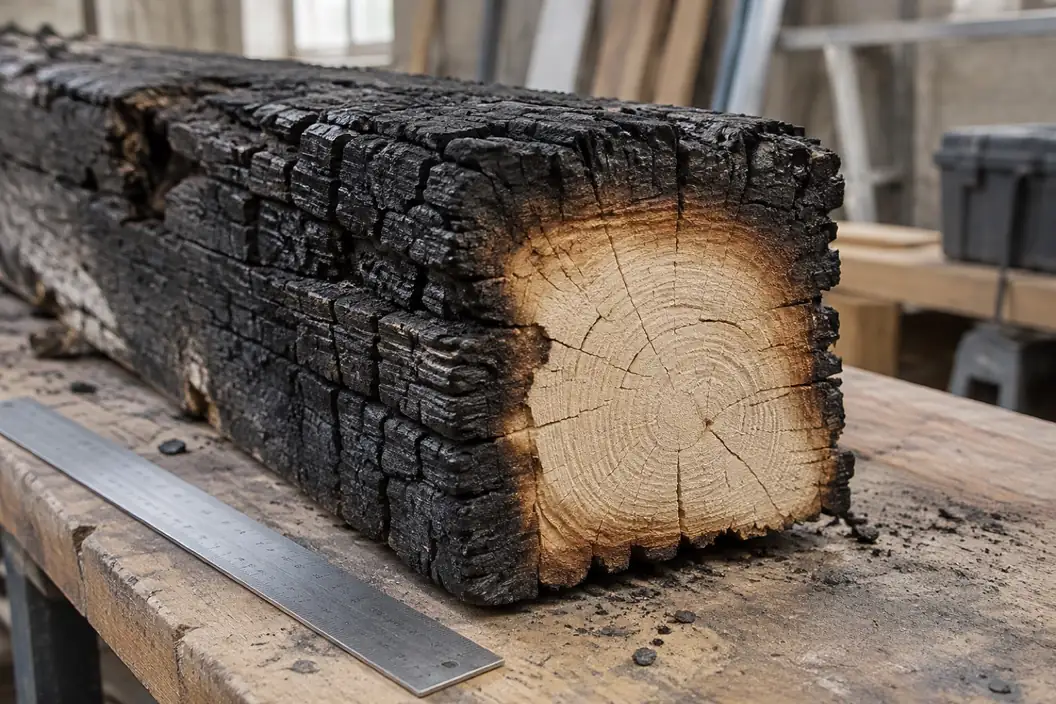
Wood burns from the outside in and protects itself as it goes. Per American Wood Council Technical Report 10, an insulating char layer shields the core; the boundary between char and sound wood sits at about 550 F, and the wood behind it is heated over a zone reaching about 1.6 inches after about 20 minutes. Design treats the char as having zero strength.
AWC calculations use a nominal char rate of 1.5 inches an hour under the standard ASTM E119 test fire, with charring slowing over time. Per the AWC report, structural checks add 20% to the char depth for the weakened heated zone, and measured rates in its cited tests ran from 1.06 to 1.77 inches an hour.
| Exposure, standard test fire | Char depth, one face | Effective depth with heated zone |
|---|---|---|
| 15 minutes | 0.49 in | 0.58 in |
| 30 minutes | 0.85 in | 1.02 in |
| 60 minutes | 1.50 in | 1.80 in |
| 90 minutes | 2.09 in | 2.50 in |
| 120 minutes | 2.64 in | 3.16 in |
The practical reading: a dry 2x member is 1.5 inches thick, per the AWC dimensions, so an hour of standard exposure on one face consumes it. Framing loses capacity before it looks burnt through, which is why charred members need structural assessment.
Heat damage past the flames
Heat travels further than flame. A room can show no burning and still have drywall that has given up its water and framing heated behind sound-looking paint. Nothing looks burnt, so it is easy to miss.
Gypsum is the clearest case. According to the Gypsum Association GA-600, gypsum is about 21% chemically combined water, released as steam when heated; the temperature just behind the calcination plane stays only slightly above 212 F, well below the point where steel loses strength or wood ignites. The board protects the frame by sacrificing itself.
| Material | What heat does | Consequence | Source |
|---|---|---|---|
| Wood behind the char | Heated zone up to 1.6 in past the 550 F char front | Strength and stiffness reduced without visible burning | AWC TR10 |
| Gypsum board | About 21% chemically combined water released as steam | Holds the far side near 212 F until calcination ends, then has nothing left | GA-600 |
| Type X gypsum board | Rated not less than one hour at 5/8 inch in the ASTM C1396 reference wall | Rating is for the assembly, not the board after a fire | GA-600 |
Per the USFA After the Fire (FA-46) booklet, the fire department disconnects unsafe utilities, and owners should not turn them back on themselves.
Smoke and soot residue
Smoke carries the fire to rooms it never entered. The residue it leaves is the subject of the industry standard for this work, ANSI/IICRC S700, First Edition 2025, which covers assessing the presence, intensity and boundaries of fire residues and odours in buildings, HVAC systems and contents. Residue type and the porosity of the surface decide whether something cleans; our smoke damage repair guide covers the residues and methods in detail. The USFA booklet adds one caution: soot and dirty water left after a fire may contain substances that can make people sick.
Water and chemical damage from suppression
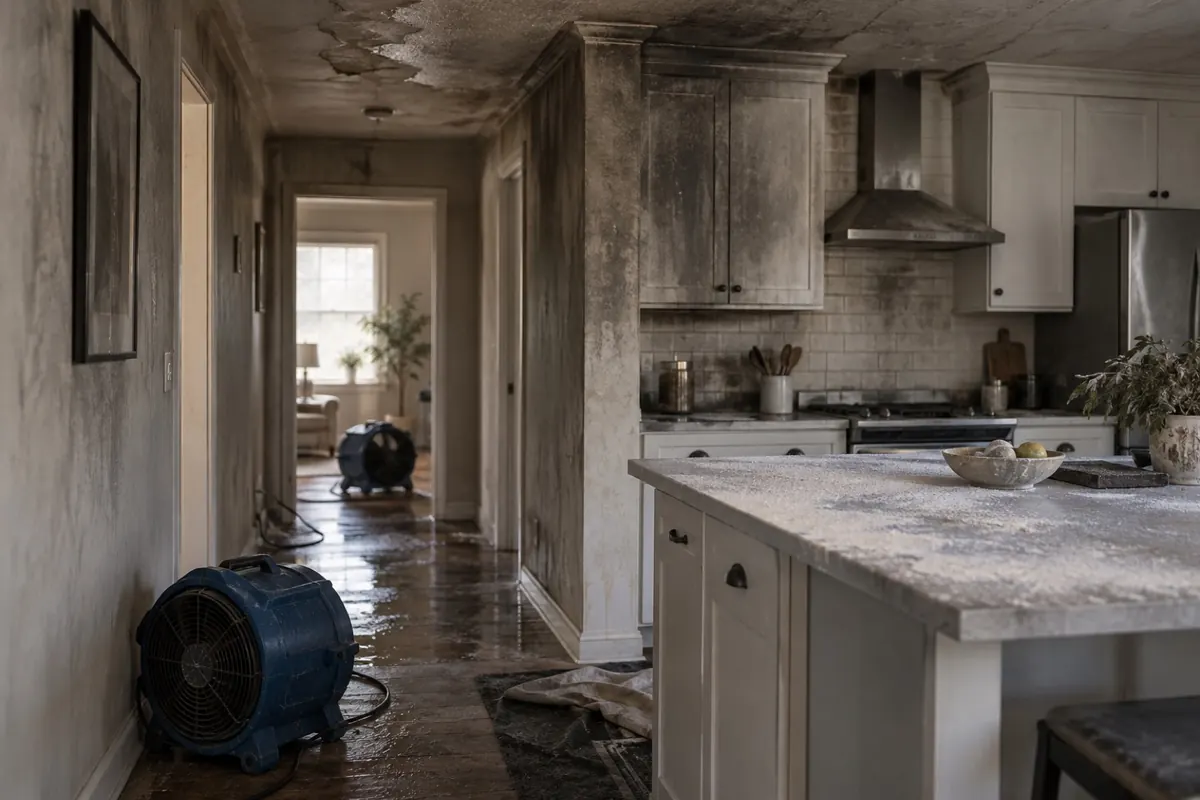
Putting a fire out does its own damage, including in rooms the fire never reached. Per the USFA After the Fire (FA-46), firefighters may break windows and cut holes in the roof to release smoke and heat, and cut into walls to find hidden fire.
| Source | What it leaves | Key figure | Per |
|---|---|---|---|
| Fire department hose line | Large volumes of water into the fire area | Sprinklers use about 90% less water, according to NFPA | NFPA |
| Home fire sprinkler | Only the head over the fire sprays | 10 to 26 gallons a minute | HFSC; USFA |
| Ventilation and overhaul | Broken windows, holes cut in roof and walls | Opens the structure to weather | USFA FA-46 |
| ABC dry chemical extinguisher | Fine powder film on surfaces | Agent is mono-ammonium phosphate | Kidde |
| Any wet building material | Mold risk begins | EPA: dry within 24 to 48 hours | EPA |
The water starts a clock: the EPA says water-damaged areas and items should be dried within 24 to 48 hours to prevent mold growth. Our structural drying page covers the method. Chemicals change what can be kept: the USDA FSIS fires and food safety guidance says food exposed to firefighting chemicals should be thrown away because the chemicals cannot be washed off.
Odour
Odour comes from residue absorbed into porous materials, and ANSI/IICRC S700 treats odour management as its own part of the work. If the porous source stays, the smell returns. Treatment options are on our smoke smell removal page.
What can be saved, and what cannot
Fire damage repair starts with sorting. The defaults below come from federal food, drug and currency guidance and the structural references above.
| Item | Default call | Why | Per |
|---|---|---|---|
| Food in cans or jars near the heat | Discard | Heat can activate spoilage bacteria and split containers | FSIS |
| Raw food, food in permeable packaging | Discard | Smoke fumes contaminate it | FSIS |
| Medicines exposed to heat | Replace | High temperatures can reduce or destroy effectiveness | FDA |
| Paper money, half or more intact | Keep for exchange | A Federal Reserve Bank or the Bureau of Engraving and Printing replaces it | USFA FA-46 |
| Charred framing | Engineer review or replace | Char has zero strength; the heated zone is weakened | AWC TR10 |
| Calcined gypsum board | Replace | Its water is gone | GA-600 |
| Nonporous items with smoke film | Usually cleanable | Residue type and surface decide | IICRC S700 scope |
| Porous items holding odour | Clean if possible, else discard | Odour returns while the source remains | IICRC S700 scope |
Read the damage in this order
A practical order for assessing a fire-damaged building, built from the mechanisms above, so none is missed.
- Wait for clearance. Per USFA, enter only when the fire department says it is safe; leave disconnected utilities off.
- Find the room of origin. Char and heat dominate there; plan for structural review.
- Probe the char. Compare char depth with member size, using the TR10 depths as a reference.
- Check for heat without flame. Crumbling drywall and warped fixtures in adjacent rooms.
- Start the water clock. Begin drying within the EPA’s 24 to 48 hour window.
- Map the smoke boundary. Room by room, including the HVAC system, which S700 covers.
- Sort contents by the table above. Document before discarding.
- Leave odour for last. It cannot be treated while residue and porous sources remain.
How adjusters sort a fire loss
The ISO base homeowners form, the ISO HO 00 03 05 11 form (Maine Bureau of Insurance copy), sorts a fire loss three ways: which coverage part the property falls under, which peril caused it, and how the loss is settled. Your own policy may differ; the policy, your state insurance department and a licensed professional are the authorities on what it pays.
| Part of the form | What it responds to | Settlement or limit in the form |
|---|---|---|
| Coverage A, dwelling; B, other structures | Direct physical loss unless excluded | Replacement cost if the building is insured to 80% of replacement cost; otherwise less |
| Coverage C, personal property | Named perils; Fire or Lightning and Smoke are listed separately | Actual cash value in the base form |
| Smoke peril wording | Sudden and accidental smoke, including furnace puffback | Excludes agricultural smudging and industrial operations |
| Coverage D, loss of use | Additional living expense if the home is not fit to live in | Shortest time to repair or settle elsewhere |
| Debris removal | Reasonable removal cost | Extra 5% of the limit if the limit is exhausted |
| Fire department service charge | Liability assumed by contract | Up to $500; not inside the protecting district |
| Ordinance or law | Code-required upgrades | Up to 10% of the Coverage A limit |
Per the form, the policyholder must protect the property from further damage, keep records of that cost, and send a sworn proof of loss within 60 days of the insurer’s request. The disputes that follow are covered in our smoke damage insurance claim guide, and the first days in what to do after a house fire.
For contractors: document by mechanism
An estimate that separates the five mechanisms is easier to defend than one that calls everything fire damage. Record char depth and member size, calcined gypsum by room, the smoke boundary including HVAC, moisture readings and when drying started, and every discarded item with its reason. Under the HO-3 structure each line is sorted by coverage part and by whether fire, smoke or suppression caused it. The restoration sequence itself sits on the fire and smoke hub.
Out of scope: this page does not cover wildfire losses, which S700 also excludes, or occupant health after a fire. For health questions, see CDC and EPA guidance.
Questions people actually ask
What is considered fire damage?
Fire damage covers everything a fire does to a building and its contents: charring, heat damage to materials the flames did not reach, smoke and soot residue, water and chemicals from suppression, and odour. USFA’s After the Fire booklet lists flames, heat, smoke and water, and notes that items the fire never touched may still be ruined.
What are some examples of fire damage?
Charred studs and joists in the room of origin, drywall that has lost its water and crumbles, warped fixtures, soot film on walls and contents in other rooms, ceilings soaked by hose streams, holes cut by firefighters, extinguisher powder, and a smoke smell that returns after cleaning.
How does fire damage work?
Flame consumes material and forms char, which AWC design calculations treat as having no strength; wood chars at a nominal 1.5 inches an hour under a standard test fire. Heat travels ahead of the char and weakens material. Smoke carries residue and odour through the building, and suppression adds water and chemicals.
Can fire damage be fixed?
Most of it can. According to USFA, most residential fires never leave the object where they started, and there the damage is mainly smoke residue and odour, which cleaning addresses. Repair becomes replacement where char has reduced a structural member, where gypsum has calcined, or where a porous item holds odour cleaning cannot reach.
How much does fire damage repair cost on average?
According to USFA’s 2023 figures, dollar loss averaged about $32,694 per residential fire, with a wide spread: about $3,413 per cooking fire against $78,746 per careless fire. Smoke-only rooms clean; charred framing and soaked materials are replaced. Only a written estimate gives a real number.
How does a fire damage insurance claim work?
On the ISO HO-3 base form, the dwelling is covered for direct physical loss unless excluded, personal property for named perils including fire and smoke, and loss of use pays additional living expense. The form requires prompt notice, protection from further damage, an inventory and a sworn proof of loss within 60 days of a request. Your own policy governs.
What should I expect from fire damage cleanup?
Drying first, because the EPA says wet materials should be dried within 24 to 48 hours; then removal of charred and calcined materials; then cleaning of smoke residue to the IICRC S700 standard; odour treatment last. Ask for an itemised written estimate and an inventory of anything discarded.
Does fire damage lead to mold?
It can, through the water used to put the fire out. The EPA says water-damaged areas and items should be dried within 24 to 48 hours to prevent mold growth, so prevention means extracting water and starting drying quickly, and removing soaked porous materials that cannot be dried in time.
Sources
- USFA residential fire estimates, 2014 to 2023, US Fire Administration.
- USFA residential fire causes and USFA dollar-loss causes, 2014 to 2023, US Fire Administration.
- USFA Topical Fire Report, Volume 21 Issue 2, Residential Building Fires (2017 to 2019), May 2021.
- USFA After the Fire (FA-46), January 2019; USFA home fire sprinklers page.
- American Wood Council Technical Report 10, Calculating the Fire Resistance of Wood Members and Assemblies, February 2021.
- Gypsum Association GA-600, Fire Resistance Design Manual, 19th edition, 2009.
- ANSI/IICRC S700, Standard for Professional Fire and Smoke Damage Restoration, First Edition 2025, IICRC.
- Home Fire Sprinkler Coalition, fire sprinkler myths; NFPA sprinkler myths and facts, updated June 2024.
- Kidde extinguisher FAQ.
- EPA mold and moisture guide, US EPA.
- USDA FSIS fires and food safety, USDA Food Safety and Inspection Service.
- FDA safe drug use after a disaster, US Food and Drug Administration.
- ISO HO 00 03 05 11 form (Maine Bureau of Insurance copy), Insurance Services Office, 2010.
- All retrieved 18 October 2026. Our methodology sets out the standing rules.
Policy wording quoted here is the ISO base form; your policy may use different wording. Confirm coverage with your policy, your state insurance department and a licensed professional.