The short answer
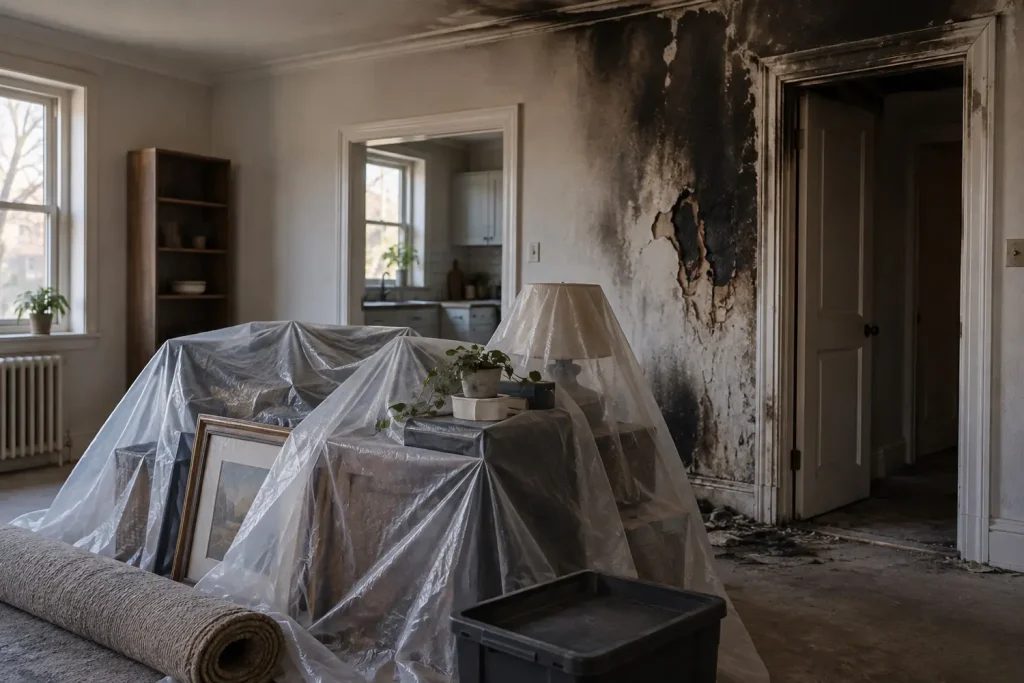
Does renters insurance cover fire damage? For your belongings, normally yes: fire and smoke are among the most consistently named perils in a standard renters form. The building is not yours and is not on your policy. Your policy pays for your contents, for the extra cost of living somewhere else while the unit is unfit, and for the damage you are responsible for if the fire started with you.
Key takeaways
- Fire is a named peril on standard renters forms, and smoke damage from a fire elsewhere in the building is normally covered too. Many tenants assume the opposite.
- The structure is the landlord’s policy. Your policy has no dwelling coverage, so the burnt ceiling and the rebuilt kitchen are not yours to claim.
- Loss of use, also called additional living expense, pays hotel, storage and above-normal food costs while the unit is uninhabitable. It is the section tenants most often do not know they hold.
- Actual cash value against replacement cost matters more after a fire than after a leak, because a fire takes the whole household at once and consumer goods depreciate quickly.
- If the fire started in your unit through negligence, the landlord’s insurer may pursue you for the building repair. Your liability section is what stands between you and that letter.
- An inventory built before a loss is worth far more than one reconstructed from memory after one. Photograph rooms now.
On this page
- Your belongings against the building
- Why fire is the easy peril to claim
- Smoke without flame is still a fire loss
- Scenario table: whose policy responds
- Loss of use, the section people miss
- ACV against RCV, with a worked example
- Liability and subrogation, the real argument
- Wildfire and where it sits
- The inventory you build before the fire
- The first week after a fire
- Sublimits that catch people out
- If the claim is reduced or denied
- Questions people actually ask
Most pages asking whether renters insurance cover fire damage is a real thing answer in a sentence and stop. The sentence is correct and it is the least useful part. What decides how much a tenant actually recovers after a fire is the split between your policy and the landlord’s, whether you bought replacement cost or actual cash value, whether you can evidence what you owned, and whether the fire started with you. This page takes those in order. Our renters water damage guide covers the same structure applied to escape of water, which behaves differently.
Your belongings against the building
A standard renters form insures three things: personal property, personal liability, and loss of use. It contains no dwelling coverage, because you do not own the dwelling. After a fire the landlord’s insurer handles the structure and the rebuild. Yours handles your contents, your temporary accommodation, and your liability if the fire is traced back to you.
| What burnt or was smoke-damaged | Whose policy | Why |
|---|---|---|
| Your furniture, clothing, electronics, books | Your renters policy, personal property section | Your belongings. The landlord’s policy never insured them. |
| Charred ceiling joists, studs, roof structure | The landlord’s property policy | Permanent structure belongs to the owner. |
| Fitted kitchen units and the appliances that came with the unit | Usually the landlord’s policy | Installed and supplied with the tenancy, so part of the building. |
| A freestanding washing machine you bought yourself | Your renters policy | Moveable, and yours. |
| The neighbour’s contents, after a fire that started with you | Your liability section, or their own contents cover | Liability answers for damage you are responsible for causing. |
| Hotel bills while the block is closed for repair | Your renters policy, loss of use section | Additional living expense is a tenant coverage. |
| Firefighting water damage to your sofa | Your renters policy, personal property section | Damage caused fighting a covered fire is normally treated as part of the fire loss. |
Two claims exist, and neither insurer is obstructing you
A fire in the unit below burns through the floor and takes your bedroom furniture with it. The joists and the floor are a building loss on the landlord’s insurance. Your bed, your wardrobe and your clothes are a contents loss on yours. The two files run in parallel and are adjusted separately. Tenants who wait for the landlord’s adjuster before opening their own claim lose weeks for no benefit.
Improvements you paid for sit in an awkward middle
If you installed shelving, a fitted blind or flooring at your own expense, it may have become part of the building at the moment of installation. Some renters forms carry a small limit for tenant improvements and betterments; many do not. Check the declarations page for a named limit before you assume the cost is recoverable, and keep the invoice for anything you fitted.
Why fire is the easy peril to claim
Water losses turn on a chain of qualifications: sudden against gradual, escape against flood, backup against overflow. Fire does not work that way. Fire is a named peril in the base form, and the argument is normally about the amount rather than about whether the policy responds at all. Our page on water backup coverage for renters covers the endorsement that handles backups.
| Fire-related cause | Treatment for your contents | Why |
|---|---|---|
| Fire in your own unit | Generally covered | Fire is a named peril. Your own negligence does not remove cover for your own property. |
| Fire in a neighbouring unit | Generally covered | The peril reached your property. Where it started is a recovery question between insurers. |
| Smoke from a fire elsewhere in the building | Generally covered | Smoke from a hostile fire is normally treated as fire damage. |
| Water and foam used to put the fire out | Generally covered | Damage from fighting a covered peril is usually included. |
| Scorching from a heater placed too close to furniture | Often excluded or limited | Several forms exclude damage from a friendly fire staying where it belongs, or from heat without ignition. |
| Cigarette burns in a carpet, no fire | Generally excluded | Damage without a hostile fire is not a fire loss. |
| Arson committed by you | Excluded | Intentional loss is excluded on every standard form. |
| Arson committed by a stranger | Generally covered | The intentional-act exclusion applies to the insured, not to third parties. |
The cause investigation is about liability, not your contents
A fire of any size brings an origin and cause determination, and tenants sometimes read that as a threat to their own claim. It usually is not. The investigation decides who ends up paying for the building, which is a question between insurers. Your own contents claim normally proceeds on the basis that a fire happened, and the one thing that does break it is evidence you set it deliberately.
Smoke without flame is still a fire loss
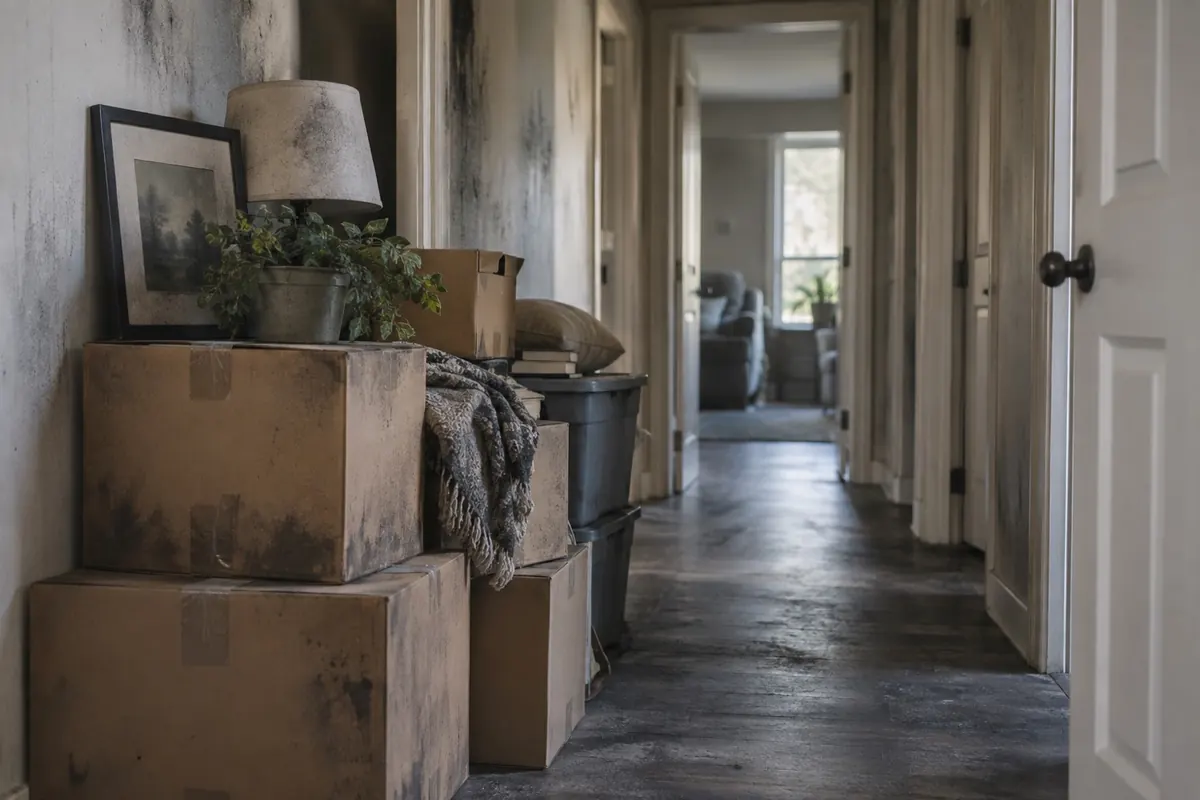
The single most common renters fire claim is not a burnt unit. It is a unit two doors down that never caught, where smoke travelled through shared voids and service risers and left an odour in every soft furnishing. Tenants assume that because nothing is charred, nothing is claimable. The opposite is usually true: smoke from a hostile fire is a covered cause of loss, and soft goods are the hardest category to clean.
| Material | Typical smoke outcome | Why |
|---|---|---|
| Upholstered furniture and mattresses | Often replaced rather than cleaned | Odour penetrates the foam core, which cannot be verified clean from the surface. |
| Clothing and soft furnishings | Usually cleanable by specialist laundering | Washable fibres release particulate and odour under ozone or hydroxyl treatment plus laundering. |
| Books and paper | Frequently a total loss | Porous and absorbent across every surface, with no economic cleaning route for most volumes. |
| Electronics | Assessed individually, often replaced | Acidic residue on circuit boards causes corrosion that shows up months later. |
| Hard surfaces, glass, sealed ceramics | Normally cleanable | Non-porous, so residue sits on the surface. |
| Food and opened consumables | Discarded | Packaging is not airtight against smoke, and this is rarely disputed. |
Two of our pages go deeper on this. Our smoke damage insurance claim guide covers how those claims are argued, and our smoke damage repair guide covers what the cleaning work actually involves.
Odour is the part that gets argued about
Visible soot is easy to agree on. Residual odour in an item that looks clean is not, because it cannot be photographed. The practical answer is to have the contents restorer record which items they judge non-salvageable and why, at the point of pack-out, rather than arguing about a sofa six weeks later from a phone photograph.
Scenario table: whose policy responds
This is the table tenants want. Read it as the general pattern, then check your own declarations page and endorsements against it.
| Scenario | Whose policy | Typically covered for you | What to watch |
|---|---|---|---|
| Fire starts in your unit, accidental cause | Yours for contents and living costs. Landlord’s for the building. | Contents, loss of use. Liability engaged for building damage. | Expect an origin and cause investigation. Your contents claim normally proceeds regardless. |
| Fire starts in a neighbouring unit | Yours for contents and living costs. Landlord’s for the building. | Contents, loss of use. | Your insurer may later recover from the responsible party. That runs behind the scenes and should not delay you. |
| Smoke only, no flame reached your unit | Yours for contents. Landlord’s for structural cleaning. | Contents cleaning or replacement, loss of use if unfit to occupy. | Get the non-salvageable list written at pack-out, not later. |
| Wildfire reaches the building | Yours for contents. Landlord’s for the building. | Contents, loss of use, and evacuation costs on some forms. | Check for a wildfire deductible or a moratorium on new cover during an active event. |
| Kitchen fire you caused by leaving a pan unattended | Yours on both sections. Landlord’s insurer may subrogate. | Your own contents and loss of use. Liability responds to the building and the neighbours. | Negligence is still accidental. Report it rather than hiding it. |
| Electrical fault in the building’s own wiring | Yours for contents. Landlord’s for the building. | Contents, loss of use. | Liability sits with whoever was responsible for maintaining the wiring, which is normally not the tenant. |
Loss of use, the section people miss
After a fire the unit is frequently unfit to occupy for months rather than days, which makes loss of use the largest single line on many renters fire claims. It pays the additional cost of living elsewhere: not your whole new rent, but the amount by which your living costs rose because you cannot be in your home.
| Cost while displaced | Inside loss of use? | Note |
|---|---|---|
| Hotel or short-term rental | Yes | Normally a standard comparable to the unit you lost, not an upgrade. |
| Temporary rent above your normal rent | Yes, the excess only | It pays the additional amount, not the full new rent. |
| Meals above your normal food spending | Often, the excess only | The test is the extra cost of having no kitchen, not the whole restaurant bill. |
| Storage for whatever survived | Usually | A direct consequence of having nowhere to put your belongings. |
| Laundry and pet boarding | Often | Classic additional expenses caused by the displacement. |
| Extra commuting from the temporary address | Sometimes | Some forms include additional mileage or fares. |
| Your normal rent, if the lease is abated | No | A tenancy question with the landlord, not an insured expense. |
Two caps sit on this, and they both bite after a fire
Loss of use is usually capped both by money and by time. The money cap is often expressed as a share of the contents limit. The time cap is often expressed in months, or as the reasonable time required to repair. A fire rebuild that runs past the time cap leaves a tenant paying the difference, which is a reason to ask the landlord for a realistic reoccupation date early and in writing rather than discovering the gap at month nine.
Keep receipts from the first night
Loss of use reimburses demonstrable additional cost. The first night’s hotel, the parking, the toothbrush and change of clothes bought at 2am, the meals, the laundromat: all of it needs to be kept, dated and categorised. A tenant photographing receipts as they go recovers materially more than one reconstructing eight weeks of spending from a bank statement.
ACV against RCV, with a worked example
This distinction matters more after a fire than after almost any other loss, because a fire takes an entire household in one event. A leak ruins a rug and a bookcase. A fire takes the sofa, the bed, the wardrobe, the kitchen contents, the electronics and the clothes at the same moment, and every one of those has been depreciating since the day it was bought.
Actual cash value pays the depreciated value of what you lost. Replacement cost pays what the equivalent item costs new, usually in two stages: an actual cash value payment first, then the difference once you have actually replaced the item and produced the receipt.
| Item | Age | Illustrative replacement cost | Illustrative ACV | Illustrative RCV |
|---|---|---|---|---|
| Three-seat sofa | 5 years | $1,400 | $560 | $1,400 |
| Bed, frame and mattress | 6 years | $1,100 | $330 | $1,100 |
| Wardrobe and chest of drawers | 7 years | $900 | $225 | $900 |
| Laptop and monitor | 3 years | $1,600 | $640 | $1,600 |
| Television and sound bar | 4 years | $900 | $360 | $900 |
| Clothing, whole wardrobe | mixed | $3,200 | $960 | $3,200 |
| Kitchen contents, books, small items | mixed | $1,900 | $760 | $1,900 |
| Total | $11,000 | $3,835 | $11,000 |
Why the gap widens when everything goes at once
On the illustrative numbers above, actual cash value settles at roughly 35 per cent of what replacing the same household costs. That is not a carrier being difficult; it is what a depreciation schedule does to seven-year-old furniture. A tenant on actual cash value after a partial water loss replaces one or two items and absorbs a small gap. A tenant on actual cash value after a fire absorbs the gap on everything they own, at once, while also paying for a hotel.
Liability and subrogation, the real argument for the policy
This is the part almost nobody explains, and it is the single strongest reason a tenant carries the cover. If the fire started in your unit because of something you did, the landlord’s insurer pays to rebuild the building and then looks for someone to recover that money from. That someone is you. The letter arrives months later, long after the fire has stopped being the thing you think about daily, and the sum on it is a building repair rather than a sofa.
| Common negligent cause | Who typically bears the building cost | What your liability section does |
|---|---|---|
| Cooking left unattended | Landlord’s insurer pays, then pursues the tenant | Responds to the building repair and to the neighbours’ losses, up to your liability limit. |
| Candles left burning | Landlord’s insurer pays, then pursues the tenant | Same, subject to the limit and to any exclusion in your form. |
| Overloaded extension leads and daisy-chained adapters | Landlord’s insurer pays, then pursues the tenant | Same. The investigation report is what establishes the cause. |
| Space heater placed against soft furnishings | Landlord’s insurer pays, then pursues the tenant | Same. Some leases separately prohibit these, which is a tenancy issue on top. |
| Smoking materials not fully extinguished | Landlord’s insurer pays, then pursues the tenant | Same, subject to the limit and the lease terms. |
| Fault in the building’s fixed wiring | Landlord’s insurer, normally with no recovery against you | Not normally engaged. Maintaining fixed wiring is the owner’s duty, not the tenant’s. |
| Appliance the landlord supplied fails on its own | Landlord’s insurer, possibly recovering from the manufacturer | Not normally engaged, because you neither owned nor maintained it. |
Negligent is still accidental, so report it
Tenants sometimes do not report a fire they believe they caused, on the theory that their own fault removes their cover. Liability exists precisely for damage you are at fault for. The exclusion on every standard form is for intentional loss, not for carelessness. Leaving a pan on a hob is carelessness, and carelessness is what the section was written to answer.
A waiver of subrogation in the lease changes the picture
Some leases contain a mutual waiver of subrogation, under which the landlord’s insurer agrees not to pursue the tenant for damage to the building. Where one exists it is a material protection, and it is worth knowing whether yours has one before a fire rather than after. Where none exists, your liability limit is the whole of your protection, and the common default limits were not written with a multi-unit building rebuild in mind.
Check the limit against the building, not against your sofa
Contents limits get chosen by looking around the room. Liability limits should be chosen by looking at the building. A fire that starts in a ground-floor kitchen in a six-unit block can produce a building claim and several contents claims from neighbours, and the premium difference between a low and a high liability limit on a renters policy is generally small relative to that exposure.
Wildfire and where it sits
Wildfire is fire, so on standard renters forms it engages the fire peril and your contents are normally covered in the ordinary way. Three practical differences are worth knowing, and none of them is about whether the policy responds. Our wildfire damage by state report shows where those losses have been recorded.
- Cover availability moves before the fire does. Carriers commonly stop writing new business in an area while an event is active, so a policy bought during an evacuation warning may not be available at all. Buying ahead is the only route.
- Separate deductibles appear in some markets. Some forms in high-exposure regions carry a distinct wildfire or brush-fire deductible rather than the standard one. It will be named on the declarations page.
- Evacuation costs may be payable before any damage. Several forms extend additional living expense to a civil authority order that prevents you occupying the unit, whether or not the building is ultimately damaged. That is often the only part of a wildfire renters claim that is ever made.
- Smoke contamination without flame is the common outcome. Far more units are smoke-affected than burnt, and that is a contents claim in exactly the way described above.
The US Fire Administration publishes national fire statistics and prevention guidance, and is the standing federal reference for fire incidence and cause data in the United States.
The inventory you build before the fire
A contents claim is an evidence exercise. The insurer is not asking you to prove a fire happened; that part is obvious. It is asking you to establish what you owned, roughly what it cost and roughly when you bought it, for every item. After a total loss there is nothing left to photograph, which is why an inventory made beforehand is worth more than any amount of effort afterwards.
| What to record | How | Why it matters at claim time |
|---|---|---|
| Wide video of every room | Walk each room slowly, narrate what things are, open the wardrobes and cupboards | Establishes that the items existed and were in the unit. Takes about ten minutes for a whole flat. |
| Close photographs of high-value items | Include the model plate or serial number where there is one | Turns a disputed ‘television’ into a specific model with a replacement price. |
| Receipts and order confirmations | Email search for order confirmations, then save them outside the home | Purchase date and price are the two things a depreciation calculation needs. |
| A written list by room | Item, rough purchase date, rough price | This is the document the adjuster actually works from. |
| Where the copies live | Cloud storage or email to yourself, not a drawer in the flat | An inventory stored in the unit burns with the unit. |
| Refresh cadence | Redo the video when you move, and after any large purchase | A three-year-old inventory misses whatever you bought since. |
Ten minutes now against three weeks later
The asymmetry here is stark. Recording a walkthrough video is a ten-minute job that most tenants never do. Reconstructing a household inventory from bank statements and memory after a total loss is weeks of work done at the worst possible time, and it reliably undercounts, because the items people forget are the accumulated small ones that add up to a large share of the total.
The first week after a fire
Standard forms impose a duty to protect the property from further damage and a duty to substantiate the loss. After a fire there is a third constraint that does not apply to a leak: you may not be allowed back into the building at all.
- Do not re-enter until the fire service releases the building. Structural damage and residual hot spots are not things to assess yourself, and no insurance benefit comes from getting in early.
- Notify your insurer the same day, separately from the landlord. Two policies, two notifications. Your claim does not travel on the landlord’s file.
- Ask for the loss of use advance immediately. Most carriers will advance funds for accommodation and essentials before any contents settlement, and that is what the first week is paid for.
- Photograph everything before the pack-out. Contents restorers will remove items for cleaning or disposal. Once a sofa is on a lorry it is much harder to argue about.
- Get the non-salvageable list in writing at pack-out. Item, reason, who decided. This is the document the contents settlement is built on.
- Keep damaged items until the adjuster releases them, or photograph them thoroughly before disposal.
- Start the inventory immediately, while recall is fresh. Room by room, from the doorway inward, including what was inside closed cupboards.
- Keep every displacement receipt from the first night.
Coverage is decided by the exact wording of your policy and by the facts your insurer establishes, not by a general article. This page describes the common pattern in standard US renters forms so that you know which questions to ask. It is not insurance advice, it is not advice on your specific policy, and it does not create any expectation of coverage. Read your own declarations page and endorsements, and speak to your agent or a licensed adviser.
Sublimits that catch people out
The contents limit on the declarations page is not the amount payable for every category inside it. Standard forms carve out special limits for classes of property that are easy to lose and hard to value, and a fire hits all of them simultaneously.
| Category | Usual treatment | What to do about it |
|---|---|---|
| Jewellery and watches | Low special limit, often much lower for theft than for fire | Schedule individual items with a valuation if the total is meaningful. |
| Cash and bullion | Very low special limit on every standard form | Nothing to do except know it. The limit is not negotiable upward by much. |
| Business property kept at home | Low limit, sometimes excluded | If you work from home with equipment or stock, ask about a separate endorsement. |
| Firearms, silverware, collectibles | Named special limits | Schedule them, or accept the sublimit knowingly. |
| Property of others in your care | Limited, and sometimes excluded | Relevant if you house-share or store a friend’s belongings. |
| Items away from the unit | Often covered at a reduced percentage of the contents limit | Matters for whatever was in a car or a storage unit. |
If the claim is reduced or denied
After a fire, outright denial is uncommon. Reduction is not. Get the insurer’s position in writing with the clause it relies on named, then identify which of the three usual arguments you are actually in.
- Valuation, not coverage. The policy responded and the settlement is lower than the cost of replacing what you lost. This is answered with receipts, model numbers and current retail quotes, item by item, not with a general complaint about the total.
- Proof of ownership. The insurer is not satisfied an item existed. Bank and card statements, emailed order confirmations, photographs that happen to show the item in the background, and warranty registrations all count.
- Cleanable against replaceable. The insurer treats smoke-affected items as restorable and you do not. The contents restorer’s own written assessment is the evidence that moves this, which is why it should be obtained at pack-out.
- Sublimit rather than refusal. A settlement that stops at a round number for a category is probably a special limit doing its job, not an adjuster’s decision. Check the form before arguing.
Internal appeal first, then your state insurance department, which handles consumer complaints against carriers licensed in that state. If the dispute is about what restoration should have cost rather than about your contents, our restoration cost guide covers how mitigation work is priced, and our methodology states the standing rules we hold ourselves to on every figure published here.
Questions people actually ask
Does renters insurance cover fire damage to my belongings?
Generally yes. Fire is a named peril on standard renters forms, and the personal property section responds to your belongings whether the fire started in your unit or elsewhere in the building. Damage from the water and foam used to put the fire out is normally included as part of the same loss.
Does renters insurance cover the building after a fire?
No. A renters policy has no dwelling coverage. The structure, the fixed installations and the rebuild are insured on the landlord’s property policy. Yours covers your belongings, your liability and your additional living expenses.
Is smoke damage covered if the fire was somewhere else?
Normally yes. Smoke from a hostile fire is typically treated as fire damage, and a unit that never caught fire can still have a substantial contents claim. Soft furnishings, mattresses, books and electronics are the categories most often replaced rather than cleaned.
What if I started the fire by accident?
Report it. Your personal property section still responds to your own belongings, because the exclusion on standard forms is for intentional loss rather than for carelessness. Your liability section is what responds to the building and to the neighbours, and that is the main reason the cover is worth carrying.
Can the landlord’s insurance company come after me?
It can, through subrogation, where the fire is traced to something you did or failed to do. The landlord’s insurer pays for the building and then seeks to recover that money from the responsible party. Your liability limit is what stands between you and that demand, and some leases contain a waiver of subrogation that removes the exposure.
Will renters insurance pay for a hotel after a fire?
That is the loss of use or additional living expense section, and yes, where the unit is not fit to occupy. It reimburses cost above your normal spending, is usually capped both by an amount and by a time period, and needs receipts from the first night. Ask your carrier for an advance rather than waiting for the contents settlement.
Should I buy replacement cost or actual cash value cover?
Replacement cost, wherever the premium difference is modest. A fire takes a whole household at once, and on the illustrative worked example above actual cash value settled at roughly 35 per cent of what buying the same items again would cost. Those figures are invented for the arithmetic, but the ratio is what a depreciation schedule does to furniture that is several years old.
Sources
- Coverage patterns here reflect standard US renters forms of the HO-4 type: personal property, personal liability and loss of use, with no dwelling coverage. Carrier wordings differ materially and the policy governs in every case.
- US Fire Administration, part of the Federal Emergency Management Agency, is the federal source for national fire incidence, cause and prevention data in the United States. Retrieved 23 September 2026.
- Treatment of smoke-affected contents reflects common contents restoration practice, in which porous and absorbent materials are replaced where cleaning cannot be verified through the material, and non-porous materials are cleaned in place.
- Subrogation description reflects ordinary insurer recovery practice following payment of a first-party building claim. Whether recovery is pursued in any given case is a commercial decision for the carrier.
- All dollar figures in the ACV against RCV worked example are ILLUSTRATIVE and invented for arithmetic. No carrier depreciation schedule is reproduced and no pricing survey was conducted.
- State insurance departments handle consumer complaints against carriers. The relevant department is the one in the state where the policy was issued.
This page is general information about how standard renters policies are structured. It is not insurance advice, it is not advice on any specific policy, and it does not create any expectation of coverage. Read your own policy and speak to your agent or a licensed adviser.