The short answer
Does renters insurance cover water damage? For your belongings, usually yes, when the escape of water was sudden and accidental. For the building itself, no: that is the landlord’s policy, not yours. That single split explains almost every surprise on a renters water claim. Flood is excluded and needs separate cover, sewer backup usually needs an endorsement, and gradual leaks are generally not paid at all.
Key takeaways
- A renters policy covers your personal property, your liability, and your loss of use. It does not cover the structure you live in.
- Sudden and accidental escape of water is the test for contents. Gradual seepage and deferred maintenance generally fail it.
- Flood means rising surface water from outside the building. It is excluded from standard renters forms and requires a separate product.
- Water and sewer backup is usually excluded unless a backup endorsement was added, and the endorsement normally carries its own low sublimit.
- Loss of use pays hotel and extra living costs if the unit becomes uninhabitable. It is the most overlooked part of the policy.
- If you caused the escape, your liability section is what responds to the landlord’s and the neighbours’ damage. That is the main reason landlords require the policy in the first place.
On this page
- Your stuff against the building
- The sudden and accidental test
- Scenario table: who claims, and on whose policy
- Flood is a separate product
- Water backup needs an endorsement
- ACV against RCV, with a worked example
- Loss of use, the overlooked section
- Liability when you caused it
- How your policy meets the landlord’s
- What to document, and in what order
- If the claim is denied
- Questions people actually ask
Most guides asking whether renters insurance covers water damage answer as though a tenant and an owner were in the same position. They are not, and the gap is the whole story: a tenant insures two things a landlord does not care about, and does not insure the one thing a landlord cares about most. This page sets out that division, the scenarios where it bites, and the endorsements that close the rest.
Your stuff against the building, and why it matters
A standard renters form insures personal property, personal liability and loss of use. It contains no dwelling coverage, because you do not own the dwelling. The landlord insures the structure separately, and that policy has no interest in your belongings. Fire works on the same split, as our guide to whether renters insurance covers fire damage explains.
| What got wet | Whose policy | Why |
|---|---|---|
| Your sofa, bed, clothes, television, laptop | Your renters policy, personal property section | Your belongings. The landlord’s policy never insured them. |
| The ceiling, drywall, subfloor, built-in cabinetry | The landlord’s property policy | Permanent parts of the structure belong to the owner. |
| The carpet that came with the unit | Usually the landlord’s policy | Fitted flooring supplied with the unit is part of the building. |
| A rug you bought and brought with you | Your renters policy | Moveable, and yours. |
| Your neighbour’s belongings, after water came from your unit | Your liability section, or their own contents cover | Liability answers for damage you are responsible for causing. |
| The hotel bill while the unit dries out | Your renters policy, loss of use section | Additional living expense is a tenant coverage. |
The ceiling collapse example, which comes up constantly
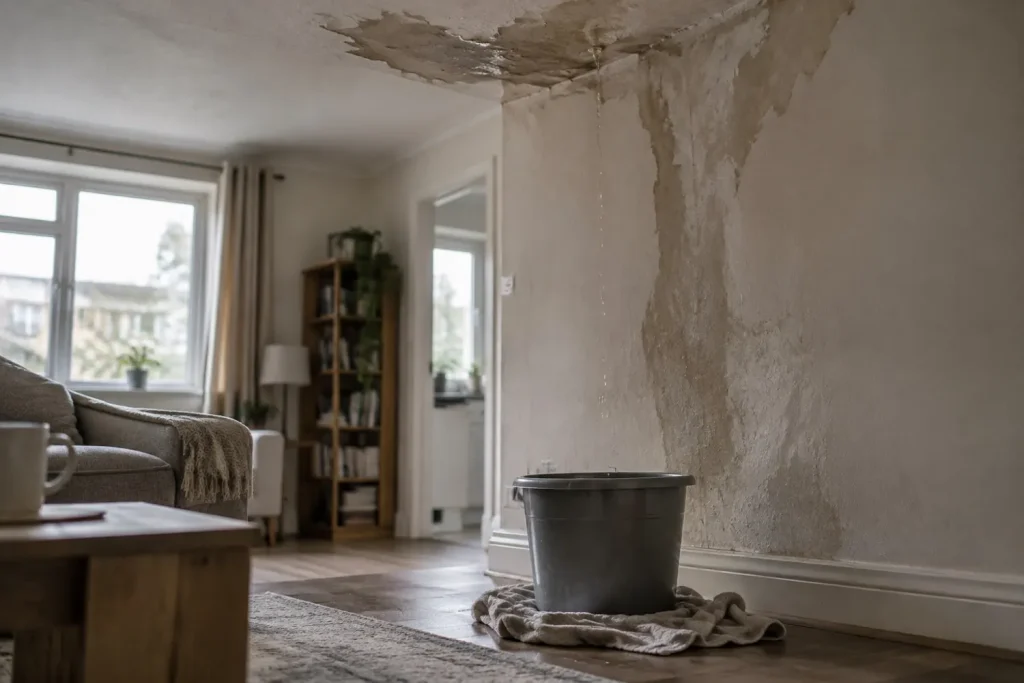
A pipe fails upstairs, the ceiling gives way, and it lands on your sofa. Two claims now exist on different policies. The ceiling is a building loss on the landlord’s insurance; the sofa is a contents loss on yours. Neither insurer is being obstructive in declining the other half.
The sudden and accidental test
For contents the question is not how much water arrived but what caused the escape. Standard forms are built around sudden and accidental discharge and exclude the slow and the foreseeable.
| Cause of loss | Treatment for your contents | Why |
|---|---|---|
| Supply line to a washing machine bursts | Generally covered | Sudden, accidental, and not something you could have watched happen. |
| Water heater tank splits | Generally covered | Sudden appliance failure, even though the tank is not yours. |
| Bath left running and it overflows | Contents covered, liability in play for others | Accidental though negligent, which is what liability is for. |
| A shower pan leaking into the floor for months | Generally excluded | Reads as gradual damage and a maintenance failure. |
| Mould behind a wardrobe with no identified escape | Generally excluded or heavily limited | No sudden covered cause for the policy to attach to. |
| Rain through a window you left open | Often disputed, frequently declined | Some forms exclude rain through an opening no peril created. |
| Rain through a storm-damaged roof | Contents often covered; the roof is the landlord’s | The storm created the opening, which is the distinction. |
Scenario table: who claims, and on whose policy
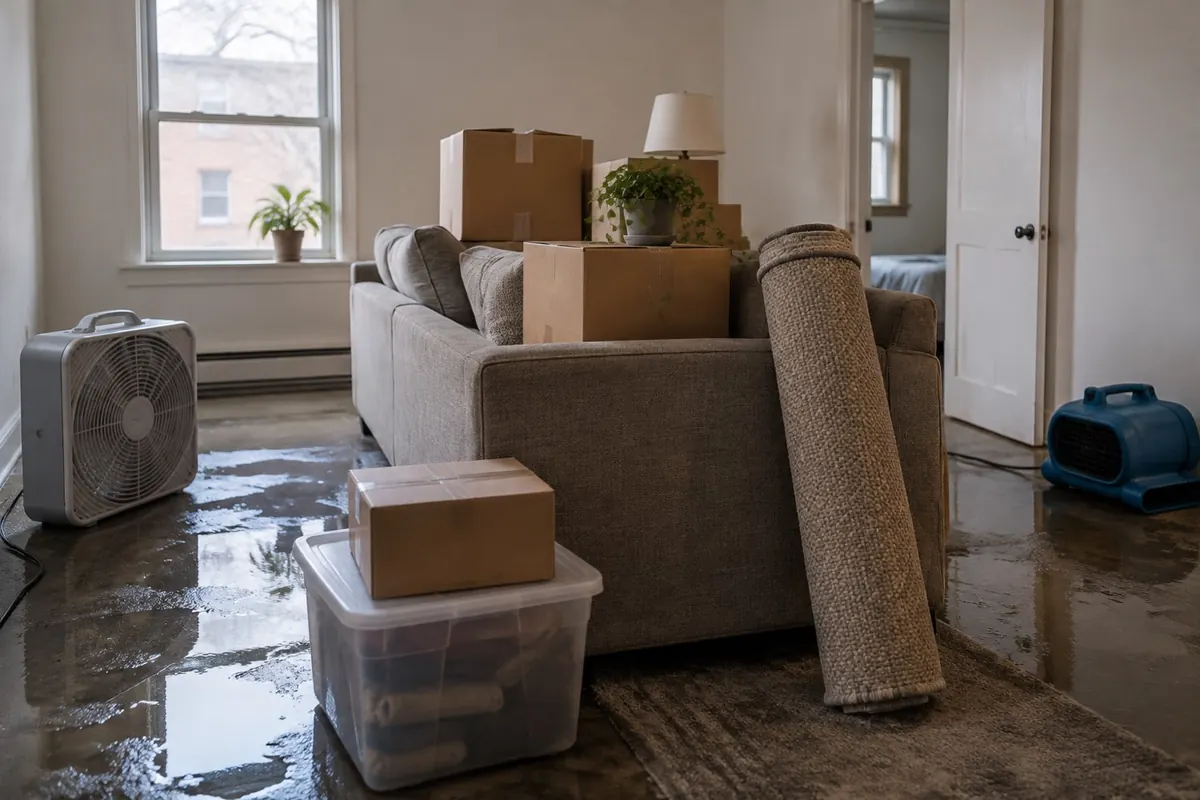
This is the table most tenants want. Read it as the general pattern, then check your own declarations page against it.
| Scenario | Who claims | Whose policy pays | Contents covered? |
|---|---|---|---|
| Leak from the flat above damages your belongings | You, for contents. Landlord, for the ceiling. | Yours for contents, landlord’s for structure. Recovery possible against the upstairs tenant. | Yes, if sudden |
| Your bath overflows and runs through to downstairs | You, for contents. The neighbour, against your liability. | Yours on both sections: property for yours, liability for theirs. | Yes, plus liability |
| Pipe bursts inside the wall of your unit | You, for contents. Landlord, for the wall and pipe. | Yours for contents, landlord’s for building and repair. | Yes |
| Sewer backs up through the shower drain | You, only if you hold the endorsement. | Yours only with a backup endorsement. Landlord’s for the building. | Only with an endorsement |
| River bursts its banks and floods the ground floor | You, under a separate flood policy if you hold one. | Neither standard policy. Flood is a separate product. | No, not on a standard form |
| Roof leaks during a storm onto your bed | You, for contents. Landlord, for the roof. | Yours for contents, landlord’s for the roof. | Usually, if a storm made the opening |
| Your washing machine hose fails while you are out | You, for contents. Neighbour and landlord, against your liability. | Yours on both sections. The appliance may be yours or the landlord’s. | Yes, plus liability |
Flood is a separate product, for tenants too
Flood has a narrow meaning in insurance: rising surface water from outside the building. Standard renters forms exclude it, as homeowners forms do. Tenants often assume flood is someone else’s problem because they do not own the building. The building is, the belongings are not, and a landlord’s flood policy does nothing for your furniture. Contents-only cover is available through the FEMA, National Flood Insurance Program and through private carriers, and it is priced separately from building cover precisely because tenants are the buyers.
Water backup needs an endorsement
Sewer and drain backup is its own exclusion, separate from flood. Water coming up through a drain has not escaped from a pipe inside the building and has not risen across the surface from outside, so it falls outside both the covered peril and the flood definition. Standard renters forms exclude it, and cover is added by endorsement.
| Point | What tenants should check |
|---|---|
| Whether you hold it at all | Look for a line naming water backup, sewer backup or sump overflow on the declarations page. Not named, not held. |
| The sublimit | Backup endorsements carry their own limit, well below the contents limit. A large contents limit does not mean large backup cover. |
| Whether it covers only contents | On a renters policy it will, because there is no building cover to extend. Structural cleanup sits with the landlord. |
| Whether the deductible differs | Some endorsements carry their own deductible. |
| Cause exclusions inside the endorsement | Some wordings exclude blockage in a lateral you are responsible for, or a failed sump pump with no power outage. |
ACV against RCV, with a worked example
This is where renters policies differ most sharply from owners policies in effect. A building depreciates slowly; a sofa, a mattress, a laptop and a wardrobe of clothes do not. Actual cash value pays the depreciated value of what you lost. Replacement cost pays what the equivalent costs new, usually after you have actually replaced it.
| Item | Age | Illustrative replacement cost | Illustrative ACV | Illustrative RCV |
|---|---|---|---|---|
| Three-seat sofa | 5 years | $1,400 | $560 | $1,400 |
| Mattress and bed frame | 6 years | $1,100 | $330 | $1,100 |
| Laptop | 3 years | $1,200 | $480 | $1,200 |
| Television | 4 years | $700 | $280 | $700 |
| Clothing, wardrobe total | mixed | $2,500 | $750 | $2,500 |
| Books, kitchenware, small items | mixed | $900 | $360 | $900 |
| Total | $7,800 | $2,760 | $7,800 |
Why the gap is wider for tenants than for owners
A tenant’s insured assets are almost entirely depreciating consumer goods. On the illustrative numbers above, ACV recovers roughly a third of what replacing everything costs. Those figures are invented, but the shape of the result is what a depreciation schedule does to five-year-old furniture.
Loss of use, the overlooked section
If the unit becomes unfit to live in, loss of use, also called additional living expense, pays the extra cost of living elsewhere while it is repaired. Tenants underuse it, partly because the landlord is assumed to be responsible for rehousing them.
| Cost while displaced | Inside loss of use? | Note |
|---|---|---|
| Hotel or short-term rental | Yes | Normally a standard comparable to the unit, not an upgrade. |
| Temporary rent above your normal rent | Yes, the excess | It pays the additional amount, not the whole rent. |
| Meals above your normal food spend | Often, the excess only | The test is the extra cost of having no kitchen. |
| Laundry, storage, pet boarding | Often | Classic additional expenses caused by the displacement. |
| Extra commuting from the temporary address | Sometimes | Some forms include the additional mileage or fares. |
| Your normal rent, if you stop paying it | No | A tenancy question with the landlord, not an insured expense. |
Keep the receipts from hour one
Loss of use reimburses demonstrable additional cost, so the first night’s hotel receipt, the parking, the meals and the laundromat all have to be kept and dated. A tenant reconstructing three weeks of spending from memory recovers less than one photographing receipts as they go.
Liability when you caused it
This is the section landlords care about and tenants underrate. If water escaped because of something you did, the damage to the building, the units below and your neighbours’ belongings is a liability exposure. One overflowing bath can reach three floors.
Subrogation is how you find out you were liable
Your neighbour claims on their own contents policy, their insurer pays them, and that insurer then looks for someone to recover from. If the escape started in your unit because of an unattended appliance, that is you, and the letter arrives months later. A liability limit is what turns that letter into your insurer’s problem rather than yours.
Negligent is still accidental
Tenants sometimes do not report a loss they caused, on the theory it was their own fault and therefore not covered. Liability exists precisely for damage you are at fault for; it excludes only damage caused on purpose. Leaving a bath running is negligence.
How your policy meets the landlord’s
Two policies sit side by side on the same event. Knowing where the seam runs prevents most of the friction.
- The landlord’s property policy covers the structure, fixed installations and commonly loss of rent. It does not cover your belongings or your hotel.
- Your renters policy covers your belongings, your liability and your additional living expenses, not the building.
- The landlord’s deductible is not your problem unless you caused the loss, when their insurer may look to your liability.
- A waiver of subrogation in the lease, where one exists, changes who can pursue whom afterwards.
- Neither policy repairs the plumbing that failed. The repair to the cause is a maintenance cost, which is why both insurers pay for water damage and neither pays for the pipe.
So file on your policy and let the landlord file theirs, in parallel, on day one. Our homeowners coverage guide covers the building side of the same event.
What to document, and in what order
Standard forms impose a duty to protect the property from further damage and a duty to substantiate the loss. Those two pull against each other for about fifteen minutes. This order satisfies both.
- Stop the water if you safely can, and call the landlord or the managing agent. Note the time you called.
- Photograph and video before anything moves. Wide shots of each room, then close shots of each damaged item.
- Then mitigate. Lift what can be lifted and move dry items out of the wet zone. Throw nothing away yet.
- Notify your insurer promptly, separately from the landlord. Two policies, two notifications.
- Build the inventory item by item: what it was, roughly when bought, what it cost. Bank and card statements reconstruct this better than memory.
- Keep damaged items until the adjuster releases them, or photograph them thoroughly before disposal. Discarding a ruined mattress before it is seen weakens the claim on it.
- Keep every displacement receipt from the first night, for the loss of use claim.
Coverage is decided by the exact wording of your policy and the facts your insurer establishes, not by a general article. This page describes the common pattern in standard US renters forms so you know which questions to ask. It is not advice on your policy and it does not replace reading your own declarations page and endorsements.
If the claim is denied
A denial is a position based on a stated reason. Get that reason in writing, with the clause it relies on named, then work out which of the three usual arguments applies.
- The cause was misclassified. A failure called gradual may have been a sudden event with a delayed discovery. A plumber’s report on the failure mode is what moves this.
- The wrong exclusion was applied. Escape of water, flood and backup are three different things and get confused. Water from a pipe is not flood, whatever the letter says.
- The scope was undervalued rather than denied. Partial payment on a low-priced inventory is a valuation dispute, not a coverage one, and receipts and current quotes answer it.
Internal appeal first, then your state insurance department. On valuation it helps to know how the repair side is priced: our restoration cost guide covers what mitigation costs, our water category reference covers the contamination classification that decides whether belongings can be cleaned or must be replaced, and our methodology states our standing rules.
Questions people actually ask
Does renters insurance cover water damage to my belongings?
Generally yes, where the escape was sudden and accidental: a burst supply line, a failed water heater, an overflowing appliance. Gradual leaks and maintenance failures are excluded, flood needs a separate policy, and sewer backup usually needs an endorsement.
Does renters insurance cover the building or the ceiling?
No. A renters policy has no dwelling coverage. Ceiling, walls, floors and fixed installations are insured on the landlord’s property policy. Yours covers belongings, liability and loss of use.
If the leak came from the flat upstairs, whose insurance pays?
Your contents claim goes on your own policy and the landlord claims for the building on theirs. If the upstairs occupier was responsible, recovery runs between insurers afterwards, which should not delay you filing.
What if I caused the water damage myself?
Report it. Your personal property section still responds to your own belongings, and liability is what exists for the damage you caused to the building and other occupants. Liability excludes deliberate damage, not negligence, and an unattended bath is negligence.
Will renters insurance pay for a hotel while my flat dries out?
That is the loss of use or additional living expense section, and yes, where the unit is not fit to live in. It reimburses cost above your normal spending, is usually capped by a share of the contents limit or a time limit, and needs receipts.
Is sewer backup covered by renters insurance?
Usually not under the base form. Backup is a common exclusion and cover is added by endorsement, which carries its own sublimit and sometimes its own deductible. Check the declarations page for a line naming backup; if it is not named, assume it is not there.
Should I choose replacement cost or actual cash value cover?
Replacement cost, wherever the premium difference is modest, because tenant belongings depreciate quickly. On the illustrative worked example above, actual cash value settled at roughly a third of the cost of buying the same items again. Those figures are invented, but the ratio is what a depreciation schedule does.
Sources
- Coverage patterns here reflect standard US renters forms of the HO-4 type: personal property, personal liability and loss of use, with no dwelling coverage. Carrier wordings differ and the policy governs.
- FEMA, National Flood Insurance Program, on the separation of flood cover from standard property policies and on the availability of contents-only cover for tenants. Retrieved 23 September 2026.
- Backup treatment here reflects the common structure of backup endorsements: a named add-on carrying its own sublimit.
- All dollar figures in the ACV against RCV worked example are ILLUSTRATIVE and invented for arithmetic. No carrier depreciation schedule is reproduced.
- State insurance departments handle consumer complaints against carriers. The relevant one is in the state where the policy issued.
This page is general information about how standard renters policies are structured. It is not insurance advice, it is not advice on any specific policy, and it does not create any expectation of coverage. Read your own policy and speak to your agent or a licensed adviser.