The short answer
Popcorn ceiling asbestos is a question of dates and a lab result. EPA restricted sprayed asbestos insulation in 1973 and, from 19 June 1978, sprayed decorative coatings, the class popcorn texture belongs to. Older stock, hand-applied texture and trace contamination mean the date only sets the odds. Samples read by polarized light microscopy against a 1 percent line settle it.
Key takeaways
- The 1978 rule bans spraying, not owning. EPA’s 19 June 1978 amendment names spray-on decorative coatings as the main products it stopped; nothing ordered existing ceilings out.
- The 1977 consumer ban covers patching compounds, not texture, and let stock already shipped be sold until 11 June 1978.
- OSHA presumes it. Sprayed or troweled surfacing in a building constructed no later than 1980 is treated as asbestos until a test says otherwise.
- A negative is a statement about 1 percent: material at or below that line is not regulated asbestos-containing material, which is not the same as containing none.
- States split: New York lets an owner-occupant remove any amount, South Coast AQMD bars even unpaid help from friends or family.
On this page
- What the texture is, in regulatory terms
- The dates: what was banned, and when
- Why a later ceiling can still test positive
- Testing: one scrape, one microscope, one percent
- The decision path
- Leave, paint, cover or remove
- Can you remove it yourself?
- What the published prices say
- For contractors: wet and damaged texture
- Questions people actually ask
Pages ranking for this question disagree on the basic dates. This one reads the regulations and the agencies themselves, in the order you meet them. Lay-in and glued tiles are a separate material; see asbestos ceiling tiles.
What this page does not cover: health effects or what any exposure means for a person. EPA’s asbestos pages and the CDC’s ATSDR are the public references, and a physician is the person to ask.
What the texture is, in regulatory terms
Popcorn, cottage cheese and acoustic ceiling all mean a lumpy coating sprayed or troweled onto drywall or plaster. 29 CFR 1926.1101 calls it surfacing material, meaning material sprayed, troweled-on or otherwise applied to surfaces, with acoustical plaster on ceilings as its example.
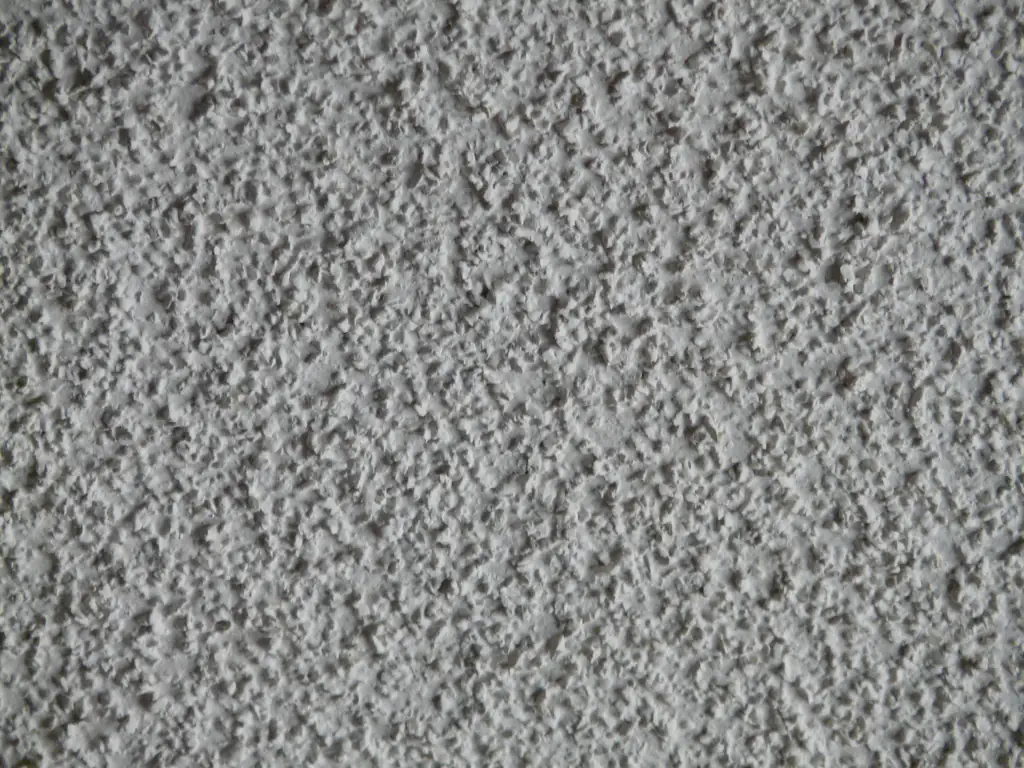

Under the asbestos NESHAP, 40 CFR 61.141 defines friable material as over 1 percent asbestos and able, when dry, to be crumbled, pulverized or reduced to powder by hand pressure. Dry popcorn texture that powders under a thumb fits, which is why removal is friable work. The CPSC booklet Asbestos in the Home adds the restoration warning: sprayed decorative material that is loose, crumbly or water-damaged may release fibres.
The dates: what was banned, and when
The quoted dates come from three rules. Per EPA's record of its asbestos actions, EPA banned spray-applied fireproofing and insulation in 1973, the CPSC banned asbestos wall patching compounds in 1977, and EPA banned spray-applied surfacing for all other purposes in 1978.
| Date | Rule | What it stopped | What it left alone |
|---|---|---|---|
| 6 April 1973 | EPA asbestos NESHAP | Spray-applied fireproofing and insulation | Decorative texture |
| 15 December 1977 | CPSC, 16 CFR 1304 | Consumer spackle and joint compound | Industrial-only compound; ceiling texture |
| 16 January 1978 | CPSC, same rule | Compound made or first shipped after this date | Stock already in commerce |
| 11 June 1978 | CPSC, same rule | All covered compound, whenever made | Installed material |
| 19 June 1978 | EPA NESHAP amendment | Spraying any material over 1 percent asbestos, decorative coatings first | Troweled texture; binder-locked coatings |
| 1989 to 1991 | EPA TSCA ban | Most asbestos products, until partially overturned in 1991 | Installed material |
| March 2024 | EPA TSCA chrysotile rule | Ongoing uses of chrysotile | Installed material |

The 1978 page answers the popcorn question. The Federal Register of 19 June 1978, page 26372 extends the spraying provisions to all materials containing more than 1 percent asbestos, effective that day, and names spray-on asbestos-containing decorative coatings as the primary products prohibited. Some guides garble this: Fixr's popcorn ceiling guide says the Clean Air Act was passed in 1978, when 1978 is the year EPA amended a standard already made under it. The full chronology is on when was asbestos banned.
Why a later ceiling can still test positive
Each rule regulates what is made, sold or sprayed from a date, and each has an edge.
| Mechanism | What the rule says | Effect on a ceiling |
|---|---|---|
| Sell-through | Part 1304 reached already-shipped compound only on 11 June 1978 | A legal window for stock in the supply chain |
| Industrial channel | Part 1304 excludes compound sold solely for industrial use | Not every bag was a consumer product |
| Spray only | 40 CFR 61.146 regulates spray-on application | Troweled texture sits outside that wording |
| Binder exemption | Spray allowed if a bituminous or resinous binder leaves it non-friable | A narrow, lawful exception |
| The 1 percent line | Regulated material is more than 1 percent | Spraying at or below it was never barred |
No primary source found for this page measures how much asbestos texture went up after 1978, so we give no number. The regulators did set a date: 29 CFR 1926.1101 requires sprayed or troweled surfacing in buildings constructed no later than 1980 to be treated as presumed asbestos-containing material, PACM, unless rebutted by an inspection or bulk samples collected as 40 CFR 763.86 describes.
Testing: one scrape, one microscope, one percent
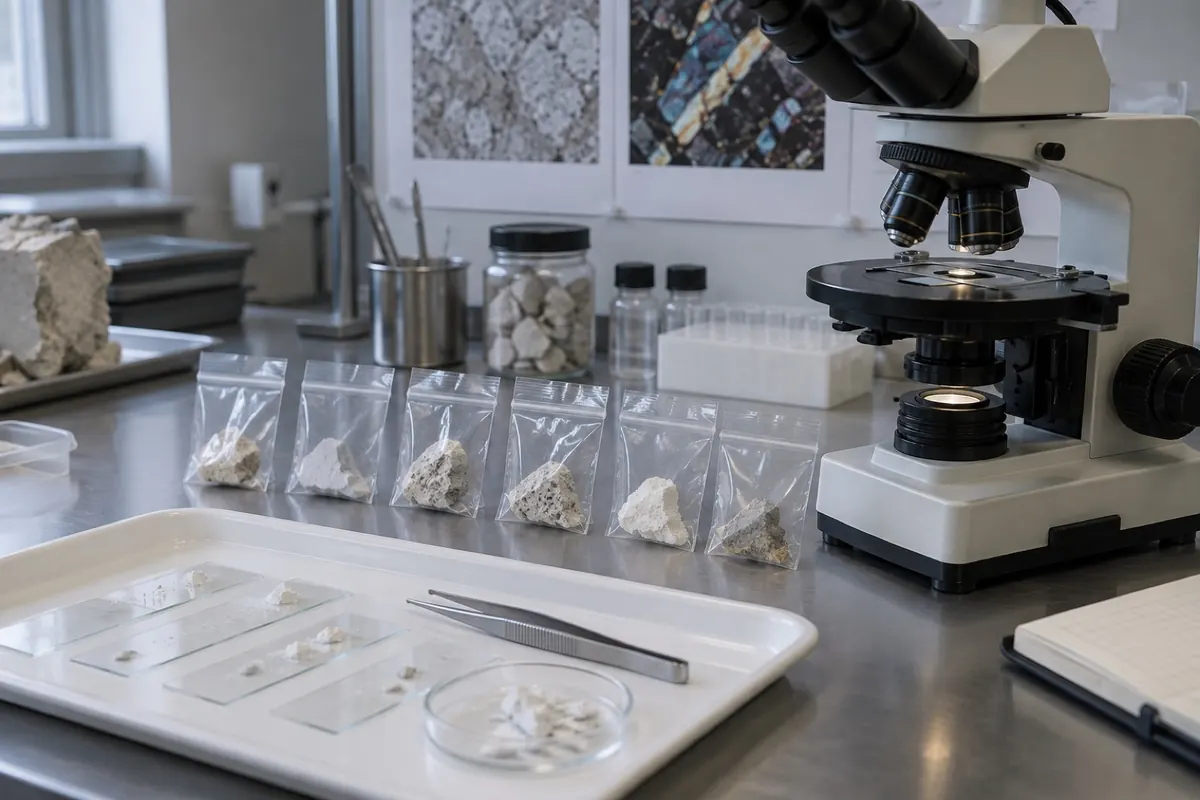
The test is a small piece of texture, wetted, scraped into a sealed bag and read under a polarized light microscope. Per 40 CFR 763.87, an area is not ACM only if every required sample shows 1 percent or less, and is ACM if any one shows more. For surfacing material, EPA’s school rule at 40 CFR 763.86 requires at least three samples from a school area of 1,000 square feet or less, and the Seattle Asbestos Test price list recommends three for a house.
| Lab report says | What it means | What to do |
|---|---|---|
| None detected | No asbestos seen in that sample | Confirm with more samples before a big job |
| Trace, or under 1 percent | Present, but not regulated ACM | Still work wet; OSHA exposure limits still apply |
| 1 percent | Not over the line | Ask for a point count |
| Over 1 percent | Asbestos-containing material | The whole homogeneous area counts as ACM |
| Under 10 percent, visual estimate | Friable result needing a firmer count | NESHAP requires point counting to verify |
Billing catches people out. According to the Seattle Asbestos Test price list, popcorn counts as one or two materials, paint coat and texture, at $50 each at 24 hours; the Wisconsin State Laboratory of Hygiene charges $48 a sample at 12 to 14 working days. See our asbestos testing cost and testing kit pages. EPA homeowner guidance says taking samples yourself is not recommended.
The decision path
Work down the list; each step ends it or sends you on.
- Will anything disturb it? If it is undamaged and no work is planned, EPA says leave it alone and you need not test.
- Is it damaged or wet? Keep people out, do not sweep or vacuum debris, and get a professional assessment.
- Built no later than 1980? OSHA presumes the texture is asbestos. Later buildings lower the odds, not to zero.
- Test before you disturb. Three samples, read by PLM. Note whether it is painted, because that decides whether wet removal is practical.
- Negative? Confirm with additional samples, as the Southwest Clean Air Agency advises, then treat it as ordinary work.
- Positive and staying? Paint or cover it, keep the lab report with the house records, and tell anyone who cuts into it.
- Positive and going? Check your state and local rule on who may remove it, then get written quotes.
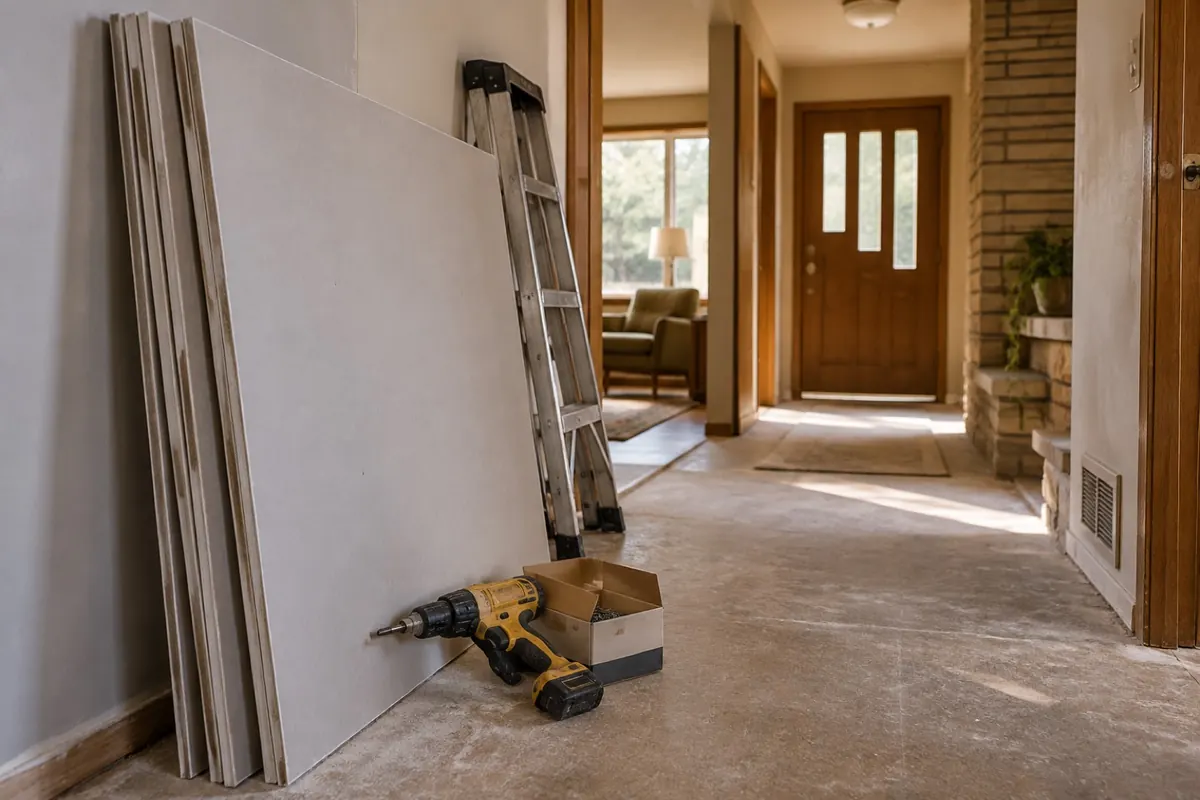
Leave, paint, cover or remove
EPA homeowner guidance sets out the menu: leave material in good condition alone, repair it by encapsulation (a sealant that binds or coats it) or enclosure (covering it), and remove it when remodelling will disturb it or damage is extensive.
| Option | Fits when | Published cost | The catch |
|---|---|---|---|
| Leave it alone | Intact, dry, no work planned | None | Anyone who later cuts into it needs telling |
| Paint or encapsulate | Intact and well bonded | $2 to $6 per sq ft (HomeAdvisor) | Added weight can drop texture; paint blocks later wetting |
| Cover with drywall | Ceiling will be refinished anyway | $450 to $1,050 for a 10 x 30 ft room (Fixr) | Screws pierce the texture, a disturbance in itself |
| Remove under wet methods | Renovation will disturb it, or it is failing | $3 to $7 (Fixr) to $9 to $20 (HomeAdvisor) per sq ft | Costliest; the only option that ends it |
The catches come from the agencies. The Puget Sound Clean Air Agency warns that popcorn made too heavy by added encapsulant, or by water damage, may fall off the ceiling in clumps. The Southwest Clean Air Agency popcorn ceiling manual says an intact ceiling can usually be painted, by spraying, but that paint can seal the texture against the wetting its removal method depends on. Other materials are priced on our asbestos removal cost page.
Can you remove it yourself?
The federal answer turns on the building, not the owner. 40 CFR 61.141 excludes residential buildings having four or fewer dwelling units from the NESHAP, and EPA's 1995 Clarification of Intent states that renovation or demolition of an isolated small residential building by any entity is not covered. Owner occupancy enters through state and local rules, which vary sharply.
| Jurisdiction | Can the owner remove it? | Conditions |
|---|---|---|
| Federal NESHAP | Isolated house of up to 4 units: not covered | Several houses on one site, or a commercial or public project, are covered |
| New York (Dept. of Labor) | Yes, any type or amount | Owner lives there and does all the work; flippers excluded |
| Massachusetts (310 CMR 7.15) | Exemptions cover solely non-friable work | Friable texture falls outside them; ask MassDEP first |
| Washington, Puget Sound | Yes, owner-occupant | Notice and $25 fee for friable removal from 48 sq ft a year |
| Washington, Southwest Clean Air | Owner or certified contractor only | Unpaid family may help; hiring anyone else is illegal |
| California, South Coast AQMD | Yes, owner-occupant in person | Not laborers, friends or family; outside waste still regulated |
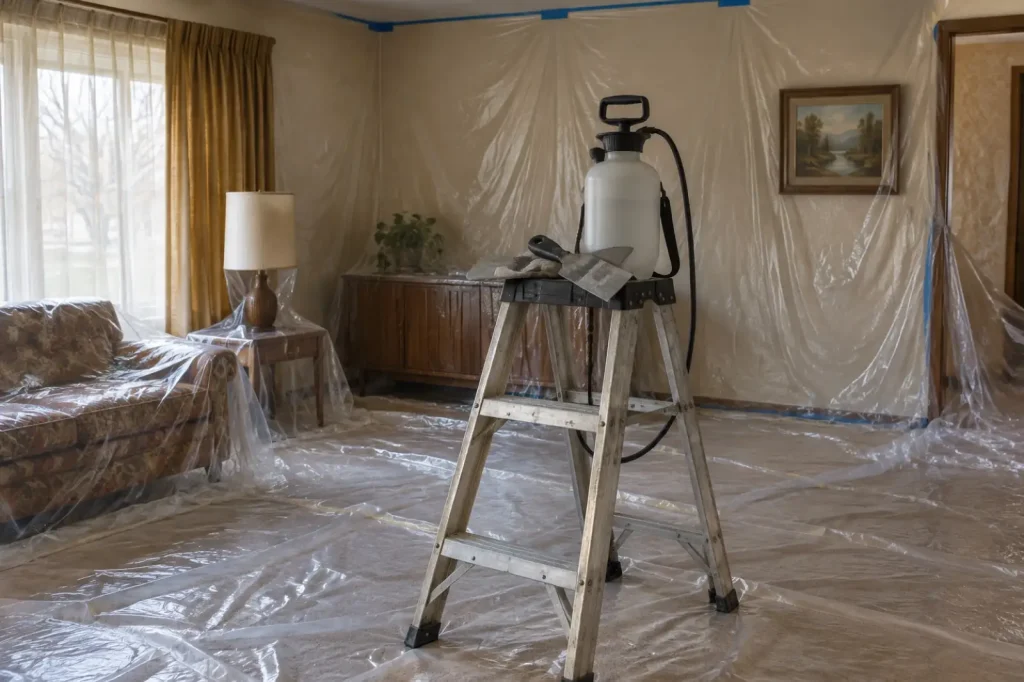
One bedroom ceiling clears the Puget Sound line alone. For owners who qualify, the Southwest Clean Air Agency popcorn ceiling manual sets the procedure: plastic on walls and floors, heating and cooling off, texture soaked with water and detergent, scraped wet, double bagged and taken to a site licensed for the waste. If water cannot get through a painted ceiling, it says, do not proceed. Agencies for every state are on our asbestos accreditation map.
What the published prices say
Five guides from three publishers price asbestos popcorn removal, in two camps rather than one range.
| Source | Updated | Published figures |
|---|---|---|
| HomeAdvisor, popcorn | 19 June 2026 | Removal $932 to $3,091, average $2,011; asbestos adds $5 to $20 per sq ft; testing average $480 |
| HomeAdvisor, asbestos | 17 June 2026 | Asbestos popcorn $9 to $20 per sq ft; encapsulation $2 to $6 |
| Fixr, popcorn | 31 January 2025 | Standard $1 to $4 per sq ft; asbestos $3 to $7 |
| Bob Vila | 21 December 2023 | Asbestos popcorn $3 to $7 per sq ft; encapsulation $2 to $6 |
| Fixr, asbestos | 18 August 2022 | Asbestos popcorn $3 to $7 per sq ft; testing $250 to $750 |
On Fixr’s room the gap is wide: according to Fixr's popcorn ceiling guide and Bob Vila's asbestos removal guide, abatement at $3 to $7 a square foot comes to $900 to $2,100, while HomeAdvisor's asbestos removal guide at $9 to $20 gives $2,700 to $6,000. The lower range appears in all three older guides, the newest dated January 2025; HomeAdvisor’s was updated in June 2026 and may sit closer to a current quote. Whether a policy pays is a question for the policy and your state insurance department; see does insurance cover asbestos removal.
For contractors: wet and damaged texture
Water losses are where crews meet popcorn texture. A wet ceiling may sag, shed texture in clumps or need drain holes, and each is a disturbance. 29 CFR 1926.1101 covers the crew in any building: its scope includes repair and renovation of structures containing asbestos and asbestos spill or emergency cleanup. The NESHAP adds duties on a covered facility such as an apartment block; per EPA's asbestos NESHAP page, houses renovated within a commercial or public project are not exempt.
| Item | The rule | What goes in the file |
|---|---|---|
| Presumption | Pre-1981 surfacing is PACM until rebutted by accredited sampling | Lab report with lab, date and analyst |
| Work class | Removal is Class I; repair that disturbs it is Class III | Scope naming the class and controls |
| Wet methods | Required unless shown infeasible | Notes and photos of wetting |
| Covered buildings | Five or more units, or commercial: inspect first; full rules at 160 sq ft of RACM | NESHAP notification |
| Emergency loss | Notice by the following working day | Date and hour of the event, and why it was urgent |
| Waste | Wet, leak-tight, labelled | Waste shipment record |
Put testing on its own line before any tear-out. Our water-damaged ceiling guide covers the drying that follows.
Questions people actually ask
How likely is asbestos in a popcorn ceiling?
No national sampling study was found that gives a reliable percentage. The rules are clearer: OSHA presumes sprayed or troweled surfacing in a building constructed no later than 1980 contains asbestos until tested, and not all popcorn ceilings do, per the Southwest Clean Air Agency. Three lab samples replace the odds with an answer.
Will a house built in 1978 have asbestos in the ceiling?
It may. EPA’s ban on spraying decorative coatings over 1 percent asbestos took effect on 19 June 1978, so a 1978 house sits on the line, and troweled texture and earlier stock fell outside that rule. OSHA’s presumption runs to buildings constructed no later than 1980. Test before sanding, scraping or drilling.
Is it okay to live in a house with a popcorn ceiling?
EPA’s homeowner guidance says undamaged material that will not be disturbed should be left alone, and need not be tested. The CPSC booklet adds that loose, crumbly or water-damaged sprayed material may release fibres, so the condition of the ceiling, not its texture, is what to watch.
What should I do if I accidentally scraped a popcorn ceiling?
Stop, keep people out, and switch off heating or cooling. EPA says not to dust, sweep or vacuum debris that may contain asbestos; the Southwest Clean Air Agency says to use wet rags instead. Bag the debris wet, and have the texture tested before any further work.
Can a homeowner legally remove an asbestos popcorn ceiling?
Federally, an isolated house of up to four units is outside the asbestos NESHAP. State and local rules decide the rest: New York allows an owner-occupant to remove any amount, Puget Sound requires notice and a 25 dollar fee above its small-quantity exemption, and South Coast AQMD limits the exemption to the owner in person.
How much does asbestos popcorn ceiling removal cost?
Published guides split. Fixr and Bob Vila list 3 to 7 dollars a square foot; HomeAdvisor’s 2026 asbestos guide lists 9 to 20. On a 300 square foot room that is about 900 to 2,100 dollars at the lower rate and 2,700 to 6,000 at the higher, before testing, according to those guides’ own figures.
Sources
- Federal Register of 19 June 1978, page 26372: EPA asbestos amendments, 43 FR 26372. Retrieved 11 October 2026.
- EPA's record of its asbestos actions, EPA, updated 21 January 2026. Retrieved 11 October 2026.
- 40 CFR 61.146, 40 CFR 61.141 and 40 CFR 61.145, asbestos NESHAP, via eCFR. Retrieved 11 October 2026.
- 16 CFR Part 1304, CPSC patching compound ban, 42 FR 63362, via eCFR. Retrieved 11 October 2026.
- 29 CFR 1926.1101, OSHA construction asbestos standard, via eCFR. Retrieved 11 October 2026.
- 40 CFR 763.86 and 40 CFR 763.87, AHERA rules, via eCFR. Retrieved 11 October 2026.
- EPA's 1995 Clarification of Intent, Federal Register, 28 July 1995. Retrieved 11 October 2026.
- EPA homeowner guidance (updated 25 June 2026) and EPA's asbestos NESHAP page (updated 22 December 2025), EPA. Retrieved 11 October 2026.
- CPSC booklet Asbestos in the Home, CPSC publication 453, UNT web archive. Retrieved 11 October 2026.
- Puget Sound Clean Air Agency, homeowner renovation page; Southwest Clean Air Agency popcorn ceiling manual, undated. Retrieved 11 October 2026.
- New York State Department of Labor, publication P229 (1/26). Retrieved 11 October 2026.
- 310 CMR 7.15, via Cornell Legal Information Institute. Retrieved 11 October 2026.
- South Coast AQMD, Rule 1403 owner-occupant page. Retrieved 11 October 2026.
- HomeAdvisor's popcorn ceiling guide and HomeAdvisor's asbestos removal guide, HomeAdvisor. Retrieved 11 October 2026.
- Fixr's popcorn ceiling guide (Adam Graham) and Fixr's asbestos removal guide, Fixr. Retrieved 11 October 2026.
- Bob Vila's asbestos removal guide, Bob Vila. Retrieved 11 October 2026.
- Seattle Asbestos Test price list, undated; Wisconsin State Laboratory of Hygiene, homeowner fees. Retrieved 11 October 2026.
- Room totals are arithmetic on the figures above. Our methodology sets the standing rules; related pages sit on the standards hub.
Rules and prices change. Confirm the current rule with your state or local asbestos agency and get written quotes before work on a textured ceiling.