The short answer
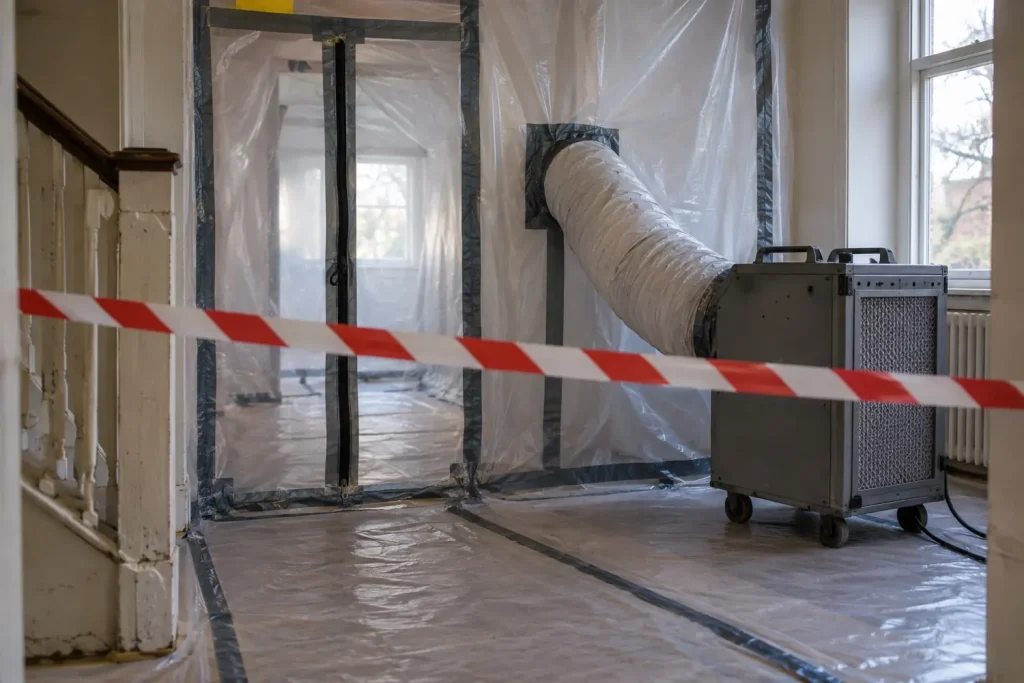
Asbestos removal cost runs about $1,200 to $3,000 for a small localised job, $2,000 to $6,000 for floor tile and adhesive across a room, and $15,000 to $30,000 or more for whole-house or commercial abatement. Per square foot the range is roughly $5 to $20. Friability and access, not area, move the number most, because containment costs the same to build whether the area is small or large.
Key takeaways
- Containment and negative air are largely fixed costs. That is why a small job carries a minimum and why the per-square-foot rate falls as scope grows.
- Friable material costs materially more than intact non-friable material at the same square footage, because the required controls are different rather than because the labour is harder.
- Licensed disposal is a real line, not a rounding error. Asbestos-containing waste goes to a facility permitted to accept it, and the tipping fee plus manifest paperwork is billed.
- Encapsulation is a legitimate alternative to removal for intact non-friable material, and it is cheaper. It is also deferral, and it has to be recorded and managed rather than forgotten.
- Insurance rarely pays for asbestos removal during a routine renovation. It may respond where abatement is required as part of a covered loss such as fire or water damage. Policy wording decides.
On this page
- What this page covers, and what it does not
- Cost by scope tier
- Per square foot, and why it misleads
- Cost by material
- Friability is the biggest single driver
- What is inside the price
- Disposal, tipping fees and the manifest
- Encapsulation versus removal
- Clearance testing and the rebuild
- What insurance does and does not pay
- How to compare three abatement quotes
- Why doing it yourself saves less than expected
- Questions people actually ask
Published asbestos removal cost figures vary more than almost any other remediation number, and the reason is that the jobs being averaged are not comparable. Pulling one run of pipe lagging out of a basement and stripping a whole roof of weathered cement sheet share a regulatory framework and nothing else. This page separates the tiers, shows what sits inside the price, and sets out which of the two legitimate responses, removal or encapsulation, fits which situation.
What this page covers, and what it does not
Scope boundary, stated deliberately. This page covers cost, regulation, procedure and how to compare quotes. It does not cover health effects, disease, symptoms or medical risk, and it will not attempt to tell you what an exposure means for your health. Those are clinical questions and they belong with a clinician and with federal health and occupational sources. OSHA asbestos safety and health topic page is the authoritative federal starting point for workplace exposure rules and controls, and EPA asbestos laws and regulations covers the regulatory framework. If you have a health concern about a specific exposure, speak to a doctor.
Cost by scope tier
Five tiers cover most of what gets quoted in residential and light commercial work. The bands below are compiled from published contractor and aggregator price guides current in 2026 and are indicative rather than survey output.
| Scope tier | Typical total | What it usually covers | What pushes it to the top of the band |
|---|---|---|---|
| Small localised, one floor area or one pipe run | $1,200 to $3,000 | Survey, limited containment, removal, bagging, permitted disposal, clearance testing | Awkward access, occupied property, or the minimum charge dominating a very small area. |
| Floor tile plus adhesive, whole room | $2,000 to $6,000 | Containment of the room, tile and mastic lift, subfloor cleaning, disposal, clearance | Multiple layers of tile and mastic, and whether the subfloor has to be removed too. |
| Pipe or boiler lagging | $3,000 to $8,000 | Full containment with negative air, glovebag or enclosure removal, disposal, clearance | Linear footage, height, confined space, and whether the plant has to stay in service. |
| Siding or roofing, exterior | $6,000 to $15,000 | Controlled removal of cement sheet, ground protection, disposal, and often a replacement cladding scope | Weathered sheet that breaks on handling, storey height, and replacement material cost. |
| Whole house or commercial abatement | $15,000 to $30,000 or more | Phased containment across multiple areas, multiple materials, extensive disposal, staged clearance | Building size, occupancy constraints, number of distinct materials, and out-of-hours working. |
| Emergency or fire and water damage abatement | Priced per event, frequently above the equivalent planned tier | Abatement inside an existing loss scope, coordinated with the restoration contractor | Response timing, debris condition, and coordination with a carrier and an adjuster. |
Why the small tier has a floor it cannot go below
A licensed abatement crew mobilising to a property has to establish controls before touching anything: barriers, sheeting, a decontamination arrangement, negative air where required, waste-handling discipline and the documentation trail. Building that for ten square feet takes most of the time it takes for a hundred. Add the survey, the clearance test and the permitted disposal run, and there is a floor under the price that has nothing to do with the quantity of material.
The top of a band is usually access, not area
When a quote lands at the high end of its tier, the reason is more often how hard the material is to get at than how much of it there is. A crawl space with eighteen inches of headroom, a boiler room reached through a finished basement, a second-storey exterior needing scaffold, or an occupied building where work has to happen at night all add cost that does not show up in a square-footage count.
Per square foot, and why it misleads
Per-square-foot rates for asbestos abatement run roughly $5 to $20 depending on material, condition and access. The figure is useful for comparing two bids on the same defined scope and misleading for budgeting, because the fixed setup cost means the rate is not constant across job sizes.
Read that chart as a warning about comparison. A $20 per square foot quote on a small friable job and a $6 quote on a large intact non-friable job can both be entirely reasonable, and the two rates tell you almost nothing when placed side by side. What makes two bids comparable is an identical scope: the same materials, the same measured areas, the same containment class and the same clearance criteria.
Ask for the rate and the fixed component separately
A defensible quote can usually be split into a mobilisation and containment component that does not vary much with quantity, and a removal component that does. Asking a contractor to show that split makes the quote legible, and it tells you immediately whether adding an adjacent area to the scope is cheap or expensive.
Cost by material
Material type sets the controls, and the controls set the price. These bands are indicative and assume a straightforward access situation.
| Material | Typical cost basis | Indicative range | Why it prices where it does |
|---|---|---|---|
| Vinyl floor tile, intact | Per square foot of floor area | $5 to $12 per sq ft | Non-friable and bound in the tile matrix, so controls are lower. Volume of waste is the main driver. |
| Black bituminous adhesive under tile | Per square foot, often priced with the tile | $3 to $10 per sq ft additional | Mastic removal is slower than tile lift and sometimes needs the subfloor taken up with it. |
| Pipe insulation and lagging | Per linear foot | $10 to $30 per linear ft | Commonly friable, so full containment and negative air. Fittings and elbows cost more per foot than straight runs. |
| Boiler and duct lagging | Per unit or per job | $2,000 to $8,000 | Confined space, awkward geometry, and plant that may need to stay available. |
| Textured coating or sprayed ceiling | Per square foot of ceiling | $8 to $20 per sq ft | Friable when disturbed, overhead work, and large contiguous areas. |
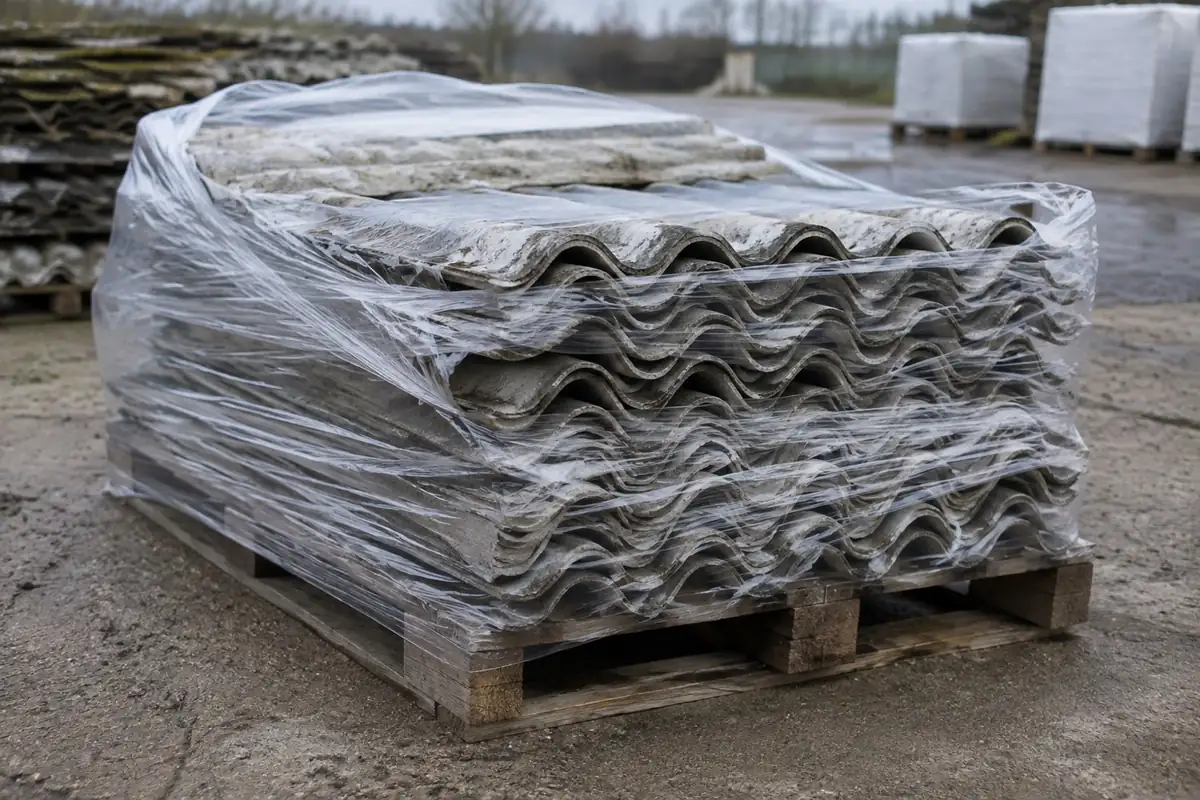
| Cement sheet siding or roofing | Per square foot of cladding | $8 to $20 per sq ft | Exterior access and scaffold, plus a replacement cladding scope. Weathered sheet breaks and escalates the controls. |
| Vermiculite loft insulation | Per square foot of loft area | $10 to $25 per sq ft | Loose fill, so it is friable by nature. Removal is a containment and extraction job. |
| Small items: gaskets, rope seals, fire door cores | Per item, usually inside a minimum charge | Absorbed into the minimum | Quantity is trivial; the cost is mobilisation and controls. |
Floor tile and mastic are two jobs priced as one
This is where quotes most often diverge on apparently identical work. One contractor prices lifting the tile. Another prices lifting the tile and removing the adhesive beneath it. A third prices lifting the tile, removing the adhesive and taking up the subfloor because the adhesive will not release cleanly. All three can be honest quotes for different scopes. Our page on asbestos testing kits and laboratory analysis covers why the tile and the mastic need separate samples in the first place, which is the reason the scope question exists.
Replacement is a separate scope and often the larger one
Removing asbestos cement siding leaves a building with no siding. Removing a textured ceiling coating leaves a ceiling needing finishing. The abatement quote and the reinstatement quote are different scopes, frequently from different trades, and the reinstatement is regularly the bigger of the two. Get both numbers before deciding, because a cheap abatement attached to an expensive rebuild is not a cheap project.
Friability is the biggest single driver
Friable material crumbles under hand pressure and releases fibres when disturbed. Non-friable material holds fibres bound in a matrix such as vinyl, cement or bitumen. The distinction is central to the federal regulatory framework described at EPA asbestos laws and regulations, and it is the largest single reason two quotes on the same square footage differ.
Condition can reclassify a material and reprice a job
Asbestos cement sheeting is a non-friable product. After decades on an exterior wall, the cement matrix weathers, the surface goes chalky and the sheet breaks when handled. A survey describing the material as cement sheet without describing its condition will produce a quote that the site cannot support. This is a common source of variation orders, and it is avoidable by insisting the survey records condition as well as material type.
Glovebag work versus full enclosure
For limited friable work on pipe runs, glovebag techniques allow removal inside a sealed bag attached to the pipe rather than building a room-sized enclosure. Where it is applicable it is substantially cheaper. It is not applicable everywhere: fitting geometry, pipe surface temperature, insulation condition and the quantity involved all bear on it. If a quote is notably below the lagging band, the method is worth asking about, and so is whether it genuinely suits the installation.
What is inside the price
Eight components make up an abatement invoice. A quote that shows them separately is a quote you can interrogate.
| Component | What it is | How it behaves with scope |
|---|---|---|
| Survey and sampling | Accredited inspection, sampling plan, laboratory analysis, written report | Largely fixed per building, plus a per-sample laboratory fee of roughly $25 to $75. |
| Notification and permits | Notification to the delegated authority where the project is regulated, plus any local permit | Fixed per project, and it has a lead time that affects the schedule. |
| Containment and engineering controls | Barriers, sheeting, sealed openings, negative air units, HEPA filtration, decontamination arrangement | Largely fixed per contained area. This is the cost floor on small jobs. |
| Licensed abatement labour | Trained and accredited workers and a supervisor, in respiratory protection and protective clothing | Scales with quantity, and with access difficulty more than people expect. |
| Wetting agents and consumables | Amended water and surfactants, sheeting, tape, filters, disposable clothing, bags | Scales with quantity and with crew days. |
| Waste packaging | Sealed double bagging or wrapping, labelled to the regulatory requirement | Scales directly with waste volume. |
| Licensed disposal | Transport to a facility permitted to accept asbestos waste, plus tipping fees and the waste manifest | Scales with volume and with haul distance to the nearest permitted facility. |
| Clearance air testing | Post-abatement verification against written criteria, usually by an independent consultant | Per contained area, per event. A failure means a repeat at cost. |
The survey comes first, always
An abatement quote that arrives without a survey behind it is a guess with a number attached. The survey establishes which materials are present, where, in what condition and in what quantity, and that is the input the quote is calculated from. It is also the document that makes three bids comparable, because without it each contractor is pricing their own assumption about the scope.
Disposal, tipping fees and the manifest
Disposal is the line most often underestimated by people comparing quotes, and the one with the least flexibility. Asbestos-containing waste must go to a facility permitted to accept it, packaged and labelled to requirement, with documentation that follows the waste from the site to the facility. The framework is set out at EPA asbestos laws and regulations, and the delegated authority in each state administers it; EPA publishes per-state contacts at EPA state asbestos contacts.
| Disposal element | What it involves | What moves the cost |
|---|---|---|
| Packaging | Sealed double bagging or wrapping, labelled | Waste volume, and whether material has to be cut to fit. |
| Transport | Haul from site to the permitted facility | Distance. In areas with few permitted facilities this is a real differentiator between markets. |
| Tipping fee | Charged by the receiving facility, commonly by weight or volume | Regional. Cement products are heavy, which matters where the fee is by weight. |
| Manifest and documentation | Waste shipment record tracking the material to the facility | Fixed administrative cost, and it is the document proving the waste went where it should. |
| Skip or container hire | Dedicated covered container where volumes justify it | Duration on site, which is driven by project length. |
Practical consequence for comparing quotes. If one bid is materially cheaper and the difference is in the disposal line, ask which facility the waste is going to and ask to see the manifest afterwards. Disposal is where the corners get cut, and improper disposal is the owner’s problem as well as the contractor’s.
Encapsulation versus removal
Removal is not the only legitimate response. Encapsulation seals intact non-friable material in place with a coating or an enclosure so that fibres cannot be released, and management in place leaves the material undisturbed under a monitoring regime. Both are recognised approaches, both are cheaper than removal, and both are deferral rather than resolution.
| Factor | Removal | Encapsulation or enclosure | Management in place |
|---|---|---|---|
| Typical cost | $5 to $20 per sq ft | Commonly 30% to 60% of the removal cost for the same area | Inspection and record-keeping cost only |
| What it achieves | The material is gone and the liability with it | Release is prevented while the seal or enclosure stays intact | Nothing changes physically; the risk is documented and monitored |
| Suitable when | Material is friable, damaged, or will be disturbed by planned work | Material is intact, non-friable, accessible for inspection, and will not be disturbed | Material is intact, non-friable and in a location nobody touches |
| Not suitable when | Nothing, but cost or occupancy may rule out the timing | Material is friable or damaged, or the area is due for renovation | Anyone will drill, cut or renovate the area |
| Ongoing obligation | None once cleared and documented | Periodic inspection of the seal, and a record that it is there | Periodic inspection and a live management record |
| Effect on a sale | Clean, with a clearance record to show | Disclosable. Buyers and their surveyors will ask | Disclosable, and it transfers the deferred cost to the buyer |
| What it does to a future renovation | Removes the constraint | The material is still there and still governs the work | The material is still there and still governs the work |
Encapsulation is a decision that has to be written down
The failure mode for encapsulation is not technical, it is administrative. A sealed material that nobody records becomes a material that a future contractor drills into without knowing. That turns a managed situation into an uncontrolled release, and it costs far more than the removal would have. If encapsulation is the choice, the record of what was sealed, where, when and by whom is part of the deliverable, not an optional extra.
When deferral is the right commercial answer
Intact asbestos cement sheeting on an outbuilding that nobody is going to touch for a decade is a reasonable candidate for management in place. So is intact floor tile under a carpet in a room with no renovation plans. The judgement turns on whether the material will be disturbed, whether it can be inspected, and whether the record will survive a change of ownership. If any of those three is shaky, the deferral is not really being managed.
Renovation timing changes the answer
If a room is going to be renovated in eighteen months, encapsulating the floor now and removing it then means paying for both. Sequencing the abatement into the renovation is almost always cheaper than doing it twice, because the containment and mobilisation get paid for once. Planned work is the single strongest argument for removal over encapsulation.
Clearance testing and the rebuild
Abatement is not finished when the material leaves the building. It is finished when the area passes clearance against the written criteria and the documentation is complete. Clearance air testing by transmission electron microscopy is the standard method after friable abatement, priced at roughly $75 to $250 per sample on published laboratory price lists, and it is normally performed by a consultant independent of the abatement contractor.
| Stage | Who does it | Indicative cost | What it produces |
|---|---|---|---|
| Pre-abatement survey | Accredited inspector | $400 to $1,200 residential | Materials, locations, condition, quantities, and the scope the quotes are priced from. |
| Notification | Contractor, to the delegated authority | Administrative | Permission to proceed on a regulated project, after a lead time. |
| Abatement | Licensed abatement contractor | The tiers above | Material removed, packaged, manifested and disposed of. |
| Clearance testing | Independent consultant | $300 to $1,000 per event including analysis | A written pass or fail against the criteria, before containment comes down. |
| Reinstatement | General contractor or specialist trade | Separate scope, frequently larger than the abatement | Flooring, cladding, ceiling finish or insulation replaced. |
Do not let the rebuild start before the clearance passes
Closing up a wall or laying new flooring before clearance is confirmed means that a failure has to be reached through new work. Written clearance criteria agreed before the job starts, and a contract that puts the cost of a re-test after a failure on the abatement contractor, are the two provisions that keep this from becoming an argument.
What insurance does and does not pay
The general position is that property insurance rarely pays for asbestos removal undertaken as part of a routine renovation or improvement. Discovering asbestos while remodelling a kitchen is typically treated as a pre-existing building condition rather than a covered loss, and many policies carry pollution or contamination wording that speaks to it directly.
| Situation | Usual position | What decides it |
|---|---|---|
| Asbestos found during a planned renovation | Generally not covered | Treated as a pre-existing condition of the building. No sudden covered event caused it. |
| Abatement required because a covered loss disturbed the material | May respond, as part of the covered loss scope | Whether the abatement is necessary to repair the covered damage, and the policy’s pollution wording. |
| Fire damage that disturbed asbestos-containing material | Frequently within the loss scope | Causation, and whether repair of the fire damage requires the abatement. |
| Water damage that disturbed asbestos-containing material | Sometimes within the loss scope | Whether the water event is covered in the first place, then the same causation test. |
| Contractor released fibres through improper work | A liability question, not a property claim | The contractor’s liability cover and the terms of the contract. |
| Storm damage to asbestos cement roofing or siding | May respond for the damaged element | Whether the peril is covered, and how the policy treats matching and replacement of a discontinued material. |
Two practical points. First, the causation question is the whole argument: abatement needed to repair a covered loss is a different proposition from abatement you were going to need anyway. Second, document conditions before any work begins, because a claim decided months later turns on the record taken on day one.
Where asbestos abatement is required inside a water or fire loss, the abatement sits inside a larger restoration scope and the sequencing matters to both the cost and the claim. Our water damage restoration cost page covers how mitigation and reconstruction are priced as separate scopes, which is the same structure that applies here.
How to compare three abatement quotes
Bids on abatement diverge mostly because they are pricing different scopes. Seven questions make them comparable.
- Which survey are you pricing from? All three bids should price the same survey, with the same material list, areas and condition descriptions.
- Which materials are in, and which are out? Tile and mastic, coating and substrate, sheet and flashing. Ambiguity here is the commonest source of a variation order.
- What containment class, and is negative air included? This is the largest cost difference between two bids on the same area.
- Is licensed disposal included, and to which facility? Get tipping fees named rather than folded into a lump sum.
- Is clearance testing included, and by whom? An independent consultant is the norm. Testing performed by the abatement contractor is worth much less.
- Who pays for a re-test after a failed clearance? Answered in the contract, not after the failure.
- Is reinstatement included or excluded? Removing siding leaves a wall. Get the rebuild priced before you choose.
One more check that costs nothing. Ask for the contractor’s licence or accreditation reference and verify it with the state authority. EPA publishes per-state contacts at EPA state asbestos contacts, which is the correct starting point for checking who administers accreditation in a given jurisdiction. Our state licensing review covers the comparable pattern on the mould side, where variation between states is much wider because there is no equivalent federal accreditation framework underneath it.
Why doing it yourself saves less than expected
In some jurisdictions an owner-occupier may remove certain non-friable material from their own single family home. Where that is permitted, the saving is smaller than the labour line suggests, because most of the cost is not labour.
| Cost element | Contractor job | Owner attempt | What actually happens |
|---|---|---|---|
| Survey and analysis | Included in the quote | Still needed | You pay for it either way. Laboratory fees run roughly $25 to $75 per sample. |
| Containment materials and equipment | Owned, amortised across jobs | Bought or hired for one job | Buying sheeting, a HEPA negative air unit and respiratory protection for one job is poor economics. |
| Respiratory protection | Fit-tested programme in place | A purchased mask | Protection depends on fit testing and a programme, which is the part that cannot be bought off a shelf. |
| Licensed disposal | Included, with a manifest | Still required, and harder to arrange | Permitted facilities frequently deal with licensed haulers rather than walk-in loads. |
| Clearance testing | Included or arranged | Still advisable | Without it you have no record that the area is clear. |
| Documentation for a future sale | Clearance record exists | Usually nothing | A buyer’s surveyor asks for records. Undocumented work is worth less than no work in a negotiation. |
| Risk of escalation | Contractor carries it | Owner carries it | A non-friable material broken during removal becomes a bigger job than the one that was avoided. |
The honest summary is that the do-it-yourself route makes sense for a small quantity of intact non-friable material where it is lawful, where you can arrange permitted disposal, and where nobody will later need a record that the work was done properly. Those three conditions hold together less often than people expect. Our methodology sets out how the figures on this page are sourced and labelled.
Questions people actually ask
How much does asbestos removal cost?
A small localised job typically runs $1,200 to $3,000, floor tile and adhesive across a room $2,000 to $6,000, pipe or boiler lagging $3,000 to $8,000, exterior siding or roofing $6,000 to $15,000, and whole-house or commercial abatement $15,000 to $30,000 or more. Per square foot the band is roughly $5 to $20. These are indicative figures compiled from published price guides current in 2026.
Why is asbestos removal so expensive for a small area?
Because containment, negative air, decontamination arrangements, the survey, the clearance test and the permitted disposal run cost close to the same whether the area is ten square feet or a hundred. That fixed setup is why small jobs carry a minimum and why the per-square-foot rate falls as scope grows.
Is encapsulation cheaper than removal?
Yes, commonly 30% to 60% of the removal cost for the same area on indicative published pricing, and it is a recognised approach for intact non-friable material that will not be disturbed. It is deferral rather than resolution: the material is still there, it has to be recorded and periodically inspected, and it is disclosable on a sale.
Does homeowners insurance cover asbestos removal?
Rarely for routine renovation, because discovering asbestos while remodelling is generally treated as a pre-existing building condition rather than a covered loss. It may respond where abatement is required as part of a covered loss, such as fire or water damage that disturbed the material. The policy wording and the cause of loss decide it, so read the policy and ask the carrier.
Can I remove asbestos floor tile myself?
In some jurisdictions an owner-occupier may remove certain non-friable material from their own single family home, and intact floor tile is the usual example. Check the rule for your jurisdiction through the EPA state contact list first. Disposal at a permitted facility is still required, and the saving is smaller than it looks because most of the cost is not labour.
How long does asbestos abatement take?
A small localised job is commonly one to two days including setup and clearance. A room of flooring is typically two to four days. Whole house or commercial work runs a week to several weeks depending on phasing and occupancy. Notification lead times on regulated projects add to the calendar before work can begin.
What happens if the clearance test fails?
The contained area stays contained, corrective cleaning is performed and the area is re-tested. That is why the contract should say who pays for a re-test after a failure, and why reinstatement should not start until clearance has passed in writing.
Sources
- EPA asbestos laws and regulations. United States Environmental Protection Agency, on the federal regulatory framework including NESHAP work practice and notification requirements, the regulatory definition of friable material, and waste disposal requirements. Retrieved 23 September 2026.
- OSHA asbestos safety and health topic page. Occupational Safety and Health Administration, on workplace exposure controls, respiratory protection and work practice requirements during abatement. Retrieved 23 September 2026.
- EPA state asbestos contacts. United States Environmental Protection Agency per-state asbestos contact list, cited as the correct starting point for jurisdiction-specific accreditation, notification and owner removal questions. Retrieved 23 September 2026.
- Scope tier bands, per-square-foot ranges, material ranges, laboratory fees, survey pricing and the encapsulation cost relationship are compiled from published contractor, laboratory and aggregator price guides current in 2026. They are indicative rather than survey results. We have not conducted an abatement pricing survey; when we do, its sample and method will be published with it. The per-square-foot chart is arithmetic applied to the indicative band, not a price list.
- Insurance positions stated on this page are general and not advice. Coverage is determined by the specific policy wording, the cause of loss and the jurisdiction.
- Scope note: this page covers cost, regulation and procedure. It does not address health effects or medical risk, which are questions for a clinician and for federal health sources.