The short answer
Asbestos siding is asbestos-cement (transite) cladding, usually rigid shingles of Portland cement and asbestos fibre made from the early 1900s into the 1980s. Intact, it is a non-friable material under the federal asbestos NESHAP and can stay in place. Breaking, drilling, sanding or pressure-washing it is what changes the rules, and only a lab test confirms it.
Key takeaways
- Rigid, brittle shingles with nails in a row just above the lower edge and a pressed face, on a house clad before the mid-1980s, are the classic candidate. Fibre-cement and vinyl are the lookalikes.
- EPA’s 1994 roofing manual puts asbestos-cement sheet at 15 to 40 percent asbestos, far above the 1 percent line in 40 CFR 61.141.
- Intact cement siding is Category II nonfriable ACM. It becomes regulated (RACM) when it is likely to be crumbled, pulverized or reduced to powder, which is what heavy-equipment demolition does.
- Leaving it alone is what the Southwest Clean Air Agency calls possibly the safest, easiest and least expensive option. Paint by the UK HSE’s low-pressure method; pressure-washing is prohibited in Western Australia.
- Overcladding is not a universal loophole: Oregon’s Lane Regional Air Protection Agency forbids new siding over transite.
- According to five named cost guides, removal runs $3 to $15 per square foot, and the guides do not reconcile with each other.
On this page
- Five clues that point to asbestos-cement
- Asbestos-cement, fibre-cement or vinyl
- Why intact siding is non-friable
- What turns it into regulated material
- Leave, paint, cover or remove
- The decision path
- Who may remove it, by jurisdiction
- Removal prices, by named source
- For contractors
- Questions people actually ask
Today’s results for this topic include a forum thread, a law firm, a video and lab marketing pages. This one reads the federal rule, four agency guides and five published price lists side by side. Roofing has its own rules, covered on our asbestos shingles page.
Out of scope: health effects. This page covers identification, regulation, options and prices only; for health questions see EPA's Learn About Asbestos page and CDC's ATSDR asbestos pages, and a clinician.
Five clues that point to asbestos-cement
No clue is proof. Each raises or lowers suspicion enough to decide whether a sample is worth taking; our asbestos testing cost guide lists published lab fees.

| Clue | What to look for | Why it matters |
|---|---|---|
| Era | Asbestos-cement shingles and siding were produced into the 1980s, per the NPS; Hatschek’s patent was reissued in the US in 1907. | A re-clad older house can still hide original shingles. |
| Rigid and brittle | Cement snaps and chips at corners; it does not bend or dent. | Vinyl flexes and wood dents. |
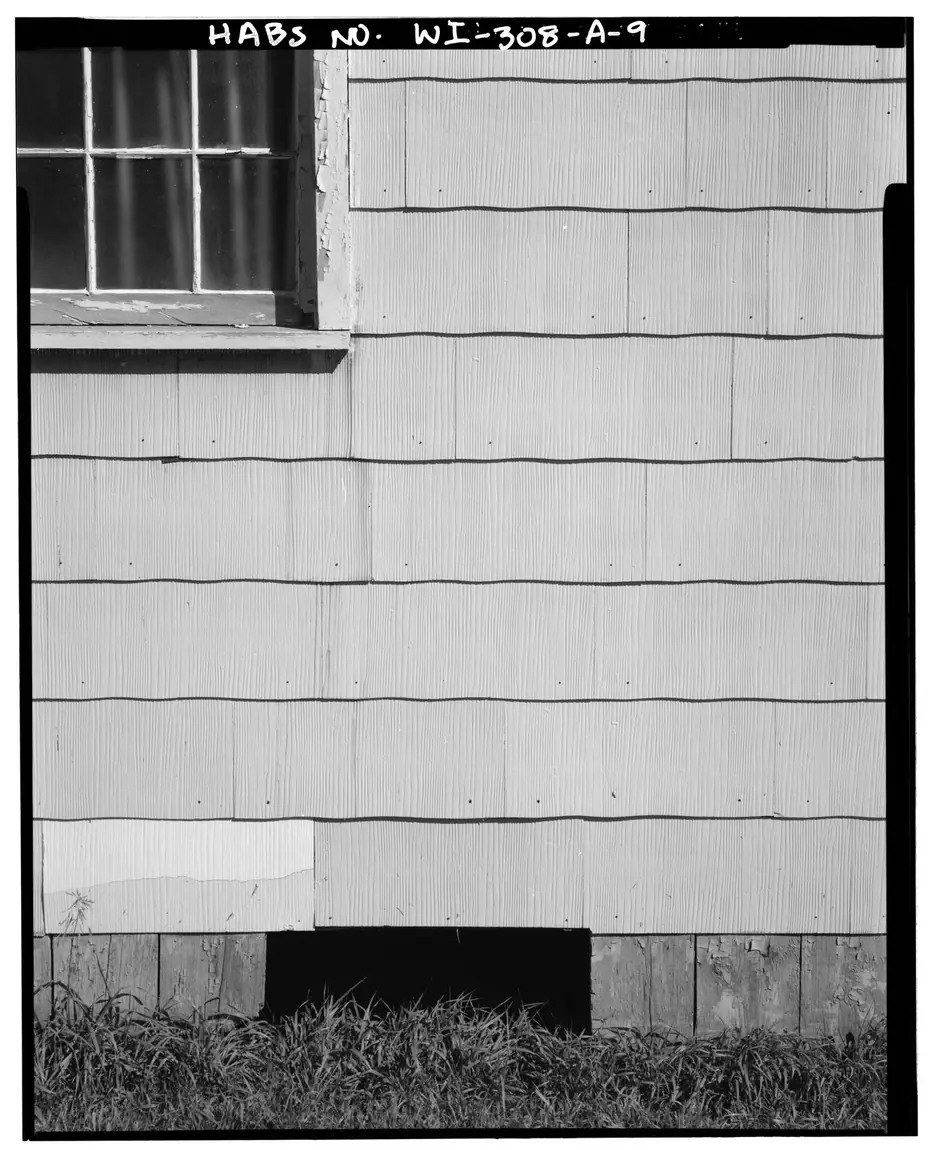
| Nails near the lower edge | On the HABS photograph below, nails sit just above the bottom of each course. EPA notes A/C roof shingles came with factory-punched pilot holes. | Face-nailed, not hidden behind a lap. |
| Pressed face | The NPS describes pressing that gave a rough rustic surface or one imitating weathered wood. | Identical grain course after course means a moulded product. |
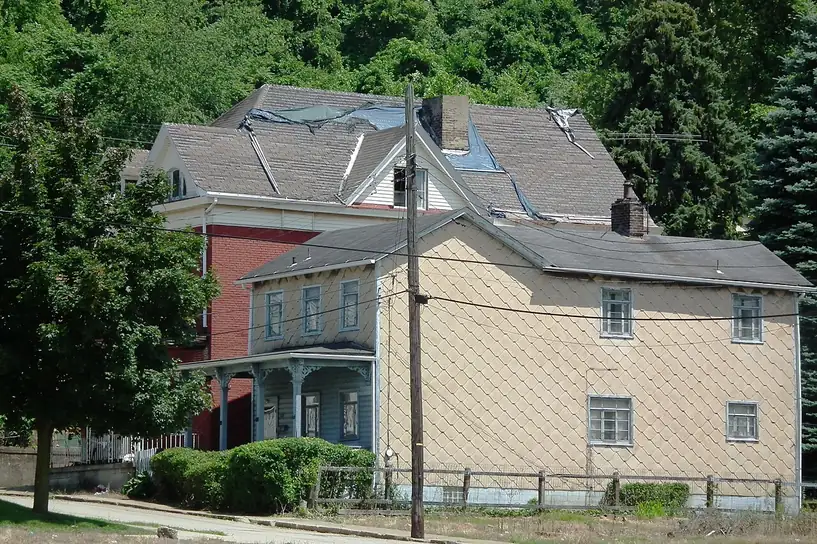
| Pattern | Straight courses with a wavy lower edge, or diamond and hexagonal layouts (the NPS lists American, Dutch Lap and French). | The diamond wall in the first photograph is a strong flag. |
Per the EPA roofing guidance manual (EPA-340/B-94-001), A/C roof shingles were cut from 9 by 16 to 14 by 30 inches. No federal size table for siding was found, so do not rule a shingle in or out by size. The Southwest Clean Air Agency’s sampling method is to wet and break off about one square inch into a sealed bag; skip the test and its guide says to assume asbestos.
Asbestos-cement, fibre-cement or vinyl
Asbestos-cement and fibre-cement are both rigid, cementitious and paintable. The difference is the fibre. The 2015 James Hardie safety data sheet for HardiePlank and HardieShingle lists crystalline silica, calcium silicate, calcium carbonate and cellulose, with no asbestos. Installation date is the first sorting tool.
| Material | Made of | In the hand | Status |
|---|---|---|---|
| Asbestos-cement (transite) | Cement and asbestos fibre; 15 to 40% in A/C sheet per EPA | Rigid, brittle, chips at corners | Category II nonfriable ACM |
| Fibre-cement (modern) | Cement, silica and cellulose (under 15% on the Hardie SDS); no asbestos listed | Rigid; planks or shingles, usually newer installs | Not ACM; cutting makes silica dust |
| Vinyl | Plastic | Flexes and dents; hollow back | Not ACM; often laid over older cladding |
| Wood | Timber | Grain varies piece to piece | Not ACM; may hide A/C shingles beneath |
Why intact siding is non-friable, in the rule’s own words
The definitions sit in 40 CFR 61.141, the asbestos NESHAP. The test is mechanical: can the dry material be crumbled by hand pressure? Cement siding cannot, so it is Category II. EPA’s roofing manual adds that Category II material is more likely to become friable when damaged than Category I, which is why handling drives every rule below.
| NESHAP term | Definition (40 CFR 61.141) | Where siding sits |
|---|---|---|
| Friable | Can be crumbled, pulverized or reduced to powder by hand pressure when dry | Not intact cement siding |
| Category I nonfriable | Packings, gaskets, resilient floor covering, asphalt roofing products over 1% | Roofing; see our shingles page |
| Category II nonfriable | Any other material over 1% that cannot be crumbled by hand pressure when dry | Intact asbestos-cement siding |
| RACM | Includes Category II material with a high probability of becoming crumbled, pulverized or reduced to powder | Siding that will be smashed, ground or bulldozed |
Two limits matter. The same section excludes residential buildings having four or fewer dwelling units from the facility definition, so a single house is generally outside the NESHAP, though not outside state rules. And per 40 CFR 61.145, covered jobs cross the threshold at 160 square feet of RACM on facility components, with notice due 10 working days ahead.
What turns it into regulated material
The EPA letter of 14 January 1993, linked from the EPA transite siding guidance page, says transite, typically Category II nonfriable ACM, must be removed before demolition if the building has at least 160 square feet of ACM, because almost all demolition will subject it to the regulation if left in place. Left in place during a normal demolition, the whole debris pile becomes regulated waste.
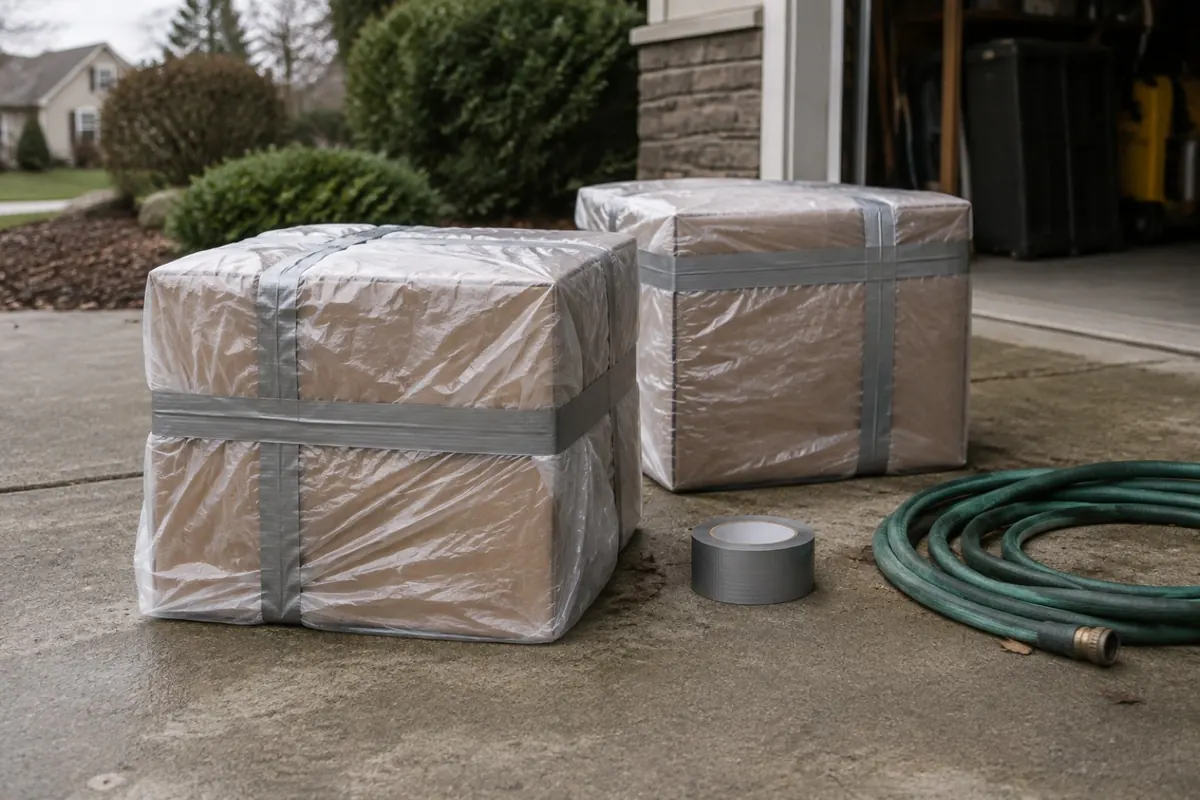
Smaller disturbances follow the same logic. The EPA homeowner asbestos guidance says not to saw, sand, scrape or drill holes in asbestos-containing material. OSHA 29 CFR 1926.1101 prohibits cutting, abrading or breaking siding, shingles or transite panels unless less fibre-releasing methods cannot be used, and requires amended water and lowering by chute, crane, hoist or wrapped bundle. And 40 CFR 61.145(c)(6) bars dropping, throwing or sliding regulated material.
Pressure-washing is the trap, because it is how siding gets prepared for paint. The WorkSafe WA safety alert 12/2018 reports that high-pressure water breaks down the cement surface and spreads residue over neighbouring properties, with clean-up costs of $7,000 to $50,000 reported there. It is prohibited in that state.
Leave, paint, cover or remove
The EPA homeowner asbestos guidance frames the choice: intact material that will not be disturbed will not release fibres, sealing binds or coats it, covering places something over it, and removal may be required when remodelling will disturb it.
| Option | What it involves | Published cost | The catch |
|---|---|---|---|
| Leave it | Keep intact; secure loose pieces without breaking them | Nil | SWCAA calls it possibly the safest, easiest and least expensive option |
| Paint (encapsulate) | Damp-wipe, low-pressure spray; never sand | $2 to $6 per sq ft (three guides) | UK HSE: done wrongly, painting can make the product fail |
| Cover (overclad) | New siding fastened through or over the old | Not priced by any guide read | Banned in Lane County, Oregon: installation renders CAB friable |
| Remove | Wet, cut nail heads, pry off whole, wrap, landfill | $3 to $15 per sq ft (five guides) | Who may do it varies by state |
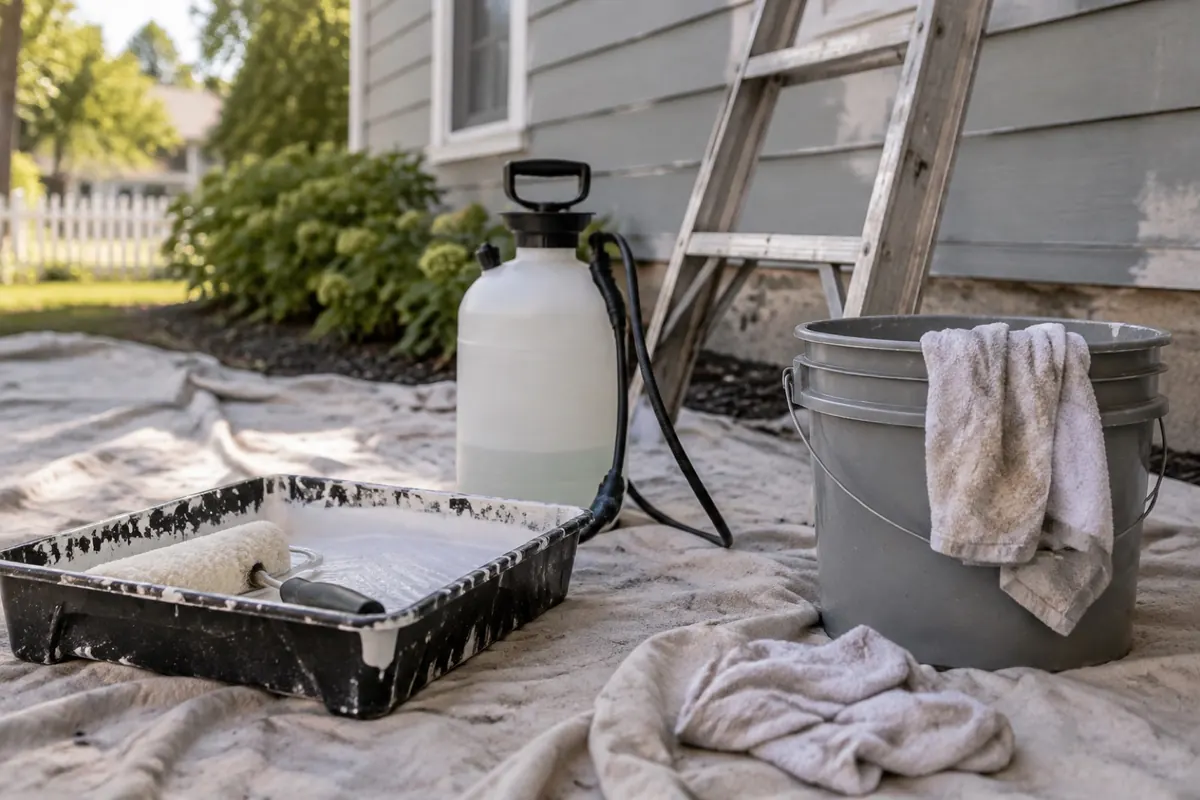
The most specific published painting method found is the UK HSE’s: repair the surface, wipe dust with a damp rag, paint preferably by low-pressure spray, never sand or rub down. It is not automatically cheap: Fixr reports encapsulation up to $6 a square foot against removal from $7.
The decision path
Seven questions, in order. Each one ends the decision or narrows it.
- Is work planned that touches the wall? If not, keep the siding intact and stop here.
- Is it asbestos-cement? If two or more clues fit, test a sample or presume it is ACM, as Oregon’s LRAPA allows on a single-material job.
- What condition is it in? Connecticut requires a licensed abatement contractor when shingles cannot come off mostly intact.
- What is the building? An owner-occupied single house sits outside the federal facility definition; rentals, multi-unit and commercial buildings usually do not.
- What does your agency require? Find the state programme on our asbestos accreditation map, then the local air agency.
- Is the cheaper finish legal there? Paint only by low-pressure methods; overclad only where fastening through transite is allowed.
- Budget from line items. Measured area, the disposal site’s fee and replacement cladding, priced separately.
Who may remove it, by jurisdiction
Because the NESHAP leaves most houses out, the agency that governs a re-siding job is usually a state health department or a regional air agency. Six published positions:
| Jurisdiction | Who it covers | Permission and notice | Handling and disposal |
|---|---|---|---|
| Federal (EPA NESHAP) | Excludes buildings of four or fewer units | 160 sq ft RACM; notice 10 working days ahead | Wet, seal leak-tight, label, approved landfill |
| Federal (OSHA) | Duties written for employers of the workers | Siding removal is Class II work | Amended water; cut nails with flat, sharp tools; lower panels |
| Washington (SWCAA) | Owner-occupied single-family homes | Owner or certified abatement contractor only | Two layers of 6 mil plastic; dispose within 10 calendar days |
| Oregon (LRAPA) | Accredited survey before renovation | Notification and fee for non-friable CAB | No overclad; permitted landfill; shipment form |
| Connecticut (DPH) | Homeowner may usually remove it | Licensed contractor if not removable mostly intact | Special waste; no more than 1 cubic foot in household trash |
| Minnesota (MDH) | Lists transite siding in homes | Strongly recommends a licensed contractor | Avoid breaking, sanding, cutting, drilling |
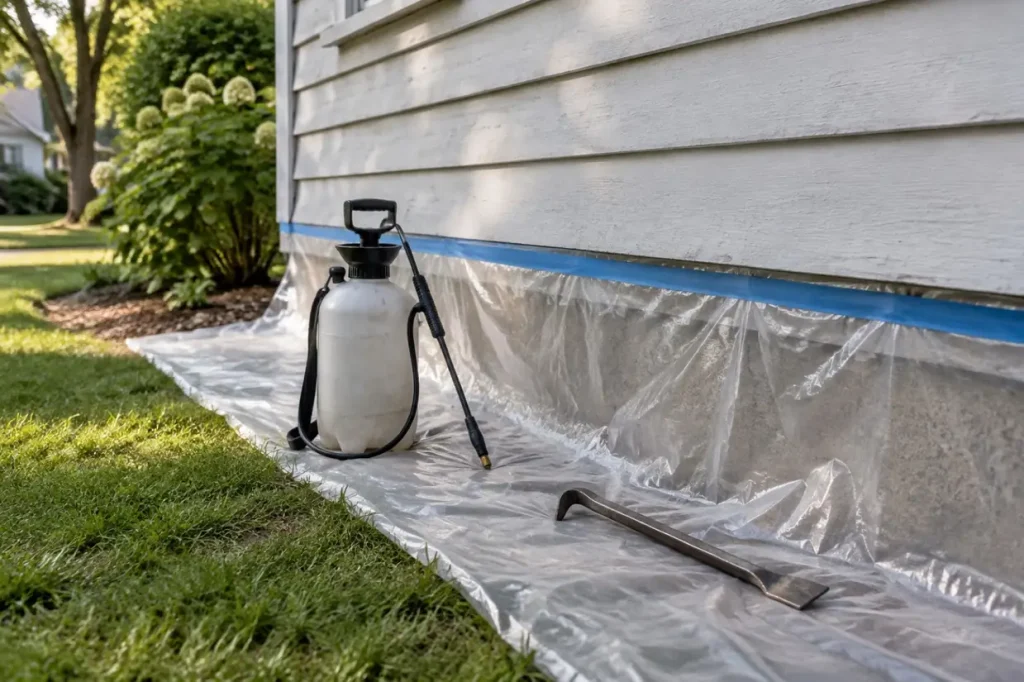
The Southwest Clean Air Agency guide is the fullest US agency homeowner procedure for this material: a 6-foot strip of 6 mil plastic at the wall base, hosing about 50 square feet at a time, pulling or cutting nails and lowering each wetted piece by hand, per the guide. It applies only to an owner-occupied single-family home.
Removal prices, by named source
Five consumer cost guides publish a figure. None names the contractors behind it, and they disagree, so they are shown with dates rather than averaged.
| Source | Updated | What is priced | Published figure |
|---|---|---|---|
| Fixr | August 2022 | Removal, per sq ft | $7 to $9 |
| Fixr | August 2022 | Example, 1,500 sq ft home | about $7,500 |
| HomeAdvisor siding guide | 20 June 2026 | Typical job | $708 to $5,696 (average $3,202) |
| HomeAdvisor siding guide | 20 June 2026 | Per sq ft | $8 |
| HomeAdvisor removal guide | 17 June 2026 | Siding, per sq ft | $3 to $15 |
| The Asbestos Institute | 8 January 2024 | Per sq ft | $7 to $10 |
| The Asbestos Institute | 8 January 2024 | 2,000 sq ft, with disposal | $14,000 to $20,000 |
| Bob Vila | 21 December 2023 | Siding, per sq ft | $7 to $9 |
| Computed here | 11 October 2026 | Fixr rate times 1,500 sq ft | $10,500 to $13,500 |
Two inconsistencies matter. According to Fixr, removal is $7 to $9 a square foot, yet its example puts a 1,500 square foot home at about $7,500; at its rate that area is $10,500 to $13,500. HomeAdvisor reports a typical job of $708 to $5,696 at $8 a square foot, implying about 88 to 712 square feet: a partial wall, not a house.
New cladding is a separate line: Fixr reports $7,500 to $22,500. For coverage questions, our page on whether insurance covers asbestos removal reads policy language; your policy and state insurance department have the final word.
For contractors
For restoration firms, siding usually arrives sideways: a storm-damaged wall, a fire elevation or a window opening cut through transite. Removal by employees is Class II asbestos work under OSHA, with cementitious siding practices in paragraph (g)(8)(iii). Scope it before demolition starts.
| Document or line item | Why the file needs it |
|---|---|
| Survey or test result before the wall is opened | LRAPA requires a survey on site; EPA’s 1993 letter makes left-in-place transite a demolition problem |
| Area by elevation, with condition notes | Sets whether the 160 sq ft line applies and whether pieces will come off intact |
| Method statement: wet, cut nails, lower, never drop | Mirrors OSHA 1926.1101(g)(8)(iii) |
| Notification copy, where required | LRAPA and covered NESHAP jobs |
| Waste manifest and landfill ticket | SWCAA requires a manifest; Connecticut treats it as special waste |
| Separate lines: removal, disposal, new cladding | What an adjuster compares against published figures |
An adjuster typically asks for the test result, measured area, method and disposal receipt. Our asbestos removal cost guide covers abatement pricing more broadly, and the standards hub collects the rules used here.
Questions people actually ask
Is it okay to live in a house with asbestos siding?
Agency guidance treats intact siding as low concern. Minnesota’s health department says asbestos cement siding that is intact and in good condition is generally considered nonfriable and not hazardous, and the Southwest Clean Air Agency says it will not release fibres unless disturbed. The concern comes from breaking, drilling, sanding or pressure-washing it, so plan any wall work around it.
How can you tell if siding has asbestos?
Look for rigid, brittle cement shingles on a house clad before the mid-1980s, with nails in a row near the lower edge, a pressed wood grain or rough face, and straight or diamond courses. Those clues only raise suspicion. A laboratory test of a small wetted sample confirms it, or you can presume the material is asbestos and follow the handling rules.
Is it worth removing asbestos siding?
Often not, unless work forces it. The Southwest Clean Air Agency calls leaving it alone possibly the safest, easiest and least expensive option, and Connecticut does not require removal unless a renovation or demolition puts the shingles in the way. Removal makes sense when the wall must be opened, the shingles are failing, or a demolition is planned.
Can you still get asbestos siding?
Not as a new US product. The National Park Service says asbestos-cement shingles and siding were produced into the 1980s, and EPA’s 1994 roofing manual describes A/C shingles as no longer manufactured in the US. Salvaged pieces still circulate. US law never simply banned the material; our page on when asbestos was banned explains why.
Can you paint asbestos siding?
Yes, with care. EPA lists sealing as a recognised repair, and the UK Health and Safety Executive’s sheet a16 sets the method: repair the surface, wipe dust with a damp rag, paint preferably by low-pressure spray, and never sand or rub down. Do not pressure-wash first; Western Australia prohibits high-pressure water on asbestos cement.
Can you put new siding over asbestos siding?
It depends on your agency. HomeAdvisor’s guide says covering is safe when an asbestos professional takes precautions, but Lane Regional Air Protection Agency in Oregon does not allow new siding over cement asbestos board because installation renders it friable. Fasteners pass through or between shingles, so check local rules before quoting an overclad.
Sources
- 40 CFR 61.141, 40 CFR 61.145 and 40 CFR 61.150, asbestos NESHAP, eCFR text via Cornell LII. Retrieved 11 October 2026.
- OSHA 29 CFR 1926.1101, Class II definition and (g)(8)(iii). Retrieved 11 October 2026.
- EPA roofing guidance manual (EPA-340/B-94-001), US EPA, August 1994. Retrieved 11 October 2026.
- EPA transite siding guidance page (updated 12 November 2025) and EPA letter of 14 January 1993 to J. Dufour, US EPA. Retrieved 11 October 2026.
- EPA homeowner asbestos guidance (updated 25 June 2026) and EPA's history of its asbestos actions (updated 21 January 2026), US EPA. Retrieved 11 October 2026.
- National Park Service roofing history (asbestos-cement), Technical Preservation Services, copy hosted by the City of Detroit. Retrieved 11 October 2026.
- Southwest Clean Air Agency siding guide, December 2007. Retrieved 11 October 2026.
- Lane Regional Air Protection Agency fact sheet, updated 4 March 2025. Retrieved 11 October 2026.
- Connecticut DPH siding fact sheet, April 2022. Retrieved 11 October 2026.
- Minnesota Department of Health, Roofing and Siding Asbestos, updated 22 May 2025. Retrieved 11 October 2026.
- UK HSE sheet a16, Painting asbestos cement products. Retrieved 11 October 2026.
- WorkSafe WA safety alert 12/2018, 9 November 2018. Retrieved 11 October 2026.
- James Hardie safety data sheet, James Hardie Building Products, issued 1 June 2015. Retrieved 11 October 2026.
- Fixr (August 2022), HomeAdvisor's asbestos siding guide (20 June 2026), HomeAdvisor's asbestos removal guide (17 June 2026), The Asbestos Institute (8 January 2024), Bob Vila (21 December 2023). Retrieved 11 October 2026.
- Out-of-scope pointers: EPA's Learn About Asbestos page and CDC's ATSDR asbestos pages.
- Computed figures are arithmetic on the published numbers above. Our methodology sets out the standing rules.
Rules differ by state, county and air district, and they change. Confirm requirements with your state asbestos programme or local air agency, and get written quotes rather than relying on guide averages.