The short answer
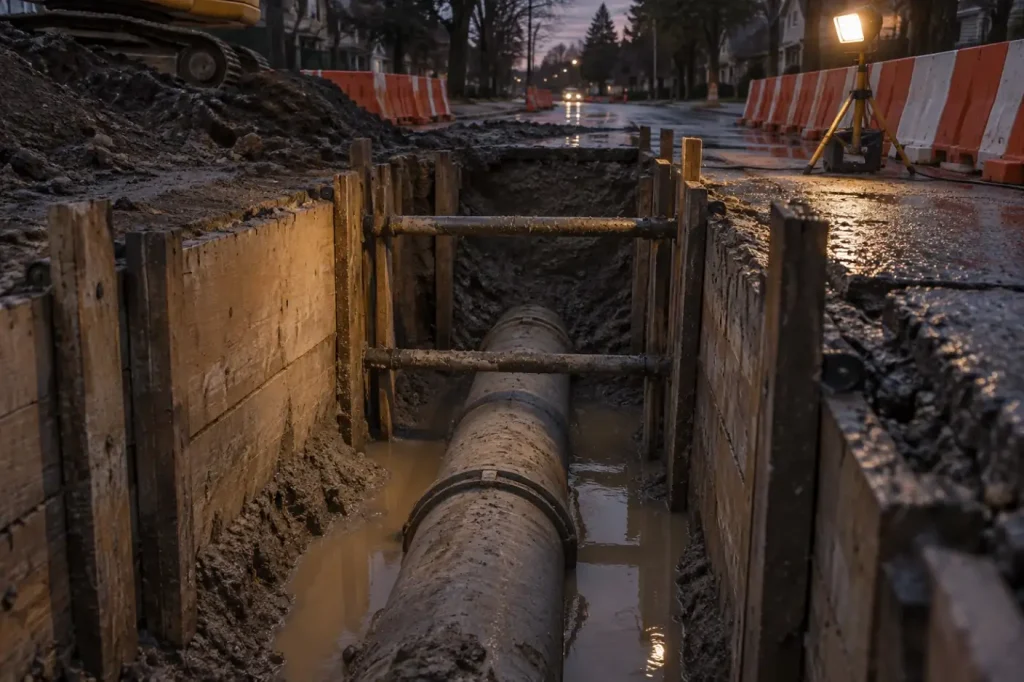
Asbestos cement pipe, also called transite or A/C pipe, is a cement pipe reinforced with asbestos fibre, used for water mains, sewers, storm drains and flues. EPA estimates it is about 15 percent of North American water mains. Intact, it is Category II nonfriable material; once crushed, burst or broken it becomes regulated asbestos-containing material with strict cutting and disposal rules.
Key takeaways
- EPA’s 2022 memo puts A/C pipe at about 15 percent, roughly 600,000 miles, of North American water main, mostly laid 1940 to 1980.
- EPA says pipe bursting and pipe breaking render A/C pipe friable and do not comply with the asbestos NESHAP.
- Approved routes: open trench, close tolerance pipe slurrification (approved 30 May 2019) and abandonment in place.
- OSHA calls A/C pipe removal Class II work; a repair that fits in one glove bag or waste bag can be Class III.
- Abrasive disc saws without point of cut ventilation or HEPA exhaust, compressed air and dry sweeping are banned at any exposure under 29 CFR 1926.1101(g)(3).
- The drinking water MCL is 7 million fibres per litre longer than 10 micrometres.
On this page
What this page does not cover. Health effects, including cancer, mesothelioma, asbestosis, lung disease, symptoms and diagnosis, are outside its scope; see EPA's Learn About Asbestos page.
What A/C pipe is and how much is still buried
EPA's 13 April 2022 memorandum on AC pipe replacement describes AC pipe, also known as transite pipe, as a popular choice for potable water, sanitary sewer and storm drain lines in the mid-1900s. The Minnesota Department of Health product list lists cement-asbestos board (Transite) products including pipes, ducts and chimney flue lining, which is where it turns up inside buildings. Searches for asbestos concrete pipe and concrete asbestos pipe mean the same product, although EPA lists plain concrete as a separate pipe material.
| Measure | Figure | Source and date |
|---|---|---|
| Share of water mains | About 15% (about 600,000 miles), North America | EPA memo, 13 April 2022 |
| Miles installed | More than 600,000 miles in the United States | Montana DEQ, undated |
| Installation era | Majority laid 1940 to 1980 | EPA memo, 2022 |
| Installation era | From the 1930s, peak 1950s and 1960s | EPA Region 8, 2024 |
| Typical life | 50 years | EPA memo 2022; EPA Region 8 2024 |
| Typical life | 50 to 75 years | Montana DEQ, undated |
EPA's April 2018 notice (83 FR 18042) explains the replacement wave: as A/C pipe ages, its cementitious bonds weaken from water pH, suspended particulate, acidic sewer gases and sandy soil scrubbing the outside. Per EPA Region 8's November 2024 drinking water newsletter, EPA tried to ban asbestos products in 1989, the rule was overturned, and a 2019 Significant New Use Rule now requires EPA review before discontinued uses, including asbestos cement pipe and fittings, return. More on our when asbestos was banned page.
Identifying transite pipe
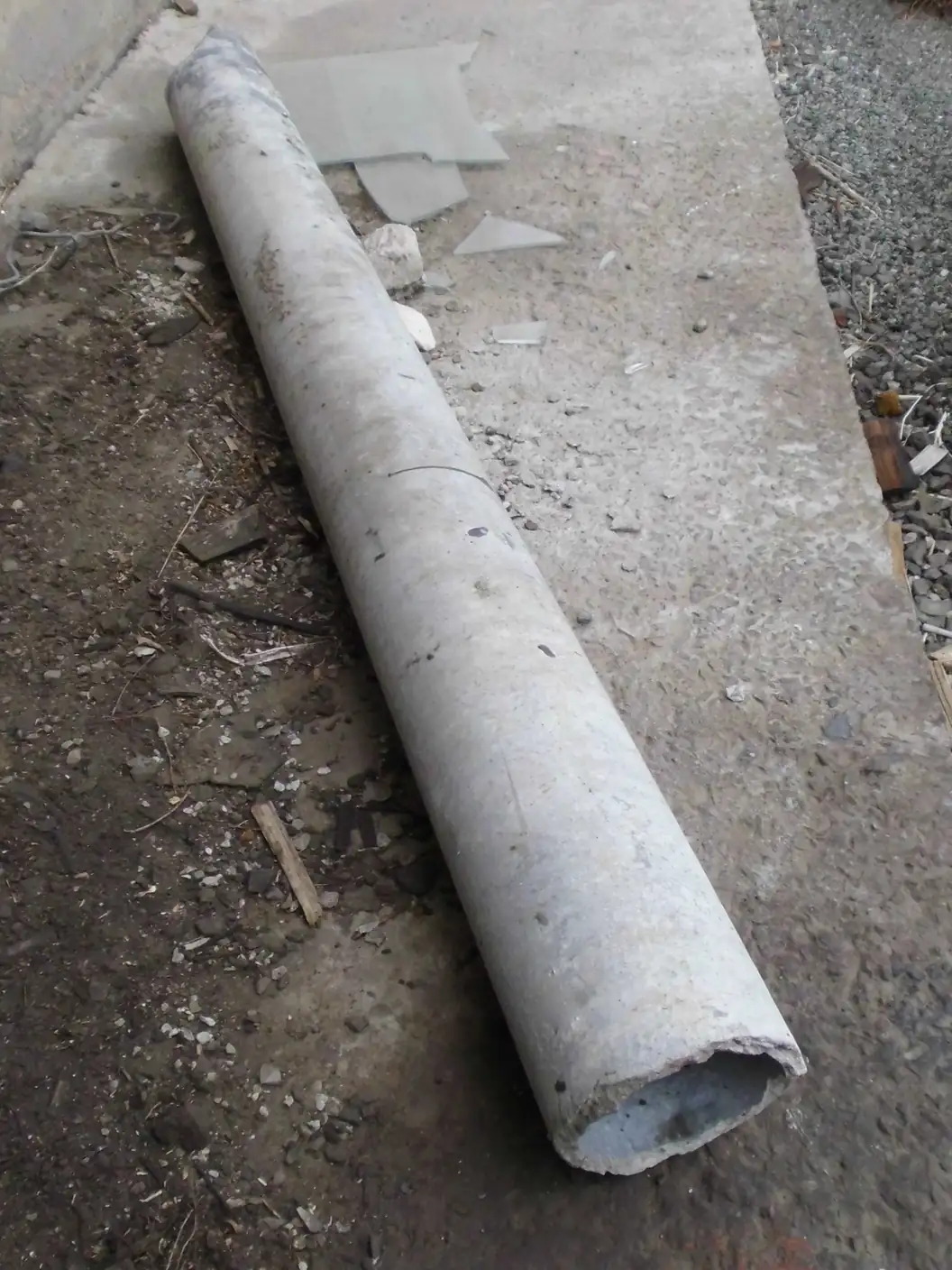
How to identify asbestos cement pipes starts with paperwork, not a hammer. EPA's June 2019 final approval (84 FR 26852) says A/C pipe is readily distinguishable from the few other pipe types used for water, and utilities locate it by records and camera inspection. On private property the proof is a lab result: 40 CFR 61.141 defines asbestos-containing material by polarized light microscopy at more than 1 percent.

| Clue | What it shows | What it is worth |
|---|---|---|
| Utility records | Pipe material on record; EPA says owners check camera inspections against them | Fastest answer for mains |
| Install date | Majority laid 1940 to 1980 (EPA, 2022) | Narrows the odds; not proof |
| Use | Water, sewer, storm drain (EPA); flue lining and ducts (MDH) | Tells you where to look |
| Material family | Cementitious, not clay, iron, PVC or plain concrete (EPA, 2018) | Plain concrete looks similar |
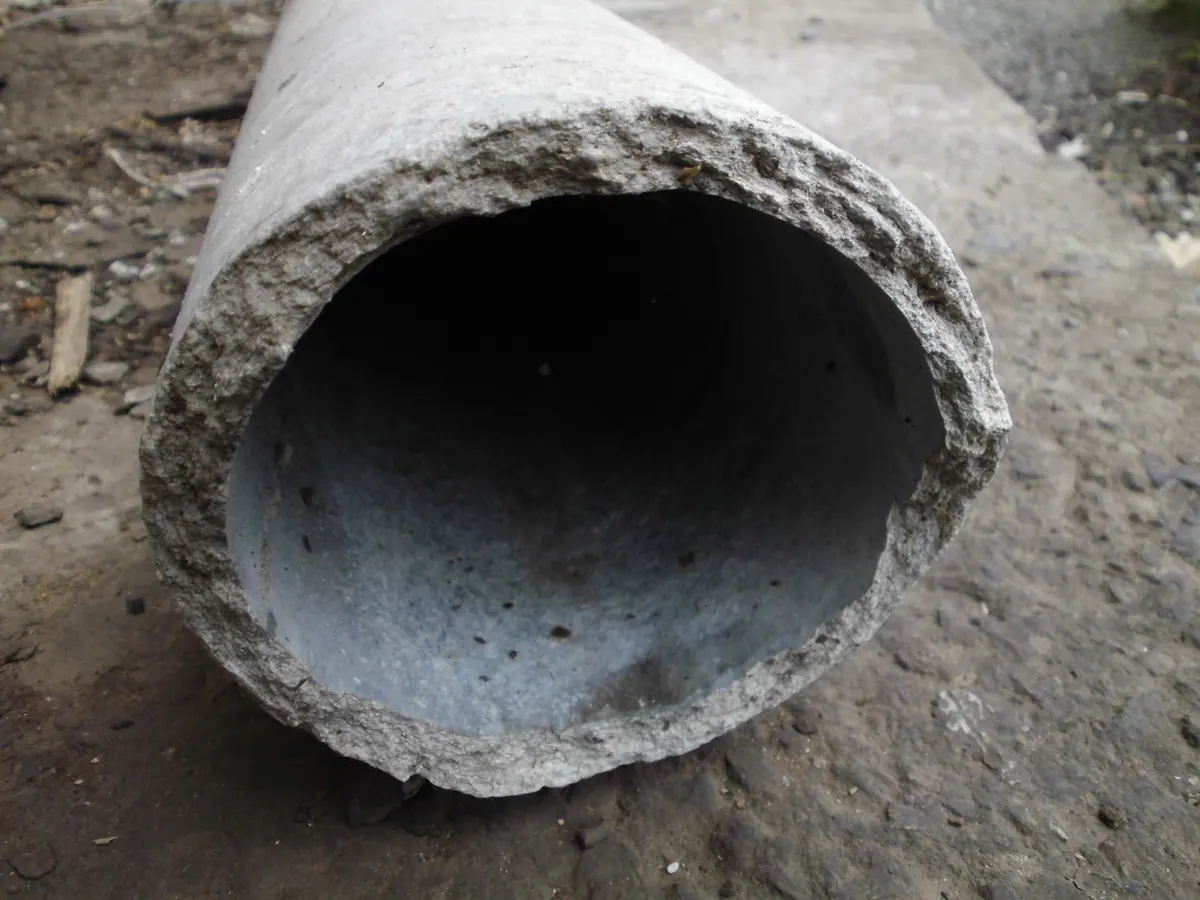
| Condition | Old pipe in poor condition may behave like wet cardboard (EPA, 2018) | Signals friability |
| Lab analysis | PLM per 40 CFR 61.141; more than 1% is ACM | The only confirmation |

Asbestos lagging wrapped around heating pipes is a different, friable material: see our asbestos pipe insulation page.
NESHAP status: Category II until it is not
40 CFR 61.141 defines Category II nonfriable ACM as material, other than Category I, with more than 1 percent asbestos that cannot be crumbled, pulverized or reduced to powder by hand pressure when dry. Intact A/C pipe sits there. It becomes regulated asbestos-containing material, RACM, when it has a high probability of becoming, or has become, crumbled, pulverized or reduced to powder by the forces expected in the work. The general vocabulary is on our asbestos-containing material page.
EPA's April 2018 notice (83 FR 18042) applies that to pipe: good pipe becomes RACM if the work is likely to crumble it, and most pipe municipalities replace is likely friable already. Pipe removal is a renovation, not a demolition. The work practices apply at 260 linear feet of RACM in a calendar year under 40 CFR 61.145(a)(4), and EPA's June 2019 final approval (84 FR 26852) warns that projects may not be split to stay under it.
| Situation | NESHAP status | Consequence |
|---|---|---|
| Intact pipe left alone | Category II nonfriable ACM | Not RACM; no work practices |
| Abandoned in place, new line elsewhere | Not subject to the NESHAP | Subject if later acted on so as to create RACM |
| Open trench, wet snap cuts, sections whole | Conforms to the rule | Renovation; notify above the threshold |
| Poor condition, or crushed, burst or broken by equipment | RACM | Full 61.145 and 61.150 duties |
| RACM left in the ground | Waste disposal site | 61.154 and 61.151 standards |
States can be far stricter: Montana DEQ's pipe bursting brochure requires permitting, fees, accredited workers, clearance and a licensed landfill once 3 linear feet is rendered regulated. The federal framework is on our sibling page on asbestos regulations.
Pipe bursting and other trenchless methods
EPA’s position is plainest in EPA's 13 April 2022 memorandum on AC pipe replacement. Pipe bursting pulls an expansion head through the old pipe, pushing it outward until it breaks; pipe breaking does the same in strips. The memo says both render the existing pipe friable and do not comply with the asbestos NESHAP, and that broken pieces can rise to the surface through soil migration, erosion and frost heaving. EPA Region 8's November 2024 drinking water newsletter repeated in 2024 that bursting is not permitted.
EPA's June 2019 final approval (84 FR 26852) gives the mechanics. No approval is needed for a method that meets the rule, but EPA has approved neither pipe bursting nor pipe reaming, and a bursting project above the RACM threshold must meet the active waste disposal site standard in 61.154, plus the inactive site standard in 61.151 if RACM stays in the ground; EPA's April 2018 notice (83 FR 18042) notes inactive sites carry deed notation duties. The approved trenchless route is close tolerance pipe slurrification: the pipe is ground into a wet slurry and vacuumed out, leaving a nonfriable skim coat on the new pipe.
On dates: industry writing often cites a 2012 EPA statement on bursting. This page relies on the 2018, 2019, 2022 and 2024 EPA documents above and on the July 1991 determination as cited by Michigan EGLE's January 2025 bulletin. All point the same way.
OSHA rules for cutting A/C pipe
OSHA's 29 May 2007 letter on AC water pipe answered a Louisiana attorney’s question about a public utility tapping and tying in to asbestos cement water pipe. Removal is normally Class II work because it removes ACM that is not thermal system insulation or surfacing material. Repair that removes no more than one glove bag or waste bag could be Class III. Where the class is unclear, assume the higher one.
| Situation | Rule | Source |
|---|---|---|
| Removal of A/C pipe | Normally Class II work | OSHA letter, 2007 |
| Repair removing no more than one glove bag or waste bag | Can be Class III | OSHA letter, 2007 |
| Unclear class | Assume the higher class | OSHA letter, 2007 |
| Any exposure level | No high-speed abrasive disc saws without point of cut ventilator or HEPA enclosure; no compressed air; no dry sweeping; no employee rotation | 1926.1101(g)(3) |
| Class II removal | Wet with amended water; remove intact; no cutting, abrading or breaking unless less-release methods are not feasible; bag or keep wet by end of shift | 1926.1101(g)(8)(v) |
| All operations | HEPA vacuums, wet methods, prompt cleanup | 1926.1101(g)(1) |
| Exposure limits | 0.1 f/cc 8-hour TWA; 1.0 f/cc over 30 minutes | 1926.1101(c) |
Snap cutters, wet cuts and the AWWA manual
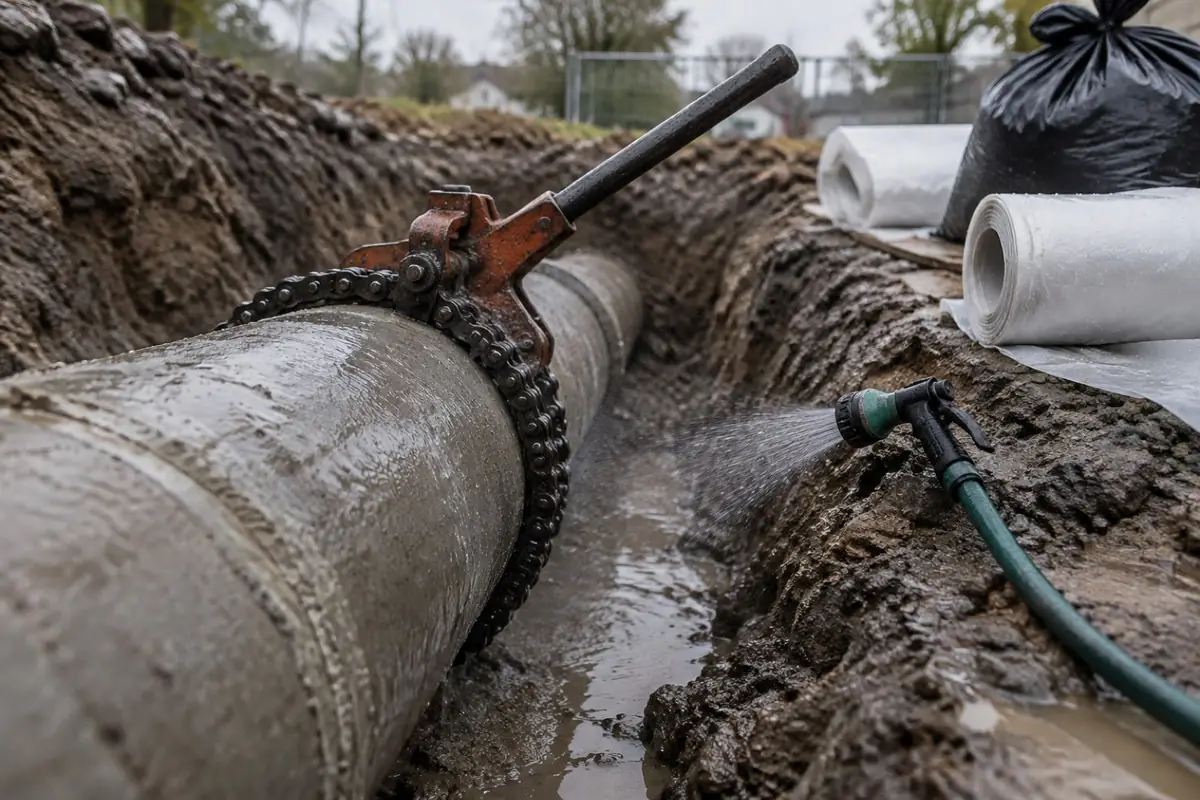
EPA's April 2018 notice (83 FR 18042) describes the open trench cut: a cutter is clamped around the pipe and scored while water is applied, the pipe is snapped, and the cut repeats to make 6 to 8 foot sections wrapped in plastic. That fits OSHA’s preference for intact removal. OSHA’s 2007 letter called the American Water Works Association work practices generally compliant, but rejected a consultant’s claim that work below the exposure limit is exempt.
Asbestos in drinking water from A/C mains
40 CFR 141.62 sets the limit at 7 million fibres per litre, counting fibres longer than 10 micrometres, and EPA's drinking water contaminant table lists the common sources as decay of asbestos cement in water mains and erosion of natural deposits. 40 CFR 141.23 builds A/C pipe into monitoring: a system vulnerable through A/C pipe corrosion samples at a tap served by it.
| Item | Rule | Citation |
|---|---|---|
| Maximum contaminant level | 7 million fibres per litre, fibres longer than 10 micrometres | 40 CFR 141.62(b) |
| Who it binds | Community and non-transient non-community water systems | 40 CFR 141.62(b) |
| Routine monitoring | Once in the first three-year period of each nine-year cycle, from 1 January 1993 | 40 CFR 141.23(b)(1) |
| Waiver factors | Source water and use of A/C pipe with corrosive water | 40 CFR 141.23(b)(3) |
| Where to sample if A/C pipe is the risk | A tap served by A/C pipe, when contamination is most likely | 40 CFR 141.23(b)(5) |
| After an exceedance | Quarterly monitoring | 40 CFR 141.23(b)(8) |
These rules bind the water system. For a specific tap, ask the utility for its latest asbestos result or waiver.
Disposal of A/C pipe
Disposal follows the NESHAP status. Under 40 CFR 61.150(a)(5), Category II waste that did not become crumbled, pulverized or reduced to powder is outside the wetting, sealing and labelling rules. Anything that crossed into RACM goes, wet and sealed, to a site operated under 61.154. Landfills and states set their own acceptance rules, so confirm before loading.
| Waste | Rule | Source |
|---|---|---|
| Intact Category II waste, not crumbled | Outside the 61.150(a) wetting, sealing and labelling rules | 40 CFR 61.150(a)(5) |
| RACM waste | Wet, sealed while wet in leak-tight containers or wrapping, OSHA labels, generator name and site on off-site loads | 40 CFR 61.150(a)(1) |
| Where it goes | A site run under 61.154, as soon as practical | 40 CFR 61.150(b) |
| CTPS slurry | Leak-tight containers to a 61.154 landfill; never fill or cover | 84 FR 26852 |
| Montana, regulated pipe | Licensed Class II or IV landfill | Montana DEQ |
Repairing a break in an A/C water line
A main break is usually the utility’s job. 40 CFR 61.141 defines an emergency renovation as unplanned work caused by a sudden, unexpected event, including nonroutine equipment failures. Under 40 CFR 61.145 the RACM amount is estimated from that event, and a covered emergency renovation is notified no later than the following working day; utilities predict routine nonscheduled repairs as a calendar year total. On the pipe, a repair that fits in one bag may be Class III, wet methods and HEPA cleanup apply regardless, and pipe shattered at the break is the material the NESHAP calls RACM.
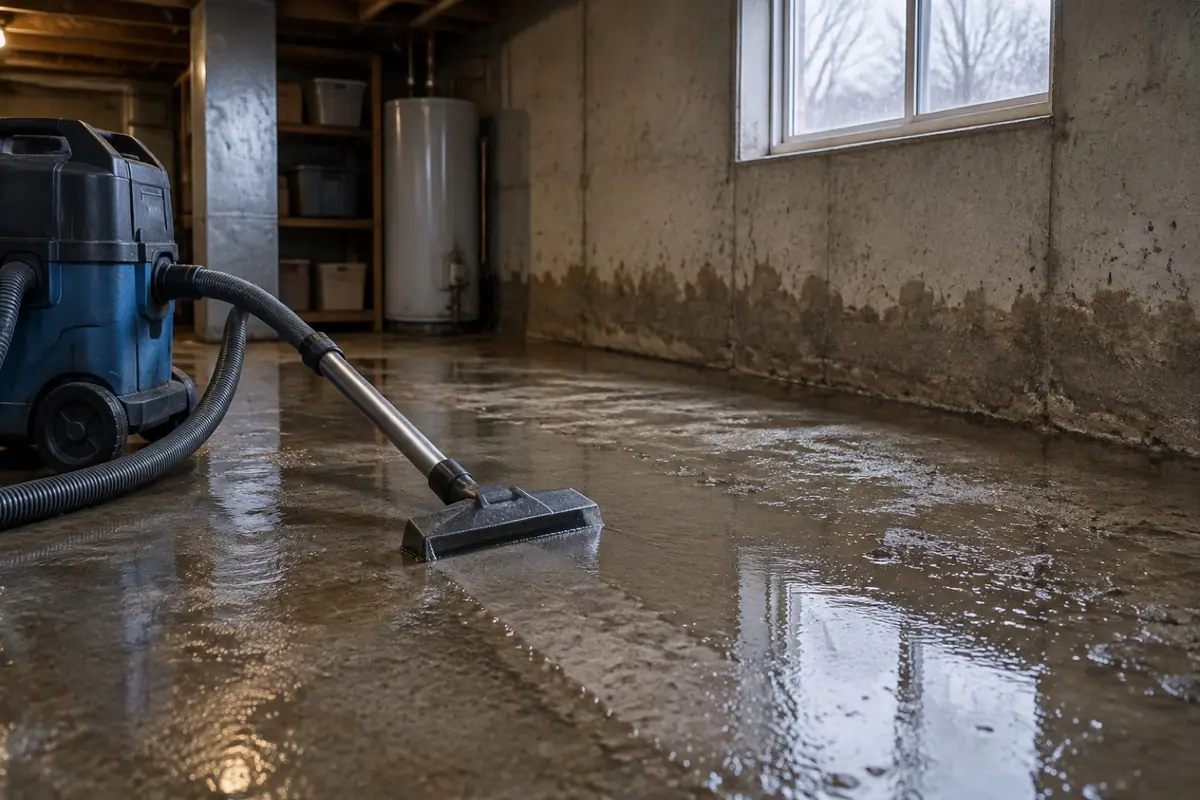
When a broken A/C line floods a building
For the restoration contractor, a transite break is a water loss with an asbestos footnote. OSHA’s standard covers asbestos spill and emergency cleanup under 29 CFR 1926.1101(a)(5), and OSHA's 14 November 2024 letter confirmed that property remediation involving asbestos-containing material falls under the construction standard, quoting its appendix that asbestos cement pipe can emit fibres if cut, sawed or broken. The path below keeps the two jobs apart.
- Find out whose pipe it is. A street main break is the utility’s excavation; the restoration job starts at the foundation.
- Document the source. Photograph the break, the trench and any utility markings before work starts.
- Treat fragments as suspect. Do not dry sweep, shovel dry or break cement pipe pieces washed inside; OSHA’s (g)(3) ban on dry cleanup applies to debris containing ACM.
- Separate the scopes. Extraction and drying are the restoration job; collecting pipe debris is work for a trained asbestos crew.
- Categorise the water. Excavation silt changes the water’s character; classify it under the IICRC framework.
- Write it up. Separate line items for water work and any asbestos debris handling, with photos and the utility’s work order number.
Water category is covered on our IICRC water categories page, and plumbing failures inside the house on burst pipe repair. Coverage is set by the policy wording: point the owner to the policy, the state insurance department and a licensed professional.
For contractors: what the adjuster will ask
Expect three questions: where the water came from, whether asbestos material entered the building, and who handled it. The file should hold the utility’s work order, dated photos of the trench and any fragments, the asbestos crew’s disposal receipt, and moisture logs. Cement siding, the other common transite product, is on our asbestos siding page.
Questions people actually ask
How do you identify asbestos cement pipe?
Start with the utility’s pipe records; EPA says most AC water pipe was laid between 1940 and 1980. It is a cementitious pipe, but plain concrete pipe looks similar, so appearance is only a clue. Confirmation is a lab result by polarized light microscopy showing more than 1 percent asbestos, the definition in 40 CFR 61.141.
Are asbestos cement pipes safe?
Intact A/C pipe is Category II nonfriable material under the asbestos NESHAP, and EPA limits asbestos in drinking water to 7 million fibres per litre. Cutting, crushing or breaking changes that: OSHA notes the pipe can then emit fibres, and EPA treats crushed pipe as regulated asbestos. Health questions are outside this page; see EPA’s asbestos pages.
When was asbestos cement pipe banned in the USA?
It was not banned outright. EPA Region 8 notes that EPA’s 1989 attempt to ban asbestos products was overturned, and that a 2019 Significant New Use Rule requires EPA review before discontinued uses, including asbestos cement pipe and fittings, re-enter the market. The same newsletter says use was largely discontinued by the end of the last century.
What was asbestos cement pipe used for?
Potable water mains, sanitary sewers and storm drains, according to EPA’s 2022 memorandum, which calls it a popular choice in the mid-1900s. The Minnesota Department of Health also lists Transite pipes, ducts and chimney flue lining, which is how it appears inside buildings as vent and flue pipe.
Is asbestos cement pipe still in use?
Yes. EPA’s 2022 memo puts it at about 15 percent, roughly 600,000 miles, of North American water main, with a typical 50-year life that much of it has passed or is nearing. That is why EPA approved close tolerance pipe slurrification in 2019 as a trenchless way to replace it.
Can pipe bursting be used on transite pipe?
Not under EPA’s reading of the asbestos NESHAP. EPA’s 13 April 2022 memorandum says pipe bursting and pipe breaking render A/C pipe friable and do not comply, and EPA Region 8 repeated in 2024 that bursting is not permitted. The approved options are open trench, abandonment in place and CTPS.
Sources
- EPA's 13 April 2022 memorandum on AC pipe replacement, U.S. EPA OAQPS, hosted by Florida DEP. Retrieved 18 October 2026.
- EPA's April 2018 notice (83 FR 18042) and EPA's June 2019 final approval (84 FR 26852), EPA alternative work practice notices for asbestos cement pipe replacement. Retrieved 18 October 2026.
- EPA Region 8's November 2024 drinking water newsletter. Retrieved 18 October 2026.
- OSHA's 29 May 2007 letter on AC water pipe, OSHA, corrected 5 January 2012. Retrieved 18 October 2026.
- OSHA's 14 November 2024 letter, OSHA. Retrieved 18 October 2026.
- 29 CFR 1926.1101, via eCFR. Retrieved 18 October 2026.
- 40 CFR 61.141, 40 CFR 61.145 and 40 CFR 61.150, asbestos NESHAP, via eCFR. Retrieved 18 October 2026.
- 40 CFR 141.62 and 40 CFR 141.23, via eCFR, with EPA's drinking water contaminant table. Retrieved 18 October 2026.
- Montana DEQ's pipe bursting brochure, undated. Retrieved 18 October 2026.
- Michigan EGLE's January 2025 bulletin, 21 January 2025. Retrieved 18 October 2026.
- Minnesota Department of Health product list, updated 18 December 2025. Retrieved 18 October 2026.
- EPA's Learn About Asbestos page. Retrieved 18 October 2026.
- Method: methodology. Hub: standards.
A summary of federal and selected state rules, not legal advice. The state asbestos programme, the water utility and a competent person decide how they apply to a job.