The short answer
Asbestos containing material (ACM) is any material containing more than 1 percent asbestos. OSHA, EPA’s AHERA school rule and the asbestos NESHAP all use that line. Around it sit related terms: presumed asbestos-containing material for insulation and surfacing in buildings from 1980 or earlier, friable and nonfriable, NESHAP Category I and II, and regulated material, each with its own duties.
Key takeaways
- ACM means more than 1 percent asbestos. Exactly 1 percent is not ACM under any of the three federal definitions.
- PACM is an OSHA presumption, not a lab result: thermal system insulation and surfacing material in buildings constructed no later than 1980.
- Assumed is an inspector’s choice under AHERA; presumed is imposed by OSHA. Both end with sampling.
- NESHAP sorts nonfriable ACM into Category I and II, and both become regulated material once sanded, ground, cut or crumbled in the work.
- The OSHA work class follows the material: removing TSI or surfacing is Class I, removing other ACM is Class II.
- Below 10 percent by visual estimate, NESHAP requires point counting to confirm friable material.
On this page
Most pages ranking for this term are product lists. Lists help, but contractors and owners trip over the definitions: whether a material is ACM, PACM or RACM decides who may touch it and what paperwork follows. This page quotes each term from the regulation that creates it. For what suspect materials look like, see our identification guide.
What this page does not cover. It quotes legal definitions, not health information; for that, see the EPA Learn About Asbestos page.
The 1 percent line, and who draws it
OSHA’s construction standard, 29 CFR 1926.1101(b), defines asbestos-containing material (ACM) as any material containing more than one percent asbestos, and 29 CFR 1910.1001 uses the same words for general industry. AHERA’s 40 CFR 763.83 applies the same test to school buildings. The NESHAP definitions in 40 CFR 61.141 attach a method: more than 1 percent as determined by polarized light microscopy under Appendix E to Subpart E of Part 763. In ACM asbestos shorthand on a survey or lab report, that one line is the whole definition.
NESHAP adds a second test, per the 40 CFR 61.141 text: if friable material measures less than 10 percent by a method other than point counting, verify it by point counting. The reason is precision. A visual estimate near the line can fall either side of it, and point counting resolves smaller fractions.
The EMSL Analytical price guide shows what that buys: a calibrated visual estimate reports to below 1 percent, a 400 point count to below 0.25 percent and a 1,200 point count to below 0.08 percent, with price rising for each.
The definitions, quoted
Each term below is quoted from the regulation that defines it. Where the same word appears in two rules, both are shown, because they are not always identical.
| Term | Rule | Exact text | Plain reading |
|---|---|---|---|
| Asbestos | OSHA 1926.1101(b) | “chrysotile, amosite, crocidolite, tremolite asbestos, anthophyllite asbestos, actinolite asbestos, and any of these minerals that has been chemically treated and/or altered” | Six minerals, and OSHA adds that asbestos includes PACM. |
| ACM | OSHA 1926.1101(b) | “any material containing more than one percent asbestos” | The core definition. |
| ACM (schools) | AHERA 763.83 | “any material or product which contains more than 1 percent asbestos” | Same line, for schools. |
| ACBM | AHERA 763.83 | “surfacing ACM, thermal system insulation ACM, or miscellaneous ACM that is found in or on interior structural members or other parts of a school building” | ACM that is part of the building. |
| PACM | OSHA 1926.1101(b) | “thermal system insulation and surfacing material found in buildings constructed no later than 1980” | Presumed by date, until rebutted. |
| Surfacing material | OSHA 1926.1101(b) | “material that is sprayed, troweled-on or otherwise applied to surfaces” | Acoustical plaster, fireproofing. |
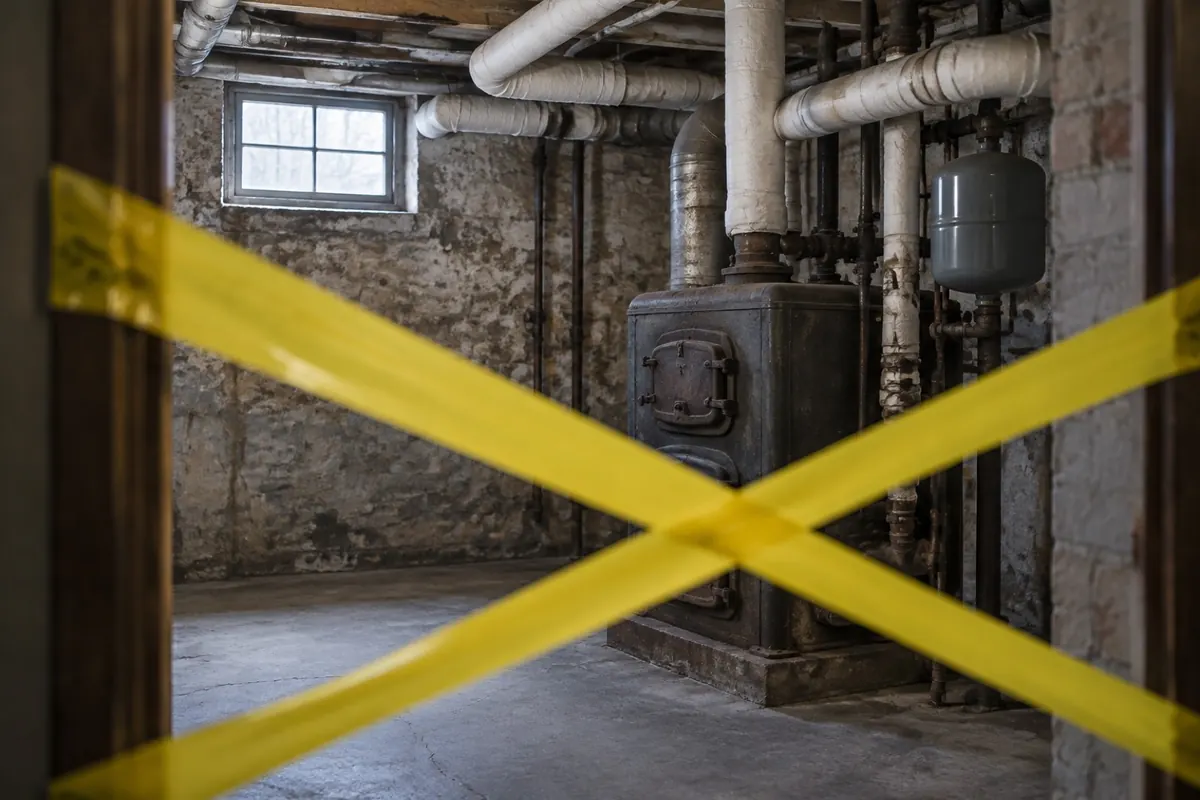
| TSI | OSHA 1926.1101(b) | “ACM applied to pipes, fittings, boilers, breeching, tanks, ducts or other structural components to prevent heat loss or gain” | Insulation on hot or cold systems. |
| Miscellaneous material | AHERA 763.83 | “interior building material on structural components, structural members or fixtures, such as floor and ceiling tiles” | Everything not surfacing or TSI. |
| Homogeneous area | AHERA 763.83 | “uniform in color and texture” | The unit sampled and reported. |
The NESHAP names the same minerals by species: the asbestiform varieties of serpentinite (chrysotile), riebeckite (crocidolite), cummingtonite-grunerite, anthophyllite and actinolite-tremolite. The minerals themselves are covered on our types of asbestos page.
Friable, Category I, Category II and RACM
Friability is a hand test written into law. AHERA’s 40 CFR 763.83 calls material friable if, when dry, it may be crumbled, pulverized or reduced to powder by hand pressure, and includes previously nonfriable material once damaged to that point. 40 CFR 763.85(c) adds that thermal system insulation with an intact jacket is treated as nonfriable. The NESHAP splits nonfriable material into two categories and then defines what it actually regulates.
| NESHAP term | Exact text, 40 CFR 61.141 | When removal before demolition is not required |
|---|---|---|
| Category I nonfriable ACM | “asbestos-containing packings, gaskets, resilient floor covering, and asphalt roofing products containing more than 1 percent asbestos” | When it is not in poor condition and not friable. |
| Category II nonfriable ACM | “any material, excluding Category I nonfriable ACM, containing more than 1 percent asbestos … that, when dry, cannot be crumbled, pulverized, or reduced to powder by hand pressure” | When the probability is low it will crumble in demolition. |
| RACM | Friable asbestos material; Category I that has become friable or will be sanded, ground, cut or abraded; Category II likely to crumble in the work. | Must be removed first, unless encased in concrete or unsafe to reach, per 61.145(c)(1). |
RACM matters because the NESHAP thresholds count it. Per the 40 CFR 61.145 text, full requirements apply at 260 linear feet on pipes, 160 square feet on other components or 35 cubic feet off components.
TSI, surfacing material and the OSHA work classes
OSHA’s 29 CFR 1926.1101 sorts asbestos work by what is disturbed, and the first sort is whether the material is TSI or surfacing.
| OSHA class | Definition, 1926.1101(b) | Typical materials |
|---|---|---|
| Class I | Removal of TSI and surfacing ACM and PACM. | Pipe and boiler lagging, sprayed fireproofing. |
| Class II | Removal of ACM which is not TSI or surfacing material. | Wallboard, floor tile and sheeting, roofing and siding shingles, construction mastics, as the rule lists. |
| Class III | Repair and maintenance where ACM, including TSI and surfacing ACM and PACM, is likely to be disturbed. | Cutting into a wall to reach a valve. |
| Class IV | Maintenance and custodial activities contacting but not disturbing ACM or PACM, and cleanup of debris. | Cleaning above a ceiling with known ACM. |
Pipe lagging and popcorn texture are the two TSI and surfacing materials homeowners meet most; our pages on asbestos pipe insulation and popcorn ceiling asbestos cover them.
Presumed asbestos containing material versus assumed
Presumed is OSHA’s word. 29 CFR 1926.1101(k)(1)(i) says employers and building owners shall identify TSI and sprayed or troweled on surfacing materials as asbestos-containing unless they rebut it, that asphalt and vinyl flooring installed no later than 1980 must also be considered asbestos-containing, and that owners who knew, or should have known through due diligence, about other ACM must treat it as such.
Assumed is an inspector’s choice. Under 40 CFR 763.85(a)(4)(iv) an accredited inspector may assume some or all homogeneous areas are ACM and sample the rest. New York uses the word too: the New York Department of Labor homeowner notice lists white pipe wrap, 9 inch tiles, Transite siding and vermiculite as assumed from history.
| Status | Who decides | Basis | How it ends |
|---|---|---|---|
| Presumed (PACM) | OSHA, by rule | Material type plus a 1980 or earlier date | Rebuttal under 1926.1101(k)(5) |
| Assumed | The inspector or owner | A choice to skip sampling | Sampling and PLM analysis |
| Suspect | Inspector, on site | Material type and appearance | Assumed or sampled |
| Known ACM | The lab | One sample over 1 percent | Removal; status stays |
Which rule applies: the decision table
Find the row that matches the building and who is doing the work. More than one rule often applies at once.
| Situation | OSHA | NESHAP | AHERA | State or local |
|---|---|---|---|---|
| K to 12 school building, any work | Yes, for workers | Yes, for renovation or demolition | Yes: inspection and plan | Check state programme |
| Office, store, plant or 5 plus unit apartment renovation | Yes | Yes: thorough inspection; work practices above thresholds | No | Check state programme |
| Demolition of a regulated facility, even with no asbestos | Yes | Yes: inspection and notice | No | Permit rules |
| House of 4 or fewer units, owner does the work | No employees, no OSHA | Excluded by 61.141 | No | May apply; New York survey rule does |
| Contractor crew in a 1975 house | Yes: PACM presumption | Excluded | No | May apply |
| Municipal demolition of disaster-damaged homes | Yes | May apply, per EPA | No | Check |
| Custodial staff in a commercial building | Yes, 1910.1001 general industry | Only for renovation | No | Varies |
The demolition row surprises people. Per the 40 CFR 61.145(a)(2) text, notification still applies to a facility being demolished when the RACM is below the thresholds or there is no asbestos at all. The survey itself is described on our asbestos inspection page.
Common ACM by building system
The Minnesota Department of Health product list, updated December 2025, is one of the most complete public lists. EPA’s Learn About Asbestos page adds textured paint, furnace gaskets and vermiculite. Grouped by system, with the OSHA status each usually carries:
| Building system | Examples on the MDH list | Usual status |
|---|---|---|
| Heating and cooling | Boiler and breeching insulation, pipe lagging and elbows, duct insulation, gaskets | TSI; PACM if 1980 or earlier |
| Ceilings | Acoustical plaster, popcorn texture, ceiling tiles and mastic | Plaster and texture are surfacing; tiles are miscellaneous |
| Flooring | Asphalt and vinyl tiles, sheet vinyl, mastics | Category I; assumed under OSHA flooring rule |
| Walls | Joint compound, wallboard, decorative plaster, caulks and putties | Category II if intact; friable once it crumbles |
| Exterior and roofing | Cement siding and shingles, felt, base flashing, roof tar | Roofing is Category I; cement is Category II |
| Electrical and fire | Cloth wire insulation, panel parts, fire doors, spray fireproofing | Fireproofing is surfacing |
| Insulation fill | Vermiculite in attics and walls | EPA says assume it contains asbestos |
How much asbestos a product held varied widely. According to the USGS Circular 1255-KK, asbestos-cement pipe ran 15 to 25 percent, sheet 20 to 50 percent and shingle 10 to 30 percent, with a few products reported as high as 70 percent. All are far above the 1 percent line.
Flooring is the hardest call by eye; our guide to telling asbestos floor tiles covers what dates and sizes suggest.
How each status is rebutted
OSHA’s 29 CFR 1926.1101(k)(5) is the only federal rule that spells out a rebuttal, and it is strict about who may do it.
| Status | How it is rebutted | Who may do it |
|---|---|---|
| PACM (TSI and surfacing) | A completed AHERA inspection showing the material is not ACM, or tests of bulk samples collected as 40 CFR 763.86 describes. | Accredited inspector or certified industrial hygienist; lab in NVLAP, the AIHA round robin or equivalent. |
| Presumed flooring, mastic and backing | A determination based on recognized analytical techniques that the material is not ACM. | An industrial hygienist, per (k)(5)(iii) and (g)(8)(i)(I). |
| Assumed under AHERA | Sample the homogeneous area; it clears only if every required sample is 1 percent or less, per 763.87(c). | Accredited inspector; NVLAP lab for schools. |
| NESHAP friable status | PLM under Appendix E; point count if a non-point-count result is below 10 percent. | Not named; state programmes may license. |
Keep the paperwork. OSHA lets owners skip communicating about rebutted material, but the data supporting the rebuttal must be retained under paragraph (n). AHERA’s 40 CFR 763.87 adds that one sample over 1 percent makes the whole area ACM.
For contractors
- Scope from status. Write the scope by status: PACM and known ACM need OSHA asbestos work practices for their class; rebutted material does not. Unknowns are suspect until sampled.
- Notice duties. Under 1926.1101(k)(4), a crew that discovers ACM or PACM must tell the owner and other employers within 24 hours.
- Containment. The NESHAP training list in 61.145(c)(8) names the controls: wetting, local exhaust ventilation, negative pressure enclosures, glove bags and HEPA filtration. OSHA’s flooring rules add HEPA vacuums, wet scraping and a ban on dry sweeping.
- Documentation. Keep the lab report, the rebuttal data and the status of every material.
Removal is covered on the asbestos abatement page, sealing in place on asbestos encapsulation, and HEPA air filtration on what an air scrubber is. The standards hub collects the rest.
Questions people actually ask
What is asbestos containing material?
Under OSHA’s construction and general industry standards and EPA’s AHERA rule, asbestos-containing material is any material containing more than 1 percent asbestos. The NESHAP uses the same line, measured by polarized light microscopy, and adds a point count check below 10 percent. A material at exactly 1 percent is not ACM under the federal definitions.
What materials can contain asbestos?
Public lists run to dozens of products. The Minnesota Department of Health groups them into ceilings, flooring, walls, roofing, heating and cooling insulation, cement board, electrical and fire protection products, and vermiculite. EPA’s list adds textured paint, furnace gaskets, heat-resistant fabrics and automotive brakes and clutches.
What material contains the most asbestos?
Concentrated products such as cement board held a lot. According to USGS Circular 1255-KK, asbestos-cement pipe contained 15 to 25 percent asbestos, sheet 20 to 50 percent and shingle 10 to 30 percent, with a few products reported as high as 70 percent. Every one is far above the 1 percent regulatory line.
How can you tell if a material contains asbestos?
Not by looking. Product type and installation date tell you what to suspect, and OSHA presumes some materials from 1980 or earlier contain asbestos. Only bulk sampling by an accredited inspector and polarized light microscopy at an accredited lab confirm it. Our identification guide covers what to suspect.
Is a little bit of asbestos exposure ok?
That is a health question outside this page; EPA’s Learn About Asbestos page is the place to start. What the rules set is a workplace limit: OSHA’s permissible exposure limit is 0.1 fiber per cubic centimetre as an eight hour average, with a 1.0 fiber excursion limit over 30 minutes.
What equipment do professionals use to contain asbestos dust?
The NESHAP training list names wetting, local exhaust ventilation, negative pressure enclosures, glove bags and HEPA filtration. OSHA adds HEPA vacuums for floors, wet methods for scraping, a ban on dry sweeping, and negative pressure enclosures for any mechanical chipping of flooring, and for Class I jobs impermeable dropcloths or plastic sheeting and a decontamination area.
Sources
- 29 CFR 1926.1101, paragraphs (b), (c), (g)(8), (k) and (n). eCFR, Title 29 as of 14 October 2026. Retrieved 18 October 2026.
- 29 CFR 1910.1001, definitions and (j)(8) rebuttal. eCFR. Retrieved 18 October 2026.
- 40 CFR 763.83, 40 CFR 763.85 and 40 CFR 763.87, AHERA definitions, inspection and analysis. eCFR, Title 40 as of 15 October 2026. Retrieved 18 October 2026.
- 40 CFR 61.141 and 40 CFR 61.145, asbestos NESHAP definitions, thresholds and removal exceptions. eCFR. Retrieved 18 October 2026.
- EPA demolition guidance on ACM, EPA, updated 2 September 2026. Retrieved 18 October 2026.
- Learn About Asbestos page, EPA, updated 13 July 2026. Retrieved 18 October 2026.
- EPA vermiculite guidance, EPA, updated 17 April 2026. Retrieved 18 October 2026.
- Minnesota Department of Health product list, updated 18 December 2025. Retrieved 18 October 2026.
- New York Department of Labor homeowner notice, form P229, January 2026. Retrieved 18 October 2026.
- USGS Circular 1255-KK, Mineral Commodity Profiles: Asbestos, Robert L. Virta, 2005. Retrieved 18 October 2026.
- EMSL Analytical price guide, PLM reporting limits. Retrieved 18 October 2026.
- NIST NVLAP programme, NIST, updated 17 July 2026. Retrieved 18 October 2026.
- Plain readings in the tables are ours. Our methodology sets out how we source everything on this site.
States and cities can define these terms more strictly. Check your state asbestos programme before relying on a federal definition for a project.