The short answer
An asbestos inspection is a building survey by an accredited inspector who finds every suspect material, touches it to judge friability, groups it into homogeneous areas, then either assumes it is asbestos or samples it for laboratory analysis. Federal rules require one in schools, and before renovating or demolishing most buildings other than houses of four or fewer units. Undamaged material you will not disturb needs no inspection.
Key takeaways
- One word, three federal duties: the AHERA school inspection, the NESHAP thorough inspection before renovation or demolition, and OSHA’s duty on owners to locate asbestos before construction work.
- An accredited inspector has passed at least a 3-day course with 4 hours of hands-on training and an exam, and refreshes every year.
- The 3-5-7 rule is the AHERA minimum for friable surfacing material: 3, 5 or 7 samples per homogeneous area, by size.
- One sample over 1 percent makes the whole homogeneous area asbestos-containing; clearing it takes every sample at 1 percent or less.
- States go further than federal law: New York requires a survey by a certified inspector before work on houses too.
- EPA advises a different firm for the inspection than for any removal.
On this page
The pages ranking for this term are a forum thread, local firms and a real estate blog. None shows the rule an inspector works to. That rule is short, and once read it lets you judge any proposal or report in minutes.
What this page does not cover. It describes regulations, sampling and paperwork, not health; for health information see the EPA Learn About Asbestos page. Prices are on our asbestos testing cost page, which compares named price lists.
Three rulebooks, one word
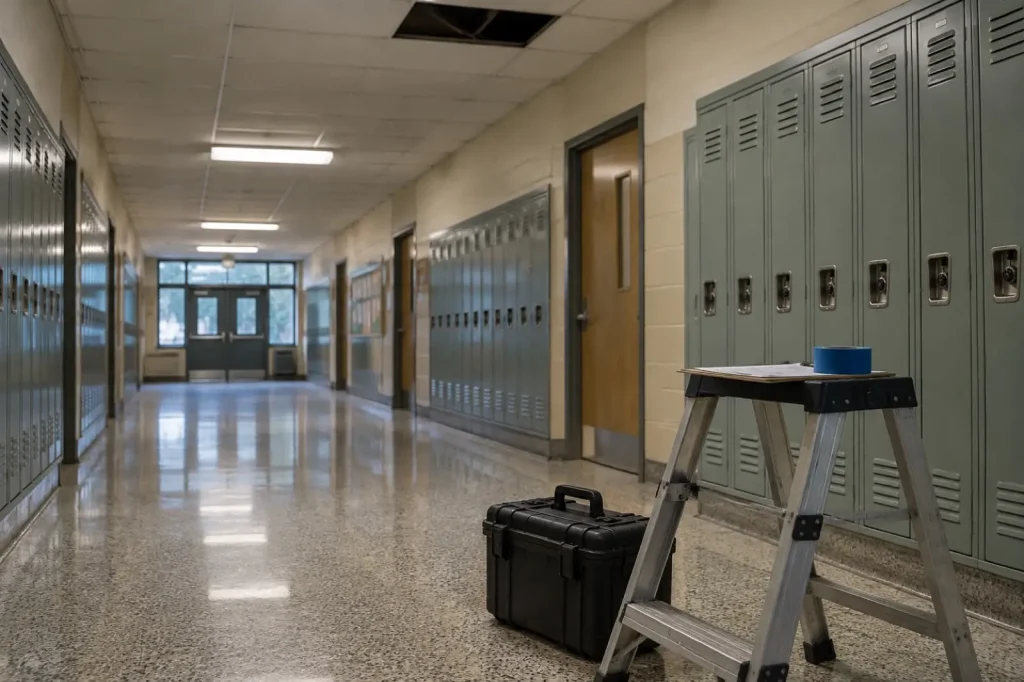
AHERA is the school rule. Under 40 CFR 763.85, each local education agency must have every school building inspected by an accredited inspector to identify all friable and nonfriable asbestos-containing building material, then reinspected at least once every 3 years. The Model Accreditation Plan (40 CFR 763, Appendix C to Subpart E) says all persons who inspect for that material in schools or public and commercial buildings must be accredited.
The asbestos NESHAP covers renovation and demolition. 40 CFR 61.145(a) requires the owner or operator to thoroughly inspect the affected part of the facility for asbestos, including Category I and Category II nonfriable material, before work starts. 40 CFR 61.141 defines a facility to exclude residential buildings having four or fewer dwelling units.
OSHA covers the workers. Under 29 CFR 1926.1101(k)(2), building owners must determine the presence, location and quantity of asbestos-containing and presumed asbestos-containing material before construction work begins, and tell bidding employers, employees and tenants. OSHA names no inspector, but its rebuttal rule at (k)(5) accepts only an AHERA inspection, or sampling by an accredited inspector or a certified industrial hygienist.
| Rulebook | Who it binds | Trigger | Who may inspect |
|---|---|---|---|
| AHERA, 40 CFR 763 Subpart E | Schools, public and private | Using a school building; reinspect every 3 years | Accredited inspector, per 763.85(a)(3) |
| NESHAP, 40 CFR 61 Subpart M | Owner or operator of the work | Demolition, or renovation of a regulated facility | Not named in 61.145; states may license |
| OSHA, 29 CFR 1926.1101(k) | Building owners and employers | Construction, renovation and maintenance work | Accredited inspector or CIH to rebut a presumption |
| State programme | Varies, sometimes houses | Permits, renovation, demolition | State licence or certificate |
Who may be an asbestos inspector
A certified asbestos inspector, in the federal sense, is a person accredited under the EPA Model Accreditation Plan, usually through a state programme that must meet the plan as a floor.
| Requirement | What the plan says | What to check |
|---|---|---|
| Initial course | At least 3 days, with 4 hours hands-on, respirator fit testing and a written exam. | The course certificate, not a business card. |
| Exam | 50 multiple-choice questions, pass mark 70 percent. | Same pass mark for every discipline. |
| Certificate | Unique number, discipline, dates, and expiry 1 year after course and exam. | An expired certificate shows on its face. |
| Refresher | One half-day every year for reaccreditation. | The refresher date, not just the first course. |
| Qualifications | EPA suggests a high school diploma; states may require more. | Your state’s added rules. |
A general home inspector is not an asbestos inspector unless they also hold the accreditation, and the EPA homeowner guidance says a trained and accredited asbestos professional should take samples.
What happens on site: the AHERA sequence
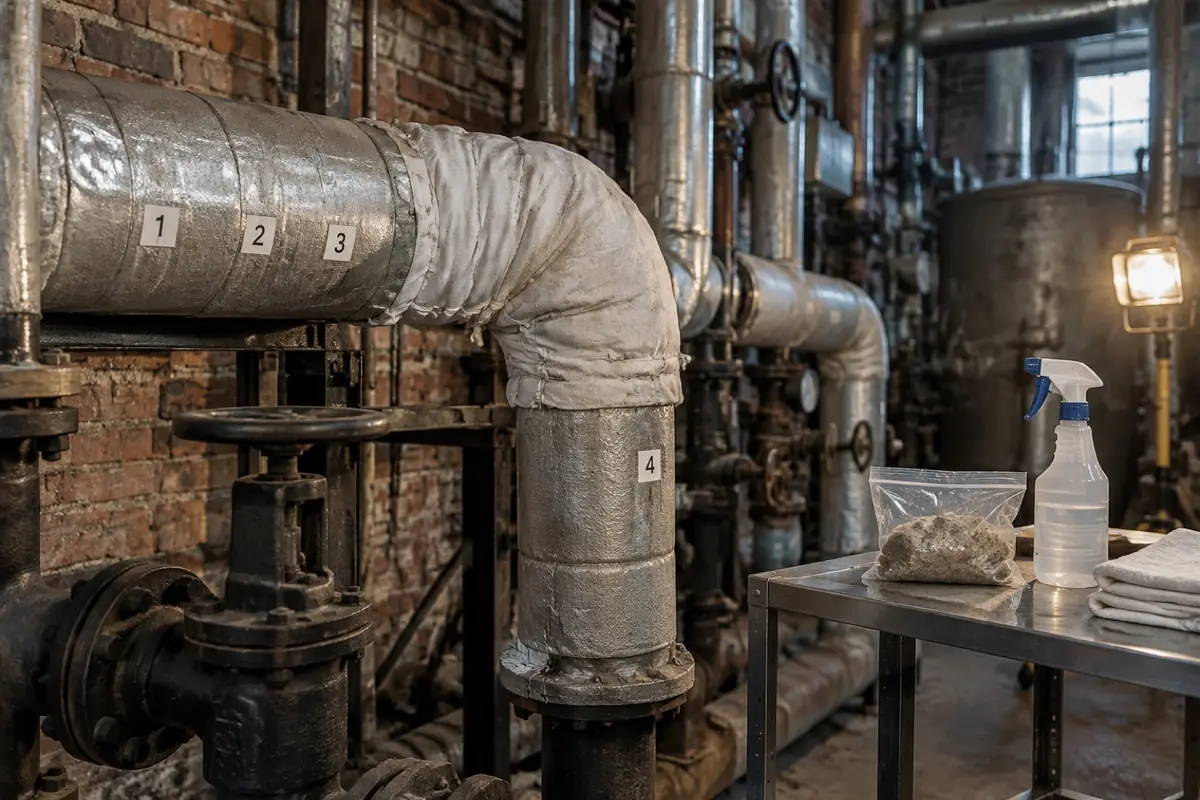
The clearest description of an inspection in federal law is the five steps in 40 CFR 763.85(a)(4). It was written for schools, but OSHA’s rebuttal rule borrows it, and a competent inspection for asbestos in any building follows it.
| Step | What the rule requires | In practice |
|---|---|---|
| 1. Look | Visually inspect to identify all suspected material. | List inaccessible areas as such. |
| 2. Touch | Touch all suspected material to judge friability. | Friable means crumbled by hand pressure when dry. |
| 3. Group | Identify homogeneous areas of friable and nonfriable suspect material. | Uniform in colour and texture, per 763.83. Sampling is per area, not per room. |
| 4. Assume or sample | Assume areas are asbestos, or sample each one not assumed. | Assuming is lawful and cheaper today, but binds the owner to asbestos handling. |
| 5. Assess | Assess friable material sampled, assumed or found earlier. | Written assessment under 763.88. |
Step four is where inspections differ most. An inspector who assumes everything has made no error under the rule, but the owner now carries every material as asbestos until someone samples it. The terms are defined on our asbestos containing material page.
Sampling: the 3-5-7 rule and the rest of 763.86
The 3-5-7 rule comes from 40 CFR 763.86(a). For each homogeneous area of friable surfacing material not assumed to be asbestos, the inspector collects samples in a statistically random manner: at least three for 1,000 square feet or less, five for over 1,000 up to 5,000, and seven above 5,000 square feet, per the regulation. Surfacing material means sprayed or troweled coatings such as acoustical plaster and fireproofing.
| Material type | Minimum under 763.86 |
|---|---|
| Thermal system insulation | At least 3 samples per homogeneous area. |
| Patched thermal system insulation | At least 1 if the patch is under 6 linear or square feet. |
| Cement or plaster on fittings | Enough to decide whether it is asbestos. |
| Fiberglass, foam glass, rubber | None, once the inspector identifies it. |
| Friable miscellaneous material | Enough to decide whether it is asbestos. |
| Nonfriable suspect material | Enough to decide, unless assumed. |
How the lab result decides the area
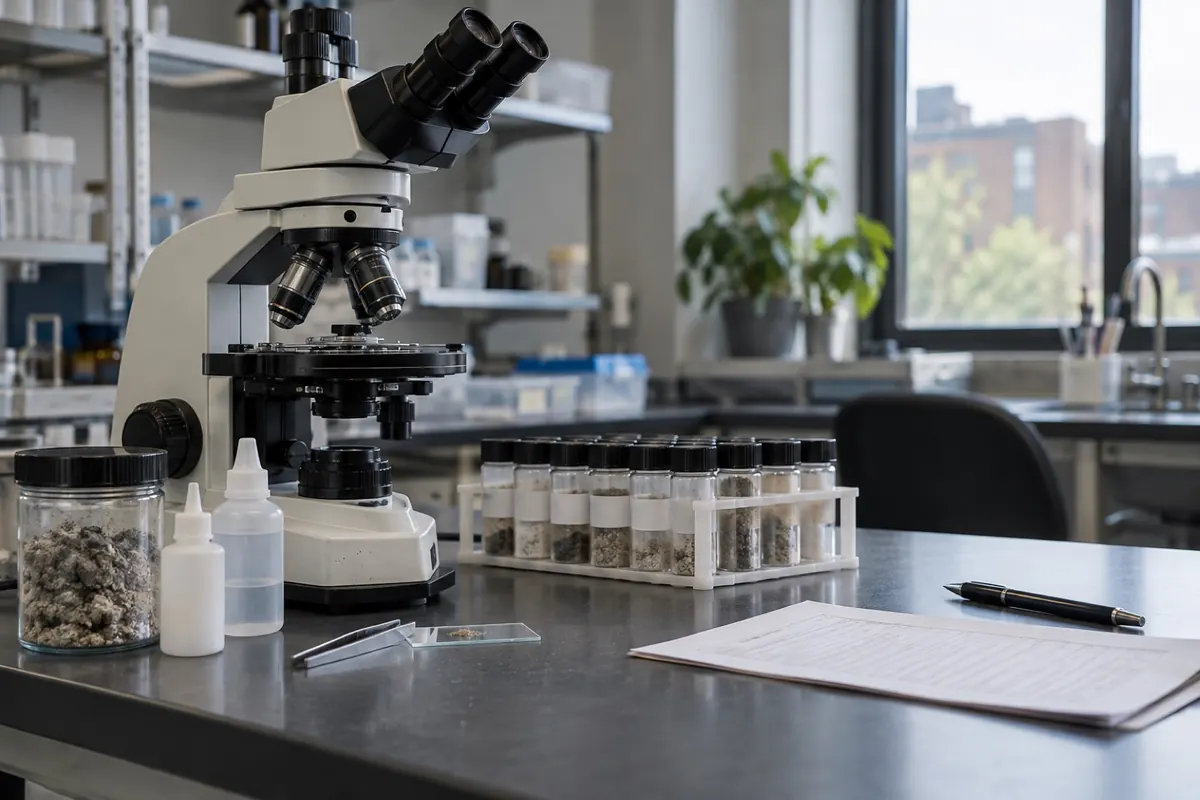
40 CFR 763.87 adds three rules. Samples are not composited. They are analysed by polarized light microscopy under Appendix E to Subpart E. And an area is non-asbestos only if every required sample shows 1 percent or less, while one sample above 1 percent makes the whole area asbestos-containing. School labs must be accredited through the NIST NVLAP asbestos programme.
What the report must contain
40 CFR 763.85(a)(4)(vi) lists what the inspector must record within 30 days, 40 CFR 763.87(d) adds lab details and 40 CFR 763.88 sets the assessment. Outside schools no federal rule fixes the format, but a report missing these items cannot rebut an OSHA presumption. Use it to audit any report.
| Report item | Required by | Why you want it |
|---|---|---|
| Date, and each inspector’s signature, state and accreditation number | 763.85(a)(4)(vi)(A) | Proves accreditation on the day. |
| Homogeneous areas sampled and the exact location and date of each sample | 763.85(a)(4)(vi)(B) | Lets a contractor find each sample point. |
| Every area assumed to be asbestos | 763.85(a)(4)(vi)(B) | Assumed areas carry asbestos controls. |
| How sample locations were chosen | 763.85(a)(4)(vi)(C) | Shows the random sampling test was met. |
| Each area classed as surfacing, thermal system insulation or miscellaneous | 763.85(a)(4)(vi)(D) | The class drives OSHA work classification. |
| Lab name, analysis date and analyst signature | 763.87(d) | Lets you check accreditation. |
| Assessment of friable material in one of seven categories | 763.88(b) | Separates damaged from manageable material. |
| Location and extent of damage, with recommendations | EPA homeowner guidance | EPA’s minimum for a house. |
| Analytical method used | 61.145(b)(4)(v) | The NESHAP notice must state it. |
State accreditation and licensing: four examples
States run accreditation, and many exceed the federal floor. Four examples, read on each agency’s site, show the range; our asbestos accreditation map covers every state.
| State and agency | Who must inspect | Notable rule |
|---|---|---|
| New York, Department of Labor (Code Rule 56) | A certified New York State Asbestos Inspector | Survey before demolition, renovation, remodel or repair, filed with the permit office and the Asbestos Control Bureau. Buildings exempt from the survey must be assumed to contain asbestos. |
| Texas, Department of State Health Services | A licensed inspector employed by a licensed consultant agency | Required for surveys in public buildings. According to Texas DSHS, the licence needs an exam, 5 supervised surveys and a $130 fee. |
| California, Cal/OSHA | A certified consultant or technician | Certification required for asbestos sampling, under Title 8 sections 1529(q) and 341.15. |
| Minnesota, Department of Health | An MDH certified inspector | According to MDH, the fee is $105 and certification runs one year from the latest course. |
New York is strictest for houses. The New York Department of Labor survey requirements say surveys are required for all demolitions, renovations, remodels or repairs regardless of construction date, or the building must be assumed to contain asbestos. The New York homeowner exemption notice exempts an owner-occupied single-family home where the owner does the abatement. The Texas DSHS asbestos FAQ and Cal/OSHA certification page confirm the Texas and California rules, and the Minnesota Department of Health certification page sets Minnesota’s.
When a homeowner needs one
Federal rules mostly leave houses alone, though the EPA demolition guidance on ACM says the NESHAP may apply to municipal demolition of residences damaged by disasters and fires, and the EPA asbestos NESHAP page covers demolishing houses for an urban renewal project.
Otherwise the EPA homeowner guidance sets the line. You do not need testing if materials are undamaged and will not be disturbed. Consider an accredited inspection before a remodel or if materials are damaged. The assessor should not be connected with a removal firm. Vermiculite is the exception: the EPA vermiculite guidance says assume it contains asbestos, leave it alone, and that testing may give erroneous results. See our asbestos insulation page.
Do you need an asbestos inspection? The decision path
Work down the list and stop at the first step that settles it.
- Is it a school? AHERA applies: accredited inspector, reinspection every 3 years, management plan.
- Demolition, in anything but a house of four or fewer units? NESHAP requires a thorough inspection, then notice 10 working days before work.
- Renovation of a commercial, public or larger residential building? Still a thorough inspection. Removal and notice duties start at 260 linear feet on pipes, 160 square feet on other components or 35 cubic feet off components.
- A contractor’s crew will disturb materials? OSHA requires the owner to identify asbestos first; in buildings constructed no later than 1980, surfacing and thermal system insulation are presumed asbestos.
- Does the permit office require a survey? New York does, for houses too.
- Damaged material, or work that cuts, sands or drills it? EPA says consider an accredited inspection.
- Vermiculite? Do not sample; EPA says assume asbestos and leave it.
- None of these? Intact and undisturbed material needs no testing, per EPA.
Owners allowed to sample their own house can use a lab-only route, covered on our asbestos testing kit page.
How long it takes
No rule sets the length of the site visit; it depends on the number of homogeneous areas and access. Lab turnaround is your choice: the EMSL Analytical price guide prices PLM analysis from 3 hours to 2 weeks, and the Wisconsin State Laboratory of Hygiene quotes 12 to 14 working days at its normal rate. The regulatory clocks are fixed.
| Clock | Length | Rule |
|---|---|---|
| Report newly found asbestos on a worksite | 24 hours | 1926.1101(k)(4) |
| NESHAP notice before stripping or removal | 10 working days before | 61.145(b)(3)(i) |
| Tell the owner what asbestos remains | 10 days after | 1926.1101(k)(3)(iii) |
| AHERA records into the management plan | 30 days | 763.85(a)(4)(vi) |
For contractors
- Scope. Ask the owner for the survey OSHA requires before tear-out. Without one, resilient flooring must also be assumed asbestos unless an industrial hygienist determines otherwise, per 1926.1101(g)(8).
- Emergency work. NESHAP allows notice of an emergency renovation no later than the following working day. It does not waive the inspection.
- Documentation. Keep the survey, the signed lab report, chain of custody and photos of each sample point. New suspect material found by your crew triggers the 24 hour notice.
- The line item. Bill inspection and lab analysis separately from abatement, by a separate firm as EPA recommends.
Coverage is a policy question; our page on whether insurance covers asbestos removal describes the policy language. Removal is covered on the asbestos abatement page, and the standards hub collects the rest.
Questions people actually ask
How much does an asbestos inspection cost?
It is priced in two parts: a visit fee for the inspector and a lab fee for each sample or layer, with rush turnaround costing more. Our asbestos testing cost page compares the published price lists of named labs and inspectors, so the cost detail lives there rather than being repeated here.
What is the 3-5-7 rule for asbestos testing?
It is the minimum number of bulk samples for friable surfacing material per the AHERA school rule, 40 CFR 763.86(a): at least three for a homogeneous area of 1,000 square feet or less, five for over 1,000 up to 5,000, and seven above 5,000 square feet. Thermal system insulation needs at least three per area.
Do all homes built before 1978 have asbestos?
No rule says so, and no date proves it either way. OSHA presumes surfacing material and thermal system insulation in buildings constructed no later than 1980 are asbestos until rebutted, and New York requires buildings exempt from its survey rule to be assumed to contain asbestos. Only sampling and lab analysis settle it for a given material.
How do I schedule an asbestos inspection for a commercial property?
Define the scope first: the areas the renovation or demolition will touch. Then hire an inspector accredited in your state, confirm the lab is NVLAP accredited, and ask for a report listing homogeneous areas, sample locations and assumed materials. Allow time for the NESHAP notice, due 10 working days before regulated work starts.
How do I choose a reputable asbestos inspection company?
Check accreditation rather than reviews. Ask for the inspector’s current certificate and state licence, look the firm up in the state licensee search where one exists, and confirm the lab’s NIST NVLAP accreditation. EPA advises using a different firm for the assessment than for any removal, so the inspector has no stake in the abatement scope.
How long does an asbestos inspection take?
The visit depends on the building and the number of homogeneous areas, and no rule fixes it. Lab turnaround is chosen by the client: EMSL prices PLM analysis from 3 hours to 2 weeks, and the Wisconsin State Laboratory of Hygiene quotes 12 to 14 working days at its normal rate.
Sources
- Model Accreditation Plan (40 CFR 763, Appendix C to Subpart E). eCFR, Title 40 as of 15 October 2026. Retrieved 18 October 2026.
- 40 CFR 763.85, 40 CFR 763.86, 40 CFR 763.87 and 40 CFR 763.88, AHERA. eCFR. Retrieved 18 October 2026.
- 40 CFR 61.141 and 40 CFR 61.145, asbestos NESHAP. eCFR. Retrieved 18 October 2026.
- 29 CFR 1926.1101, paragraphs (b), (g)(8) and (k). eCFR, Title 29 as of 14 October 2026. Retrieved 18 October 2026.
- EPA asbestos NESHAP page, EPA, updated 22 December 2025. Retrieved 18 October 2026.
- EPA demolition guidance on ACM, EPA, updated 2 September 2026. Retrieved 18 October 2026.
- EPA homeowner guidance, EPA, updated 25 June 2026. Retrieved 18 October 2026.
- EPA vermiculite guidance, EPA, updated 17 April 2026. Retrieved 18 October 2026.
- Learn About Asbestos page, EPA, updated 13 July 2026. Retrieved 18 October 2026.
- NIST NVLAP asbestos programme, NIST, updated 17 July 2026. Retrieved 18 October 2026.
- New York Department of Labor survey requirements (P232) and New York homeowner exemption notice (P229), both January 2026. Retrieved 18 October 2026.
- Texas DSHS asbestos FAQ and Texas DSHS licence requirements, undated. Retrieved 18 October 2026.
- Cal/OSHA certification page, dated September 2026. Retrieved 18 October 2026.
- Minnesota Department of Health certification page, updated 5 November 2024. Retrieved 18 October 2026.
- EMSL Analytical price guide and Wisconsin State Laboratory of Hygiene, turnaround options. Retrieved 18 October 2026.
- No inspection was performed for this page. Our methodology sets out how we source everything on this site.
Rules change, and states and cities add their own. Confirm with your state asbestos programme or delegated NESHAP agency before relying on this for a project.