The short answer
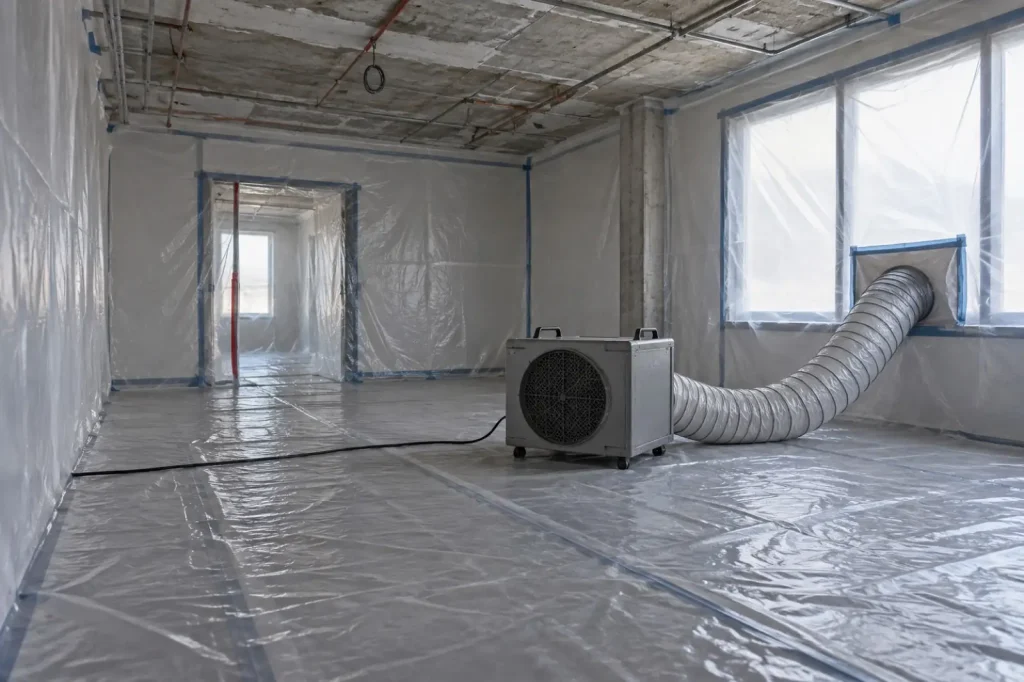
Asbestos abatement is the set of response actions that stop asbestos-containing material from releasing fibres: removal, encapsulation, enclosure and repair. On a regulated job it runs in a fixed order. The owner notifies the air agency at least 10 working days ahead, the crew isolates the area under negative pressure, wets and bags the material, and a clearance air test has to pass before the plastic comes down.
Key takeaways
- Abatement is four actions, not one: removal, encapsulation, enclosure and repair. Only removal takes the material out.
- The 10 working day NESHAP notice runs from postmark or delivery, and a working day is Monday to Friday, holidays included.
- An OSHA negative pressure enclosure needs at least 4 air changes an hour and 0.02 inches of water below outside, smoke-tested every shift.
- Federal TEM clearance uses 13 samples, judged against 70 structures per square millimetre or a Z-test.
- Most houses sit outside the federal NESHAP, which excludes residential buildings with four or fewer units. States often step in.
On this page
This page reads the three federal texts that govern the work, the EPA school rule (AHERA), the EPA air rule (the asbestos NESHAP) and the OSHA construction standard, and sets out what they make a job do, in order. Prices live in our asbestos removal cost guide.
Out of scope. This page covers regulation and work practice, not health effects; for those see the EPA’s asbestos pages and the federal Agency for Toxic Substances and Disease Registry.
The four response actions
40 CFR 763.83, the AHERA definitions section, names removal, encapsulation, enclosure, repair, and operations and maintenance (O&M) as the response actions for friable asbestos-containing building material (ACBM). The trade uses the same words outside schools.
| Response action | Definition in 40 CFR 763.83 | What stays in the building |
|---|---|---|
| Removal | Taking out or stripping substantially all ACBM from a damaged area, functional space or homogeneous area | Nothing |
| Encapsulation | Treating ACBM with a material that embeds the fibres in an adhesive matrix, as a surface membrane (bridging) or by soaking in (penetrating) | All of it |
| Enclosure | An airtight, impermeable, permanent barrier around ACBM | All of it |
| Repair | Returning damaged ACBM to an undamaged or intact state | All of it |
The EPA Purple Book (EPA 560/5-85-024, 1985) called removal the only truly permanent solution, since no building containing asbestos can be demolished without first removing the ACM. Sealing choices are covered on our asbestos encapsulation page.
How AHERA chooses between them
| Condition found | Required response | 763.90 paragraph |
|---|---|---|
| Damaged thermal system insulation | At least repair; remove if repair is not feasible | (b) |
| Damaged friable surfacing or miscellaneous ACM | Any of the four; the least burdensome that protects health may be chosen | (c) |
| Significantly damaged friable ACM | Isolate at once; remove, or enclose or encapsulate if sufficient | (d) |
| Friable ACM with potential for damage | At least an O&M programme | (e) |
Which rules apply to your building
Find your row first. 40 CFR 61.141 defines a NESHAP facility to exclude residential buildings having four or fewer dwelling units. The EPA homeowner asbestos guidance says federal law does not require accreditation for work in detached single-family homes, though some states and localities do. 29 CFR 1926.1101 follows the worker: it covers removal or encapsulation by employers in any building.
| Building | Federal NESHAP | MAP accreditation | OSHA 1926.1101 | State or local example |
|---|---|---|---|---|
| Owner-occupied single-family house | No | Not required federally | Yes, if employees do the work | Minnesota: licence above 10 linear ft, 6 sq ft or 1 cubic ft of friable ACM; domiciled owner exempt |
| Rental or building with 2 to 4 units | No | Not required federally | Yes | Puget Sound agency: certified contractor for a rental or condominium |
| 5 or more units, commercial or public | Yes, at the thresholds | Required for friable work | Yes | State licensing may apply |
| School | Yes | Required, plus AHERA clearance | Yes | State programme on top |
Start from the strictest layer that reaches the job. Minnesota Statutes 326.71 covers friable residential work far below the federal thresholds, and Minnesota Statutes 326.72 exempts only a domiciled owner of a single-family house. The Puget Sound Clean Air Agency lets an owner-occupant remove asbestos from their own house after filing a notification.
The asbestos abatement process, step by step
This is the asbestos removal process for a job large enough to trigger the federal rules, built from the regulation text: the checklist to hold a contractor to. Smaller residential jobs drop the federal notice but keep most of the work practice.
| Step | What happens | Rule | Leaves behind |
|---|---|---|---|
| 1. Survey | Thoroughly inspect the affected area, including Category I and II nonfriable ACM | 61.145(a) | Survey report |
| 2. Quantify | Total the RACM against 260 linear ft on pipes, 160 sq ft on other components or 35 cubic ft | 61.145(a) | Work plan |
| 3. Notify | Written notice at least 10 working days ahead; update at a 20% change, per the rule | 61.145(b) | Notice copy |
| 4. Regulated area | Demarcate, sign, restrict access; a competent person supervises | 1926.1101(e) | Entry log |
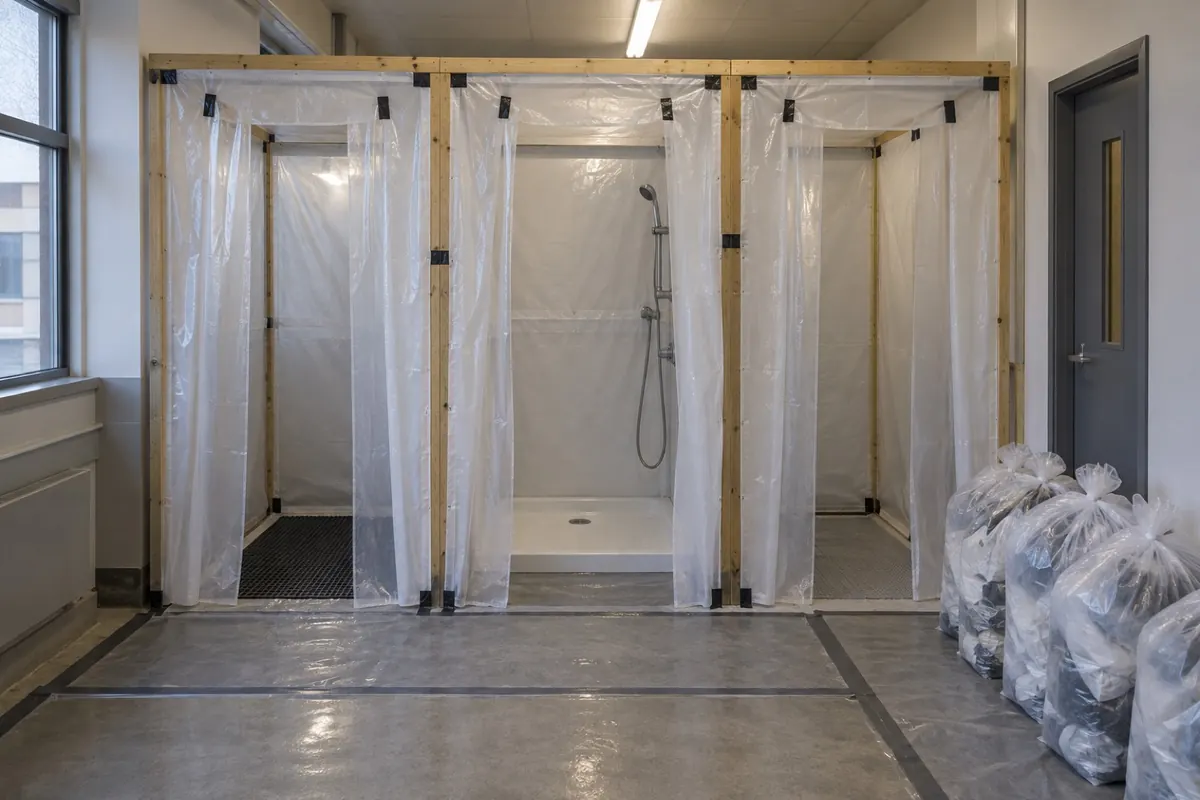
| 5. Isolate | Critical barriers, HVAC sealed with two layers of 6 mil plastic, drop cloths, decon unit | 1926.1101(g)(4), (j) | Set-up checklist |
| 6. Negative pressure | 4 air changes an hour and 0.02 in. of water, smoke-tested | 1926.1101(g)(5)(i) | Manometer record |
| 7. Wet removal | Keep material adequately wet; lower, never drop | 61.145(c) | Air monitoring |
| 8. Package | Seal wet in leak-tight containers, labelled | 61.150(a) | Container count |
| 9. Inspect | Visual inspection of each space | 763.90(i)(1) | Sign-off |
| 10. Clear | Aggressive air sampling, TEM, barrier still up | 763.90(i); App. A | Clearance report |
| 11. Dispose | To a 61.154 site with a waste shipment record | 61.150(b), (d) | Signed record |
The notice is the step that trips up emergency jobs. Per 40 CFR 61.145(b), it is postmarked or delivered at least 10 working days before stripping, removal or any site preparation that would disturb the material. 40 CFR 61.141 counts Monday to Friday, holidays included, so that is two calendar weeks at minimum. An emergency renovation notifies as early as possible and no later than the following working day. The delegated agency is often a state agency, per the EPA asbestos NESHAP page.
Containment and negative pressure
Under 29 CFR 1926.1101(e), all Class I, II and III work happens inside a regulated area that is demarcated, signed, limited to authorised people and supervised by a competent person. For Class I removals above 25 linear feet or 10 square feet of pipe insulation or surfacing material, paragraph (g)(4) requires critical barriers over openings or an equivalent method proved by perimeter monitoring, and (j)(1) requires an equipment room, shower and clean room in series.
The enclosure specification in 29 CFR 1926.1101(g)(5)(i) is testable: at least 4 air changes per hour, at least 0.02 column inches of water below outside pressure shown by a manometer, air moved away from workers toward HEPA filtration, and a breach inspection and smoke test before work and at the start of each shift. The machine doing that is a HEPA air filtration unit; our guide to air scrubbers explains how it runs as a negative air machine. Glove bags, the other common Class I method, are 6 mil, used once and never on surfaces above 150 degrees F, per 29 CFR 1926.1101(g)(5)(ii).
Wet methods, packaging and disposal
Water is the main control. 40 CFR 61.141 defines adequately wet as mixed or penetrated with liquid enough to prevent particulate release, and says visible emissions prove the material was not wet enough. 40 CFR 61.145(c) requires RACM to be kept wet until contained. 29 CFR 1926.1101(g)(3) prohibits dry sweeping, compressed air for removal, high-speed abrasive saws without HEPA-exhausted ventilation, and rotating employees to dilute exposure.
| Requirement | What 40 CFR 61.150 says | Paragraph |
|---|---|---|
| Wet and seal | Adequately wet, then seal in leak-tight containers or wrapping while wet | (a)(1)(i), (iii) |
| Hazard label | The OSHA asbestos warning label, readily visible | (a)(1)(iv) |
| Generator label | Generator name and the site where the waste arose | (a)(1)(v) |
| Waste shipment record | Travels with the load; signed by the disposal site | (d)(1), (d)(2) |
| Chase and report | No signed copy in 35 days: chase. None in 45 days: report to the agency | (d)(3), (d)(4) |
| Retain | Records kept at least 2 years | (d)(5) |
Clearance air testing
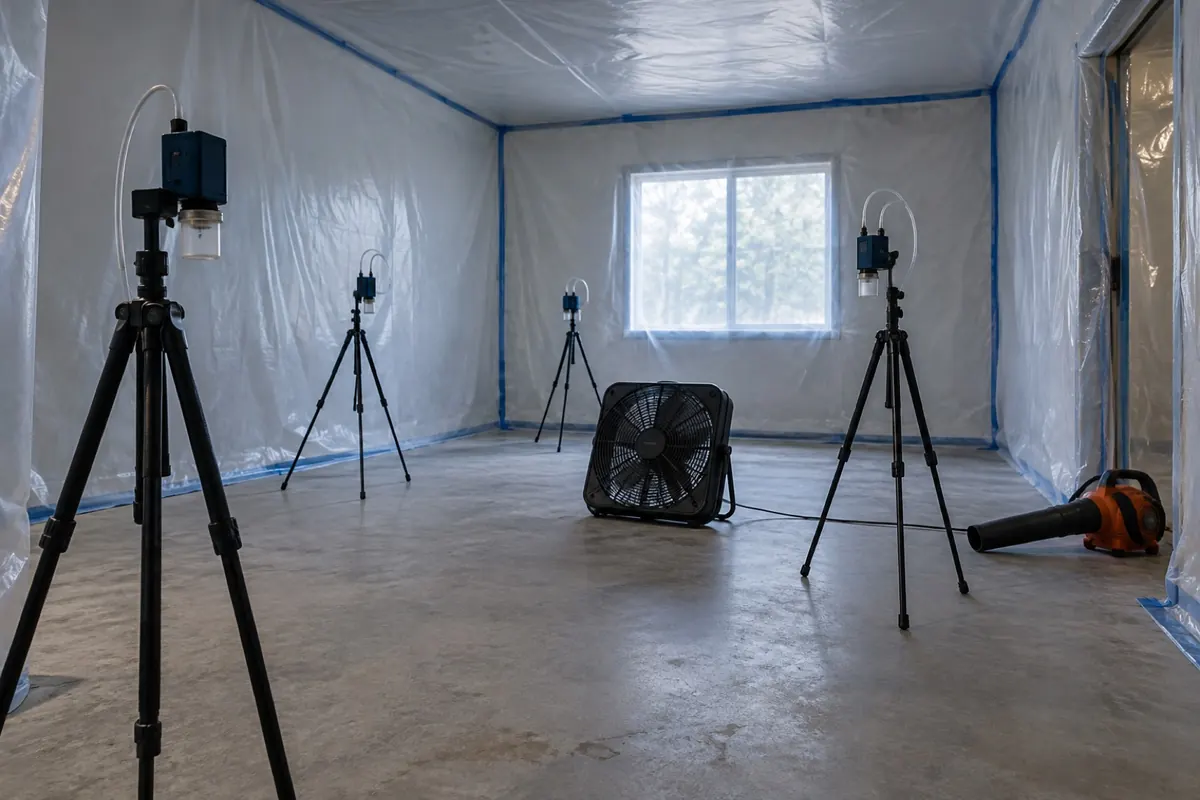
Per 40 CFR 763.90(i), each removal, encapsulation or enclosure project other than small-scale, short-duration work needs a visual inspection and then aggressive air sampling analysed by transmission electron microscopy (TEM). Private specifications borrow the pass marks, and 29 CFR 1926.1101(g)(4)(ii) cites them as one way to prove a Class I barrier holds.
| Test | Pass condition | Rule |
|---|---|---|
| Visual | Each functional space confirmed complete first | 763.90(i)(1) |
| TEM screening | Per EPA, five inside samples of at least 1,199 litres (25 mm filter) averaging no more than 70 s/mm2 | 763.90(i)(4) |
| TEM Z-test | Inside average not statistically above outside (Z of 1.65 or less), blanks below 70 s/mm2 | 763.90(i)(3) |
| PCM option | Jobs up to 160 sq ft or 260 linear ft; each of five samples 0.01 f/cc or less | 763.90(i)(5) |
Aggressive means rough. Per EPA’s Appendix A to Subpart E of Part 763, the final plastic stays up and the air units stay on, surfaces are swept with the exhaust of a leaf blower of at least one horsepower, and fans aimed at the ceiling keep dust airborne, one per 10,000 cubic feet. 70 s/mm2 is a filter count; 0.01 f/cc is an air concentration, set against OSHA’s worker limits below.
OSHA work classes I to IV
29 CFR 1926.1101(b) sorts work by what is disturbed, and the class sets the controls and training. Its definition of repair includes encapsulation, so sealing ACM is not a lighter category of work.
| Class | Definition, 1926.1101(b) | Controls | Training, (k)(9) |
|---|---|---|---|
| Class I | Removal of thermal system insulation and surfacing ACM | Competent person, barriers, HVAC isolation, NPE or glove bag | MAP worker course equivalent |
| Class II | Removal of other ACM: wallboard, floor tile, sheeting, roofing and siding shingles, mastics | Intact removal, wetting, no sanding of flooring | 8 hours per material category |
| Class III | Repair and maintenance likely to disturb ACM | Wet methods; mini-enclosure or glove bag on TSI | 16 hours |
| Class IV | Custodial contact without disturbance; clean-up after Classes I to III | HEPA vacuums, wet methods | 2 hours |
Training and accreditation
The EPA Model Accreditation Plan (Appendix C to Subpart E of Part 763) defines five disciplines, each with an initial course, an examination and an annual refresher. The EPA asbestos laws and regulations page records that the 1990 ASHARA amendments extended accreditation to abatement in all public and commercial buildings. Training providers get courses approved by state programmes at least as stringent as the MAP.
| Discipline | Initial course, minimum | Annual refresher |
|---|---|---|
| Worker | 4 days | 1 day |
| Contractor/supervisor | 5 days | 1 day |
| Inspector | 3 days | Half a day |
| Management planner | 3 day inspector course plus 2 days | Half a day each |
| Project designer | 3 days | 1 day |
On a large job, ask for the supervisor’s current contractor/supervisor accreditation and the state licence. The NESHAP adds one more: 40 CFR 61.145(c)(8) requires an on-site representative trained in the NESHAP, refreshed every 2 years, with evidence posted at the site.
For contractors: scope and paper trail
For a restoration firm, abatement usually arrives mid-job, when a water or fire loss opens an older wall or ceiling. The duty does not pause: 40 CFR 61.145(a)(4)(iv) covers emergency renovations, with the amount estimated from the sudden event. Scope abatement as its own line by material, with containment, decon, monitoring, clearance and disposal shown separately. The documents below are what an owner, adjuster or agency inspector can ask to see. Coverage questions belong to the policy and the state insurance department; our insurance and asbestos removal guide explains the wording.
| Document | Required by |
|---|---|
| Survey and lab results | 61.145(a) |
| NESHAP notice and updates | 61.145(b) |
| Posted NESHAP training evidence | 61.145(c)(8) |
| Clearance report | 763.90(i); Appendix A |
| Signed waste shipment records, kept 2 years | 61.150(d) |
Keep the tester independent: the EPA homeowner asbestos guidance says whoever assesses the need for removal should not be connected with the firm doing it. Related standards sit in our standards hub.
Questions people actually ask
What is an asbestos abatement?
Asbestos abatement is any response action that controls fibre release from asbestos-containing material: removal, encapsulation, enclosure or repair, as defined in 40 CFR 763.83. Removal takes the material out; the other three leave it in place under a management programme, and regulated material must still come out before demolition.
What are the typical stages of a professional asbestos abatement project?
Survey, quantify, notify the air agency at least 10 working days ahead where the NESHAP applies, set up the regulated area and containment, run negative pressure, remove the material wet, package and label the waste, inspect, pass clearance air testing, and dispose of the waste under a signed waste shipment record.
Can you stay in your house during asbestos abatement?
Not in the work area. EPA’s homeowner guidance says not to allow household members or pets into the area until the work is complete, and to make sure the contractor seals it off with plastic sheeting. Whether the rest of the house stays usable depends on the size of the job and its containment.
How do I prepare my home for professional asbestos abatement?
Get the survey and a written contract first; EPA advises a contract naming the work plan, clean-up and the federal, state and local rules the contractor must follow. Keep people and pets out, agree where the decon unit and the air unit exhaust go, and book an independent clearance tester before work starts.
How much does asbestos abatement cost?
Cost follows the response action, the material, the area and the containment the rules require, with clearance testing and disposal as separate lines. Our asbestos removal cost guide compares published price ranges by material, naming each source and its date instead of quoting one national average.
Will homeowners insurance pay for asbestos abatement?
That depends on the policy wording and the cause of loss, so no general page can answer it for your policy. Read the exclusions and pollutant language in your own policy, ask your state insurance department how it reads them, and talk to a licensed professional. Our insurance guide explains what to look for.
How do I find a licensed asbestos abatement contractor, and what certifications matter?
EPA says state agencies keep the most current lists of accredited professionals, so start with your state asbestos programme. For large jobs ask for current MAP accreditation for workers and the contractor/supervisor, the state contractor licence, the NESHAP on-site training required by 40 CFR 61.145(c)(8), and OSHA training records.
Where can I find asbestos abatement training programs?
Under the EPA Model Accreditation Plan, providers get each course approved by a state programme at least as stringent as the plan, and those approvals count as EPA approval. Your state asbestos programme lists approved providers; our state accreditation map links each programme.
Sources
- 40 CFR 763.83, 40 CFR 763.90 and 40 CFR 763.91, AHERA, via eCFR. Retrieved 18 October 2026.
- Appendix A to Subpart E of Part 763, TEM clearance protocol, via eCFR. Retrieved 18 October 2026.
- EPA Model Accreditation Plan (Appendix C to Subpart E of Part 763), via eCFR. Retrieved 18 October 2026.
- 40 CFR 61.141, 40 CFR 61.145 and 40 CFR 61.150, asbestos NESHAP, via eCFR. Retrieved 18 October 2026.
- 29 CFR 1926.1101, OSHA asbestos construction standard, via eCFR. Retrieved 18 October 2026.
- EPA homeowner asbestos guidance, last updated 25 June 2026. Retrieved 18 October 2026.
- EPA asbestos NESHAP page, last updated 22 December 2025. Retrieved 18 October 2026.
- EPA asbestos laws and regulations page, last updated 11 December 2025. Retrieved 18 October 2026.
- EPA Purple Book (EPA 560/5-85-024, 1985), Section 4.2.1.3. Retrieved 18 October 2026.
- ASTM E1368-23, ASTM International, scope page. Retrieved 18 October 2026.
- Minnesota Statutes 326.71 and Minnesota Statutes 326.72. Retrieved 18 October 2026.
- Puget Sound Clean Air Agency, Homeowner Renovation page. Retrieved 18 October 2026.
- No abatement job was observed or measured for this page. Our methodology sets out the rules.
State and local rules can be stricter; confirm with your state asbestos programme before work starts.