The short answer
Asbestos testing cost has two parts that are priced separately: a laboratory fee for each sample or layer, and a fee for someone to come out and take the samples. According to the published price lists compared below, PLM analysis of a bulk sample at normal turnaround runs from $29 to $50, rush work costs 1.6 to 4.0 times as much, and a local sampling visit adds $250 to $325 before lab fees. A whole-house renovation survey lands between about $500 and $1,050 across those sources.
Key takeaways
- Labs bill per layer, not per bag. A floor tile and its mastic are two results and two fees, per the EMSL price list end notes.
- Turnaround is a lever you control. The same PLM analysis costs 1.6 to 4.0 times as much on a rush basis across the three labs that publish both rates.
- TEM costs more than PLM and answers a narrower question. EMSL recommends it as a follow-up when a floor tile or mastic reads below 1% or not detected by PLM.
- The 3-5-7 rule is real but it is a school rule: the minimum sample counts for surfacing material under the federal AHERA regulation.
- EPA says taking samples yourself is not recommended. Some local rules still allow it for an owner-occupied house; check yours first.
On this page
- The two parts of every bill
- Lab fees per sample, by source
- What a visit costs
- Where the published figures disagree
- PLM against TEM, and what each costs
- How many samples, and the 3-5-7 rule
- Five worked scenarios
- What each accredited discipline does
- When testing is required
- Can you take the sample yourself?
- Questions people actually ask
Two things decide the bill: how many separate results the lab has to produce, and whether anyone has to drive to the property. This page splits those apart, sets published prices from named labs side by side, and works through five common situations. For what happens after a positive result, our asbestos removal cost guide picks up from there.
This page describes prices and rules. For decisions about your building, the authorities are the EPA, your state asbestos programme and, for workers, OSHA. Our state asbestos accreditation map lists the agency for every state.
The two parts of every bill
Every asbestos test is a laboratory reading a physical sample under a microscope. The cost question is therefore two questions. First, how many results does the lab have to produce, and how fast. Second, who takes the samples and how far they travel. Air Allergen, a Georgia lab and inspection firm, puts it plainly on its Air Allergen pricing page: a base price covers the visit, sampling and the report, and per-sample lab fees cover the analysis.
The split matters because the two halves scale differently. Lab fees scale with the number of distinct materials and layers. The visit is close to a fixed cost: Seattle Asbestos Test, per its Seattle Asbestos Test price list, charges $250 to come out within its immediate service area and $750 for its remote area, with lab fees billed separately. That fixed cost is why small jobs feel expensive per result.
Lab fees per sample, by source
Four labs publish a PLM fee for bulk building material. Each row is quoted from that source’s own page.
| Source | What is priced | Normal turnaround | Faster turnaround |
|---|---|---|---|
| Air Allergen (Georgia) | Mail-in PLM, per sample | $29 | Not published |
| Wisconsin State Laboratory of Hygiene | Homeowner PLM, per sample | $48 (12 to 14 working days) | $72 priority, $96 rush |
| Seattle Asbestos Test | PLM, per material | $50 (24 hours) | $80 (within 1 hour) |
| EMSL Analytical | PLM, EPA/600/R-93/116, per layer | $36.50 (2 weeks), $38.25 (1 week) | $60 (24 hours), $147 (3 hours) |
Per sample, per material or per layer
The unit on the invoice is where most surprises come from. EMSL’s end notes state that fees are per layer, with tile and mastic charged separately. Seattle Asbestos Test bills per material and gives worked examples: sheet vinyl is two materials, a floor tile is two (tile and mastic), wallboard is two (paint with texture, then gypsum with paper), and vermiculite is one. The Wisconsin lab states its fee per sample, and its sample report shows a single kitchen sample analysed in four layers. Ask which unit applies before you send anything.
Our guide to telling whether floor tiles contain asbestos explains why the mastic is its own material, and therefore its own line on the bill.
What a visit costs
Getting someone to check for asbestos means paying for the trip and the sampling as well as the lab. Three published visit fees were found, all quoted before any lab charges.
| Source | Service | Visit fee | Lab fees on top |
|---|---|---|---|
| Seattle Asbestos Test | Sampling on site | $250 / $500 / $750 (immediate / intermediate / remote area) | Per material, from $50 |
| Seattle Asbestos Test | AHERA inspection | $250 / $500 / $1,000 plus samples | Per material |
| Air Allergen | Sampling for personal information | $275 | $29 per sample |
| Air Allergen | Survey for remodeling or demolition permits | $325 | $29 per sample; 15 to 25 samples typical for a home |
Air Allergen also lists travel beyond 40 miles at $2 per mile on its Air Allergen pricing page, which is the clearest published example of why rural visits cost more. The Seattle tiers make the same point: its remote-area sampling fee is three times its immediate-area fee.
Why the inspector should not be the abatement firm
The EPA homeowner asbestos guidance is direct on this: an asbestos professional hired to assess the need for repair or removal should not be connected with the firm that does the removal, and it is better to use two different firms so there is no conflict of interest. An independent visit buys a result nobody has a reason to inflate.
Where the published figures disagree
Cost guides that rank for this question quote national ranges without naming a lab. They are shown here with their dates, next to a total computed from one firm’s published rates, so the spread is visible rather than averaged away.
| Source | Date | What the range covers | Range |
|---|---|---|---|
| The Asbestos Institute | 9 June 2025 | All testing types | $250 to $850 |
| The Asbestos Institute | 9 June 2025 | Full inspection, home | $500 to $850 |
| Fixr | Updated 19 August 2022 | Inspection and testing | $250 to $750 (average $500) |
| Air Allergen, computed here | Retrieved 7 October 2026 | Remodel survey, 15 to 25 samples | $760 to $1,050 |
Three things explain the gap. The guides blend single-sample jobs with whole-house surveys. The Fixr figure is four years old. And the computed Air Allergen total assumes a full renovation sample count. Use the itemised price lists, not the guide ranges, as the basis for a budget. Our pricing hub sets out how we treat every cost figure on the site.
PLM against TEM, and what each costs
Polarized light microscopy, PLM, is the default for building materials. It is the method the federal school rule names: 40 CFR 763.87 requires bulk samples to be analysed by PLM and not composited. Transmission electron microscopy, TEM, resolves much finer fibres and costs more. The NIST NVLAP asbestos programme accredits labs for PLM, TEM or both, and AHERA requires school samples to go to an NVLAP-accredited lab.
| Analysis (EMSL list) | Slowest turnaround | Fastest turnaround | What it answers |
|---|---|---|---|
| PLM, calibrated visual estimate | $36.50 | $147 | Is asbestos present, and roughly how much |
| PLM, 400 point count | $68 | $295 | A firmer percentage near the 1% line |
| TEM, bulk NOB (floor tile, mastic) | $75 | $175 | Fine fibres PLM can miss in tile and adhesive |
| TEM, air, AHERA method | $108 | $430 | Air clearance after abatement, not material ID |
When the extra TEM fee is worth paying
EMSL’s own end notes say additional analysis by TEM is recommended when a PLM result on NOB material is not detected or under 1%. On that list TEM on an NOB layer costs 2.1 times the slowest PLM fee ($75 against $36.50). The 1% figure matters because it is the federal line: per 40 CFR 763.87, a homogeneous area is treated as not asbestos-containing only if every required sample shows 1% or less, and as asbestos-containing if any one sample shows more.
Point counting is the cheaper refinement for a borderline PLM result. Air Allergen states on its Air Allergen pricing page that it includes a free secondary point count on samples that come back at 1% asbestos; ask whether yours charges for it. Method detail is covered on our asbestos testing kit page.
How many samples, and the 3-5-7 rule
People search for a 3-5-7 rule for asbestos testing, and it does exist, but not as a general rule for houses. It is the minimum sampling schedule for friable surfacing material, such as sprayed or troweled ceiling and wall coatings, in the federal AHERA regulation for schools. Per 40 CFR 763.86, an accredited inspector collects at least three bulk samples from a homogeneous area of 1,000 square feet or less, at least five from an area over 1,000 and up to 5,000 square feet, and at least seven from an area over 5,000 square feet.
The same section sets at least three samples for each area of pipe and boiler insulation. None of this binds a homeowner, but inspectors often apply it elsewhere as the published federal benchmark for a defensible negative.
| Homogeneous area of surfacing material | AHERA minimum samples | Lab fees at $29 to $50 each |
|---|---|---|
| 1,000 sq ft or less | 3 | $87 to $150 |
| More than 1,000 up to 5,000 sq ft | 5 | $145 to $250 |
| More than 5,000 sq ft | 7 | $203 to $350 |
For the budget, what counts is the number of homogeneous areas, not the number of rooms. A house with one popcorn texture throughout is one area. A house with three generations of flooring is at least three, and each of those may be two layers. Air Allergen’s typical counts are two samples for tile or linoleum, two for drywall, three for a textured ceiling and two to three for plaster.
Five worked scenarios
Each total is arithmetic on the published prices above. None is a quote for your building.
| Situation | Total from published prices | Note |
|---|---|---|
| One suspect material, mailed by the owner, normal turnaround | $29 (Air Allergen) to $48 (Wisconsin) | Lab fee only. |
| Floor tile plus black mastic, mailed | $73 (EMSL 2-week rate, two layers) to $100 (Seattle, two materials) | Two layers, two fees. |
| Popcorn ceiling under 1,000 sq ft, three samples taken by a professional | $362 (Air Allergen) to $400 (Seattle, immediate area) | AHERA minimum for that size. |
| Whole-house survey before a remodel | $760 to $1,050 (Air Allergen, 15 to 25 samples) | Typical permit survey. |
| Confirming a negative floor tile result by TEM | add $75 to $175 per layer (EMSL) | Per EMSL end note 9. |
The pattern is consistent. One mailed sample costs tens of dollars, a professional visit for a single ceiling costs a few hundred dollars, and a full pre-renovation survey approaches or passes a thousand. If the answer comes back positive, the next number is the abatement scope, which our removal cost guide breaks down by friability and area.
What each accredited discipline does on a project
Asbestos accreditation is not one licence. The federal EPA Model Accreditation Plan, 40 CFR Part 763 Appendix C to Subpart E defines five disciplines with separate training, exams and annual refreshers, and states that run their own programmes build on it. Our state accreditation map shows where each state’s programme sits and how to confirm a credential is current.
| Discipline | Minimum initial training | Role on a project |
|---|---|---|
| Inspector | At least 3 days | Visually inspects, touches suspect material to judge friability, identifies homogeneous areas, takes bulk samples, assesses condition and writes the inspection record. |
| Management planner | Inspector course plus 2 days | Turns a school inspection into a management plan and response actions. Requires current inspector accreditation. |
| Project designer | At least 3 days | Designs the abatement: containment, work practices and the specification the contractor bids on. |
| Contractor / supervisor | At least 5 days | Runs the abatement on site and is responsible for the crew following the design and the rules. |
| Worker | At least 4 days, 14 hours hands-on | Carries out the removal, repair or encapsulation inside the containment. |
For a testing budget only the inspector row matters. The plan requires accreditation for anyone inspecting schools or public and commercial buildings; single-family homes are left to state and local rules.
When testing is required
Federal law requires inspection before demolition and renovation of covered buildings, but its definition of a covered building leaves most houses out. Under the asbestos NESHAP, 40 CFR 61.145 requires the owner or operator to thoroughly inspect the affected part of a facility for asbestos before demolition or renovation begins. 40 CFR 61.141 defines a facility to exclude residential buildings having four or fewer dwelling units. The EPA asbestos NESHAP page sets out the notification side.
States and local air agencies can and do go further. The Puget Sound Clean Air Agency in Washington State is a clear example. If you own and live in the single-family house being remodelled, you may conduct your own survey. For a rental, a condominium, or the demolition of your own house, you must hire an AHERA-certified building inspector. That one agency page shows the answer depends on the building and the job.
A permit office asking for a survey is usually applying one of these local rules, so ask which one. Worker protection during any disturbance falls under OSHA; see the OSHA asbestos topic page. Check your state through our accreditation map before budgeting, because the rule decides whether the cheap option is allowed.
Can you take the sample yourself?
The EPA homeowner asbestos guidance answers this directly: a trained and accredited professional should take samples, if done incorrectly sampling can be more hazardous than leaving the material alone, and taking samples yourself is not recommended. The same page says that if materials are not damaged and will not be disturbed, you do not need to have the home tested.
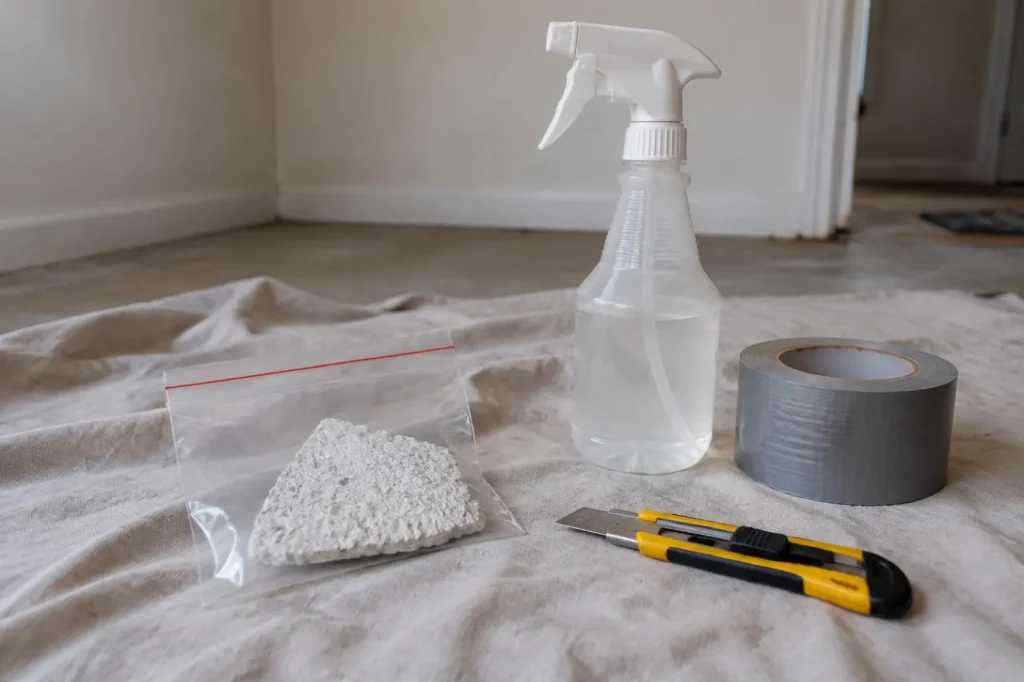
Some public labs still accept homeowner samples, and the Wisconsin State Laboratory of Hygiene publishes instructions: moisten the area before cutting, send at least a 1 inch square of flat material, include any mastic or glue, and bag it in a sealable container. Local rules such as the Puget Sound agency’s also allow an owner survey in narrow cases. Where both the rules and the material allow it, self-sampling turns a visit fee into a lab fee. Where the material is friable, damaged or crumbling, it does not.
Kit and method choices are covered on our asbestos testing kit page.
Questions people actually ask
Is it expensive to test for asbestos?
The lab part is not. Published PLM fees at normal turnaround run from $29 to $50 a sample across the four labs compared here. The visit is the expensive part: $250 to $325 before lab fees on the published lists.
What is the 3-5-7 rule for asbestos testing?
It is the minimum sampling schedule for friable surfacing material under the federal AHERA school regulation, 40 CFR 763.86: at least three bulk samples for an area of 1,000 square feet or less, five for over 1,000 up to 5,000, and seven for over 5,000. It does not bind private homes.
How much does it cost to get someone to check for asbestos?
Published visit fees found for this page run from $250 (Seattle Asbestos Test, immediate area) to $325 (Air Allergen, permit survey), with lab fees added per sample. For three samples from one ceiling that comes to about $362 to $400 on those two firms’ price lists.
Can I test for asbestos myself?
EPA says taking samples yourself is not recommended, because sampling done incorrectly can release fibres. Some local rules allow an owner survey of an owner-occupied house before a remodel. Never sample friable or damaged material.
Why did the lab charge for more samples than I sent?
Labs commonly bill per layer or per material. EMSL’s price list states that tile and mastic are charged separately, and Seattle Asbestos Test counts sheet vinyl and wallboard as two materials each. A single bag can produce two or more results.
How long do asbestos test results take?
It depends on what you pay for. The Wisconsin State Laboratory of Hygiene quotes 12 to 14 working days at its normal rate, Air Allergen quotes results in two to three business days for its surveys, and EMSL prices turnaround from three hours to two weeks.
Sources
- EMSL Analytical 2026 commercial price list, EMSL Analytical, Inc.: PLM, point count and TEM rates by turnaround, and end notes 8 and 9. Retrieved 7 October 2026.
- Wisconsin State Laboratory of Hygiene, Wisconsin Occupational Health Laboratory. Homeowner fees by turnaround and sampling instructions. Retrieved 7 October 2026.
- Air Allergen pricing page, Air Allergen, Stone Mountain, Georgia. Retrieved 7 October 2026.
- Seattle Asbestos Test price list, Seattle Asbestos Test; undated, visit fees labelled as estimates. Retrieved 7 October 2026.
- The Asbestos Institute, The Asbestos Institute, article dated 9 June 2025. Retrieved 7 October 2026.
- Fixr, cost guide updated 19 August 2022. Retrieved 7 October 2026.
- EPA homeowner asbestos guidance, United States Environmental Protection Agency, last updated 25 June 2026. Retrieved 7 October 2026.
- 40 CFR 763.86 and 40 CFR 763.87, AHERA sampling and analysis rules for schools, via eCFR. Retrieved 7 October 2026.
- EPA Model Accreditation Plan, 40 CFR Part 763 Appendix C to Subpart E, discipline definitions, training minimums and annual refresher requirement, via eCFR. Retrieved 7 October 2026.
- 40 CFR 61.141 and 40 CFR 61.145, asbestos NESHAP facility definition and pre-renovation inspection duty, via eCFR, with the EPA asbestos NESHAP page. Retrieved 7 October 2026.
- NIST NVLAP asbestos programme, National Institute of Standards and Technology. Retrieved 7 October 2026.
- Puget Sound Clean Air Agency, homeowner renovation requirements. Retrieved 7 October 2026.
- OSHA asbestos topic page, Occupational Safety and Health Administration.
- Scenario totals and ratios are arithmetic on the published prices above, computed when this page was built. No price on this page was estimated or invented. Our methodology sets out the standing rules.
Prices change and are set by each lab and inspector. Confirm the current rate, the billing unit and the turnaround with the provider before sending samples.