The short answer
Asbestos shingles are roofing shingles made with asbestos: mostly asbestos-cement slates, which EPA says were sold until 1992, plus asphalt-asbestos shingles sold until 1979. Intact, both are nonfriable. The federal asbestos NESHAP excludes houses of four or fewer units, so state rules, OSHA and the building code decide most tear-offs.
Key takeaways
- Per EPA’s 1994 roofing manual, asbestos-cement roof shingles were cut from sheet containing 15 to 40 percent asbestos, sized 9 by 16 to 14 by 30 inches.
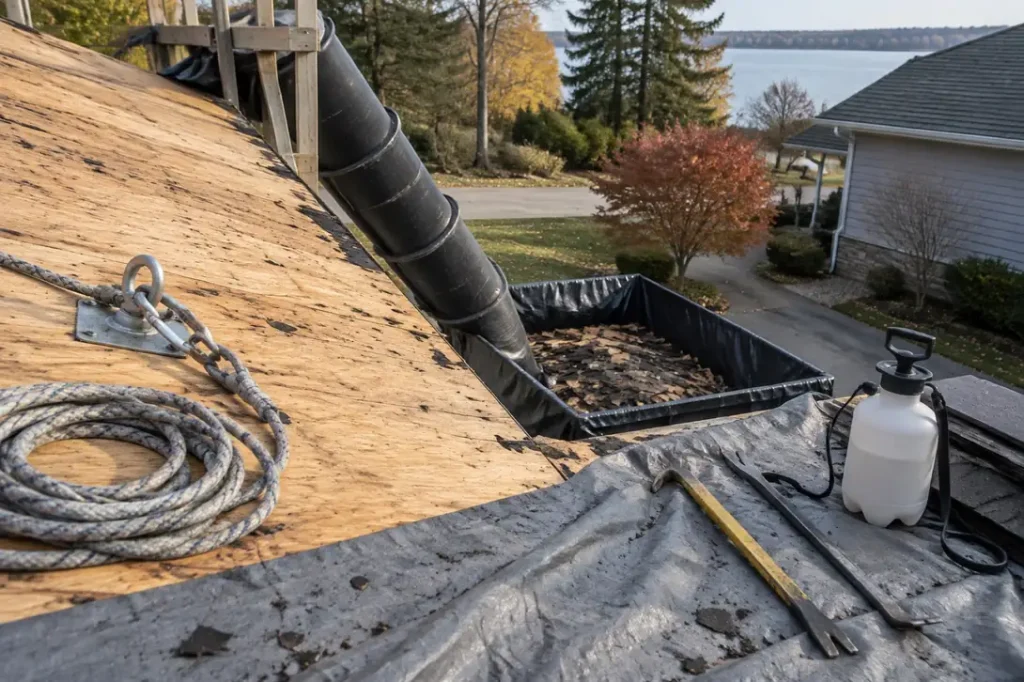
- EPA’s roofing interpretive rule says carefully prying off intact A/C shingles with bars and shovels is not subject to the NESHAP; dropping them or scraping them off with heavy machinery is.
- On covered buildings, a rotating-blade cutter on asphalt roofing triggers the NESHAP at 5,580 square feet, per EPA, because that much cutting creates 160 square feet of regulated material.
- Roofing over is usually off the table: the 2018 IRC bars a recover where the existing covering is asbestos-cement tile.
- Felts and mastics are the overlooked suspects. EPA’s manual lists asbestos asphalt roof cement and coatings as still sold in 1994.
- Disposal is a local fee schedule, not a federal price. Four 2026 landfill schedules read for this page price non-friable asbestos by the ton or the cubic yard, with minimums and pre-approval.
On this page
- Which asbestos roof product is it?
- Telling A/C shingles from slate and asphalt
- The EPA roofing rule, decoded
- OSHA work practices on the roof
- Roof over it, or tear it off?
- Disposal and landfill rules
- What removal costs, by named source
- Before anyone climbs the ladder
- For roofing and restoration contractors
- Questions people actually ask
Roofs carry asbestos in more places than the visible shingle. In 1994 EPA issued a roofing guidance manual and an interpretive rule to clarify when the asbestos NESHAP applies to roof removal; this page works from both. Asbestos-cement wall shingles follow similar rules but different options, covered on our asbestos siding page.
Out of scope: health effects. This page covers identification, regulation, disposal and prices; for health questions see EPA's Learn About Asbestos page and CDC's ATSDR asbestos pages, and a clinician.
Which asbestos roof product is it?
The EPA roofing guidance manual (EPA-340/B-94-001) sorts asbestos roofing into two families that the NESHAP treats differently. Per 40 CFR 61.141, asphalt roofing products over 1 percent asbestos are Category I nonfriable ACM; cement products such as A/C shingles are Category II. EPA’s manual adds that EPDM, PVC, modified bitumen and roof insulation never contained asbestos.
| Roofing product | NESHAP category | When sold (EPA, 1994) | Where it shows up |
|---|---|---|---|
| Asbestos-cement (A/C) shingles and slates | Category II | Sold until 1992 | Rigid cement units nailed like slate; the main product this page covers |
| Asphalt-asbestos shingles | Category I | Sold until 1979 | Per EPA, not used widely |
| Asbestos roofing felts and underlayment | Category I | US production ended by the early 1980s | Under shingles; often rolled up whole if in good condition |
| Asbestos base flashings | Category I | Not made in the US since about the early 1980s | At walls, curbs and penetrations |
| Asphalt roof cement, coatings, mastics | Category I | Listed as sold to the present in 1994 | Around chimneys, vents and patches |
| Corrugated or flat A/C sheet | Category II | Used since the 1930s | Mostly industrial roofs and walls |
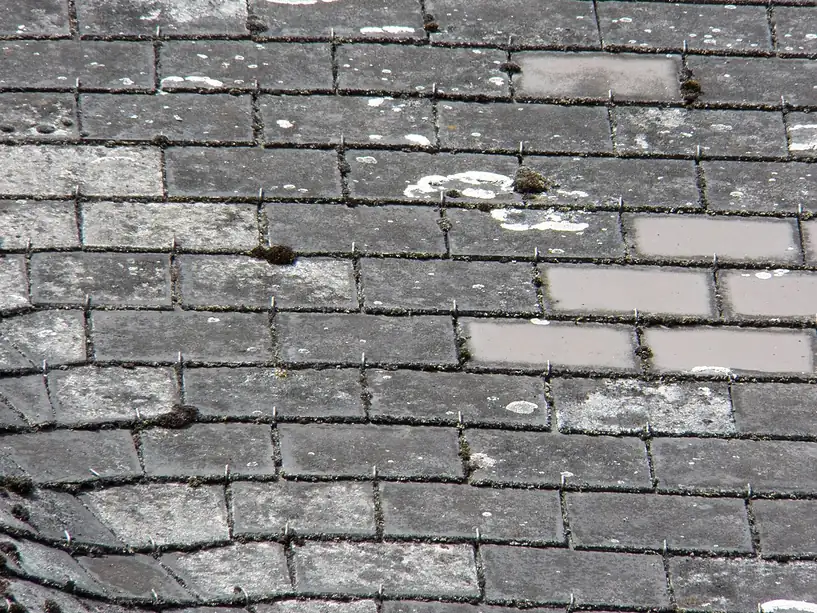

The Minnesota Department of Health lists the same suspects for homes: asphalt roofing felt, asphalt roofing shingles, cement roofing shingles and roof underlayment. The top layer’s age is not the roof’s age.
Telling A/C shingles from slate and asphalt
According to the National Park Service roofing history (asbestos-cement), Ludwig Hatschek invented his process for rolled and pressed asbestos-cement sheet in 1900; his patent was reissued in the US in 1907, and A/C shingles were sold as lightweight, economical, fireproof substitutes for slate, wood and clay. They were made to look like slate.
| Material | What gives it away | Typical laying pattern |
|---|---|---|
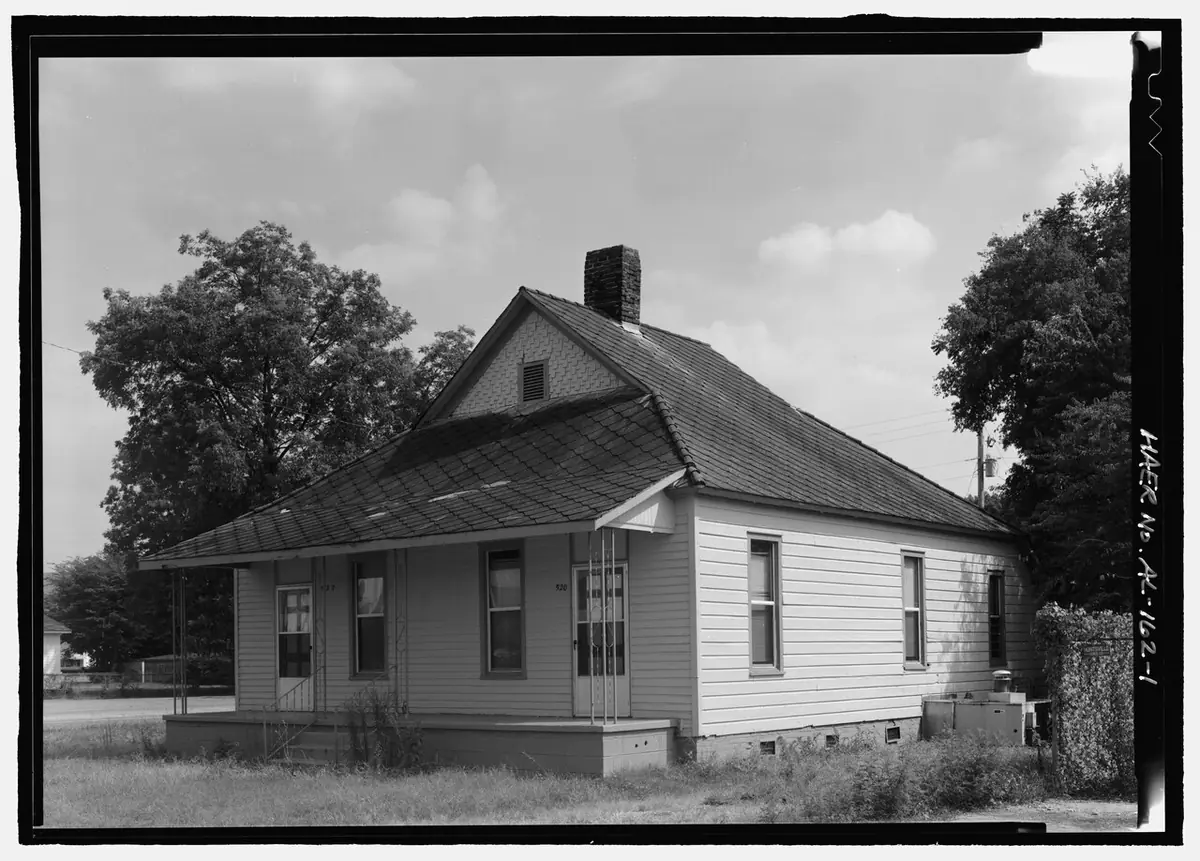
| Asbestos-cement shingle | Uniform thickness; factory-punched nail holes; pressed rustic or weathered-wood texture; colours such as Indian Red and Newport Gray; early ones often faded | Hexagonal, honeycomb or diamond (French), Dutch Lap or American |
| Natural slate | Split stone; edges and thickness vary piece to piece; layered cleavage on broken edges | American (rectangular) |
| Asphalt shingle | Flexible mat with ceramic-coated granules; tears rather than snaps | Strips with tabs |
| Modern fibre-cement slate | Rigid like A/C but newer; check installation records and labels on bundles | Rectangular |
The EPA roofing guidance manual (EPA-340/B-94-001) notes pilot holes were routinely predrilled or punched at the factory, and that A/C shingles lasted 30 to 50 years. A hexagonal or diamond roof on a pre-1980s house, with uniform, pre-holed units, is a strong candidate. Only a lab result confirms it; see our asbestos testing kit page for sampling routes.
The EPA roofing rule, decoded
The binding text is the Interpretive Rule Governing Roof Removal Operations, 40 CFR Part 61, Subpart M, Appendix A, published at 59 FR 31158 on 17 June 1994. Its first line settles most residential questions: the NESHAP does not cover roofing projects on single family homes or on residential buildings containing four or fewer dwelling units. For everything else, material and method decide.
| Building or material | Area | Removal method | NESHAP outcome |
|---|---|---|---|
| House or building of four or fewer units | Any | Any | Not covered by the NESHAP |
| Any covered building | Under 160 sq ft of roofing | Any | Not covered (notification still required for demolitions) |
| Asphalt (Category I) | Any | Slicing, power plow, spud bar, axe, knife, shovel | Not covered; waste may go as non-asbestos |
| Asphalt (Category I) | 5,580 sq ft or more | Rotating-blade roof cutter | Covered; cutting debris is asbestos-containing waste |
| Asphalt (Category I) | Any | Power tear-off machine prying up the roof | Not regulated |
| A/C shingles (Category II) | Any | Careful prying with bars and shovels, lowered to the ground | Not covered if not crumbled |
| A/C shingles (Category II) | 160 sq ft or more crumbled | Dropped from the roof or scraped off with heavy machinery | Covered; waste goes to an approved landfill |
EPA adds that merely breaking an A/C shingle does not necessarily make it regulated, and that a contractor at the threshold may skip testing only by following the notification and work practices anyway.
OSHA work practices on the roof
Where the NESHAP stops, worker protection does not. OSHA 29 CFR 1926.1101 defines Class II asbestos work as removing ACM that is not thermal system insulation or surfacing material, which takes in roofing, and sets an exposure limit of 0.1 fibre per cubic centimetre as an eight-hour average. Paragraph (g)(8) then writes roofing-specific practices.
| Paragraph of 1926.1101 | Requirement | Applies to |
|---|---|---|
| (g)(8)(ii)(A) | Remove roofing material intact to the extent feasible | All asbestos roofing |
| (g)(8)(ii)(B) | Wet methods for material that is or will be rendered not intact, unless infeasible or unsafe | All |
| (g)(8)(ii)(C) | Continuously mist cutting machines during use | Built-up and asphalt roofs |
| (g)(8)(ii)(F) | Transfer lowered, unwrapped material to a closed receptacle without dispersing dust | All |
| (g)(8)(ii)(G) | Isolate roof-level HVAC intakes or shut the system down | All |
| (g)(8)(iii)(A) | No cutting, abrading or breaking shingles unless less fibre-releasing methods cannot be used | A/C shingles |
| (g)(8)(iii)(B) and (D) | Spray each shingle with amended water before removal; cut nails with flat, sharp instruments | A/C shingles |
| (g)(8)(iii)(C) | Lower unwrapped shingles by covered chute, crane or hoist, or bag or wrap them and lower by end of shift | A/C shingles |
One practice is missing from that list because no list could make it safe: pressure-cleaning. The WorkSafe WA safety alert 12/2018 reports a painter who pressure-cleaned an asbestos-cement roof to prepare it for paint and contaminated neighbouring properties; the practice is prohibited in Western Australia.
Roof over it, or tear it off?
For asphalt shingles, a recover is the least-disturbance option and EPA’s manual calls it usually less expensive. For asbestos-cement, the building code closes that door. Per the 2018 IRC section R908 as adopted by Gillette, Wyoming, a roof recover shall not be permitted where the existing roof covering is slate, clay, cement or asbestos-cement tile, where the roof has two or more applications of any covering, or where it is water soaked or deteriorated.
| Existing roof | Recover allowed? | IRC 2018 basis | What that means |
|---|---|---|---|
| Asbestos-cement tile or shingle roof | No | R908.3.1.1 item 2 | Tear off to the deck |
| One layer of asphalt shingles (asbestos or not) | Usually yes | R908.3.1.1 items 1 and 3 not triggered | Recover leaves the asbestos layer in place, undisturbed |
| Two or more existing layers | No | R908.3.1.1 item 3 | Tear off; every layer may need testing |
| Water-soaked or deteriorated roof | No | R908.3.1.1 item 1 | Tear off |
Per the EPA manual, NRCA found 31 percent of its members’ projects were re-covers, and estimated about 70,000 roof removal jobs a year outside houses of four or fewer units. The data are three decades old, but recover is a mainstream choice, not a dodge.
Disposal and landfill rules
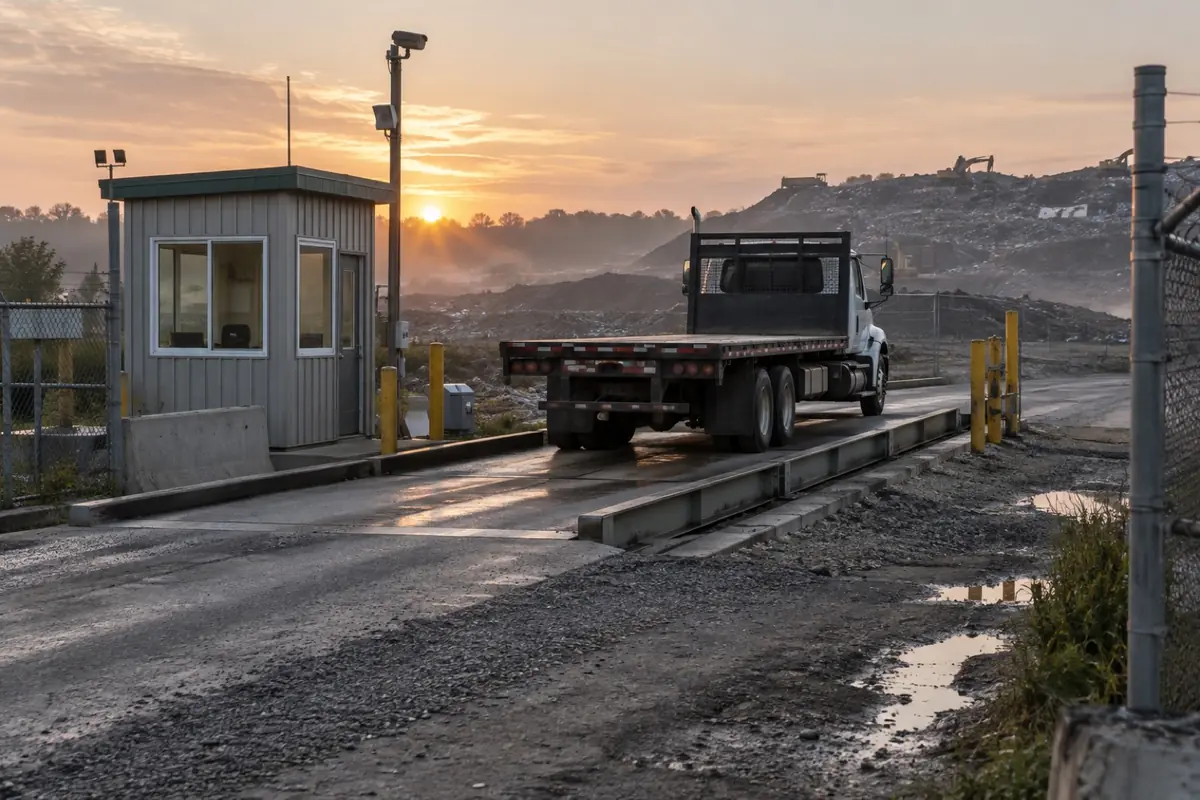
Federal disposal rules attach only to regulated waste. Per EPA’s 40 CFR Part 61, Subpart M, Appendix A, waste from slicing or manual removal of asphalt roofing may be disposed of as non-asbestos waste, and A/C shingles removed without crumbling are not subject to NESHAP disposal requirements. Regulated waste must be adequately wet, sealed leak-tight, labelled and taken to a landfill run under 61.154, with a waste shipment record, per 40 CFR 61.150. EPA adds that other state and local rules may apply, and they set the price.
| Landfill | Effective | Non-friable asbestos fee | For comparison |
|---|---|---|---|
| Chautauqua County, NY | 1 January 2026 | $44 per ton | MSW $32 per ton; friable $85 per ton, $400 minimum |
| Lycoming County, PA | 6 April 2026 | $132 per ton (friable or not) | Resident MSW $69.80 per ton; $500 minimum for businesses, not residents |
| Larimer County, CO | 2026 schedule | $40 per cubic yard (rubble class) | Loose trash $13.25 per cubic yard |
| Altamont Landfill, CA | 19 January 2026 | $314.50 per cubic yard (residents) | Friable $428.45 per cubic yard; asbestos waste needs pre-approval |
Per those schedules, non-friable asbestos costs 1.9 times the resident trash rate in Lycoming County and 1.4 times the MSW rate in Chautauqua County. Weight per square varies by product and is not published by any source read here, so get the tonnage estimate from the roofer.
What removal costs, by named source
Three published sources give a per-square-foot roof figure, and all three print the same range. None says what is in it.
| Source | Dated | What is priced | Published figure |
|---|---|---|---|
| HomeAdvisor | 17 June 2026 | Roof and shingles, per sq ft | $50 to $120 |
| Bob Vila | 21 December 2023 | Roof and shingles, per sq ft | $50 to $120 |
| RoofVista (contractor, 12 states) | 15 March 2026 | Full abatement, per sq ft | $50 to $120 |
| RoofVista | 15 March 2026 | Encapsulation, per sq ft | $15 to $40 |
| RoofVista | 15 March 2026 | Disposal, 2,000 sq ft roof | $5,000 to $15,000 |
| RoofVista | 15 March 2026 | New roofing, 2,000 sq ft roof | $9,000 to $17,000 |
| Computed here | 11 October 2026 | HomeAdvisor rate per 100 sq ft square | $5,000 to $12,000 |
Treat that range with caution. According to HomeAdvisor it works out at $5,000 to $12,000 per 100 square foot roofing square, and it runs 5.6 to 17.1 times Fixr’s $7 to $9 for siding, a near-identical material removed with the same pry-bar method EPA describes. No guide says whether its figure assumes full containment, a commercial NESHAP job or a house. Price from a written scope; our asbestos removal cost guide explains how abatement scopes are built.
Before anyone climbs the ladder
A seven-step checklist that turns the rules above into a job plan, for owners and contractors alike.
- Identify the layers. Note the top covering, count the layers at an edge or vent, and list flashing cement and felts.
- Test or presume. Sample each suspect layer, or presume ACM and follow the handling rules. Lab fees are set out in the asbestos testing cost guide.
- Classify the building. Four or fewer dwelling units sits outside the federal NESHAP. Anything else, measure the area against 160 square feet.
- Check the state programme. Licensing, notification and disposal are set there; start from our asbestos accreditation map.
- Decide recover or tear-off. Asbestos-cement, two layers or a wet deck means tear-off under the IRC.
- Choose the method. Pry, do not grind; lower, do not drop; wet; no pressure-washing.
- Book disposal first. Call the landfill for fees, minimums, wrapping and pre-approval before the crew starts.
For roofing and restoration contractors
Storm and fire losses put crews on asbestos roofs with little notice. For employers, OSHA’s Class II practices apply whenever crews remove asbestos roofing; the NESHAP applies on covered buildings past the thresholds above; state rules sit on top.
An adjuster’s file usually wants the lab result or presumption, area by slope, layer count, method statement, any notification and the landfill ticket. Write tear-off, disposal and the new roof as separate lines. Coverage is a policy question: our page on whether insurance covers asbestos removal reads common policy language, and the policy, the state insurance department and a licensed professional decide it. The standards hub collects the rules used here.
Questions people actually ask
Is it bad to have asbestos shingles?
Intact asbestos shingles are not treated as an urgent problem. Minnesota’s health department says asbestos cement and asphalt roofing that is intact and in good condition is generally considered nonfriable and not hazardous. The issue is disturbance: breaking, grinding, pressure-washing or tearing them off carelessly. Plan any roof work around the material and its rules.
How do you know if shingles are asbestos?
Look for rigid cement shingles of uniform thickness with factory-punched nail holes, often laid in a hexagonal, diamond or Dutch Lap pattern, on a roof dating from before the 1990s. Old asphalt shingles, felts and flashing cement can also contain it. Only a laboratory analysis of a sample confirms it; otherwise presume it is asbestos.
Should I buy a house with asbestos shingles?
That is a budgeting question more than a rules question. An intact roof can stay in service, but under the 2018 IRC an asbestos-cement roof cannot be recovered, so replacement means a tear-off. Get the roof tested, a written tear-off quote and the local landfill’s fee before you price the offer.
When did they stop making asbestos shingles?
EPA’s 1994 roofing manual says asbestos-cement roof shingles were sold until 1992 and asphalt-asbestos shingles until 1979, and the National Park Service says A/C shingles and siding were produced into the 1980s. US law never simply banned them; our page on when asbestos was banned explains why.
Can you roof over asbestos shingles?
Not over asbestos-cement. The 2018 International Residential Code, section R908.3.1.1, does not permit a recover where the existing covering is slate, clay, cement or asbestos-cement tile, or where two or more layers already exist. A single layer of asphalt shingles that may contain asbestos can usually be recovered if it is sound, subject to your local code.
How do you dispose of asbestos shingles?
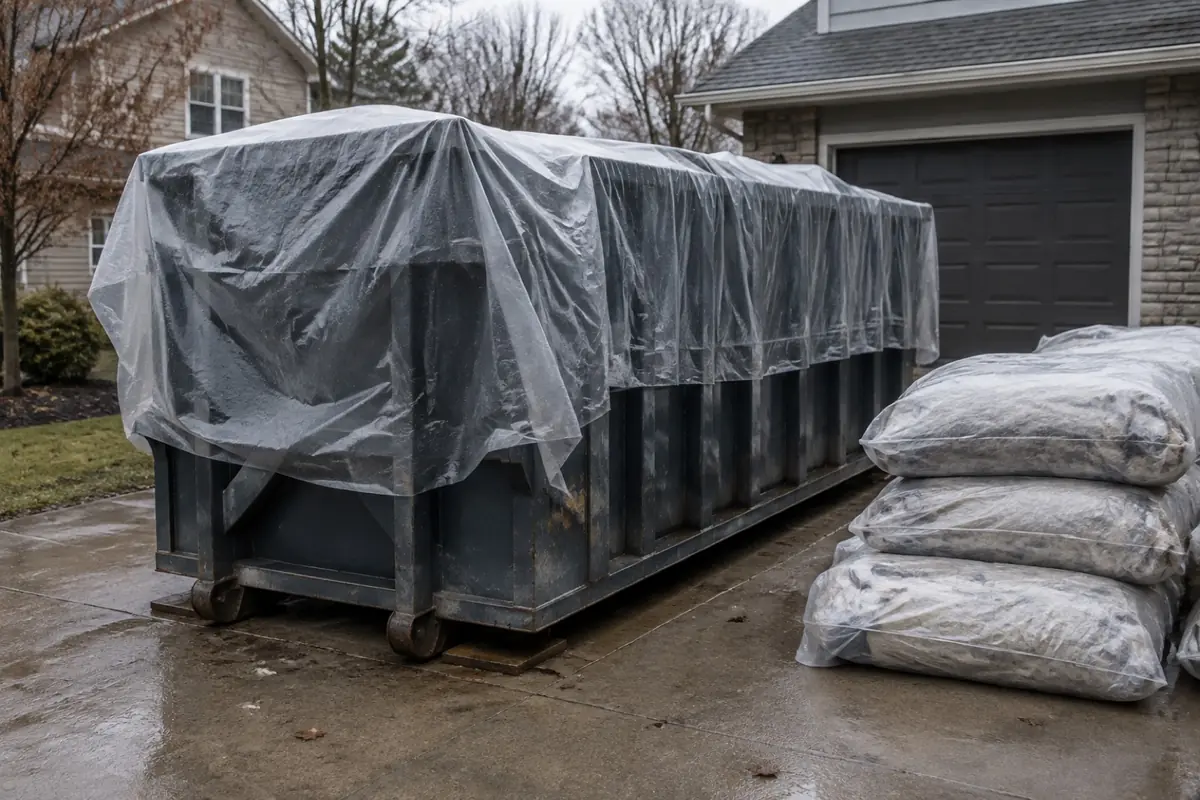
Wet them, keep them whole, wrap or bag them, and take them to a landfill that accepts asbestos. Regulated waste must be sealed leak-tight, labelled and manifested under 40 CFR 61.150. Fees are local: four 2026 schedules read here price non-friable asbestos per ton or per cubic yard, and some require pre-approval. Call first.
Do old asphalt shingles contain asbestos?
Some do, but they are the minority. EPA’s 1994 manual says asphalt-asbestos shingles were sold until 1979 but were not used widely. The likelier asphalt suspects are old felts, which US producers stopped by the early 1980s, and roof cement or coatings around flashings. Test before a tear-off rather than assuming.
Sources
- 40 CFR Part 61, Subpart M, Appendix A, Interpretive Rule Governing Roof Removal Operations, 59 FR 31158, 17 June 1994, as amended 1995, via Cornell LII. Retrieved 11 October 2026.
- EPA roofing guidance manual (EPA-340/B-94-001), Applicability of the Asbestos NESHAP to Asbestos Roofing Removal Operations, US EPA Office of Air and Radiation, August 1994. Retrieved 11 October 2026.
- 40 CFR 61.141, 40 CFR 61.145 and 40 CFR 61.150, asbestos NESHAP, via Cornell LII. Retrieved 11 October 2026.
- OSHA 29 CFR 1926.1101, (b), (c) and (g)(8)(ii) to (iii). Retrieved 11 October 2026.
- 2018 IRC section R908 as adopted by Gillette, Wyoming, reproduced with ICC permission. Retrieved 11 October 2026.
- National Park Service roofing history (asbestos-cement), Technical Preservation Services, copy hosted by the City of Detroit. Retrieved 11 October 2026.
- Minnesota Department of Health, Roofing and Siding Asbestos, updated 22 May 2025. Retrieved 11 October 2026.
- WorkSafe WA safety alert 12/2018, 9 November 2018. Retrieved 11 October 2026.
- EPA's history of its asbestos actions, US EPA, updated 21 January 2026. Retrieved 11 October 2026.
- {‘nf’: 44.0, ‘f’: 85.0, ‘f_min’: 400.0, ‘cd’: 44.0, ‘msw’: 32.0} (effective 1 January 2026), {‘asb’: 132.0, ‘res_msw’: 69.8, ‘min’: 500.0} (effective 6 April 2026), {‘rubble_cy’: 40.0, ‘trash_cy’: 13.25} (2026) and {‘nf_cy’: 314.5, ‘f_cy’: 428.45, ‘msw_ton’: 164.1} (effective 19 January 2026). Retrieved 11 October 2026.
- HomeAdvisor (updated 17 June 2026), Bob Vila (updated 21 December 2023), RoofVista (15 March 2026) and Fixr (August 2022). Retrieved 11 October 2026.
- Out-of-scope pointers: EPA's Learn About Asbestos page and CDC's ATSDR asbestos pages.
- Computed figures are arithmetic on the published numbers above. Our methodology sets out the standing rules.
Codes, state rules and landfill fees change and vary by jurisdiction. Confirm with your building department, state asbestos programme and landfill before work, and price from written quotes.