The short answer
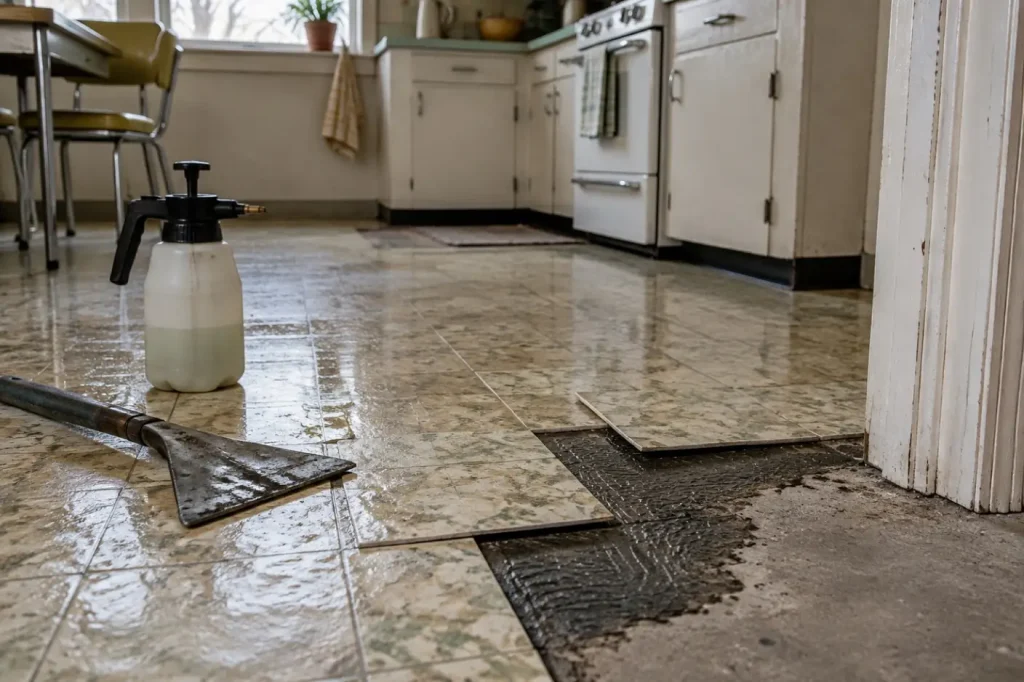
To remove asbestos floor tiles without turning them into regulated friable waste, the published industry and agency method keeps every tile whole: mist it with water or soften it with heat, pry it up with a hand scraper and bag it unbroken. Sanding, grinding, beadblasting and mechanical chipping are what change the tile’s legal status under the federal asbestos rule.
Key takeaways
- Asbestos floor tile is Category I nonfriable material under 40 CFR 61.141, alongside packings, gaskets and asphalt roofing.
- It becomes regulated (RACM) once it is friable or is sanded, ground, cut or abraded. EPA’s 1994 Keyes letter says the extent of damage matters, not the tool.
- RFCI’s practices forbid sanding, dry sweeping, dry scraping, drilling, sawing, beadblasting and mechanical chipping, and call removal the last alternative.
- Mastic is the harder half: 4 of the 7 EPA floor tile determinations concern adhesive, mostly shot blasting, allowed only if kept adequately wet.
- Agencies disagree on hand tools: RFCI allows long-handled scrapers, Georgia EPD treats them as a regulated friable method.
- EPA and RFCI both prefer covering intact tile over removing it, but under the school rule carpet is not an enclosure.
On this page
The documents that govern this job are short: one federal definition, one OSHA paragraph, a flooring industry booklet and a handful of EPA letters about adhesive. This page reads them and shows where agencies disagree. Whether a tile contains asbestos is a separate question, covered on how to tell if floor tiles contain asbestos.
Why floor tile starts out nonfriable, and what changes that
40 CFR 61.141 sorts asbestos materials by how easily they release fibres. Friable material crumbles under hand pressure when dry. Category I nonfriable material is a named list: “asbestos-containing packings, gaskets, resilient floor covering, and asphalt roofing products containing more than 1 percent asbestos”. Resilient floor covering means asphalt and vinyl floor tile and sheet vinyl. So an intact tile floor starts in the least regulated class.
The same section says when it moves. Regulated asbestos-containing material, RACM, includes Category I material that “has become friable” or “will be or has been subjected to sanding, grinding, cutting, or abrading”. Grinding includes mechanical chipping or drilling; cutting includes sawing but not shearing, slicing or punching. EPA’s 1994 letter to D. Keyes explains the test: “The important factor in this definition is the extent of damage caused to the material and not how the damage was done.”
| Term in 40 CFR 61.141 | What it covers | Effect on a tile job |
|---|---|---|
| Category I nonfriable ACM | Packings, gaskets, resilient floor covering, asphalt roofing, over 1 percent asbestos | Intact tile |
| Resilient floor covering | Asphalt and vinyl floor tile, sheet vinyl | Tile and sheet goods |
| RACM | Friable material, plus Category I that became friable or was sanded, ground, cut or abraded | Full NESHAP practices |
| Grinding | Reduce to powder or small fragments, including mechanical chipping or drilling | Chipping counts |
| Cutting | Penetrating with a sharp edge, including sawing; not shearing, slicing or punching | Scoring is not cutting |
The definitions bind a facility: houses with four or fewer units sit outside the NESHAP, as our sibling page on how to remove asbestos explains, but state rules borrow the same vocabulary.
Asbestos tile removal: the RFCI work practices, step by step
The Resilient Floor Covering Institute publishes RFCI Recommended Work Practices, January 2018 edition, written for removing all resilient floor structures whether or not they contain asbestos, and replacing earlier RFCI and Armstrong editions. RFCI says OSHA determined that intact resilient flooring can be removed under a negative exposure assessment by trained workers following these practices. We could not find a current EPA page that adopts the booklet; EPA’s 1991 Region 1 letter says EPA “does not formally approve or endorse specific removal techniques”. Texas writes it into rule for public buildings under 25 TAC 296.231.
| Step | What RFCI says | Why it matters |
|---|---|---|
| Presume | Unless positively certain it is asbestos-free, presume it contains asbestos | Covers tile, backing, felt and adhesive |
| Prepare | Clear furniture and moldings; HEPA-vacuum the whole floor with a metal floor tool, no brush | Removes loose debris before tiles are disturbed |
| Wet or heat | Mist tiles with a hand sprayer, unless heat will be used | Wetting may be skipped only for the heat method |
| Start low traffic | Begin where traffic was lightest; tiles in heavy traffic are adhered tightest | Fewer broken tiles |
| Pry, do not chip | Wedge a short or long-handled scraper in a seam and twist; for tight tiles, strike the handle with moderate blows at 25 to 30 degrees. No spud bar or mechanical chipper | Keeps tiles whole |
| Heat stubborn tiles | Hot-air gun or infrared machine until the adhesive softens; never a blowtorch or open flame | Releases tile without breakage |
| Bag unbroken | Impermeable bags of at least 6 mil, one full tile carton per bag, sealed and labelled | Prevents tearing and breakage |
Wet, heat, dry ice or scraper: how agencies classify each method
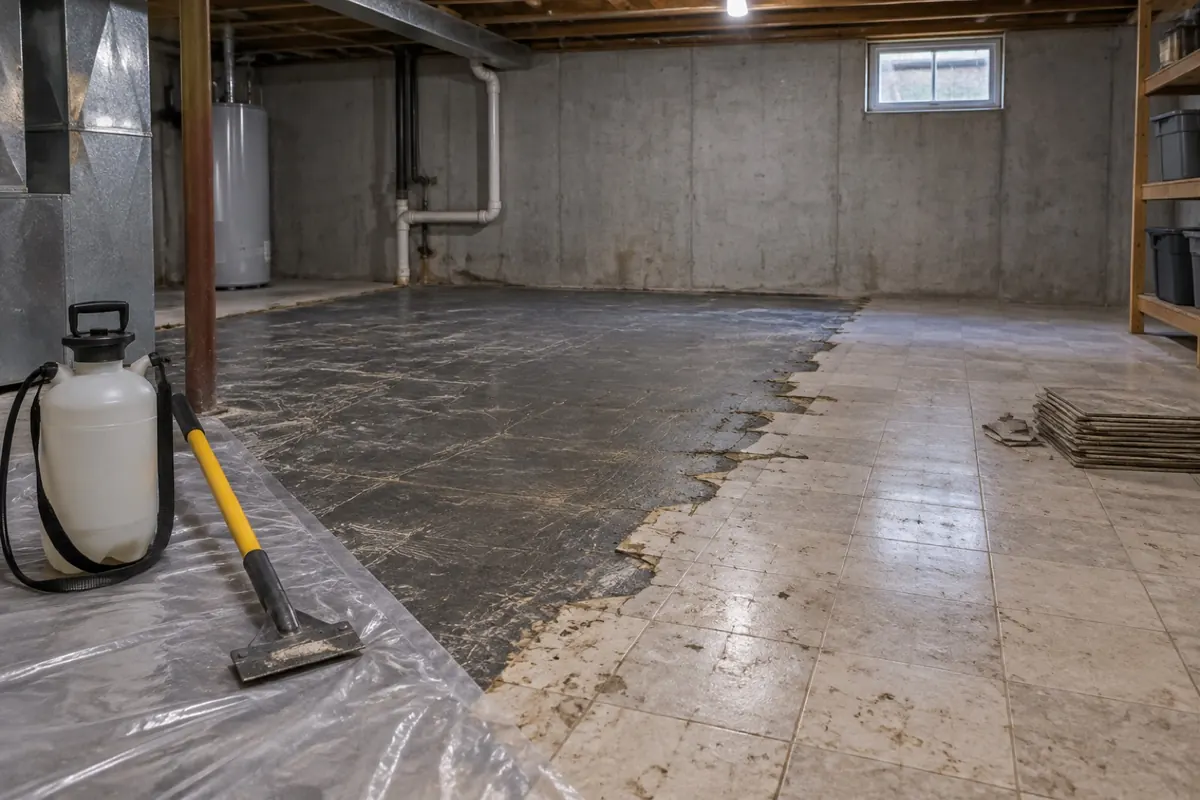
Agencies agree that sanding, grinding and shot blasting make tile regulated. They split on hand tools. Minnesota Department of Health says spud bars and ice chippers carry a lower chance of making tile friable, but no rule makes hand tools non-regulated. Georgia EPD treats long-handled scrapers and spud bars as a regulated friable project. 310 CMR 7.15(13) bans spud bars and ice scrapers but allows a hand scraper struck with a hammer. EPA’s 1991 letter to M. McGill found infrared heating alone does not damage tile in good condition.
| Method | Minnesota (MDH) | Georgia (EPD) | OSHA and RFCI |
|---|---|---|---|
| Heat or infrared | Lower chance of friable | Infrared machines not regulated | Heated tiles removed intact need no wetting |
| Water (wet methods) | Lower chance of friable | Wet removal still required for friable projects | Tiles wetted before removal |
| Dry ice | Lower chance of friable | Not a regulated activity | Not addressed |
| Solvents or chemicals | Lower chance of friable | Not a regulated activity | RFCI: solvent removers above 140 F flashpoint |
| Hand scraper, spud bar, ice chipper | Lower chance, not automatically nonfriable | Regulated friable project | RFCI: scraper yes, spud bar no |
| Mechanical chipping or grinding | Makes tile friable | Regulated friable project | OSHA: only inside a negative pressure enclosure |
| Shot blasting | Makes tile friable | Regulated friable project | RFCI: beadblasting prohibited |
The mastic problem: cutback adhesive
The black adhesive under older tile is often the harder material. RFCI says vinyl asbestos tile and asphalt tile contained asbestos, “as did some asphaltic ‘cutback’ adhesives”. OSHA’s sampling appendix in 29 CFR 1926.1101 says tile and mastic should be analysed separately because the mastic may contain asbestos while the tile does not. EPA’s 1988 letter to T. Loving dealt with exactly that case and said that if the mastic releases fibres during the work, it becomes subject to the NESHAP from that moment.
EPA’s own index makes the point: 4 of its 7 floor tile determinations concern adhesive. The 1990 1990 shot blasting determination says shot blasting crumbles mastic, so the material must be adequately wet before and during the work and until collected, and visible emissions at collection are evidence it was not. Under OSHA paragraph (g)(8)(i)(D), all scraping of residual adhesive and backing must be wet.
| Approach | What the source says | Limits |
|---|---|---|
| Wet-scrape to a thin film | RFCI: detergent solution, 1 oz per gallon, keep it wet, scrape ridges until a thin, smooth film remains | For new tile laid in asphaltic adhesive over concrete |
| Complete removal | RFCI: removal solution, soak 5 to 10 minutes, floor machine with a black pad, kept wet, slurry HEPA-vacuumed | Concrete subfloors; amount depends on the new floor |
| Solvent mastic removers | RFCI: products with flashpoint over 140 F comply with OSHA but may leave residue that harms the new adhesive | New flooring warranties may not cover residue damage |
| Encapsulant over cutback | RFCI: not recommended; may affect the new adhesive bond | Use the replacement maker’s instructions |
| Shot blasting | EPA: allowed only adequately wet throughout | Regulated friable project in Georgia |
Checklist before removing asbestos tile
- Test tile and mastic as separate layers, or presume both are asbestos. OSHA presumes vinyl and asphalt flooring installed no later than 1980 is asbestos-containing.
- Ask whether it can stay. RFCI calls removal the last alternative.
- Check condition. EPA’s McGill letter says tile that is peeling, cracking or crumbling must be tested for friability.
- Pick a method that keeps tiles whole: wetting or heat with a hand scraper, never a spud bar or chipper.
- Decide the mastic by the new floor and subfloor, as RFCI does.
- Set a stop rule. If tiles start breaking, stop, wet and cover them: Oregon DEQ, MDH and Texas all say the job then becomes friable work.
- Book disposal before the first tile comes up.
Leaving tiles in place and covering them
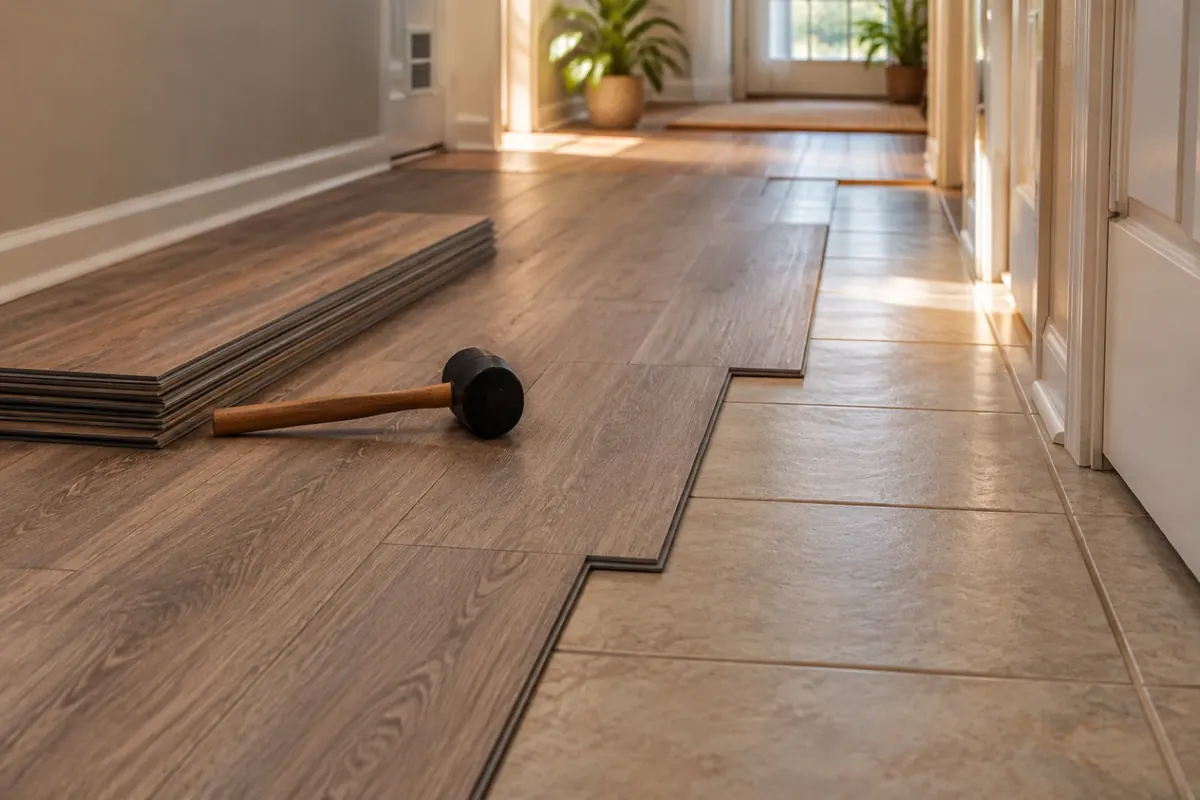
EPA's homeowner asbestos page says: “When asbestos flooring needs replacing install new floor covering over it, if possible.” RFCI agrees and lists three alternatives: install over a single layer of approved existing resilient flooring, fill the embossing with leveler first (residential only), or lay a recommended wood underlayment over flooring on a suspended wood subfloor. MDH's residential floor tile page says new flooring may go over asbestos flooring that is in good shape. One limit: EPA's AHERA carpet answer says carpet over damaged tile is not an enclosure under the school rule, because it is not impermeable, permanent or airtight. Sealants are covered on asbestos encapsulation.
Can you remove asbestos floor tile yourself?
The state by state homeowner table is on our how to remove asbestos page. The tile-specific points: Oregon DEQ's vinyl asbestos tile guidance says an owner occupant removing nonfriable tile in their own home files no notification, but tiles must stay whole and wet, and broken tile becomes friable. PSCAA Regulation III 4.05(c) requires no notice for nonfriable tile but bans sanding, grinding, abrading or sawing it unless handled as friable. Massachusetts lets an owner remove nonfriable tile only while it stays nonfriable. MDH strongly recommends a licensed contractor for any removal.
Disposal of asbestos floor tile
40 CFR 61.150(a)(5) exempts Category I waste that did not become crumbled, pulverized or reduced to powder from the NESHAP packaging rules. States and landfills still set their own.
| Source | Packaging | Where it goes |
|---|---|---|
| RFCI | Heavy-duty impermeable bags of at least 6 mil, one carton per bag, labelled | Approved landfill only |
| Oregon DEQ | Kept wet, two 6-mil bags with the asbestos label and generator name and address | Landfill permitted for asbestos, with an ASN-4 report |
| Massachusetts | Two 6-mil bags, one inside the other, or lidded drums; sharp-edged tile in leak-proof drums or boxes | Removed from the work area every shift |
| PSCAA | Container labelled “nonfriable asbestos waste” | Ask the local disposal company |
| Texas public buildings | Double-bagged and labelled | Final disposal within 30 days of completion, or sooner if the container fills |
For contractors: OSHA, notices and the stop rule
Under 29 CFR 1926.1101, floor tile removal is Class II work, which must be supervised by a competent person. Flooring training must include hands-on work and last at least 8 hours. Vinyl and asphalt flooring installed no later than 1980 is presumed asbestos-containing unless an industrial hygienist determines otherwise. Paragraph (g)(8)(i) sets the work practices below.
| OSHA (g)(8)(i) | Requirement |
|---|---|
| (A) | Flooring or its backing shall not be sanded |
| (B) | HEPA vacuum, disposable bag, metal floor tool, no brush |
| (C) | Sheet goods cut with wetting; rip-up prohibited |
| (D) | Scraping residual adhesive and backing done wet |
| (E) | Dry sweeping prohibited |
| (F) | Mechanical chipping only in a negative pressure enclosure |
| (G) | Tiles removed intact unless shown not possible |
| (H) | Heated tiles removed intact need no wetting |
State paperwork differs. In Minnesota, per MDH, a job over 160 square feet that might turn friable gets a courtesy notice to the MPCA 10 working days ahead; if tiles turn friable, work stops and an emergency notification follows. In Texas public buildings, 25 TAC 296.231 allows RFCI removal by workers with an 8-hour RFCI course under a supervisor with 4 more hours, with DSHS notification. Georgia EPD requires a licensed contractor for friable work over 10 square feet. Keep tile and mastic lab results, any notice and the waste receipt. Price is on our asbestos removal cost page; full abatement on asbestos abatement.
What this page does not cover. Rules and published methods only. It does not address how toxic tile is to people; for health questions see EPA, the National Institutes of Health or CDC, and a physician.
Questions people actually ask
Can you remove asbestos floor tile yourself?
In several states an owner may remove nonfriable tile in their own single-family home, including Oregon, where an owner occupant files no notice, and Massachusetts, while it stays nonfriable. Tiles must be wetted or heated, pried up whole and bagged. Broken tile becomes friable, and agencies such as MDH strongly recommend a licensed contractor.
Can anyone remove asbestos floor tiles?
Workers need training. Under OSHA 29 CFR 1926.1101, tile removal is Class II work under a competent person, with at least 8 hours of hands-on flooring training. States add licensing: Georgia EPD requires a licensed contractor for friable work over 10 square feet. Homeowner exemptions cover owner-occupants doing their own work, not hired help.
How much does it cost to get asbestos floor tiles removed?
According to Fixr’s asbestos removal guide, updated August 2022, asbestos floor tile removal runs $5 to $15 per square foot. Testing tile and mastic as separate layers, mastic removal and disposal fees change the total. Our asbestos removal cost page compares named sources by material.
How do you remove asbestos tile glue?
RFCI describes two wet methods: wet-scrape cutback adhesive with a 1 ounce per gallon detergent solution until a thin, smooth film remains, or remove it with a removal solution and a floor machine with a black pad, kept wet and HEPA-vacuumed. OSHA requires adhesive scraping to be wet. RFCI warns solvent removers can leave residue.
Where do you dispose of asbestos tiles?
At a landfill approved for asbestos. RFCI says approved landfill only, in impermeable bags of at least 6 mil, labelled. Oregon DEQ requires two 6-mil labelled bags marked with the generator’s name and address and an ASN-4 waste shipment report. Call the landfill first; some take asbestos by appointment or on set days.
How do you encapsulate asbestos tile flooring?
For floors, encapsulation usually means covering. EPA says to install new floor covering over asbestos flooring where possible. RFCI allows going over a single existing layer, filling embossing with leveler, or adding wood underlayment over a suspended wood subfloor. RFCI does not recommend encapsulants over cutback adhesive.
Where can I buy asbestos-free floor tiles?
RFCI states that resilient floor covering products manufactured today do not contain asbestos. Colorado’s health department notes that imported products may still contain it and suggests asking the supplier or manufacturer, reading the Safety Data Sheet or having material tested by an accredited lab before installing.
What are best practices for maintaining intact asbestos floor tiles?
Do not sand, level or dry sweep it. OSHA allows stripping only with low abrasion pads below 300 rpm and wet methods, and burnishing only where the finish keeps the pad off the tile. EPA is stricter: never use a power stripper on flooring that may contain asbestos. Clean with a HEPA vacuum fitted with a metal floor tool.
Sources
- eCFR, 40 CFR 61.141, 61.145 and 61.150 (asbestos NESHAP). 61.141; 61.145; 61.150. Retrieved 18 October 2026.
- eCFR, 29 CFR 1926.1101, OSHA asbestos construction standard. ecfr.gov. Retrieved 18 October 2026.
- Resilient Floor Covering Institute, Recommended Work Practices for Removal of Resilient Floor Coverings (January 2018). rfci.com. Retrieved 18 October 2026.
- US EPA, How EPA’s Asbestos Regulations Apply to Floor Tiles and Mastic (last updated 6 November 2025). epa.gov. Retrieved 18 October 2026.
- US EPA determination letters: Loving (1988), Spratlin (1990), Antz (1991), McGill (1991), Keyes (1994). Loving; Spratlin; Antz; McGill; Keyes. Retrieved 18 October 2026.
- US EPA, Protect Your Family from Exposures to Asbestos. epa.gov. Retrieved 18 October 2026.
- US EPA, AHERA question on carpet over damaged floor tile. epa.gov. Retrieved 18 October 2026.
- Minnesota Department of Health, Commercial and Residential Floor Tile Removal. commercial; residential. Retrieved 18 October 2026.
- Georgia EPD, Asbestos Floor Tile Projects. epd.georgia.gov. Retrieved 18 October 2026.
- Oregon DEQ, How to Remove Nonfriable Vinyl Asbestos Floor Tiles. oregon.gov. Retrieved 18 October 2026.
- Massachusetts, 310 CMR 7.15 (Cornell LII). law.cornell.edu. Retrieved 18 October 2026.
- Texas, 25 TAC 296.231, RFCI removal in public buildings (Cornell LII). law.cornell.edu. Retrieved 18 October 2026.
- Puget Sound Clean Air Agency, Regulation III, sections 4.03 and 4.05. pscleanair.gov. Retrieved 18 October 2026.
- Colorado Department of Public Health and Environment, Asbestos and your health. cdphe.colorado.gov. Retrieved 18 October 2026.
- Fixr, Asbestos Removal Cost (updated 18 August 2022). fixr.com. Retrieved 18 October 2026.
Rules change and local agencies can be stricter. Confirm with the agency for your address. Research method: methodology. More on the standards hub.