The short answer
Asbestos ceiling tiles cannot be identified by eye. The pinhole and fissured surfaces people search for are still sold today in mineral fibre, and age, size and back markings only shift the odds. A polarized light microscopy test of the tile, plus the glue daubs on 12 by 12 tiles, settles it, and on commercial work the asbestos NESHAP requires that inspection before removal.
Key takeaways
- The look is not evidence. Armstrong still sells a mineral fibre tile called Fine Fissured, so the classic texture proves nothing on its own.
- Glued 12 by 12 tiles are two samples: the tile and the adhesive daubs. The Wisconsin State Laboratory of Hygiene notes that many glues contain asbestos even when the tile does not.
- OSHA does not presume ceiling tiles are asbestos the way it presumes sprayed texture. You need a test, or due diligence that tells you otherwise.
- A water-soaked tile that crumbles can move from nonfriable to regulated material, because the NESHAP classifies by how the material behaves under the forces of the job.
- On a covered building, 160 square feet of regulated material triggers the full NESHAP rules: 20 tiles of 2 by 4 feet.
- An emergency renovation still needs the inspection, but the notice deadline shrinks from 10 working days to the next working day.
On this page
Wet ceiling tiles are a routine part of commercial water losses, yet the pages ranking for this term are mostly forums, a retailer, a contractor and sites run for asbestos lawsuits. This page sets out what the regulations, the labs and one manufacturer actually say. Sprayed texture is a different material; see popcorn ceiling asbestos.
What this page does not cover: health effects or what an exposure means for a person. EPA’s asbestos pages and the CDC’s ATSDR are the public references, and a physician is the person to ask.
Which ceiling do you have?
Start with how the ceiling is built, because that decides what gets sampled and how the rules treat it.
| Ceiling | How it is fixed | What to sample | First move |
|---|---|---|---|
| Suspended 2 x 2 or 2 x 4 ft lay-in panels | Sit loose in a metal grid | One sample of each tile pattern | Lift one panel only after testing |
| 12 x 12 in tiles on furring or drywall | Glued with daubs of adhesive, or stapled | Tile and adhesive, separately | Treat the glue as its own material |
| Sprayed or troweled texture | Applied wet to the ceiling | Texture, three samples | See the popcorn ceiling page |
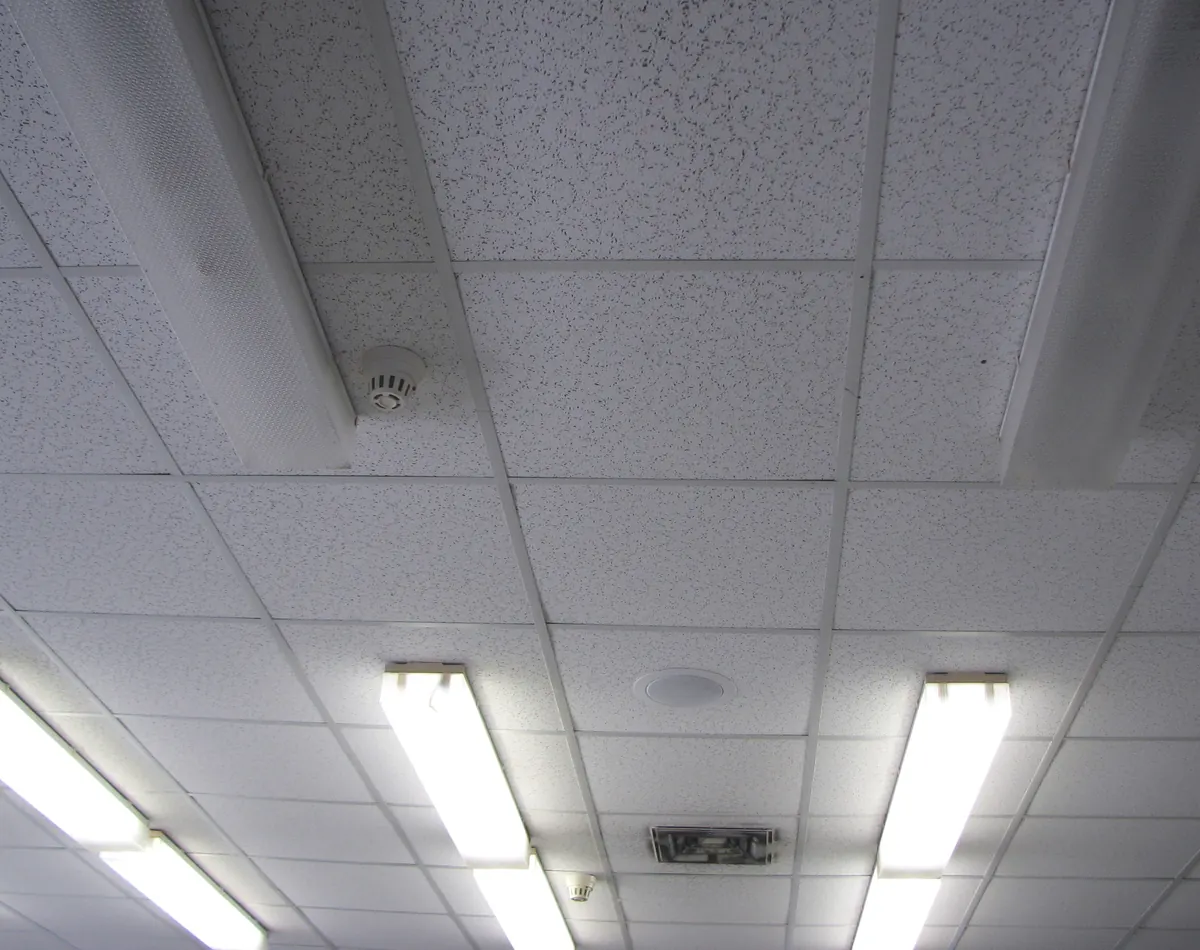

The Oregon DEQ list of materials that may contain asbestos lists acoustical ceiling tiles among friable materials, alongside adhesives and mastics when dry and brittle. That is a suspect list, not a finding: the same list says nothing about what share of tiles test positive, and no primary source found for this page gives that share.
What the look tells you, and what it does not
Every visual cue in the ranking pages describes an ordinary acoustic tile. The Armstrong Fine Fissured product page shows the classic fissured face on a mineral fibre tile in current production, and Kanopi by Armstrong describes its tiles as mostly fibre and perlite with starch binder. A tile can match every description of an asbestos tile and contain none.
| Clue | What it tells you | Why it does not settle it |
|---|---|---|
| Pinhole or fissured face | Normal acoustic tile texture | Armstrong sells Fine Fissured today, in mineral fibre |
| Light colour, soft texture | Typical of mineral fibre tile | Asbestos-free tiles look and feel the same |
| 2 x 2 or 2 x 4 ft size | A standard grid size | Still the standard sizes |
| Installed before the mid-1980s | Kanopi by Armstrong lists this as a reason to suspect | Raises the odds; no federal cut-off date exists for tiles |
| Brand or pattern on the back | Can identify the maker | No published date-code key was found to date a tile |
| Glue daubs on the back | Glued 12 x 12 installation | The adhesive needs its own test |
Maker and date clues you can source
Only one manufacturer statement was found. Kanopi by Armstrong, the Canadian site of Armstrong World Industries, states that Armstrong ceiling tiles have never contained asbestos. That is the company’s claim, not test data, and it only helps if the back of the tile identifies it as Armstrong. No statement from other makers, and no published key to back-stamp date codes, was found, so this page does not offer one.
Federal ban history does not help either. EPA's record of its asbestos actions lists bans on spray-applied surfacing, pipe and block insulation, and patching compounds, and a 1989 product ban partially overturned in 1991; ceiling tiles are not named in any of them. Unlike sprayed texture, 29 CFR 1926.1101 does not presume a tile is asbestos by building age. Its presumption covers thermal system insulation and surfacing, plus asphalt and vinyl flooring installed no later than 1980, and it adds that owners must treat other materials as asbestos if they know, or should have known through due diligence, that they are.
What to sample, and the glue daubs
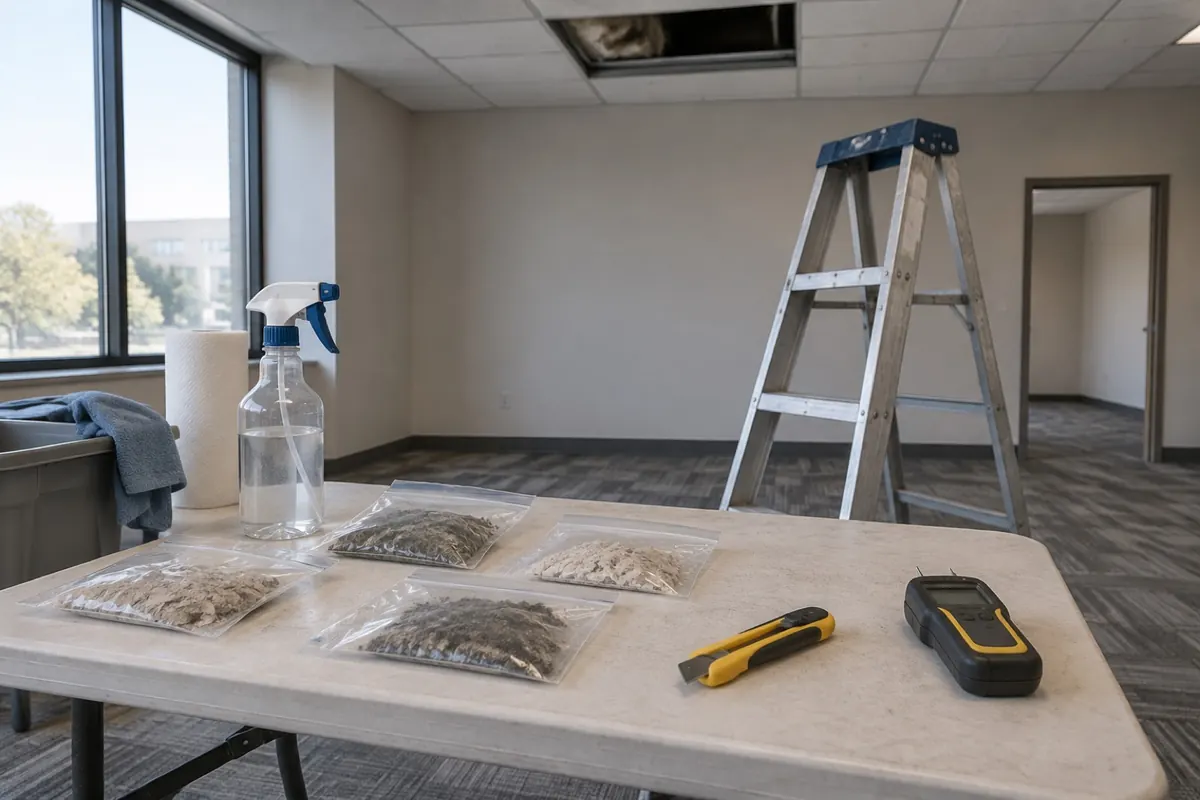
The Wisconsin State Laboratory of Hygiene gives the practical rule: moisten the spot first, take a piece at least 1 inch square, capture every layer, and if the sample is glued to something, include some of the glue, because even if the tile does not contain asbestos many of the glues do. Per 40 CFR 763.87, an area counts as asbestos-containing when any sample shows more than 1 percent.
| Ceiling | What goes in the bag | Results billed |
|---|---|---|
| Lay-in panel | A piece of the panel, full thickness | 1 |
| Painted lay-in panel | Full thickness; paint is a layer | 1 to 2, by lab |
| Glued 12 x 12 tile | The tile, plus a daub of the adhesive | 2 |
| Stapled 12 x 12 tile | The tile | 1 |
According to the Seattle Asbestos Test price list, a tile and its glue are billed as two materials, so $100 to $160 at its regular and rush rates, while the Wisconsin State Laboratory of Hygiene charges $48 a sample. The full comparison is on our asbestos testing cost page, and the floor version of the adhesive question is on asbestos floor tiles. On commercial jobs the sampling belongs to an accredited inspector, as the next sections explain.
How the rules classify a tile
Ceiling tiles are not Category I material, which 40 CFR 61.141 limits to packings, gaskets, resilient floor covering and asphalt roofing. A tile over 1 percent asbestos is either friable or Category II nonfriable, and Category II becomes regulated asbestos-containing material, RACM, when it has a high probability of being crumbled, pulverized or reduced to powder by the forces of the renovation. Under 29 CFR 1926.1101, removing asbestos material that is not thermal insulation or surfacing is Class II work.
| Tile condition | NESHAP status | OSHA work class |
|---|---|---|
| Dry, intact panel that powders under hand pressure | Friable, so RACM if over 1 percent | Class II removal |
| Dry, intact tile that does not crumble | Category II nonfriable ACM | Class II removal |
| Water-soaked tile likely to crumble as it is pulled | RACM: high probability of being reduced to powder | Class II removal, wet methods |
| Moving or cutting a tile for other work | Depends on condition | Class III repair and maintenance |
The third row is the restoration case. A dry tile may be nonfriable; the same tile after a day of soaking, sagging in the grid and pulled down by hand, meets the high-probability test in the RACM definition.
Wet tiles on a commercial loss
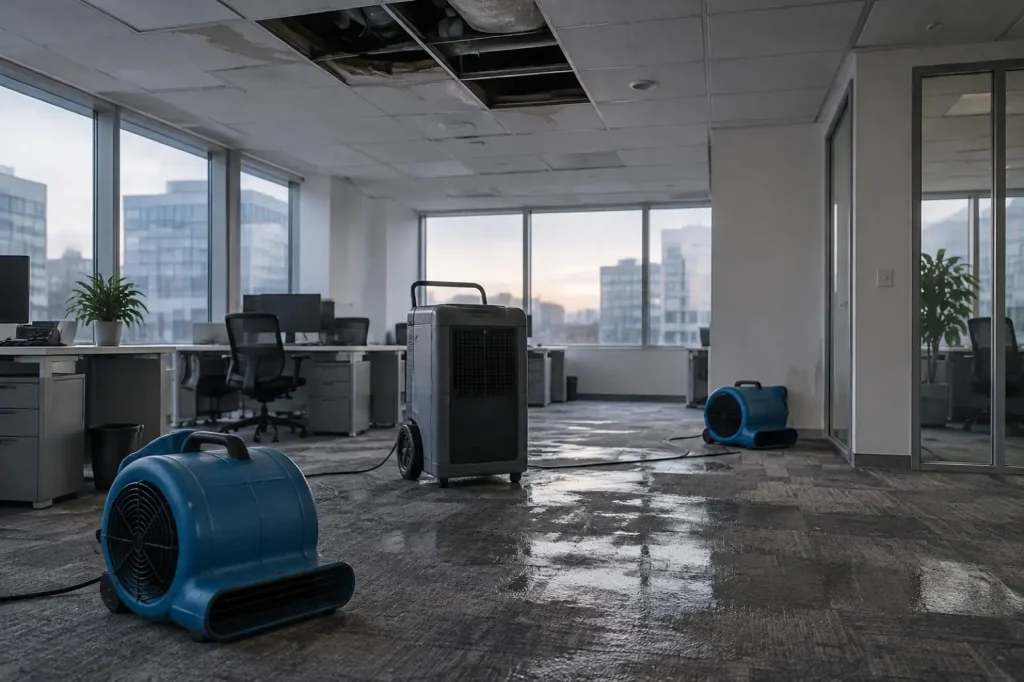
A burst pipe over an office ceiling is the textbook case: stained, sagging panels that every instinct says to pull today. The NESHAP definition of an emergency renovation operation fits it, a renovation that was not planned but results from a sudden, unexpected event, and the rule still applies. This checklist runs in order.
- Confirm the building is covered. Per 40 CFR 61.141 a facility excludes residential buildings of four or fewer dwelling units, so offices, shops, schools and apartment blocks are in. A single house is out, per EPA’s 1995 clarification.
- Inspect before tear-out. 40 CFR 61.145(a) requires the owner or operator to thoroughly inspect the affected part of the facility for asbestos, including Category I and II nonfriable material, before the renovation begins. Bag a tile and a daub for the lab.
- Estimate the quantity from the event. For an emergency renovation, the rule has you estimate the regulated material to be removed as a result of the sudden, unexpected event.
- Check it against 160 square feet. That is 20 tiles of 2 by 4 feet, 40 of 2 by 2, or 160 glued 12 by 12 tiles.
- Notify if it crosses. An emergency renovation notice is due as early as possible and no later than the following working day, with the date and hour of the emergency and how it caused an unsafe condition, equipment damage or an unreasonable financial burden.
- Work wet and lower, never drop. 40 CFR 61.145(c) requires RACM to be adequately wet and carefully lowered, not dropped, thrown or slid, with a trained person on site.
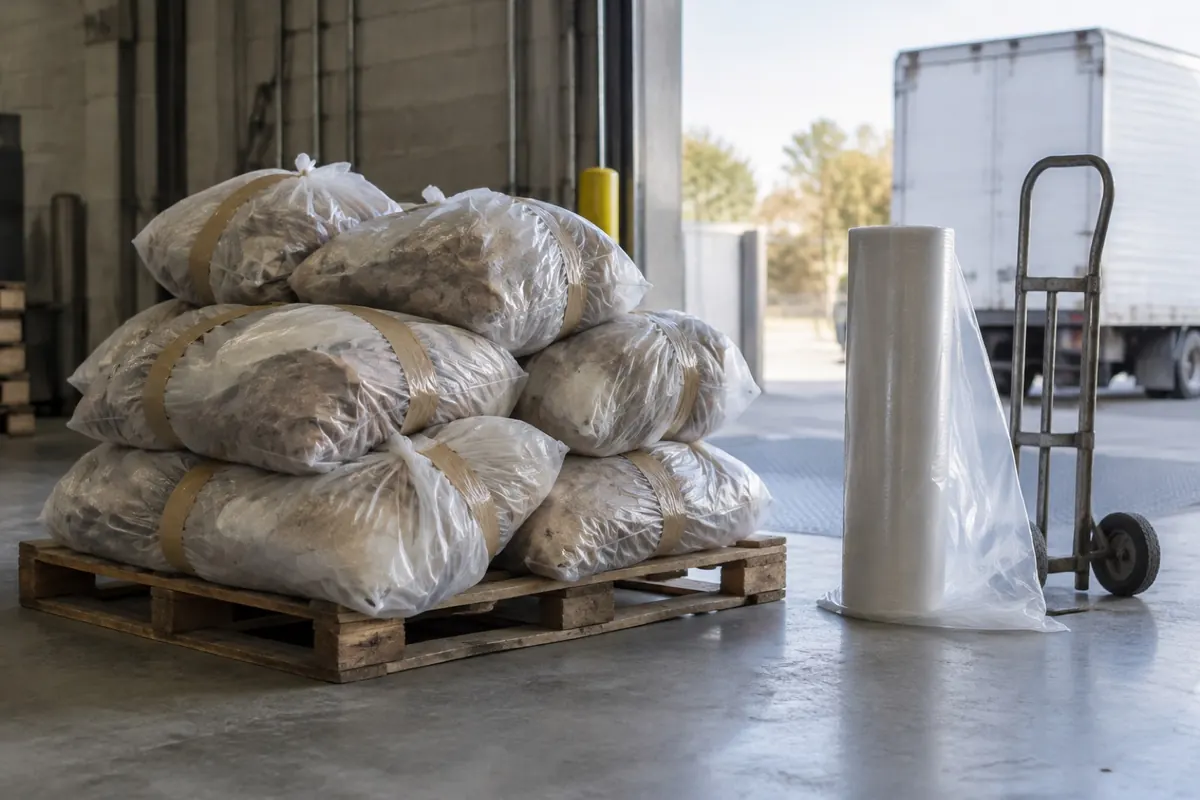
- Bag and ship it properly. Under 40 CFR 61.150 waste is sealed wet in leak-tight, labelled containers, with a waste shipment record when it leaves the site.
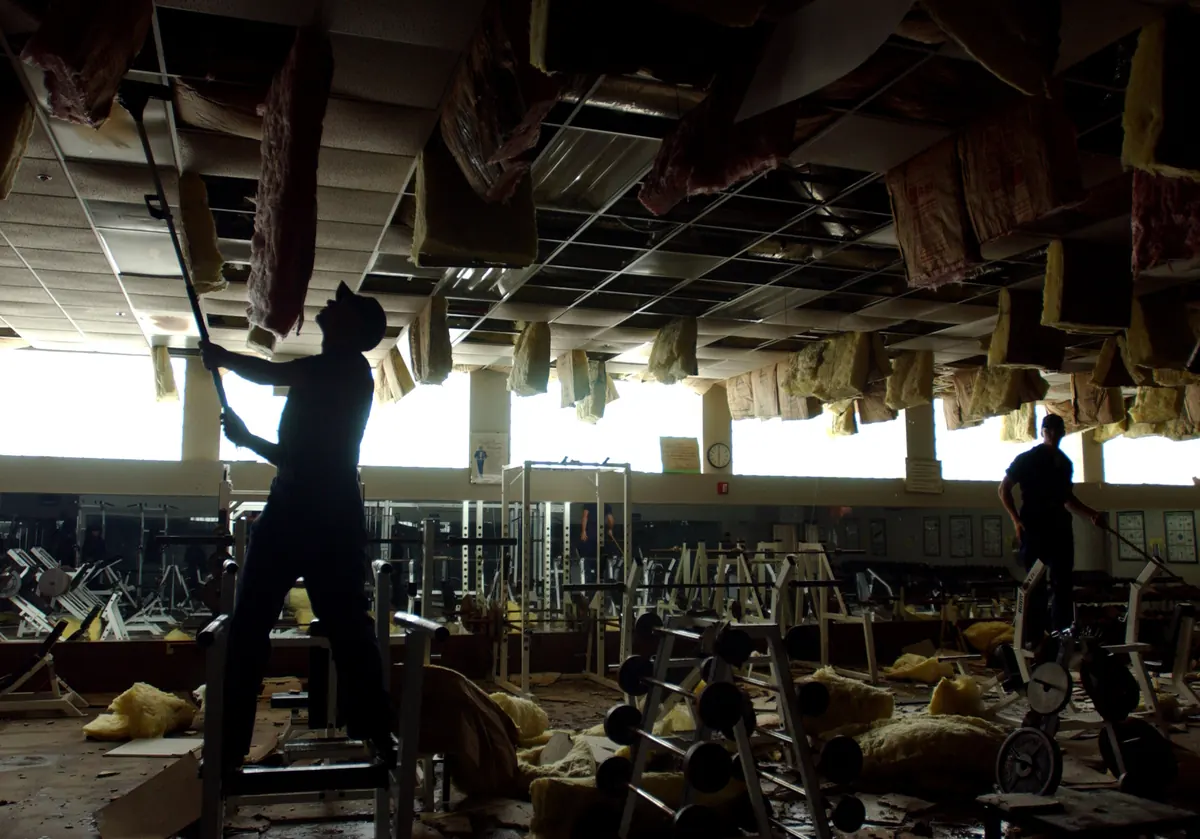

29 CFR 1926.1101 covers the crew alongside the NESHAP: its scope includes asbestos spill and emergency cleanup, and wet methods are required unless shown infeasible. State contacts, some of whom handle the NESHAP, are listed on EPA's state asbestos contacts. Drying the rest of the job is covered on commercial water damage restoration and water mitigation.
Removal and testing costs
No national cost guide found for this page publishes a removal rate for asbestos ceiling tiles specifically, so the table uses the nearest published figures and says which is which. Bob Vila’s guide is the only one found that prices ceiling tiles by name, and only for encapsulation.
| Source | Updated | Item | Published figure |
|---|---|---|---|
| HomeAdvisor | 17 June 2026 | Interior removal, all materials | $5 to $20 per sq ft |
| HomeAdvisor | 17 June 2026 | Encapsulation | $2 to $6 per sq ft |
| Bob Vila | 21 December 2023 | Ceiling tile encapsulation | $2 to $6 per sq ft |
| HomeAdvisor | 17 June 2026 | Testing | $250 to $850 |
| Fixr | 18 August 2022 | Testing; air testing | $250 to $750; $400 to $1,200 |
| Seattle Asbestos Test | Undated | Lab, per material; air monitoring visit | $50 to $80; $400 to $1,200 |
According to HomeAdvisor's asbestos removal guide, the average asbestos job is $2,249 within $1,216 to $3,283, and Bob Vila's asbestos removal guide puts it at $2,201 within $1,192 to $3,240. Commercial jobs add notification above the line, and an air clearance test where the specification calls for one. Other materials are priced on asbestos removal cost, and whether a policy pays is a question for the policy and your state insurance department; see does insurance cover asbestos removal.
For contractors: the file
Scope the tile question as its own phase, ahead of drying demolition: test, quantify, notify, remove, then dry. Each line in the estimate should point to a document a carrier’s adjuster can check.
| Stage | What the rule requires | What goes in the file |
|---|---|---|
| Before tear-out | Inspection under 40 CFR 61.145(a) | Lab report per layer, lab name, date, analyst |
| Quantity | Square feet of RACM from the event | Measured area and tile count |
| Notice | Next working day at 160 sq ft or more | Copy of the notice with date and hour |
| Work | Wet methods; Class II controls | Photos of wetting and lowering |
| Waste | Leak-tight, labelled, shipped with a record | Waste shipment record |
| Close-out | Air clearance where specified | Air results before the ceiling goes back |
Ceiling drying after the tiles are out is covered in our water-damaged ceiling guide.
Questions people actually ask
How can you tell if ceiling tiles are asbestos?
Only a lab can tell. Pinhole and fissured faces, light colour and 2 by 2 or 2 by 4 foot sizes all describe ordinary mineral fibre tiles still sold today. Age before the mid-1980s and an unidentified maker raise suspicion. A polarized light microscopy test of a tile piece, plus the adhesive on glued tiles, gives the answer against the 1 percent line.
What if I accidentally removed asbestos ceiling tiles?
Stop, keep people out of the room and leave the debris where it is. EPA says not to dust, sweep or vacuum debris that may contain asbestos. Keep one intact piece for testing and get a professional assessment. On a commercial building, the NESHAP inspection and emergency notice duties may already apply.
How bad are asbestos ceiling tiles?
In regulatory terms it depends on condition. EPA says material in good condition that will not be disturbed should be left alone. The same tile becomes regulated material under the NESHAP when it is friable or likely to be crumbled by the work, which is what water damage tends to do. Health questions are outside this page.
What should I do if I have asbestos ceiling tiles?
If they are intact and nothing will disturb them, EPA’s guidance is to leave them alone. Encapsulation is priced at 2 to 6 dollars a square foot by Bob Vila’s guide. If renovation or water damage will disturb them, hire an accredited inspector to test first and a qualified abatement contractor to remove them.
Did Armstrong ceiling tiles contain asbestos?
Armstrong says no. Kanopi by Armstrong, a Canadian Armstrong World Industries site, states that Armstrong ceiling tiles have never contained asbestos. That is a manufacturer statement rather than test data, and it only helps if markings on the back confirm the tile is Armstrong. An unmarked tile still needs a lab test before it is disturbed.
Can I replace one stained ceiling tile myself?
Lifting an untested panel out of the grid is a disturbance, however small. Test it first: a mailed sample costs tens of dollars at the labs compared on this page. If it is negative, the swap is ordinary work. If it is positive, the rules for your building and state decide who may handle it.
Sources
- 40 CFR 61.141, 40 CFR 61.145 and 40 CFR 61.150, asbestos NESHAP definitions, renovation duties and waste rules, via eCFR. Retrieved 11 October 2026.
- 29 CFR 1926.1101, OSHA construction asbestos standard, via eCFR. Retrieved 11 October 2026.
- 40 CFR 763.87, AHERA analysis rule, via eCFR. Retrieved 11 October 2026.
- EPA's 1995 Clarification of Intent, Federal Register, 28 July 1995. Retrieved 11 October 2026.
- EPA homeowner guidance (updated 25 June 2026), EPA's record of its asbestos actions (updated 21 January 2026) and EPA's state asbestos contacts (updated 1 October 2026), EPA. Retrieved 11 October 2026.
- Oregon DEQ list of materials that may contain asbestos, Oregon Department of Environmental Quality, last updated 24 December 2018. Retrieved 11 October 2026.
- Wisconsin State Laboratory of Hygiene, homeowner sampling instructions and fees. Retrieved 11 October 2026.
- Kanopi by Armstrong, Identifying asbestos ceiling tiles, 9 August 2024. Retrieved 11 October 2026.
- Armstrong Fine Fissured product page, Armstrong World Industries. Retrieved 11 October 2026.
- HomeAdvisor's asbestos removal guide, HomeAdvisor, updated 17 June 2026. Retrieved 11 October 2026.
- Bob Vila's asbestos removal guide, Bob Vila, updated 21 December 2023. Retrieved 11 October 2026.
- Fixr's asbestos removal guide, Fixr, updated 18 August 2022. Retrieved 11 October 2026.
- Seattle Asbestos Test price list, Seattle Asbestos Test, undated. Retrieved 11 October 2026.
- Tile counts and scenario totals are arithmetic on the figures above. Our methodology sets the standing rules; related pages sit on the standards hub.
Rules differ by state and local agency, and prices change. Confirm both before disturbing a ceiling.