The short answer
Asbestos in drywall is usually a question about the joint compound and texture, not only the gypsum board. The Consumer Product Safety Commission banned consumer patching and joint compounds with added asbestos in December 1977, and federal sources also list wallboard itself. Only a lab test settles it, and how the layers are analysed depends on the rule that applies.
Key takeaways
- The CPSC ban (16 CFR 1304) hit patching and tape joint compounds made after 16 January 1978, and all of them after 11 June 1978. The Commission found about half of 1977 consumer compounds used asbestos.
- EPA treats board, tape and seam compound as one wall system and recommends a composite result for the asbestos NESHAP.
- Texture, paint and skim coats are add-on layers: analysed separately, never averaged into the board.
- OSHA’s compliance policy is single layer sampling of wallboard systems, so the composite does not settle worker protection.
- A flood cut through asbestos-containing wallboard is Class II work under 29 CFR 1926.1101, or Class III if it fits in one waste bag.
- The NESHAP excludes houses with four or fewer units; OSHA still covers the contractor.
On this page
The regulations do not ask whether a wall has asbestos. They ask which layer, analysed how, under whose rule. A wall that passes as one composite sample for an air agency can still need full worker protection under OSHA, and a state can refuse the composite EPA recommends.
What this page does not cover. Health effects, including cancer, mesothelioma, asbestosis and other lung disease, symptoms and diagnosis, are outside the scope of this page; see EPA's Learn About Asbestos page and a physician.
Board, tape, mud and texture: four materials, one wall
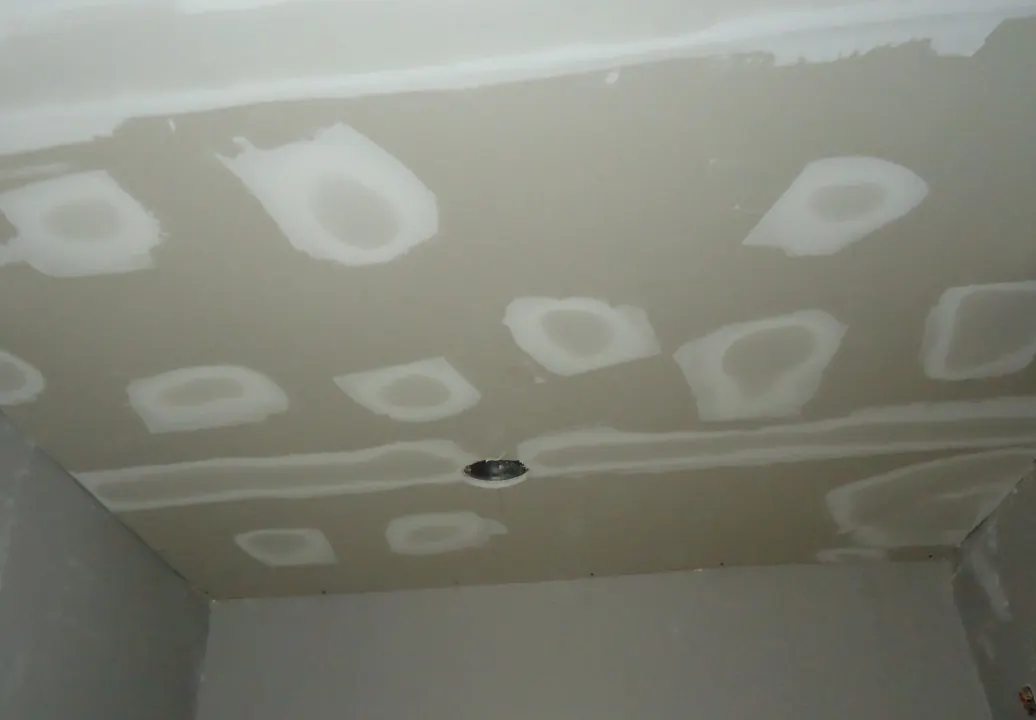
Drywall with asbestos can mean four different things. The board is a gypsum panel; tape and joint compound hide seams and fasteners; a skim coat or texture may cover the face; paint sits on top. OSHA’s technical appendix to 29 CFR 1926.1101 lists fire-resistant drywall among asbestos products, and the Minnesota Department of Health product list lists wallboard, wallboard joint compound and spackling compounds as separate entries.
| Layer | What it is | What the sources list | EPA treatment |
|---|---|---|---|
| Gypsum board | Gypsum core between paper faces | OSHA Appendix H names fire-resistant drywall; MDH lists wallboard | Base of the wall system |
| Tape and seam compound | Covers joints and fastener heads | CPSC names tape joint compound and spackling compound | Part of the composite |
| Skim coat | Compound over the whole face | MDH lists joint and spackling compounds | Outside the weighted average |
| Texture, paint | Finish on top | MDH lists ceiling texture | Add-on: analysed separately |
Gypsum board asbestos is what people search for, but the useful question is which layer the work breaks. A screw touches one; a flood cut slices all of them. Forum claims that drywall almost never contained asbestos describe the board alone.

The 1977 compound ban, read closely
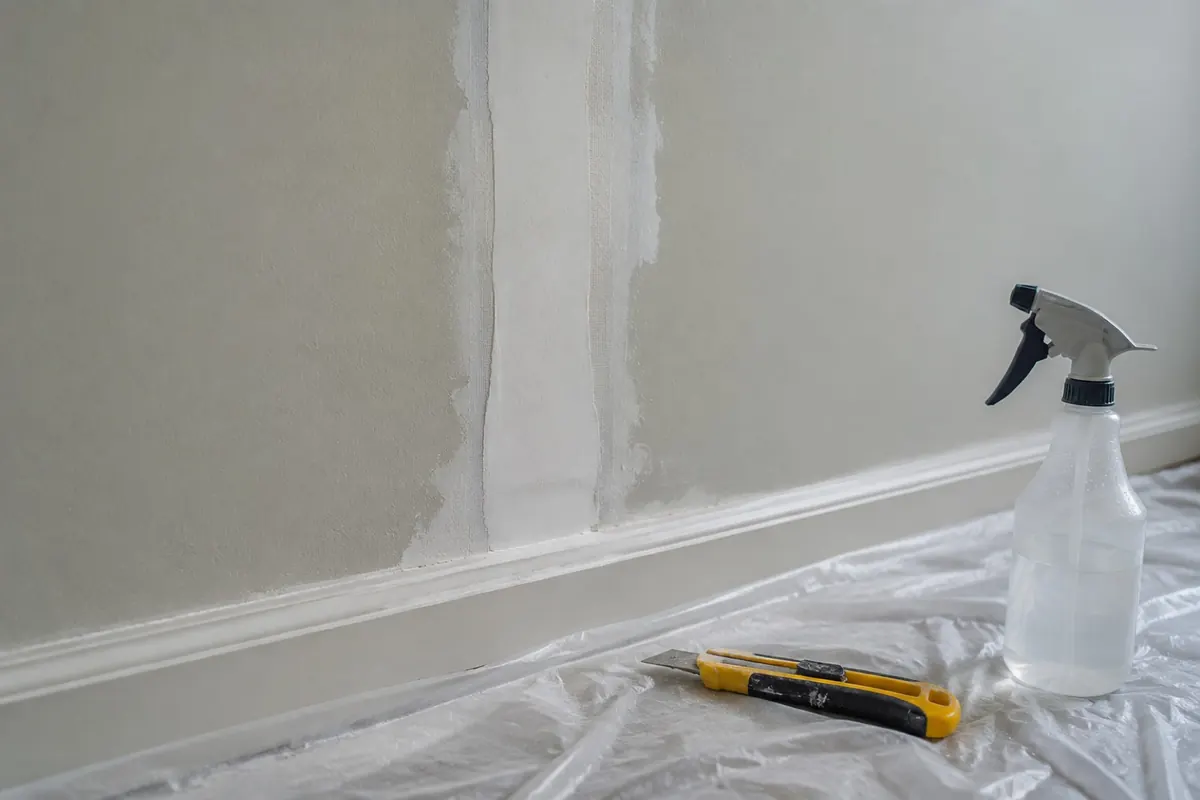
The ban people cite is 16 CFR Part 1304, the Consumer Product Safety Commission’s ban of consumer patching compounds containing respirable free-form asbestos. Its findings say the banned products include drywall spackling compounds and tape joint compounds, known as joint cement or tape joint mud. That is why asbestos joint compound is a datable product, not a rumour.
| Date or term | What the rule says | 16 CFR |
|---|---|---|
| 15 December 1977 | Rule published, 42 FR 63362 | Part 1304 source note |
| 16 January 1978 | Banned if made or first shipped after this date | 1304.4 |
| 11 June 1978 | All such consumer compounds banned, whenever made | 1304.4 |
| Exempt | Compounds sold solely for industrial use in non-consumer settings | 1304.1(c) |
Three details matter. The ban targets intentionally added asbestos in compounds and says nothing about the board. Industrial-only compounds were exempt. And the Commission said many other compounds carried asbestos contamination from raw materials. A post-1978 wall is less likely to test positive, not certain to test negative. OSHA's 14 November 2024 letter says asbestos may still be found in many home materials, more so in homes built before 1980.
Per the rule, asbestos reinforced the compound against cracking and shrinkage; attapulgite clay was the usual substitute.
Other product dates are on our when asbestos was banned page.
Composite or layer by layer: what EPA actually said
In EPA's 5 January 1994 clarification (59 FR 542), EPA wrote that joint compound and tape applied to wallboard become an integral part of it, in effect one material forming a wall system, so a composite analysis of compound, tape and board should be conducted. If the result is greater than 1 percent and at least 160 square feet of the system is involved in a calendar year, the work is subject to the asbestos NESHAP, per that notice.
The same notice excluded add-on materials: sprayed material, paint and texture must be analysed separately and may not be averaged with the board. EPA's 19 December 1995 clarification (60 FR 65243) restated that every other layered system is analysed by layer. The current EPA asbestos question and answer page repeats the wall-system position and says the inspector reports a weighted average for joint compound that is not a skim coat.
| Situation | Rule | Source |
|---|---|---|
| Tape and compound at seams and nail holes | One wall system; composite analysis of compound, tape and board | EPA, 59 FR 542 |
| Reported number for that system | Weighted average of the components (not for skim coat) | EPA Q and A page |
| Texture, paint, sprayed material | Analysed separately; never averaged with the board | EPA, 59 FR 542 |
| Any other layered sample | By layer; a gravimetric composite may screen first, but 1% or less with asbestos detected goes back to layers | EPA, 60 FR 65243 |
| Schools (AHERA) | No compositing | 40 CFR 763.87(b) |
| Worker protection | Single layer sampling of wallboard | OSHA, 1997 |
The OSHA exception that catches contractors
The composite answers an air-agency question, not the worker question. OSHA's 7 February 1997 memorandum said removal of wallboard systems containing asbestos is covered by the standard, composite sampling is beyond what the standard requires, and OSHA’s compliance policy remains single layer sampling of wallboard. A compound layer above 1 percent can sit in a wall that composites below it: outside the NESHAP, still asbestos-containing material for OSHA.
Where the states part ways with EPA
The 1994 notice calls itself guidance, and state programmes can be stricter.
| Jurisdiction | Position on layers | Source |
|---|---|---|
| EPA (NESHAP) | Composite of board, tape and seam compound; add-on layers separate | 59 FR 542; 60 FR 65243 |
| OSHA (workers) | Single layer sampling of wallboard systems | 1997 memorandum |
| Oregon | No compositing of distinct layers since November 2018, but a joint compound, tape and board system sample may be analysed; pre-2004 homes need an accredited survey before renovation unless the owner occupant does the work | DEQ, Asbestos for Businesses |
| South Carolina | No composite sampling or analysis of wallboard and joint compound, effective 3 March 2010 | Asbestos Section memo (archived) |
South Carolina's 2010 memorandum explains its reasoning. In a pilot demolition, composite data put the joint compound at 1 percent or less, yet air monitoring came back positive during multiple events, even with wet suppression, so the department stopped allowing the composite.
Plaster walls are a different system
Older houses often have plaster on lath. EPA’s EPA's 5 January 1994 clarification (59 FR 542) says distinguishable plaster and stucco layers must be analysed separately, with no wall-system composite; a thin skim layer may carry a little base coat. The Minnesota Department of Health product list lists acoustical and decorative plaster as asbestos products.
Whether plaster counts as surfacing material matters, because OSHA presumes surfacing material in buildings constructed no later than 1980 to contain asbestos. OSHA's 21 April 1998 letter said troweled cementitious plaster is not surfacing material unless it is acoustical plaster, shown by a honeycombed structure, or decorative plaster that looks like it. Stucco is not. Joint compound used as whole-wall texture is usually not, unless it cannot be told apart from acoustical plaster.
The flood cut in an older building
Whether wet board can be saved is covered on our wet drywall page; this section covers what changes when the wall may contain asbestos.
OSHA applies to the restoration contractor
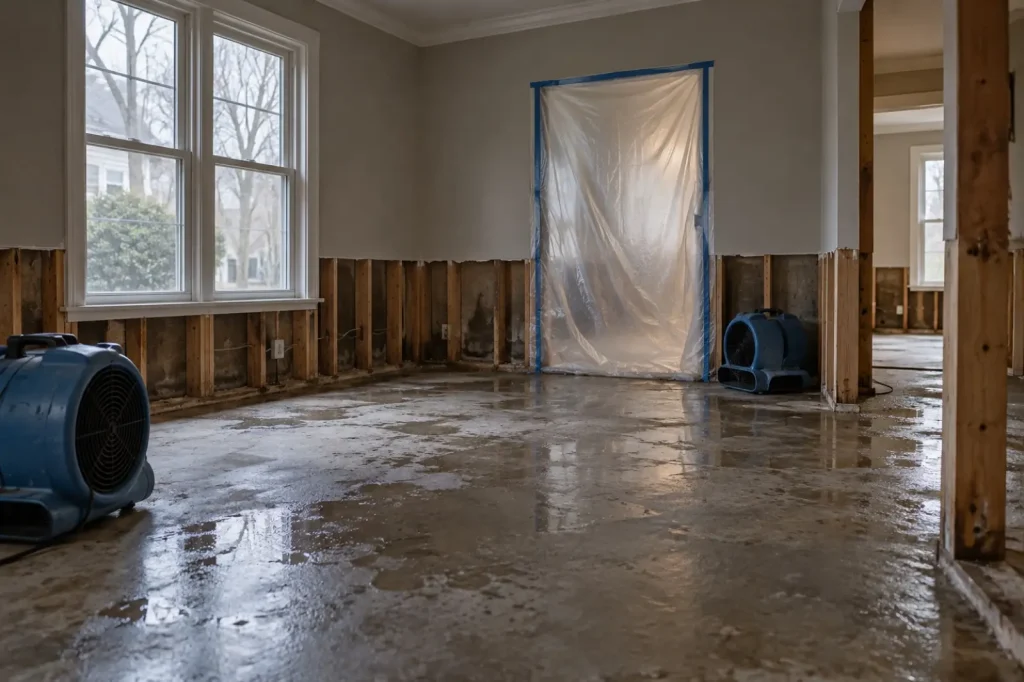
OSHA's 14 November 2024 letter answered a restoration industry member directly: remediation involving asbestos-containing material falls under the construction standard, 29 CFR 1926.1101, even for a firm that is not a typical construction company. The letter’s example was removing 24 inches of sheetrock from the floor up after contaminated water. Per OSHA, that removal follows Class II or Class III procedures, a competent person supervises Class II work, and Class III applies only if the disturbed material fits in one waste bag no more than 60 inches in width and length.
The same letter says no wall-to-wall test is required after a disaster if the standard is followed, and wallboard need not be sampled unless the employer knows, or should have known, it contains asbestos. Homeowners are not employers under the OSH Act. Exposed edges may need encapsulating, and once fully sealed, hanging new board may be Class IV work; see our encapsulation guide.
OSHA's 7 May 2026 letter covered the rebuild: abutting new board to positive board or compound and sanding the joint is Class II or Class III work, not Class I, because joint compound and wallboard are not surfacing material. It also quotes a contractor’s report that Georgia EPD knew of no way to abut new drywall to positive material and leave that material intact.
Where the NESHAP reaches a flood cut
| Building and job | Asbestos NESHAP | OSHA 1926.1101 |
|---|---|---|
| Single-family house or duplex, isolated job | Excluded: four or fewer units is not a facility | Applies |
| Several houses, one owner, one project | Covered as an installation | Applies |
| Five or more units, condo, commercial | Covered; 160 sq ft of wall system over 1% brings in the NESHAP | Applies |
| Covered building after a sudden event | Emergency renovation: notify no later than the next working day | Applies |
40 CFR 61.141 excludes residential buildings with four or fewer dwelling units. EPA's July 1995 clarification of intent (60 FR 38725) added that an isolated small house is not covered whoever renovates it, but houses handled as part of a larger project, or several under one owner on one site, are. Larger losses are covered on our flood damage restoration page.
Before the first cut: the decision path
The sequence the rules imply, in the order a crew meets them. A competent person makes the final call.
- Date the wall. Build year and remodel dates. Post-1978 compound falls under the CPSC ban, which lowers the odds but does not close the question.
- Find any survey. Oregon, for one, requires an accredited survey before renovating pre-2004 homes.
- Name the building type. Four or fewer units and an isolated job: NESHAP likely does not apply. Larger: it may.
- Dry, do not demolish. Extraction can start; cutting and sanding wait.
- Sample or presume. An accredited inspector samples every layer, or the crew treats the wall as positive.
- Get layers and the composite. One report can give both; the state decides which counts.
- Size the job. One 60 by 60 inch bag or less may be Class III; more is Class II with a regulated area.
- Plan the rebuild. Patching and sanding against positive material is covered work too.
Testing a wall system without wasting the sample
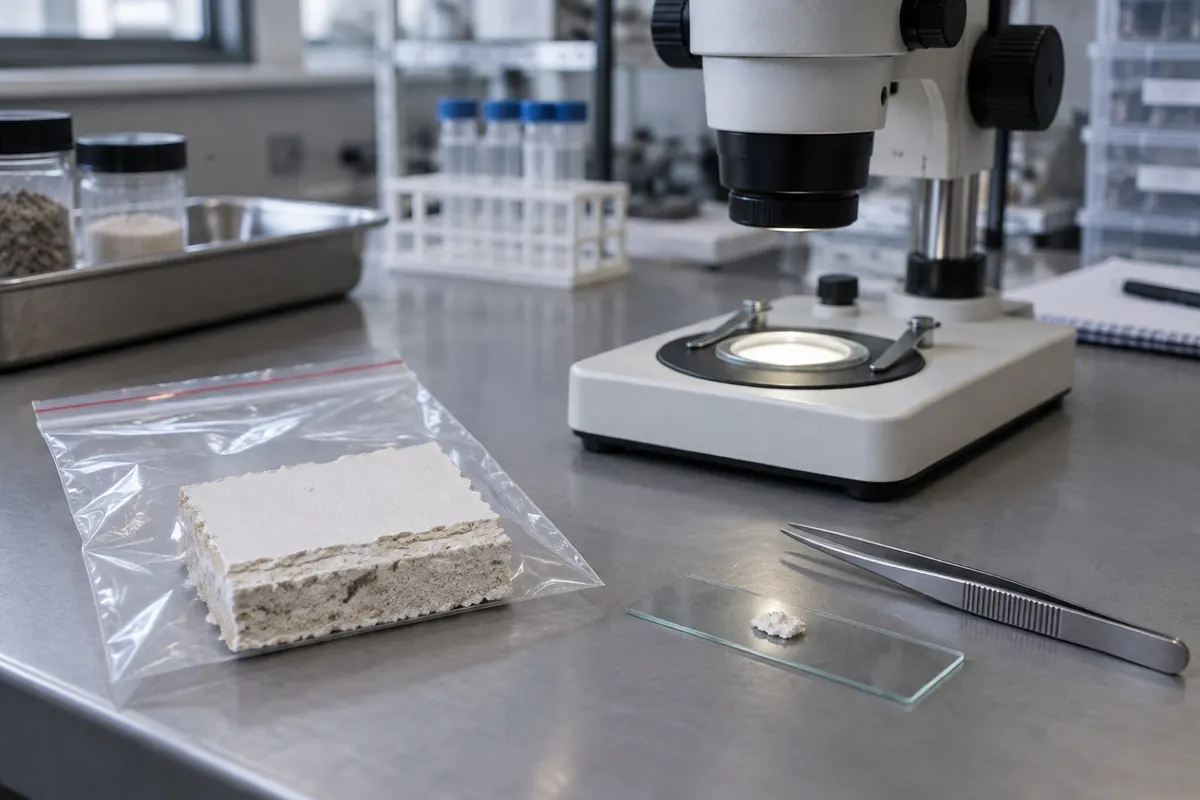
The only way to know if drywall has asbestos is a bulk sample read under a microscope. 40 CFR 61.141 sets the method: polarized light microscopy, with point counting to confirm a result under 10 percent estimated another way, and more than 1 percent asbestos as the line. The EPA homeowner guidance says a trained, accredited professional should take samples and that doing it yourself is not recommended.
Send a full-depth piece from a seam, through paint, texture, compound, tape and board. Ask the lab in writing to report every layer and to say whether a composite was run and how. Schools are simpler: 40 CFR 763.87 bans compositing. Lab choice and turnaround are covered by our sibling page on the asbestos testing lab; sprayed ceilings by popcorn ceiling asbestos.
For contractors: scope, paperwork and the line item
OSHA’s letters treat the cut itself as asbestos work when the wall is positive. A mitigation firm without trained staff should dry, stop, and hand removal to an asbestos contractor. Prohibitions in 29 CFR 1926.1101(g)(3) apply at any exposure: no high-speed abrasive disc saws without point of cut ventilation or HEPA exhaust, no compressed air, no dry sweeping, no employee rotation.
| What the adjuster and the file need | Why |
|---|---|
| Build year, survey status | Sets presumption and state rule |
| Lab report by layer | Matches OSHA’s single layer policy |
| Competent person and training | Required for Class II, 1926.1101(o) |
| Exposure assessment | 1926.1101(f), Class II and III |
| Regulated area photos | 1926.1101(e)(1) |
| Disposal receipt | State and landfill rules |
| NESHAP notice, if covered | 40 CFR 61.145(b) |
Write asbestos removal as its own line, separate from standard drywall removal, with the lab report attached. Whether a policy pays for it is a policy question: point the owner to the policy wording, the state insurance department and a licensed professional.
Questions people actually ask
How do you know if your drywall has asbestos?
Only a lab can tell. An accredited inspector cuts a sample through every layer and a lab reads it by polarized light microscopy. More than 1 percent asbestos makes a layer asbestos-containing under EPA and OSHA definitions. Age is a clue, since the CPSC ban covered consumer joint compounds from June 1978.
Does gypsum board itself contain asbestos, or only the joint compound?
Both appear in official lists. OSHA’s Appendix H to 29 CFR 1926.1101 names fire-resistant drywall, and the Minnesota Department of Health lists wallboard and joint compound separately. The 1977 CPSC ban covered compounds, not board, which is why labs are asked to report each layer.
What years did drywall joint compound contain asbestos?
The federal marker is 16 CFR 1304: consumer compounds with added asbestos were banned if made after 16 January 1978, and all of them after 11 June 1978. The CPSC found about half of 1977 consumer compounds contained asbestos. Contamination and industrial-only products mean later walls are not automatically clear.
Is it safe to cut drywall that contains asbestos?
Not without controls. Removing asbestos-containing wallboard is Class II work under OSHA’s 29 CFR 1926.1101: a trained competent person, a regulated area, wet methods and exposure assessment. Abrasive saws without HEPA capture, compressed air and dry sweeping are prohibited. A homeowner should hire an asbestos contractor rather than cut it.
I already cut or sanded old drywall. What now?
Stop, keep people and pets out of the room, and do not sweep or use a household vacuum. EPA’s homeowner guidance points to a trained and accredited professional for sampling and cleanup, so have the material tested before more work. Questions about personal exposure belong with a physician.
Do plaster walls contain asbestos?
They can. The Minnesota Department of Health lists acoustical and decorative plaster as asbestos products. EPA requires distinct plaster layers to be analysed separately, with no wall-system composite. OSHA’s 1998 letter says ordinary troweled plaster is not surfacing material unless it is acoustical or looks like it.
Sources
- 16 CFR Part 1304, Consumer Product Safety Commission, source 42 FR 63362, via eCFR. Retrieved 18 October 2026.
- EPA's 5 January 1994 clarification (59 FR 542), EPA's 19 December 1995 clarification (60 FR 65243) and EPA's July 1995 clarification of intent (60 FR 38725), EPA asbestos NESHAP clarifications, via GovInfo. Retrieved 18 October 2026.
- EPA asbestos question and answer page, EPA, updated 2 April 2026. Retrieved 18 October 2026.
- OSHA's 7 February 1997 memorandum, OSHA, layer sampling of wallboard. Retrieved 18 October 2026.
- OSHA's 21 April 1998 letter, OSHA, surfacing materials and plaster. Retrieved 18 October 2026.
- OSHA's 14 November 2024 letter, OSHA, disaster remediation of a home. Retrieved 18 October 2026.
- OSHA's 7 May 2026 letter, OSHA, drywall replacement after water-damaged ACM. Retrieved 18 October 2026.
- 29 CFR 1926.1101, OSHA construction asbestos standard with Appendix H, via eCFR. Retrieved 18 October 2026.
- 40 CFR 61.141, 40 CFR 61.145 and 40 CFR 763.87, via eCFR. Retrieved 18 October 2026.
- Oregon DEQ, Oregon Department of Environmental Quality. Retrieved 18 October 2026.
- South Carolina's 2010 memorandum, South Carolina DHEC, 3 March 2010, read via the Internet Archive copy of 29 November 2023. Retrieved 18 October 2026.
- Minnesota Department of Health product list, updated 18 December 2025. Retrieved 18 October 2026.
- EPA homeowner guidance and EPA's Learn About Asbestos page, EPA. Retrieved 18 October 2026.
- Method: methodology. Hub: standards.
A summary of federal and selected state rules, not legal advice. Your state asbestos programme, OSHA and a competent person decide how they apply to a job.