The short answer
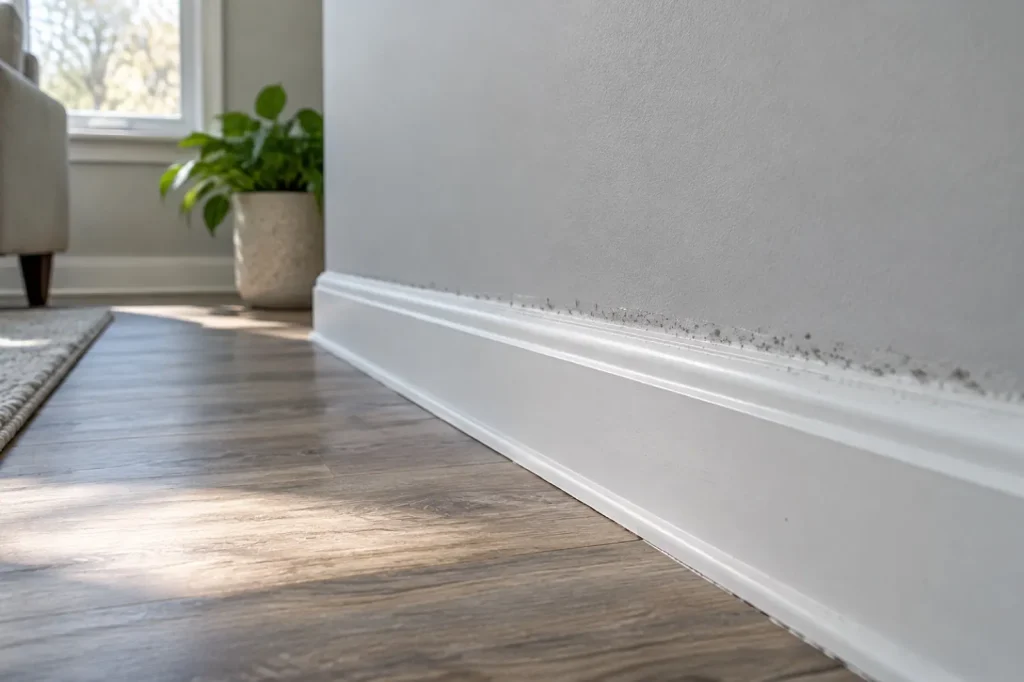
Mold on baseboards usually means water at the floor line, not a dirty room: a wet floor or slab wicking into the trim, mop water, condensation on a cold exterior wall, or a leak inside the wall. Clean painted wood or PVC trim in place, but pull the baseboard to check behind it, and replace MDF that has swollen.
Key takeaways
- FEMA and the Red Cross check walls by taking the baseboard off and probing about 2 inches above the floor; holes go low enough for the trim to hide them.
- Per the Sonae Arauco MDF Basic Low Swelling data sheet, a low-swell MDF for dry conditions may swell up to 14 percent in thickness in a 24-hour soak; Medite’s moisture-resistant board is rated at 7 percent or less, Roseburg’s at 5.5.
- Part of MDF swelling is permanent: the springback of compressed fibre, as US Patent 5028286 explains.
- The CPA recommends moisture-resistant MDF for bathrooms and for baseboards on slab-on-grade construction.
- EPA: do not paint or caulk moldy surfaces. Clean and dry first.
- Accuserve, baseboards: dry or remove says real wood trim can generally be dried in place after Category 1 or 2 water; Category 3 means careful removal.
On this page
Which situation are you in?
| What you find | Do this | Basis |
|---|---|---|
| Spots on painted trim only, wall dry, no odour | Clean in place; find the moisture source | EPA 402 Table 1, wood |
| Spots on trim and on the wall just above | Pull the baseboard and look behind it | FEMA L-198; EPA hidden mold |
| MDF trim with a swollen or fuzzy bottom edge | Photograph, remove, replace | Accuserve; CPA bulletin |
| Clean-water leak, wood trim, not swollen | Dry in place and take sill plate readings | Accuserve citing S500 |
| Floodwater or sewage reached the trim | Remove the trim; open and drain the wall | FEMA L-198; Accuserve |
| Mildew on the caulk line only | Cut the caulk out, clean, dry, re-caulk | EPA: do not caulk moldy surfaces |
What you are looking at at the floor line

| What you see | Likely cause | How to tell | Source |
|---|---|---|---|
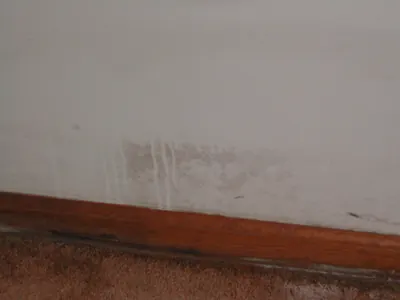
| Grey, black or green speckling on paint | Mold on the paint film | Returns after wiping; musty smell | R&R magazine |
| A grey band along the bottom edge only | Mop line: dirt and cleaner residue | Wipes off, no regrowth | See the cleaning section |
| Raised, fuzzy grain on primed MDF | Fiber raise from water | Rough to the touch, not spotted | CPA bulletin |
| Bottom edge thicker than the top | MDF thickness swell | Measure top and bottom edge | Accuserve; data sheets |
| Paint peeling off the trim | Paint over mold or wet wood | Spots under the flakes | EPA 402 |
| Spots on the caulk bead | Mildew on caulk | Trim beside it clean | EPA 402 |
EPA 402-K-01-001 warns that mold can grow on hidden surfaces such as the back side of drywall and paneling, and that paint applied over moldy surfaces is likely to peel. Restoration and Remediation magazine adds that mold with a musty odour at the baseboard suggests significant moisture behind the wall.
Why baseboards show mold first
The trim sits where four water paths meet.
Wicking from wet flooring or the slab
The Composite Panel Association MDF mouldings bulletin recommends moisture-resistant MDF for baseboards where the construction is slab-on-grade, which tells you where the industry expects floor moisture. Carpet pad and floor underlayment hold water against the trim; EPA 402-K-01-001 lists the underside of carpets and pads as hidden mold sites. Floating floors hide water under the planks next to the base; see laminate floor water damage.
Mopping water
A wet mop leaves water in the joint between floor and trim. The CPA bulletin says to protect MDF moulding from moisture and that water-based primers on MDF may show fiber raise with any significant contact with water. EPA 402-K-01-001 Method 2 itself says to use wood floor cleaner on wood rather than plain water and detergent.
Exterior-wall condensation at the floor line, and cold corners
EPA 402-K-01-001 names condensation at cold spots in the building, and walls behind furniture, as mold sites. Check the floor line of exterior walls and outside corners first, especially behind furniture. EPA’s fix is warmer surfaces through insulation or air circulation, and humidity below 60 percent, ideally 30 to 50, per EPA's Brief Guide to Mold, Moisture and Your Home.
Leaks inside the wall
Restoration and Remediation magazine lists plumbing leaks, poor foundation drainage, badly sealed windows and condensation in poorly ventilated bathrooms and basements. Water inside a wall ends at the sill plate, directly behind the trim.
MDF vs finger-jointed pine vs PVC baseboards when wet
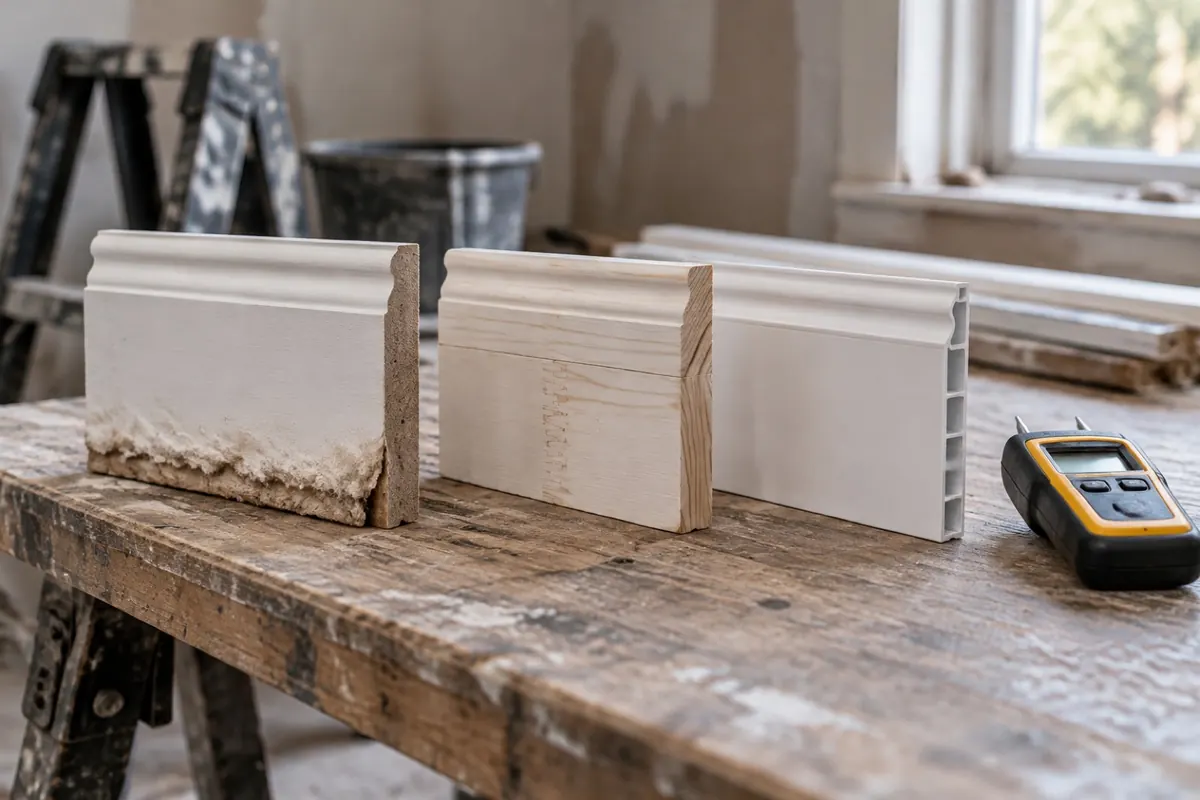
The Composite Panel Association MDF mouldings bulletin defines MDF as wood fibres and resin bonded under heat and pressure, for interior use only unless the maker says otherwise. US Patent 5028286 (Hsu, 1991) explains why wet MDF stays fat: thickness swelling is part reversible, from the wood’s hygroscopic swelling, and part irreversible, from springback of compressed wood, the main cause of instability.
| Baseboard material | Water response (published) | Reuse or replace |
|---|---|---|
| Standard or low-swell MDF | Up to 14% 24-hour thickness swell for a dry-use low-swell board, 12 to 19 mm (Sonae Arauco); swelling partly permanent | Replace if swollen, fuzzy or soft at the bottom edge |
| Moisture-resistant MDF | 7% max (Medite MR, 12 to 19 mm); 5.5% max (Roseburg Arreis Ultra, 3/4 in); 15% max after a wet cycle (Medite) | Reuse only if flat and dry after clean water; otherwise replace |
| Finger-jointed pine, primed | Wood: no mold below 20% moisture content (WWPA); joints vulnerable to moisture (Windsor Plywood) | Reuse after drying if joints are tight; replace if joints opened |
| Solid wood | Generally restorable even after Category 3 water, per Accuserve citing S500-2015 | Reuse after removal, cleaning and drying |
| Cellular PVC | 0.15% water absorption (AZEK); under 0.5% (Versatex), ASTM D570 | Reuse after cleaning; the wall behind may still be wet |
MDF baseboard water damage
Accuserve, drying baseboards in place says MDF baseboards can stain or swell easily in contact with moisture, tells technicians to photograph stained or swollen MDF and recommend removal, and calls pine more resistant. The Windsor Plywood finger-jointed pine page warns finger joints can be vulnerable to moisture and factory primer does not cover fresh cut ends. The AZEK trim specification calls for a lifetime warranty against defects that cause rot or excessive swelling from moisture; note the PVC figures are for trim boards, not baseboard profiles.
Mold behind baseboards: take them off to check
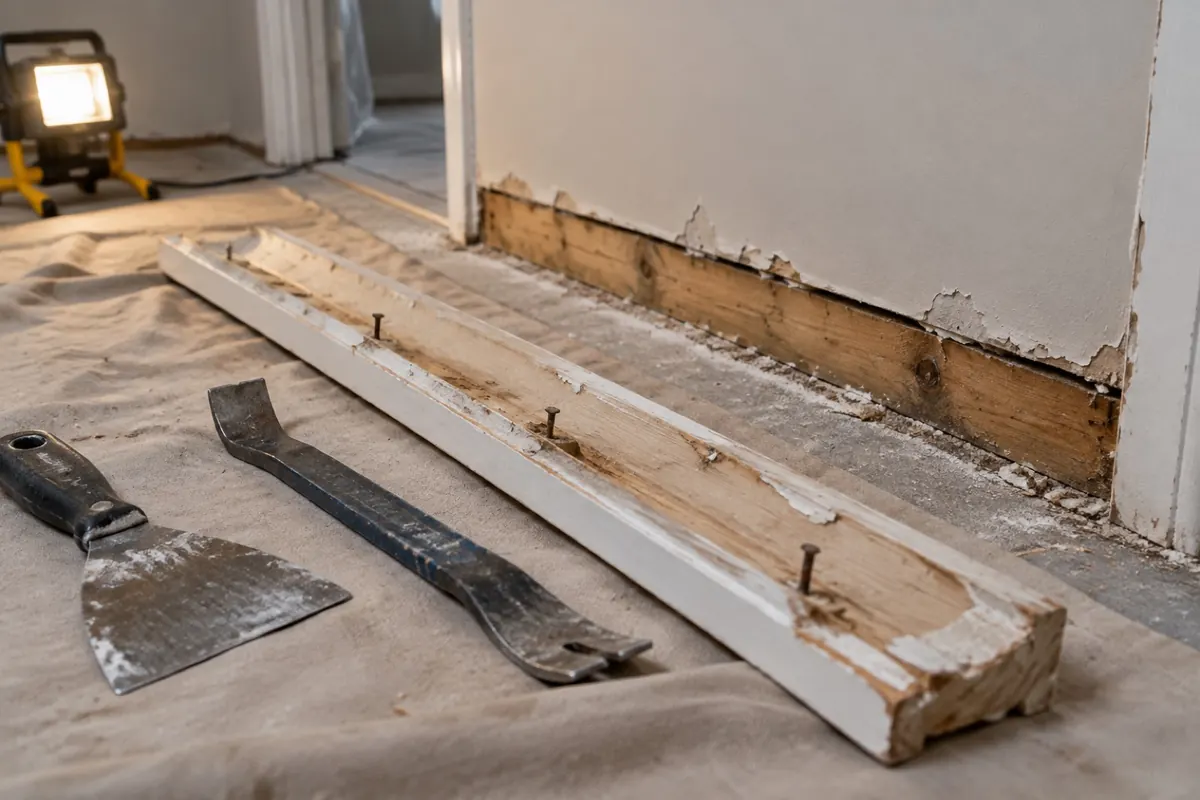
Repairing Your Flooded Home (FEMA L-198, ARC 4476) gives the published procedure. To check for water in a wall, take off the baseboard and push an awl or knife into the wall about 2 inches above the floor, just above the 2×4 sill plate. If water drips out, drill a drain hole with a hand or cordless tool, every 16 or 24 inches to match the studs, minding wiring at outlet height. Where the wallboard stays, ventilating holes go low enough for the baseboard to cover them.
Accuserve, drying baseboards in place says real wood baseboards can generally be dried in place after Category 1 or 2 water, with daily sill plate readings behind and under the trim using long probes. Accuserve, baseboards: dry or remove points to the trim work section of ANSI/IICRC S500-2021 Appendix A. Hole sizes and cavity drying equipment are on water damage in walls; dehumidification and drying goals are on structural drying.
Pulling the trim: the exact method
- Score the caulk and paint line with a utility knife. Why this differs from generic advice: otherwise the wall paper face tears off with the trim.
- Pry against a wide putty knife at each stud. Why: the CPA bulletin fastens base at each framing member, every 16 or 24 inches, so that is where the nails are.
- Number each length on the back. Why: coped corners only fit where they came from.
- Inspect the back face and the drywall edge. Why: EPA lists the back side of drywall and paneling as hidden mold sites.
- Probe, drain and vent low, as FEMA describes. Why: the trim hides the holes.
- Dry on readings, not looks. Why: FEMA warns that things look dry on the surface long before they are dry inside.
Baseboard mold after a flood
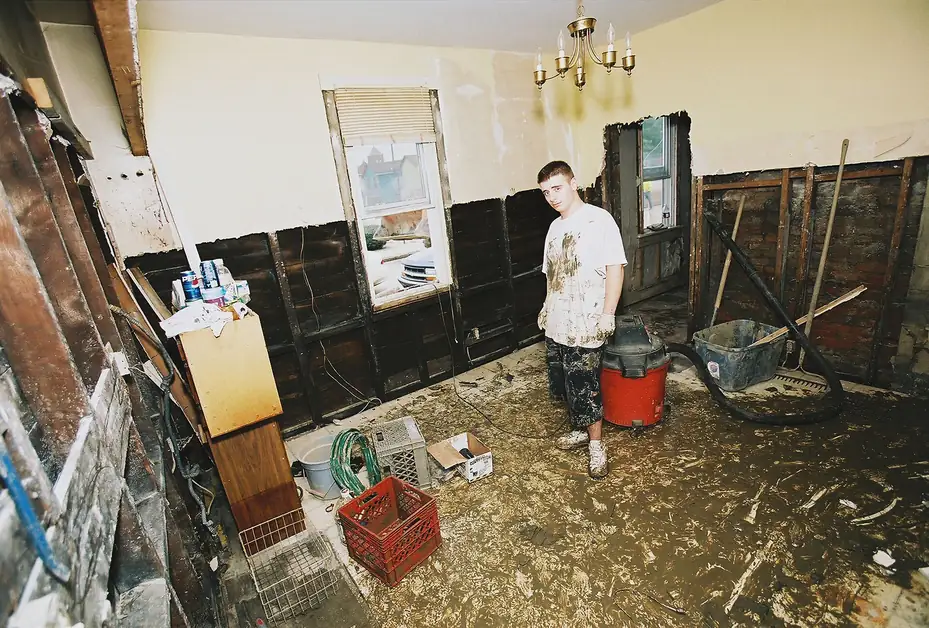

After floodwater, the trim comes off. Accuserve, baseboards: dry or remove says Category 3 water means carefully removing the baseboard so the drywall can come out and the baseboard and sill plate can be cleaned. Repairing Your Flooded Home (FEMA L-198, ARC 4476) removes all wallboard if water soaked it at least 4 feet up, and the lower 4 feet otherwise; wet insulation means the wallboard comes out. Cut heights are on wet drywall.
FEMA’s guide also suggests leaving the wall open 1 inch above the sill, hidden by the baseboard, so the cavity drains next time, if local code (a required firewall, for example) allows it.
Caulk lines
EPA 402-K-01-001 is direct: do not paint or caulk moldy surfaces; clean and dry them first. EPA's Brief Guide to Mold, Moisture and Your Home repeats it. Caulk over a moldy joint seals moisture and growth in.
| Joint | What goes wrong | What the sources say |
|---|---|---|
| Top of trim to wall | Mildew on the bead; gaps let mop and shower water behind | R&R: proper caulking at all joints and seams |
| Bottom of trim to floor | Traps water that gets under it; can hide a wet edge | EPA: clean and dry before caulking |
| Mitres and butt joints | Opens as MDF moves | CPA: leave room for caulking and minor expansion |
| Old caulk over spots | Growth continues under it | EPA: do not caulk moldy surfaces |
Cut out mildewed caulk, clean and dry the joint, then re-caulk.
How to clean mold on baseboards, by material
Surface spots on trim that is sound and dry behind are a cleaning job. The EPA 10 square foot line and the generic method are on DIY mold remediation; whether bleach is worth it is on does bleach kill mold.
| Trim | Method | Avoid | Source |
|---|---|---|---|
| Painted MDF | HEPA vacuum; wipe with a cloth wrung almost dry; dry at once | Wet mopping the joint | CPA: water raises fibres |
| Painted or stained wood | Mild detergent and water; dry | Soaking | EPA 402 Table 1 |
| Raw or unsealed wood | Mist growth before wiping; dry below 20% moisture content | Dry wiping | WWPA |
| PVC | Detergent and water; scrub | Assuming the wall behind is dry | EPA 402: non-porous surfaces |
Why this differs from generic advice: scrubbing with plenty of solution is itself the damage on MDF. Wet the growth, not the board.
Replacement: what goes back
| Step | Published detail | Source |
|---|---|---|
| Choose the material | Moisture-resistant MDF for bathrooms and slab-on-grade; PVC where it gets wet | CPA; R&R |
| Acclimate | At least 24 hours in the room | CPA |
| Prime cut ends | Factory primer does not cover fresh cuts | Windsor Plywood |
| Fasten | At each framing member; leave room for caulk and expansion | CPA |
| Paint | No latex paint below 55°F or above 65% humidity | CPA |
| Gap | Optional 1 in cavity gap above the sill, code permitting | FEMA L-198 |
Signs it is bigger than the trim
- Water drips when you probe above the sill. FEMA’s sign to drain and open the wall.
- Growth on the back of the trim or the drywall edge. The wall face is next; see mold on walls.
- Drywall bottom swollen or seams open. EPA says dry in place only with no obvious swelling and intact seams.
- Wet insulation in the cavity. FEMA says the wallboard comes out.
- Spots along several walls at the floor. Humidity, condensation or a slab problem, not one leak.
- Musty smell with clean trim. R&R reads a musty odour as moisture behind the wall.
For contractors: baseboards in the scope
| Item | Record | Why the adjuster asks |
|---|---|---|
| Trim material | MDF, pine, solid wood or PVC, with a cut end photo | Decides detach and reset versus replace |
| Swell or stain | Photos of swollen or stained MDF | Accuserve recommends removal on that basis |
| Water category | Source and category | Category 3 means removal, per Accuserve |
| Sill plate readings | Behind and under the trim, daily | Accuserve calls this critical |
| Standard cited | ANSI/IICRC S500-2021 Appendix A, trim work | Ties the line item to a standard |
What this page does not cover. Health effects are outside our scope; see CDC's mold page and EPA's Brief Guide to Mold, Moisture and Your Home, and ask a physician about personal concerns. Plumbing repairs belong to a plumber.
Questions people actually ask
How do you get rid of mold on baseboards?
Find the water first, then clean by material. HEPA vacuum, wipe painted trim with a cloth wrung almost dry or mild detergent and water, and dry it at once. If the wall above is spotted, smells musty or the trim is swollen, pull the baseboard and check behind it as FEMA’s flood repair guide describes.
Why is there mold on my baseboards?
The floor line is where water collects: wicking from a wet floor or slab, mop water in the joint, condensation on a cold exterior wall or corner, or a leak running down inside the wall to the sill plate. EPA names condensation at cold spots and walls behind furniture as common mold sites.
How do I know if there is mold behind my baseboards?
Take a section off. FEMA and the Red Cross check by removing the baseboard and pushing an awl into the wall about 2 inches above the floor; dripping water means the cavity is wet. Mold on the back of the trim or the drywall edge, a musty smell, or swollen drywall at the bottom are the other signs.
Should baseboards be removed after water damage?
It depends on water category and material. Accuserve says real wood baseboards can generally be dried in place after Category 1 or 2 water, with daily sill plate readings, and cites IICRC S500 for wood trim being restorable. Category 3 means careful removal. Swollen or stained MDF is photographed and removed.
Can MDF baseboards be saved after water damage?
Rarely, once they swell. Part of MDF swelling is permanent springback of compressed fibre, as US Patent 5028286 explains, and Accuserve recommends removing stained or swollen MDF. A board that got briefly damp from clean water and stayed flat can be dried and kept.
Can I caulk or paint over mold on baseboards?
No. EPA says do not paint or caulk moldy surfaces: clean and dry them first, because paint applied over mold is likely to peel. Cut out mildewed caulk, clean and dry the joint and the trim, then re-caulk. The CPA bulletin advises leaving room for caulk and minor expansion at MDF joints.
Sources
- Repairing Your Flooded Home (FEMA L-198, ARC 4476), FEMA and American Red Cross, August 1992, Town of Kitty Hawk copy. Retrieved 30 October 2026.
- EPA 402-K-01-001, Mold Remediation in Schools and Commercial Buildings, US EPA, Tables 1 and 2. Retrieved 30 October 2026.
- EPA's Brief Guide to Mold, Moisture and Your Home, US EPA, updated 18 February 2026. Retrieved 30 October 2026.
- CDC's mold page, updated 26 September 2024. Retrieved 30 October 2026.
- Composite Panel Association MDF mouldings bulletin, Composite Panel Association, undated. Retrieved 30 October 2026.
- Sonae Arauco MDF Basic Low Swelling data sheet, TDS0350, undated. Retrieved 30 October 2026.
- Medite MR data sheet, Medite Europe, version 4.15. Retrieved 30 October 2026.
- Roseburg Arreis Ultra data sheet, Medford, Oregon, undated. Retrieved 30 October 2026.
- US Patent 5028286, Wu-Hsiung E. Hsu, granted 2 July 1991. Retrieved 30 October 2026.
- AZEK trim specification, CSI section 06 65 00, 2023. Retrieved 30 October 2026.
- Versatex trim specification, CSI section 06 65 00, 2022. Retrieved 30 October 2026.
- Windsor Plywood finger-jointed pine page, undated. Retrieved 30 October 2026.
- Western Wood Products Association fact sheet, Mold and Wood Products No. 3. Retrieved 30 October 2026.
- Accuserve, drying baseboards in place, 17 November 2025. Retrieved 30 October 2026.
- Accuserve, baseboards: dry or remove, 23 November 2025. Retrieved 30 October 2026.
- Restoration and Remediation magazine, Rinea Blanchard, 20 June 2025. Retrieved 30 October 2026.
- Swell and absorption figures are published maxima, not our measurements; no test or survey was conducted. See our methodology and the mold hub.
Data sheets describe board products as made; installed, painted trim may behave differently. Check your own product.