The short answer
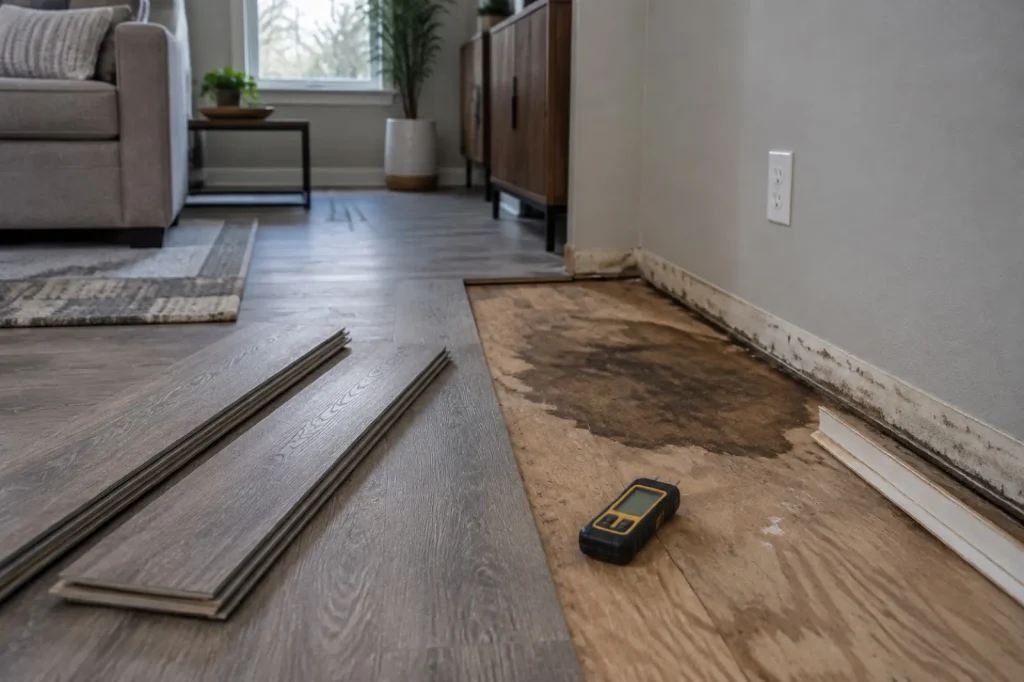
Water under vinyl plank flooring gets in at the perimeter gap, the seams and from the slab below, and the plank’s waterproof top then traps it against the subfloor. The planks usually survive; the subfloor, any attached pad and the warranty often do not. Lift the floor from the nearest wall, dry and measure the deck, then relay planks that still lock.
Key takeaways
- ‘Waterproof’ describes the plank, not the floor. Shaw’s warranty covers topical moisture ‘as long as the water does not flow over the edge of the surface’.
- All six warranty documents read for this page exclude flooding, and five of them also exclude moisture coming from below or out of the subfloor.
- Mohawk says it plainly: its waterproof warranty ‘does not cover moisture or water coming from below/underneath the product’.
- LifeProof’s own instructions say the floor ‘cannot inhibit the growth of mold’ caused by flooding or excessive subfloor moisture.
- Click-lock planks can be unclicked and relaid; FEMA notes vinyl over plywood must come up for the plywood to dry.
- Photograph before lifting and keep the planks: IVC, Shaw and AHF can ask to inspect or for samples.
On this page
- What you are looking at
- How water gets under a waterproof floor
- WPC, SPC and flexible LVT in water
- What six warranties say about water
- Confirming water is underneath
- Click-lock versus glue-down
- The lift, dry and relay method
- Mold under vinyl plank
- The decision path
- Signs it is bigger than it looks
- For contractors
- Questions people actually ask
What you are looking at: the signs of water under LVP
Vinyl plank water damage rarely shows on the face of the plank; the evidence collects at the edges, in the air and underfoot. Shaw’s warranty names the one visible tell: excess moisture can make ‘the ends and/or sides of the product to lift/flare due to the vapor pressure from underneath’.
| What you notice | What it usually means | Common look-alike | Next check |
|---|---|---|---|
| Plank ends lifting or flaring along a run | Vapour pressure from wet subfloor or slab, as Shaw describes | A floor pinned by trim or cabinets | Lift the nearest plank; meter the deck |
| Musty smell strongest at the baseboard | Moisture held in the perimeter gap or under the pad | A damp basement wall behind the trim | Pull trim; check gap and pad edge |
| Dark spotting at the wall line or under trim | Mold growing on dust, trim or the pad edge | Dirt or mop residue in the gap | Wipe one spot; growth returns, residue does not |
| Water squeezing up at a seam when you step | Free water sitting on the subfloor | Mop water on the surface | Lift planks now |
| Soft or spongy spot on a wood subfloor | Wood panel softening from long wetting | A low spot in the subfloor | Probe from below if accessible |
Swollen seams with a brown fibre edge mean laminate, a different product covered on our page on laminate floor water damage.
How water gets under a waterproof floor
A floating vinyl floor is built with gaps on purpose. The COREtec WPC installation guidelines require a 1/4 inch (6.35 mm) expansion space at the walls. That gap lets the floor move, and it lets a dishwasher leak or toilet overflow run straight to the subfloor. A click joint is tight, but no warranty read here calls it a seal.
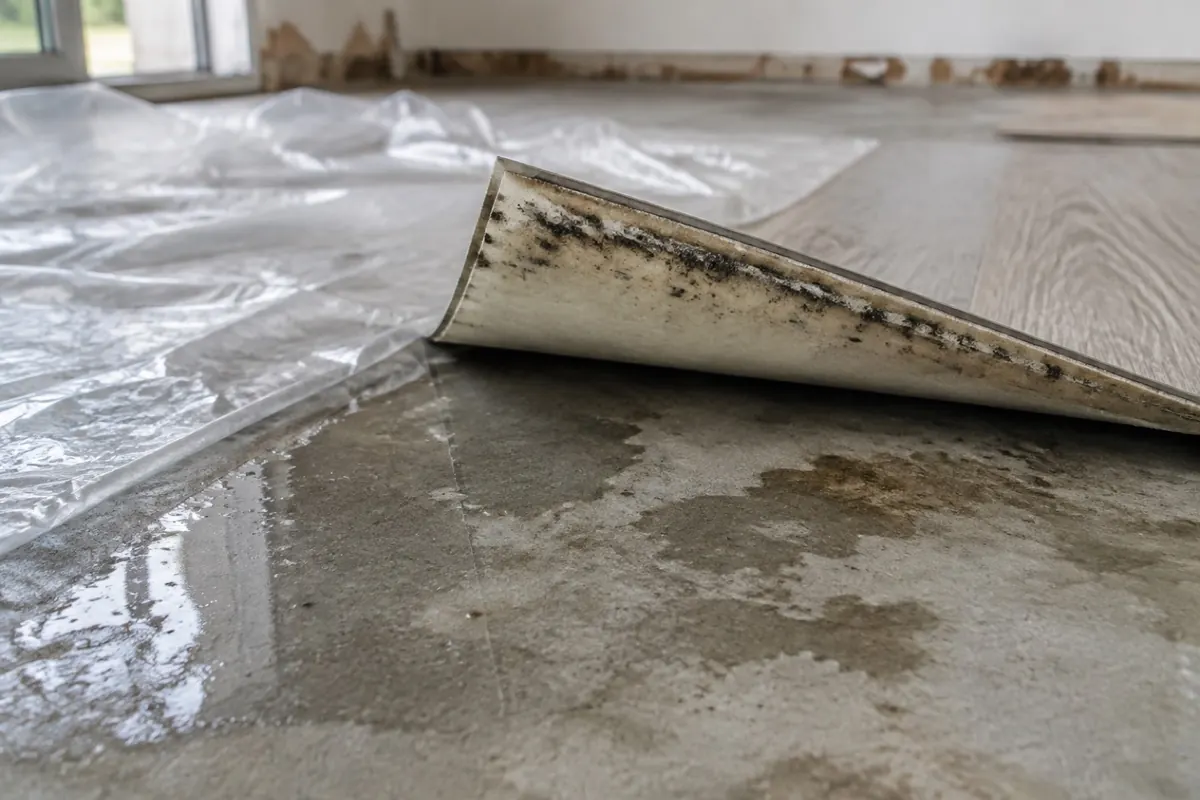
The third route is up, from a slab. The COREtec SPC installation guidelines suggest 6 mil poly over an uncured slab, and both COREtec documents warn that excessive subfloor moisture ‘could promote mold, mildew, and other moisture related issues like the trapping of moisture emissions under the flooring’.
WPC, SPC and flexible LVT: how each core responds to water
The Resilient Floor Covering Institute’s RFCI flexible LVT page describes flexible vinyl installed glued down (dry-back), floating with a click system, or loose-lay. Its RFCI rigid core page defines rigid core as ‘modular flooring with a rigid polymeric core’, in two constructions: expanded polymer core (WPC) and solid polymer core (SPC), both with ‘rigid cores that have water resistant capabilities’ and often a pre-attached cork or acoustic underlayment.
| Type | Core, per RFCI | Usual install | Where water ends up |
|---|---|---|---|
| Flexible LVT or LVP | Flexible vinyl throughout | Glue-down, click or loose-lay | Under the adhesive bed, or under the planks if floating |
| WPC rigid core | Expanded polymer core, lighter | Click; COREtec also approves glue-down | Attached pad and subfloor |
| SPC rigid core | Solid polymer core, denser and harder | Click, sometimes glue-down | Attached pad and subfloor |
Once water is underneath, the core matters less than the pad: an attached pad cannot be separated and dried on its own. Mohawk has marketed one exception, SolidTech R, with what Floor Covering News reported in October 2024 as a ‘Lifetime WetProtect Gold Floodproof Warranty’; we could not open that warranty’s text, so it is not tabled below.
What six manufacturer warranties say about water from below
We read the residential warranty each brand links from its own site. Shaw Floors and COREtec are both Shaw Industries brands, and the documents linked from the Shaw Floors vinyl warranty page (its ‘WPC and SPC Flooring’ download) and the COREtec warranty page carry identical text, revision 06282023. Shaw’s Floorte Pro is sold as a ‘Vinyl Rigid Core Floor Plank’, per a Do it Best retail listing, which puts it in that category.
| Brand and document | Water warranty clause, quoted | Flooding and water from below | Removal and reinstall |
|---|---|---|---|
| LifeProof vinyl warranty (IVC US), undated | ‘Will not be materially damaged by water exposure’; the flooring itself, ‘in standard conditions’ | ‘Does not cover flooding’; cannot prevent problems from ‘excessive moisture or alkalis in the subfloor’ | Floating only; excludes labor ‘incurred in the removal or reinstallation’ |
| LifeProof rigid core instructions and warranty (Halstead), undated | As IVC; Ultra-Fresh antimicrobial ‘does not extend to surrounding surfaces’ | ‘Does not cover flooding’; ‘cannot inhibit the growth of mold’ | Glue-down voids warranty; same labor exclusion |
| Shaw residential resilient warranty, rev. 06282023 | Topical moisture covered ‘as long as the water does not flow over the edge of the surface’ | Excludes flooding, ‘subfloor moisture emissions’ and ‘all casualty events normally covered by homeowners insurance’ | Replacement from ‘current running-line products’ |
| COREtec residential resilient warranty, rev. 06282023 | Identical to Shaw | Identical to Shaw | Identical to Shaw |
| Mohawk SolidTech limited warranty, 0254_2022, 03/2022 | ‘100% waterproof’, per the document; applies to ‘the Mohawk product itself’ | ‘does not cover moisture or water coming from below/underneath the product and does not cover flooding’ | Excludes ‘color and gloss issues’ from material added later |
| AHF Armstrong rigid core and LVT warranty, floors bought from 1 January 2019 | ‘Will not swell, buckle or lose integrity’ | In flooding ‘the flooring will not act as a waterproofing barrier for the subfloor’ | May ask for ‘uninstalled samples’ |
Mohawk’s WetProtect clause goes further and excludes mold from ‘moisture originating underneath the installed floor, or penetrating around the perimeter of the installation’. Whether a home policy responds is a question for its wording; our page on homeowners insurance and water damage sets out how that language works.
How to confirm moisture under LVP
Moisture under LVP is confirmed by lifting a plank, not by reading through one: a meter on the face reads the plastic. Pull the trim at the suspect wall, unclick a row or two, and meter the deck.
| Subfloor | Limit printed by the manufacturer | Test named | Source |
|---|---|---|---|
| Plywood, OSB, particleboard | Never above 14% moisture content, per the instructions | Moisture meter, multiple locations | LifeProof rigid core instructions and warranty (Halstead) |
| Concrete slab | 85% maximum relative humidity | In-situ RH, ASTM F2170 | LifeProof rigid core instructions and warranty (Halstead) |
| Concrete slab | 90% maximum relative humidity | In-situ RH, ASTM F2170 | COREtec WPC installation guidelines and COREtec SPC installation guidelines |
| Concrete slab | 8 lb per 1,000 sq ft per 24 hours | Calcium chloride, ASTM F1869 | LifeProof and both COREtec documents |
| Crawl space | 6 mil poly over 100% of the earth; 18 in. clearance; vents 1.5% of area, per the instructions | Visual | LifeProof and both COREtec documents |
The install limits are a ceiling, not a drying target: compare against an unaffected part of the same floor, as our subfloor water damage page explains. A slab RH test under ASTM F2170 uses probes set into the concrete, so a surface reading only says something is wet.
Click-lock planks versus glue-down: what can come up
FEMA Technical Bulletin 2 (August 2008) makes the general point for flood design: vinyl tile on concrete can be acceptable, but over a plywood floor ‘it is no longer considered acceptable because the vinyl tile must be removed to allow the plywood to dry’. A floating floor makes that removal reversible.
| Question | Click-lock floating | Glue-down (dry-back) |
|---|---|---|
| Can it be lifted without damage? | Usually, plank by plank from a wall | Rarely; planks tear or adhesive stays |
| Can the same planks go back? | Yes if the locking edges are intact | Not normally; new material and new adhesive |
| What the documents say | LifeProof warrants floating only; RFCI says the modular format ‘provides options if tile replacement is necessary’ | AHF ties its waterproof bond to ‘full-spread adhesive and locking’; COREtec approves glue-down WPC and SPC |
| Matching risk | Low with original planks | High: replacements come from current lines |
Keep lifted planks and spare cartons. IVC promises replacement ‘of similar color, pattern and quality’, Shaw from ‘current running-line products’, AHF ‘comparable AHF flooring’: none promises your dye lot.
The lift, dry and relay method for vinyl plank
For a floating vinyl floor, with why each step departs from generic advice.
| Step | What to do | Why this differs from generic advice |
|---|---|---|
| 1. Stop the source; extract surface water | Wet vac the face and the perimeter gap | Here the surface is the dry part |
| 2. Photograph before you lift | Seams, trim, carton labels, the receipt | IVC, Shaw and AHF can ask for photos, inspection or samples |
| 3. Pull trim at the wet wall | Quarter round and baseboard | The gap is where water entered and mold starts |
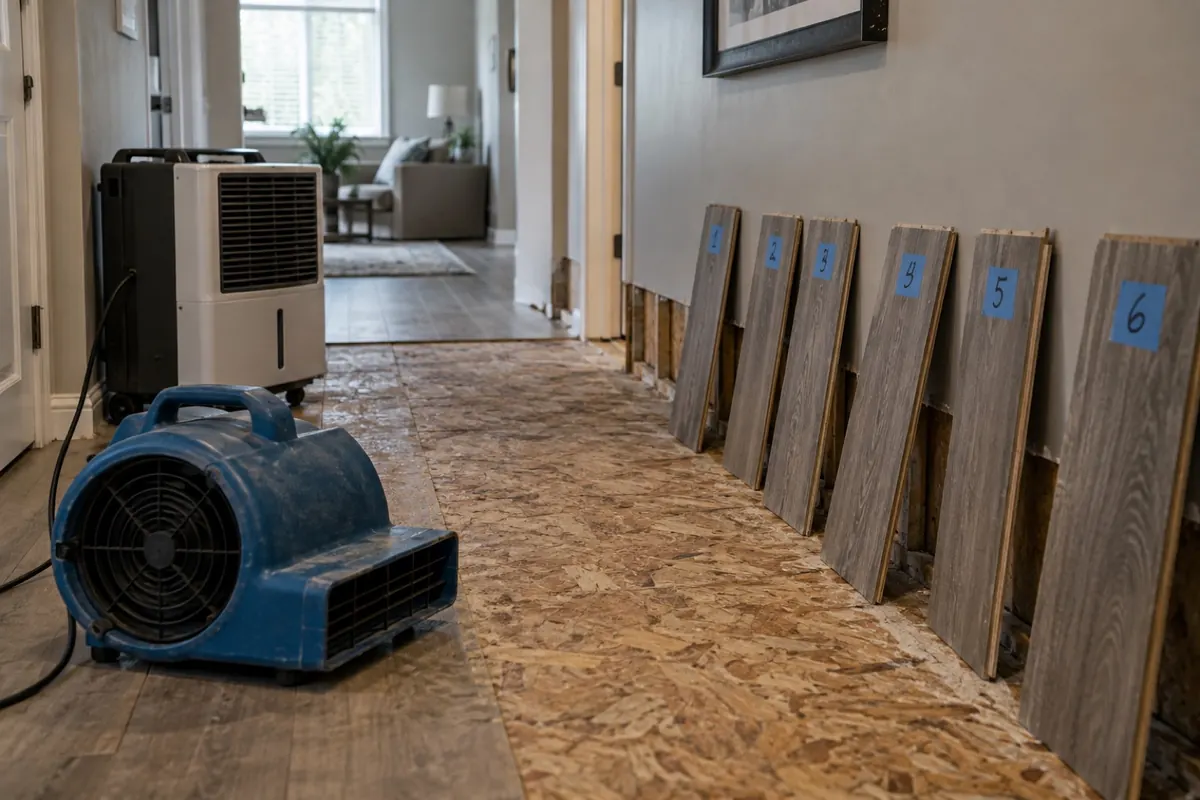
| 4. Unclick rows back from that wall | Number each plank on its back | So each returns to its own spot and stagger |
| 5. Stand attached-pad planks on edge | Face out, pad side open to the air | An attached pad cannot be removed and dried separately |
| 6. Dry the deck, not the room | Dehumidifier plus air across the exposed subfloor | EPA’s table says to check underflooring and dry it if necessary |
| 7. Meter against a dry reference | Same panel type, unaffected room | The relay limit is a ceiling, not a target |
| 8. Relay with the gap restored | Expansion space as the instructions require | LifeProof says a floating floor ‘should be allowed to expand and contract freely’ |
EPA's brief guide to mold and moisture says to dry water-damaged areas within 24 to 48 hours to prevent mold growth, and EPA Table 1, Water Damage: Cleanup and Mold Prevention lists vinyl with a direct instruction: ‘Check to make sure underflooring is dry; dry underflooring if necessary.’ Water from a toilet, a backup or a flood changes what can be kept; see water categories.
Mold under vinyl plank flooring
Mold under vinyl plank grows on the subfloor, the pad and the dust in the perimeter gap, not on the vinyl. AHF warns that ‘when excessive moisture accumulates (and in particular remains undiscovered or unaddressed) mold and/or mildew growth can occur’, and the LifeProof rigid core warranty limits its antimicrobial to the flooring, not ‘surrounding surfaces’. EPA’s table treats vinyl and slab faces as cleanable hard surfaces; a pad that grew mold usually means the plank goes. On timing, see how long mold takes to grow after water damage.
AHF’s warranty has a notable clause: it will replace a floor ‘discolored from mold, mildew, or alkali one time’, and if it happens again AHF will treat the subfloor as unsuitable for vinyl. For cleaning and EPA’s size threshold, see our DIY mold remediation guide.
The decision path: what to do with a wet vinyl floor
- Clean water, caught within a day? Extract, pull trim, lift two rows, meter the deck. Dry: relay. Wet: step 3.
- Toilet, sewer, flood or outdoor water? Treat it as contaminated and plan to discard attached-pad planks.
- Click-lock? Lift the wet area plus a margin, number planks, dry the deck against a dry reference.
- Glue-down? Assume the wet area is replaced with new material and adhesive.
- Soft wood, lasting smell or growth on the deck? The subfloor is now the job.
- Relay when the deck is within the printed limit and near the dry reference, gap restored.
Signs it is bigger than it looks
- Wet readings more than one row in from where you lifted: water has travelled under the floating floor.
- Ends lifting in a room with no spill: vapour from a slab or crawl space, which five of the six warranties exclude.
- Growth on the underside of the pad or on the deck.
- Soft, spongy or delaminating plywood or OSB.
- Wet drywall or swollen baseboard on the far side of the wall.
- A crawl space without full ground cover, which the LifeProof and COREtec instructions require.
For contractors: scope, documentation and the line items
| Item | What to record | Why the adjuster or manufacturer asks |
|---|---|---|
| Product identity | Carton label, brand, collection, core type | Five distinct water texts in six documents |
| Install method | Floating or glue-down; underlayment present | Glue-down voids LifeProof and turns reset into replace |
| Entry path | Gap, seam or slab, with photos before lifting | Topical water and water from below are treated differently |
| Moisture map | Deck readings, wet and dry reference, dates | Supports drying time and the relay decision |
| Retained samples | Lifted planks kept, labelled | IVC, Shaw and AHF claim terms mention samples |
| Line items | Detach and reset planks and trim; replaced pad planks; equipment days | Separates reused from replaced |
What this page does not cover. Health effects of mold, which EPA and CDC address, and whether a policy pays. For coverage, read the policy, and ask your state insurance department or a licensed professional. More water guides sit in our water hub.
Questions people actually ask
Will water under vinyl plank flooring dry on its own?
Usually not in time. The vinyl is a vapour barrier on top of the wet subfloor, so the water can only leave through the edges and seams. EPA advises drying water-damaged areas within 24 to 48 hours to prevent mold growth. On a floating floor the reliable route is to lift planks from the nearest wall and dry the deck directly.
How do you get water out from under vinyl plank flooring?
Extract what you can at the surface and in the perimeter gap, pull the trim at the wet wall, then unclick rows and number the planks. Run a dehumidifier with air moving across the exposed subfloor, meter it against a dry area of the same floor, and relay only when the readings match and the expansion gap is restored.
Can mold grow under vinyl plank flooring?
Yes, on the subfloor, the attached pad and dust in the perimeter gap rather than on the vinyl. LifeProof’s instructions say its floor cannot inhibit mold caused by flooding or excessive subfloor moisture, and Shaw, COREtec, Mohawk and AHF all exclude mold damage from excess moisture in their warranties.
Is vinyl plank flooring really waterproof?
The plank is; the installed floor is not sealed. Shaw’s warranty covers topical moisture only while water does not flow over the edge of the surface, and Mohawk’s covers topical water but not water from below. A floating floor has an expansion gap at the walls, and that gap is the usual way in.
Does the warranty cover water damage under LVP?
Generally no. All six documents read for this page exclude flooding, five exclude moisture from below or subfloor emissions, and the coverage that exists protects the plank itself. Damage to the subfloor, trim and walls is outside every one of them, so the question moves to the property policy and its wording.
How do I know if there is moisture under my LVP?
Look for plank ends lifting or flaring, a musty smell at the baseboard, dark spotting in the perimeter gap and water pressing up at seams. Confirm by lifting a plank and metering the deck. According to its installation instructions, LifeProof sets 14% as the maximum for wood subfloors and 85% slab RH for concrete.
Sources
- LifeProof vinyl warranty (IVC US), IVC US, Inc., undated. Retrieved 30 October 2026.
- LifeProof rigid core instructions and warranty (Halstead), with the Halstead New England warranty, undated. Retrieved 30 October 2026.
- Shaw residential resilient warranty, Shaw Industries, revision 06282023, via the Shaw Floors vinyl warranty page. Retrieved 30 October 2026.
- COREtec residential resilient warranty, same text and revision, via the COREtec warranty page. Retrieved 30 October 2026.
- COREtec WPC installation guidelines (rev. 03012022) and COREtec SPC installation guidelines (rev. 11052024). Retrieved 30 October 2026.
- Mohawk SolidTech limited warranty, document 0254_2022, 03/2022, dealer-hosted copy. Retrieved 30 October 2026.
- AHF Armstrong rigid core and LVT warranty, AHF Products, floors bought from 1 January 2019. Retrieved 30 October 2026.
- RFCI rigid core page and RFCI flexible LVT page, Resilient Floor Covering Institute. Retrieved 30 October 2026.
- EPA's brief guide to mold and moisture, updated 18 February 2026, and EPA Table 1, Water Damage: Cleanup and Mold Prevention. Retrieved 30 October 2026.
- FEMA Technical Bulletin 2 (August 2008), via Montana DNRC. Retrieved 30 October 2026.
- Floor Covering News, 7 October 2024, trade press. Retrieved 30 October 2026.
- a Do it Best retail listing, used only for the product description. Retrieved 30 October 2026.
- Exclusion counts are our tally of the six documents. No floor was tested. Our methodology sets out the standing rules.
Warranty terms change by edition: read the one that came with your floor. For coverage, read your policy and ask your state insurance department or a licensed professional.