The short answer
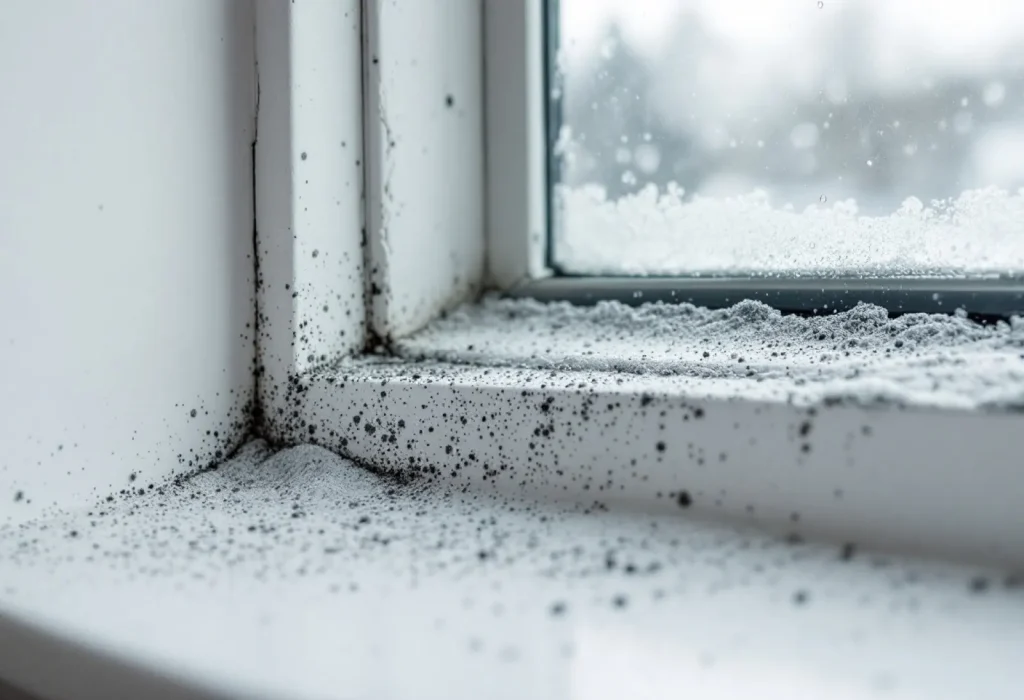
What does mold look like: patches or spots coloured differently from the material under them, typically gray, brown or black according to NIOSH, often fuzzy, often with a musty or earthy smell. CDC says mold comes in many colours, and EPA says black mold is not a species, so colour tells you neither the type nor the hazard. Dampness is the giveaway.
What do real mold patches look like on a window jamb, a basement wall and a corner?
The NIOSH Dampness and Mold Assessment Tool (DHHS publication 2019-114) gives inspectors a one line definition worth memorising: mold can include patches or spots that are coloured differently than the underlying material, typically gray, brown or black, it can appear fuzzy, and it can have a musty or earthy odour. The three photos below show what that means on real walls.
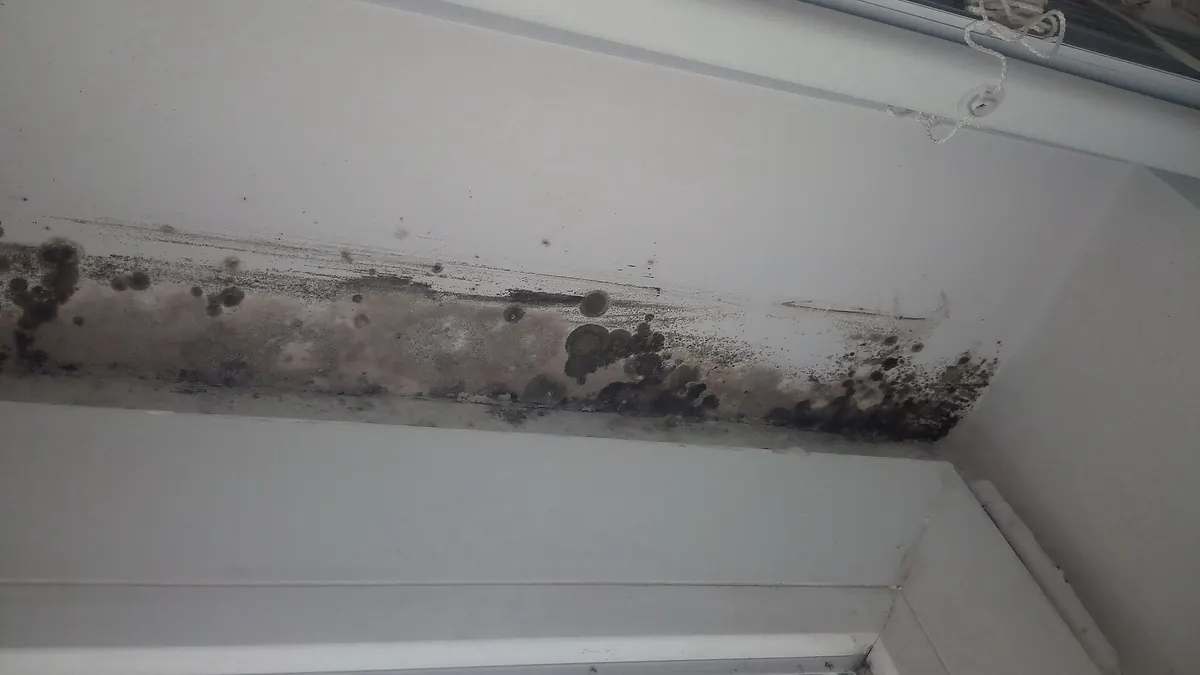

Look at the shape before the colour. In the window photo the growth is made of round colonies, some with a paler centre and a darker rim, and where neighbours touch they fuse into a band along the cold, wet edge of the frame. The EPA Mold Course, Chapter 1 names the window area, along with bathroom tile and grout, basement walls and the space around sinks, among the common sites for indoor growth.
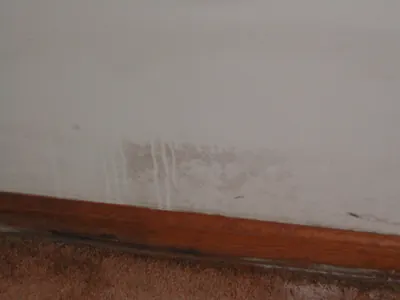

The basement photo comes from EPA’s own course, taken in a flat 3 to 4 feet below ground. There is no black patch: the paint carries a grey haze, a few drip lines and darker flecks just above the baseboard, which is how early growth on painted drywall often reads. The EPA Mold Course, Chapter 3 says most mold is found by simply looking, with your eyes, your nose and a good flashlight.
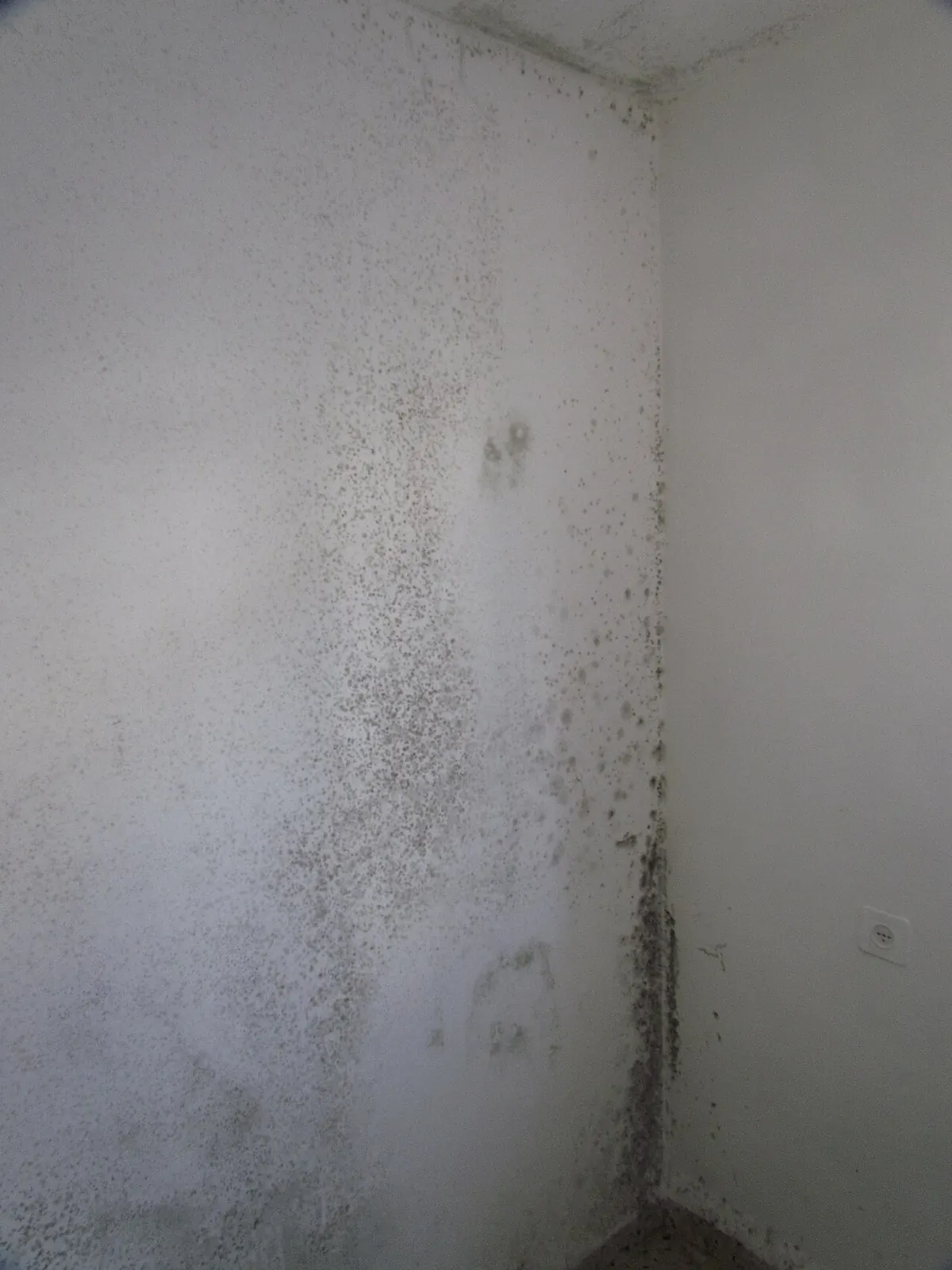

What does mold look like when it first starts, and how does a spot become a colony?
The WSU Extension Molds on Food sheet describes the body of many molds in three parts: root threads that invade the material, a stalk that rises above it, and spores at the ends of the stalks, and it says the spores give the mold the colour you see. That explains why the first days are invisible. The threads, which EPA’s EPA mold and mildew page calls hyphae, grow inside paper facing, wood or bread before anything shows on top.
Read the strip left to right. Stages 1 and 2 leave nothing on the surface. Stage 3 is the first fuzz, the word NIOSH uses. At stage 4 the patch takes the colour of its spores, per WSU, so colour arrives after growth has started, not before. At stage 5 separate spots meet, as in the window photo above. According to the NIOSH Dampness and Mold Assessment Tool, inspectors score combined areas against a sheet of paper (93.5 square inches, about 0.65 square feet) and an interior door (2,560 square inches, 17.8 square feet).
The time limit sits at the start of the strip. The EPA Brief Guide to Mold, Moisture and Your Home says that if wet or damp materials are dried 24 to 48 hours after a leak or spill, in most cases mold will not grow, and CDC uses the same window after floods. How fast each later stage follows depends on the material and the humidity, which EPA does not put a clock on.
Is it mold, mildew, efflorescence, ghosting or a water stain? A 10 row look-alike guide
The EPA Mold Course, Chapter 3 says it bluntly: not everything that looks like mold is mold. It names paint on the back of drywall or wood, alkaline crystals on soil or concrete and carpet stains as common impostors. The table adds the look-alikes described by Purdue Extension, the Brick Industry Association, Building Science Corporation and NIOSH, each with the quickest check the source gives.
| What you see | Mold or not | Quick check | Source | Go deeper |
|---|---|---|---|---|
| Flat gray or black film on shower walls or sills | Yes: mildew is mold with a flat growth habit | Seems to reappear in the same damp spot, which EPA says ventilation and more frequent cleaning usually stop | EPA mold and mildew page | Mold vs mildew |
| White, fibrous or crystal crust on brick, concrete or crawl space soil | Usually not: alkaline salts (efflorescence) | Usually dissolves in water; mold does not | EPA Mold Course, Chapter 3; Brick Industry Association Technical Note 23A | White mold page, linked below |
| Straight gray stripes over every stud or joist | Usually not: particle deposition, often called ghosting | Lines trace the studs or joists behind the board | Building Science Corporation Insight 114 | Mold or dirt |
| Gray film on exterior paint | Maybe: dirt or mildew | Drop of fresh 5 percent bleach: mildew fades in one or two minutes, dirt does not | Purdue Extension bulletin NCR-134 | Same mold or dirt page |
| Tan or brown ring on a ceiling or wall | Not by itself: a water stain | No fuzz; NIOSH scores stains separately from visible mold | NIOSH Dampness and Mold Assessment Tool | None |
| Red brown bleed around nail heads in siding | No: rust from ferrous nails | Sits exactly on the nail head and its halo | Purdue Extension bulletin NCR-134 | None |
| Blue black streaks inside bare or painted wood | A fungus, but a stain: blue stain does not weaken wood | Harmless while wood stays below 20 percent moisture | Purdue Extension bulletin NCR-134 | None |
| Dark marks on the back of drywall or wood | Sometimes not: paint can look like growth | Clear tape lift to a lab, read under a microscope | EPA Mold Course, Chapter 3 | Mold testing page, linked below |
| Dark spots on carpet | Sometimes not: carpet stains look like mold | Small piece or tape lift to a lab | EPA Mold Course, Chapter 3 | Mold testing page, linked below |
| Peeling or bubbling paint, crumbling plaster | Not mold, but water damage | NIOSH files it under damage; look for growth behind it | NIOSH Dampness and Mold Assessment Tool | None |
Two rows need a caution. Mildew grows on dirt, so the Purdue Extension bulletin NCR-134 bleach drop answers for the top layer only, and Purdue warns that bleach loses potency on standing, so an old bottle reads everything as dirt. And a water stain is not mold, but the NIOSH Dampness and Mold Assessment Tool treats stains as a sign of leaks or condensation, which is the condition mold needs next.
Does the colour tell you which mold it is, or whether black mold is worse?
No. The EPA Mold Course, Chapter 1 says molds come in many colours including white, and that black mold is not a species or specific kind of mold, and neither is toxic mold; the news media use the terms for molds that may produce mycotoxins or for Stachybotrys chartarum. The same EPA chapter says more than 200 mycotoxins have been identified and that no one can tell whether a mold is producing them just by looking at it.
The CDC About Mold page reaches the practical end point: you do not need to know the type of mold, because whatever is growing has to be removed and the moisture fixed. The Purdue Extension bulletin NCR-134 adds that the most common mildew species on house paint are black, but some are red, green or other colours. Colour still helps you find the right cleaning page, so the site keeps one page per shade: black vs regular mold, white, green, pink, yellow, orange, blue, brown, red and purple.
What does mold look like on drywall, wood, carpet, grout and concrete?
Mold eats organic material. The EPA Mold Course, Chapter 1 lists paper, cloth, wood, plant material and soil as food, and the CDC About Mold page adds ceiling tiles, dust, paints, wallpaper, insulation, drywall, carpet and fabric. So the same species looks different on each: fuzzy where it can root into paper or fabric, a thin film on glazed or painted faces, and absent on bare mineral surfaces until dirt gives it a foothold.
| Surface | What growth looks like | Source |
|---|---|---|
| Painted drywall | Spots typically gray, brown or black (NIOSH); growth on the back of the board can hide behind a clean painted face | NIOSH Dampness and Mold Assessment Tool; EPA Brief Guide to Mold, Moisture and Your Home |
| Wood framing and trim | Surface fuzz that wipes off, or blue black streaks in the grain (blue stain); normal in-service wood runs 8 to 13 percent moisture | Purdue Extension bulletin NCR-134 |
| Carpet and fabric | Spots or stains, which EPA warns can be mere carpet stains; the backing and pad must be dried too or mold will likely result | EPA Mold Course, Chapter 3 |
| Tile grout and caulk | Dark joints while the glazed tile face stays clean; bathroom tile and grout are on EPA’s list of common sites | EPA Mold Course, Chapter 1 |
| Concrete and brick | Mold needs organic food, so bare masonry grows little; white crystals that dissolve in water are alkaline salts | EPA Mold Course, Chapter 1; EPA Mold Course, Chapter 3 |
Wood is the surface most often misread. The Purdue Extension bulletin NCR-134 says blue stain is caused by microscopic fungi in sapwood, produces a blue black discoloration and does not weaken the wood structurally, and that it does no harm while moisture stays below 20 percent. Conditions that let it develop are also ideal for decay, so a moisture reading matters more than the colour.
Is a patch the size of a sheet of paper or a door? How NIOSH and EPA’s 10 square feet line up
Guides online quote different yardsticks without converting them, so here they are on one scale. The NIOSH Dampness and Mold Assessment Tool scores visible mold by combined area: up to a sheet of paper, between a sheet and a 32 by 80 inch interior door, or larger than the door, where a score of 3 should trigger immediate attention. The EPA Brief Guide to Mold, Moisture and Your Home says a homeowner can in most cases handle a moldy area under about 10 square feet, roughly 3 feet by 3 feet.
Converted, the paper is 0.65 square feet and the door is 17.8, so EPA’s 10 square foot line sits between NIOSH’s two marks: it equals about 15 sheets of paper, or a little over half a door. Add separate patches together, as NIOSH does, before comparing. Above the line, EPA points to its Mold Remediation in Schools and Commercial Buildings guide.
Where does mold show up first: windows, grout, basements and within 3 feet of an outside wall
Mold follows water. The EPA Mold Course, Chapter 1 says a little condensation, in a bathroom or around a window sill, can be enough, and lists roof leaks, condensation from high humidity or cold spots, slow plumbing leaks, humidifiers, sprinkler systems and floods as the common sources. The NIOSH Dampness and Mold Assessment Tool asks inspectors to flag any damage, mold or wetness within 3 feet of an exterior wall, and to smell for mold odour when they first walk into a room.
- Window reveals and sills that fog: EPA Mold Course, Chapter 1.
- Bathroom tile and grout, and the area around sinks: EPA Chapter 1 common sites.
- Basement walls and carpet laid on slab, like the EPA photo above.
- Behind things: the back of drywall, wallpaper and paneling, the top of ceiling tiles and under carpet pads, per the EPA Mold Course, Chapter 3.
- Rooms above EPA’s humidity line: keep indoor relative humidity below 60 percent, ideally between 30 and 50 percent, measured with a $10 to $50 meter; CDC says no higher than 50 percent.
If a room smells moldy and nothing shows, the EPA Brief Guide to Mold, Moisture and Your Home says to suspect hidden mold, and warns that removing wallpaper can lead to a massive release of spores if mold is growing on its underside. The EPA Mold Course, Chapter 3 names borescopes and moisture meters as the tools for finding it.
What does mold look like on bread, cheese and fruit, and when is cutting 1 inch away enough?
On food the stalks and spores are easier to see: the UConn Extension Handling Food with Mold says food mold can be green, white, black or even blue. What you cannot see is the threads. The WSU Extension Molds on Food sheet says that once a food shows heavy mold growth, the root threads have invaded it deeply, which is why soft foods go in the bin.
| Food | UConn Extension rule |
|---|---|
| Bread and baked goods | Discard pieces with visible mold; check the pieces next to them |
| Hard cheese such as cheddar or parmesan | Cut at least 1 inch around and below the spot |
| Firm produce such as cabbage, bell peppers, carrots | Cut at least 1 inch around and below |
| Soft produce such as strawberries or tomatoes | Discard the whole item |
| Soft cheese, yogurt, sour cream, meat and poultry | Discard |
UConn also says to keep perishables at or below 40 degrees F to slow mold, and not to drag the knife through the mold into clean food. For black growth on fridge rubber casings it gives a scrub of three teaspoons of bleach in a quart of water.
Can you confirm it is mold with your eyes, a flashlight and a tape lift, or do you need a test kit?
Usually your eyes are enough. The EPA Mold Course, Chapter 3 calls your own eyes and nose the most important equipment, with a good flashlight. When a mark is ambiguous, it says most microbiology labs need only a little of the suspect material on a clear strip of sticky tape to tell, under a microscope, whether it is mold or something that looks like mold.
Air and swab kits answer a different question. The CDC About Mold page does not recommend mold testing and notes there are no set standards for an acceptable quantity of mold in a home, and the EPA Mold Course, Chapter 3 says there are no federal limits for airborne mold. The EPA Mold Course, Chapter 1 explains the smell clue: microbial volatile organic compounds, or mVOCs, cause the musty odour and suggest mold is growing. When sampling is worth paying for is set out on mold testing.
Out of scope: health effects of mold exposure. For those, see the CDC About Mold page and the EPA pages listed below; this page covers what growth looks like and how to tell it from look-alikes. More guides sit on the mold hub.
Questions people actually ask
What kills mold immediately on a hard surface?
Removal, not a spray. CDC says household products, soap and water, or a bleach solution of no more than 1 cup of household laundry bleach in 1 gallon of water will clean mold off hard surfaces. EPA’s Mold Course says biocides such as chlorine bleach are not recommended as routine, that dead mold still has to be removed, and never to mix bleach with ammonia cleaners.
Is white fuzz on a basement wall always mold?
No. EPA’s Mold Course says a white, soluble, fibrous material on crawl space soil may be alkaline salts, and that alkaline crystals on concrete walls are usually water soluble, unlike mold. Either way, EPA says the salts indicate moisture has been a problem and the area deserves a closer inspection.
Can mold be growing when I cannot see any?
Yes. EPA lists the back of drywall, wallpaper and paneling, the top of ceiling tiles and the underside of carpet pads as hidden sites, and says to suspect hidden mold when a building smells moldy but no source shows. NIOSH asks assessors to rate mold odour from none to strong on entering each room.
Why does mold keep coming back in the same shower corner?
Because the corner stays wet. EPA’s homeowner guide says places that are often or always damp are hard to keep completely free of mold, and that running a fan or opening a window plus cleaning more often usually stops it recurring. Keep the room below EPA’s 60 percent humidity line.
Do I need to know which type of mold I have before cleaning?
No. CDC states that you do not need to know the type of mold: whatever is growing has to be removed and the moisture problem fixed. EPA adds that no one can tell by looking whether a mold is producing any of the more than 200 known mycotoxins, so identifying the species does not change the cleanup.
Sources
- NIOSH Dampness and Mold Assessment Tool, National Institute for Occupational Safety and Health, DHHS (NIOSH) Publication No. 2019-114: visible mold definition, damage and stain categories, paper and door scoring, 3 foot exterior wall check. Retrieved 21 November 2026.
- EPA Brief Guide to Mold, Moisture and Your Home, US Environmental Protection Agency, last updated 18 February 2026: 10 square feet, 24 to 48 hours, humidity below 60 percent, hidden mold. Retrieved 21 November 2026.
- EPA Mold Course, Chapter 1, US EPA, last updated 18 February 2026: common sites, colour of mold, mycotoxins, mVOCs, biocides. Retrieved 21 November 2026.
- EPA Mold Course, Chapter 3, US EPA, last updated 10 November 2026: equipment, hidden mold, mold versus soot and dirt, alkaline salts. Retrieved 21 November 2026.
- EPA mold and mildew page, US EPA, last updated 23 June 2026: hyphae and flat growth habit. Retrieved 21 November 2026.
- CDC About Mold page, Centers for Disease Control and Prevention, 26 September 2024: colours, 50 percent humidity, testing, bleach ratio. Retrieved 21 November 2026.
- Purdue Extension bulletin NCR-134, Purdue University Cooperative Extension Service with the USDA Forest Products Laboratory: mildew, bleach test, blue stain, iron stain. Retrieved 21 November 2026.
- Brick Industry Association Technical Note 23A, Brick Industry Association, June 2019: efflorescence as water-soluble salts. Retrieved 21 November 2026.
- Building Science Corporation Insight 114, Building Science Corporation: ghosting of framing members from particle deposition. Retrieved 21 November 2026.
- WSU Extension Molds on Food sheet, Washington State University Extension, Lewis County: mold structure and root threads in food. Retrieved 21 November 2026.
- UConn Extension Handling Food with Mold, University of Connecticut Extension: food handling rules and food mold colours. Retrieved 21 November 2026.
- Photos: Wikimedia Commons files by Alexander Davronov (CC BY-SA 4.0), US EPA (public domain) and a Commons contributor (CC BY-SA 4.0), credited in each caption. Retrieved 21 November 2026.
- Areas in the size chart (0.65 and 17.8 square feet) are arithmetic on the published dimensions, computed when this page was built. Our methodology sets out the standing rules.
Photos and descriptions help you recognise likely growth; only a lab reading of a tape lift confirms it. For large or hidden growth, ask a remediation firm which EPA or IICRC procedure it will follow and how it will find and fix the moisture source.