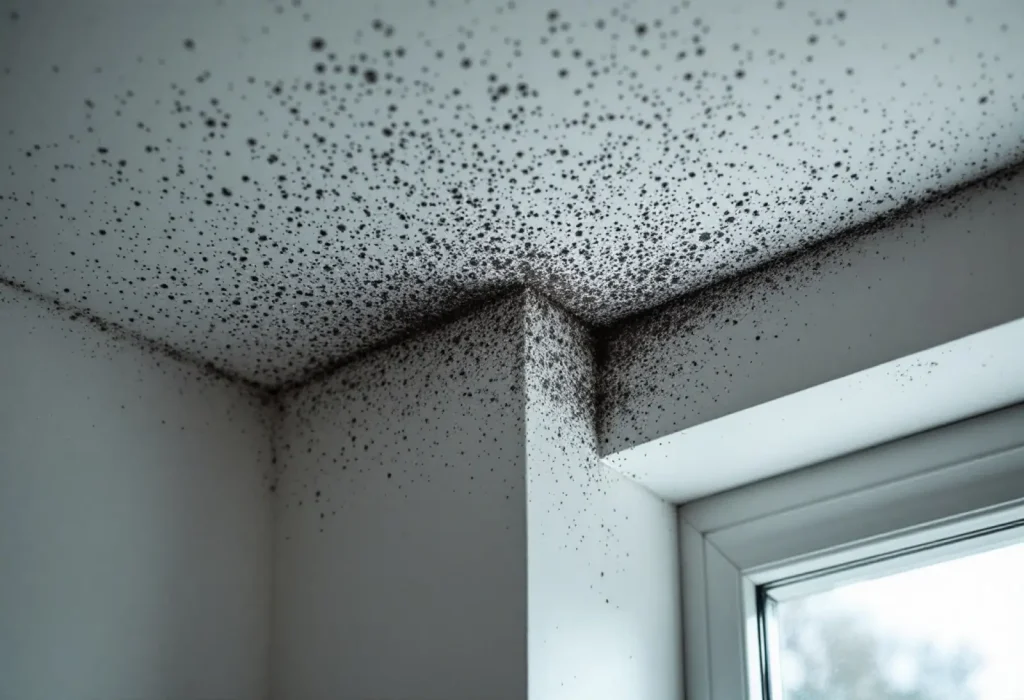
The short answer
To tell mold or dirt apart at home, put a drop or two of fresh household bleach on the spot. Purdue Extension and the USDA Forest Products Laboratory say mildew usually bleaches out in one or two minutes, and a stain that does not bleach is probably dirt. Only a lab reading a clear tape lift under a microscope confirms it.
Which mold or dirt test is most reliable, ranked from lab to settle plate?
The ranking below orders seven checks by what each one can physically detect, using the descriptions in the EPA Mold Course, Chapter 3, the Purdue Extension bulletin NCR-134 written with the Forest Products Laboratory, and Building Science Corporation Insight 114 on particle deposition. Rank 1 looks at the material itself; rank 7 measures something that is present in every house.
| Test | What it detects | False positives and misses | Cost and time | Source |
|---|---|---|---|---|
| 1. Lab direct exam of a clear tape lift | Fungal threads and spores under a microscope; EPA says a lab can tell whether it is actually mold or something that looks like it | Reads only what is on the tape: not how far growth spreads or what sits inside the wall | $68 (2 week) to $328 (3 hour) a sample at EMSL; mail time extra | EPA Mold Course, Chapter 3; EMSL Analytical 2026 price list |
| 2. High power magnifying glass | Threadlike growth on a damp surface, egg shaped spores on a dry one; dirt shows granules of irregular size and shape | Takes a practised eye; mildew can grow on top of a dirt layer, so both can be present | Price of a magnifier; minutes | Purdue Extension bulletin NCR-134; Joint Coatings and Forest Products Committee paper on mildew |
| 3. Bleach drop | Mildew pigment fading within one or two minutes under 5 percent sodium hypochlorite | Old bleach loses potency and gives a false dirt result; blue stain fungus in wood may also fade | Cents; 2 minutes | Purdue Extension bulletin NCR-134 |
| 4. Pattern and recurrence | Straight stripes over every joist point to particle deposition; an irregular patch that returns after cleaning points to growth | Cold framing lines also collect condensation, so a humid room can grow mold along the same lines | Free; wait and watch after one cleaning | Building Science Corporation Insight 114; Joint Coatings and Forest Products Committee paper on mildew |
| 5. Location and humidity | Condensation sites, walls behind furniture, shaded cold spots, rooms above 60 percent relative humidity | Dust collects in the same corners and along the same airflow paths | Hygrometer $10 to $50; a few days of readings | EPA homeowner mold guide; Purdue Extension bulletin NCR-134 |
| 6. Smell | A musty odour suggests water is or was present and growth is likely somewhere nearby | Points to a room, not to the dark spot; the source can be hidden behind drywall or under carpet | Free; seconds | EPA Mold Course, Chapter 3 |
| 7. Home culture plate or air kit | Spores that land on a dish and grow | Air carries 100 to over 1,000 fungal spores per cubic metre, so a plate grows something in almost any home; no federal limit to compare against | Kit price plus any lab fee | Joint Coatings and Forest Products Committee paper on mildew; EPA homeowner mold guide; CDC mold page |
Tests 2 and 3 cost almost nothing and settle most painted surfaces, per the Purdue bulletin. Test 1 is the tiebreaker when they disagree. Tests 5 to 7 tell you about the room, not the mark, which is why a common rule of thumb that starts with a kit or a sniff gets the order backwards.
What does a bleach drop show in one or two minutes, and where does it mislead?
The Purdue Extension bulletin NCR-134 gives the method in three sentences: apply a drop or two of household bleach (5 percent sodium hypochlorite) to the stain, mildew will usually bleach out in one or two minutes, and a stain that does not bleach is probably dirt. The bulletin was written for exterior paint, but the chemistry is the same on an interior wall.
- Use a bottle opened recently. Purdue warns that bleach deteriorates on standing and loses potency, and a weak drop reads every stain as dirt.
- Dab, do not wipe. Wiping lifts dirt and turns a 2 minute colour test into a cleaning test.
- Watch the clock: fading inside about 2 minutes is the mildew result in the Purdue bulletin.
- Never mix bleach with ammonia or ammonia cleaners; the Purdue bulletin and the EPA guide both carry that warning.
Three things break the test. Mold can grow on dirt: the Joint Coatings and Forest Products Committee paper on mildew, co-written with the USDA Forest Products Laboratory in March 1999, says mildew grows on dirt, grease and other pollutants, so a mark can be both and bleach only answers for the top layer. Blue stain fungus in wood can also fade under bleach, Purdue notes, which is still a fungal result. And a dark spot under a coat of paint never meets the drop.
What does a high power magnifier show that the bleach drop cannot?
Shape. The Purdue Extension bulletin NCR-134 says mildew can be told from dirt under a high power magnifying glass: on a damp surface the fungus shows threadlike growth, on a dry one it carries numerous egg shaped spores, while granular dirt particles are irregular in size and shape. That is the same distinction a lab makes on a tape lift, at lower magnification.
The Purdue bulletin NCR-134 ties each look to the state of the surface: threads while it is damp, spores once it dries. A patch that was bleached or scrubbed a few days ago has lost both, so judge an untouched area of the same mark, and use the bleach drop on a different spot from the one you magnify.
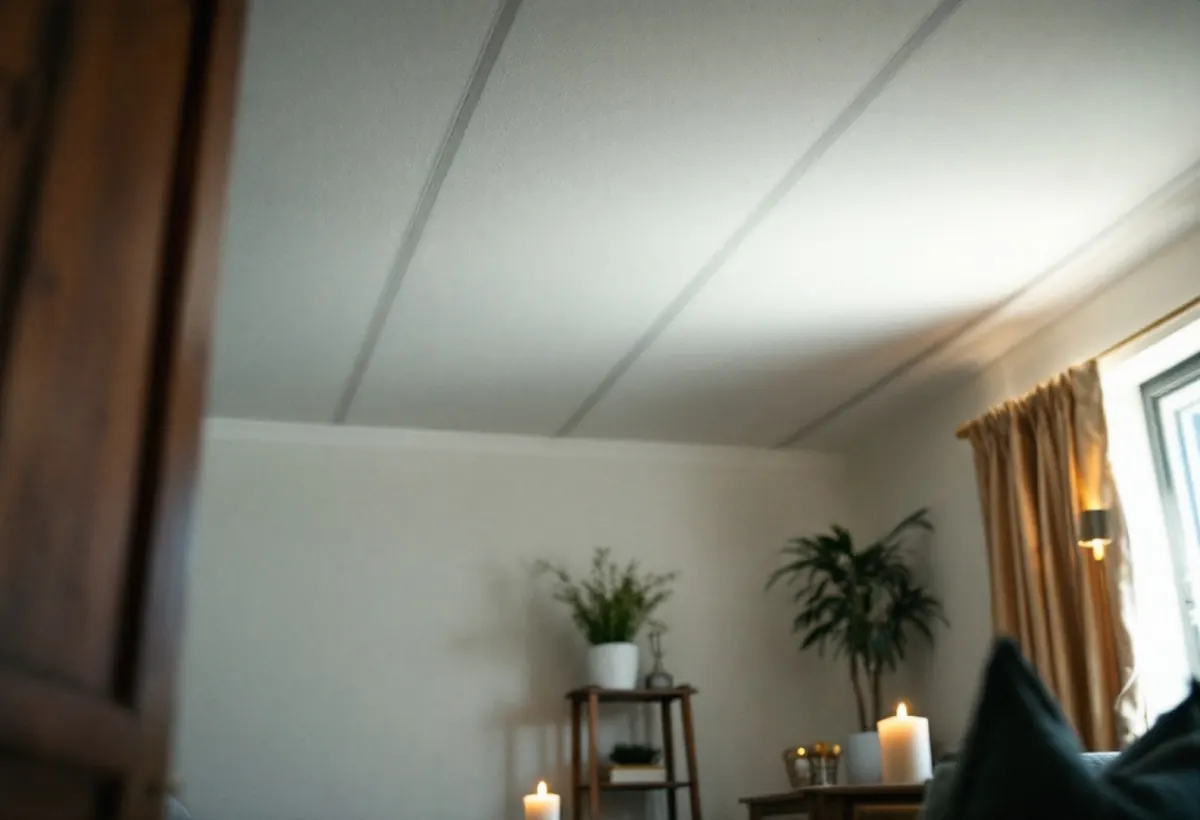
Do straight grey lines over every ceiling joist mean mold?
Usually not. Building Science Corporation Insight 114, written by Joseph Lstiburek in January 2020, explains the lines as particle deposition: air next to a cold spot moves less, tiny airborne particles stop bouncing around and plate out on the surface, and since every stud is a thermal bridge, the outlines of framing members show up as stripes. BSC says this is often called ghosting, and that it was most common with poorly insulated walls and indoor smoking.
The same paper lists where the particles come from: tobacco and cannabis smoke, candle soot, fireplace smoke, standing pilot lights on gas fireplaces, and carpet fibre or blown insulation particles cooked on electric resistance baseboard heaters and heat pump backup elements. One photograph in the paper shows the soot from a 30 minute candle burn in a bench test. Soot sources and cleanup sit on our candle soot page.
Two more patterns from BSC Insight 114 fool people into calling for a mold test. A dark line on carpet right under a closed bedroom door is impaction, particles flung out of air squeezing under the door. A grey band along the carpet at the baseboard is filtration, the carpet straining air that leaks under the wall. Neither is growth, and neither will fade under a Purdue bleach drop.
One caution cuts the other way. The cold joist line that collects soot also collects condensation, and the EPA homeowner mold guide lists condensing walls and pipes as places mold grows. In a room held above 60 percent relative humidity, a striped pattern can carry real growth; a 2 minute bleach drop on one stripe answers it.
Where does mold grow that dirt does not: damp, cold spots above 60 percent humidity
Mold needs water; dirt does not. The EPA homeowner mold guide tells homeowners to keep indoor humidity below 60 percent, ideally between 30 and 50 percent, measured with a meter that costs about $10 to $50 at hardware stores, and to act when condensation collects on windows, walls or pipes. A dark spot in a room that holds inside EPA’s 30 and 50 percent band for a week of readings is a weaker mold candidate than the same spot in a bathroom that fogs on every shower.
| Spot | Why it points to growth | Source |
|---|---|---|
| Window corners and sills that fog | Condensation on cold glass and frames | EPA homeowner mold guide |
| Wall behind a wardrobe or sofa on an exterior wall | Condensation forms where furniture blocks warm air | EPA homeowner mold guide |
| Ceiling ring below a bathroom or roof leak | Material wet longer than 24 to 48 hours | EPA homeowner mold guide |
| Eaves, porch and carport ceilings | Unheated surfaces cool fast and collect dew | Purdue Extension bulletin NCR-134 |
| Supply register edges and door bottoms | Airflow deposition, a dirt pattern rather than growth | Building Science Corporation Insight 114 |
| White fibres on crawl space soil | Often alkaline salts, not mold, but a sign of moisture | EPA Mold Course, Chapter 3 |
The Purdue Extension bulletin NCR-134 adds the outdoor version: mildew is most common in shaded or protected areas, and dew forms on parts of a house that are not heated and cool quickly. The crawl space row comes from the EPA Mold Course, Chapter 3, which warns that a white, soluble, fibrous material on crawl space soil may be alkaline salts rather than mold.
Does a musty smell prove the dark spot is mold?
It proves less than people think. The EPA Mold Course, Chapter 3 treats damp or musty odours as a sign that water is or was present and that mold growth is likely, and names the investigator’s own eyes and nose as the most important equipment, with a good flashlight. It does not say the smell identifies a particular mark.
The EPA homeowner mold guide says you may suspect hidden mold when a building smells moldy but you cannot see the source, and lists the back of drywall, wallpaper and paneling, the top of ceiling tiles and the underside of carpet pads. So a musty bedroom with a grey ceiling stripe can have dirt on the ceiling and mold somewhere else; the musty smell guide traces the odour itself.
When is a tape lift that EMSL reports at $68 to $328 worth paying for?
When the cheap tests disagree and the answer would change what you do. The EPA Mold Course, Chapter 3 says clear plastic tape can lift a sample from a suspect site for microscopic examination, and that most microbiology labs need only a little of the suspect material on sticky tape to tell whether it is actually mold or something that looks like mold.
Per the EMSL Analytical 2026 price list, that exam, code M041, costs $68 a sample at 2 week turnaround, $123 at 24 hours and $328 for 3 hour results. Inspector visit fees come on top and are broken down on the mold inspection cost page.
Federal guidance limits the case for testing. The EPA homeowner mold guide says that in most cases sampling is unnecessary when mold is visible, and that no EPA or other federal limits exist for mold or spores. The CDC mold page goes further and does not recommend mold testing at home. A tape lift that answers yes or no on one mark is the narrow exception; how to take one, and which kits do what, is on the mold testing page and the at home mold test review.
It wiped off and came back in the same spot: mold or dirt?
Growth. Dirt that is cleaned stays gone until it is redeposited; mildew comes back. The Joint Coatings and Forest Products Committee paper on mildew puts it plainly: mildew can be removed with a cleaner, but it will return if the growth conditions remain the same, and painting over it lets it grow through the new coat. A mark that reappears in the same outline after cleaning is a moisture problem, not a cleaning problem.
Colour does not settle it. The EPA homeowner guide shows white and black molds side by side and says molds come in many colors, which is why a black mark is not automatically the species people fear; the black mold comparison covers that question. What matters is size and water: the EPA homeowner mold guide says a patch under about 10 square feet, roughly 3 ft by 3 ft, can in most cases be cleaned by the homeowner once the moisture source is fixed.
Cleaning steps by surface, from painted drywall to bare paper facing, are on the mold on walls page. Every other mold question, from growth time to clearance, starts at the mold hub.
Out of scope: this page identifies marks, not health effects. For those, see the CDC mold page and the EPA homeowner mold guide.
Questions people actually ask
Can mold look exactly like dirt?
Yes. The EPA Mold Course says mold comes in many colors, not just black, and the 1999 Joint Coatings and Forest Products Committee paper says mildew on wood is most often gray or black and can grow on dirt and grease. A flat grey film can be either, which is why a 2 minute bleach drop or a tape lift beats a visual guess.
Is black dust around an air vent mold?
Usually it is particle deposition. Building Science Corporation Insight 114 describes tiny particles from candles, smoke and heating elements plating out where air moves past a surface. If the mark sits on a cold, damp register that sweats in summer cooling, test it: EPA lists condensation sites as mold sites.
Should I test a dark spot I can already see?
In most cases no. The EPA homeowner guide says sampling is unnecessary when growth is visible and that no federal limits exist for mold, and CDC does not recommend home mold testing. A single tape lift, $68 to $328 a sample according to the EMSL 2026 list, is worth it only when the result would change the plan.
How soon after a leak can a dark spot be mold rather than dirt?
EPA says that if wet materials are dried within 24 to 48 hours after a leak or spill, in most cases mold will not grow. A dark mark that appears days after a leak, centred on the water stain, is a stronger mold candidate than one that was there before the leak.
What is the white fuzzy material on my crawl space soil?
The EPA Mold Course warns that a white, soluble, fibrous material on crawl space soil may be alkaline salts rather than mold. Either way EPA reads it as a sign that moisture has been a problem and that the crawl space deserves a closer look, so check the vapour barrier and drainage.
Sources
- Purdue Extension bulletin NCR-134, Discoloration of House Paint: Causes and Cures, Daniel L. Cassens, Purdue University, and William C. Feist, USDA Forest Products Laboratory. Bleach drop and magnifier tests. Retrieved 20 November 2026.
- EPA homeowner mold guide, A Brief Guide to Mold, Moisture and Your Home, United States Environmental Protection Agency, last updated 18 February 2026. Humidity, drying time, sampling and 10 square foot guidance. Retrieved 20 November 2026.
- EPA Mold Course, Chapter 3, Investigating, Evaluating and Remediating Moisture and Mold Problems, United States Environmental Protection Agency, last updated 10 November 2026. Tape sampling, odours, crawl space salts. Retrieved 20 November 2026.
- CDC mold page, About Mold and Your Health, Centers for Disease Control and Prevention. Home testing statement. Retrieved 20 November 2026.
- Building Science Corporation Insight 114, Up in Smoke, Joseph W. Lstiburek, Building Science Corporation, January 2020. Deposition by filtration, electrostatic attraction, Brownian motion and impaction. Retrieved 20 November 2026.
- Joint Coatings and Forest Products Committee paper on mildew, Mildew and Mildew Control for Wood Surfaces, Journal of Coatings Technology, Vol. 71, No. 890, March 1999. Mildew on dirt, recurrence, airborne spore counts. Retrieved 20 November 2026.
- EMSL Analytical 2026 price list, EMSL Analytical, Inc., code M041 direct examination rates by turnaround. Retrieved 20 November 2026.
- The reliability ranking is our editorial ordering of what each test can detect, built from the sources above; no test on this page was run by us. Our methodology sets out the standing rules.
Lab prices change. Confirm the current rate, method and turnaround with the lab before sending a sample.