The short answer
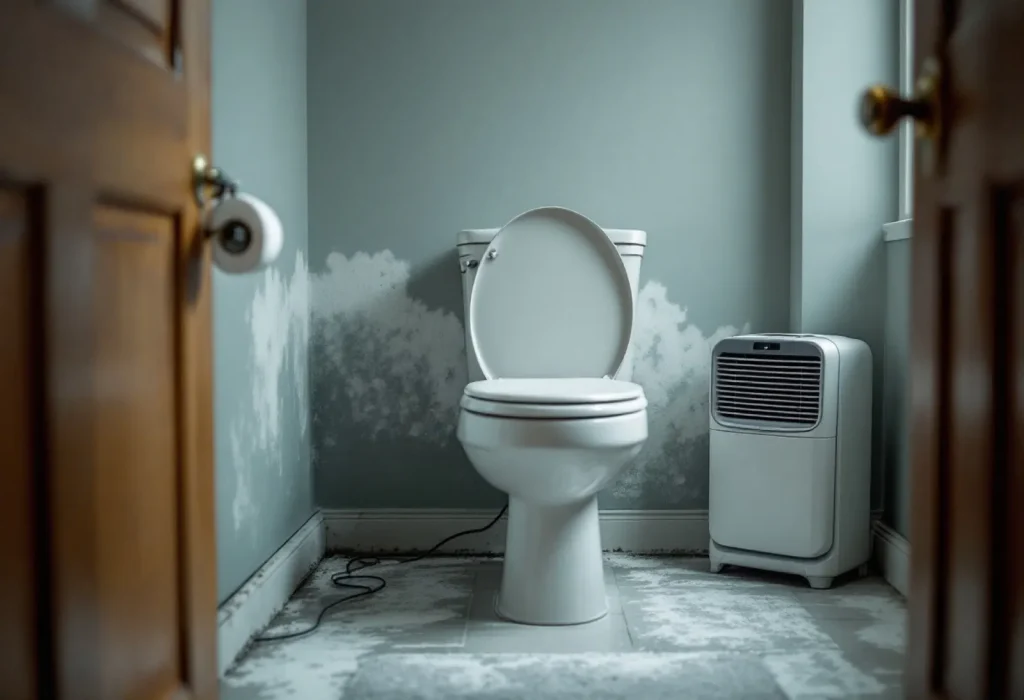
Blue mold is a colour label, not a species. Indoors, powdery blue or blue-green growth on damp walls, bread or fridge food is usually a Penicillium mold. The same name also covers an apple rot, a tobacco blight and the veins in blue cheese. Blue-black marks on wood or blue-green streaks under taps are often stains, not mold. Check which one you have first.
Key takeaways
- Dictionary.com defines blue mold first as any Penicillium forming a bluish-green furry coating on food; the University of Adelaide mycology unit counts 354 accepted Penicillium species.
- The USDA Forest Products Laboratory Wood Handbook, chapter 14 says blue stain in lumber penetrates the sapwood and cannot be removed by surfacing.
- Blue-black halos at nails on oak are usually iron stain, per the Forest Products Laboratory note Iron Stain on Wood.
- Blue-green staining under taps points to copper, which EPA's secondary drinking water standards list at a secondary level of 1.0 mg/L.
- USDA FSIS fact sheet Molds on Food says blue cheese molds are safe to eat but moldy bread should be discarded.
- CDC says you do not need to know the type of mold to remove it.
On this page
- What you are looking at indoors
- The other blue molds: apples, tobacco, garlic, cheese
- Sort it in five checks
- Blue mold on walls
- Blue on wood: mold, blue stain or iron
- Blue mold on bread and cheese
- Removal method, step by step
- Signs it is bigger than the spot
- For contractors
- Questions people actually ask
What you are looking at indoors
The EPA mold course, chapter 1 says molds come in many colours, but three blue things in a house are not alive. Mold is fuzzy or powdery and transfers to a damp towel; stains are flat. Outdoors, University of Arkansas Cooperative Extension notes slime molds can even be blue.
| What you see | Usually | Where | Next step |
|---|---|---|---|
| Powdery blue to blue-green spots that wipe off on a damp towel | Mold, often Penicillium | Damp paint, paper, grout | Method below |
| Grey-blue streaks or wedges inside lumber | Blue stain fungi | Pine and other softwood sapwood | Cosmetic if dry |
| Blue-black or grey halo around a nail or screw | Iron stain | Oak, redwood, cypress, cedar | Oxalic acid check |
| Hard blue-green streak below a tap or copper joint | Copper staining | Sinks, tubs | Water test; see green mold |
| Even blue paper face on walls being plastered | Product colour | Gypsum plaster base | Leave it |
| Blue slime on garden mulch | Slime mold | Beds, lawns | Rake it off |

The other blue molds: apples, tobacco, garlic, cheese
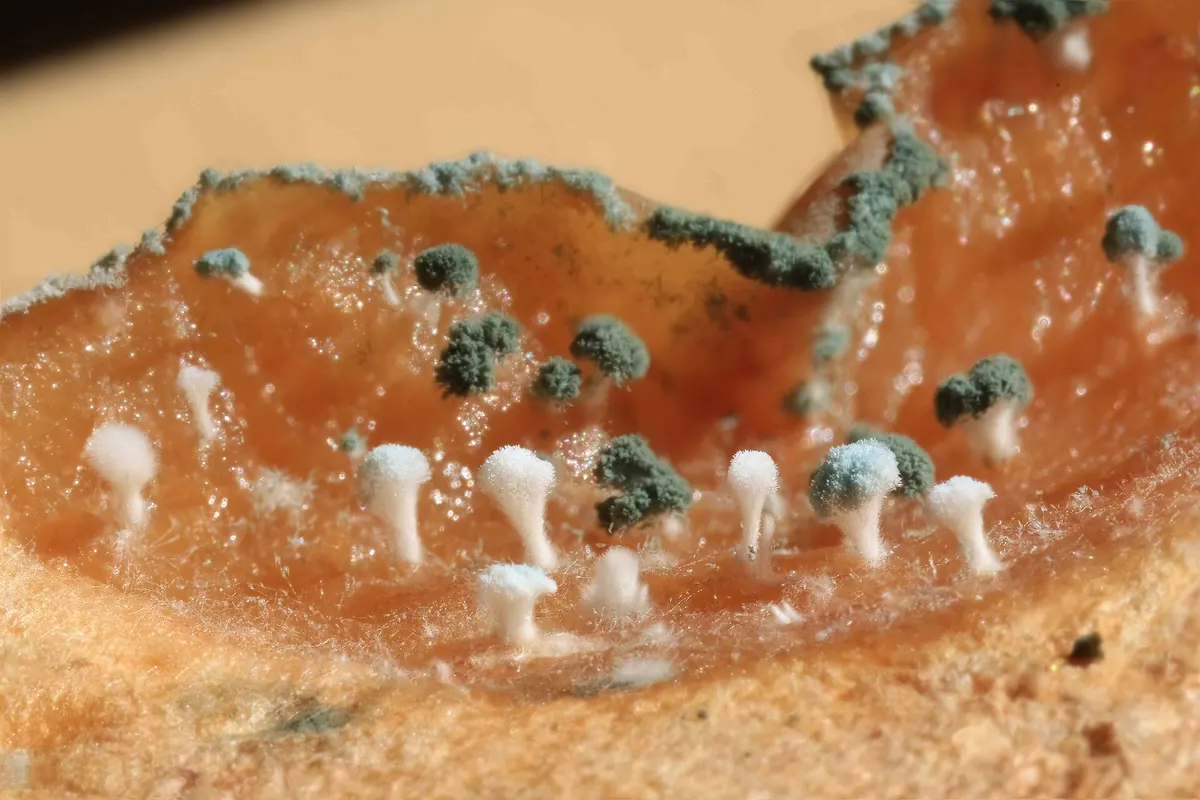
Most search results for this term are about crops. Dictionary.com adds a plant pathology sense: leaf or fruit decay with bluish or greyish mold, caused by Penicillium or Peronospora tabacina. None of these is a remediation job.
| Where | Organism | Looks like | Who handles it |
|---|---|---|---|
| Stored apples and pears | Penicillium expansum | Soft rot from punctures, bruises, cracks | Packing house; FDA juice rules |
| Tobacco leaves | Peronospora tabacina, an oomycete | Yellow spots; grey-blue spores underneath | Crop advisers |
| Garlic and onion | Penicillium species | Green to blue-green powder on scales | Cold, dry storage |
| Blue cheese | Penicillium roqueforti | Veins made on purpose | Eat it |
| Bread, fruit, fridge food | Penicillium and others | Fuzzy blue-green dots | FSIS rules below |
On fruit, Habib and colleagues in Toxins (2021) call Penicillium expansum the most common causal agent of blue mould on apples and pears. According to their study, 67.7% of the P. expansum strains produced the mycotoxin patulin on apple puree, and the FDA Compliance Policy Guide 510.150 treats apple juice at or above 50 micrograms per kilogram of patulin as actionable.
Tobacco blue mold is not a true fungus. NC State Extension calls it an oomycete that needs a living host, growing best at 60 to 75 F with humidity above 95 percent. For garlic and onion, UC IPM recommends storage at a maximum of 41 F with low relative humidity.

Sort it in five checks
- Does it have texture? Wipe a corner with a damp paper towel. Powder that transfers is growth; a flat mark that stays is a stain. Why this differs from generic advice: generic guides assume every blue mark is mold.
- Is it on wood, centred on a fastener? Likely iron stain. Why: the Forest Products Laboratory says iron reacts with wood tannins, often the first morning after rain or dew.
- Is the blue inside the board? If light sanding finds more blue, it is blue stain. Why: the FPL says it cannot be surfaced off, so sanding wastes the board.
- Is it a hard streak under water? Blue-green below a tap points to copper. Why: the fix is water chemistry, not cleaning.
- Is it soft, fuzzy and near moisture? Treat it as mold. Why: CDC says the type does not matter for removal.
Blue mold on walls
Blue mold on walls is growth on paper, paint or dust that stayed damp, so the wall material decides the method. EPA's brief guide to mold and moisture says mold may also hide behind drywall, wallpaper or paneling.
| Wall surface | What you see | What to do | Why this differs |
|---|---|---|---|
| Painted drywall | Blue-green powder near a leak | Scrub if small and paint is sound | Soft paper face means replace |
| Bare drywall paper | Fuzz on brown or white paper | Cut out and replace | The paper is the food source |
| Blue gypsum plaster base | Uniform blue, fading grey near windows | No action | USG dyes the face paper blue |
| Wallpapered wall | Spots showing through, musty smell | Do not peel it casually | EPA warns of a massive spore release |
Plaster walls have a look-alike of their own. The USG technical bulletin PM4 says a blue dye is added to the face paper of Imperial gypsum base for product identification, and that sunlight fades it to grey or yellow; the USG submittal sheet WB2713 says to keep it out of excessive moisture. Blue paper behind plaster is the board, not a colony. EPA also advises against painting over mold, because the paint is likely to peel. The general method is on mold on walls.
Blue on wood: mold, blue stain or iron
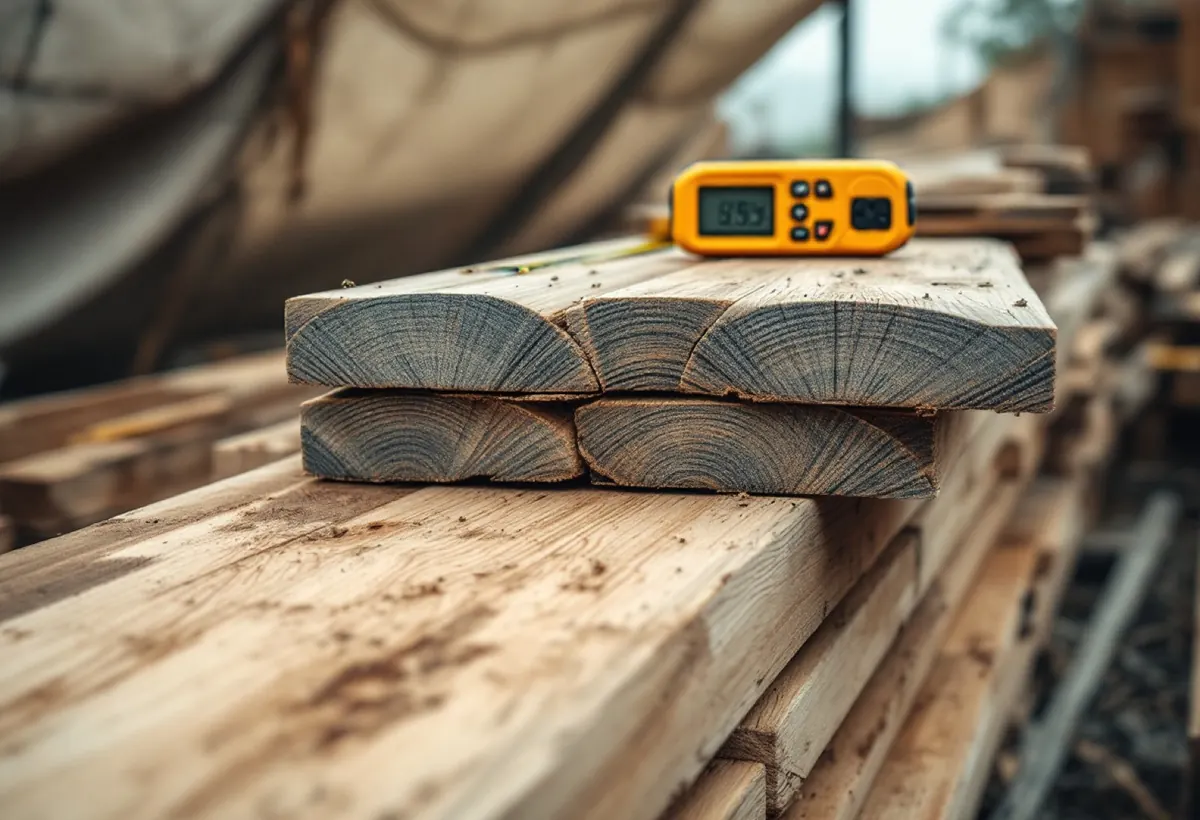
Wood is where blue is most often not mold. The USDA Forest Products Laboratory Wood Handbook, chapter 14 says blue stains vary from bluish to bluish black and grey to brown, are the most common fungal stains, penetrate the sapwood, and often show as pie-shaped wedges along the wood rays. According to the FPL, freshly cut stock piled in warm, humid weather may discolour within 5 or 6 days.
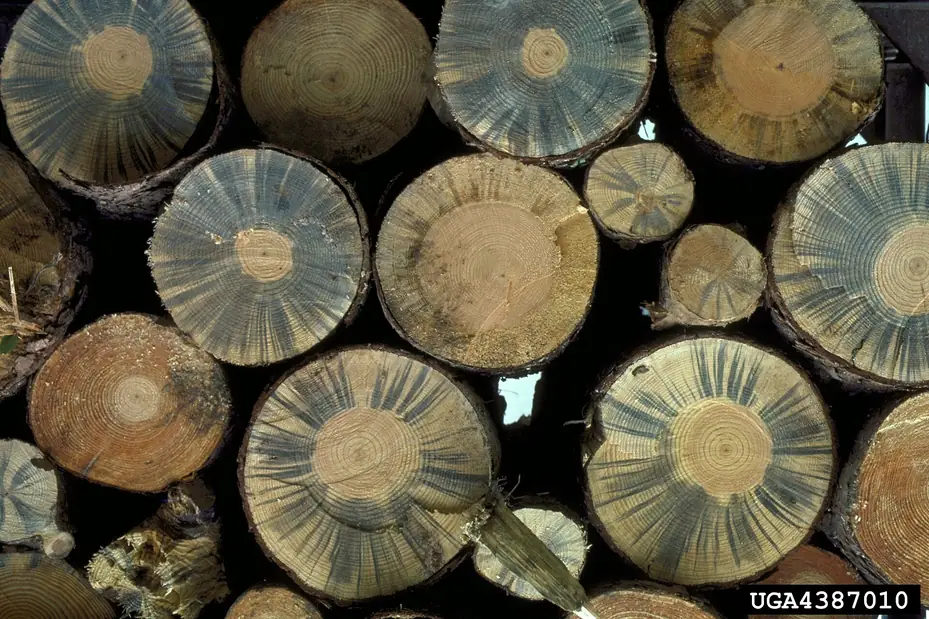

The FPL says stain fungi affect strength only slightly but make wood more absorbent, so finishes take unevenly and the wood wets more easily; incipient decay may hide in stained areas. According to the FPL, serious decay needs wood above the fiber saturation point, an average of 30%, while air-dried wood at 20% or less has a reasonable margin of safety.
| On the wood | Likely cause | Test | Action |
|---|---|---|---|
| Fuzzy blue-green growth on pine framing | Surface mold | Often brushes off softwood | Clean and dry; see mold on wood |
| Grey-blue to blue-black wedges in sapwood | Blue stain | Does not surface off | Cosmetic if kept dry |
| Blue-black halo at steel fasteners | Iron stain | Oxalic acid clears it | Stainless fasteners stop the return |
| Blue-green mold on oak | Mold with deep stain | Growth lifts, colour may stay | FPL: too deep to surface off |
| Soft wood under any colour | Decay | Probe with an awl | Structural review |
The Forest Products Laboratory note Iron Stain on Wood calls iron stain a blue-black or grey discoloration that is common on oak, redwood, cypress and cedar. Its check: apply saturated oxalic acid; if the stain clears, iron is present. If not, try bleach; if bleach clears it, it was probably mildew. According to the note, use at least 5% by weight, rinse with warm water, and do not leave it long on oak, where it can leave a pink stain. The FPL warns that oxalic acid can burn skin and eyes.
Blue mold on bread and cheese
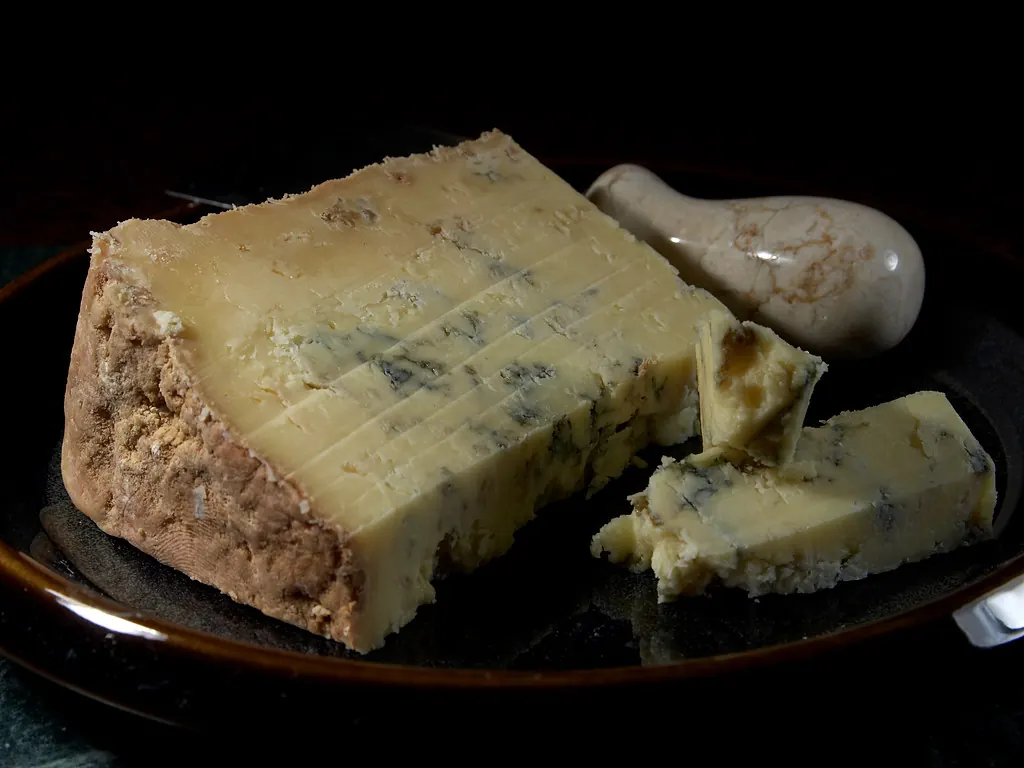
The USDA FSIS fact sheet Molds on Food says the spores give mold its colour and root threads run into the food, lists Penicillium among molds found on foods, and explains that Roquefort, blue, Gorgonzola and Stilton are made with Penicillium roqueforti spores.
| Food | FSIS rule | FSIS reason |
|---|---|---|
| Bread and baked goods | Discard | Porous; contaminated below the surface |
| Hard cheese | Cut at least 1 inch around and below | Mold cannot penetrate deep |
| Blue cheese veins | Eat | Penicillium roqueforti is safe |
| Foreign mold on Gorgonzola or Stilton | Cut at least 1 inch around and below | Handle like hard cheese |
| Foreign mold on Brie or Camembert | Discard | Not from manufacturing |
| Soft, shredded or sliced cheese | Discard | Moisture or knife contamination |
FSIS also says not to sniff moldy food, and to wash the fridge interior with 1 tablespoon of baking soda in a quart of water. Gaskets and drain lines are on mold in refrigerator.
Removal method, step by step
| Step | What to do | Why this differs from generic advice |
|---|---|---|
| 1. Fix the water | Dry wet materials within 24 to 48 hours | Blue growth on a wall is a moisture signal |
| 2. Confirm growth | Wipe test; oxalic acid on wood | Stains survive any mold cleaner |
| 3. Measure | Under about 10 square feet is homeowner scale | Larger: see DIY mold remediation |
| 4. Hard surfaces | Detergent and water, then dry | The method is wet; no dry brushing |
| 5. Porous surfaces | Bag and remove moldy paper, tile, carpet | They may have to be thrown away |
| 6. No paint over it | Clean and dry before primer | Paint over mold is likely to peel |
| 7. Humidity | Below 60% RH, ideally 30 to 50%, per EPA | Moisture control is the key to mold control |
To learn what is in the air, see mold testing. According to Fixr, the national average for remediation is $3,500, with a typical range of $1,500 to $9,000; Fixr does not price blue mold.
Signs it is bigger than the spot
| What you see | What it usually means | Next step |
|---|---|---|
| Growth returns within weeks of cleaning | The moisture source is still active | Meter the wall cavity |
| Spots show through wallpaper, or a musty smell | Growth on the paper back or drywall | Scope containment first |
| Patch larger than about 10 square feet | Beyond EPA homeowner scale | Professional scope |
| Blue stain plus soft or spongy framing | Decay as well as stain | Probe; structural review |
| Blue-black halos spreading on oak flooring | Iron plus repeated wetting | Find the water and the iron |
| Blue-green streaks that return after cleaning | Copper in the water | Water test and plumber |
For contractors
Blue is the colour most likely to inflate a scope by mistake. Blue-stained framing is, per the FPL, mostly cosmetic unless it stays wet; iron stain is chemistry; blue board is a product. Back each line item with a moisture reading and a test result.
| Document | Why it belongs in the file |
|---|---|
| Photo, scale card, wipe test result | Separates growth from stain |
| Oxalic acid and bleach result on wood | Keeps iron stain out of a mold scope |
| Moisture content of blue-stained framing | Compared with the FPL 30% and 20% lines |
| Board type behind plaster | Stops blue base being logged as growth |
| Measured area of growth | Against EPA’s 10 square foot line |
| Water source and timeline | Covered event or long-term seepage |
On claims, the ISO HO 00 03 sample form hosted by the Insurance Information Institute excludes mold, fungus or wet rot, with a give-back for such loss hidden within walls or ceilings or beneath floors when it results from accidental discharge or overflow from a plumbing, heating, air conditioning or sprinkler system, or a household appliance. An adjuster asks where the water came from and for how long. What a given policy pays depends on its form and endorsements, so the owner’s policy, their state insurance department and a licensed professional decide.
What this page does not cover. Health effects of any mold, including Penicillium, and of mycotoxins are outside our scope; CDC, EPA and NIH publish that guidance. Other colours: purple mold, green mold.
Questions people actually ask
Is blue mold dangerous?
This page does not assess health effects; CDC, EPA and NIH publish that guidance. EPA notes that no one can tell whether a mold is producing mycotoxins by looking at it, and CDC says you do not need to know the type to remove it. Blue growth gets the same cleanup as any colour.
What causes blue mold on walls?
Moisture. Blue or blue-green growth on walls is usually a mold such as Penicillium feeding on damp paint, drywall paper or dust, from leaks, condensation on cold walls or humid air. EPA recommends keeping indoor humidity below 60 percent, ideally 30 to 50 percent, and drying wet materials within 24 to 48 hours.
Can you eat bread with blue mold if you cut it off?
No. USDA FSIS says to discard bread and baked goods with mold, because porous foods can be contaminated below the surface and the visible fuzz is only part of the mold. FSIS allows cutting at least 1 inch around and below a spot only on hard cheese and firm produce.
Is the blue mold in blue cheese safe?
The intended mold is. USDA FSIS says Roquefort, blue, Gorgonzola and Stilton are made with Penicillium roqueforti and that the molds used are safe to eat. Foreign surface mold is different: cut at least 1 inch around it on Gorgonzola or Stilton, and discard Brie or Camembert with molds not from manufacturing.
What is blue green mold?
Usually Penicillium. Dictionary.com defines blue mold as any Penicillium forming a bluish-green, furry coating on food, and UC IPM describes the Penicillium rot of garlic and onion as green to blue-green powdery mold. Indoors, treat blue-green fuzz as mold. Greener growth and copper patina are on our green mold page.
Is blue mold on wood rot?
Rarely by itself. The USDA Forest Products Laboratory says blue stain fungi affect strength only slightly, though they make wood more absorbent and incipient decay can hide in stained areas. If the wood is sound and dry, blue stain is cosmetic. Soft or spongy wood needs a structural look.
Is blue mold the same as penicillin?
No. Thomas Volk of the University of Wisconsin-La Crosse explains that penicillin comes from Penicillium chrysogenum, one species in a genus the University of Adelaide counts at 354 accepted species. A blue patch on a wall or loaf could be any of many species, and colour cannot tell them apart.
Sources
- Dictionary.com, entry blue mold. Retrieved 31 October 2026.
- NC State Extension, Blue Mold of Tobacco, Daisy Ahumada, 7 October 2020, reviewed 11 December 2024. Retrieved 31 October 2026.
- UC IPM, Blue Mold Rot, UC ANR Publication 3453, updated February 2019. Retrieved 31 October 2026.
- Habib and colleagues in Toxins (2021), Occurrence and Characterization of Penicillium Species Isolated from Post-Harvest Apples in Lebanon, Toxins 13(10):730. Retrieved 31 October 2026.
- FDA Compliance Policy Guide 510.150, Adulteration with Patulin, updated November 2005. Retrieved 31 October 2026.
- USDA FSIS fact sheet Molds on Food, undated, Internet Archive capture of 4 October 2026. Retrieved 31 October 2026.
- University of Adelaide mycology unit, Penicillium. Retrieved 31 October 2026.
- Thomas Volk of the University of Wisconsin-La Crosse, Penicillium chrysogenum, November 2003. Retrieved 31 October 2026.
- USDA Forest Products Laboratory Wood Handbook, chapter 14, Biodeterioration of Wood, FPL-GTR-282. Retrieved 31 October 2026.
- Forest Products Laboratory note Iron Stain on Wood, Mark Knaebe, revised July 2013. Retrieved 31 October 2026.
- EPA's secondary drinking water standards, updated 26 May 2026. Retrieved 31 October 2026.
- USG technical bulletin PM4, 2010, and USG submittal sheet WB2713, 2018. Retrieved 31 October 2026.
- EPA's brief guide to mold and moisture and EPA mold course, chapter 1, both updated 18 February 2026. Retrieved 31 October 2026.
- CDC, Mold, 26 September 2024. Retrieved 31 October 2026.
- University of Arkansas Cooperative Extension, slime mold entries, 2010 to 2018. Retrieved 31 October 2026.
- Fixr, updated 29 August 2025. Retrieved 31 October 2026.
- ISO HO 00 03 sample form hosted by the Insurance Information Institute, form HO 00 03 10 00. Retrieved 31 October 2026.
- Real photographs are Wikimedia Commons files under the licences in their captions; scene illustrations are generated. Nothing here was tested or inspected by us. See our methodology and the mold hub.
Identification from colour is provisional. A wipe test, the FPL oxalic acid check or a laboratory sample is the reliable answer.