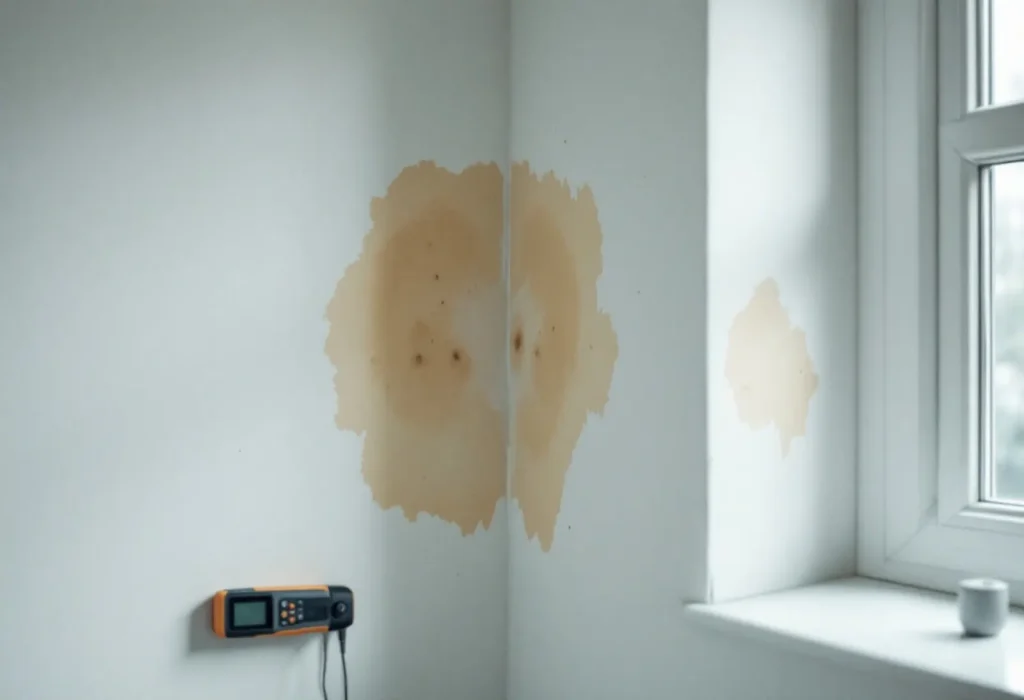
The short answer
Brown mold is fungal growth that reads brown, such as olive-brown to blackish-brown Cladosporium or an aging Aureobasidium colony, but many brown marks indoors are not mold. Water stains, yellow to reddish-brown tannin bleed from cedar and redwood, rust halos around steel fasteners and brown-rot decay all look similar. Texture, a drop of bleach and a moisture reading tell them apart.
Key takeaways
- The NIOSH Dampness and Mold Assessment Tool describes mold as patches colored differently from the material, typically gray, brown or black, often fuzzy and musty. A flat tide line is scored as a stain.
- Per the Wood Handbook, Chapter 16, a drop of household bleach lightens mildew in seconds; dirt, extractive bleed and iron stain do not change.
- Brown wood cracked into cubes that crumble is brown rot, a decay fungus that removes cellulose, per the Wood Handbook.
- Per the same handbook, serious decay needs wood above an average of 30% moisture content; air-dried wood usually sits at 20% or less.
- Per the EPA secondary drinking water standards, manganese above 0.05 mg/L gives black to brown color, a shower look-alike on well water.
- CDC says you do not need to know the type of mold. The material and the water source set the job.
On this page
A brown mark is usually a record of water before it is anything else. The ranking pages for this search mostly skip that and go straight to killing a colony that may not exist. This page sorts the mark first, by surface, then gives the fix.
What you are looking at, surface by surface
| Surface | Brown thing it may be | What gives it away | Source |
|---|---|---|---|
| Painted drywall or ceiling | Water stain | Flat discoloration from a leak, flood or condensation | NIOSH Dampness and Mold Assessment Tool |
| Painted drywall or ceiling | Mold growth | Spots colored differently from the paint, fuzzy, musty or earthy smell | NIOSH Dampness and Mold Assessment Tool |
| Painted cedar or redwood trim | Extractive (tannin) bleed | Yellow to reddish-brown, appears after wetting, through paint | Wood Handbook, Chapter 16 |
| Bare pine near a fastener | Rust | Brown halo around a corroding steel nail or screw | Wood Handbook, Chapter 16 |
| Bare framing or subfloor | Brown rot | Darker wood cracked across the grain into cubes, crumbles | USDA Forest Products Laboratory Wood Handbook, Chapter 14 |
| Bare lumber, sapwood | Fungal or chemical brown stain | Colour in the wood, not on it; does not brush off | USDA Forest Products Laboratory Wood Handbook, Chapter 14 |
| Fixtures or tile on well water | Manganese or iron | Black to brown (manganese) or reddish-orange (iron) where water dries | EPA secondary drinking water standards |
Real brown fungi are common. Mycology Online describes Cladosporium colonies as mostly olivaceous-brown to blackish-brown, sometimes buff or brown (Mycology Online: Cladosporium); Aureobasidium as cream or pink, later brown or black; and Alternaria as black to olivaceous-black with pale brown spores. Those are lab-media descriptions: a lab names a genus from structures, not shade.
Score it before you scrub it
The NIOSH Dampness and Mold Assessment Tool (Publication 2019-114) was written for schools, but its method fits any brown mark: score damage or stains, visible mold, and wet or damp separately for each surface, then note odor. A brown stain with no fuzz and no dampness is a different job from fuzzy spots on a wet wall.
| Score | Size of the affected area | What NIOSH says to do with it |
|---|---|---|
| 0 | None | Record it |
| 1 | Up to the size of a sheet of paper | Compare over time to see if problems get worse |
| 2 | Larger than a sheet of paper, up to a standard door | Compare over time to see if problems get worse |
| 3 | Larger than a standard interior door (32 by 80 inches) | Immediate attention to find the source and remediate |
Then run the brown-specific checks, in order:
- Touch and look closely. Fuzz or raised spots point to growth; a flat edge with a darker rim points to a water stain. Why this differs from generic advice: most guides assume the brown is alive.
- Bleach drop on a coin-sized spot. Per the Wood Handbook, Chapter 16, a drop or two of 5% sodium hypochlorite usually bleaches mildew in a few seconds; what does not bleach is probably dirt, extractives bleed or iron stain. Why this differs: it is a test, not a treatment.
- Meter the substrate. On wood, compare the reading with the 20% and 30% lines per the Wood Handbook. Why this differs: a dry stain is history; a wet one is an active job.
- Probe wood with a screwdriver. Cubes and crumbling mean brown rot; spongy and bleached means white rot. Why this differs: cleaning does nothing for decay.
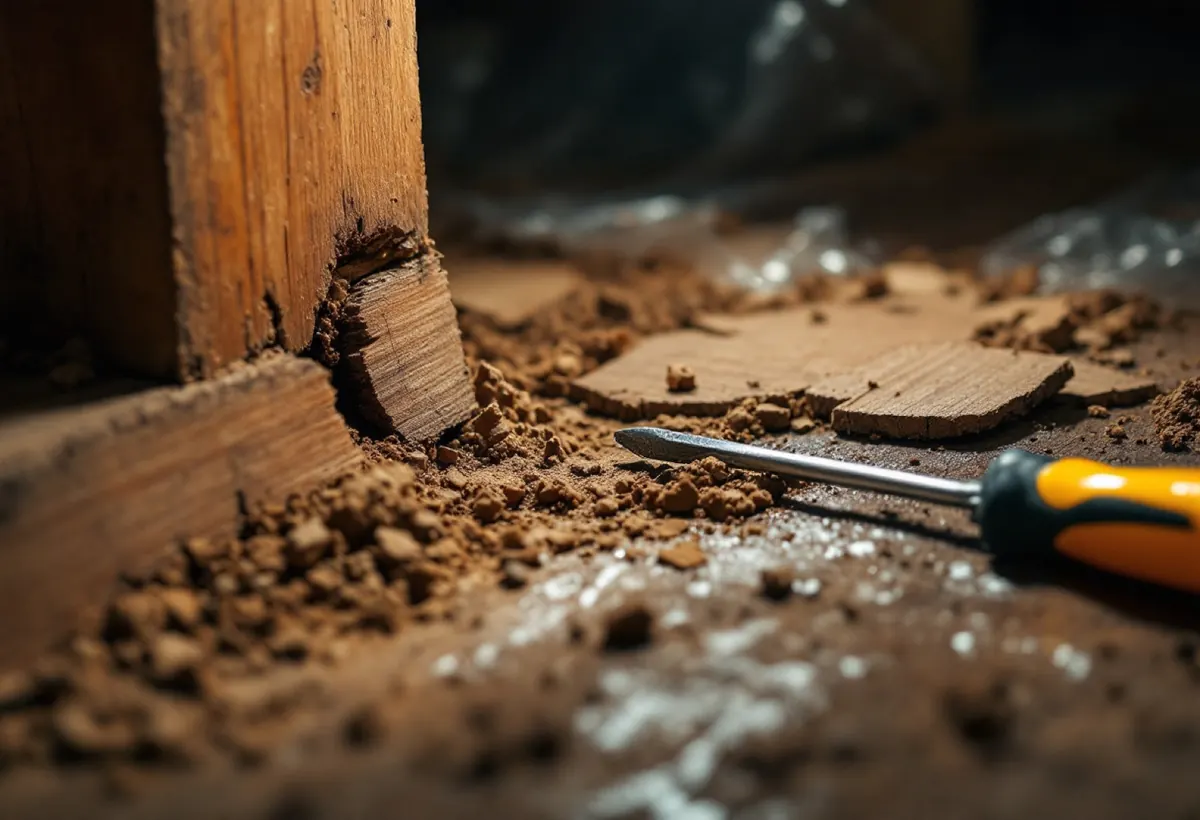
Brown mold on walls and ceilings, or a water stain
On drywall and plaster, the NIOSH Dampness and Mold Assessment Tool draws the line: stains are discoloration from leaks, flooding or condensation; damage includes peeling paint, efflorescence, rust and warping; mold is patches colored differently from the material, typically gray, brown or black, that can look fuzzy and smell musty or earthy. EPA's Mold Cleanup in Your Home adds that mold may cause staining, so a stain and a colony often sit together. Ceiling stain patterns are on water damage ceiling and general wall growth on mold on walls.
| Feature | Water stain | Brown mold | Tannin bleed on painted wood |
|---|---|---|---|
| Surface | Flat, often a darker rim | Raised spots, fuzzy or powdery | Flat, through the paint film |
| Bleach drop (FPL test) | Not described by FPL | Usually lightens in seconds | Does not lighten |
| Smell | None of its own | Musty or earthy (NIOSH) | None of its own |
| What fixes it | Find and stop the source (NIOSH) | Fix moisture; clean or remove the material | Stain-blocking primer, then topcoat |
| What does not | Painting over a wet wall | Painting or caulking over it (EPA) | More coats of the same paint (FPL) |
Brown mold on wood, or brown rot
The USDA Forest Products Laboratory Wood Handbook, Chapter 14 separates four things that look brown on wood. Stain fungi give the most common sapwood discoloration, bluish to grey to brown. A chemical brown stain in softwoods forms when natural chemicals oxidize during slow drying, with no fungus involved. Abnormal mottling with unnatural brown areas is often evidence of decay. And brown-rot fungi remove cellulose, leaving wood browner and cracked across the grain into cubes.
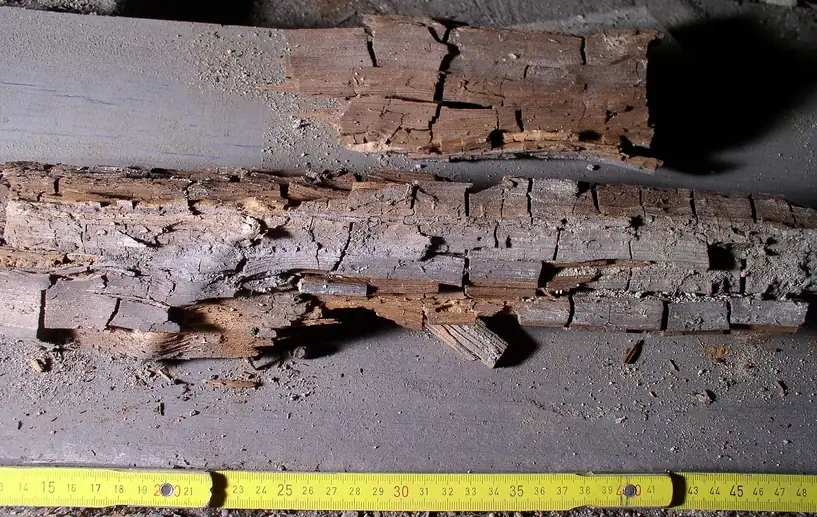

| Type | Look | What it does to the wood | Source |
|---|---|---|---|
| Mold and sap stain | Fuzzy surface growth or colour in the sapwood | Affects strength only slightly | USDA Forest Products Laboratory Wood Handbook, Chapter 14 |
| Brown rot | Browner, cracks across the grain into cubes | Can shrink, collapse and crush to powder | USDA Forest Products Laboratory Wood Handbook, Chapter 14 |
| White rot | Bleached, no cross-grain cracks, often spongy | Keeps its dimensions until severely degraded | USDA Forest Products Laboratory Wood Handbook, Chapter 14 |
| Soft rot | Shallow, soft when wet, firm just beneath | Most damaging to thin pieces | USDA Forest Products Laboratory Wood Handbook, Chapter 14 |
| Rust halo (pine) | Brown stain around a steel fastener | Slight degradation near the iron | Wood Handbook, Chapter 16 |
The handbook calls the name dry rot incorrect, because wood must have moisture to decay, and notes that some brown-rot fungi form strands that carry water from the soil into buildings. Depth and sanding are on mold on wood; plain water marks on furniture and floors are on water stains on wood.
| Threshold | Value | What it means | Source |
|---|---|---|---|
| Fully air-dried wood | 20% or less per the handbook | Reasonable margin against fungal damage | USDA Forest Products Laboratory Wood Handbook, Chapter 14 |
| Fiber saturation point | Average 30% per the handbook | Serious decay only above this | USDA Forest Products Laboratory Wood Handbook, Chapter 14 |
| Humid air alone | Below fiber saturation | Supports some mold, not significant decay | USDA Forest Products Laboratory Wood Handbook, Chapter 14 |
| Iron stain migration | Above about 16% per the handbook | Iron or its stain can move through wood | Wood Handbook, Chapter 16 |
| Heartwood decay resistance | Common building species in that group (domestic) |
|---|---|
| Resistant | Cedars including western and eastern redcedar, old-growth redwood, white oaks |
| Moderately resistant | Douglas-fir, western larch, young-growth redwood, old-growth eastern white and longleaf pine |
| Slightly or nonresistant | True firs, hemlocks, spruces, pines other than those listed, maples, birches |
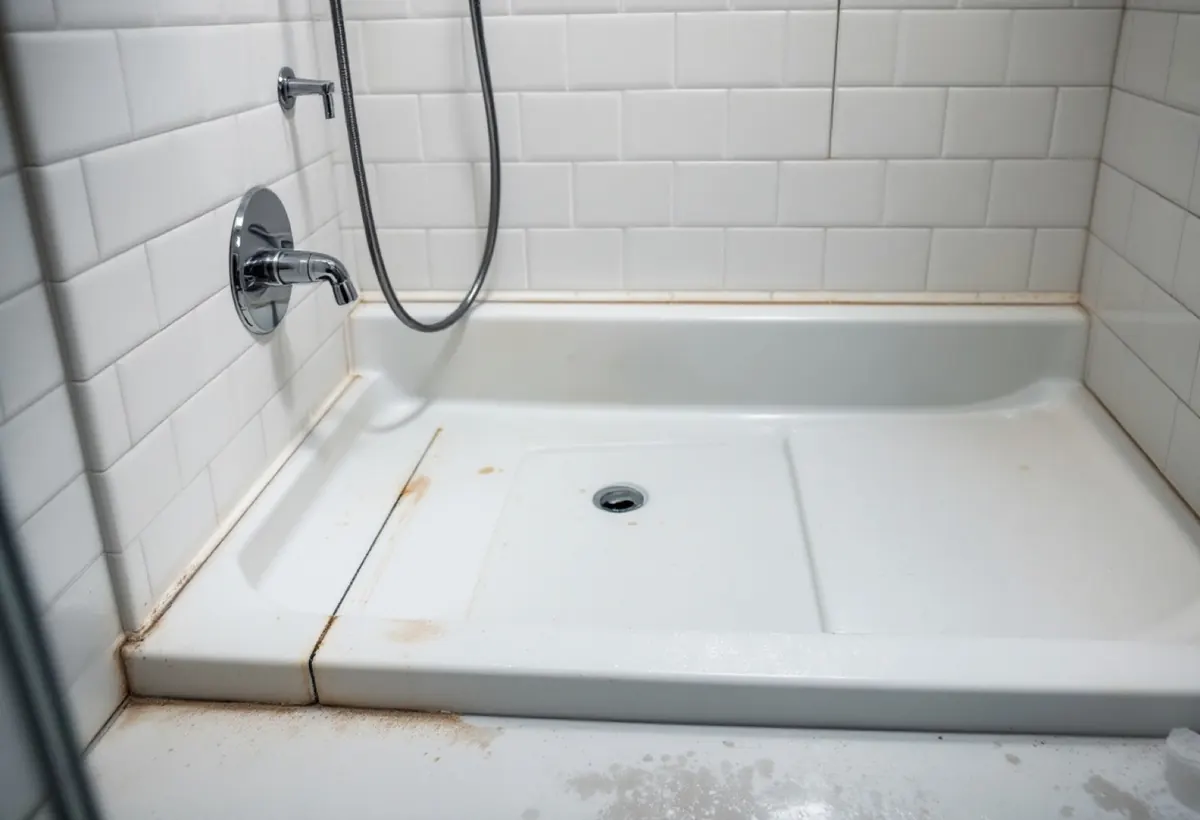
Brown mold in shower
Brown in a shower has three usual explanations, and only one is a fungus. Per Mycology Online, Aureobasidium turns from cream or pink to brown or black and Cladosporium runs olive-brown, so aging growth in caulk can read brown. The EPA secondary drinking water standards lists black to brown color for manganese above 0.05 mg/L and reddish or orange staining for iron above 0.3 mg/L. And the Wood Handbook, Chapter 16 names bathrooms among rooms where extractives bleed through paint on wood trim.
| Brown in the shower | Test | Fix | Why this differs |
|---|---|---|---|
| Speckles in silicone caulk | Bleach drop lightens it | Remove the moldy bead before re-caulking | EPA: do not caulk over mold |
| Brown-black streaks below the head or spout | Follows the water path; often well water | Water test for manganese and iron | Cleaning cannot outrun the supply |
| Brown bloom on painted window trim | No change with bleach | Stain-blocking primer, then topcoat | Extra topcoats will not stop it (FPL) |
Grout, drains and general shower growth are covered on mold in shower.
Brown mold removal, case by case
How to get rid of brown mold depends on which brown it turned out to be. The generic method and EPA’s 10 square foot line are on DIY mold remediation.
- Growth on paint or tile: per EPA's Brief Guide to Mold, clean up the mold and fix the water problem, or it will most likely come back. Why this differs: the stain beside brown growth often shows where that water ran.
- Growth on drywall paper or ceiling tile: remove it, since EPA says absorbent materials may have to go. Why this differs: bleaching the face leaves growth inside.
- Surface mold on softwood: per the Wood Handbook it can often be brushed or surfaced off. Why this differs: on oak the stain may run too deep to sand out.
- Brown rot: dry the wood and repair weakened members. Why this differs: per the handbook, wood kept air dry will not decay and existing decay will not progress.
- Tannin bleed: clean, stain-blocking primer, cure, topcoat, per the Wood Handbook.
- Rust or iron stain: oxalic acid removes iron stain, per the handbook, but it returns unless the iron source goes.
When a lab is worth it
Usually it is not: the EPA Mold Course, Chapter 3 says sampling is unnecessary in most cases when mold is visible. It also says sampling can tell mold from soot or dirt, which is the brown case, and describes clear tape pressed on a spot as one method.
Per the EMSL list, three hours costs $328 against $68 at two weeks. Sampling strategy is on mold testing.
When brown means the structure is involved

| Sign | What it suggests | Source |
|---|---|---|
| Brown wood cracked into cubes, or crumbling to powder | Brown rot; check strength | USDA Forest Products Laboratory Wood Handbook, Chapter 14 |
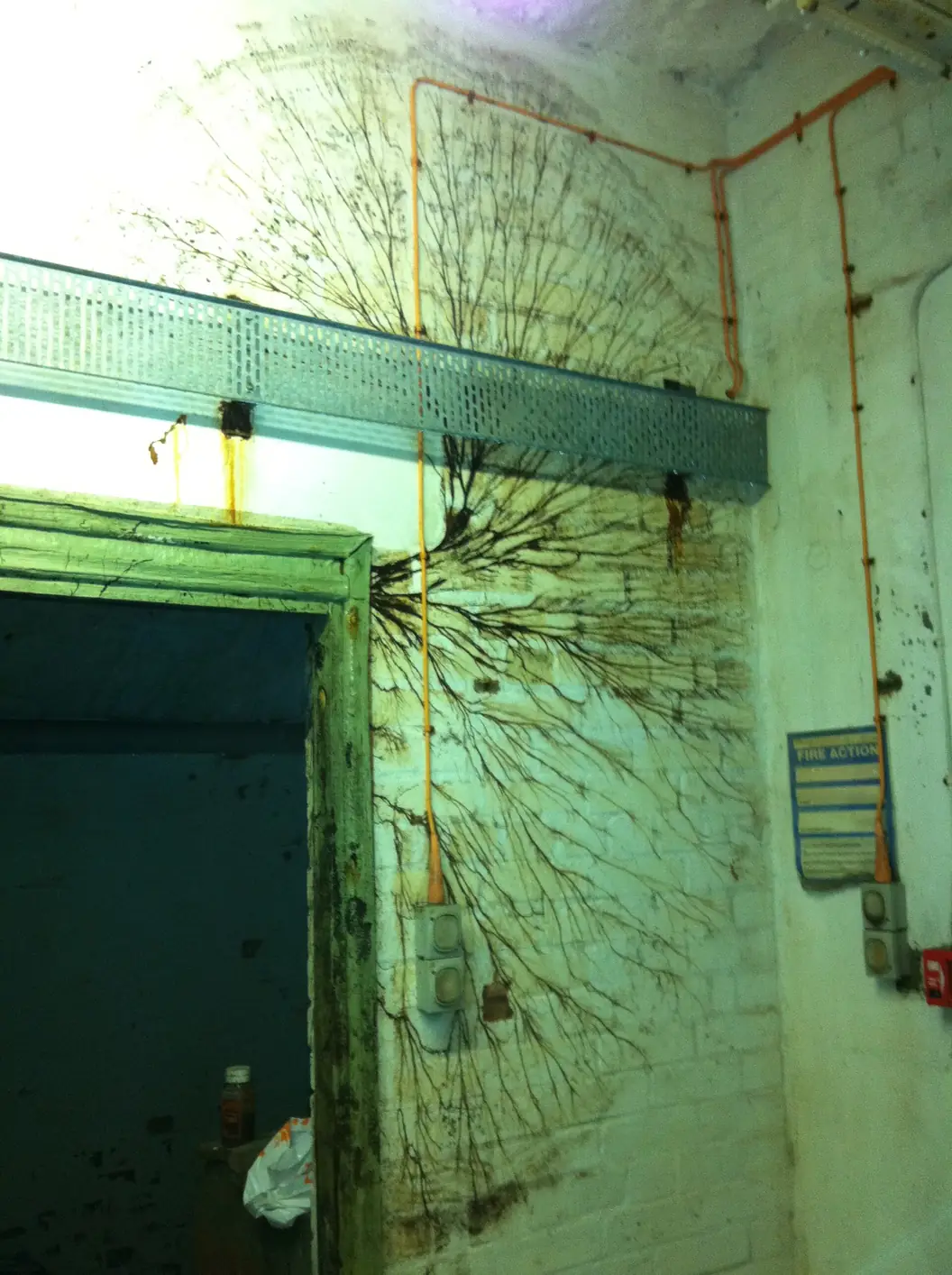
| Brown strands or fans spreading across a wall or floor | Decay fungus surface growth or water-conducting strands | USDA Forest Products Laboratory Wood Handbook, Chapter 14 |
| Wood reading above about 30% moisture content | Conditions for serious decay | USDA Forest Products Laboratory Wood Handbook, Chapter 14 |
| Any column scored 3, larger than an interior door | Immediate attention to source and remediation | NIOSH Dampness and Mold Assessment Tool |
| Strong mold odor with nothing visible | Search for hidden mold | NIOSH Dampness and Mold Assessment Tool |
| Visible brown growth on a wall face | Hidden growth may surround the visible area | EPA Mold Course, Chapter 3 |
For contractors
Brown calls split three ways: cosmetic stains that need a primer, growth that needs remediation, and decay that needs a carpenter. ANSI/IICRC S520 (fourth edition, 2024) is the procedural standard for mold remediation, and a 2024 Cal State LA mold assessment quotes its conditions: Condition 3 is actual growth, active or dormant, visible or hidden; Condition 2 is settled spores or fragments from a Condition 3 area; Condition 1 is normal fungal ecology. A tannin bleed or a dry water stain is none of them.
| Item | What to record | Why an adjuster asks |
|---|---|---|
| Scores per surface | Stain, visible mold and wet columns kept separate, plus odor | Shows what is cosmetic and what is active |
| Moisture map | Pin readings on wood against the handbook lines, by location | Ties brown to a live or past water source |
| Probe results | Cubical cracking, crumbling or sponginess, with photos | Separates remediation from structural repair |
| Framing species, if known | Group under Wood Handbook Table 14-1 | Explains why one member decayed and the next did not |
| Cause of loss | The leak, condensation or water supply behind the stain | Ties the stain to an event or a long-term condition |
Write brown rot as structural repair with its own drying line, and tannin bleed as painting, so the remediation line covers only growth.
Questions people actually ask
Is brown mold dangerous?
Colour does not decide it. CDC says mold can look like spots of many colours and that you do not need to know the type, so brown growth gets the same response as any other: fix the moisture, then clean or remove by material and area. Many brown marks are stains or rot, not mold. See the scope note below.
What does brown mold on wood look like?
Surface mold is fuzzy or powdery and often brushes off softwood. Per the Wood Handbook, stain fungi colour the sapwood itself, while brown rot turns wood browner and cracks it across the grain into cubes that crumble. Probe and meter it: per the handbook, serious decay needs an average of 30% moisture or more.
Is the brown on my wall mold or a water stain?
The NIOSH assessment tool separates them: a stain is flat discoloration from a leak, flood or condensation, while mold is spots colored differently from the material, typically gray, brown or black, often fuzzy with a musty smell. A drop of household bleach usually lightens mildew within seconds, per the Forest Products Laboratory.
Why is there brown mold in my shower?
Aging growth in caulk can turn brown: Mycology Online describes Aureobasidium going from cream or pink to brown or black. On well water, brown-black streaks may be manganese, which EPA says causes black to brown color above 0.05 mg/L. If a bleach drop does not lighten the spot, it is probably not mildew; test the water.
How do I get rid of brown mold?
Match the fix to the cause. Growth on tile or paint: clean it and fix the water problem, per EPA. Growth on drywall paper: remove the material. Brown rot: dry the wood and repair weakened members. Tannin bleed: stain-blocking primer, per the Wood Handbook. Rust: oxalic acid and removal of the iron source.
Should I test brown mold?
Rarely. EPA’s mold course says sampling is unnecessary in most cases when mold is visible, but notes it can tell mold from soot or dirt, which suits an ambiguous brown stain. Per the EMSL 2026 price list, a tape lift exam runs $68 at two weeks to $328 at three hours.
What this page does not cover. Health effects are out of scope here. For exposure questions see CDC, which notes that damp, moldy spaces may cause a variety of health effects, or none at all, and speak to a clinician. Structural repair design belongs to an engineer or builder, and wood-boring insects to our sister site, The Pest Control Brief.
Sources
- USDA Forest Products Laboratory Wood Handbook, Chapter 14, ‘Biodeterioration of Wood’, Arango, Lebow and Glaeser, FPL-GTR-282, USDA Forest Service, 2021, with Table 14-1. Retrieved 31 October 2026.
- Wood Handbook, Chapter 16, ‘Finishing Wood’, FPL-GTR-282, 2021. Retrieved 31 October 2026.
- NIOSH Dampness and Mold Assessment Tool, School Buildings form and instructions, DHHS (NIOSH) Publication No. 2019-114. Retrieved 31 October 2026.
- EPA secondary drinking water standards, US EPA, updated 26 May 2026. Retrieved 31 October 2026.
- Mycology Online: Cladosporium, Alternaria and Aureobasidium, Mycology Online, University of Adelaide. Retrieved 31 October 2026.
- EPA's Brief Guide to Mold, updated 18 February 2026. Retrieved 31 October 2026.
- EPA's Mold Cleanup in Your Home, updated 4 June 2026. Retrieved 31 October 2026.
- EPA Mold Course, Chapter 3, updated 1 December 2025. Retrieved 31 October 2026.
- CDC, ‘About Mold’, 26 September 2024. Retrieved 31 October 2026.
- EMSL Analytical 2026 price list, EMSL Analytical, Revision 1.6, 9 January 2026, code M041. Retrieved 31 October 2026.
- ANSI/IICRC S520 page, fourth edition 2024. Retrieved 31 October 2026.
- a 2024 Cal State LA mold assessment, Terra Engineering, 26 February 2024, quoting S520 conditions. Retrieved 31 October 2026.
- The door area is our arithmetic on NIOSH’s 32 by 80 inch door; nothing else was estimated. See our methodology.
Lab prices change; confirm the rate with the lab. Colour alone never identifies an organism.
More in our mold hub.