The short answer
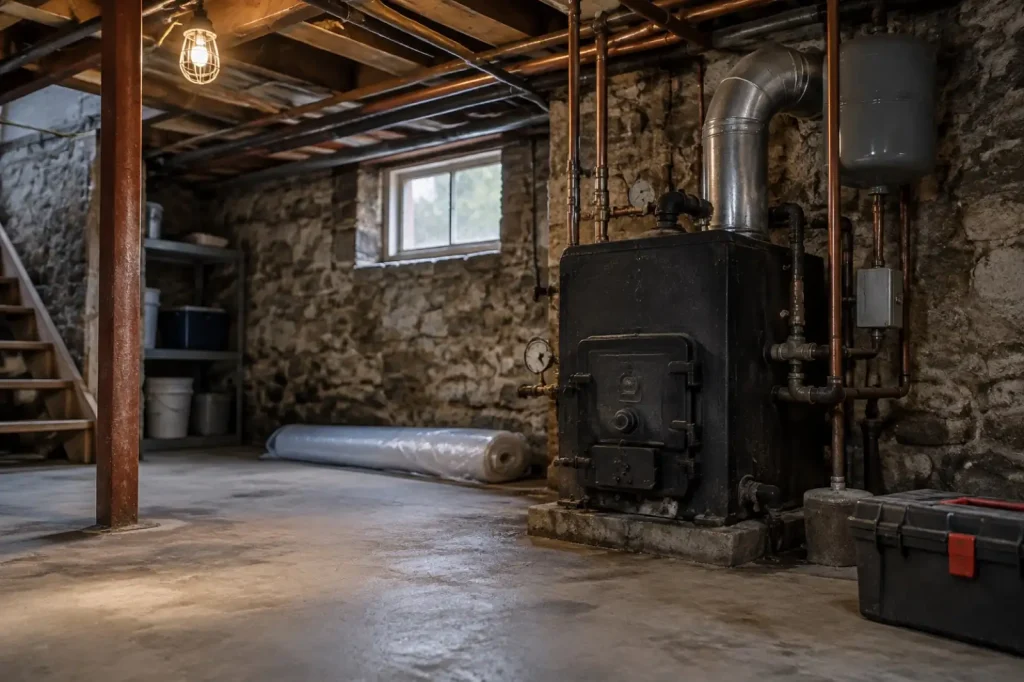
Asbestos pipe insulation is the wrap, preformed sections and plastered fittings found on older steam and hot water pipes, boilers and ducts, often white or gray under a canvas or paper jacket. You cannot confirm it by eye. OSHA presumes such insulation in buildings from 1980 or earlier contains asbestos until tested, and removing it is Class I work.
Key takeaways
- Regulators call it thermal system insulation, or TSI: insulation on pipes, fittings, boilers, breeching, tanks and ducts, per OSHA.
- According to a 1911 manufacturer catalogue, the classic 85% magnesia covering was 85% carbonate of magnesia and 15% asbestos fibre, sold in 3-foot half-sections with a canvas jacket.
- It is usually friable. The 1975 Clean Air Act amendment targeted exactly this: friable molded and wet-applied insulation.
- A burst pipe or flood does not change the rules. Wet, torn or fallen lagging is damaged material and is sampled before tear-out.
- Glove bags are legal for straight runs and elbows, but OSHA limits them to one use, 150 degrees F surfaces and two-person crews for Class I removal.
- Federal NESHAP rules skip houses of four or fewer units; OSHA still protects any contractor’s employees.
On this page
What this page does not cover. It explains identification and regulations, not health. For health information see EPA's Learn About Asbestos page, and speak to a doctor about any specific exposure. Nothing here replaces a sample analysed by an accredited lab.
The forms it took
Pipe insulation was a catalogue product, and the catalogues survive. The 1911 Philip Carey Company catalogue, a public domain scan, sold its coverings in sections three feet long, cut in halves lengthwise, each with a canvas jacket. Fittings got their own sectional covers, and over 10 inches the catalogue says plastic cement was generally used. Boilers took blocks with a thin coat of cement over them.
| Form | How the source describes it | Where you see it |
|---|---|---|
| Magnesia sectional covering | About 85% carbonate of magnesia, 15% asbestos fibre; 3-foot sections split lengthwise, canvas jacket | Straight steam and hot water runs |
| Air cell | Alternate layers of plain and corrugated asbestos paper, forming dead air cells; half-sections with canvas jacket | Straight runs, lower-pressure lines |
| Molded asbestos covering | Asbestos fibre and magnesia molded into sections, canvas jacket | Straight runs |
| Felt and laminated coverings | Asbestos felt or serrated asbestos paper layers, often with wool felt | Underground and wet lines |
| Fitting covers and plastic cement | Sectional covers for elbows, tees and valves; cement troweled on larger fittings | Elbows, tees, valves |
| Blocks and cement on boilers | Sectional blocks with a thin coat of cement over them | Boilers, domes, heaters, breeching |
| Tape and blanket | Pipes covered with an asbestos blanket or tape | Hot water and steam pipes |
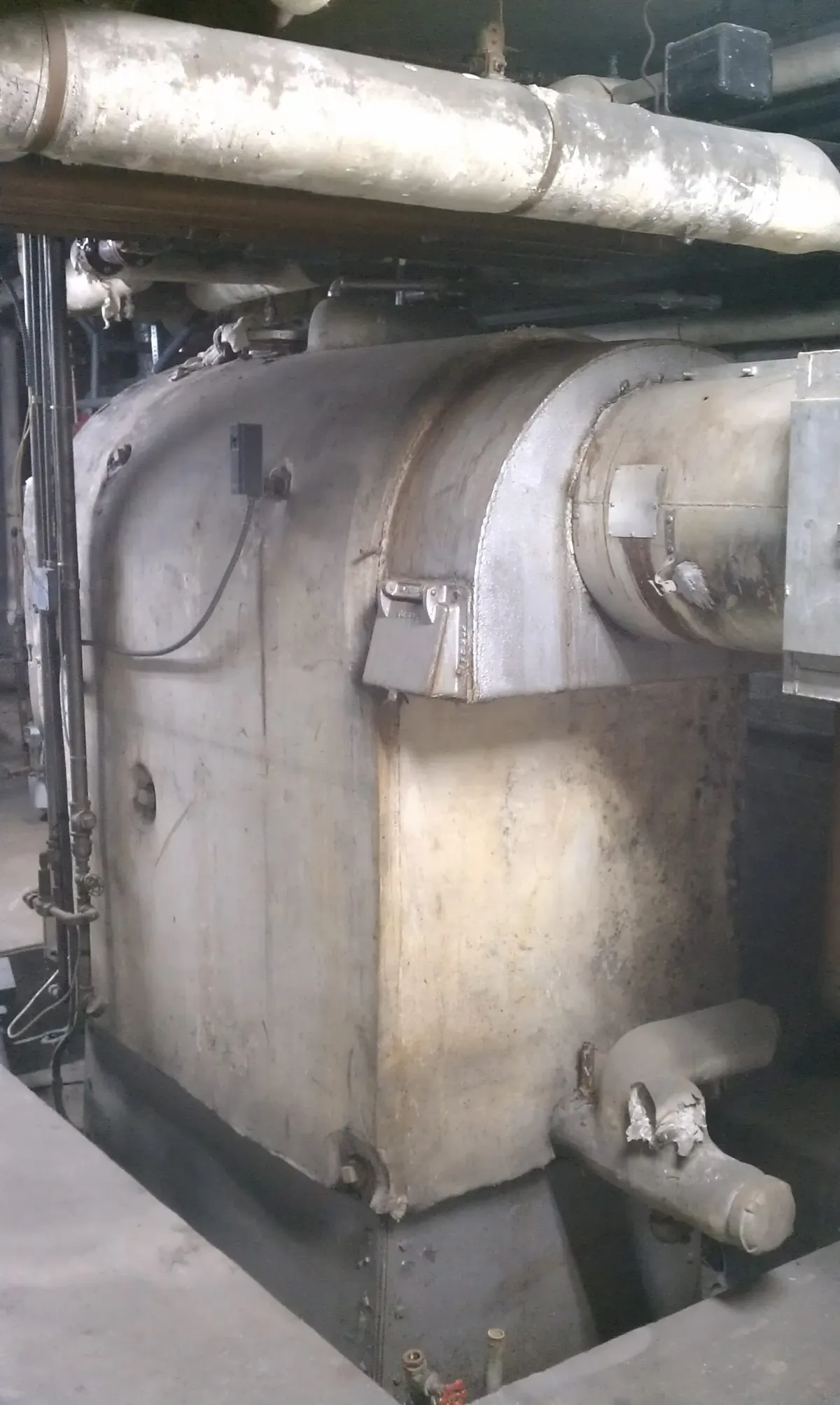

The Asbestos.com insulation guide describes surviving pipe wrap as having a corrugated cardboard texture, chalky white or gray, often under a canvas or paper jacket, and block as white or gray slabs. The Minnesota Department of Health product list lists pipe lagging, pipe elbow insulation, boiler and breeching insulation, tank and duct insulation and thermal taping compounds. For attic and wall insulation, see our asbestos insulation page.
Why regulators call it TSI, and why it is usually friable
Contractors and inspectors rarely say pipe lagging in paperwork. The federal rules use defined terms, and those terms decide which procedures apply.
| Term | Definition | Source |
|---|---|---|
| Thermal system insulation (TSI) | Material on pipes, fittings, boilers, breeching, tanks, ducts or other components to prevent heat loss or gain; TSI ACM is over 1% asbestos | OSHA 29 CFR 1926.1101 |
| PACM | TSI and surfacing material in buildings constructed no later than 1980, presumed asbestos until rebutted | OSHA 29 CFR 1926.1101 |
| Class I work | Removal of TSI and surfacing ACM and PACM | OSHA 29 CFR 1926.1101 |
| Class III work | Repair and maintenance where ACM, including TSI, is likely to be disturbed; no more than one 60 by 60 inch bag of material | OSHA 29 CFR 1926.1101 |
| Friable (NESHAP) | Over 1% asbestos and, when dry, can be crumbled or reduced to powder by hand pressure | 40 CFR 61.141 |
| RACM | Friable material, plus nonfriable material that has become or will become friable | 40 CFR 61.141 |
Friability is the point. The non-mandatory Appendix H to OSHA 29 CFR 1926.1101 says the potential to release fibres depends largely on friability, and names pipe and boiler insulation among the places asbestos is present. EPA singled the category out early: the 40 FR 48292 (14 October 1975) required that friable molded and wet-applied insulation installed afterwards contain no commercial asbestos. That rule survives as 40 CFR 61.148.
Corrugated paper, the air cell material, went later. EPA's 1994 technical amendment defines it with pipe coverings as a major application, and 40 CFR 763.165 has barred its manufacture and import since 26 August 1996. The full sequence is on our when was asbestos banned page.
Identification clues, and their limits
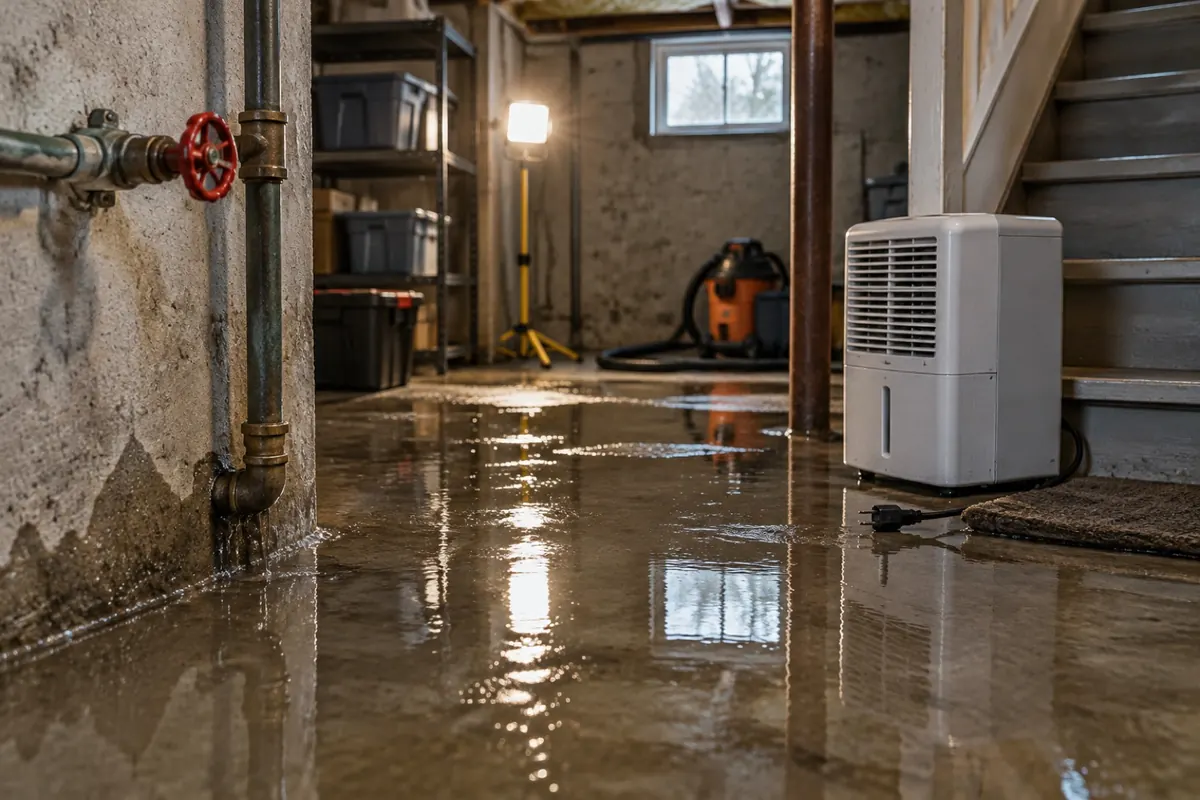
EPA homeowner guidance is blunt: generally you cannot tell whether a material contains asbestos by looking at it unless it is labelled, and if in doubt you should treat it as asbestos and leave it alone. The clues below raise or lower suspicion. None settles it.
| Clue | What it suggests | Why it is not proof |
|---|---|---|
| Building constructed 1980 or earlier | OSHA presumes TSI is asbestos | A presumption, not a result |
| Sectional wrap with a canvas or paper jacket and bands | Matches the catalogue forms | EPA: appearance alone does not identify asbestos |
| Corrugated layers visible at a cut end | Matches air cell | Only a lab can confirm fibre |
| Hard plaster-like coating on elbows, tees, valves | Fitting cement; EPA says sample each system | Fittings and runs can differ |
| Chalky white or gray, crumbles when touched | Friable insulation | Do not touch to test it |
| Fiberglass, foam glass or rubber | AHERA lets an inspector skip sampling | AHERA treats patched sections as separate areas |
The federal school rule shows how professionals sample. Per 40 CFR 763.86, an accredited inspector takes at least three bulk samples from each homogeneous area of TSI, one from a patch under 6 linear or square feet, and samples each system where cement or plaster is used on fittings. Fees are on our asbestos testing cost page; general identification is on what does asbestos look like.

Burst pipes, floods and fire: damage scenarios in restoration
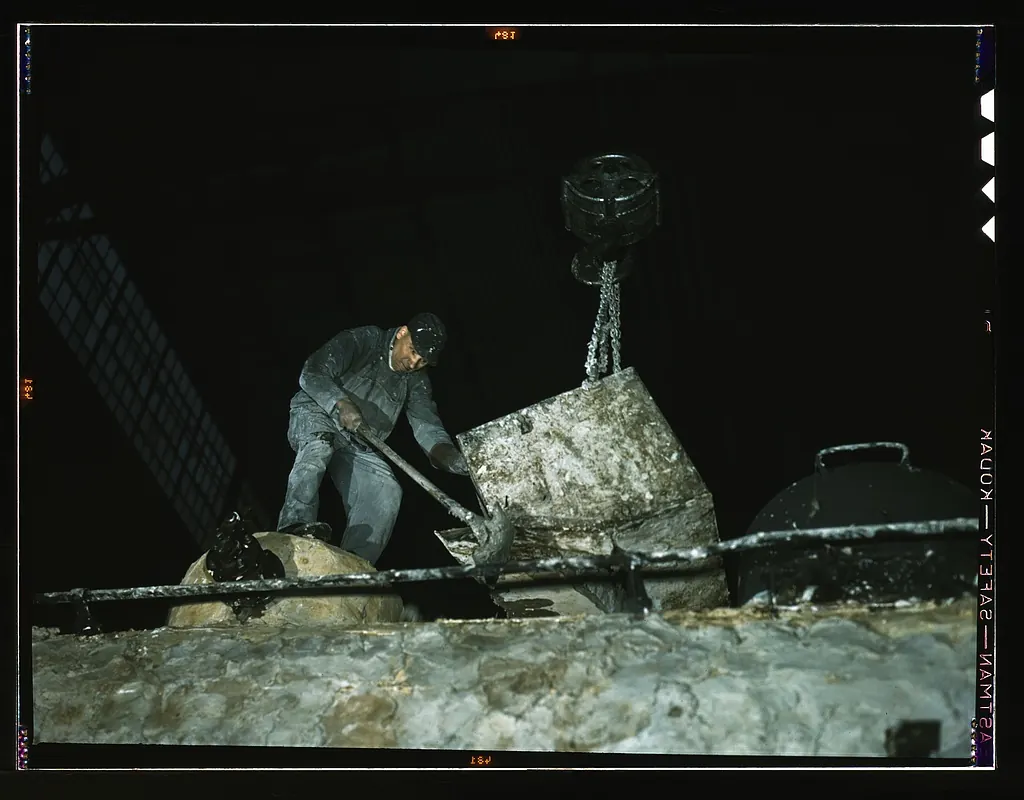
Water losses and old pipe insulation meet constantly, because the insulation sits on the plumbing that fails. EPA’s 40 CFR 763.88 assessment rule lists the damage signs to look for: flaking, blistering, water damage and severely torn jackets.
| Scenario | What happens to TSI | First moves | Rule that applies |
|---|---|---|---|
| Burst or frozen pipe | Wet, sagging or split lagging; debris in the water | Stop the water; keep people out; sample before tear-out | NESHAP emergency renovation; OSHA Class I or III |
| Basement flood | Lower runs and boiler bases soaked; jackets loosen | Do not sweep or vacuum debris; mark the area | EPA homeowner guidance |
| Fire or smoke | Charred jackets, cracked cement, fallen pieces | Assess before demolition and cleaning | NESHAP inspection duty for covered buildings |
| Mechanical damage in repairs | Torn jackets, gouged sections | Stop work; wet and wrap only if trained | OSHA Class III |
The emergency is anticipated in the rules. 40 CFR 61.141 defines an emergency renovation as one caused by a sudden, unexpected event, including nonroutine equipment failure, and per 40 CFR 61.145 the notice is due as early as possible but no later than the following working day. Repair context is on our burst pipe repair page, and the scale of the problem on our frozen pipe damage statistics report.
Found suspect lagging? A seven-step path
- 1. Stop and leave it alone. EPA’s first rule is do not disturb undamaged material, and do not sweep, vacuum or dust debris.
- 2. Is it damaged, wet or crumbling? If no, go to step 3. If yes, keep people and pets out, turn off forced-air heating and cooling as EPA describes contractors doing, and go to step 4.
- 3. Will any planned work touch it? If no, monitor it for wear. If yes, go to step 4.
- 4. Get it sampled by an accredited inspector, separate from the removal firm, as EPA advises.
- 5. Negative result for every homogeneous area? Proceed with normal work and keep the report.
- 6. Positive, or presumed? Choose repair (encapsulation or a protective jacket) for minor damage, or removal by a trained abatement firm.
- 7. Check state and local rules on our accreditation map before anyone, including the owner, removes it.
Steps 1, 4 and 6 follow EPA homeowner guidance, which says pipe, furnace and boiler insulation can sometimes be sealed, that exposed piping may be covered with a protective wrap or jacket, and that removal is the choice when damage is extensive or remodelling will disturb it.
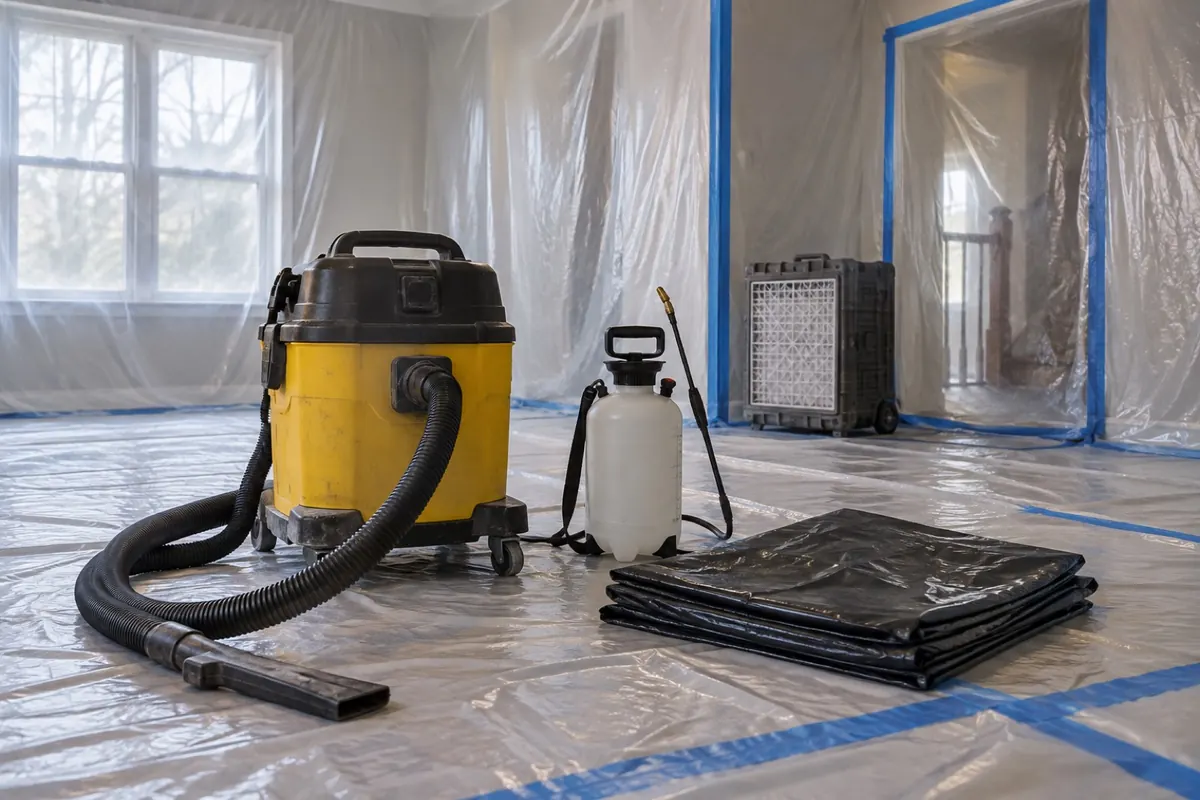
Glove-bag removal under OSHA 1926.1101(g)
A glove bag is a sealed plastic sleeve with built-in gloves, taped around the pipe so the insulation is cut away inside it. OSHA permits glove bag systems under OSHA 29 CFR 1926.1101 paragraph (g)(5)(ii) for straight runs, elbows and other connections, with specific rules. EPA’s homeowner page says glove bags may be adequate for some repairs such as pipe insulation removal.
| Requirement | What OSHA says | Why it matters |
|---|---|---|
| Bag | 6 mil plastic, no seam at the bottom; no more than 60 by 60 inches | Contains debris and water |
| Fittings | Bags for elbows and connections must be designed for them, unmodified | No improvised bags on fittings |
| Fit | Covers the full pipe circumference; smoke-tested and sealed before use | Proves the enclosure holds |
| Use | Once only, never moved | A new bag for each position |
| Temperature | Not on surfaces above 150 degrees F | Hot lines must cool or use another method |
| Adjacent material | Loose material nearby wrapped in two layers of 6 mil plastic | Stops disturbance spreading |
| Crew and close-out | At least two people for Class I; bag collapsed with a HEPA vacuum | Staffing and close-out are set by rule |
The bag is not a shortcut around the rest of the standard. Per OSHA 29 CFR 1926.1101, all work uses wet methods, HEPA vacuums and prompt cleanup in leak-tight containers; Class I work is supervised by a competent person; and respirators are required for Class I work and for Class III work that disturbs TSI.
The homeowner rules
Federal law treats houses gently and workers strictly. 40 CFR 61.141 excludes residential buildings with four or fewer dwelling units from its facility definition, so the federal inspection and notice rules do not reach most houses. OSHA 29 CFR 1926.1101 protects employees, so it binds any contractor you hire, whatever the building.
| Situation | EPA NESHAP | OSHA 1926.1101 | Net effect |
|---|---|---|---|
| House or building of 1 to 4 units, owner doing the work | Outside the federal facility definition | Not an employer | State and local rules may still apply |
| Same house, contractor hired | Outside NESHAP | Contractor’s crew is covered | Class I or III procedures |
| 5 or more units, commercial, public | Inspection always; notice at 260 linear ft of pipe or more | Covered | Both sets of rules |
EPA’s guidance still points one way. EPA homeowner guidance says removal is complex and should be done only by a trained and accredited professional, that improper removal may increase exposure, and that taking samples yourself is not recommended. Its don’ts include sawing, sanding, scraping or drilling asbestos material.
Published costs
Price guides quote pipe work per square foot, which is an odd unit for a pipe. Treat them as rough bands, and note the dates.
| Source | Date | What is priced | Published figure, per the source |
|---|---|---|---|
| Fixr | Updated 18 Aug 2022 | Pipe insulation removal | $10 to $15 per sq ft |
| Fixr | Updated 18 Aug 2022 | Boiler; duct | $30 to $40; $35 to $55 per sq ft |
| Fixr | Updated 18 Aug 2022 | Hourly rate | $400 to $600 (average $500) |
| HomeAdvisor | Updated 17 Jun 2026 | Pipe insulation; HVAC ducts | $5 to $15; $35 to $55 per sq ft |
| HomeAdvisor | Updated 17 Jun 2026 | Typical project | $1,216 to $3,283 |
| The Asbestos Institute | Feb 2022 post, 2021 data | Removal minimum fee | $1,500 to $3,000 (average $2,250) |
Both guides put boiler and duct work well above pipe runs. Our asbestos removal cost page covers abatement pricing across materials, and does insurance cover asbestos removal covers policy language.
For contractors: scope, documentation and the line items
On a water or fire job, suspect TSI changes the scope before it changes the price. Under OSHA paragraph (k), owners must determine and disclose ACM and PACM before work starts, and employers must identify it before their crews go in.
| Line item or record | Why it is there | Rule |
|---|---|---|
| Sampling and lab analysis | Clears or confirms each homogeneous area and fitting system | 40 CFR 763.86 |
| Abatement as its own line | Class I removal needs a competent person and controls | OSHA 29 CFR 1926.1101 |
| Containment beyond the bag | Over 25 linear or 10 square feet of TSI, barriers or isolation | OSHA 29 CFR 1926.1101 |
| Notification | Covered buildings at 260 linear feet; emergency notice by next working day | 40 CFR 61.145 |
| Owner disclosure | Owners must tell bidders and tenants where ACM or PACM is | OSHA 29 CFR 1926.1101 |
Give the adjuster the lab report, the linear footage and fitting count, and the reason drying or demolition paused. Keep the sampling result with the moisture map; our water damage restoration cost page shows where the line sits in a typical estimate. More rules are on the standards hub.
Questions people actually ask
How to tell if pipe insulation has asbestos?
Only a lab can tell. EPA says you generally cannot identify asbestos by looking unless the material is labelled. Clues raise suspicion: a building from 1980 or earlier, canvas-jacketed sections, corrugated layers at a cut end, or plaster-like fitting covers. An accredited inspector takes bulk samples for lab analysis.
How bad is asbestos pipe insulation?
It is the category regulators treat most strictly because it is usually friable, meaning it crumbles under hand pressure, which is why OSHA makes its removal Class I work. Intact and undisturbed, EPA advises leaving it alone. For health questions, see the out-of-scope note at the top and ask a doctor.
When did they stop using asbestos in pipe insulation?
In steps. A 1975 Clean Air Act amendment required new friable molded and wet-applied insulation to contain no commercial asbestos. Corrugated paper, used for air cell pipe covering, has been barred from manufacture and import since 26 August 1996 under 40 CFR 763.165. Installed insulation was never ordered out.
What does 1920s asbestos insulation look like?
Catalogues of the era describe it. According to the 1911 Philip Carey Company catalogue, steam pipe coverings came in 3-foot sections split lengthwise with a canvas jacket, including 85% magnesia covering with 15% asbestos fibre, and air cell covering made of plain and corrugated asbestos paper. Fittings were capped with sectional covers or troweled cement.
Can I wrap or encapsulate asbestos pipe insulation myself?
EPA says pipe, furnace and boiler insulation can sometimes be sealed or covered with a protective wrap or jacket, but that this should be done only by a professional trained to handle asbestos safely. Federal NESHAP rules do not cover most houses, but state and local rules may. Check before you start.
Can asbestos pipe insulation be removed with a glove bag?
Yes, on straight runs, elbows and other connections, where OSHA allows glove bag systems in place of a larger enclosure. The limits are strict: 6 mil bags no larger than 60 by 60 inches, one use, no surfaces above 150 degrees F, and two workers for Class I removal, per 29 CFR 1926.1101.
Sources
- OSHA 29 CFR 1926.1101, including Appendix H, eCFR.
- 40 CFR 61.141, 40 CFR 61.145 and 40 CFR 61.148, asbestos NESHAP, eCFR.
- 40 CFR 763.86 and 40 CFR 763.88, AHERA sampling and assessment, eCFR.
- 40 CFR 763.165 and EPA's 1994 technical amendment, govinfo.
- 40 FR 48292 (14 October 1975), Federal Register on govinfo.
- EPA's Learn About Asbestos page (updated 13 July 2026) and EPA homeowner guidance (updated 25 June 2026).
- EPA asbestos actions page (updated 21 January 2026).
- Minnesota Department of Health product list (updated 18 December 2025).
- 1911 Philip Carey Company catalogue, Internet Archive, public domain mark.
- Asbestos.com insulation guide (updated 4 June 2026).
- Fixr cost guide (updated 18 August 2022).
- HomeAdvisor cost guide (updated 17 June 2026).
- The Asbestos Institute, February 2022 post citing 2021 figures.
- All retrieved 11 October 2026. See our methodology for how we use published prices.
This page summarises published rules and prices and is not legal advice. State and local asbestos rules vary; confirm them before any work.