The short answer
Waterproofing basement cost runs about $500 to $2,000 for interior sealant or coating alone, $5,000 to $10,000 for an interior drainage system with a sump, and $12,000 to $20,000 or more for exterior excavation and membrane. Crack injection prices separately at roughly $400 to $900 per crack. The method is chosen by diagnosis, and a meaningful share of wet basements are fixed by gutters, downspout extensions and grading for a few hundred dollars.
Key takeaways
- The diagnosis drives the method. Condensation, surface water and hydrostatic groundwater pressure look almost identical to a property owner and need completely different fixes.
- Start with the cheapest legitimate fixes. Gutters, downspout extensions and grading away from the house resolve a real share of wet basement complaints for a few hundred dollars.
- Interior sealant paint is widely oversold. It can work against vapour and minor seepage, and it will fail against hydrostatic pressure because the pressure pushes it off the wall.
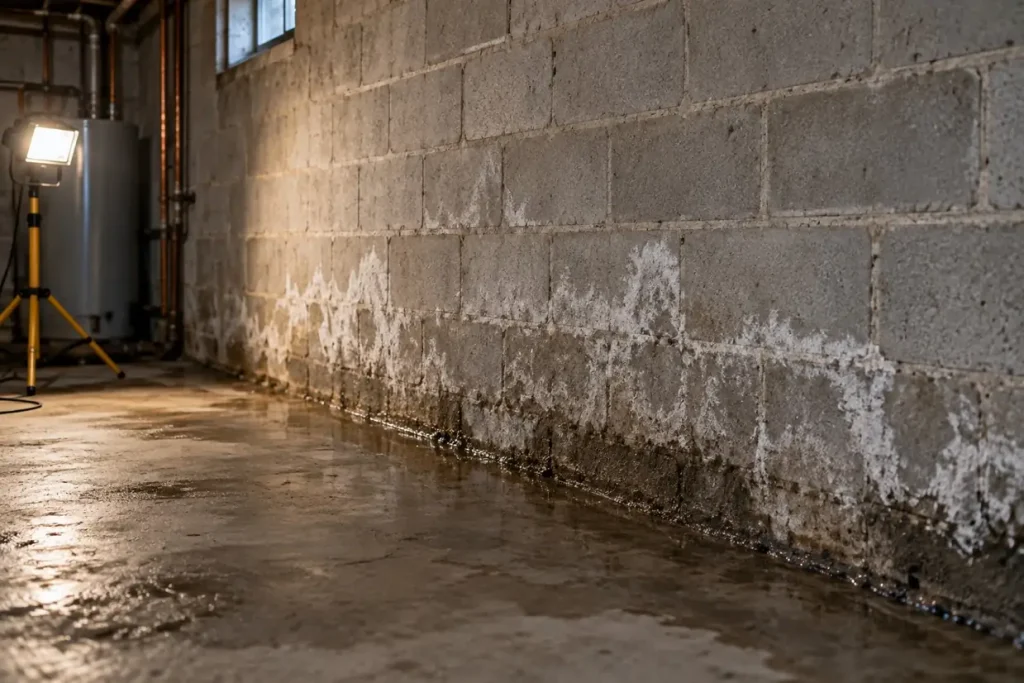
- Efflorescence, the white mineral deposit on masonry, is evidence that water has moved through the wall and evaporated. It is a symptom to read, not the problem to treat.
- A lifetime warranty from a firm that may not exist in ten years is worth what it is worth. Transferability and exclusions matter more than the word lifetime.
On this page
- The diagnosis drives the method
- What each method costs
- Start with the cheap legitimate fixes
- Why sealant paint is oversold
- Reading efflorescence and other evidence
- Crack injection, and when it is the whole job
- Interior drainage systems
- Exterior excavation and membrane
- Wall construction changes the answer
- When it is condensation, not groundwater
- What a waterproofing warranty is worth
- The order to spend money in
- Questions people actually ask
Waterproofing basement cost is quoted across a range so wide that the number alone tells you nothing. The same wet wall can attract a $900 proposal and a $19,000 proposal in the same week, and both contractors can be describing competent work. The difference is not usually greed. It is that they have diagnosed different problems, or that one of them has not diagnosed anything at all. This page is about choosing the method, which is the decision that sets the price.
The diagnosis drives the method
Three distinct problems produce a wet basement, and from inside the room they present almost identically: dampness on the wall, a smell, and staining. They require different work, at prices that differ by twenty times, and the single most expensive mistake available here is treating one as another.
| Symptom observed | Likely cause | Correct method | Wrong method that gets sold anyway |
|---|---|---|---|
| Damp appears in humid weather, worst in summer, no link to rain. Moisture on cold pipes and the floor. | Condensation. Warm humid air meeting cold masonry. | Dehumidification, insulating cold surfaces, ventilation control, sealing the dryer vent and other sources. | A full interior drainage system, which will run almost never and change nothing, because there is no groundwater to collect. |
| Water appears during or shortly after heavy rain, often near downspouts or at one corner. Dry between storms. | Surface water. Gutters, downspouts or grading directing runoff against the wall. | Clear the gutters, extend the downspouts, correct the grading so the ground falls away from the building. | Exterior excavation and membrane, which is a large sum spent to waterproof against water that did not need to arrive. |
| Water seeps at the joint between floor and wall, worst in spring or after prolonged wet periods. Rises rather than runs. | Hydrostatic pressure. The water table rises and pushes water through the floor and wall joint. | Interior perimeter drainage to a sump, or exterior drainage where the wall itself is at risk. | Interior sealant paint, which will be pushed off the wall by the same pressure it was applied to resist. |
| Water enters through a visible crack in a poured wall, in a stream or a trickle. | A single defect rather than a systemic problem. | Crack injection at that crack, after checking whether the crack is structural or shrinkage. | A whole-perimeter system priced against one crack. |
| Damp patches high on the wall, above grade level. | Above-grade water. Flashing, a gap at the rim joist, a window well filling, or spalled mortar. | Repair the specific entry point. | Anything involving a trench, because the water is not coming from below. |
| White powdery deposit on masonry, wall feels dry now. | Water has moved through the masonry at some point and evaporated, depositing salts. | Establish whether it is historic or active before choosing anything. | An immediate drainage contract sold off the deposit alone. |
The test that separates surface water from groundwater
Timing is the most useful free diagnostic available. Surface water arrives with rain and leaves shortly after it stops, and it tends to appear at a consistent location that lines up with a downspout, a low spot, or a slope running toward the building. Hydrostatic water lags rainfall by hours or days, follows the season rather than the storm, and appears along the floor and wall joint rather than at a single point. Keeping a note of when water appears relative to weather, over a few events, is worth more than any single inspection.
More than one cause is normal
This is not a multiple choice question with one answer. A basement with a genuine water table problem usually also has a gutter running over. Fix the cheap causes first and then measure what is left, because what remains is a far more honest brief for a drainage contractor.
What each method costs
These are whole-job ranges by method. The gap between the tiers is the story, and it is why the diagnosis question above has to be settled before any of these numbers means anything.
| Method | Typical range | What it addresses | What it does not address |
|---|---|---|---|
| Interior sealant or coating | $500 to $2,000 | Vapour transmission through masonry and minor damp. Cosmetic improvement on a wall that is essentially sound. | Hydrostatic pressure. The coating is pushed off the wall by water pressure behind it. |
| Crack injection | $400 to $900 per crack | A discrete crack in a poured concrete wall that is passing water | The wider water problem, and any structural cause of the crack. |
| Interior drainage with sump | $5,000 to $10,000 | Hydrostatic water reaching the floor and wall joint. Gives the water a managed exit. | The wall itself, which still gets wet. Also does nothing for condensation. |
| Exterior excavation and membrane | $12,000 to $20,000+ | Water reaching the wall at all. Relieves pressure on the structure and protects the wall face. | Interior humidity sources, and any water entering above grade. |
| Grading, gutters and downspout extensions | A few hundred dollars typically | Surface water directed against the building, which is a real share of wet basement complaints. | A genuinely high water table. |
| Dehumidification | Equipment cost plus running cost | Condensation and residual humidity after the water is controlled | Liquid water entering the space. |
Start with the cheap legitimate fixes
This section should be first in every sales conversation and is routinely skipped, because there is very little margin in it. Say it plainly: a real share of wet basement complaints are surface water problems that are fixed for a few hundred dollars, and a contractor who does not raise the subject before quoting a system is selling rather than diagnosing.
| Fix | What it does | Why it is skipped |
|---|---|---|
| Clear the gutters | A blocked gutter overflows at the wall, delivering the entire roof catchment directly against the foundation. | There is no contract in it. It is an afternoon with a ladder. |
| Extend the downspouts | Moves roof water several feet away rather than releasing it at the base of the wall. Extensions are inexpensive. | Visually unpopular, and easy for a homeowner to shorten again. |
| Correct the grading | The ground should fall away from the building. Settled backfill often slopes back toward it, which turns the perimeter into a collection channel. | Requires soil and labour, and looks like landscaping rather than waterproofing. |
| Fix window wells | A well without a functioning drain or cover fills during rain and delivers water straight to the window. | It looks minor until it is the whole cause. |
| Check the driveway and patio slope | Hardscape that has settled toward the house directs a large impervious catchment at the wall. | Correcting it is concrete work, so it gets deferred. |
| Redirect the dryer vent and seal air leaks | An interior humidity source that presents as a damp wall. | Nobody associates a laundry appliance with a wet basement. |
The reason this ordering saves money even when it fails
Suppose the gutters and grading are corrected and the basement is still wet. Nothing has been wasted, because the remaining problem is now properly characterised. A drainage system sized against a wall that is also receiving roof runoff is sized against a problem that did not have to exist.
Why sealant paint is oversold
Interior waterproofing coatings occupy an unusual position: they are a legitimate product doing a legitimate job, sold constantly for a job they cannot do. Being precise about the boundary is the useful contribution here.
| Condition | Does a coating help | Why |
|---|---|---|
| Vapour moving through masonry, wall feels damp but no liquid water | Often yes | The coating reduces vapour transmission, which is what it is formulated for. |
| Minor seepage through porous block, low volume, no pressure | Sometimes, as part of a package | It can slow a small amount of movement, though it treats the surface rather than the cause. |
| Cosmetic improvement on a sound wall | Yes | This is a finish, and as a finish it performs. |
| Hydrostatic pressure pushing water through the wall or the floor joint | No | The pressure acts behind the coating. Adhesion to the substrate is the only thing resisting it, and it loses. The coating blisters and peels off in sheets. |
| Water entering through an active crack | No | Paint bridges nothing structural. The crack moves and the coating splits. |
| Wall face spalling or mortar failing | No, and it can obscure the problem | Covering deteriorating masonry hides the evidence that a diagnosis depends on. |
The physics is short and decides the question
Water under pressure behind a wall exerts that pressure on whatever is on the other side of the masonry. A coating is a film bonded to the inner face. Its resistance is its adhesion to the substrate, and that adhesion is tested by water pressure acting across the whole area rather than at a point. Where the pressure is meaningful, the film comes away, usually taking some of the surface with it. This is not a quality problem with the product. It is the wrong application for it.
The version of this that does work
Coatings earn their place where the water problem has already been solved by drainage and what remains is vapour and appearance. Applied after an interior drainage system is installed and running, a coating on a dry wall does what it is designed to do. Applied instead of the drainage system, it buys a few seasons and then fails, and the second quote arrives with the first one already spent.
Reading efflorescence and other evidence
The white crystalline deposit on basement masonry is called efflorescence, and it is one of the more misread signals in this business. It is mineral salt left behind when water that has moved through the masonry evaporates at the surface. The water carried the salts out of the material and then left.
That makes efflorescence evidence, not the problem. It tells you water has moved through the wall, which is genuinely useful. It does not tell you when, how much, or whether it is still happening. A deposit from a wet decade ago looks much the same as one from last month. Scrubbing it off and watching whether it returns is the practical way to find out which one you have, and it costs nothing.
| Evidence | What it indicates | What it does not prove |
|---|---|---|
| Efflorescence | Water has moved through the masonry and evaporated at the surface | That it is happening now, or at what volume. |
| A tide line or staining at a consistent height | Water has stood at that level, more than once probably | Whether the source was groundwater, a burst pipe or an appliance. |
| Rust on the base of steel columns or appliance feet | Standing water has been present | How recently or how often. |
| Musty odour with no visible water | Elevated moisture somewhere, possibly concealed | The location. Odour travels, and the source is often behind finishes. |
| Condensation on cold pipes and the floor in summer | Interior humidity exceeding the dew point of cold surfaces | Anything about groundwater. This points the other way. |
| Lifting or cupping of floor finishes | Moisture moving up through the slab | Whether the slab lacks a vapour retarder or the water table is high. |
The reason to be careful with all of it is that persistent moisture behind finishes becomes a remediation problem. The EPA mold cleanup guidance is explicit that controlling moisture is the controlling factor in preventing mould growth, which is why the sequence is always moisture first and finishes afterwards. Our mould remediation cost page covers what it costs once growth is established.
Crack injection, and when it is the whole job
Where a poured concrete wall is passing water through a discrete crack and the rest of the basement is dry, injection is frequently the correct and complete answer at roughly $400 to $900 per crack. It is one of the few places in this trade where a small intervention genuinely resolves the problem.
| Injection type | Behaviour | Typical application |
|---|---|---|
| Polyurethane | Expands on contact with water and stays flexible | Actively leaking cracks, and cracks that move slightly with seasonal temperature. |
| Epoxy | Rigid, and bonds the two faces structurally | Where the crack needs to be restored to structural continuity, typically specified by an engineer. |
The question to settle before injecting anything
A crack that is passing water is a symptom of something. Shrinkage cracking in a poured wall is common, generally vertical, and ordinarily benign. Stepped cracking through block joints, horizontal cracking mid-wall, or any crack that is wider at one end and visibly displaced points at movement rather than shrinkage. Injecting a moving crack seals it until it moves again. Anything suggesting structural movement wants a qualified engineering assessment before a waterproofing contract, not after.
Why block walls are different
Injection is a poured-wall technique. A hollow block wall does not crack in the same way and does not hold injected material in the same way, because water inside the wall travels through the cores rather than along a single defect. The equivalent intervention on a block wall is usually drilling weep holes at the base to release water from the cores into an interior drainage system, which is a different job with a different price.
Interior drainage systems
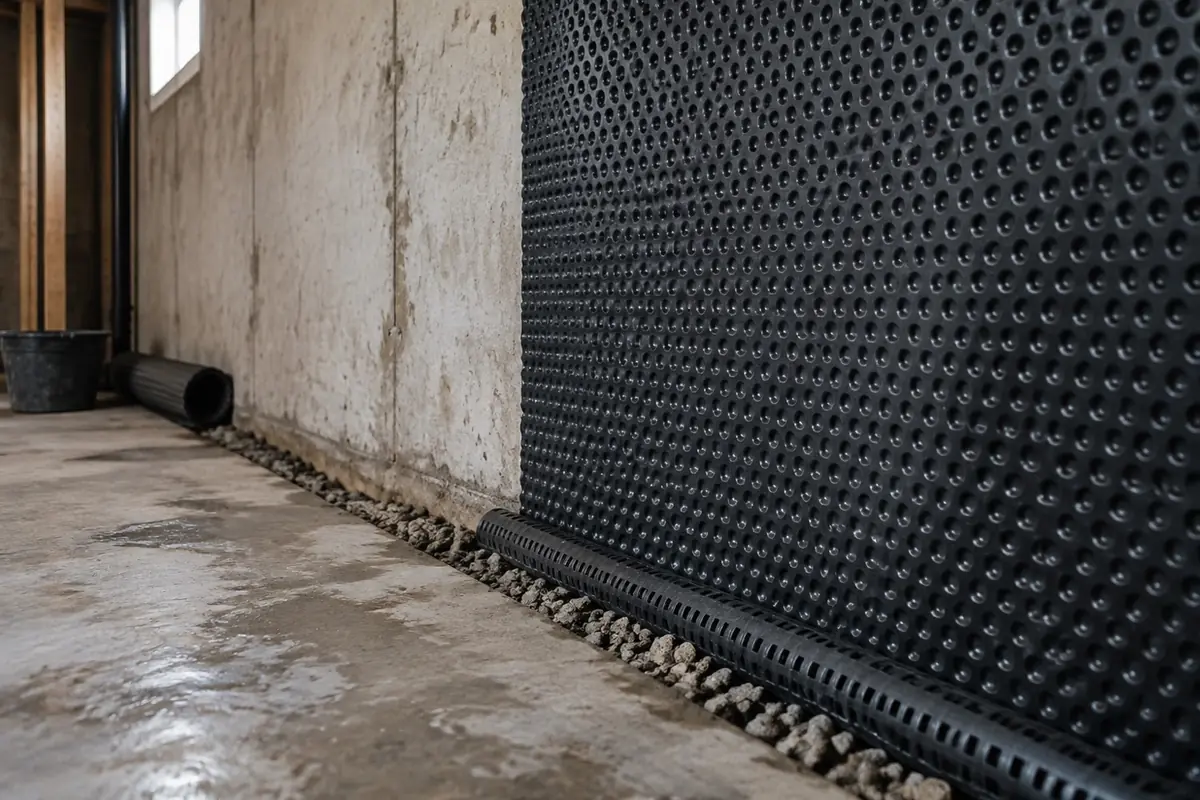
Interior drainage is the method most commonly sold for hydrostatic water in a basement, and at $5,000 to $10,000 it is the middle tier where most of the market sits. A channel is cut around the inside perimeter of the slab, a perforated pipe is bedded in stone, the slab is patched, and the water is routed to a sump basin where a pump lifts it out.
What it does honestly: it gives water that is already reaching the wall a managed route out, rather than letting it spread across the floor. What it does not do: keep the wall dry, or relieve pressure on the structure. For a sound wall that is accepted as the price of a solution that costs a third of the exterior alternative. Our french drain cost page covers the interior against exterior decision in full, and our sump pump installation cost page covers the pump that the whole system depends on.
The dependency that the price does not show
An interior system converts a passive water problem into a system with a powered component. It works while the pump works and the discharge stays clear, and the most common time a sump is needed is a storm, which is also the most common time the power fails. A backup is therefore part of the real cost of this method rather than an accessory, and quotes that leave it out are quoting an incomplete system.
Exterior excavation and membrane
The exterior method excavates down the outside of the foundation to footing level, cleans the wall face, applies a waterproofing membrane and usually a drainage board, installs a footing drain in stone with filter fabric, and backfills. At $12,000 to $20,000 and above it is the most expensive option and the only one that stops water reaching the wall at all.
| Component | Function | Where quotes differ |
|---|---|---|
| Excavation to footing depth | Exposes the full wall face so it can be treated | Depth, access for machinery, and how spoil is handled. This is most of the cost. |
| Wall preparation | Cleaning, parging where needed, repairing defects in the face | Whether preparation is included or assumed unnecessary. |
| Waterproofing membrane | A continuous barrier across the wall face | Sheet membrane against liquid-applied, and whether it is genuinely waterproofing or a damp-proof coating. |
| Drainage board | Creates a drainage plane so water falls to the footing drain rather than standing against the membrane | Frequently omitted from cheaper quotes. |
| Footing drain in stone with fabric | Collects the water and carries it to a discharge | Fabric specification, stone grading, and whether cleanouts are included. |
| Backfill and reinstatement | Returns the ground, ideally with free-draining material near the wall | Whether hardscape, planting and irrigation are reinstated or excluded. |
Damp-proofing is not waterproofing, and the words get used loosely
There is a meaningful distinction between a damp-proof coating, which resists moisture transmission, and a waterproofing membrane, which is intended to resist water under pressure. Many foundations were damp-proofed when built and were never waterproofed. A quote that says waterproofing and specifies a spray-applied bituminous coating with no drainage board is describing damp-proofing. Ask which it is, and ask for the product name.
When the excavation is happening anyway
The cost case for exterior work changes completely if the ground is already open. A foundation repair, a new extension, a replacement driveway, or utility work along the wall all present a window where the excavation, which is the expensive part, is already paid for. The incremental cost of membrane and a footing drain at that moment is a fraction of the standalone figure, and it is the single best time to do this work.
Wall construction changes the answer
The same water table produces different problems against different walls, and a method that suits one is not automatically right for another.
| Wall type | How water behaves | Method implications |
|---|---|---|
| Poured concrete | Generally sound, with water entering at cracks, cold joints and tie holes rather than through the body | Crack injection is viable. Interior drainage handles the floor joint. The wall itself tolerates being wet. |
| Hollow concrete block | Water enters the cores and fills them, then finds its way out at joints and at the base | Weep holes into an interior drainage system release the cores. Interior coatings on block are particularly prone to being pushed off. |
| Stone or rubble foundation | Water moves through the mortar and the voids. These walls are often permeable by design. | Sealing the inner face traps water in the wall. Drainage and managed evaporation generally suit better, and specialist advice is warranted. |
| Brick foundation | Water moves through mortar joints. Repointing may be part of the answer. | Aggressive interior sealing can drive moisture and salt damage into the masonry. |
| Precast panel | Panel joints are the usual path | Joint treatment rather than whole-wall treatment. |
When it is condensation, not groundwater
Condensation deserves its own section because it is the cause most often misdiagnosed as a drainage problem, and the cheapest to fix if identified correctly.
The mechanism is simple. Basement masonry stays cool year round. Warm humid summer air meets that cool surface and the moisture in it condenses. The wall is wet, the floor is wet, the smell is present, and no water has entered the building. Drainage installed against this sits idle while the basement stays damp.
| Signal | Points to condensation | Points to groundwater |
|---|---|---|
| Season | Worst in warm humid weather | Worst in spring or after prolonged wet periods |
| Relationship to rain | Little or none | Clear, though it may lag by hours or days |
| Where moisture appears | On cold surfaces generally: pipes, the slab, the lower wall | At the floor and wall joint, or at specific defects |
| Plastic sheet taped to the wall for a day | Moisture forms on the room side of the sheet | Moisture forms between the sheet and the wall |
| Effect of a dehumidifier | Noticeable improvement | Little change to the source, though it helps the air |
Where the basement is a crawl space rather than a full basement, the moisture dynamics differ again and the standard answer is encapsulation rather than drainage. Our crawl space encapsulation cost page covers that case, including the stack effect that makes crawl space air into living space air. Where mold has already grown there, our guide to crawl space mold remediation covers removal and the moisture fix.
What a waterproofing warranty is worth
Waterproofing is sold on warranty more heavily than almost any other trade, and the word lifetime does a great deal of work in those conversations. It is worth reading the document rather than the brochure.
| Warranty term | What to check | Common reality |
|---|---|---|
| Lifetime | Whose lifetime, and of what. The structure, the product, or your ownership. | Frequently means for as long as you own the property, which ends at sale unless it transfers. |
| Transferable | Whether it passes to a buyer, whether a fee applies, and whether a notice period applies | Non-transferable warranties are worth considerably less at resale, which is often when the value would be realised. |
| Scope of cover | Whether it covers the installed system only, or the outcome of a dry basement | Many cover the system’s function, not the dryness of the room. Water entering somewhere the system was not installed is outside cover. |
| Exclusions | Acts of nature, flooding, condensation, structural movement, seepage through areas not treated | The exclusion list is usually where the real terms live. Read it first, before the headline. |
| Maintenance conditions | Requirements to service the pump, keep discharge clear, maintain grading | Non-compliance is a standard basis for declining a claim. |
| The firm behind it | How long they have traded, and whether the warranty is backed by anything beyond the company | A warranty is a promise from a business. If the business closes, so does the promise, unless it is insurance-backed. |
A useful way to weigh a long warranty: ask what happens if the company is no longer trading when you need it. If the answer is that the warranty is insurance-backed by a third party, that is a real position. If the answer is that they have been in business a long time, that is a hope. Both can be acceptable, and they are not the same thing, so price them differently.
The order to spend money in
If there is one thing to take from this page, it is the sequence. Every step is cheaper than the next, every step improves the specification for the step after it, and stopping early is a legitimate outcome at any point.
- First, observe. Note when water appears relative to rain and season, and where. A few events of record is worth more than any single visit.
- Second, the cheap legitimate fixes. Gutters, downspout extensions, grading, window wells. A few hundred dollars, and a real share of complaints end here.
- Third, rule condensation in or out. The taped plastic sheet test and a dehumidifier answer this for very little.
- Fourth, treat discrete defects. If a single crack is the path, injection at $400 to $900 may be the whole job.
- Fifth, interior drainage. Where hydrostatic water is confirmed and the wall is sound, $5,000 to $10,000 including a sump and a backup.
- Sixth, exterior. Where the wall itself is at risk, block cores are filling, or the ground is open anyway, $12,000 to $20,000 and above.
- Throughout, get an engineer on anything structural. Bowing walls, horizontal cracking and visible displacement are not waterproofing questions, and a drainage contractor is not the right person to rule them out.
Two contractors quoting honestly on the same basement can land four figures apart because they have stopped at different points on that list. Asking each one which step they think you are at, and why, converts an incomparable pair of prices into a comparable pair of diagnoses. Our methodology sets out how we compile the ranges on this page.
Questions people actually ask
How much does basement waterproofing cost?
Roughly $500 to $2,000 for interior sealant or coating, $400 to $900 per crack for injection, $5,000 to $10,000 for an interior drainage system with a sump, and $12,000 to $20,000 or more for exterior excavation and membrane. Grading, gutter and downspout work sits well below all of those at a few hundred dollars. These are indicative ranges compiled from published price guides, not quotes.
Does interior waterproofing paint actually work?
It works against vapour transmission and minor damp on a sound wall, which is what it is formulated for. It fails against hydrostatic pressure, because the pressure acts behind the film and the only thing resisting it is the coating’s adhesion to the masonry. Applied after drainage has solved the water problem it performs as intended. Applied instead of drainage it buys a few seasons.
What does efflorescence mean in a basement?
It means water has moved through the masonry and evaporated at the surface, leaving behind mineral salts the water carried out of the material. It is evidence rather than the problem itself, and it does not indicate whether the movement is still happening. Scrubbing it off and seeing whether it returns is a free way to establish whether it is historic or active.
Is interior or exterior waterproofing better?
They address different things. Exterior work stops water reaching the wall and relieves pressure on the structure, which matters where the wall itself is at risk. Interior drainage gives water that has already reached the wall a managed exit, at roughly a third of the cost. For a sound wall with seasonal groundwater, interior is frequently the correct choice rather than merely the cheaper one.
Can I fix a wet basement myself?
The first tier of fixes is genuinely within reach: clearing gutters, fitting downspout extensions, correcting the fall of soil away from the building, covering or draining window wells, and running a dehumidifier to establish whether the problem is condensation. Those resolve a real share of complaints. Slab cutting, sump installation and anything involving excavation against a foundation are not sensible do-it-yourself projects.
Do basement waterproofing warranties transfer to a new owner?
Some do and some do not, and it is the single most important term to check because resale is often when the value would actually be realised. Where a warranty transfers there is frequently a fee and a notice period. It is also worth establishing whether the warranty covers the installed system’s function or the dryness of the room, because those are different promises.
Why are my two waterproofing quotes so far apart?
Almost always because they have diagnosed different problems or scoped different methods. A coating quote and an exterior excavation quote are not competing prices for the same work. Ask each contractor which cause they have identified, what evidence points to it, and what they would expect to happen if the cheaper option were done first. Comparable diagnoses produce comparable prices.
Sources
- EPA mold cleanup guidance. United States Environmental Protection Agency, on moisture control as the controlling factor in preventing mould growth, and on precautions where growth is present. Retrieved 23 September 2026.
- Method cost tiers ($500 to $2,000 interior sealant; $400 to $900 per crack injection; $5,000 to $10,000 interior drainage with sump; $12,000 to $20,000 and above exterior excavation and membrane) are compiled from published contractor and aggregator price guides current in 2026. They are indicative rather than survey results. We compile published guides and public datasets; we have not conducted a contractor pricing survey.
- Coating performance boundaries, injection material behaviour, membrane and drainage board function, and wall-type behaviour are compiled from published manufacturer and contractor guidance current in 2026. We compare published specifications rather than testing products.
- Warranty terms, including transferability, exclusions and maintenance conditions, vary by contractor and by jurisdiction. The written document governs in every case.
- Anything involving foundation movement, bowing walls, horizontal cracking or load bearing elements needs a qualified structural assessment rather than a waterproofing proposal. Nothing here substitutes for local code or an engineer’s judgement, and code treatment of foundation drainage and damp-proofing varies by jurisdiction and code edition.