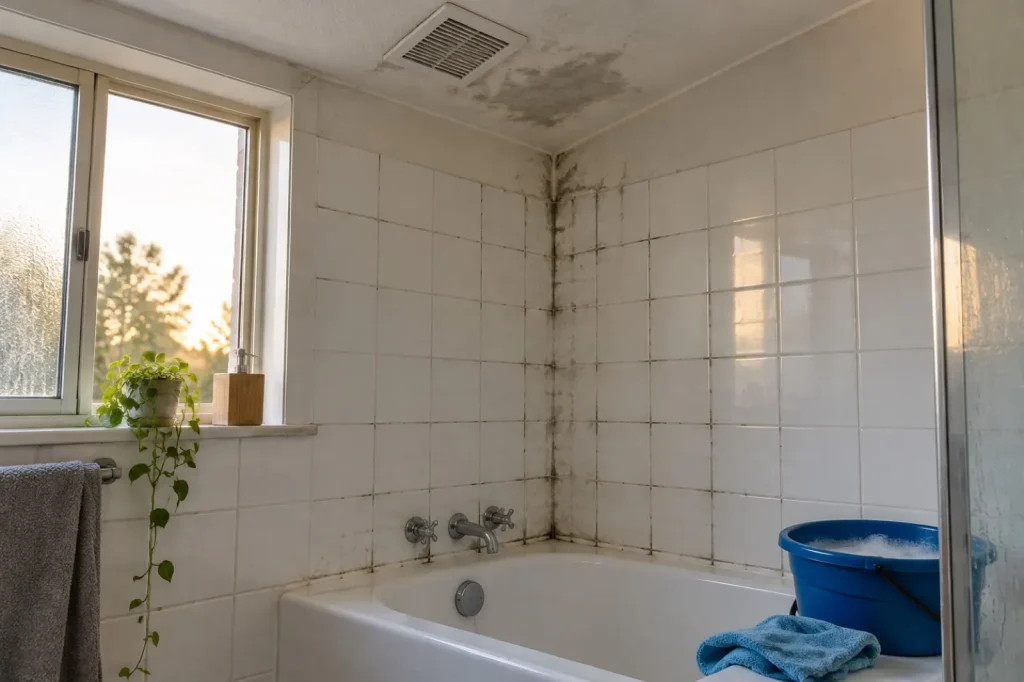
The short answer
How to kill black mold is the wrong question, because killing it is not enough. EPA says dead mold may still cause allergic reactions, so it must be removed. Fix the water first, size the patch, contain it, then HEPA vacuum and scrub hard surfaces with detergent and water, bag porous material that is moldy, and dry everything within 48 hours.
Key takeaways
- EPA: it is necessary to clean up mold contamination, not just to kill the mold, because dead mold is still allergenic.
- Species does not change the method. CDC says you do not need to know the type of mold; whatever it is, you need to remove it.
- EPA does not recommend a biocide such as chlorine bleach as routine practice. Detergent, water and a HEPA vacuum do the work.
- EPA Table 2 lists only HEPA vacuuming for small areas of moldy drywall and adds discard once the area passes 10 square feet.
- Paint does not kill mold. Manitoba Health says it only temporarily hides the problem.
- Mold that returns after cleaning usually means the moisture source is still there, per Manitoba Health, not that the product was too weak.
On this page
Most pages ranking for this question hand out recipes. The agencies that write cleanup guidance say something different, and plainly. This page sets out what EPA, CDC, the New York City health department and Manitoba Health instruct, as one sequence and one surface table.
What this page does not cover. Health effects of mold exposure are out of scope; see EPA’s mold pages and CDC. Whether dark growth is Stachybotrys is covered in our black mold vs regular mold guide; the answer does not change the method.
Kill or remove: what EPA actually says
EPA's A Brief Guide to Mold, Moisture and Your Home puts it in one sentence: dead mold may still cause allergic reactions in some people, so it is not enough to simply kill the mold, it must also be removed. EPA's schools and commercial buildings guide adds that the purpose of remediation is to remove the mold, and that a biocide such as chlorine bleach is not recommended as a routine practice.
EPA also ends the hunt for the strongest product. In most cases it is not possible or desirable to sterilize an area; background spores remain, and they will not grow if the moisture problem is resolved. The goal is dry and clean, not sterile.
| Approach | What it does | What is left | Agency position |
|---|---|---|---|
| Spray a biocide and leave it | Kills some surface growth | Dead growth and stain | Not enough: dead mold must be removed |
| Spray, then wipe | Kills, then lifts part of it | Residue in grout and paper | Biocide not routine practice |
| Detergent wipe plus HEPA vacuum | Physically removes growth | Background spores only | EPA and NYC default |
| Cut out and bag | Removes the material itself | Nothing, once cleaned and dry | EPA Method 4 for porous items |
So what kills black mold?
Many things kill mold on contact, which is why recipe pages disagree. On bleach the agencies split: CDC's mold clean-up page allows no more than 1 cup of bleach in 1 gallon of water and says never to mix it with ammonia or any other cleanser, while EPA advises against routine biocide use. See our pages on bleach, vinegar and registered mold killers. None changes the sequence below.
The five-step sequence
This is the order of the key steps in EPA's schools and commercial buildings guide, compressed for one room. Skipping step 1 is why people say nothing worked.
- Fix the water. Stop the leak, condensation or humidity feeding the growth before you clean.
- Decide the size band. Under about 10 square feet is small, 10 to 100 medium, over 100 large.
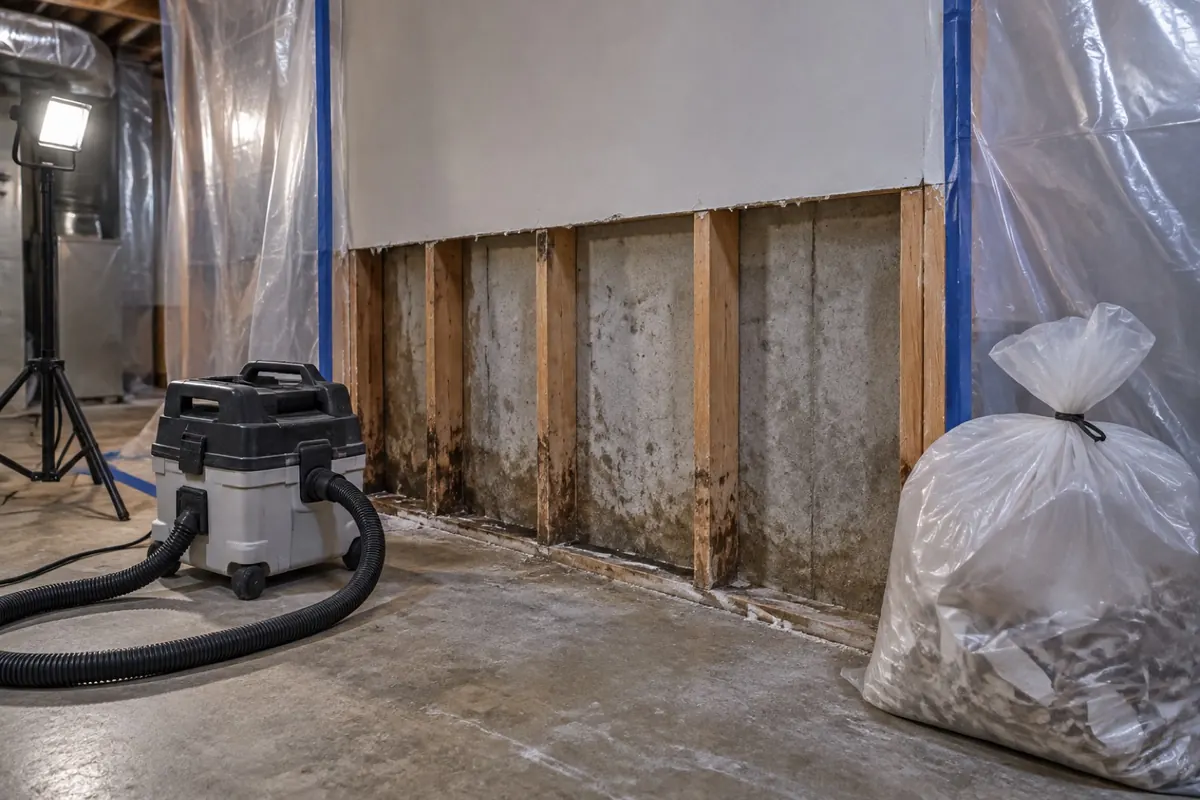
- Contain. Cover what you cannot clean, seal vents, shut off air handling serving the room, keep people out.
- Remove. Damp wipe with detergent where the surface allows, bag porous material that cannot be cleaned, HEPA vacuum once dry.
- Dry and verify. Dry within 48 hours, check with a meter, look again later.
Step 1: fix the water
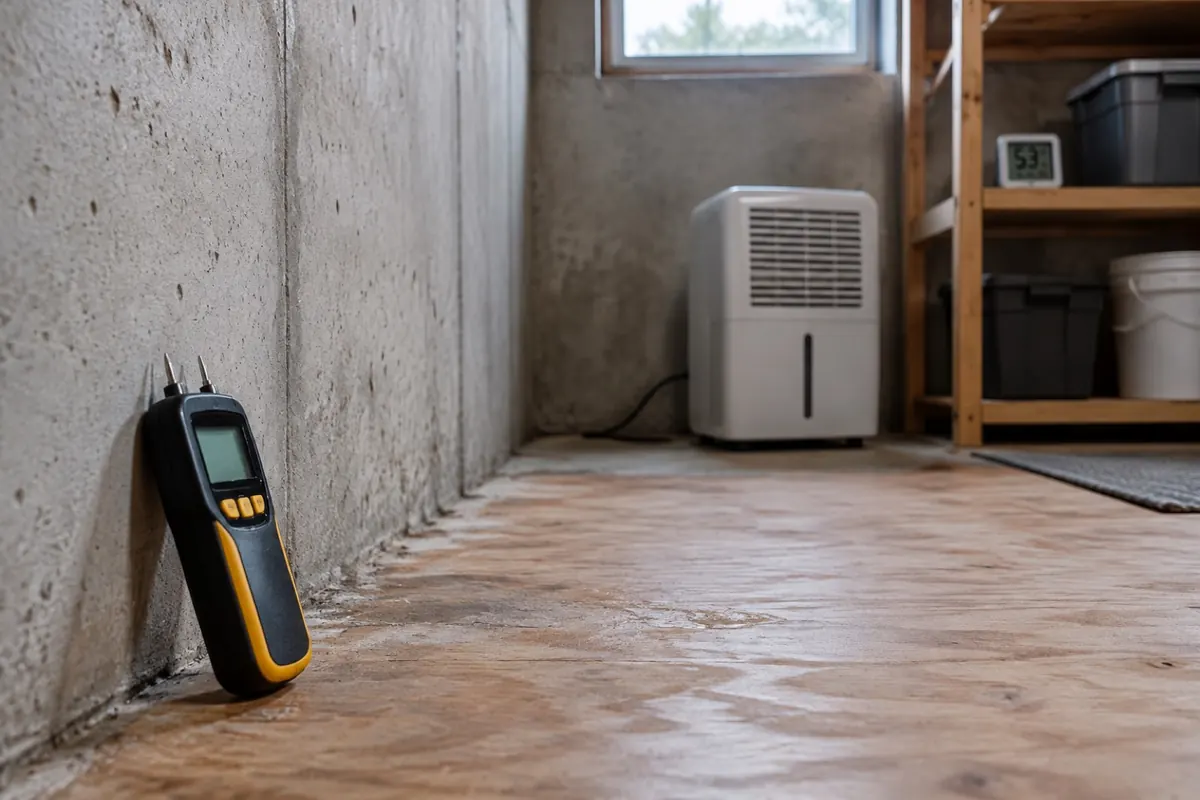
EPA's mold prevention chapter opens with the rule that governs the rest: the key to mold control is moisture control. It names leaky plumbing, envelope leaks, condensation and wet foundations, and sets a target of below 60% relative humidity, ideally 30 to 50%, per the same EPA chapter.
EPA's A Brief Guide to Mold, Moisture and Your Home says that if wet materials are dried within 24 to 48 hours, in most cases mold will not grow. Past that window, porous material may be colonized behind the surface, which is why step 4 treats it differently. If the water was sewage, this method does not apply: the notes to EPA 402-K-01-001 Table 2 say OSHA then requires protective equipment and containment.
Step 2: decide the size band
EPA's Mold Cleanup in Your Home draws the owner line at less than about 10 square feet, roughly 3 feet by 3 feet. Above that it points to its schools and commercial guide, which EPA says applies to other building types, and whose Table 2 sets three tiers.
| Size band | Protective equipment | Containment | Who usually does it |
|---|---|---|---|
| Small, under 10 sq ft | N-95, gloves, goggles | None required | Owner, or trained maintenance staff |
| Medium, 10 to 100 sq ft | Limited or full, by judgment | Single 6-mil poly, slit entry, negative pressure | Trained building maintenance staff |
| Large, over 100 sq ft | Full-face HEPA respirator, suit | Double poly, airlock, HEPA exhaust outdoors | Trained remediation workers |
Count every patch in the room as one total. Whether an owner should take a given job on is covered by our DIY mold remediation page.
Step 3: contain before you touch it
The NYC Department of Health guidelines sets the small-job baseline: the work area should be unoccupied, and carpet, electronics, the floor and the exit path covered with plastic sheeting sealed with tape. EPA adds: do not run an HVAC system you suspect is contaminated, because it could spread mold through the building.
For a medium area, EPA’s limited containment is one layer of 6-mil fire-retardant polyethylene with a slit entry, vents and doors sealed, under negative pressure. Its field test: working containment billows inward; sheeting that flutters outward has failed. EPA flags breaking up wallboard, opening cavities, stripping wallpaper and drying with fans as the actions most likely to release spores.
Step 4: remove it, surface by surface
EPA's Mold Cleanup in Your Home gives the rule in two lines: scrub mold off hard surfaces with detergent and water and dry completely; porous materials may have to be thrown away, because mold can fill their crevices. Method numbers below are EPA’s: 1 wet vacuum, 2 damp wipe, 3 HEPA vacuum after drying, 4 discard.
| Surface | EPA methods | Usual outcome | How, and why |
|---|---|---|---|
| Glazed ceramic tile | 1, 2, 3 (small) | Clean | Scrub with detergent, rinse, dry; replace cracked or damaged grout and caulk (Manitoba) |
| Painted drywall | 3 (small), 3, 4 (medium) | Clean if growth is on the paint | Damp cloth, baking soda or a little soap, no soaking; mold under the paint means replace (Manitoba) |
| Bare drywall | 3 (small), 3, 4 (medium) | Usually discard | Cut at least 6 inches beyond growth (NYC); never wet vacuum gypsum board (EPA) |
| Wood | 1, 2, 3 (small), 1, 2, 3, 4 (large) | Clean if structurally sound | Method 2 uses a wood floor cleaner, not water and detergent (EPA) |
| Concrete or block | 1, 3 at every size | Clean, never discard | Brush with soap and warm water, dry quickly; lift carpet or boxes off the slab (Manitoba) |
| Fabric: carpet, upholstery, drapes | 1, 3 (small), 1, 3, 4 (medium) | Launder washables, discard wet soft goods | Drapes per the maker’s laundering instructions (EPA); a moldy mattress cannot be cleaned (Manitoba) |
Painted against bare drywall
Mold feeding on the paper face is inside the material; mold on an intact paint film may be on the surface. Manitoba Health’s test: if the mould is underneath the paint, the drywall is removed and replaced. Our mold on walls guide covers reading the pattern, and mold in the shower covers grout and caulk.
Wood is cleaned, then judged
The NYC Department of Health guidelines says wood and concrete can be cleaned if structurally sound. Soft wood is a rot question; our mold on wood page covers the difference.
How to clean black mold without spreading it
The skill is in not moving spores around. The NYC Department of Health guidelines says to use the gentlest method that removes the mold, mist surfaces with dilute detergent before removal, and clean adjacent surfaces for settled spores with a HEPA vacuum.
| Tool | Why | Source |
|---|---|---|
| HEPA vacuum | Captures spores a household vacuum blows out | Manitoba; EPA Method 3 |
| Spray bottle of dilute detergent | Mists surfaces to hold dust down | NYC dust suppression |
| Detergent and water | Lifts growth off hard surfaces | EPA home guide |
| 6-mil plastic bags | Seal debris before it leaves the room | EPA Method 4 |
| N-95, gloves, goggles | Minimum protection, small job | EPA Table 2 |
| Humidity gauge, moisture meter | Prove the room and material dry | EPA chapter 3 |
Order matters: mist, bag what is coming out, damp wipe what stays, let it dry, then HEPA vacuum. Per EPA 402-K-01-001 Table 2, the HEPA pass comes after the material is thoroughly dried, with the contents sealed in plastic bags.
Step 5: dry and verify
EPA's schools and commercial buildings guide lists how you know the job is finished, and none of the items is a product. EPA calls it a judgment call with no easy answer.
| Check | Why it matters |
|---|---|
| Moisture problem fixed | Otherwise growth returns from the same cause |
| No visible mold, damaged material or moldy odor | EPA’s test for completed removal |
| Materials read dry against an unaffected area | A meter catches what touch misses |
| Room humidity below 60%, ideally 30 to 50% | EPA target that keeps spores dormant |
| A revisit shows no water damage or regrowth | EPA lists a revisit as a finish check |
Testing is usually unnecessary for a visible patch: CDC's About Mold page says CDC does not recommend mold testing, and EPA says sampling is usually unnecessary when growth is visible. Our mold testing page covers the exceptions.
How to treat black mold that keeps coming back
The Manitoba Health guide says mould that returns after cleaning usually means the moisture source has not been removed, and that painting over it does not kill it. EPA says paint applied over mold is likely to peel. The NYC Department of Health guidelines adds that fogged biocides are not recommended and that anti-microbial paint is no substitute for removal and moisture control. For a bathroom that regrows, EPA advises more ventilation and more frequent cleaning.
For contractors: scope it as removal, not kill
Write the scope around removal and drying, because that is what the guidance supports. An antimicrobial line with no removal behind it is easy to challenge. In New York, New York Labor Law section 946 allows disinfectants and antimicrobial coatings only if the plan specifies them, they are EPA-registered for the use and the label is followed. Under OSHA 29 CFR 1910.134, required respirator use means a written program, medical evaluation and fit testing before first use and at least annually.
| Document this | Why |
|---|---|
| Moisture source and fix | The first question an adjuster asks |
| Measured area per room | Sets the EPA tier and containment |
| Containment type and pressure | Photograph sheeting billowing in |
| Materials removed, by quantity | Supports the discard line |
| Products, with EPA registration | Required in New York |
| Photos plus meter readings | Shows finish criteria met |
Questions people actually ask
What kills black mold instantly?
Disinfectants kill some mold on contact, but nothing removes it instantly, and killing is not the goal. EPA says dead mold may still cause allergic reactions, so it must also be removed. If you use a registered product, follow its label contact time, then fix the moisture and remove the growth.
What kills black mold permanently?
Nothing applied to the surface. EPA says sterilizing an area is usually neither possible nor desirable; background spores remain and will not grow if the moisture problem is resolved. Permanent means dry: fix the leak, keep humidity below 60% per EPA, and remove colonized porous material.
Is bleach or vinegar better to kill black mold?
Neither is what the agencies lead with. EPA does not recommend chlorine bleach as routine practice and says to scrub hard surfaces with detergent and water. CDC allows no more than one cup of bleach per gallon and says never to mix it with ammonia or other cleansers.
Can I live in a home with black mold?
That is a health question outside this page’s scope; EPA and CDC cover it. The practical guidance is consistent: CDC says that no matter what type of mold is present, you need to remove it, and the NYC health department says the work area should be unoccupied during cleanup.
How do you clean black mold off drywall?
On painted drywall with surface growth, Manitoba Health says to wipe with a damp cloth and baking soda or a little soap without soaking the paper. Mold under the paint means the board is replaced. EPA adds discard once the area passes 10 square feet, and NYC says cut six inches beyond visible growth.
Do I need to test whether it is really black mold first?
No. CDC says you do not need to know the type of mold and does not recommend mold testing; EPA says sampling is usually unnecessary when growth is visible. The method is the same for every species: fix the water, contain, remove and dry.
Sources
- EPA's A Brief Guide to Mold, Moisture and Your Home, US EPA, updated 18 February 2026. Retrieved 18 October 2026.
- EPA's Mold Cleanup in Your Home, US EPA, updated 4 June 2026. Retrieved 18 October 2026.
- EPA's schools and commercial buildings guide (chapter 3), US EPA, updated 29 April 2026. Retrieved 18 October 2026.
- EPA's mold prevention chapter, US EPA, updated 8 September 2026. Retrieved 18 October 2026.
- EPA 402-K-01-001 Table 2, Mold Remediation in Schools and Commercial Buildings, reprinted September 2008. Retrieved 18 October 2026.
- CDC's mold clean-up page, CDC, dated 16 February 2024. Retrieved 18 October 2026.
- CDC's About Mold page, CDC, dated 26 September 2024. Retrieved 18 October 2026.
- NYC Department of Health guidelines, November 2008, Internet Archive copy of 15 January 2026. Retrieved 18 October 2026.
- Manitoba Health guide, Addressing Moisture and Mould in Your Home, Manitoba Health, undated. Retrieved 18 October 2026.
- OSHA 29 CFR 1910.134, Respiratory Protection. Retrieved 18 October 2026.
- New York Labor Law section 946, read via the NewYork.Public.Law mirror. Retrieved 18 October 2026.
- Fixr, mold remediation cost, updated 29 August 2025. Retrieved 18 October 2026.
- The discard chart and metric conversions are computed from the sources above. Our methodology sets out the standing rules; the mold hub lists related guides.
This page describes published cleanup guidance. It does not replace an on-site assessment where the area is large or the water was contaminated.