The short answer
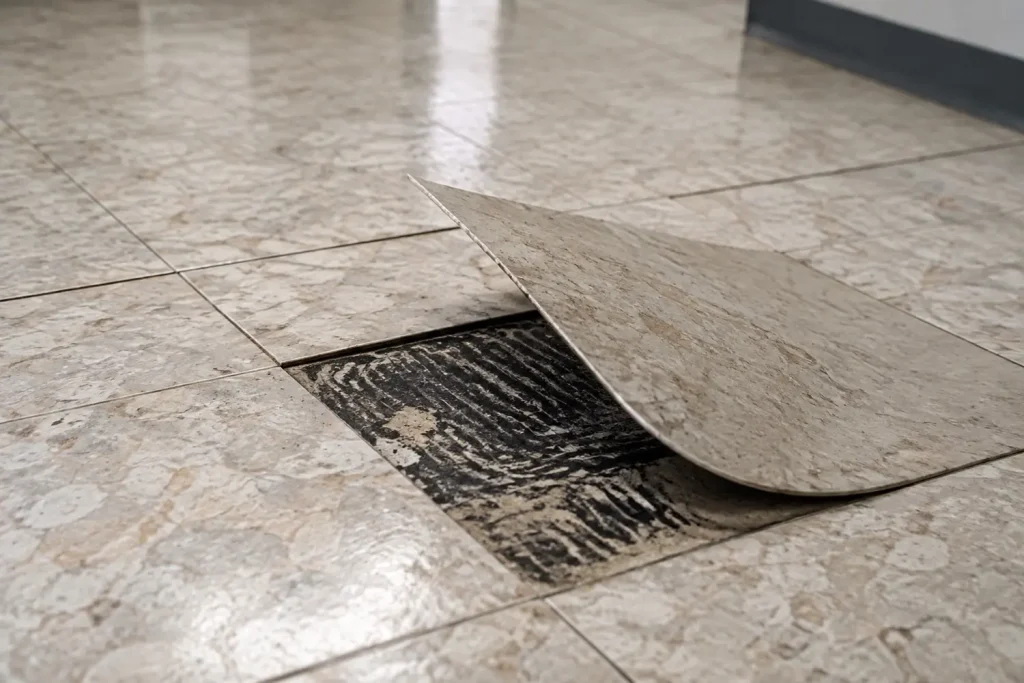
The honest answer to asbestos floor tiles how to tell is that you cannot tell visually with certainty, and nobody can. Only laboratory analysis of a physical sample confirms it. What visual inspection does is raise or lower suspicion enough to decide whether testing is warranted: nine by nine inch tiles, installation before roughly 1980, and dark bituminous cutback adhesive underneath are the three strongest indicators.
Key takeaways
- No visual test is conclusive. Size, date and adhesive raise suspicion. A laboratory report is the only thing that settles it.
- The black mastic under the tile is its own material and commonly contained asbestos independently of the tile. It is the single most frequently forgotten part of this question.
- Intact vinyl tile is non-friable. The hazard is created by what you do to it, so never dry-sand, grind, cut or use a rotary tool on suspect flooring.
- Encapsulation in place, meaning floating a new floor over the old one, is a legitimate and often preferred answer for intact tile because it avoids disturbance entirely.
- Who may take the sample depends on the building and the material condition. Damaged or friable material, and commercial or public buildings under AHERA, generally require an accredited person.
Scope boundary, stated deliberately. This page covers identification indicators, the friable and non-friable distinction, encapsulation and removal as options, testing routes and who is permitted to sample. It does not cover health effects, disease, symptoms or medical risk, and it will not try to tell you what any exposure means for your health. Those are clinical questions and they belong with a clinician and with federal sources: OSHA asbestos standards for occupational exposure rules and controls, and EPA asbestos laws and regulations for the regulatory framework.
On this page
- Start here: you cannot tell by looking
- The indicators, ranked
- Tile size, and why nine by nine matters
- Installation date, and why 1980 is a soft line
- The adhesive is its own material
- Surface feel, colour and pattern
- What gets mistaken for it
- Friable versus non-friable governs everything
- What never to do to a suspect tile
- Encapsulate in place, or remove
- The testing route, step by step
- Who is allowed to take the sample
- Questions people actually ask
Start here: you cannot tell by looking
This deserves to be the first thing on the page rather than a footnote at the bottom, because a great deal of content on this subject implies otherwise. Asbestos fibres in a vinyl or asphalt floor tile are bound inside the tile body at a microscopic scale. They are not visible, they do not change the colour of the tile in any reliable way, and there is no household test that detects them.
What identification actually does is triage. It tells you whether a tile belongs in the group worth sampling or the group that almost certainly does not. That is a genuinely useful thing, because it stops people paying for analysis on a floor laid in 2014 and stops people ripping up a floor laid in 1962 with a scraper and no thought. Everything below is about that triage, not about certainty.
A practical consequence: if you have already decided the floor is coming up regardless of the result, and the building and the jurisdiction permit you to handle it, the pragmatic route is often to test rather than assume, because a positive result changes the disposal route and a negative one saves you from paying for regulated disposal you did not need.
The indicators, ranked
Treat these as a suspicion score rather than a checklist with a pass mark. Several weak indicators together mean more than one strong one alone, and none of them is proof.
| Indicator | What raises suspicion | Strength | Why it is not proof |
|---|---|---|---|
| Tile size | Nine by nine inch tiles are the classic tell and are strongly associated with asbestos-era flooring | Strong | Twelve by twelve inch tiles from the same era can also contain it, and nine inch tiles were also made without it. |
| Installation date | Flooring installed before roughly 1980 sits inside the period of common use | Strong | Existing stock was installed for years afterwards, and older buildings are routinely refloored. |
| Adhesive underneath | Dark, tarry, bituminous cutback adhesive | Strong, and it is a separate material | Not every dark adhesive is cutback, and cutback does not always contain asbestos. |
| Surface feel | An oily or slightly greasy feel on older tile, sometimes described as waxy | Weak on its own | Decades of polish, wax and cleaning products produce the same feel. |
| Colour and pattern | Period palettes and the streaked or marbled patterns typical of asphalt and vinyl asbestos tile | Weak, suggestive only | Patterns were reproduced later without asbestos, and reproduction flooring exists. |
| Brittleness and edge condition | Tiles that snap cleanly rather than flex, with edges that chip | Weak | Ageing changes any vinyl product, and substrate movement causes the same damage. |
Tile size, and why nine by nine matters
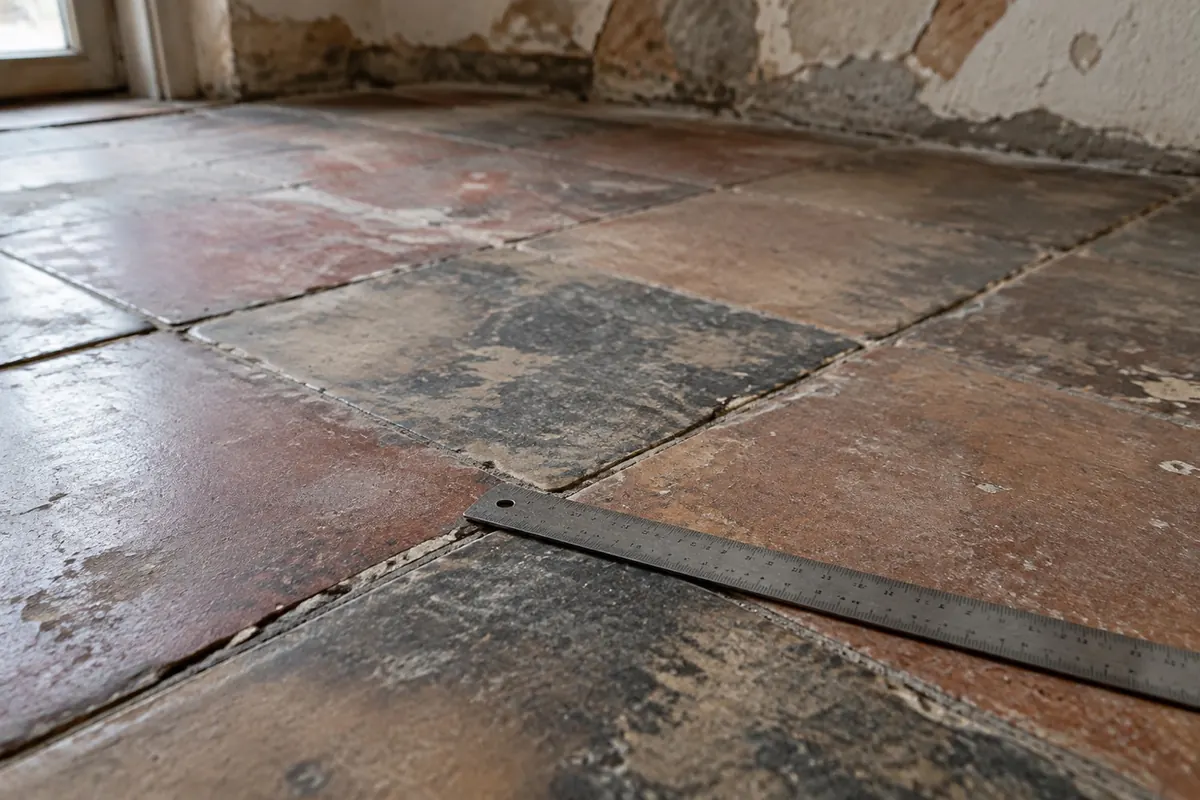
Nine by nine inch tile is the single most recognisable indicator and it is worth understanding why. Flooring of that dimension was widely produced during the decades when asbestos was a common filler in vinyl and asphalt tile, and the size fell out of general use afterwards. Finding it in situ therefore says something about when the floor was laid even when no paperwork survives.
Twelve inch tiles are not automatically safe
This is the most common misreading of the nine inch rule. Twelve by twelve inch tiles were produced during the overlapping period too and can contain asbestos. Treating a twelve inch tile as cleared because it is not nine inches is exactly the reasoning error the indicator invites. The size shifts the probability. It does not set it to zero.
Two floors in one place is extremely common
Older tile was frequently left down and covered rather than removed, because covering was cheaper and because nobody thought about it. Lifting a corner of a modern vinyl plank floor in a 1960s building and finding nine inch tile underneath is an ordinary event, not an unusual one. Anyone planning to take up flooring in an older building should establish what is under the layer they can see before, not during, the work.
Installation date, and why 1980 is a soft line
The commonly cited date is around 1980, and it is a useful orientation rather than a boundary. It reflects the period during which use declined under the regulatory framework described by EPA asbestos laws and regulations, not a moment when production stopped everywhere at once.
| Building period | What it usually means | Reasonable action |
|---|---|---|
| Before 1960 | High prior probability for any original resilient flooring still in place | Assume candidate status and test before disturbance. |
| 1960 to 1980 | The core period of common use in resilient flooring | Assume candidate status and test before disturbance. |
| 1980 to the early 1990s | Declining use, but existing stock continued to be installed | Still worth testing if the tile has period characteristics. |
| After the mid 1990s | Low prior probability for new flooring, but says nothing about layers underneath it | Test the older layer if one is found, not the new one. |
The practical version of the date rule: it is the age of the material that matters, not the age of the building. A 1930s house that was refloored in 2018 has a 2018 floor. A 1998 extension floored with salvaged tile has a problem the build date will not reveal.
The adhesive is its own material
This is the part that gets forgotten most often, and it changes the shape of the whole job. The dark, tarry adhesive commonly found under older resilient flooring, generally called cutback adhesive or black mastic, was itself a product that commonly contained asbestos. It is a separate material from the tile, with a separate result.
The consequence is that four outcomes are possible rather than two, and people who sample only the tile learn about one axis of a two-axis problem. A negative tile result with an untested adhesive is not a cleared floor.
| Tile result | Adhesive result | What it means for the work |
|---|---|---|
| Negative | Negative | Ordinary flooring removal. No asbestos controls apply to either layer. |
| Negative | Positive | The tile can be handled normally but the adhesive layer cannot. The mastic drives the method and the disposal route. |
| Positive | Negative | Tile drives the method. The adhesive may still be a mechanical problem, but not a regulated one. |
| Positive | Positive | Both layers are regulated material. This is the case where encapsulation in place is most often the better answer. |
Why the adhesive is usually the harder half
A tile lifts. Adhesive does not: it is bonded to the substrate in a thin film, and removing it mechanically is precisely the sanding, grinding and scraping that is prohibited on regulated material. That asymmetry is why floors where both layers test positive so often end up encapsulated rather than removed, and why a quote that prices tile removal without addressing the mastic is an incomplete quote.
Surface feel, colour and pattern
These are the weakest indicators and they are the ones most confidently repeated online, so they are worth handling carefully.
The oily feel
Older asphalt and vinyl tiles often develop a slightly oily or waxy surface feel. It is a real observation and it is genuinely associated with period flooring. It is also produced by decades of floor polish, by plasticiser migration in any old vinyl product, and by cleaning products. Use it as a small nudge toward testing, never as a finding.
Colour and pattern
Period flooring runs to particular palettes and to streaked or marbled patterns, and an experienced surveyor will genuinely recognise the look. The problem is that the look has been reproduced continuously ever since, in materials containing nothing of the sort. Pattern recognition tells you the floor looks old. It does not tell you the floor is old, and it certainly does not tell you what is in it.
What a surveyor is actually doing differently
The difference between a surveyor’s visual assessment and an owner’s is not better eyesight. It is that the surveyor is assembling the whole picture, including construction records, the layers present, the edge conditions, what else in the building is of the same vintage, and what comparable buildings of that period have contained. They still send a sample to a laboratory, because they also cannot tell by looking.
What gets mistaken for it
Two confusions cost people money in opposite directions: assuming something is asbestos when it is not, and assuming something is not when it might be.
| Material | Why it gets confused | What actually distinguishes it |
|---|---|---|
| Modern luxury vinyl tile in period colours | Reproduction patterns imitate mid-century flooring closely | Thickness, a wear layer, click edges or a paper backing, and modern adhesive. |
| Rubber or composition tile | Similar size and a similar surface feel | Flexibility and a different substrate bond. Still a candidate for testing in an older building. |
| Ordinary bitumen damp-proofing | Looks like cutback adhesive to the eye | Position in the assembly. A membrane under a slab is not a floor adhesive, though either can be a candidate material. |
| Sheet vinyl with a felt backing | The backing looks fibrous and alarming | It is sheet, not tile, and the backing is the material of concern rather than the wear surface. |
| Ceramic or quarry tile over old adhesive | The visible tile is clearly not a candidate | The adhesive bed underneath may be, which is the point of checking layers rather than surfaces. |
Friable versus non-friable governs everything
This single distinction decides what you may legally do, what a removal costs, and whether leaving the material alone is a reasonable answer. Friable material can be crumbled or reduced to powder by hand pressure. Non-friable material holds its fibres bound in a matrix. Our guide to asbestos containing material quotes the legal definitions of friable and non-friable.
Intact vinyl or asphalt floor tile is non-friable. The fibres are locked in the tile body and an undisturbed tile in good condition is not shedding them into the room. This is the reason intact flooring is so frequently left in place rather than removed, and it is a genuine engineering position rather than a cost dodge.
| Condition | Classification | What it permits | What it rules out |
|---|---|---|---|
| Intact, bonded, no damage | Non-friable, good condition | Leaving in place, cleaning normally, covering with a floating floor | Nothing abrasive or percussive. |
| Cracked, curling or loose tiles | Non-friable but deteriorating | Assessment, and often encapsulation or controlled removal | Sweeping up broken pieces as ordinary rubbish. |
| Crumbling, powdering or heavily broken | Can meet the friable definition | Professional assessment and controlled work only | Any owner-performed handling, in most jurisdictions. |
| After sanding, grinding or cutting | Rendered friable by the method | Nothing. This is the condition the rules exist to prevent | This is why the prohibited methods are prohibited. |
What never to do to a suspect tile
Non-friable material becomes a problem through method. These are the methods that convert a stable floor into airborne fibre, and none of them is a grey area.
- Never dry-sand it. Sanding a suspect tile or its adhesive is the textbook way to render a non-friable material friable.
- Never grind it or use a rotary tool. Angle grinders, floor grinders, buffers with abrasive pads and rotary scrapers all do the same thing at higher speed.
- Never cut or drill it dry. Circular saws, reciprocating saws and core drills through suspect flooring generate exactly the dust the rules exist to prevent.
- Never break tiles to lift them faster. Smashing tile to get a scraper under it is common and it is the wrong instinct entirely.
- Never sweep or vacuum debris with ordinary equipment. A domestic vacuum will pass fine particulate straight through and redistribute it.
- Never assume disposal is ordinary waste. Where material tests positive, disposal is regulated separately from removal. EPA state asbestos contacts is the route to your own state’s rules.
The inverse is worth stating too, because fear causes its own harm. Walking on an intact tiled floor, cleaning it with a damp mop, putting furniture on it and living with it are not disturbance. The prohibition is on abrasive and percussive methods, not on the floor existing.
Encapsulate in place, or remove
For intact tile, encapsulation is frequently the better answer and it is under-discussed because it is the option nobody sells hard. Floating a new floor over the old one, or covering it with an underlayment and a new surface, leaves the material undisturbed and avoids the entire removal and disposal chain.
| Factor | Encapsulate in place | Remove |
|---|---|---|
| Cost basis | Cost of the new floor covering and any levelling. No abatement labour, no regulated disposal. | Assessment, controlled removal labour, containment where required, regulated disposal, and often clearance. |
| Disruption | Days. The space is a normal flooring job. | Longer, with the area out of use and access controlled while work proceeds. |
| Floor height | Raises the floor, which affects doors, thresholds, appliances and stair risers. | No height change. |
| Future work | The material is still there. Any future person opening that floor inherits the question. | The question is closed for that area. |
| Record keeping | Document what was left, where, its condition and the date. This record is the point of the approach. | Retain the laboratory results, the waste disposal documentation and any clearance record. |
| When it fits | Intact, well-bonded tile in a space that tolerates a height change. | Deteriorating material, work that must go through the floor, or a sale or refinancing that requires the material gone. |
The record is the part people skip
Encapsulation only works as a strategy if the next person knows. Leaving material in place without documenting it converts a managed decision into a trap for whoever opens that floor in fifteen years. Write down what the material is, where it is, what the laboratory said, what was put over it and when. Keep it with the building records and hand it over on sale. In a commercial or public building this is not optional, it is part of the management requirement.
Encapsulation is not a coat of paint
The word encapsulation is used loosely, and in the flooring context it generally means physically covering the material with a new assembly rather than sealing it with a coating. Sealers and encapsulant coatings exist and have their place on some materials, but for floor tile the reliable approach is a covering layer that takes the wear, so nothing abrades the old surface.
The testing route, step by step
Where testing is the answer, the route is well defined. Our asbestos testing kit page covers the kit market, laboratory method and accreditation in detail. The short version as it applies to flooring.
| Step | What it involves | Why it matters here |
|---|---|---|
| Decide whether you may sample | Building type, material condition and jurisdiction determine whether an accredited person is required | Getting this wrong is a regulatory problem, not just a technical one. |
| Sample the tile and the adhesive separately | Two materials, two samples, two results | This is the step most commonly missed on flooring. |
| Sample enough locations | Different rooms, different install phases and different visible tile types are different materials | A negative in one room does not clear a different tile in the next room. |
| Accredited PLM analysis of the bulk sample | Polarised light microscopy is the standard method for bulk building materials, performed by an accredited laboratory | Accreditation is what makes the result usable by anyone other than you. |
| Read the report by material, not overall | The report reports each sample separately, including layers within a sample | A floor is not positive or negative. Each material is. |
Why PLM is the standard for a tile
Polarised light microscopy identifies asbestos fibre types in bulk material by their optical properties, and it is the established method for building materials of this kind. It is not the method used for air samples, which answer a different question. For a piece of floor tile, a bulk analysis by an accredited laboratory is the correct request, and it is what a laboratory will assume you want unless you say otherwise. Our guide to the types of asbestos explains how a lab tells the regulated minerals apart.
Who is allowed to take the sample
This is jurisdictional and people assume it does not reach them. The general shape, which EPA asbestos laws and regulations sets out and which state programmes vary, is that the building type and the material condition both matter.
| Situation | Who generally samples | Why |
|---|---|---|
| Owner-occupied single family home, intact tile | Often the owner may, subject to state rules | Federal accreditation requirements are written primarily around schools and public and commercial buildings. |
| Any material that is damaged, crumbling or friable | A professional | Taking a sample from friable material is itself a disturbance event requiring controls. |
| Schools | An accredited inspector | AHERA and the EPA Model Accreditation Plan impose specific requirements on school buildings. |
| Public and commercial buildings | An accredited inspector in most cases | The regulatory framework extends to these building types, and employer duties under OSHA also attach. |
| Rental property | Usually the landlord’s responsibility, via a professional | A tenant sampling a landlord’s building creates both regulatory and liability problems. |
Check your state before you touch anything
Several states require accredited sampling in settings where the federal framework would not, and several regulate disposal of non-friable material that the federal position treats more permissively. EPA state asbestos contacts is the shortest route to the right office. One phone call before sampling is faster than unwinding a disposal problem afterwards, and our state licensing review shows how widely state-level remediation rules diverge in general.
Questions people actually ask
How can I tell if my floor tiles contain asbestos?
You cannot tell visually with certainty, and neither can a professional. Nine by nine inch tiles, installation before roughly 1980 and dark bituminous cutback adhesive underneath all raise suspicion enough to justify testing. Only laboratory analysis of a physical sample confirms it.
Are all nine by nine inch tiles asbestos?
No. The size is strongly associated with the era of common use, which makes it the most useful single indicator, but nine inch tiles were also produced without asbestos. Equally, twelve by twelve inch tiles from the same period can contain it, so the size alone clears nothing.
Is the black glue under the tile a separate problem?
Yes, and it is the part most often forgotten. Cutback adhesive, commonly called black mastic, was its own product and commonly contained asbestos independently of the tile above it. It is sampled separately and it frequently drives the method, because adhesive cannot simply be lifted the way a tile can.
Can I just leave the tiles and put a new floor on top?
For intact, well-bonded tile this is a legitimate and often preferred approach, because it avoids disturbance entirely. The trade-offs are floor height and the fact that the material remains for whoever opens that floor later, which is why documenting what was left and where matters.
Is it safe to walk on asbestos floor tiles?
Intact tile is non-friable and the fibres are bound in the tile body, so ordinary use such as walking, damp mopping and furniture is not disturbance. What creates a problem is abrasive or percussive method: sanding, grinding, cutting, drilling or breaking the tile. For any health question about a specific situation, speak to a clinician and consult federal sources.
What is the one thing I should absolutely not do?
Do not dry-sand, grind or use a rotary tool on suspect flooring or its adhesive. That is the method that turns a stable non-friable material into airborne fibre, and it is the single action the rules in this area exist to prevent.
Do I need a professional to take the sample?
It depends on the building and the material. Damaged or friable material, schools under AHERA, and public and commercial buildings generally require an accredited person. An owner-occupied home with intact tile is often treated differently, subject to state rules, so check your state asbestos contact before sampling anything.
Sources
- EPA asbestos laws and regulations. United States Environmental Protection Agency, on the federal regulatory framework, friability definitions and the building types to which accreditation requirements attach. Retrieved 23 September 2026.
- EPA state asbestos contacts. United States Environmental Protection Agency, directory of state asbestos programme contacts. State rules are frequently stricter than the federal position on both sampling and disposal. Retrieved 23 September 2026.
- OSHA asbestos standards. Occupational Safety and Health Administration, on asbestos standards, prohibited methods and employer duties. Retrieved 23 September 2026.
- Indicator strengths, look-alike materials, the encapsulate versus remove comparison and the sampling procedure summary are compiled from published EPA and state asbestos programme guidance and building inspection practice current in 2026. They are indicative triage aids rather than identification.
- Laboratory method, accreditation frameworks and detection limits are set out on our asbestos testing kit page, and removal pricing on our asbestos removal cost page. This page deliberately does not restate either.
- Our methodology sets out the standing rules on what we publish as compiled guidance versus measured data, and the health boundary we hold on every asbestos page.