The short answer
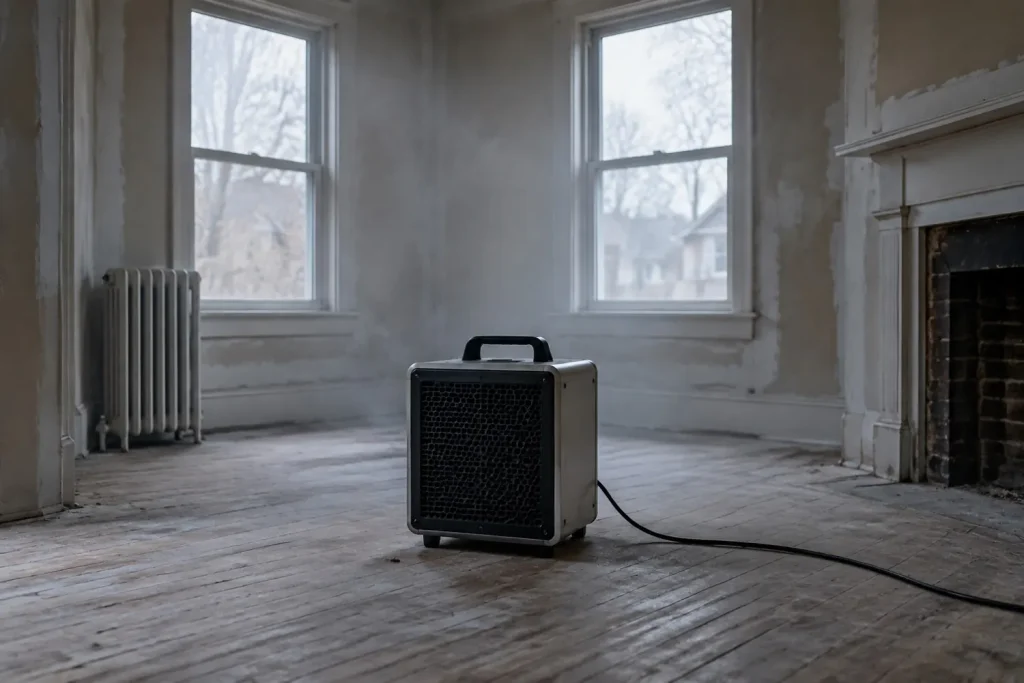
To get smoke smell out of house interiors you have to remove the residue producing it, in that order, because you cannot deodorise what you have not cleaned. The professional sequence is remove the source material, clean every surface including cavities and the HVAC system, treat the remaining absorbed odour with a hydroxyl or ozone generator, then seal only what still off-gasses afterwards. Masking or sealing before removal fails, and the smell returns in the first warm or humid week.
Key takeaways
- Odour is a source problem, not an air problem. The smell is residue still present, releasing volatile compounds into the room.
- Anything that treats the air before the source is removed buys weeks at most. Warm humid weather accelerates off-gassing, which is why the complaint arrives after sign-off rather than during the work.
- Four stages, in order: remove, clean, treat the air, seal what remains. Reversing any two of them costs more than doing it properly.
- Hydroxyl generators can run in occupied space and work slowly. Ozone is faster and stronger, requires the space vacated, and needs ventilation and a clearance period before re-entry.
- Ozone also degrades rubber and some plastics, so sensitive items come out of the space before treatment starts.
- DIY genuinely works on light odour: ventilate, wash textiles, replace HVAC filters, clean hard surfaces. It does not touch wet smoke or protein residue, and bowls of vinegar or coffee grounds are masking rather than removal.
- Cigarette smoke is a harder problem than a single fire, because deposition happened over years. It often needs sealing, repainting and replacement of textiles and ceiling surfaces.
On this page
- The rule that decides everything
- Where the smell is actually coming from
- The four-stage professional sequence
- Stage one: remove the source
- Stage two: clean, including the places you cannot see
- Stage three: treat the air
- Hydroxyl against ozone
- Thermal fogging, and what it is for
- Stage four: seal only what still off-gasses
- What you can realistically do yourself
- What does not work, and why it seems to
- Cigarette smoke is a different problem
- How to check the smell is actually gone
- Questions people actually ask
The question of how to get smoke smell out of house interiors gets answered badly almost everywhere, because most answers start with products. Air purifiers, odour neutralisers, sprays, bowls of things left in corners. None of those is where the answer starts. The answer starts with a physical fact about where smells come from, and once you accept that fact the whole sequence follows from it. This page is about odour only. For the surfaces, the methods and what cleaning costs, see our smoke damage repair guide. For how the work gets paid for, see our smoke damage insurance claim guide.
The rule that decides everything
You cannot deodorise what you have not cleaned. Everything else on this page is a consequence of that sentence.
A smell is molecules arriving at your nose. Those molecules are coming from somewhere, and after a fire that somewhere is residue: soot on surfaces, greasy film on ceilings, particulate in a carpet, absorbed compounds in timber and plasterboard. While that residue is in the building it keeps releasing. Treating the air removes what is airborne at that moment and does nothing about the supply.
This is why odour failures have such characteristic timing. The work finishes, the building is cool and ventilated, nobody smells anything, the invoice is paid. Then the heating goes on and the smell is back. Nothing had been done to the source; the building was simply cold enough that the release rate was low.
The practical version of this rule for a property owner: if somebody proposes treating the smell without first proposing to clean, that is the wrong sequence and it will not hold. Ask what is being removed before you ask what is being applied.
Where the smell is actually coming from
Smoke odour has three physical locations in a building, and they need different work. Understanding which one you are dealing with explains why some rooms respond to a wipe-down and others do not respond to anything short of removal.
| Where the odour sits | What it looks like | What removes it | How long it lasts untreated |
|---|---|---|---|
| On surfaces, as deposited residue | Visible soot, grey film, or a greasy amber sheen on ceilings and walls | Cleaning, matched to the residue type. This is the majority of the odour on most losses | Indefinitely. It does not evaporate away on its own. |
| Inside porous material, absorbed | Nothing visible. Timber, plasterboard, masonry, insulation, foam and textiles that were in the smoke | Removal of the material, or cleaning plus sealing where removal is impractical | Months to years, with release accelerating in warm humid conditions. |
| In enclosed spaces and cavities | Nothing visible, and often no access. Wall cavities, duct runs, under floors, above ceilings, inside cabinetry | Opening and cleaning where practical, HVAC cleaning, then air treatment that reaches where cloths do not | Long, and it re-emerges into cleaned rooms through every opening. |
Why warm and humid makes it worse
Volatile compounds release faster as temperature rises, and humidity helps them move out of porous material. This is ordinary physics and it has two practical consequences. The first is that odour sign-off in a cold ventilated building is meaningless. The second is that a building which smells fine in February can smell strongly in July without anything having changed, which is why seasonal callbacks happen on jobs everybody thought were finished.
Different residues produce different persistence
Dry smoke from a fast hot fire produces a sharper, lighter odour that responds well to cleaning. Wet smoke from a smouldering fire produces a heavy acrid smell that is harder to shift because the residue is bonded to surfaces. Protein residue from a cooking fire produces the most persistent odour of all relative to how little damage it does, which is exactly why those losses are underestimated. Our smoke damage repair guide covers the residue types and the methods that match them.
The four-stage professional sequence
Professional deodorising is four stages in a fixed order. The order is not a preference, it is a dependency chain, and each stage assumes the one before it finished.
| Stage | What it involves | What happens if it is skipped |
|---|---|---|
| 1. Remove the source material | Charred material, heavily contaminated material and porous material that absorbed residue comes out of the building | Everything downstream is treating a source that is still generating. The smell returns regardless of what else was done. |
| 2. Clean every surface, including cavities and the HVAC | Dry-then-wet cleaning matched to residue, top down, plus the duct network and air handler if the system ran | Cleaned rooms recontaminate from the ducts on the next heating cycle, and cavity odour keeps emerging through every opening. |
| 3. Treat the remaining absorbed odour | Hydroxyl or ozone generation, reaching compounds absorbed into material and sitting in places cleaning cannot reach | Residual absorbed odour remains. This is the stage that handles what is genuinely inside material rather than on it. |
| 4. Seal only what still off-gasses | Pigmented shellac or purpose-made sealer on cleaned framing and substrates that still release after treatment | Nothing, if the earlier stages worked. Sealing is a finishing stage, not a substitute for any of them. |
Stage one: remove the source
The first stage is a skip, not a bottle. Material that absorbed residue through its full depth is not going to stop smelling, because the odour is in the body of the material rather than on its face. Before anything is thrown away, our guide to the days after a house fire explains why the inventory comes first.
| Material | Odour verdict | Reason |
|---|---|---|
| Fibreglass, mineral wool and cellulose insulation | Remove | Open fibre structure absorbs odour compounds through its depth and cannot be cleaned through or verified. |
| Carpet underlay | Remove | Open-cell foam holds both particulate and absorbed odour, and it sits under a surface being lifted anyway. |
| Mattresses and foam-cored upholstery | Usually remove | Foam is the worst material in a building for holding smoke odour, and flushing it is not practical. |
| Charred timber and sheet material | Remove | The carbon layer holds odour and the material is degraded. Light surface char on framing may be cleaned and sealed instead. |
| Ceiling tiles, mineral and fibre | Usually remove | Absorbent body, marks easily when cleaned, and cheap enough that removal wins on cost as well as odour. |
| HVAC filters | Remove and replace, on day one | They hold a concentrated dose of exactly the material producing the smell, and they are consumable anyway. |
Contents leave before air treatment, not after
Soft contents hold odour and keep releasing it into a room being treated, which slows everything down and can make a room appear to fail. Clothing, linen, curtains, cushions and soft toys go out for specialist laundering early. Items sensitive to ozone go out before ozone treatment specifically, which is covered below.
Stage two: clean, including the places you cannot see
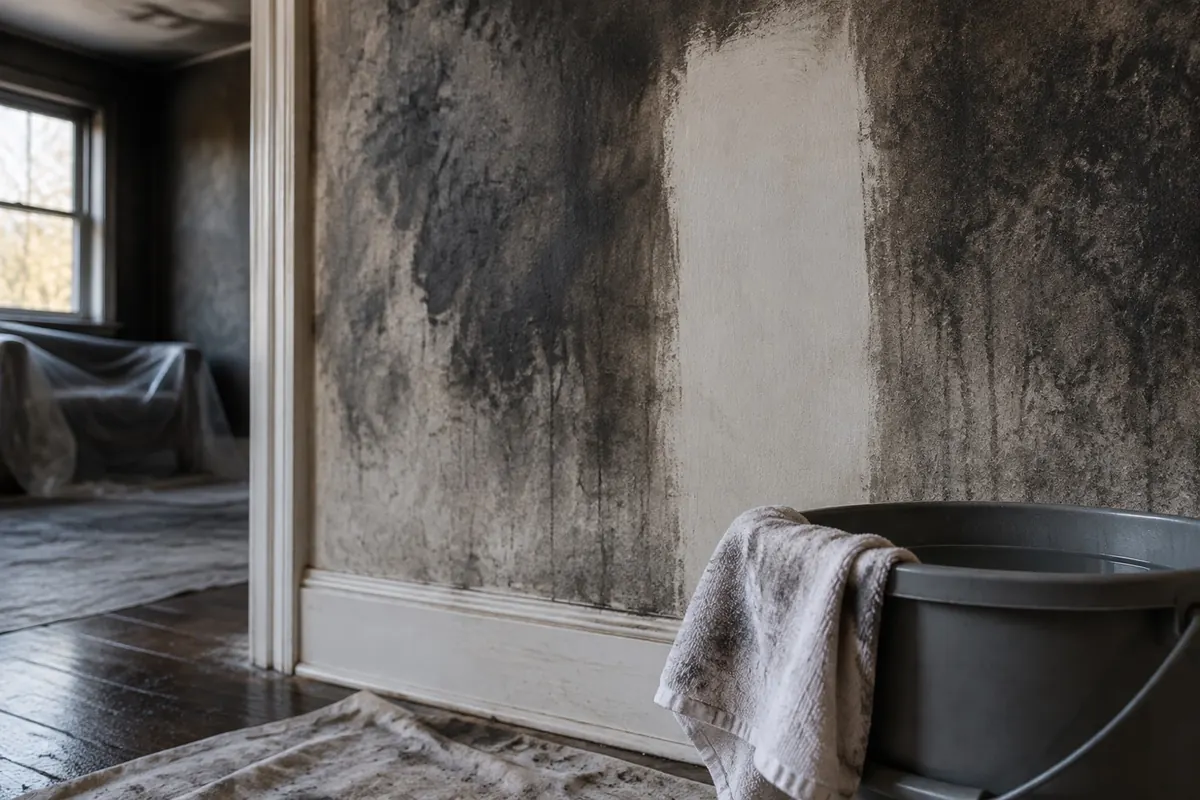
Cleaning is where most of the odour actually goes, because most of the odour is residue sitting on a surface. The detail that separates a job that holds from one that does not is the surfaces nobody thinks of, because smoke reached all of them and a cleaning crew working from a visual inspection will not.
- Ceilings and the tops of everything. Door frames, cupboard tops, picture rails, light fittings. Protein residue in particular coats these and they are invisible from standing height.
- Inside cabinetry and wardrobes. Raw particleboard interiors absorb odour and are a common reason a kitchen still smells after the faces are spotless.
- Behind and under appliances, and the floor beneath them, where airflow deposited residue and nobody cleans routinely.
- Inside light fittings, switches and outlets. Devices with residue inside the body are normally replaced rather than cleaned.
- Wall and ceiling cavities where accessible, which on a loss with demolition means before the new insulation goes in.
- The HVAC system, which gets its own paragraph below because it is the single most common reason cleaned rooms start smelling again.
The HVAC system is the reason the smell comes back
If the heating or air conditioning ran during or after the fire, the duct network holds residue and every room the system supplies is part of the odour problem. Cleaning the rooms and not the ducts produces a building that smells clean until the system next runs, at which point it redistributes residue into every one of them. Duct cleaning belongs before air treatment, not after. Our air duct cleaning cost guide covers what a legitimate service includes, what a cheap quote usually leaves out, and the published position on when duct cleaning is actually indicated.
Washing textiles properly
Washable fabric often recovers, and it usually takes more than one cycle. Restoration laundering commonly runs several washes with an odour-counteracting additive, with the items held in a treated space between cycles. Household washing at normal settings will improve light odour and will not resolve heavy deposition. Items with foam interiors or bonded backing generally do not recover at all, because the odour sits in a layer the wash water never flushes.
Stage three: treat the air
Once the source is out and the surfaces are clean, what remains is odour absorbed into material and sitting in spaces no cloth reached. That is what air treatment is for, and it is the stage people try to do first.
Both main technologies oxidise odour compounds into simpler compounds that do not smell, rather than covering them. That is the difference between destroying a molecule and adding a stronger one next to it. The trade-off between the two is about occupancy.
Hydroxyl against ozone
Hydroxyl: slower, and it lets people stay
A hydroxyl generator produces hydroxyl radicals, usually with ultraviolet light, and they oxidise odour compounds in the air and on exposed surfaces. The defining practical feature is that these units can generally run with people and pets in the building, which changes the whole shape of a job. Work can be phased, occupants can stay, and the treatment runs alongside the cleaning rather than after everyone has moved out.
The cost of that is time. Hydroxyl treatment runs for days rather than hours, often continuously through the cleaning phase. It is also the gentler option on soft goods and sensitive materials, which is why it suits occupied homes with contents still in place.
Ozone: faster, stronger, and the building has to be empty
An ozone generator produces ozone, a strong oxidiser, which is exactly why it works quickly and exactly why the space has to be unoccupied. Ozone is hazardous to breathe. Treatment happens with people, pets and plants out of the area, and the space is ventilated with a clearance period afterwards so the ozone reverts before anyone goes back in. Equipment instructions and applicable safety requirements govern how that is done. General indoor air quality material is published by the EPA at EPA indoor air quality guidance.
Ozone also attacks materials, not just odour. It degrades rubber, which means seals, gaskets, elastic in clothing and the backing on some flooring. It affects certain plastics, some artwork and some textiles. Anything sensitive comes out of the treated space before the unit runs, which is one of the reasons contents pack-out and ozone treatment tend to be scheduled together.
Which one a job gets, and why
The decision is usually made for the contractor by the occupancy status rather than chosen on merit. With people still living in the property, ozone is unavailable for occupied areas and the odour work runs on the longer hydroxyl timeline. Once the property is vacated, ozone becomes available and the timeline shortens, but displacement has its own cost. That trade-off is worth raising early rather than discovering halfway through.
Thermal fogging, and what it is for
Thermal fogging pairs a deodorising agent with heat, producing a fine warm fog that behaves in the air roughly the way smoke did. Because it moves like smoke moved, it follows the same routes: into cavities, around penetrations, through the gaps where a cloth never went.
| Thermal fogging | What it is for | What it is not for |
|---|---|---|
| Purpose | Reaching absorbed odour in cavities and penetrations along the paths smoke actually travelled | Removing residue. It is a treatment stage, not a cleaning stage. |
| Timing | After source removal and surface cleaning, as part of the treatment phase | Before cleaning. Applied to uncleaned residue it masks temporarily and the smell returns. |
| Occupancy | Performed in vacated space with ventilation afterwards, following the product instructions | Occupied areas. The building is cleared and aired before re-entry. |
| Outcome | Reduction of residual absorbed odour in places other methods do not reach | A substitute for removing insulation, cleaning ducts or replacing foam. None of those has an aerosol alternative. |
Stage four: seal only what still off-gasses
Sealing is the last stage and the most misused. Applied correctly, to a cleaned substrate that still releases odour after treatment, it locks down what remains and the job holds. Applied as a shortcut, over residue that was never removed, it is the single most expensive mistake available on a fire job.
Sealing over an active source does not stop the source. It slows the release rate for a few weeks, and then the compounds find a route out through every joint and fixing hole. The sealer then has to come off before the cleaning can happen. Three scopes where there should have been one.
Where sealing is the right answer
- Cleaned framing and joists after demolition and media cleaning, where residue in open grain cannot be removed further.
- Subfloor that has been cleaned but sits under new flooring, so it will not be accessible again.
- Masonry and concrete where porosity runs deeper than surface cleaning reaches.
- Cabinet interiors of raw particleboard that have been degreased and still release, where replacing the boxes is disproportionate.
- Cleaned plasterboard that passed the odour check but sits in an area with a history of recurrence, as insurance before redecoration.
In each case the substrate was cleaned first, and the sealer closes off a residue that could not be reached rather than one nobody tried to reach. That distinction is the whole thing.
What you can realistically do yourself
There is a real DIY answer here and it is worth stating honestly, because plenty of smoke odour is light enough to handle without a contractor. The boundary is residue type and extent, not effort.
| What you can do | How much it helps | The limit |
|---|---|---|
| Ventilate: open windows on opposite sides, run fans pointing out | Substantial on light odour, and it is the first thing to do in every case | Removes airborne odour, not the source. Stops helping once the obvious smell has cleared. |
| Wash every washable textile, more than once | Substantial. Fabric holds a large share of light smoke odour | Foam-cored and bonded items do not recover in a domestic wash. |
| Replace the HVAC filters | Meaningful and cheap, and it stops the system recirculating a loaded filter | It is not duct cleaning. If the system ran during the fire the ducts themselves hold residue. |
| Clean hard surfaces: worktops, tile, glass, metal, sealed floors | Substantial. These surfaces recover well and hold a lot of residue | Dry-clean first. Going straight in with a wet cloth smears dry soot into the surface. |
| HEPA vacuum carpets, upholstery and soft furnishings thoroughly | Meaningful, and it removes particulate before it is disturbed further | A non-HEPA vacuum passes fine soot through and redistributes it. |
| Wipe down cabinet and wardrobe interiors | Meaningful, and commonly skipped | Raw interiors absorb odour and may need sealing rather than cleaning. |
Where DIY stops working, clearly
Wet smoke from a smouldering fire is bonded to surfaces and needs solvent chemistry applied carefully, and wiping at it spreads it. Protein residue from a cooking fire coats the entire building including ceilings and needs degreasing everywhere, which is a scale problem rather than a skill problem. Anything that got into insulation or foam needs the material removed. And if the HVAC ran, no amount of surface work in the rooms addresses what is in the ducts. Those four situations are where a contractor earns the fee.
What does not work, and why it seems to
A whole category of household advice does something real and does not do what people think it does. It is worth being precise about the difference, because these measures are harmless and the belief that they have solved the problem is not.
| Measure | What it actually does | Why it is not a solution |
|---|---|---|
| Bowls of white vinegar left in rooms | Adds its own strong smell, which competes with and partly masks the smoke odour | The residue is still releasing at the same rate. When the vinegar goes, the smell is unchanged. |
| Bowls of coffee grounds or baking soda | Adsorbs a small quantity of airborne compounds within a very short distance of the bowl | The surface area and contact are far too small to affect a room, let alone a building. |
| Air fresheners, plug-ins and scented sprays | Adds a stronger smell so the smoke odour is less noticeable | Pure masking, and it fails completely on warm days when the release rate climbs. |
| Ozone from a consumer-grade unit run in an occupied room | Produces ozone in a space where people are present | Ozone treatment requires the area vacated with ventilation and a clearance period. Running one in an occupied room is not how the method is meant to be used. |
| Repainting without cleaning first | Hides the visible staining for a while | Residue interferes with adhesion so the paint fails, the compounds off-gas through it, and the new paint has to be stripped. |
| Running a domestic air purifier and nothing else | Removes airborne particulate, which helps while it runs | It is treating output, not source. The moment it stops, the concentration rebuilds. |
Cigarette smoke is a different problem
A house that smells of tobacco is harder to fix than a house that had a fire, which surprises people. The reason is deposition time. A fire deposits residue over hours. Years of indoor smoking deposit a tar and nicotine film continuously, layer on layer, into every surface and every porous material in the building, with no event to mark the start.
| Surface or material | Typical outcome | Why |
|---|---|---|
| Walls and ceilings | Clean, then seal with a pigmented shellac primer, then repaint | The film is thick and continuous. Cleaning alone leaves enough in the substrate to bleed through ordinary paint. |
| Ceilings specifically | The worst affected surface, and the one most often skipped | Warm air carried the residue upward continuously for years. Textured ceilings are frequently replaced rather than treated. |
| Carpet and underlay | Usually replaced | Fibre and foam hold absorbed residue through their depth. Cleaning improves them and does not resolve them. |
| Curtains and soft furnishings | Laundering, or replacement where laundering fails | Fabric absorbs continuously and holds a heavy load after years. |
| HVAC ductwork and filters | Cleaning and filter replacement, sometimes duct replacement | The system circulated the film through the network for the whole period. |
| Cabinetry, particularly interiors | Degrease, then seal interiors | Raw interiors absorb and continue releasing after the faces are clean. |
| Hard flooring and sealed surfaces | Cleaning and degreasing, which usually works | Non-porous surfaces hold the film on the face where it can be removed. |
The sequence is the same as for fire odour, with more weight on stages one and four. More material comes out, and more of what stays gets sealed, because the loading is deeper. Air treatment alone on a long-term smoker’s property is the classic false economy: the building smells fine for a fortnight and then returns to where it started.
How to check the smell is actually gone
There is no instrument reading that settles this. The check is a nose in a room, and the only thing that makes it reliable is the conditions you do it in.
- Close the building up for at least a day. Windows shut, ventilation off, so the concentration is allowed to build to whatever the source supports.
- Bring it to normal temperature, or warmer. Cold suppresses release and produces a false pass. Heating the space is the point.
- Walk in from outside. Anyone who has been in the building has already adapted and will not smell what a visitor smells.
- Check enclosed spaces specifically. Wardrobes, cupboards, cabinet interiors, the space under the stairs. These concentrate what the open rooms disperse.
- Run the HVAC and smell what comes out of the registers. If the system was part of the loss, this is the test that matters.
- Do not sign a completion on a cold ventilated building. That is the condition under which every failed job passes.
If it passes that, it holds. If it fails, the failure tells you where to go back to: a room that smells means surfaces, a cupboard that smells means absorbed odour in the substrate, and registers that smell mean the duct network. General fire loss material is published by the US Fire Administration. Our methodology sets out our standing rules for what we publish and how it is sourced.
Questions people actually ask
How do I get smoke smell out of my house fast?
There is no fast route that holds, because the smell is residue still present and releasing. The fastest honest sequence is ventilate immediately, replace the HVAC filters, wash every textile, and clean hard surfaces dry-first. That alone resolves light odour. Anything heavier needs the source removed before treatment, and skipping that step means doing the job twice.
Will an air purifier get rid of smoke smell?
It removes airborne particulate while it runs, which helps, and it does nothing about residue on surfaces or absorbed in material. The concentration rebuilds when it stops, because the source is still supplying. It is a useful adjunct alongside cleaning and not a replacement for it.
Does ozone really remove smoke odour, and is it safe?
Ozone oxidises odour compounds rather than masking them and it works well, which is why professionals use it. It requires the space unoccupied, with people, pets and plants out, followed by ventilation and a clearance period before re-entry, because ozone is hazardous to breathe. It also degrades rubber and some plastics, so sensitive items come out first. Follow the equipment instructions and applicable safety requirements.
What is the difference between a hydroxyl generator and ozone?
Hydroxyl generators can generally run with people and pets present and work more slowly over days, which suits occupied properties and phased work. Ozone is stronger and faster but requires the space vacated and a clearance period afterwards, and it degrades some materials. Occupancy is usually what decides which one a job gets.
Why does the smoke smell keep coming back in warm weather?
Because volatile compounds release faster as temperature and humidity rise. A building that passed a check in cool conditions had a low release rate rather than no source. If the smell returns in the first warm week, residue was left somewhere: in cavities, in insulation, or in the duct network.
Can I just paint over smoke-damaged walls to seal the smell in?
Not over uncleaned residue. The residue interferes with paint adhesion so the coating fails, and the compounds off-gas through it anyway. Sealing works as a final stage on a substrate that has already been cleaned and still releases, using a pigmented shellac or purpose-made sealer. As a shortcut it means stripping the new paint later and cleaning then.
How long does it take to get cigarette smoke smell out of a house?
Longer than a fire, because deposition happened over years rather than hours. It typically means cleaning every surface, sealing and repainting walls and ceilings, replacing carpet and underlay, laundering or replacing soft furnishings, and cleaning the duct network. Air treatment on its own gives a fortnight of improvement and then the property returns to where it started.
Sources
- EPA indoor air quality guidance, United States Environmental Protection Agency, for general indoor air quality material. Retrieved 23 September 2026.
- US Fire Administration, United States Fire Administration, for fire loss and fire prevention material. Retrieved 23 September 2026.
- The four-stage deodorising sequence, thermal fogging, source-removal guidance and tobacco odour remediation reflect generally described fire restoration practice. No proprietary method or product is reproduced and no equipment or product was tested for this article.
- Hydroxyl and ozone operating distinctions describe the general occupancy and material constraints associated with each technology. Manufacturer instructions and applicable safety requirements govern actual use, and nothing here is a product recommendation.
- The sequence comparison chart is ILLUSTRATIVE and schematic, showing the mechanism described in the text rather than measured outcomes. It is not survey data and not a guarantee of any particular result.