The short answer
Mold inspection cost typically runs $300 to $1,000 for a residential property, rising to $1,000 to $2,000 or more on large or complex buildings. Laboratory fees are often billed separately at roughly $30 to $75 per sample, and a typical job submits three to six samples. What you are paying for is a written finding you can act on, not a visit.
Key takeaways
- The price band is $300 to $1,000 for a house. The variable is not the hour on site, it is how many samples go to a laboratory and whether thermal imaging and cavity inspection are included.
- An air sample without an outdoor control sample is close to meaningless. Spores are present in outdoor air everywhere, so the reading only has meaning as an indoor-versus-outdoor comparison.
- There is no federal permissible exposure limit for mould, so no laboratory can report a pass or fail against a legal threshold. Any report that claims to is overstating what the number can carry.
- A free inspection offered by a firm that also sells remediation is a sales call. That is not an accusation of bad faith, it is the structure of the transaction.
- Post-remediation verification is a separate inspection with a separate fee. Florida licenses assessors and remediators separately under Chapter 468 Part XVI; the state file pulled 23 September 2026 listed 3,310 assessors against 3,192 remediators.
On this page
- What an inspection costs
- What a real inspection includes
- The free inspection problem
- Instruments, and what each one finds
- Air sampling and the outdoor control
- There is no federal exposure limit
- Laboratory fees and sample counts
- What the written report has to contain
- Clearance testing is a second job
- Where the law separates the two roles
- Home test kits, and what they can tell you
- How to choose an inspector
- Questions people actually ask
Most published figures for mold inspection cost stop at the number. The number is the least interesting part, because two quotes at the same price can buy completely different documents. One buys a walk through the house and a verbal opinion. The other buys moisture mapping, cavity inspection, laboratory results with an outdoor control, and a written protocol a remediation contractor can price from. This page covers what separates them.
What an inspection costs
The bands below are compiled from published inspector and aggregator price guides current in 2026. They are indicative rather than survey output. Treat them as the shape of the market, then ask any quote what it includes before comparing it to another.
| Job type | Typical fee | Usually includes | What pushes it up |
|---|---|---|---|
| Limited scope, one room or one suspected area | $200 to $400 | Visual assessment, moisture meter readings, verbal finding or short letter | Adding any laboratory sample at all. |
| Standard residential inspection | $300 to $1,000 | Full visual assessment, moisture mapping, thermal imaging, two to four air samples plus an outdoor control, written report | Sample count, crawl space or attic access, second storey. |
| Large or complex residential | $1,000 to $2,000 | As above across more zones, plus cavity inspection and surface sampling | Square footage, multiple HVAC zones, occupied-property scheduling. |
| Commercial or multi-unit | $1,500 to $5,000 or more | Zone-by-zone sampling, HVAC assessment, formal protocol document | Number of units, tenant coordination, report format demanded by counsel or a carrier. |
| Post-remediation verification, sometimes called clearance | $300 to $800 per event | Visual clearance, moisture confirmation, air samples with outdoor control, pass or fail finding against the written protocol | A failed clearance means a re-test, billed again. |
| Legal or insurance grade documentation | $1,500 to $5,000 or more | Everything above, plus chain-of-custody discipline, photographic log, and an assessor prepared to stand behind the finding | Deposition or expert-report work is billed hourly on top. |
Why the same house gets quoted at $350 and at $900
Three variables account for almost all of the spread. The first is sample count: each laboratory sample carries a fee and a share of the assessor’s reporting time. The second is instrumentation: thermal imaging and borescope work take longer and need equipment that a clipboard inspection does not. The third is the report itself. A one-page letter and a twenty-page protocol with a photographic log represent very different amounts of desk time, and desk time is most of what an assessor sells.
What a real inspection includes
An assessment worth paying for follows a sequence. Find the moisture first, because mould is a symptom of moisture and a report that names the growth without naming the water source has not finished the job. Then establish extent, then sample to characterise it, then write it down in a form somebody can act on.
| Stage | What happens | Why it matters to the price |
|---|---|---|
| Intake and history | Occupant reports, leak history, previous repairs, HVAC service record | Cheap, and it directs everything after it. Skipping it is how inspections miss the actual source. |
| Visual assessment | Systematic inspection of accessible surfaces, staining, efflorescence, warping, odour source tracing | Time on site. Scales with square footage and access difficulty. |
| Moisture mapping | Pin and pinless meter readings across affected and unaffected material to establish a dry standard | Adds time, not much equipment cost. This is the step that distinguishes assessment from opinion. |
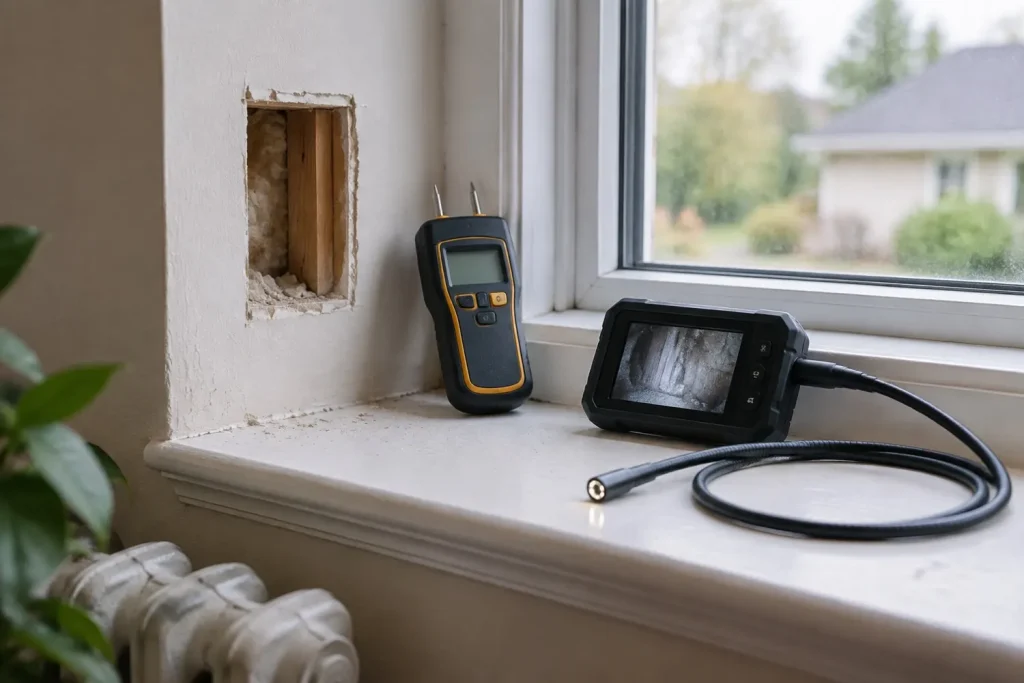
| Thermal imaging | Infrared survey to locate temperature anomalies indicating hidden moisture behind finishes | Equipment and training cost, and it is often the line that moves a quote from $400 to $700. |
| Cavity inspection | Borescope through a small drilled port into a wall or ceiling void | Minor destructive access, so it needs consent and patching. Adds time and liability. |
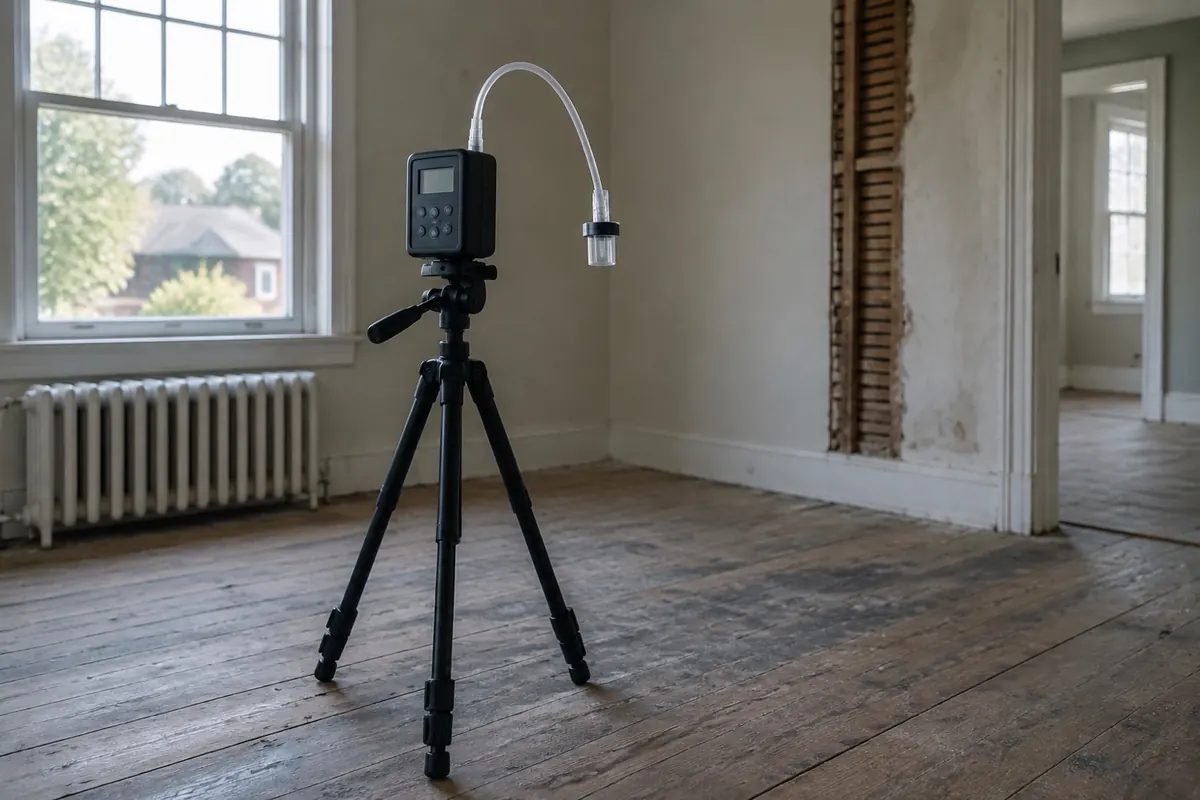
| Sampling | Air samples using spore trap cassettes with an outdoor control, plus tape-lift or bulk surface samples where growth is visible | Per-sample laboratory fee, plus pump calibration and chain-of-custody paperwork. |
| Laboratory analysis | Microscopic identification and spore counts, or culture where speciation is needed | Roughly $30 to $75 per sample, frequently billed as a pass-through. |
| Written report and protocol | Findings, extent, moisture source, and a remediation protocol scoped for a contractor to price | Desk time. The largest single component of a good assessor’s fee. |
The moisture source is the deliverable
EPA guidance on mold cleanup in your home is direct about this: moisture control is the controlling factor, and cleaning without fixing the water gets you a repeat. An assessment that identifies growth in a bathroom ceiling and stops there has sold you half a finding. The question the report has to answer is where the water came from, whether it is still arriving, and what has to change so it stops.
What is usually not included
- Destructive investigation. Opening walls beyond a borescope port is a separate scope, and usually a contractor’s work rather than an assessor’s.
- HVAC interior inspection. Duct interiors often need a specialist and separate access.
- Repair of the moisture source. Plumbing, roofing and grading work sit outside an assessment entirely.
- Clearance testing. Almost always a separate visit with a separate fee, after remediation is complete.
- Contents evaluation. Assessing soft furnishings and stored belongings is commonly excluded or priced by the hour.
The free inspection problem
Plenty of firms advertise a free mould inspection. The offer is real, and so is the structural problem behind it. A free inspection is paid for by the remediation work it generates, which means the person deciding whether you need remediation is the person who gets paid if the answer is yes. That is a conflict of interest in the plain sense of the phrase, and it does not require anyone to act in bad faith to bias an outcome.
The practical test is simple. Ask a firm offering a free inspection whether they will perform the remediation they recommend. If the answer is yes, you have a proposal rather than an assessment. That can still be perfectly useful for a small, obvious, visible problem where nobody disputes what needs doing. It is the wrong document for an insurance claim, a property transaction, a landlord dispute, or any situation where the extent is genuinely uncertain.
This is not a claim that firms offering free inspections are dishonest. It is a claim about who pays for what. If the assessment is funded by the remediation, the assessment is a cost of sale. Read it that way and it is still informative.
Instruments, and what each one finds
Four instruments do most of the work, and each answers a different question. Knowing which question you need answered is how you avoid paying for equipment that will not help.
| Instrument | What it detects | What it cannot do |
|---|---|---|
| Pin and pinless moisture meters | Moisture content in a material, compared against a dry standard taken on unaffected material of the same type | Cannot see through to a cavity, and readings are only meaningful against a baseline of the same material. |
| Thermography, infrared camera | Temperature anomalies that indicate evaporative cooling from wet material behind a finish | Does not see moisture. It sees temperature, and a cold spot has several possible causes, so readings need confirmation with a meter. |
| Borescope | Visual confirmation of growth, insulation condition and standing water inside a closed cavity | Sees only what the port looks at. Needs a small hole, so consent and patching are part of the job. |
| Hygrometer and thermo-hygrometer | Air temperature and relative humidity, used to calculate dew point and assess condensation risk | Describes the air, not the material. A dry room can sit above a saturated subfloor. |
| Calibrated air sampling pump with spore trap cassette | Airborne spore concentration over a measured volume, for laboratory counting | Snapshot of one moment in one place. Disturbance, HVAC operation and weather all move the result. |
| Particle counter | Total airborne particulate, useful as a screening indicator | Does not identify anything. It counts particles, not spores. |
Thermal imaging is misread more often than any other output
An infrared image showing a dark patch on a wall is frequently presented as a picture of mould. It is not. It is a picture of a temperature difference, which can be caused by wet material, by a missing insulation batt, by a stud, by a duct, or by sunlight that hit the wall two hours ago. A competent report treats a thermal anomaly as a lead to be confirmed with a moisture meter, and says so. A report that presents the thermal image as the finding has skipped the step that makes it evidence.
Air sampling and the outdoor control
This is the single most consequential thing to understand about mould laboratory results. Mould spores are a normal constituent of outdoor air, in every season, in every climate, at concentrations that vary enormously with weather, vegetation and time of day. An indoor spore count therefore has no meaning on its own. It only becomes interpretable when compared against a simultaneous outdoor sample taken as a control.
| Sample type | What it is for | What a competent report does with it |
|---|---|---|
| Outdoor control | Establishes the background spore profile at that property on that day | Becomes the comparator for every indoor sample. Without it the indoor numbers are uninterpretable. |
| Indoor air, affected area | Airborne concentration and genus profile where a problem is suspected | Compared against outdoor for both total count and genus mix. |
| Indoor air, unaffected area | Interior baseline away from the suspected source | Distinguishes a localised problem from a whole-building condition. |
| Surface tape lift | Confirms whether visible discolouration is fungal growth and identifies the genus | Answers the question an air sample cannot: is this thing on the wall actually growing there. |
| Bulk sample | A piece of the material itself, for cases where surface sampling will not settle it | Destructive, so it is used where material is being removed anyway. |
| Swab sample | Surface sampling where tape will not adhere, such as rough or porous material | Useful for identification, poor for quantification. |
Why the genus mix matters more than the total count
Two properties can return identical total indoor spore counts and present completely different findings. If the indoor profile mirrors the outdoor profile in proportion, the likely reading is normal infiltration. If the indoor sample is dominated by genera that are scarce outdoors that day, particularly those associated with chronically wet building material, the reading points to an indoor source. This is why a report that gives you one number and no comparison has not told you anything.
Sampling conditions change the answer
- HVAC state. Running or off changes airborne concentration substantially, so it has to be recorded.
- Disturbance. An undisturbed room samples lower than the same room after someone walks across the carpet.
- Weather. Outdoor counts move with rain, wind and season, which is exactly why the control has to be taken the same day rather than pulled from a table.
- Pump calibration and run volume. Concentration is count divided by volume, so an uncalibrated pump produces a number that looks precise and is not.
- Windows and doors. Open during sampling and the indoor sample partly becomes an outdoor sample.
There is no federal exposure limit for mould
No United States federal agency has set a permissible exposure limit, threshold limit value or action level for airborne mould or mould spores. This is not an oversight that a laboratory can work around. It means no sample result can be reported as compliant or non-compliant, because there is nothing to be compliant with.
What that means for a report you have been given: if it states that your counts exceed a safe level, ask which published limit it is citing. There is no federal one. Assessors legitimately compare indoor results against the outdoor control and against unaffected interior areas, and legitimately reference published interpretive guidance. Those are comparisons, not legal thresholds, and a good report says which it is doing.
EPA guidance on mold cleanup in your home does not publish numerical limits either. Its guidance is framed around visible growth, moisture control and remediation practice rather than around counts, and it recommends fixing the moisture problem and removing the growth regardless of what a number says. The practical consequence is that a visible, confirmed growth problem does not need a laboratory result to justify remediation, and sampling is most useful where the extent is hidden or where the finding will be contested.
Laboratory fees and sample counts
Laboratory analysis is usually a separate line, and it is usually a pass-through with a modest handling margin. Indicative published pricing runs roughly $30 to $75 per sample for spore-trap or tape-lift analysis, with culture work and speciation costing more and taking longer. A typical residential job submits three to six samples, one of which is the outdoor control.
The reason to understand the arithmetic is that sample count is the easiest place for a quote to grow and the easiest place for it to be cut. Twelve samples on a three-bedroom house is generally more than the question requires. One sample with no outdoor control is less than the method requires. If a quote is materially above or below the band, sample count is usually why.
Turnaround is a real cost lever
Standard laboratory turnaround is commonly two to five business days. Same-day and next-day rush analysis is widely offered at a premium, sometimes double the standard fee. That is worth paying when a property transaction or an occupancy decision is waiting on the result, and not worth paying otherwise.
Accreditation is the question to ask about the laboratory
Ask which laboratory the samples go to and what accreditation it holds for the analysis being performed. An assessor who cannot answer that has not thought about the chain that turns a cassette into evidence. Chain-of-custody documentation matters for the same reason: if the finding is ever contested, the paperwork trail between the sampling pump and the report is part of what makes it hold.
What the written report has to contain
The report is the product. Everything else is the process that produced it. A report that a remediation contractor can price from, and that an adjuster can read without asking follow-up questions, is worth several times one that says mould was observed.
| Report element | What it should say | Why a contractor needs it |
|---|---|---|
| Scope and limitations | Which areas were inspected, which were not, and why | Defines what the finding covers. Absence of a limitation section is itself a warning sign. |
| Moisture source finding | Where the water came from, whether it is active, and what has to be repaired | Without this the remediation gets redone. This is the single most important line in the document. |
| Extent, by area and material | Square footage of affected material, by type, per room | This is what the remediation quote is priced from. |
| Moisture readings with a dry standard | Readings on affected and unaffected material of the same type, with the baseline stated | Establishes the target the drying has to reach and proves the finding is measured rather than judged. |
| Laboratory results with the outdoor control | Full laboratory report attached, indoor results presented against the control | A summary without the raw report cannot be independently checked. |
| Remediation protocol | Containment class, engineering controls, materials to remove versus clean, clearance criteria | This is the document contractors bid against. Without it, three quotes describe three different jobs. |
| Photographic log | Dated photographs keyed to locations in the narrative | Carries the file if there is a dispute months later. |
| Clearance criteria | The specific, written conditions the work must meet to pass | Defines when the job is finished, before it starts. |
Clearance criteria written before the work starts
A protocol that does not define what passing looks like sets up an argument at the end of the job. Criteria written in advance, typically covering visual cleanliness, moisture content against the dry standard, and air sample results compared to the outdoor control, mean that finishing is a test rather than a negotiation.
Clearance testing is a second job
Post-remediation verification, often called clearance testing, is a distinct inspection performed after the remediation contractor has finished and before containment comes down and rebuild begins. It checks the work against the protocol’s written criteria. It is not part of the original inspection fee, and the timing matters: once new drywall is closed up, a failed clearance is expensive to act on.
| Stage | Who performs it | Typical fee | What it produces |
|---|---|---|---|
| Initial assessment | Independent assessor or inspector | $300 to $1,000 | Finding, extent, moisture source, remediation protocol. |
| Remediation | Remediation contractor | Separate scope entirely | Removal, cleaning, drying, documentation of work performed. |
| Post-remediation verification | Assessor, in several states required to be a different company from the remediator | $300 to $800 per event | Pass or fail against the protocol criteria, in writing. |
| Re-test after a failure | Same assessor | Billed again, commonly at the same rate | Second pass or fail finding after corrective work. |
Budget for the possibility of a failure. It is not rare, and a remediation contract that makes the contractor responsible for the cost of a re-test after a failed clearance aligns the incentives correctly. Our walkthrough of the remediation process covers where verification sits in the sequence, and our mold remediation cost page covers what the remediation itself runs.
Where the law separates the two roles
The conflict of interest described above is not only an editorial observation. Several states have written the separation into law, licensing assessment and remediation as distinct activities and restricting one company from performing both on the same property.
Florida is the clearest example. Florida Statutes Chapter 468, Part XVI, covering mould-related services, establishes separate licence categories for mould assessors and mould remediators. Our pull of the state licence file on 23 September 2026 showed 3,310 assessors against 3,192 remediators, which is close to parity and tells you the assessment side is a real profession in that market rather than a formality.
Not every state does this. Many have no mould licensing at all, which means the same company can assess, remediate and clear its own work with nothing but its own judgement in between. Our state mould licensing review sets out which states license the work and which do not, and what that means for how much weight a clearance letter carries.
What to do in a state with no licensing
Recreate the separation contractually. Hire the assessor directly, on a fee basis, with a written condition that they will not bid the remediation. Then put the protocol out to remediation contractors. Then bring the same assessor back for verification. It costs more than a single all-in arrangement and it is the only way to get an independent finding where the statute does not provide one.
Home test kits, and what they can tell you
Retail mould test kits sell for roughly $10 to $50, sometimes with laboratory analysis included and sometimes not. They are not a substitute for an assessment, and the reason is structural rather than a matter of quality.
| Kit type | Typical price | What it can establish | Where it falls short |
|---|---|---|---|
| Settle plate, petri dish left open in a room | $10 to $25 | That viable spores are present in the air, which is true in every building | No measured air volume, so no concentration. No outdoor control. Growth on the plate proves almost nothing. |
| Surface swab or tape lift with prepaid analysis | $30 to $60 | Whether visible discolouration is fungal, and often the genus | Only tells you about the spot you sampled. Does not establish extent or source. |
| Air cassette kit with prepaid analysis | $40 to $100 plus analysis | A spore count, if a calibrated pump was used | Most kits do not include a calibrated pump, and few users take a simultaneous outdoor control. |
There is one situation where a kit is genuinely useful: you can see discolouration, you want to know whether it is fungal growth before deciding whether to spend money on an assessment, and a surface sample with laboratory analysis answers that for under $60. Outside that narrow case, the kit produces a number without the comparison that makes numbers mean anything.
How to choose an inspector
Seven questions separate an assessment from a visit. Ask them before booking, not after the report arrives.
- Will you also bid the remediation? If yes, you are buying a proposal. Decide whether that is what you want.
- Does the fee include laboratory analysis, or is that separate? Get both numbers, and get the expected sample count.
- Will you take a simultaneous outdoor control sample? If the answer is anything other than yes, stop.
- Which laboratory, and what accreditation does it hold for this analysis? A specific answer is the point.
- Does the report include a remediation protocol I can put out to bid? A finding without a protocol leaves you unable to compare quotes.
- Will you state the moisture source and what has to be repaired? This is the line that prevents a repeat.
- What are the written clearance criteria? Defined before the work starts, or the end of the job is a negotiation.
One more thing worth checking. Ask what happens if the inspection finds nothing. An assessor whose answer is a written report saying so is selling assessment. An assessor who seems uncomfortable with the question may be selling something else. Our water damage restoration cost page covers the adjacent case where the moisture event is recent and known, which is often the cheaper path to the same answer.
Questions people actually ask
How much does a mold inspection cost?
Typically $300 to $1,000 for a residential property, and $1,000 to $2,000 or more for large or complex buildings. Laboratory analysis is frequently billed separately at roughly $30 to $75 per sample, with a typical job submitting three to six samples. These are indicative bands compiled from published price guides current in 2026.
Are free mold inspections worth taking?
They are informative, and they are a sales visit. A firm that also sells remediation has a financial interest in the finding, so a free inspection is a proposal rather than an independent assessment. For a small visible problem that may be fine. For an insurance claim, a property transaction or a disputed extent, pay for an independent assessor.
Do I need air sampling, or is a visual inspection enough?
If growth is visible and the moisture source is obvious, the EPA’s guidance points to fixing the moisture and removing the growth without needing a laboratory result to justify it. Sampling earns its fee where the extent is hidden, where occupants report symptoms with no visible source, or where the finding will be contested.
Why does the inspector need an outdoor sample?
Because mould spores are present in outdoor air everywhere, so an indoor count has no meaning on its own. Results are interpreted as an indoor-versus-outdoor comparison of both total count and genus mix, taken the same day at the same property. An indoor sample without a control is not interpretable.
Is there a safe level of mould in the air?
No United States federal agency publishes a permissible exposure limit or action level for airborne mould, so no laboratory result can be reported as passing or failing a legal threshold. Reports legitimately compare indoor results against an outdoor control and against unaffected areas, which is a comparison rather than a compliance test.
Can the company that did my remediation also do the clearance test?
In several states, no. Florida licenses mould assessors and mould remediators separately under Chapter 468 Part XVI, which restricts one company from performing both roles on the same property. In states with no licensing there may be no legal bar, but a clearance letter written by the firm that did the work carries much less weight with a carrier or a buyer.
How long does an inspection take and when do I get the report?
On site, commonly two to four hours for a house, longer with crawl space, attic or multiple zones. Laboratory turnaround is typically two to five business days, with rush analysis available at a premium, so the written report usually follows within a week.
Sources
- EPA guidance on mold cleanup in your home. United States Environmental Protection Agency, on moisture control as the controlling factor in mould growth and on remediation practice. The agency publishes no numerical airborne exposure limit. Retrieved 23 September 2026.
- Institute of Inspection, Cleaning and Restoration Certification, ANSI/IICRC S520 Standard for Professional Mold Remediation. Cited for its assessment, protocol and verification framework; the text is ANSI-copyrighted and sold by IICRC, so it is described rather than reproduced here.
- Florida Statutes Chapter 468, Part XVI, Mold-Related Services, on the separate licensing of mould assessors and mould remediators and the restriction on one firm performing both roles on the same property. Retrieved 23 September 2026.
- Florida Department of Business and Professional Regulation, mould licensee extract, our own pull: 3,310 assessors and 3,192 remediators. Retrieved 23 September 2026.
- Inspection fee bands, laboratory per-sample fees and retail test kit prices are compiled from published inspector, laboratory and aggregator price guides current in 2026. They are indicative rather than survey results. We have not conducted an inspector pricing survey; when we do, its sample and method will be published with it. The laboratory fee chart is arithmetic applied to the indicative per-sample band, not a price list.
- Cross-references: our methodology sets out the standing rules for how figures on this site are sourced and labelled.