The short answer
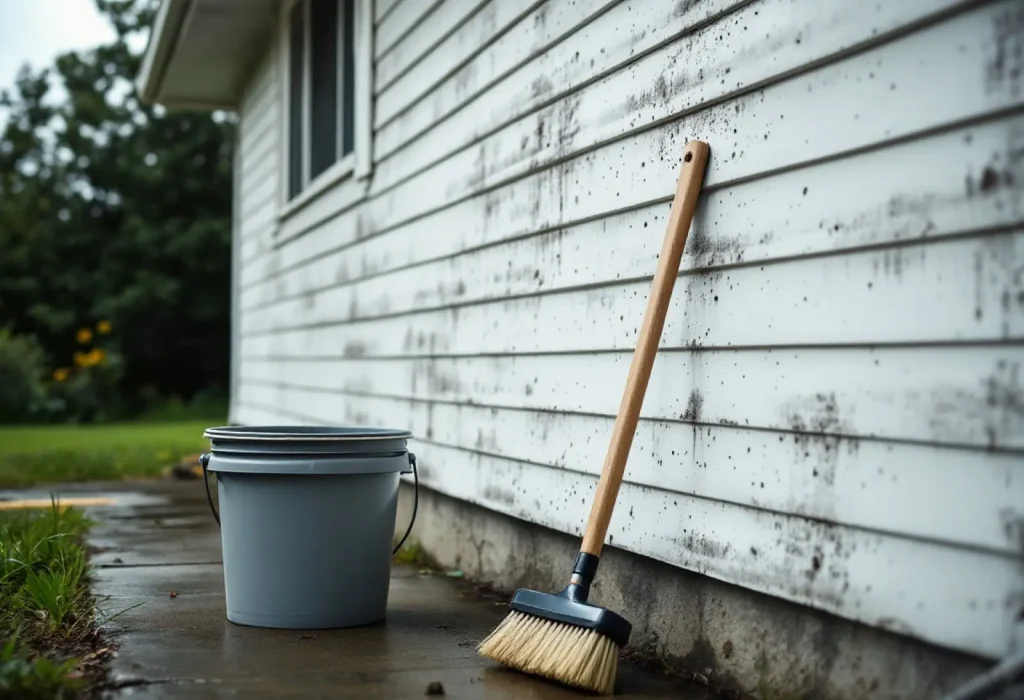
Mold on vinyl siding is usually mildew growing on a film of dirt, or algae, not the vinyl itself, and per the siding makers’ care guides it washes off with 1/3 cup detergent, 2/3 cup trisodium phosphate, 1 quart of 5% bleach and 3 quarts of water, scrubbed with a soft brush and rinsed before it dries. Spray level, never upward into the laps.
Black specks, green film or white chalk: which one is on your siding?
Start with the color and the location, then confirm with bleach. According to Purdue Extension NCR-134, written with the USDA Forest Products Laboratory, the test is simple: put a drop or two of household bleach (5% sodium hypochlorite) on the stain, and mildew will usually bleach out in 1 or 2 minutes while dirt does not. Use fresh bleach, because it loses strength on standing, per Purdue Extension NCR-134.
| What you see | Where it shows | Most likely | Check | Source |
|---|---|---|---|---|
| Black or dark gray specks | Under eaves, porch ceilings and enclosures that rain does not reach | Mildew on the dirt film | A drop or two of fresh 5% bleach clears mildew in 1 to 2 minutes; dirt stays | Gentek cleaning guide; CertainTeed how-to page; Purdue Extension NCR-134 |
| Green film | North wall, shaded lower courses, behind shrubs | Algae | If detergent fails, CertainTeed says to ask the siding contractor for a cleaner | University of Illinois Extension; CertainTeed how-to page |
| Dull white or pale powdery film | Walls exposed to sun and weather | Chalk from weathered pigment, not a growth | A dull film, not spots; CertainTeed calls it normal and washes it off with soapy water | CertainTeed care sheet; CertainTeed how-to page |
| Gray or brown grime | Anywhere; Gentek names industrial fallout, tree sap and chimney fumes | Atmospheric dirt, soot or sap | Does not bleach out in 2 minutes | Gentek cleaning guide; Purdue Extension NCR-134 |
Vinyl resists the growth; the dirt on it does not. The CertainTeed how-to page says vinyl siding is mold and mildew resistant, but mildew can grow on the dirty coating, and it appears as black spots on surface dirt in areas not subjected to rainfall. The Gentek cleaning guide says the same: mildew is usually first detected under eaves and porch enclosures.
Green on a north wall is algae more often than mold. A University of Illinois Extension answer to a homeowner with a green film on the north side of vinyl siding put it plainly: it is common to have algae develop on the north side of the house. The green growth guide covers green growth indoors, and the sibling page on telling mold from dirt walks through the same test on other surfaces.
Nine published recipes side by side: how much bleach is in each?
The makers agree more than guides online suggest. Four maker documents print the same mildew mix almost word for word: 1/3 cup detergent, 2/3 cup trisodium phosphate, 1 quart of 5% sodium hypochlorite and 3 quarts of water, per the CertainTeed how-to page, Mastic care page, Ply Gem cleaning page and the Gentek cleaning guide. The table puts every recipe found next to its dwell, rinse and pressure rules.
| Source | Mildew or mold mix as printed | Bleach in final mix (calc.) | Dwell and rinse | Pressure rule |
|---|---|---|---|---|
| CertainTeed how-to page (current) | 1/3 cup detergent, 2/3 cup trisodium, 1 qt 5% sodium hypochlorite, 3 qt water | 1.25% | Apply by hand, rinse with a garden hose | Does not recommend power washing vinyl |
| CertainTeed care sheet (October 2006) | 1/2 cup detergent, 2/3 cup trisodium phosphate, 1 qt 5% sodium hypochlorite, 3 qt water | 1.25% | Rinse thoroughly with a garden hose | Avoid prolonged or high pressure rinsing of open ventilated areas |
| Mastic care page and Ply Gem cleaning page | 1/3 cup detergent, 2/3 cup trisodium phosphate, 1 qt 5% sodium hypochlorite, 3 qt water | 1.25% | Scrub gently, rinse thoroughly, bottom up | 1,500 to 2,400 PSI, 40 degree tip, eye level, never upward |
| Gentek cleaning guide | 1/3 cup household detergent, 2/3 cup trisodium phosphate, 1 qt 5% sodium hypochlorite, 3 qt water | 1.25% | Bottom to top, rinse often with a garden hose | Not stated |
| Alside (effective 1 March 2025) | 1/3 cup powdered detergent, 2/3 cup household cleaner, 1 gal water with 1 qt laundry bleach in place of 1 qt water | 1.25% if the bleach is 5% | At least 3 minutes wet, rinse before it dries, overcast 55 to 75 F | Avoid prolonged or high pressure rinsing of open ventilated areas |
| VSI manual (2020) | 1/3 cup powder detergent, 2/3 cup powder household cleaner, 1 gal water, plus 1 qt liquid laundry bleach | 1.0% if the bleach is 5% | Bottom to top | Not stated |
| PEPA care page and VSI manual stain chart | 30% vinegar, 70% water for larger areas of mold and mildew | None | Rinse before the solution dries | Allowed with caution: level, never upward |
| Purdue Extension NCR-134 (March 1988, painted wood) | 1/3 cup household detergent, 1 qt 5% bleach, 3 qt warm water | 1.25% | Rinse thoroughly with a hose | Not stated |
| University of Illinois Extension | A weak 10% bleach solution | 0.5% if the bleach is 5% | Keep it off plants | Not stated |
According to that arithmetic, the maker mixes sit at 1.25% sodium hypochlorite, a quarter of the strength of the jug, and the VSI manual mix at 1.0%. A common rule of thumb online of a quart of bleach per gallon of water, with no detergent, lands close on strength but drops the detergent and trisodium phosphate that every maker recipe includes. The CertainTeed care sheet warns that greater concentration may cause damage to the siding and soffit.
Two cautions travel with every recipe. EPA says never mix chlorine bleach with cleaners or detergents that contain ammonia because toxic fumes could be produced, per EPA's Brief Guide to Mold, Moisture and Your Home, and Alside bans ammoniated cleaners on its siding outright. According to their own wording these recipes assume a 5% product, so check the percentage on the jug: a stronger bleach raises every number in the chart. Whether bleach actually kills what it whitens is covered on the bleach page.
Can you pressure wash vinyl siding at 1,500 to 2,400 psi?
Only if your siding’s maker allows it, and the makers split. According to the Mastic care page and Ply Gem cleaning page, a power washer may be set between 1,500 and 2,400 PSI with a 40 degree tip, held straight at eye level and never aimed upward, because water may collect behind the siding and cause leaks, streaks and decay. The CertainTeed how-to page says it does not recommend power washing vinyl or polymer siding at all, citing moisture intrusion, damage and discoloration.
The industry body sits between them. The Polymeric Exterior Products Association care page says a power washer can be used with caution, that some manufacturers do not recommend it while others limit the PSI and the cleaners, and that the stream should never be aimed upward. Alside and the 2006 CertainTeed care sheet both say to avoid prolonged or high pressure rinsing of open, ventilated areas.
If the brand is unknown, a garden hose and a soft brush satisfy every document cited here, and the PEPA care page tells owners to read both the siding and the washer instructions before starting.
How to wash it: bottom up, 3 minutes wet, rinse before it dries
The steps below merge the instructions printed in 6 documents; each line names the document it comes from, so a reader with one brand of siding can follow that maker where they differ.
- Pick the day. Alside says an overcast, cool day of 55 to 75 F, washing small areas at a time.
- Protect the surroundings. Cover brick or stone below the wall, per the PEPA care page, and keep the solution off shrubs, per the VSI manual and Purdue Extension NCR-134.
- Use the soft tool. A long-handled car washing brush or soft cloth, per the VSI manual; Alside warns that rubbing hard can make glossy patches on the finish.
- Wash from the bottom up to avoid streaks, per the VSI manual, Gentek cleaning guide and Mastic care page.
- Let it work. Alside keeps the solution on for not less than 3 minutes, then rinses before it dries; no other maker cited here prints a dwell time.
- Rinse with clear water from a garden hose, per every maker above, with any stream held level, per Mastic care page.
Wear gloves and keep the mix off skin and eyes: the Mastic care page prints both, and the Gentek cleaning guide prints the skin and eye warning. EPA's Brief Guide to Mold, Moisture and Your Home says ordinary household rubber gloves are fine for water and mild detergent, but that a biocide such as chlorine bleach calls for gloves chosen for that chemical.
Why do the north wall, the eaves and the shrub side go green first?
Because they stay wet longest and rain never rinses them. Purdue Extension NCR-134 says mildew is most common on walls behind trees or shrubs where air movement is restricted, and that it follows the dew pattern of the house: eaves and the ceilings of carports and porches cool fast, collect dew, and that dew feeds the growth.
The Alside care and warranty document ties the cleaning schedule to the same map: rainfall is usually enough to wash its siding, but areas not exposed directly to rain should be rinsed periodically with a garden hose. The CertainTeed care sheet adds that mildew is worse in warmer climates with consistently high humidity and recommends cleaning at least once a year.
EPA’s rule indoors applies outside too: the key to mold control is moisture control, per EPA's Brief Guide to Mold, Moisture and Your Home. On siding that points back to the shrubs Purdue names: cut back, they let air move across the wall again. The same shade and dew logic explains growth on a deck or a brick wall on the same side of the house.
Which cleaning mistakes void a vinyl siding warranty?
Read the warranty before buying a cleaner. The Alside care and warranty document says the warranty remains in effect only if normal cleaning practices are followed and shall be null and void if harmful cleaning compounds are used; that document is effective for products made on or after 1 March 2025. The same document lists mildew among the conditions the warranty does not cover, so mildew removal stays the owner’s job.
Coatings sold as mold resistant are the second trap. The Mastic care page says painting Mastic siding will void the warranty on the finish, Alside excludes products painted, varnished or similarly coated without its authorization, and the PEPA care page says painting could void the product warranty. The PEPA care page also lists organic solvent cleaners, undiluted chlorine bleach, liquid grease remover, nail polish remover and furniture polish as products to avoid.
A cleaner sold for siding still needs a test patch. The CertainTeed care sheet says to test any cleaner on an inconspicuous area first and to ask the siding contractor or a building materials retailer for a mildew cleaner if its mix does not work. Ask which siding brand the product is approved for, and whether it contains ammonia or solvents, the two ingredients the Alside care text bans.
When does growth on siding point to water behind it?
Vinyl siding is a cladding, not the water barrier. The Vinyl Siding Institute installation manual says vinyl siding is not a water-resistive barrier, that it provides a supplemental rainscreen, and that it must be installed over a water-resistive barrier under the most recent building codes. Growth on the face is a surface problem the recipes above handle; damp drywall or stains on the inside of the same wall are a different problem, and the guide to water damage in walls covers how those are checked.
Two look-alikes belong elsewhere. Dark streaks on the roof above the siding belong to The Roofing Brief, our sister site for roofing. Cement shingle siding is not vinyl at all, and the asbestos siding page covers how to tell it apart before any scrubbing or washing.
Out of scope: health effects of mold. This page covers identifying and washing growth on vinyl siding; for health questions, start with EPA's Brief Guide to Mold, Moisture and Your Home.
Questions people actually ask
What kills mold on vinyl siding?
According to CertainTeed, Mastic, Ply Gem and Gentek, the mix is 1/3 cup detergent, 2/3 cup trisodium phosphate, 1 quart of 5% bleach and 3 quarts of water, about 1.25% sodium hypochlorite once mixed. Scrub with a soft brush and rinse with a garden hose before it dries. Never add an ammonia cleaner, which EPA warns can produce toxic fumes.
Does vinegar work on mildew on vinyl siding?
According to the Polymeric Exterior Products Association, a solution of 30% vinegar and 70% water for larger areas of mold and mildew is effective, and the Vinyl Siding Institute installation manual’s stain chart lists the same ratio. It is a milder option than the bleach recipe, but no maker cited here prints a dwell time for it, so test a small area first and rinse before it dries.
Can I paint vinyl siding with mildew resistant paint?
Not without checking the warranty. Mastic says painting its siding will void the warranty on the finish, and Alside’s warranty (effective 1 March 2025) excludes products painted, varnished or similarly coated unless Alside authorizes it. The Polymeric Exterior Products Association says to check with the siding maker before painting. Cleaning once a year, as CertainTeed recommends, is the published alternative.
Is the white film on my vinyl siding mold?
Usually not. CertainTeed describes chalk, a dull film that forms on all pigmented materials exposed to sunlight, as a normal condition that its soapy water wash removes. Mold and mildew show as black spots in sheltered areas that rain does not reach. A drop of fresh 5% bleach clears mildew in 1 to 2 minutes according to Purdue Extension; chalk and dirt stay.
How often should vinyl siding be washed to keep mildew off?
CertainTeed’s 2006 care sheet recommends cleaning vinyl siding at least once a year. Alside says rainfall usually washes its siding but that areas not exposed directly to rain, such as under eaves and porches, should be rinsed periodically with a garden hose. Those sheltered spots are where Gentek and CertainTeed say mildew is first detected, so rinse them more often than open walls.
Sources
- Polymeric Exterior Products Association care page, How to Clean and Maintain Your Vinyl Siding, Polymeric Exterior Products Association (formerly the Vinyl Siding Institute), Alexandria, Virginia. Retrieved 20 November 2026.
- Vinyl Siding Institute installation manual, Vinyl Siding Installation Manual, Vinyl Siding Institute, copyright 2020, file posted October 2022: Water-Resistive Barrier and Cleanup sections. Retrieved 20 November 2026.
- CertainTeed care sheet, Cleaning Vinyl Siding, CertainTeed Corporation, dated 10/06. Retrieved 20 November 2026.
- CertainTeed how-to page, How to Clean Vinyl Siding, CertainTeed LLC. Retrieved 20 November 2026.
- Alside care and warranty document, The Care and Cleaning of Vinyl Siding, Soffit and Accessories and Lifetime Limited Warranty, Alside, a division of Associated Materials, effective for products manufactured on or after 1 March 2025. Retrieved 20 November 2026.
- Mastic care page, Care and Maintenance, Mastic Home Exteriors by Ply Gem. Retrieved 20 November 2026.
- Ply Gem cleaning page, How to Clean Your Vinyl Siding, Ply Gem. Retrieved 20 November 2026.
- Gentek cleaning guide, Cleaning Guide for Vinyl Siding, Gentek Building Products, bilingual edition. Retrieved 20 November 2026.
- Purdue Extension NCR-134, Discoloration of House Paint: Causes and Cures, Purdue University Cooperative Extension Service with the USDA Forest Products Laboratory, revised March 1988. Retrieved 20 November 2026.
- University of Illinois Extension, Ask Extension: Removing green moss/mold, University of Illinois Extension, Champaign County unit. Retrieved 20 November 2026.
- EPA's Brief Guide to Mold, Moisture and Your Home, United States Environmental Protection Agency, last updated 18 February 2026. Retrieved 20 November 2026.
- The bleach strength column and chart are arithmetic on the printed recipes (5% times the bleach share of the liquid, powders ignored); no figure was estimated, according to the formula stated. Our methodology sets out the standing rules, and the mold hub lists related guides.
Cleaning products carry label directions that override general guidance, and siding warranties differ by maker and product line. Before using a cleaner or a pressure washer, ask the siding manufacturer which products and pressures its warranty allows for your panels.