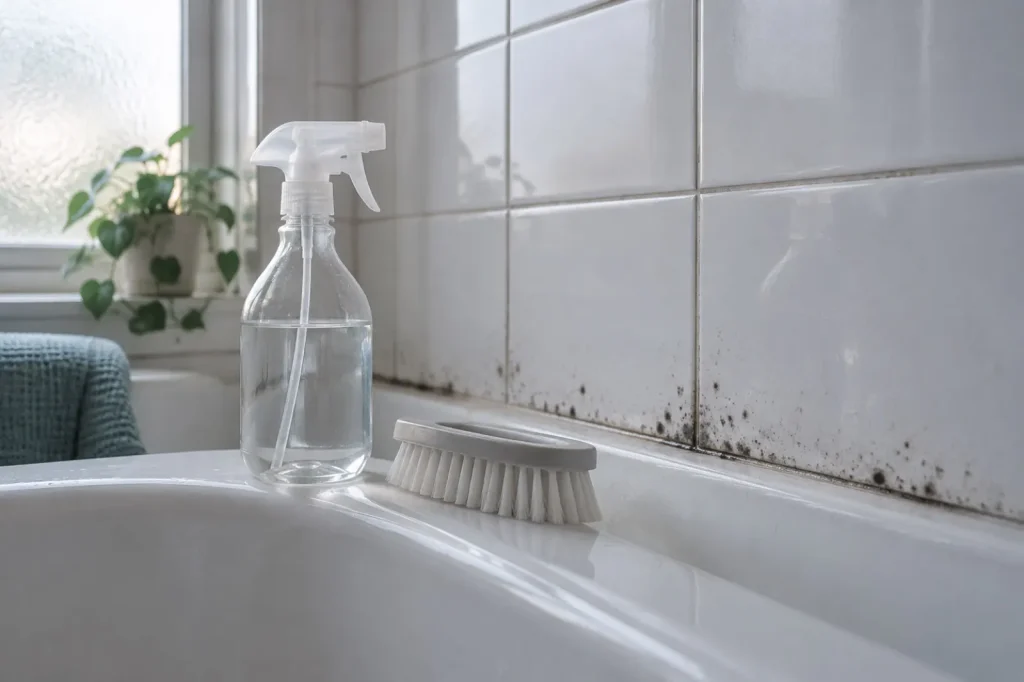
The short answer
Does vinegar kill mold? Only some of it, and only in lab tests. In a 2015 University of Adelaide study, vinegar at 4.0 to 4.2 percent acetic acid inhibited Penicillium chrysogenum but had no effect on Aspergillus fumigatus. Vinegar is not an EPA-registered antimicrobial, so no label backs a kill claim, and EPA says mold must be removed, not just killed.
Key takeaways
- The most cited study, Rogawansamy and colleagues, IJERPH 2015, tested vinegar on agar, not walls, and it stopped one of two common indoor molds.
- That study did not test bleach. It compared vinegar with tea tree oil, two hospital disinfectants and 70 percent ethanol.
- Grocery vinegar has no EPA registration, so no regulator has reviewed a mold claim or contact time for it.
- EPA’s hard surface method is detergent and water, then drying. None of the three EPA mold guides read for this page mentions vinegar.
- In Peitzsch and colleagues, J Environ Monit 2012, none of 10 commercial treatments eliminated viable mold from gypsum board or pine.
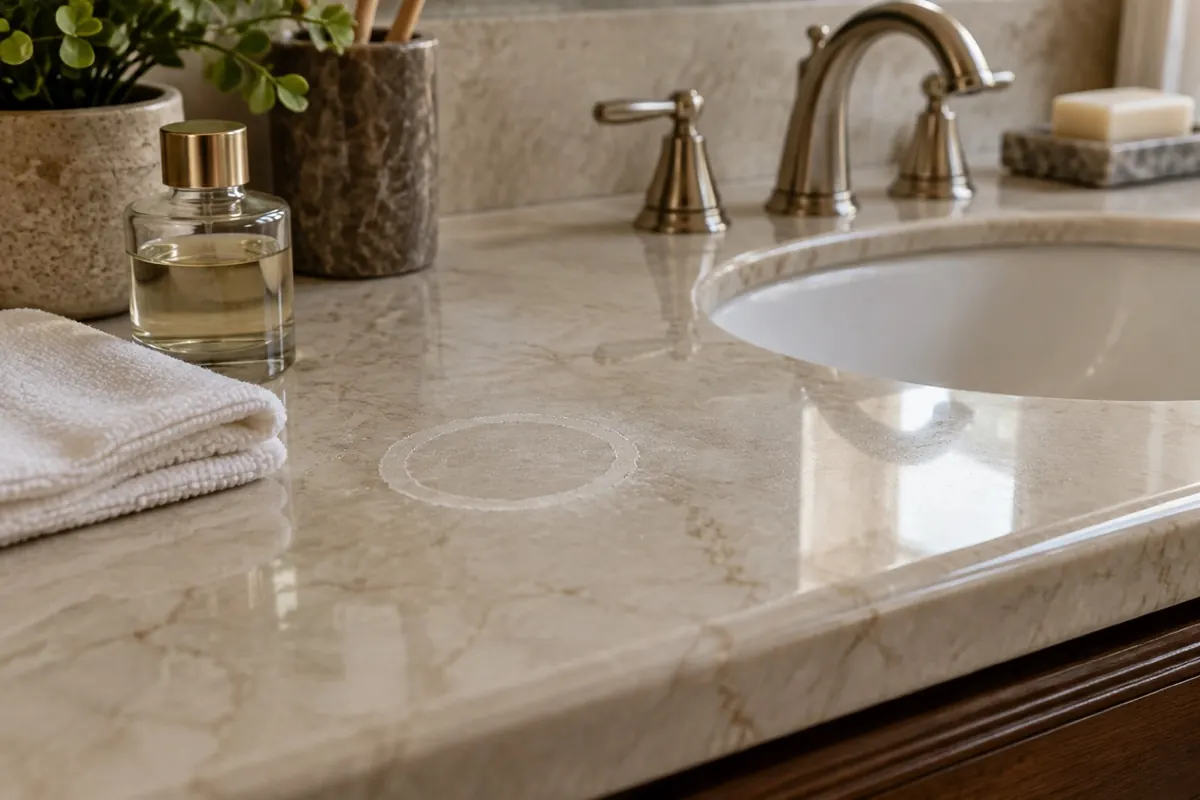
- Vinegar etches marble, limestone and travertine, and repeated use weakens cement grout.
On this page
Cleaning brands say vinegar kills most mold; remediation firms say it kills none. Neither usually cites anything. For the agency split on bleach and its safety rules, see our does bleach kill mold page.
What the vinegar study measured
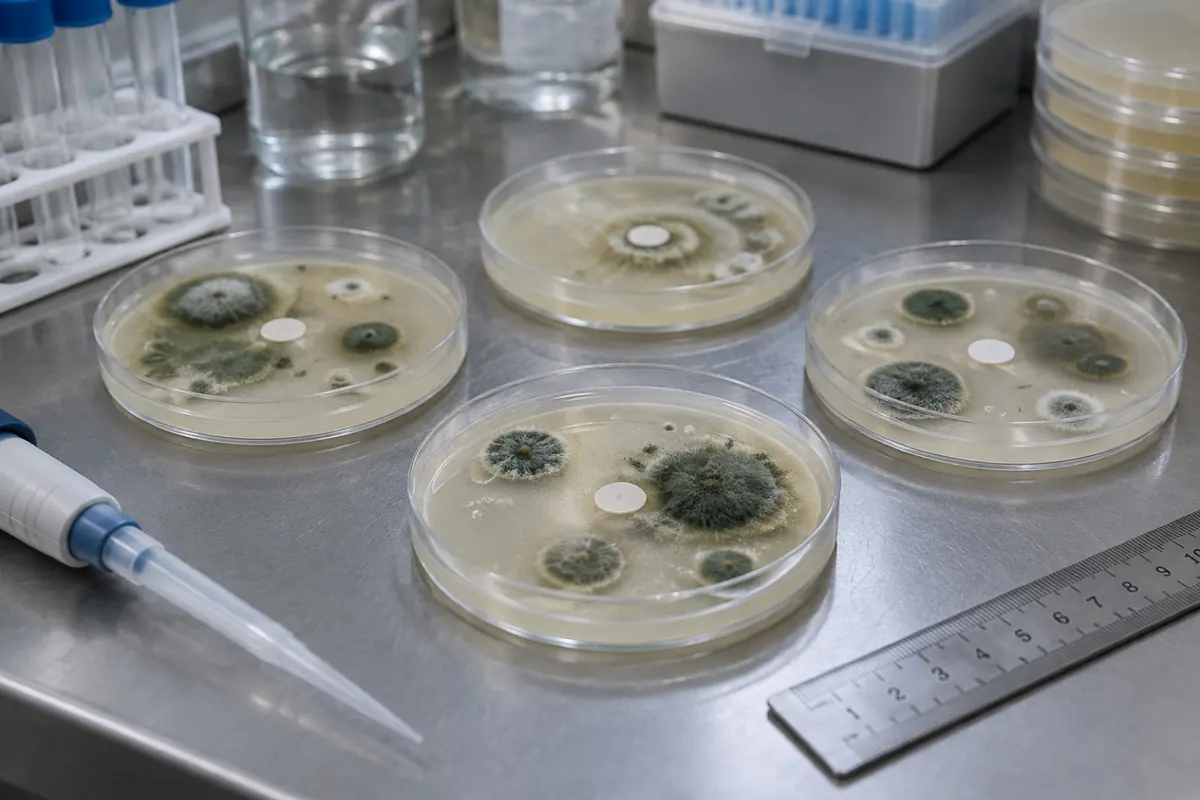
The paper most pages lean on is Rogawansamy and colleagues, IJERPH 2015, from the University of Adelaide. It is often described as a vinegar against bleach test. It is not: it tested 5 agents, namely Virkon, Cavicide, 70 percent ethanol, vinegar at 4.0 to 4.2 percent acetic acid, and tea tree oil. Bleach was discussed from other papers, not tested.
Each agent went onto a 9 mm paper disc on spore-seeded agar, read after seven days; a clear zone over 9.5 mm counted as activity. Agar is not drywall, and the authors say real surfaces still need testing.
| Agent | Strength tested | Aspergillus fumigatus zone | Penicillium chrysogenum zone |
|---|---|---|---|
| Tea tree oil, liquid | 100% oil | 83 mm | 43.5 mm |
| Tea tree oil, vapour | 100% oil, no contact | 81 mm | 20.6 mm |
| Virkon | 10% (ten times label rate) | 19.25 mm | 18.67 mm |
| Virkon | 5%, 3% and 1% | No inhibition | No inhibition |
| Cavicide | undiluted | 16 mm | 16 mm |
| Cavicide | 75% | No inhibition | No inhibition |
| Vinegar | 4.0 to 4.2% acetic acid | No inhibition | 15 mm |
| Ethanol | 70% | No inhibition | No inhibition |
Per Rogawansamy and colleagues, IJERPH 2015: ‘The use of vinegar as an antifungal agent may not be effective against the diverse fungal genera found in the indoor air environment.’ Vinegar did suppress spore production in the Penicillium it inhibited, and the authors suggested its lack of persistence may limit it to cleaning non-porous materials.
Six agents against mold, side by side
No study has tested every household option on the same material. This table puts the strength and the test surface next to each finding, so a lab plate is never mistaken for a wall.
| Agent | Concentration tested | Test surface | What the source found | Source |
|---|---|---|---|---|
| Vinegar | 4.0 to 4.2% acetic acid | Agar disc | Stopped Penicillium chrysogenum (15 mm zone), not Aspergillus fumigatus | Rogawansamy and colleagues, IJERPH 2015 |
| Acetic acid vapour | 1.9 or 2.5 microlitres per litre of air, 30 min | Inoculated fruit | Pome fruit decay from Penicillium expansum fell from 98% to 16% | Sholberg, Plant Dis 1998 |
| Chlorine bleach | 2.4% sodium hypochlorite | Lab carriers | Nonculturable after 5 min (non-porous) and 10 min (porous ceramic) | Reynolds and colleagues, J Occup Environ Hyg 2012 |
| Bleach, hydrogen peroxide and three others | Peroxide at 17%; others not stated | Pine wood blocks | Growth stopped at first; spores recovered after rinsing | Chakravarty and Kovar 2013, via Rogawansamy and colleagues, IJERPH 2015 |
| Hydrogen peroxide | 0.2% | Agar plate, 5 min | 0.44 log (63.30%) reduction of Aspergillus niger | Rabby and colleagues, Int J Microbiol 2025 |
| Quaternary ammonium (Cavicide) | 0.28% benzethonium chloride, 17.2% isopropyl alcohol | Agar disc | Undiluted: 16 mm zone on both molds; no effect at 75% | Rogawansamy and colleagues, IJERPH 2015 |
| Quaternary ammonium | Not stated in abstract | Gypsum wallboard | Stachybotrys re-emerged within 5 weeks with the quat alone | Price and Ahearn, Curr Microbiol 1999 |
| Borates (DOT) | 0.25% and 2.00% g/v | Southern pine, up to 12 weeks | No mold protection alone; worked only with fatty acids | USDA Forest Products Laboratory FPL-RP-673 |
| Detergent and water | Not a biocide | EPA guidance | Scrub growth off hard surfaces, then dry completely | EPA's Mold Cleanup in Your Home |
| 10 commercial methods, incl. boron and ammonium products | Label instructions | Gypsum board and pine | None eliminated viable mold | Peitzsch and colleagues, J Environ Monit 2012 |
Agar and smooth carriers flatter every agent; wood and gypsum hold spores where liquid does not reach, hence the regrowth rows. The scales also differ, so ranking agents here would be false precision.
In Rabby and colleagues, Int J Microbiol 2025, that blend beat 0.2 percent hydrogen peroxide about 13 times over in log terms, but peracetic acid is a different chemical; it says nothing about vinegar alone.
How strong household vinegar is
The benchmark strength for white vinegar is 5 percent acetic acid: the USDA Complete Guide to Home Canning says ‘white distilled and cider vinegars of 5 percent acidity (50 grain) are recommended’ for pickling, and the FDA Compliance Policy Guide 525.825 says diluted vinegar should ‘in no case’ fall below 4 percent. The bottle states its strength.
| Benchmark | Acetic acid | What it means | Source |
|---|---|---|---|
| FDA minimum for vinegar | 4% | Diluted vinegar must state its strength | FDA Compliance Policy Guide 525.825 |
| Vinegar in the Adelaide study | 4.0 to 4.2% | The strength behind the one-mold result | Rogawansamy and colleagues, IJERPH 2015 |
| USDA strength for pickling | 5% (50 grain) | Recommended for white distilled and cider vinegar | USDA Complete Guide to Home Canning |
| EPA cap for vinegar as an inert | 8% | Allowed in exempt minimum risk products only as an inert | 40 CFR 152.25(f) |
The tested vinegar sat at the FDA floor, about 1 percentage point under grocery strength: not a different product. A stronger cleaning vinegar that claims to kill mold should carry an EPA registration number.
Why vinegar has no EPA kill claim
Mold killers are pesticides in law. FIFRA, the Federal Insecticide, Fungicide, and Rodenticide Act, covers ‘any substance or mixture of substances intended for preventing, destroying, repelling, or mitigating any pest’, and EPA's What is a Pesticide? page says a product is likely one if its labeling ‘makes a claim to prevent, kill, destroy, mitigate, remove, repel’ a pest.
Per 40 CFR 152.15, ‘No person may distribute or sell any pesticide product that is not registered’, and a substance counts as one if the seller ‘claims, states, or implies’ it works as one. Grocery vinegar is sold as food and makes no such claim. That is why no regulator has checked a vinegar mold claim.
| Question | Grocery vinegar | EPA-registered antimicrobial |
|---|---|---|
| Is it a pesticide in law? | Not as sold for food; only if the seller claims it controls a pest. | Yes, and it must be registered before sale. |
| Has EPA reviewed a mold claim? | No. | Yes, for the organisms and surfaces on its label. |
| Is there a contact time? | None from any regulator. | On the label, and the label binds the user. |
| Minimum risk exemption? | Only as an inert, up to 8% acetic acid, per EPA rule 40 CFR 152.25(f) | Not needed; it was reviewed |
| Registration number? | None. | EPA Reg. No. on the container. |
The minimum risk exemption under FIFRA section 25(b) does not help. EPA’s list of active ingredients in 40 CFR 152.25(f) includes citric acid, clove oil and thyme oil, but not vinegar, which appears only among permitted inert ingredients as ‘Vinegar (maximum 8% acetic acid in solution)’.
Killing is not EPA’s goal
The question assumes killing is the job. EPA disagrees: EPA's Mold Remediation in Schools and Commercial Buildings says ‘it is necessary to clean up mold contamination, not just to kill the mold.’ Dead growth left on a surface is still growth on a surface.
| Question | What EPA says | Source |
|---|---|---|
| Kill or remove? | ‘It is not enough to simply kill the mold, it must also be removed.’ | EPA's A Brief Guide to Mold, Moisture and Your Home |
| Hard surfaces | ‘Scrub mold off hard surfaces with detergent and water, and dry completely.’ | EPA's Mold Cleanup in Your Home |
| Porous materials | May have to be thrown away; mold may be ‘difficult or impossible to remove completely.’ | EPA's Mold Cleanup in Your Home |
| Sterilising | ‘In most cases, it is not possible or desirable to sterilize an area.’ | EPA's Mold Remediation in Schools and Commercial Buildings |
| Recurrence | Without fixing the water problem, ‘most likely, the mold problem will come back.’ | EPA's A Brief Guide to Mold, Moisture and Your Home |
So vinegar’s weak kill record matters less than people think. It can help lift growth from a hard, acid-safe surface; it cannot make mold safe to leave in place. Our mildew remover guide sets out which chemistries lift mildew stains, surface by surface.
Where vinegar is reasonable, and where it is not
Find the material first. The surface decides whether growth can be reached and whether the acid damages what it touches.
| Surface | Vinegar? | Why | Source |
|---|---|---|---|
| Glazed tile, glass, sealed hard plastic | Reasonable as a cleaner | Non-porous; growth scrubs off. Detergent and water is EPA’s method. | EPA's Mold Cleanup in Your Home |
| Cement grout | Not for routine use | Grout runs pH 11 to 13; acids weaken it and make it more porous. | Ceramic Tile Education Foundation, in Stone World |
| Marble, limestone, travertine, onyx | No | Calcite ‘dissolves readily in weak acid’. | USGS acid rain and stone page |
| Granite and natural stone tops | No | ‘Do not use vinegar or lemon juice as cleaners.’ | Stonemark natural stone care guide |
| Drywall, ceiling tile, carpet, insulation | No | Porous; may have to be discarded. | EPA's Mold Cleanup in Your Home |
| Bare wood framing | Unproven | No study read here tested vinegar on wood; treated pine regrew. | Peitzsch and colleagues, J Environ Monit 2012 |
| Anything just cleaned with bleach | Not until rinsed | Vinegar plus chlorine bleach releases chlorine gas. | Poison Control |
Material guides go deeper: mold in the shower for tile and grout, mold on walls for drywall, and mold on wood for framing.
A method that stays inside the evidence
This sequence uses vinegar only where nothing argues against it. Size limits and the full owner method are on our DIY mold remediation page; larger or hidden jobs follow the mold remediation process.
| Step | Do this | Why, and the source |
|---|---|---|
| 1 | Measure. Over about 10 square feet, or sewage or other contaminated water: stop. | EPA DIY guideline. |
| 2 | Fix the moisture source. | EPA: otherwise mold returns. |
| 3 | Check the surface matrix. Porous or acid sensitive: no vinegar. | EPA; USGS; stone and grout makers. |
| 4 | Was bleach used on it? Rinse with water first. | Poison Control: never mix. |
| 5 | Wear gloves and unvented goggles. | EPA PPE guidance. |
| 6 | Scrub with detergent and water, or vinegar on acid-safe hard surfaces. | EPA hard surface method. |
| 7 | Rinse and dry completely. | Drying is part of EPA’s method. |
| 8 | Recheck days later: no growth, no musty odour. | EPA completion test. |
| 9 | Need a kill step? Use an EPA-registered product at its label rate. | The label is the law. |
For contractors: vinegar on a scope or a protocol
Owners often try vinegar before calling. Record it and do not build on it: with no EPA registration, vinegar cannot honestly appear on a protocol or estimate as an antimicrobial step. EPA's Mold Remediation in Schools and Commercial Buildings also notes some states require registered pesticide applicators for biocides in schools.
| Document this | Detail | Why an adjuster or auditor asks |
|---|---|---|
| Product in the protocol | Brand, EPA Reg. No., label use | Vinegar has no number to record. |
| Dilution and dwell time | From the label | No regulator states them for vinegar. |
| Surface list | Cleaned versus removed | EPA treats porous and hard materials differently. |
| Safety Data Sheets | Every chemical the crew handles | OSHA Hazard Communication, 29 CFR 1910.1200. |
| Owner’s prior treatments | What was sprayed, and when | Bleach residue plus an acid is a gas hazard. |
What this page does not cover. Health effects of mold, including EPA’s health reasons for removing dead mold, are outside our scope; see EPA’s mold pages, the CDC or NIH. Our mold hub lists our other mold guides.
Questions people actually ask
How long does it take for vinegar to kill mold?
No regulator publishes a time, because vinegar has no EPA-registered mold claim. The Adelaide study read its agar plates after seven days, which is not a contact time for a wall. Registered products state a dwell time on the label. Treat vinegar as a cleaner: scrub, rinse and dry.
What kills 100% of mold?
Nothing reliably does on building materials. In a 2012 Lund University study, none of ten commercial methods eliminated viable mold from gypsum board or pine. EPA says sterilising an area is usually neither possible nor desirable; remove the growth and fix the moisture instead.
Is bleach or vinegar better for mold?
In separate lab studies, 2.4 percent bleach made test molds nonculturable within minutes, while vinegar stopped one of two molds. Neither is EPA’s first choice: its hard surface method is detergent and water. Bleach has its own limits, covered on our does bleach kill mold page. Never combine them.
Can I spray vinegar on mold and leave it?
EPA says mold must be removed, not just killed, so leaving it in place is the wrong goal. The Adelaide authors also noted vinegar’s lack of persistence on surfaces. Spray, scrub the growth off, rinse and dry. Do not use it at all on marble, limestone or travertine.
Does vinegar kill black mold?
No study read for this page tested household vinegar against Stachybotrys, the mold usually meant by black mold. Colour does not change the method: EPA sizes the job by area and material, not species, and porous material with growth may have to go. Our guide to black mold versus regular mold covers identification.
Does vinegar kill mold on wood?
There is no direct evidence for household vinegar on wood. In studies on pine, agents that stopped growth at first allowed regrowth after rinsing, because spores sit below the surface. Dry the wood, clean it, and replace it if it has softened.
Can you mix vinegar and bleach to clean mold?
No. Poison Control says mixing vinegar with chlorine bleach releases chlorine gas that is very irritating to the airways, eyes, nose and throat. Use one product, rinse and ventilate before using another. The full mixing rules are on our does bleach kill mold page.
Sources
- Rogawansamy and colleagues, IJERPH 2015: Rogawansamy, Gaskin, Taylor, Pisaniello. Retrieved 13 October 2026.
- Reynolds and colleagues, J Occup Environ Hyg 2012, Sholberg, Plant Dis 1998, Peitzsch and colleagues, J Environ Monit 2012 and Price and Ahearn, Curr Microbiol 1999, PubMed abstracts. Retrieved 13 October 2026.
- Rabby and colleagues, Int J Microbiol 2025, Table 1. Retrieved 13 October 2026.
- USDA Forest Products Laboratory FPL-RP-673, Coleman, Yang and Clausen, 2013. Retrieved 13 October 2026.
- EPA's A Brief Guide to Mold, Moisture and Your Home (updated 18 February 2026), EPA's Mold Cleanup in Your Home (4 June 2026) and EPA's Mold Remediation in Schools and Commercial Buildings (29 April 2026). Retrieved 13 October 2026.
- EPA's What is a Pesticide? page and EPA's antimicrobial pesticides page, both updated 29 January 2026. Retrieved 13 October 2026.
- 40 CFR 152.15 and 40 CFR 152.25(f), via eCFR. Retrieved 13 October 2026.
- FDA Compliance Policy Guide 525.825, revised March 1995. Retrieved 13 October 2026.
- USDA Complete Guide to Home Canning, Guide 1, revised 2015. Retrieved 13 October 2026.
- USGS acid rain and stone page, last modified 1997. Retrieved 13 October 2026.
- Stonemark natural stone care guide. Retrieved 13 October 2026.
- Ceramic Tile Education Foundation, in Stone World: Scott Carothers, 3 February 2025. Retrieved 13 October 2026.
- Poison Control, National Capital Poison Center. Retrieved 13 October 2026.
- Clorox EPA Reg. No. 5813-114 label, master label, accepted 28 April 2026. Retrieved 13 October 2026.
- Margins and ratios are arithmetic on the values above. See our methodology.
This page summarises published research and federal guidance. It does not evaluate any product and does not replace an assessor on a large or hidden problem.