The short answer
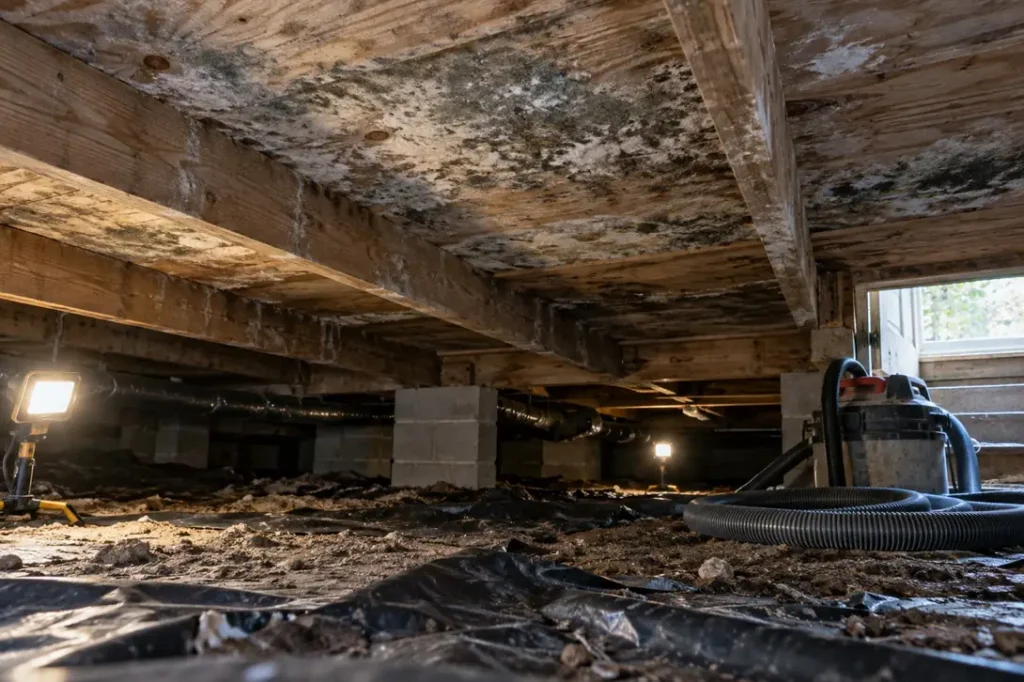
Crawl space mold remediation means physically removing growth from joists, subfloor and framing, by HEPA vacuuming, brushing or sanding, or media blasting, and then fixing the moisture that grew it. HomeAdvisor and Fixr both report $500 to $2,000 for crawl space mold removal. Without a sealed ground cover and air moisture control, the growth tends to come back.
Key takeaways
- The vented crawl is often the cause: the Advanced Energy report found vented crawls above 70% relative humidity 98% of one summer.
- A ground cover alone did not stop it: carefully laid 6-mil plastic in the vented crawls still left high humidity and surface mold.
- Wood moisture is the number to track. The USDA Wood Handbook reports that air dried wood at 20% or less gives a margin of safety.
- Kill is not removal. EPA does not recommend bleach as routine and says dead mold must still be removed.
- Four price guides report the same $500 to $2,000 crawl space range, and This Old House says its figures come from Angi.
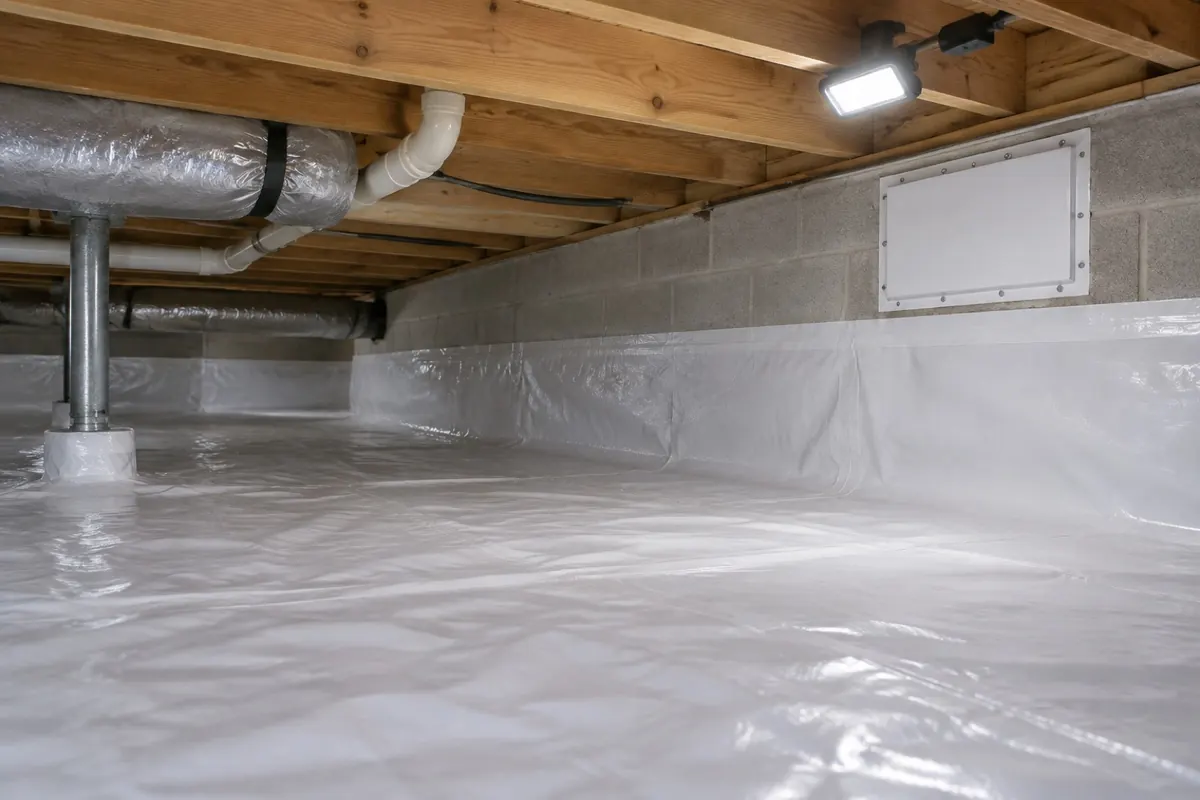
- IRC R408.3 sets the closed option: a sealed Class I vapor retarder plus exhaust, conditioned air or dehumidification.
On this page
The ranking pages here are mostly forum threads and contractor pages that agree on little except the spray bottle. The published research is clearer: a crawl space grows mold because of where its water comes from, and removal is the smaller half of the job.
What this page does not cover: health effects, which are outside our scope; for those, see EPA’s mold pages, the National Institutes of Health and CDC. Encapsulation pricing is on our crawl space encapsulation cost page, and this page does not repeat it.
Why crawl spaces grow mold
The USDA Forest Products Laboratory Wood Handbook names the mechanism in one line: in buildings with crawl spaces, wetting of the floor framing and sheathing by condensation may cause serious damage, and the primary source of condensation is soil moisture. It lists humidity and plumbing leaks as the other main sources inside buildings.
The vents that are supposed to dry the space can make it wetter in a humid summer. Advanced Energy, of Raleigh, North Carolina, monitored twelve matched houses on one cul-de-sac for the US Department of Energy. In summer 2003, according to Davis and Dastur (ACEEE, 2004), the wall vented crawl spaces stayed above 70% relative humidity 98% of the time and above 80% for 86% of the time, and reached condensation conditions repeatedly. The closed crawl spaces, the paper reports, were above 70% only 5% of the time and never reached condensation.
The Advanced Energy's final report to DOE gives the reason: vented crawls had long spells above 80% humidity with dew points in the mid 70s F, conditions it says supported mold growth and deterioration.
The moisture reading that matters
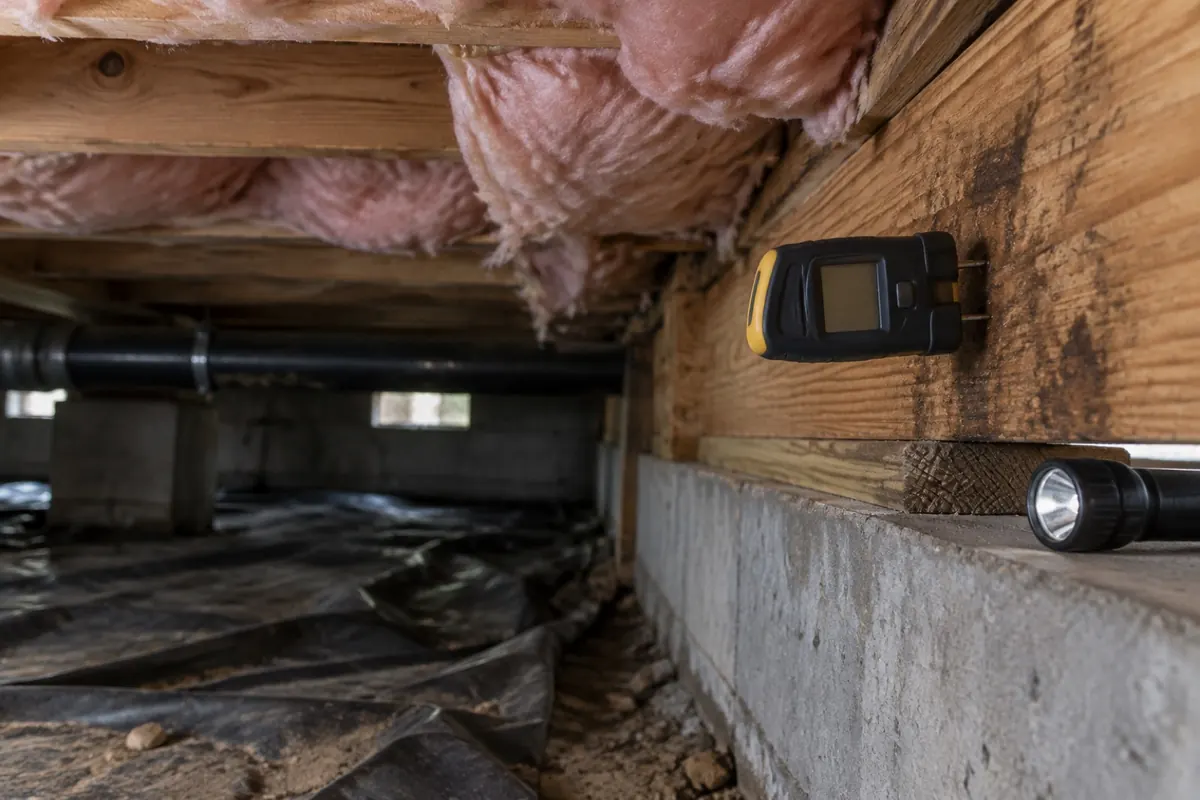
Wood moisture content is the number that ties the two halves together. According to the USDA Forest Products Laboratory Wood Handbook, serious decay occurs only above the fiber saturation point, which averages 30%, and humid air alone will not wet wood enough for decay but will permit some mold. Fully air dried wood, according to the same chapter, usually does not exceed 20% and gives a reasonable margin of safety against fungal damage.
| Joist or subfloor reading | What the sources say | What it means for the job |
|---|---|---|
| Under 20% | Per the FPL: air dried, margin of safety | Dry enough to clean and keep; hold it there |
| 20% to 30% | Per the FPL: humid air permits some mold | Find the source first; growth will resume |
| Above 30% | Per the FPL: fiber saturation, decay possible | Liquid water is reaching the wood; probe for decay |
| Sill plate or OSB subfloor | AE excluded both from averages | Treated sills and OSB read misleadingly on pin meters. |
The FPL chapter says mold fungi affect wood strength only slightly but make it more absorbent, which can invite decay fungi. Our page on mold on wood covers telling mold, stain and rot apart.
Removal methods, and what each can and cannot do
Every credible method removes growth rather than just killing it. EPA Table 2 lists all four EPA methods for wood surfaces: wet vacuum, damp wipe, HEPA vacuum after drying, and removal. Work runs under negative air; our page on what an air scrubber is covers that equipment.
| Method | What it does | Limit |
|---|---|---|
| HEPA vacuum | Removes loose growth and dust after drying (EPA Method 3) | Does not lift growth bonded to the grain |
| Damp wipe or scrub | Detergent and water on framing (EPA Method 2) | Adds water; the wood must dry quickly |
| Wire brush or sanding | Surfaces off growth; FPL says it often brushes off softwood | Dusty; hyphae may go deeper; oak may stain too deep |
| Dry ice blasting | Cold Jet says the ice sublimates and adds no secondary waste | Vendor claims; debris still needs HEPA collection |
| Soda blasting | Media blasted at the framing | Cold Jet, a rival vendor, says soda needs cleanup time |
| Antimicrobial spray or fog | Applies a registered product | EPA: not routine; kill is not removal |
| Encapsulant coating | Seals the cleaned surface | EPA: do not paint or caulk moldy surfaces |
| Remove and replace | Cuts out decayed or soaked members | Needed where FPL decay thresholds are passed |
Antimicrobials and their limits
EPA's answer on bleach says a biocide such as chlorine bleach is not recommended as a routine practice, and that killing mold is not enough: it must also be removed. EPA's Mold Cleanup in Your Home warns that paint or caulk over moldy surfaces is likely to fail, which is the problem with an encapsulant sprayed over growth nobody removed. Where a product is used, EPA's pesticide label guidance quotes the label statement that use inconsistent with the labeling violates federal law.
What the published guides charge
The published numbers agree almost too well. HomeAdvisor, Fixr, This Old House and Bob Vila each report $500 to $2,000 for removing mold from a crawl space, and This Old House reports that its cost data was sourced from Angi. Identical ranges across four guides suggest one shared origin rather than four independent surveys, so treat them as one data point.
| Source | Published price | Date on the page |
|---|---|---|
| HomeAdvisor | $500 to $2,000 | updated 19 June 2026 |
| Fixr | $500 to $2,000 | updated 29 August 2025 |
| This Old House (Angi data) | $500 to $2,000 | updated 11 March 2026 |
| Bob Vila | $500 to $2,000 | updated 17 April 2024 |
| HomeAdvisor, all mold jobs | $10 to $25 per sq ft | as above |
| This Old House, all mold jobs | $10 to $25 per sq ft | as above |
| Fixr, all mold jobs | $10 to $30 per sq ft | as above |
| Fixr: dry ice removal | $1,400 to $2,000 | updated 29 August 2025 |
| Fixr: dry fog | $800 to $1,100 | updated 29 August 2025 |
| Fixr: air scrubbers and HEPA vacuums | $500 to $1,000 | updated 29 August 2025 |
The totals and the per-square-foot rates cannot both describe a whole crawl. At HomeAdvisor’s own figures, $2,000 buys about 200 square feet of affected area at its $10 low rate and 80 at $25, according to simple division. Widespread growth prices above the headline range, and no total includes the moisture fix. Our mold remediation cost page covers wider pricing.
The moisture fix is the real job
Building code sets two routes. Per the code text of IRC Section R408.1, as in the IRC Section R408 as reprinted by the City of Eaton and the 2012 IRC text reprinted by the Georgia Department of Agriculture, a vented crawl needs at least 1 square foot of net vent area per 150 square feet, or 1 per 1,500 where the ground is covered by a Class I vapor retarder, with a vent within 3 feet of each corner. R408.3 lets the vents go entirely if two conditions are met.
| R408 requirement, per the code text | Worked example, 1,500 sq ft crawl |
|---|---|
| Vented: 1 sq ft net vent per 150 sq ft | 10 sq ft of net vent |
| Vented with Class I retarder: 1 per 1,500 | 1 sq ft of net vent |
| Unvented: Class I retarder, seams overlapped 6 in and sealed, 6 in up the stem wall | Whole floor, sealed to the wall |
| Plus exhaust: 1 cfm per 50 sq ft | 30 cfm continuous |
| Or conditioned air: 1 cfm per 50 sq ft | 30 cfm with return path |
| Or dehumidification: 70 pints a day per 1,000 sq ft | 105 pints a day |
| R408.5: remove vegetation, organic material, wood forms | Clear before the liner goes down |
| R408.4 access: 18 by 24 in floor, 16 by 24 in wall | Needed for clearance access |
The research behind the closed option is the same Advanced Energy study. Its Advanced Energy's final report to DOE found closed crawls holding daily average humidity below 60% with dew points between 55 and 60 F, using 1 cfm of conditioned air per 30 square feet, and about 30% lower wood moisture readings than the vented control group. The 2004 paper reports energy savings of 15% and 16% over eleven months.
Grade and drainage come before the liner: R408.6 requires the under-floor grade to be raised or an approved drainage system where groundwater can rise to within 6 inches of the floor, according to the code text, and the FPL handbook recommends 18 inches of clearance under joists for inspection. Equipment and drainage hardware belong to the HVAC and plumbing trades.
Why remediating without the moisture fix fails
EPA's Brief Guide to Mold puts it plainly: if you clean up the mold but don’t fix the water problem, the mold problem will most likely come back. The crawl space evidence is specific. In the Advanced Energy study the four vented control crawls got new full coverage 6-mil polyethylene, seams overlapped and staked without gaps, meeting the intent of the code, and still had high humidity, condensation and surface mold growth. The report concludes that air moisture controls are mandatory for a dry crawl.
| What was done | Why it does not hold | Source |
|---|---|---|
| Sprayed a biocide, nothing removed | Dead mold must still be removed; moisture unchanged | EPA bleach answer |
| Coated growth with an encapsulant | Coatings over mold are likely to fail | EPA home guide |
| Cleaned, left vents open in a humid climate | Vented crawls sat above 70% RH 98% of a summer | Advanced Energy report |
| Laid loose plastic, no air control | Careful 6-mil cover still left surface mold | Advanced Energy report |
| Cleaned, ignored a plumbing leak or bad grading | Fixing leaks, drainage and cover cut wood moisture about 2 points | Advanced Energy report |
| Sanded, left wood above 20% | Humid conditions keep permitting mold; FPL margin is 20% | FPL Wood Handbook |
The order of work
Each step depends on the one before.
- Stop liquid water. Plumbing leaks, standing water and grading first. In the Advanced Energy crawls, full ground cover, plumbing repairs and drainage cut average wood moisture by about 2 percentage points within a month.
- Measure. Pin readings on joists, beams and subfloor against unaffected framing. Note where readings pass the FPL thresholds.
- Probe for decay. Soft or cubically cracked wood is a carpentry item, not a cleaning item.
- Set up. Negative air, HEPA filtration and respiratory protection.
- Remove. HEPA vacuum, then brush, sand or blast, then HEPA vacuum again. Bag debris and wet insulation.
- Dry and verify. Readings below the FPL margin and no visible growth.
- Close or correct the crawl. Vapor retarder and air moisture control under R408, priced separately.
What the contractor’s scope and clearance should say
A crawl space scope that only says remediate mold is unpriceable and unverifiable. The table lists what a complete one names. For clearance, EPA commercial guide, Chapter 3 says visible mold, mold-damaged materials and moldy odors should not be present, and S520 practice, as quoted in a 2024 Cal State LA assessment, defines Condition 1 as normal fungal ecology for a similar environment.
| Scope item | What it should state |
|---|---|
| Moisture source | Cause found and who fixes it, in this scope or a named follow-on |
| Readings | Wood moisture by location, before and after, with the meter used |
| Area | Measured affected area of joists and subfloor |
| Containment | Negative air, access sealing, HEPA units |
| Removal method | HEPA, brushing, sanding or blasting, by member |
| Products | Any antimicrobial or coating, with label use |
| Disposal | Insulation, debris and old liner, bagged |
| Clearance | Visual, odour and moisture criteria; who judges it and whether independent |
| Exclusions | Encapsulation, drainage, structural repair, priced separately |
For contractors
Crawl work under 29 CFR 1910.134 means a written respiratory program, medical evaluation before use and fit testing for tight-fitting facepieces wherever respirators are necessary. Several states license mold work, so check our state mold licensing guide before quoting across a state line. For an adjuster or owner, the file should show cause, readings, before and after photos, and the moisture fix as its own line. Our mold remediation process page and our mold hub cover the rest.
Questions people actually ask
How much does it cost to remediate mold in a crawl space?
HomeAdvisor, Fixr, This Old House and Bob Vila each report $500 to $2,000, and This Old House says its data comes from Angi. HomeAdvisor reports $10 to $25 per square foot across mold jobs, Fixr $10 to $30, so a crawl with widespread growth costs more. Moisture control is priced separately.
How serious is mold in a crawl space?
For the structure, it depends on moisture. The USDA Wood Handbook reports that mold affects wood strength only slightly, but decay occurs above fiber saturation, about 30% moisture content. Mold is the warning that framing is staying damp; the reading tells you whether decay is possible.
Can you remediate mold yourself in a crawl space?
A small area, yes: EPA says growth under about 10 square feet can usually be handled by a homeowner. Crawl spaces are often larger, tight and dusty, and the lasting fix needs vapor retarder and air moisture work under IRC R408. Use HEPA vacuuming and protection, not a spray alone.
Can you put DampRid in a crawl space?
According to DampRid’s product page, its 4 lb tub covers up to 1,000 square feet for up to 6 months, and it lists basements, garages and stored vehicles, not crawl spaces. The IRC dehumidification option, per the code text, is sized at 70 pints of moisture removal a day per 1,000 square feet.
Does a vapor barrier alone stop crawl space mold?
Not in a humid climate. In the Advanced Energy study, vented crawls with carefully installed full coverage 6-mil polyethylene still had high humidity, condensation and surface mold. The closed crawls added sealed vents, a sealed liner and conditioned air, and stayed below 60% average humidity, according to the report.
Is spraying mold in a crawl space enough?
No. EPA says biocides such as bleach are not recommended as a routine practice and that it is not enough to kill mold: it must also be removed. A spray changes neither the moisture nor the dead growth, and EPA says mold returns if the water problem stays.
Sources
- Advanced Energy's final report to DOE: Davis, Dastur, Warren and others, A Field Study Comparison of the Energy and Moisture Performance Characteristics of Ventilated Versus Sealed Crawl Spaces in the South, 22 June 2005, DOE award DE-FC26-00NT40995. Retrieved 13 October 2026.
- Davis and Dastur (ACEEE, 2004), Moisture Solution Becomes Efficiency Bonanza in Southeastern United States, ACEEE Summer Study. Retrieved 13 October 2026.
- USDA Forest Products Laboratory Wood Handbook, Chapter 14, Biodeterioration of Wood, C.A. Clausen, FPL-GTR-190, 2010. Retrieved 13 October 2026.
- IRC Section R408 as reprinted by the City of Eaton, Ohio, undated handout, and the 2012 IRC text reprinted by the Georgia Department of Agriculture. Retrieved 13 October 2026.
- EPA's Brief Guide to Mold (updated 18 February 2026) and EPA's Mold Cleanup in Your Home (4 June 2026), EPA. Retrieved 13 October 2026.
- EPA's answer on bleach (8 September 2026), EPA commercial guide, Chapter 3 and EPA Table 2 (April 2026), EPA. Retrieved 13 October 2026.
- EPA's pesticide label guidance, EPA, updated 2 June 2026. Retrieved 13 October 2026.
- 29 CFR 1910.134, via the Legal Information Institute. Retrieved 13 October 2026.
- HomeAdvisor, mold remediation cost guide, updated 19 June 2026; Fixr, updated 29 August 2025; This Old House, updated 11 March 2026; Bob Vila, updated 17 April 2024. Retrieved 13 October 2026.
- Cold Jet, restoration and remediation page; vendor. Retrieved 13 October 2026.
- DampRid's product page, Hi-Capacity 4 lb tub. Retrieved 13 October 2026.
- a 2024 Cal State LA assessment, Terra Environmental Services, 26 February 2024. Retrieved 13 October 2026.
- Worked-example code figures and area-per-price figures are arithmetic on the published rules and prices. Our methodology sets out how we source every figure.
Code editions and local amendments vary, and prices are set by each contractor. Confirm the adopted code with your building department.