The short answer
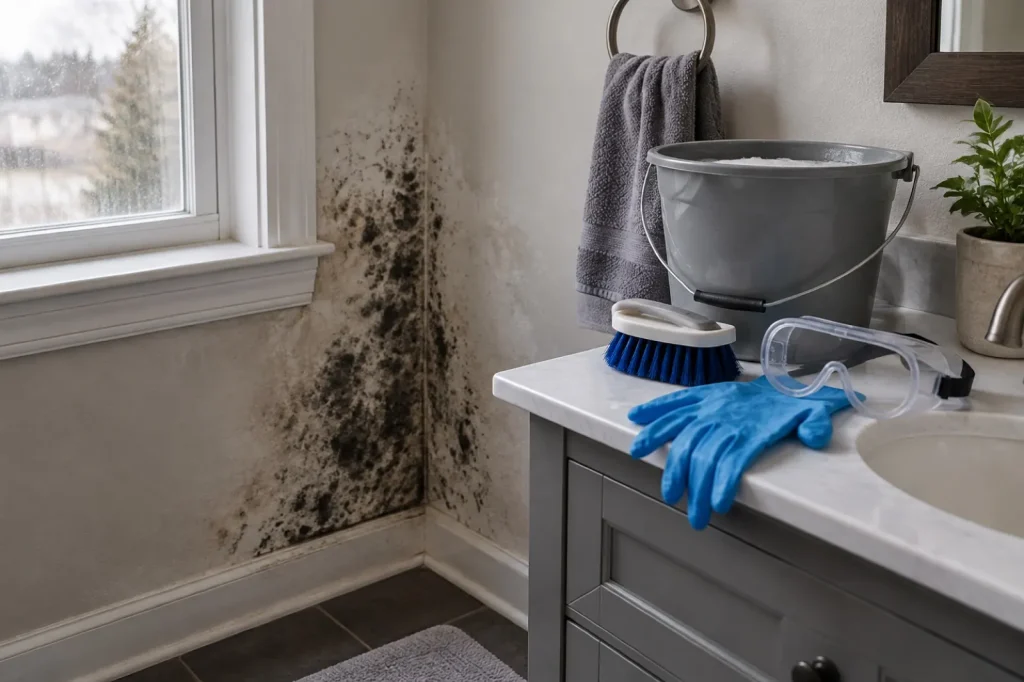
DIY mold remediation is reasonable when the mold covers less than about 10 square feet, came from clean water, is not in the heating or cooling system and is not hidden inside a wall. That is EPA’s guideline. Fix the moisture first, scrub hard surfaces with detergent and water, bag moldy porous material, and wear an N-95 respirator, long gloves and unvented goggles.
Key takeaways
- EPA’s line is ‘less than about 10 square feet’, roughly a 3 ft. by 3 ft. patch. Above it, EPA points to its professional guide.
- Size is not the only stop: HVAC involvement, sewage water and hidden growth each rule out DIY in EPA’s guidance.
- EPA does not recommend bleach as a routine practice. CDC disaster guidance still gives a recipe of 1 cup per gallon of water.
- EPA says it is not enough to kill mold; it must also be removed, which is why sprays alone fail.
- In EPA Table 2, wallboard under 10 square feet gets one method only: HEPA vacuum after drying. Damp wiping is listed for hard surfaces and wood.
- New York City bars owners of buildings with 10 or more units, and their staff, from doing mold work over ten square feet themselves.
On this page
Go or no-go, in one table
Find your row before you buy anything.
| Your situation | Verdict | Why | Source |
|---|---|---|---|
| Under 10 sq ft on tile, metal, glass or sealed wood; clean water; leak fixed | Go | EPA: in most cases you can handle the job yourself. | EPA |
| Under 10 sq ft on drywall, ceiling tile or carpet | Go, with care | Moldy porous items may have to be thrown away; NYC removes moldy ceiling tile and insulation. | EPA; NYC |
| 10 to 100 sq ft | Stop and plan | EPA points to its professional guide; CDC says consider a professional. | EPA; CDC |
| Over 100 sq ft | No-go | Full containment; NYC assigns trained remediation workers. | EPA Table 2; NYC |
| Any growth in or near the HVAC system | No-go | EPA: do not run it; it could spread mold through the building. | EPA |
| Musty smell, no visible source, or growth behind wallpaper or paneling | No-go for opening up | Removing wallpaper can cause a massive release of spores. | EPA |
| Sewage or other contaminated water | No-go | EPA: call in a professional; OSHA requires PPE and containment. | EPA |
| Anyone in the home has health concerns | Ask first | EPA: consult a health professional before starting cleanup. | EPA |
| NYC building with 10 or more units, over 10 sq ft, owner or staff doing it | Not allowed | Must be done by a New York licensed firm. | NYC 24-154 |
What the 10 square foot line means
The figure comes from two EPA documents. EPA's A Brief Guide to Mold, Moisture and Your Home says: ‘If the moldy area is less than about 10 square feet (less than roughly a 3 ft. by 3 ft. patch), in most cases, you can handle the job yourself, follow the guidelines.’ It continues: ‘If there has been a lot of water damage, and/or mold growth covers more than 10 square feet, consult EPA’s Mold Remediation in Schools and Commercial Buildings.’
That guide, EPA's Mold Remediation in Schools and Commercial Buildings, builds Table 2 on three bands: under 10 square feet, 10 to 100, and over 100. EPA says the bands make it easier ‘to select appropriate techniques, not on the basis of health effects’. Count every patch, including any found once materials come off.
Four hard stops below 10 square feet
A small patch can still be the wrong job for an owner.
The HVAC system
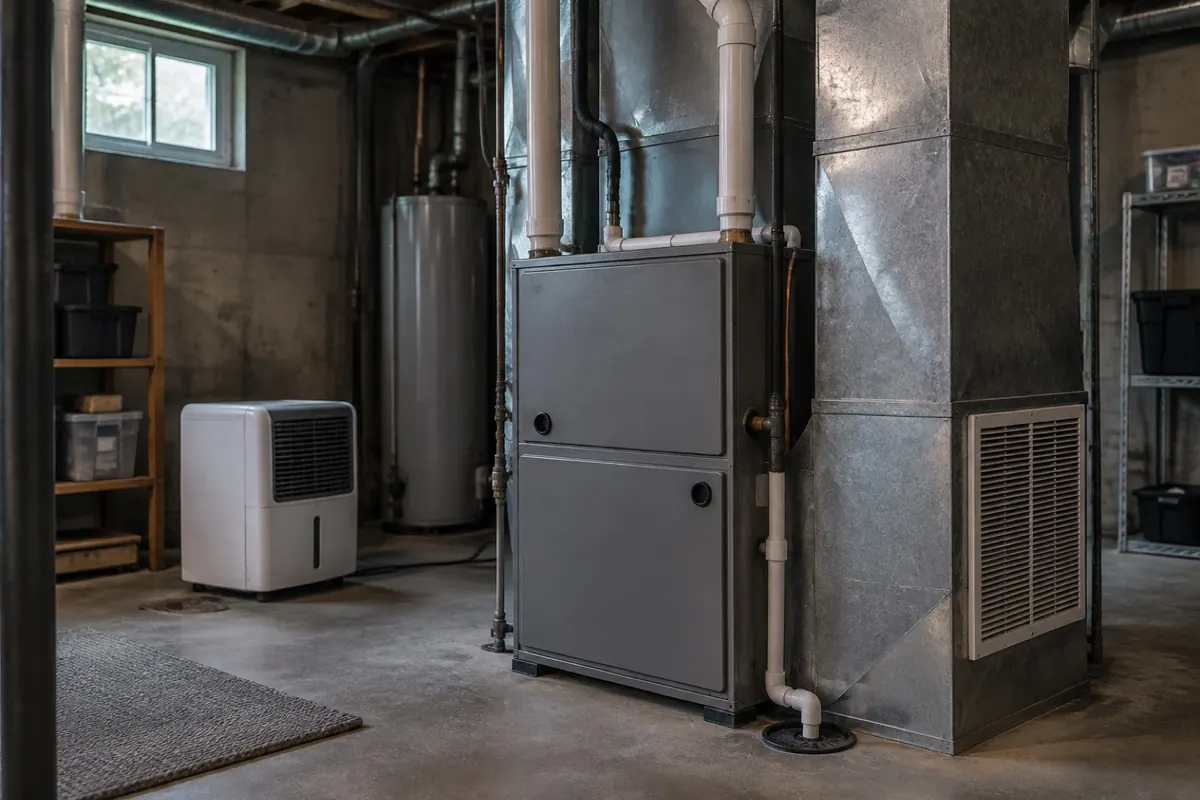
EPA's A Brief Guide to Mold, Moisture and Your Home says: ‘Do not run the HVAC system if you know or suspect that it is contaminated with mold’, because it could spread mold throughout the building. The NYC guidelines go further: professional help ‘should always be considered in addressing even small amounts of mold growth or moisture problems within an HVAC system.’
Hidden cavities
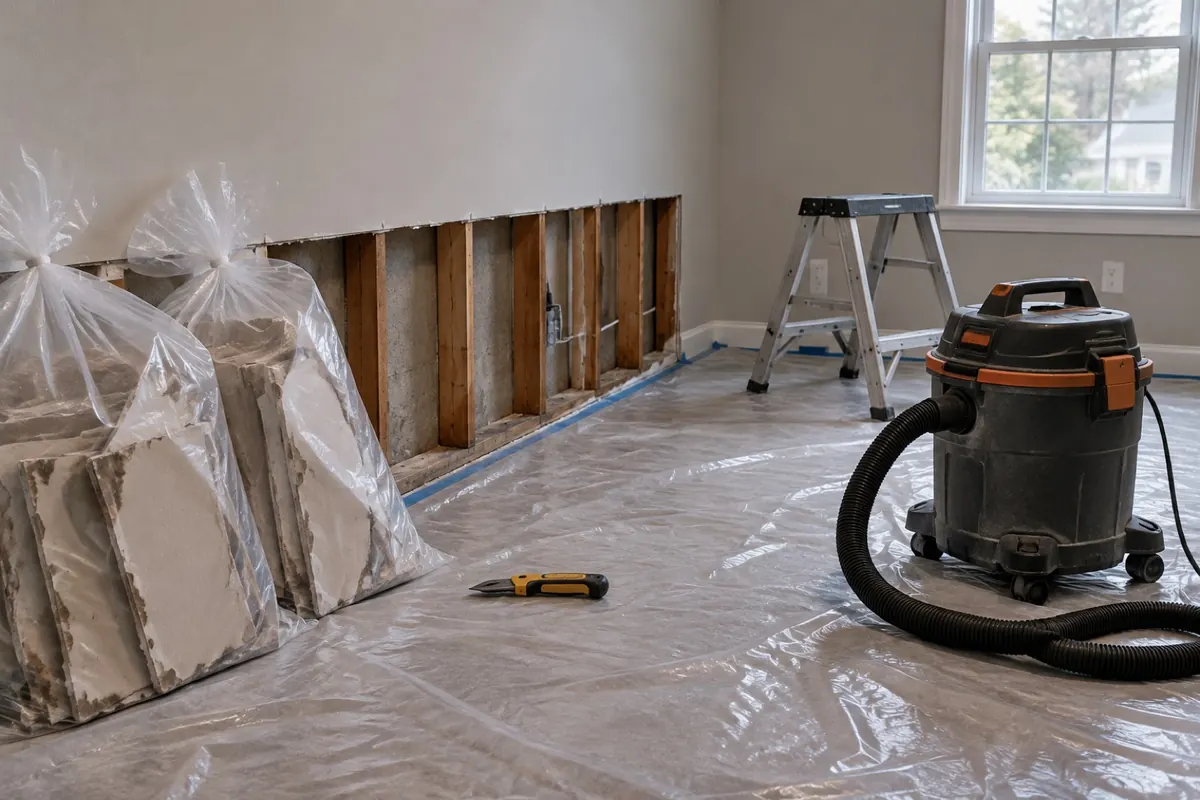
EPA lists the back of drywall, the top of ceiling tiles, the underside of carpets and pads and the inside of ductwork as places mold hides, and warns that removing wallpaper ‘can lead to a massive release of spores’ if mold is growing behind it. Georgia Extension adds that wet fibrous or open-cell foam insulation inside walls must be replaced even if the wallboard looks dry; our guide to wet drywall covers that cut.
Category 3 water
If sewage or other contaminated water caused the damage, EPA says to call in a professional experienced with contaminated water, and its Table 2 notes that OSHA requires PPE and containment in those cases. The restoration industry calls this Category 3; see our guide to the IICRC water categories.
Sensitive occupants
EPA calls for a more cautious approach when sensitive individuals are present, and says anyone with health concerns should consult a health professional before starting cleanup. NYC adds that the work area should be unoccupied at every size.
Clean it or bin it
EPA's A Brief Guide to Mold, Moisture and Your Home gives the rule in one line: ‘Absorbent or porous materials, such as ceiling tiles and carpet, may have to be thrown away if they become moldy,’ because mold can grow into the empty spaces and crevices and be ‘difficult or impossible to remove completely.’ The NYC guidelines sort materials into three classes.
| Class | Examples | NYC 2008 | EPA |
|---|---|---|---|
| Non-porous | Metal, glass, hard plastic | Almost always cleanable. | Damp wipe and scrub. |
| Semi-porous structural | Wood, concrete | Cleanable if structurally sound. | Wet vacuum, damp wipe for wood, HEPA when dry. |
| Porous | Ceiling tile, insulation | Remove and discard. | Table 1: discard even when only wet. |
| Wallboard | Drywall, gypsum board | Discard beyond a small area; cut six inches past growth. | HEPA only under 10 sq ft; discard from 10 sq ft. |
| Soft furnishings | Carpet, upholstery, drapes | Valuables to a restoration professional. | Wet vacuum and HEPA; discard from 10 sq ft. |
Under 10 square feet EPA lists damp wiping for only 3 of 8 material types, never wallboard. And wet vacuums ‘may spread spores if sufficient liquid is not present’, so they are for water, not dry dust.
Protective gear, per EPA
EPA's Mold Remediation in Schools and Commercial Buildings sets the floor: ‘The minimum PPE is an N-95 respirator, gloves and eye protection.’
| Item | EPA specification | Detail |
|---|---|---|
| Respirator | N-95 minimum. EPA: it will ‘filter out 95% of the particulates in the air’. | EPA’s home guide gives an undated cost of about $12 to $25. It must fit properly. |
| Gloves | Long, to the middle of the forearm. | Household rubber with water and mild detergent; natural rubber, neoprene, nitrile, polyurethane or PVC with bleach or strong cleaners. |
| Eye protection | Goggles without ventilation holes. | EPA: safety glasses or goggles with open vent holes are not acceptable. |
| Clothing | Disposable clothing recommended on medium or large jobs. | NYC lists full body suits only for areas over 100 sq ft. |
Bleach, and why EPA does not recommend it
EPA's A Brief Guide to Mold, Moisture and Your Home is direct: ‘The use of a chemical or biocide that kills organisms such as mold (chlorine bleach, for example) is not recommended as a routine practice during mold cleanup.’ In most cases, EPA adds, sterilising is neither possible nor desirable: background spores remain and will not grow once the moisture is fixed. And ‘it is not enough to simply kill the mold, it must also be removed.’ The schools guide adds that biocides are toxic to humans as well as to mold. Other public sources still print a recipe:
| Source | Position | Ratio | Warning |
|---|---|---|---|
| EPA, home guide and schools guide | ‘Not recommended as a routine practice’; professional judgment may indicate it. | None given | Never mix chlorine bleach with ammonia |
| NYC Department of Health, 2008 | Disinfectants ‘seldom needed’; recommended for sewage-related growth. | None given | Must be EPA-registered |
| CDC Preventing Mold, reviewed August 2026 | Gives a cleaning solution. | 1 cup bleach per 1 gallon water | Never mix with ammonia |
| University of Georgia Extension, 2023 | Gives a disinfectant formula; not full strength. | Half to 1 cup per gallon | Never mix with ammonia or acids such as vinegar |
The CDC ratio sits in its natural-disaster toolkit, and NYC reserves disinfectants for specific concerns such as growth from sewage. For an ordinary patch from a leak or condensation, EPA’s detergent-and-water method is the primary guidance.
Why kill sprays fail
Each spray promise below is set against what EPA or the NYC Department of Health says. Even a spray that works as labelled leaves dead growth in place and does nothing about the moisture that fed it.
| What the label implies | What the guidance says |
|---|---|
| Kills mold on contact | EPA: it is not enough to kill mold; it must also be removed. |
| No scrubbing needed | EPA: scrub mold off hard surfaces with detergent and water, and dry completely. |
| Penetrates drywall and wood | EPA: mold in porous material may be difficult or impossible to remove completely. |
| Fog or mist the whole room | NYC: fogging biocides are not recommended; their effectiveness is unproven. |
| Seal it with mold-resistant paint | NYC: anti-microbial paint is no substitute for removal. EPA: do not paint moldy surfaces. |
| A garden fungicide will do | EPA: do not use fungicides made for outdoor use indoors. |
| Stops it coming back | EPA: if you clean up the mold but do not fix the water problem, it will most likely return. |
The method, step by step
This is the owner’s version of a small, clean-water job; the professional sequence is in our mold remediation process guide.
| Step | Do this | Why, and the source |
|---|---|---|
| 1 | Fix the water and dry within 24 to 48 hours. | EPA: the key to mold control is moisture control. |
| 2 | Measure the growth, including the back of anything you move. | Under about 10 sq ft, or stop (EPA). |
| 3 | Check the four hard stops. | HVAC, hidden, sewage, health. |
| 4 | Put on N-95, long gloves and unvented goggles. | EPA minimum PPE. |
| 5 | Clear the room; tape plastic over items that are hard to clean; leave the HVAC and fans off. | NYC small-area steps; EPA lists fans as stirring up mold. |
| 6 | Mist the surface lightly with dilute soap solution. | NYC dust suppression. |
| 7 | Cut out moldy porous material and seal it in plastic bags in the room. | NYC: no special disposal requirements. |
| 8 | Scrub hard surfaces with detergent and water. | EPA cleanup method; no bleach needed. |
| 9 | Dry completely, then HEPA vacuum the area. | EPA Method 3, after drying. |
| 10 | Check: no visible mold, no moldy odor, dry. Revisit soon. | EPA completion test. Paint only after. |
EPA’s test for done: the water problem is fixed, visible mold and moldy odors are gone, and a revisit soon after shows no new damage. Sampling is usually unnecessary. If the patch returns quickly, NYC reads it as an ongoing water problem.
When the law says no
Federal guidance is advisory; some states and one city write mold work into law, near EPA’s line.
| Jurisdiction | What applies to an owner | Rule |
|---|---|---|
| Federal | EPA guidance only. EPA says it does not regulate mold or mold spores in indoor air. | Advisory 10 sq ft |
| Texas | No licence needed under 25 contiguous sq ft; an owner of residential property with fewer than 10 units is also exempt on that property. | 1958.102 (c), (e) |
| New York State | Licensing covers remediation ‘by a business enterprise’ on projects over ten sq ft. | Labor Law 930 |
| New York City | Owners of buildings with 10 or more units, their agents and staff may not do projects over ten sq ft. | 24-154; per the law, an owner’s first violation costs up to the greater of $1,000 or 20 cents per sq ft of floor area |
| Florida | Assessment and remediation are defined as work on mold over 10 sq ft; confirm owner coverage with the state board. | 468.8411 |
Every other state is mapped in our state mold licensing guide.
For contractors: when the owner tried first
Many calls follow a DIY attempt, so scope what was disturbed, not only what shows. Ask what was removed, whether fans or the HVAC ran, and whether paint went over growth, and record it in the assessment. In New York City, owners of buildings with 10 or more units cannot self-perform over ten square feet. In Texas, a licensed firm remediating 25 contiguous square feet or more must notify the state under 16 TAC 78.110. Small-job minimums and pricing are in our mold remediation cost guide, and schedule effects in how long mold remediation takes.
What this page does not cover. Health effects of mold are outside our scope. For those, see EPA’s mold pages, the CDC or a health professional. Our mold hub lists our other guides.
Questions people actually ask
Can you remediate mold by yourself?
Usually, if the growth covers less than about 10 square feet, the water was clean, the HVAC system is not involved and nothing is hidden in a wall. That is EPA’s guideline. Wear an N-95, long gloves and unvented goggles, scrub hard surfaces with detergent and water, and bag moldy porous material.
What kills mold permanently, naturally?
Nothing does, because killing is not the fix. EPA says a background level of spores always remains indoors and will not grow without moisture. Permanent control means fixing the leak or humidity, removing the growth, and keeping indoor humidity below 60 percent, ideally 30 to 50 percent, as EPA advises.
Can black mold be fully remediated?
Yes, by the same methods. EPA’s cleanup tables are organised by area and material, not colour. EPA asks for a more cautious approach when a particularly toxic species is identified or suspected. Our guide to black mold versus regular mold covers identification.
Is bleach or vinegar better for removing mold?
Neither is EPA’s method. EPA says scrub hard surfaces with detergent and water, and does not recommend bleach as routine practice. The EPA pages read for this article do not mention vinegar. Georgia Extension warns never to mix bleach with acids such as vinegar, or with ammonia.
Can I remove mold from drywall myself?
Only a small area. EPA Table 2 lists HEPA vacuuming after drying for wallboard under 10 square feet and adds discard from 10 square feet up. NYC removes wallboard with more than a small area of growth, cutting at least six inches beyond it. Stop if the back of the board or the insulation is moldy.
When is professional mold remediation required by law?
It depends where you are. Texas requires a licence from 25 contiguous square feet unless an owner exemption applies. New York City requires licensed firms for work over ten square feet in buildings with 10 or more units. EPA’s federal guidance is advisory.
Sources
- EPA's A Brief Guide to Mold, Moisture and Your Home, last updated 18 February 2026. Retrieved 11 October 2026.
- EPA's Mold Cleanup in Your Home, last updated 4 June 2026. Retrieved 11 October 2026.
- EPA's Mold Remediation in Schools and Commercial Buildings, last updated 29 April 2026, and EPA 402-K-01-001 (PDF), Tables 1 and 2, reprinted September 2008. Retrieved 11 October 2026.
- NYC Department of Health guidelines, Guidelines on Assessment and Remediation of Fungi in Indoor Environments, November 2008, archived nyc.gov copy. Retrieved 11 October 2026.
- NYC Administrative Code section 24-154, Local Law 61 of 2018. Retrieved 11 October 2026.
- CDC's Preventing Mold page, last reviewed 26 August 2026. Retrieved 11 October 2026.
- University of Georgia Extension Circular 1047-2, Removing Mold in Your Home, revised 1 March 2023. Retrieved 11 October 2026.
- Texas Occupations Code section 1958.102 and 16 TAC 78.110. Retrieved 11 October 2026.
- New York Labor Law section 930, Labor Law Article 32. Retrieved 11 October 2026.
- Florida Statutes section 468.8411, Chapter 468 Part XVI. Retrieved 11 October 2026.
- Material counts are computed from EPA Table 2 as transcribed. See our methodology.
This page summarises public guidance for small, clean-water jobs. It is not a substitute for a licensed assessor where state or city law requires one.