The short answer
Mold remediation cost typically runs $10 to $25 per square foot for standard work and $15 to $30 where growth is hidden inside wall cavities or HVAC. Most contractors apply a $500 to $1,500 minimum regardless of area, and a whole-structure job runs $10,000 to $30,000 or more. Containment, not floor area, sets the floor.
Key takeaways
- Containment, negative air and decontamination cost the same to build whether the area is 10 square feet or 100. That fixed setup is why small jobs carry a minimum charge.
- Because setup is fixed, the per-square-foot rate falls as the job grows. A $20 quote on 40 square feet and a $12 quote on 400 can describe identical work.
- The EPA’s 10 square foot figure is advisory guidance. Florida separately writes 10 square feet into statute. Different instruments, different force.
- Several states separate assessment from remediation to remove the conflict of interest. Florida’s licence file pulled 23 September 2026 showed 3,310 assessors against 3,192 remediators.
- The quoted price usually excludes moisture repair, rebuild, contents and clearance testing. Four bills is the normal shape of a mould job.
On this page
- What the ranges look like
- Why containment is the cost floor
- Why the per-foot rate falls
- What common mould jobs actually cost
- What is inside the rate
- The 10 square feet rule is not law
- Assessment and remediation are separated
- What the standard actually governs
- What the price does not include
- Insurance and sublimits
- Why published averages disagree
- How to read a mould estimate
- Questions people actually ask
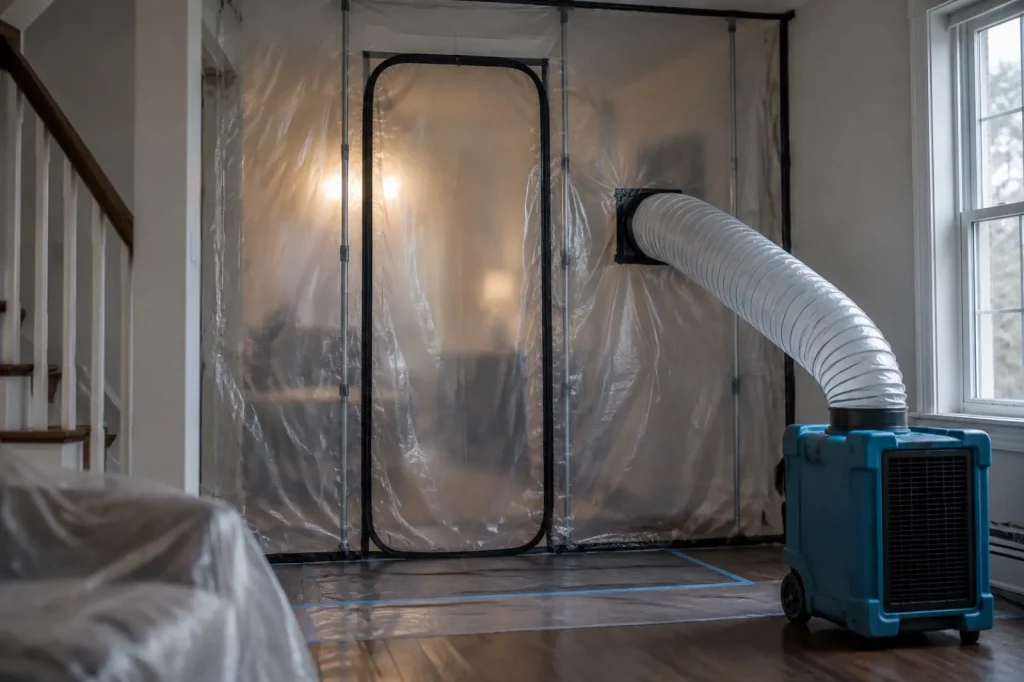
Mold remediation cost is mostly a function of containment, not of area. Once a crew has built containment, run negative air and set up decontamination, the marginal cost of treating more square footage inside it is small. That explains most of what looks strange about mould pricing: the minimum charge on a tiny job, the falling per-foot rate on a large one, and the gap between two quotes describing the same work.
What the ranges look like
These are the bands published contractor and aggregator price guides converge on for 2026. They are indicative, and they cover remediation only, a narrower scope than most people assume. Quotes also use mitigation, remediation and abatement for overlapping work, which our guide to mold mitigation vs remediation untangles.
| Job type | Typical cost | What drives it |
|---|---|---|
| Small, contained area under 10 sq ft | $500 to $1,500 minimum | Mobilisation, containment, HEPA filtration and disposal cost the same regardless of area, so it prices at a floor, not a rate. |
| Standard remediation | $10 to $25 per sq ft | Containment, HEPA filtration, antimicrobial treatment, removal and bagging of affected porous material. |
| Hidden or complex | $15 to $30 per sq ft | Demolition to reach wall cavities, HVAC cleaning, staged containment, independent verification. |
| Whole structure | $10,000 to $30,000+ | Multi-zone containment, contents handling, extended timeline, usually reconstruction on top. |
Read the units before you compare two quotes
Two per-square-foot figures are not comparable until you know which footage each counts: visible growth, the containment footprint (always larger, since containment encloses a working area), or wall and ceiling surface removed (several times the floor area on a full-height cut-out). A quote that does not say compares to nothing.
Why containment is the cost floor
Remediation is a particulate control problem before it is a cleaning problem. Disturbing colonised material makes spores airborne, so the work area is isolated, held under negative pressure and exhausted through HEPA filtration. None of that scales with area. OSHA's mold safety and health topic page sets out the worker protection side, including respiratory protection.
| Setup element | What it is | How it scales with area |
|---|---|---|
| Containment barrier | Sheeting, zip walls, sealed penetrations, a decontamination chamber | Barely. A 40 sq ft room and a 400 sq ft room need the same perimeter logic and chamber. |
| Negative air machine | HEPA-filtered extraction holding the area below surrounding pressure | In unit steps, not smoothly. One machine covers many room volumes. |
| PPE and mobilisation | Respirators, suits, fit testing; travel, load-in, setup, teardown | Per worker per day, and flat per job. Not per square foot. |
| Disposal | Bagged porous material, filters, consumed PPE, tipping fees | The one element that genuinely tracks job size. |
The minimum charge is arithmetic, not a markup
A contractor who builds containment, runs negative air for two days, supplies PPE to two technicians, disposes of the waste and returns to tear it down has spent most of a small job’s budget before any mould is touched. A price low enough to look reasonable per foot would mean the setup was not built, which is worse: spores released during demolition settle across the property, converting a single-room scope into a whole-floor one.
Why the per-foot rate falls as the job grows
If a fixed setup cost sits under a variable treatment cost, average cost per square foot has to fall as area rises. Not a discount, not a volume concession: the shape of the cost curve.
| Affected area | Typical total | Implied per sq ft |
|---|---|---|
| 4 sq ft, contained | $500 to $1,500 | $125 to $375 |
| 100 sq ft, single room | $1,500 to $3,500 | $15 to $35 |
| 400 sq ft, two rooms | $4,000 to $10,000 | $10 to $25 |
| 1,500 sq ft, whole structure | $15,000 to $30,000+ | $10 to $20+ |
So the quoted per-square-foot rate is the wrong number to negotiate. Interrogate how much area the contractor intends to contain and why, because that decision sets both setup and treatment.
What common mould jobs actually cost
Per-foot rates help compare bids and are useless for budgeting, because nobody knows their affected area before an inspection. These are whole-job bands.
| Scenario | Typical remediation | What drives the spread |
|---|---|---|
| Bathroom ceiling and wall around a failed shower pan | $800 to $2,500 | Whether growth passed into the cavity, and whether the pan repair is included. Usually it is not. |
| Basement wall behind finished panelling | $2,000 to $6,000 | Cut height, insulation behind the panel, groundwater against a plumbing leak. |
| Crawlspace joists and subfloor underside | $2,500 to $8,000 | Access, whether encapsulation follows, and whether the ground is the source. |
| Attic sheathing after a roof or ventilation failure | $2,500 to $9,000 | Sheathing area, insulation removal, roof repair sequencing. |
| HVAC system and ductwork involvement | $3,000 to $10,000 | Duct material, cleaning against replacement, and whether the air handler is colonised. |
| Whole structure after prolonged undetected moisture | $10,000 to $30,000+ | Zone count, contents volume, occupancy, the rebuild. |
Mould that followed a water loss is priced differently
Growth that appeared after a burst supply line sits on top of a water mitigation file, and the scopes overlap. Materials already scheduled for removal on the water side should not be billed twice on the mould side. Our water damage restoration cost page covers that scope. Settle in writing which job is running first.
What is inside the rate
A defensible rate is built rather than guessed. Comparing two bids means comparing assumptions about four components.
| Component | What it is | Why it moves |
|---|---|---|
| Labour | Technician hours at burdened cost | Certification level, state licence requirements, crew size set by the containment, and time lost to decontamination cycles. |
| Setup and equipment | Containment materials, negative air machines, air scrubbers, HEPA vacuums | Fixed per containment, then per unit per day for as long as it stays up. |
| Consumables and disposal | Antimicrobial agents, PPE, sheeting, bagging, tipping fees | Material removed and crew days, not floor area. |
| Verification and overhead | Coordination, documentation, the return visit if clearance fails | Who writes the clearance criteria, and how tight they are. |
Duration is the variable most people forget. Equipment bills per unit per day and containment stays up until clearance passes, so five days rather than three is more equipment days, more PPE and two more crew days. Ask for expected days and what happens if it runs longer.
The 10 square feet rule is guidance, not law
EPA's mold cleanup guidance suggests a homeowner can generally handle mould covering less than about 10 square feet, roughly three feet by three, and should consider a professional above that. The figure gets repeated online as though it were a legal threshold. It is not. It is federal guidance aimed at homeowners, with no enforcement behind it.
What can be legally binding is state licensing. Florida writes a 10 square foot threshold into statute for when mould-related services require a licence, a different instrument with different force. See Florida Statutes Chapter 468, Part XVI.
The distinction matters when somebody tells you what you are allowed to do. EPA guidance addresses homeowners and has no enforcement. The Florida statute addresses anyone doing mould assessment or remediation for compensation in that state, sets licensing requirements, and separates assessor from remediator. They get conflated because both reference 10 square feet.
Area is also not the only trigger. EPA guidance points towards professional help where growth followed contaminated water, where it sits in HVAC, or where a household member has a respiratory condition. A small patch on a duct interior is not a do-it-yourself job because it is small.
Assessment and remediation are deliberately separated
Several states treat the company that tells you that you have mould and the company paid to remove it as a conflict of interest, and license the two separately. Florida is the clearest example because its licence register is public.
An almost one-to-one split is what a rule of this shape produces: if one firm could do both, one credential would dominate. For a property owner that means budgeting for two vendors. For a contractor the sign-off closing the job is billed by somebody else, so price the return visit if clearance fails.
Rules differ by state, and most states have none
Licensing is not national. Some states license both functions, some neither, and thresholds vary where they exist. Our state mould licensing review sets out which states regulate the work. In an unregulated state the conflict the Florida rule removes is still there, and the protection is commissioning clearance testing from a firm that is not doing the remediation.
What the standard actually governs
ANSI/IICRC S520 is the mould remediation standard, 4th edition, published 2024, and the reference point most estimates and disputes return to. The text is ANSI-copyrighted and sold by IICRC, so what follows describes its framework, not its wording.
- It governs process, not price. No rate card: it sets out how work is scoped, contained, performed and verified.
- The moisture source is the controlling problem. Remediation without correcting the water intrusion is a repeat visit, which is also EPA’s position.
- Remediation means removal, not killing. The aim is a return to normal fungal ecology: physical removal, not spraying something on it.
- It is a consensus standard, not a regulation. It binds when a contract, an insurer’s requirement or a state rule references it, which is common but not automatic.
Our mould remediation process page walks the sequence a compliant job follows.
What the price does not include
This is the largest source of surprise on a mould file. The quote covers removing the contamination. Four other things sit outside it, each with its own bill.
- Finding and fixing the moisture source. Remediation without repairing the leak is a repeat job. Plumbing, roofing, grading or ventilation work is a separate trade and a separate invoice, and most remediators will not warrant work into an uncorrected source.
- Reconstruction. Replacing the drywall, insulation, trim and flooring that came out is a rebuild scope, priced closer to general construction rates.
- Contents. Cleaning, packing out or replacing belongings is priced separately, and soft goods inside a contaminated area are often not economic to clean.
- Clearance testing. Post-remediation verification is often billed by the independent assessor rather than the remediator, and in some states that separation is a legal requirement.
If you are the property owner: get the moisture source repair quoted, or at least identified, before remediation is scheduled. Remediation done while the source is still active is money spent on a problem that has not stopped.
Insurance, sublimits and the cause of loss
Mould coverage behaves differently from water coverage, and the gap costs people money they did not budget for. Three features recur across standard homeowners policies.
| Feature | What it means in practice |
|---|---|
| Mould sublimit | Mould is commonly capped well below the dwelling limit, and that cap often covers remediation and rebuild together. A large dwelling limit can still carry a small mould cap. |
| Cause of loss test | Cover generally depends on the mould having followed a covered sudden and accidental water loss. Gradual moisture, long-term seepage and deferred maintenance are usually excluded. |
| Documentation of the trigger | Because cover turns on the cause, the evidence of what happened and when decides the claim: photographs, the plumbing report and the mitigation file. |
Our coverage guide covers the water side, which is usually where a mould claim is decided. Read the sublimit before you need it: it decides whether a large job is mostly insured.
Why published averages disagree
Cost aggregators publish national averages for mould remediation that differ substantially from one another and from the bands here. Not dishonesty: they measure different things and rarely say which.
- Scope bundling. Some figures are remediation only, some fold in the rebuild, the larger number on most jobs.
- Area definition. Visible growth, containment footprint and surface removed are three denominators for one job.
- Residential and commercial blended. Commercial work carries different access and occupancy constraints.
- No sample and no date. Most do not state how many jobs they rest on or when the pricing was collected.
How we counted. The ranges here are compiled from published contractor and aggregator price guides current in 2026, plus structural detail from the ANSI/IICRC S520 framework and EPA and OSHA guidance. They are indicative, not the output of a pricing survey, and we have not run one. If we do, its sample and method will be published with it. The Florida licence counts are our own pull of the state register, exact as at 23 September 2026. Our methodology sets out the standing rules.
How to read a mould estimate
Six questions separate an estimate you can rely on from a number.
- What area is being contained, and why? The footprint drives setup cost and crew size, and should follow from the inspection rather than a round number.
- Is this remediation only? Get remediation, moisture repair, contents and rebuild as four figures. Merged, they compare to nothing.
- How many days, and what if it runs longer? Equipment and crew bill by the day, and containment stays up until clearance passes.
- Who writes the clearance criteria, and who pays if it fails? In separated-licence states that is somebody other than the remediator. Get the answer in writing.
- What is the moisture source, and is its repair in this scope? Usually it is not. Confirm who is doing it and when: sequencing it after remediation wastes the remediation.
- What documentation closes the job? Photographs of containment in place, moisture readings, a disposal record and the clearance result. Without those there is no evidence the work met the scope.
Questions people actually ask
How much does mold remediation cost per square foot?
About $10 to $25 per square foot standard, rising to $15 to $30 where growth is hidden in wall cavities or HVAC, on indicative 2026 ranges compiled from published price guides. Most firms apply a $500 to $1,500 minimum because containment setup costs the same regardless of area.
Why does a tiny mould job cost several hundred dollars?
Because almost none of the cost is the mould. Containment, negative air with HEPA filtration, PPE, disposal and mobilising a crew are the same operations on four square feet as on forty. The minimum is what those fixed operations cost.
Can I remediate mold myself?
EPA guidance suggests homeowners can generally handle areas under about 10 square feet with appropriate precautions. Contaminated water, HVAC involvement, or a household member with a respiratory condition point towards a professional. Some states require a licence above a threshold, and Florida writes 10 square feet into statute.
Is the EPA 10 square foot rule a legal limit?
No. It is advisory guidance for homeowners with no enforcement. Florida separately sets a 10 square foot threshold in statute under Chapter 468, Part XVI for when licensed mould services are required. The two get confused because they use the same number.
Does insurance cover mold remediation?
Sometimes, and usually subject to a sublimit far below the dwelling limit. Cover generally depends on whether the mould followed a covered sudden water loss rather than gradual moisture or deferred maintenance. Read the sublimit: it often decides the outcome.
Why do I need a separate company to test after the work?
In states that license assessment and remediation separately, the firm doing the removal cannot sign off its own work. Florida’s licence register pulled 23 September 2026 showed 3,310 assessors against 3,192 remediators, close to one of each.
Is mold remediation worth it?
Where there is active moisture and visible growth, the alternative is a growing scope plus damage to the materials underneath. Fix the moisture source first: remediation without it is money spent twice.
Sources
- Institute of Inspection, Cleaning and Restoration Certification, ANSI/IICRC S520 Standard for Professional Mold Remediation, 4th edition, 2024. Cited for its framework; the text is ANSI-copyrighted and sold by IICRC, so it is described rather than reproduced here.
- EPA guidance on mold cleanup in your home. United States Environmental Protection Agency. The 10 square foot figure is advisory guidance for homeowners with no enforcement. Retrieved 23 September 2026.
- Florida Statutes Chapter 468, Part XVI, Mold-Related Services, sections 468.84 to 468.8424, on licensing of assessors and remediators and the statutory 10 square foot threshold. Retrieved 23 September 2026.
- OSHA's mold safety and health topic page. Occupational Safety and Health Administration, on worker protection during mould work. Retrieved 23 September 2026.
- Florida Department of Business and Professional Regulation, mould licensee extract, our own pull. 6,875 records: 3,310 assessors, 3,192 remediators, 331 continuing education courses, 42 providers. Retrieved 23 September 2026.
- Cost ranges are compiled from published contractor and aggregator price guides current in 2026. They are indicative, not the result of a pricing survey. The scaling table is arithmetic applied to those bands to show how a fixed setup cost behaves, not a price list.