The short answer
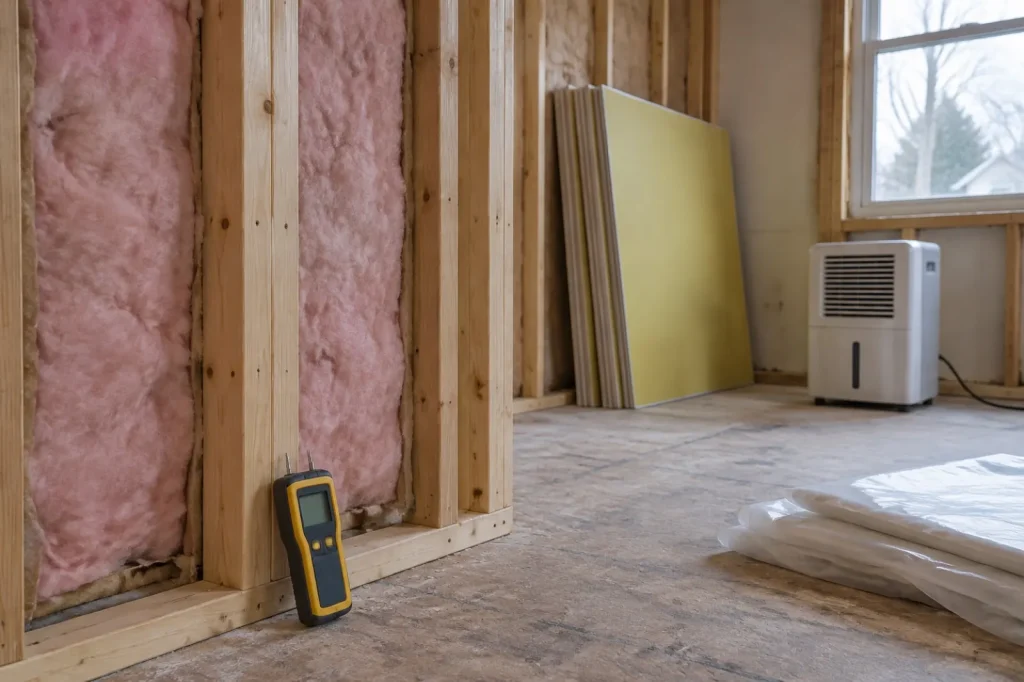
Mold damage restoration is the rebuild that follows mold removal: new framing where wood decayed, insulation, drywall, primer, paint, flooring and cleaned contents. The order is fixed. The moisture source is repaired, the work area passes clearance, framing is dry enough to close, and only then do walls go back up. Rebuilding before clearance can seal in a problem.
Key takeaways
- Clearance comes before carpentry. New York law keeps containment up until the assessor reports that clearance has been achieved.
- Texas requires a certificate of mold remediation within 10 days of completion, and sellers pass five years of them to buyers.
- Close walls on numbers, not dates: according to the FPL Wood Handbook, finish can normally go on when headers and joists approach an average of 12% moisture content.
- Mold-resistant board is not mold-proof. ASTM D3273 is a four week chamber test, and USG says it may not represent field performance.
- Do not paint over mold. EPA says to clean and dry first, because paint applied over moldy surfaces is likely to peel.
- Contents follow EPA’s table: hard surfaces clean, porous items often do not, and wet insulation and ceiling tiles are discarded.
- In Texas and New York the firm that tests cannot also remediate the same project or property; Florida sets a 12 month separation.
On this page
The pages ranking for this phrase are franchise service pages and directories describing removal. This page covers what comes after: the rebuild.
Where restoration starts
Mold remediation removes growth and contaminated material; mold restoration puts the building back. The removal steps, from containment to HEPA cleaning, are on our mold remediation process page; this page starts at their end point.
EPA's Mold Remediation in Schools and Commercial Buildings defines that end point in four tests. The water or moisture problem is completely fixed. Visible mold, mold damaged materials and moldy odors are gone. If samples were taken, the kinds and concentrations of mold indoors are similar to outside. A revisit shortly afterward shows no new water damage or growth. EPA calls it ultimately a judgment call, which is why some states turn it into a document signed by someone other than the remediator.
The industry standard, ANSI/IICRC S520 (fourth edition, 2024), lists post-remediation verification as a component; its text is sold by IICRC, so the hard rules below come from public statutes.
The rebuild sequence
Use this as a gate checklist. Each step has a condition that must be true before the next one starts.
| Step | Gate to pass | Who signs off |
|---|---|---|
| 1. Moisture source repaired | Leak, drainage or condensation cause corrected and documented | EPA finish test 1; NY Labor Law 947(2) |
| 2. Removal complete | Removal work done to the written plan | Remediation contractor |
| 3. Clearance | Post-remediation assessment passes; containment comes down only after notice of clearance | Independent assessor in NY and TX |
| 4. Framing and substrate dry | Meter readings near in-service levels; per the FPL, headers and joists near a 12% average | Contractor, with a meter log |
| 5. Structural repairs | Decayed members replaced with dry lumber, or treated or durable wood where moisture cannot be controlled | Contractor; engineer if integrity is in doubt |
| 6. Insulation and board | New insulation; mold-resistant or paperless board where wetting may recur | Contractor |
| 7. Prime and paint | Clean, dry surfaces only; any antimicrobial coating used per its label | Contractor |
| 8. Floors, trim, contents | Finish flooring and trim; cleaned contents returned | Contractor or contents specialist |
| 9. Close-out file | Clearance report or certificate, meter log, photos, material data sheets | Owner keeps it |
Two states put clearance on paper. Under New York Labor Law 946, no one may remove containment until the remediation licensee receives notice from the assessment licensee that clearance has been achieved, and New York Labor Law 947 requires a post-remediation assessment showing no visible mold and work done to the plan, then a written passed clearance report. Under Texas Occupations Code 1958.154, the owner gets a certificate of mold remediation within 10 days of finishing, with a mold assessment license holder’s statement that the contamination was remediated to the plan.
Why rebuilding before clearance fails
The usual cause is schedule pressure. Each shortcut below costs more to undo than to wait for.
| Shortcut | What happens | Basis |
|---|---|---|
| Walls closed before clearance | If the assessment fails, finished drywall and paint come back out | NY 947(4) final status report and new work |
| Moisture source not fixed | Growth returns on new material | EPA: fix the water problem first |
| Framing still wet when boarded | Shrinkage defects such as nail pops, and wood held wet | FPL ch. 13; decay risk above 20% |
| Paint over remaining mold | Paint likely to peel; growth hidden | EPA Mold and Paint guidance |
| Insulation dried and reused | Wet insulation is discard and replace | EPA Table 1 |
The PABCO Gypsum bulletin states the practical version: on built walls, the drywall must come off so insulation and framing can be inspected and dried before construction proceeds, and when in doubt about a panel, throw it out.
Framing moisture before walls close
The Forest Products Laboratory’s Wood Handbook chapter 13 gives the numbers to close on. Its Table 13-2 sets recommended moisture content at installation for interior wood by climate.
| Region, per the FPL Table 13-2 | Average | Individual pieces |
|---|---|---|
| Most areas of the United States | 8% | 6% to 10% |
| Dry southwestern area | 6% | 4% to 9% |
| Damp, warm coastal area | 11% | 8% to 13% |
For framing, the handbook gives three working rules. According to the Wood Handbook, if framing is no more than about 5% above its in-service moisture content when the wall finish goes on, there will be little or no evidence of shrinkage defects; per the same chapter, when headers and joists approach an average of 12%, interior finish and trim can normally be installed; and extended storage above 20% can allow decay. Per the handbook, test at least 10% of each item, for example six of 60 floor joists.
Replacing decayed members
The 2021 Wood Handbook chapter 14 is specific about repairs. Correct the moisture condition that caused the decay. If the source is entirely eliminated, it is necessary only to replace the weakened wood with dry lumber; if it cannot be corrected, replace infected parts with preservative-treated wood or the heartwood of a decay resistant species. EPA adds that if mold may have damaged building integrity, consult a structural engineer.
Rebuild materials: paperless and mold-resistant board
Paper is mold food, so the upgrade is board with treated paper or none. The table compares published claims, not a product test.
| Board | Facing | ASTM D3273 claim | Typical rebuild use |
|---|---|---|---|
| Standard paper-faced gypsum | Paper face and back | None claimed | Dry rooms with no recurring wetting |
| USG Sheetrock Mold Tough | Treated core; moisture and mold-resistant paper | Score of 10 on tested products (USG) | Baths, basements, rebuilds after a leak |
| Georgia-Pacific DensArmor Plus | Fiberglass mats, no paper; moisture-resistant core | 10 of 10 (GP) | Basements and walls with a wetting history |
Read those 10s carefully. Per the standard, ASTM D3273-21 is a 4 week environmental chamber test run above 93% relative humidity at 90 F, and the standard says a rating does not imply any specific period free of fungi. The USG Sheetrock Mold Tough submittal sheet adds that the test may not represent field performance and any material can be overwhelmed by mold, and the PABCO Gypsum bulletin says mold-resistant panels are not mold-proof. Our page on mold on walls explains the D3273 scale in more detail.
Paint and primers
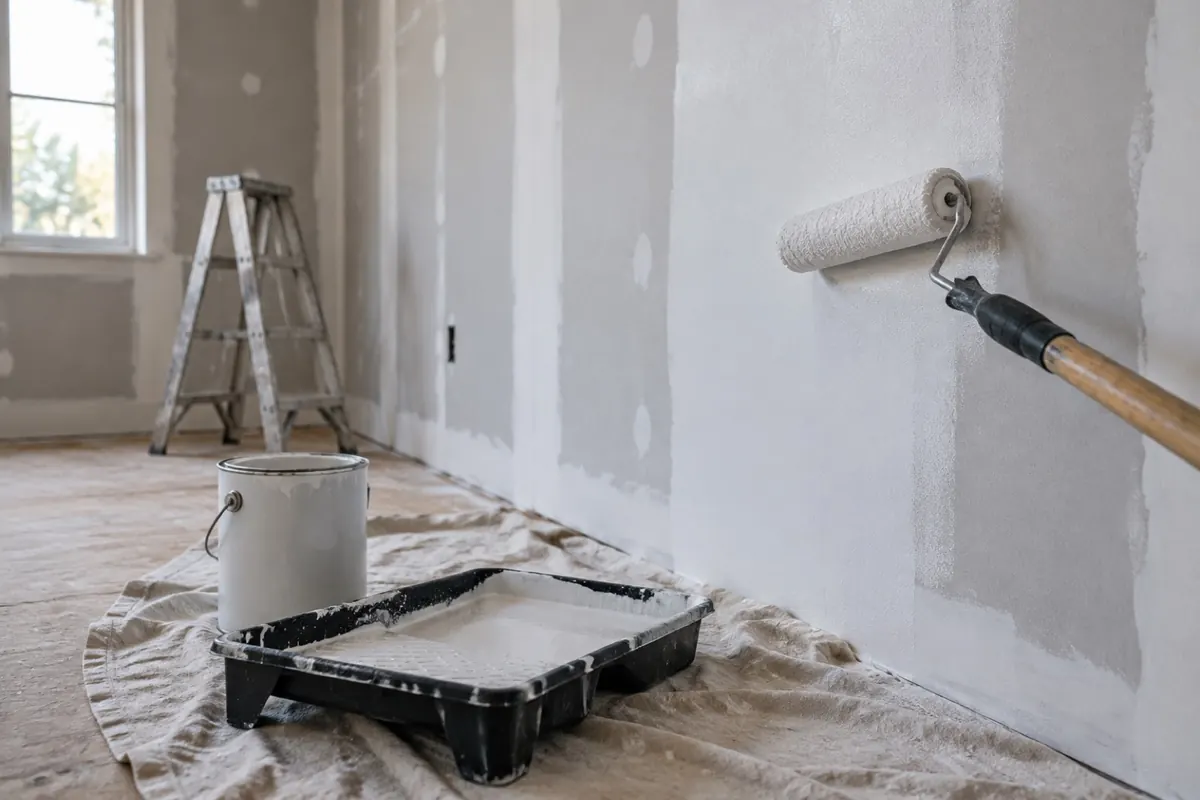
EPA's Brief Guide to Mold, Moisture and Your Home is blunt: do not paint or caulk moldy surfaces; clean up the mold and dry the surfaces before painting, because paint applied over moldy surfaces is likely to peel.
| Question | Answer | Source |
|---|---|---|
| Paint over existing mold | No: clean and dry first; paint over mold is likely to peel | EPA |
| Antimicrobial or mold killing primer | Only per label; Zinsser’s is EPA registered (Reg. No. 87469-1-69587) and labeled for non-porous surfaces | Zinsser TDS |
| Heavy growth under a mold killing primer | Label requires pre-cleaning of overgrowth and loose material | Zinsser TDS |
| Cold room | Label: do not apply below 50 F | Zinsser TDS |
| Antimicrobial coating on a New York job | Only if the plan specifies it, it is EPA registered for that use, and per label | NY Labor Law 946(5) |
Labels can seem to contradict EPA. The Zinsser Mold Killing Primer technical data says it can paint over and kill existing mold, yet the same label says to fix moisture problems first, not to salvage damaged or structurally unsound materials, and to remove heavy growth before applying. The primer protects a clean surface; it does not replace cleaning. It calls for a topcoat within 72 hours and gives full adhesion at 7 days.
Restoring contents
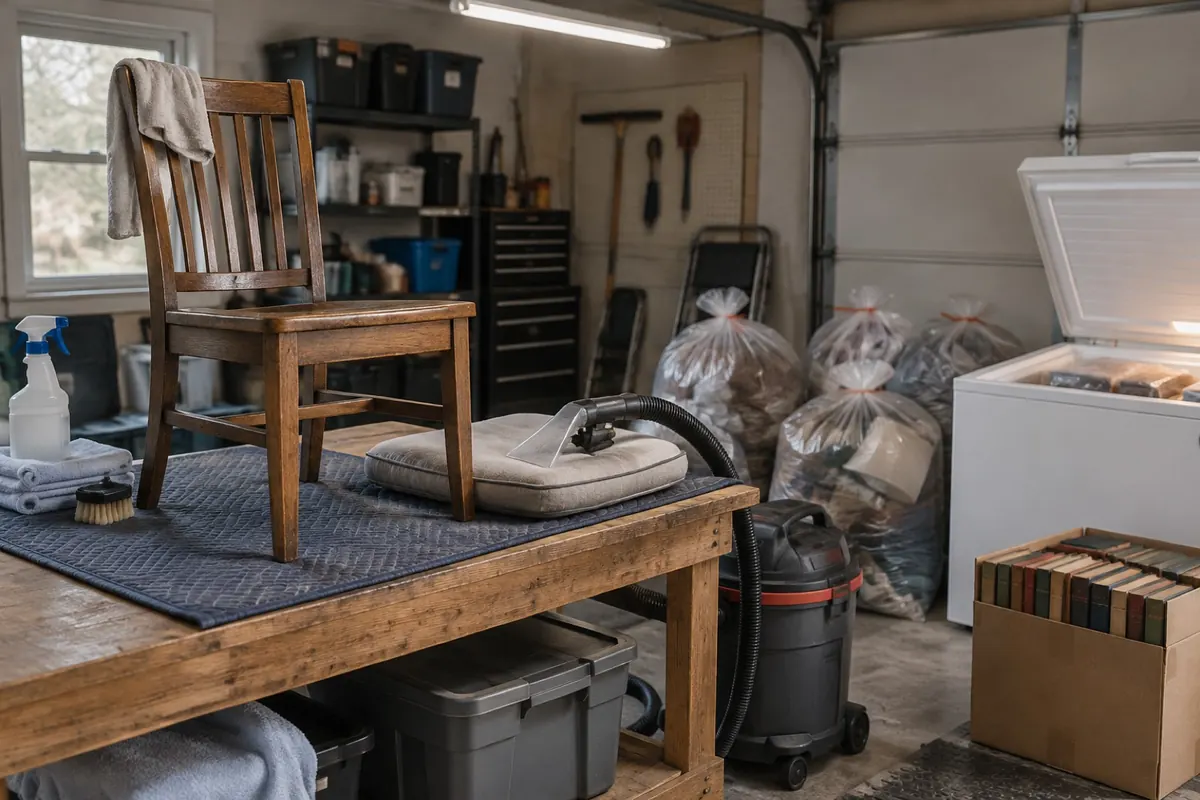
Contents follow EPA's Mold Remediation in Schools and Commercial Buildings, whose Tables 1 and 2 assign four methods: 1, wet vacuum; 2, damp wipe with water and detergent; 3, HEPA vacuum once dry; 4, discard, double bagged in 6 mil polyethylene and disposed of as ordinary construction waste.
| Item | EPA method | Realistic outcome |
|---|---|---|
| Non-porous hard items (plastic, metal) | Wet vacuum, damp wipe, HEPA vacuum (1, 2, 3) | Usually restored |
| Wood furniture and surfaces | 1, 2, 3; discard added for large areas | Usually restored |
| Upholstered furniture and drapes | 1, 3; discard added for medium and large areas | Specialist for valuable pieces |
| Carpet and backing | 1, 3; discard added for medium and large areas | Often replaced |
| Books and papers | HEPA vacuum (3); wet items: discard, photocopy, or freeze | Valuable items to a conservator |
| Ceiling tiles, cellulose and fiberglass insulation | Discard and replace | Not restored |
| Window drapes, wet only | Launder or clean per manufacturer | Usually restored |
EPA notes that mold may cause staining that cleaning cannot reverse, and suggests a specialist for expensive or sentimental items. What mold does to each material, including leather and textiles, is covered on our mold damage page.
What mold damage repair costs
Published prices for the rebuild are thinner than for removal. The figures below are as printed by Fixr and Inch Calculator; they are national guides, not quotes.
| Item | Published range | Source: publisher, date |
|---|---|---|
| Mold damage repair, added to remediation | $75 to $3,000 | Fixr, updated 29 August 2025 |
| Mold remediation, national range | $1,500 to $9,000 (average $3,500) | Fixr, updated 29 August 2025 |
| Mold remediation in walls | $1,000 to $12,000 | Fixr, updated 29 August 2025 |
| Restoration after severe mold | $10,000 to $20,000 | Fixr, updated 29 August 2025 |
| Drywall installation | $1.50 to $3.50 per sq ft; $580 to $1,800 for a 12 by 12 room | Inch Calculator, updated 5 October 2023 |
A patch of board and a gutted basement are both called mold damage repair. Our mold remediation cost page covers the removal side.
Insurance and the line items
The standard ISO HO 00 03 homeowners form sets out the wording that rebuild line items are argued against. Endorsements and state forms change it, so this describes the base form only; check the policy, the state insurance department and a licensed professional for a real claim, and see our guide to whether homeowners insurance covers mold remediation.
| Policy provision (HO 00 03) | What the base form says | What an adjuster asks for |
|---|---|---|
| Mold exclusion and its exception | Excludes mold, fungus or wet rot; insures hidden mold from accidental discharge of water from plumbing, HVAC, sprinkler or appliance | Source, location and date of the discharge |
| Tear out and replace | Cost to tear out and replace part of the building when necessary to repair the system or appliance | Why each opening was needed |
| Reasonable repairs | Reasonable cost of necessary measures to protect covered property from further damage | Mitigation invoices and dates |
| Rebuild line items | Board, insulation, framing, primer, paint, trim, flooring | Clearance document, meter log, photos |
Choosing a firm
The most useful filter is structural: in several states the firm that tests cannot be the firm that removes. Texas Occupations Code 1958.155 says a license holder may not perform both mold assessment and remediation on the same project, and no one may own an interest in both. New York Labor Law 936 bars both on the same property. Florida Statutes 468.8419 bars an assessor from remediating, or a remediator from assessing, a structure it worked on within 12 months (certain Division I contractors excepted), and bans referral fees between the two.
Our state mold licensing page lists the other states. Beyond licensing, ask for the written work plan (New York requires one before site preparation), the clearance criteria, a meter log, and who is doing the rebuild.
For contractors
Scope the rebuild as its own phase with its own gate. OSHA's SHIB 03-10-10 calls removal of contaminated material and structural repair the primary response once the water problem is corrected; adjusters want the clearance document, the moisture readings behind closing walls, and data sheets for specialty board or coatings billed.
What this page does not cover. Health effects of mold are out of scope; for those, see EPA, CDC and NIH resources and a health professional.
Questions people actually ask
Can mold damage be repaired?
Usually, yes. Non-porous materials and most wood surfaces can be cleaned; EPA’s tables send wet insulation, ceiling tiles and heavily affected wallboard and carpet to replacement. Wood weakened by decay is replaced with dry lumber once the moisture source is fixed, per the FPL Wood Handbook. Repair starts only after clearance.
How expensive is mold damage repair?
According to Fixr’s guide, updated August 2025, mold damage repair runs $75 to $3,000 on top of remediation, which it lists at $1,500 to $9,000 nationally, and restoration after severe mold $10,000 to $20,000. According to Inch Calculator, drywall runs $1.50 to $3.50 per square foot.
What should you not put on mold?
Paint and caulk, according to EPA: clean and dry the surface first, because paint over mold is likely to peel. EPA also says biocides such as bleach are not recommended as routine practice, never to mix bleach with ammonia, and not to use outdoor fungicides indoors.
Would homeowners insurance cover mold damage restoration?
It depends on the policy. The standard ISO HO 00 03 form excludes mold but gives back hidden mold caused by an accidental discharge from plumbing, HVAC or an appliance, and endorsements often change that. Read your policy, ask your state insurance department, and see our coverage guide.
How long does mold damage restoration take?
Removal time is covered on our page on how long mold remediation takes; the rebuild adds clearance, drying and construction. The FPL Wood Handbook gives one benchmark: framing left exposed about 30 days in warm, dry weather loses enough moisture that further drying in place is minimal, and longer in cool, damp weather. Meter readings decide.
How do restoration companies handle structural repairs?
They correct the moisture source, then replace decayed members. The FPL Wood Handbook says dry lumber is enough once the source is eliminated, and preservative-treated or naturally durable wood is needed where it cannot be. EPA and OSHA advise a structural engineer when building integrity may be affected.
How do I choose a reliable mold restoration company?
Check the state license, then the structure of the job. In Texas and New York the assessor and remediator must be different firms, and Florida sets a 12 month separation. Ask for a written plan, the clearance criteria, moisture readings before walls close, and data sheets for rebuild materials.
Sources
- EPA's Mold Remediation in Schools and Commercial Buildings, EPA 402-K-01-001, September 2008 reprint. Retrieved 18 October 2026.
- EPA's Brief Guide to Mold, Moisture and Your Home, US EPA. Retrieved 18 October 2026.
- OSHA's SHIB 03-10-10, A Brief Guide to Mold in the Workplace. Retrieved 18 October 2026.
- Wood Handbook chapter 13, USDA FPL Wood Handbook FPL-GTR-190 (2010). Retrieved 18 October 2026.
- Wood Handbook chapter 14, Biodeterioration of Wood, FPL-GTR-282 (2021). Retrieved 18 October 2026.
- ANSI/IICRC S520, IICRC standard page. Retrieved 18 October 2026.
- New York Labor Law 936, New York Labor Law 946 and New York Labor Law 947, New York State Senate. Retrieved 18 October 2026.
- Texas Occupations Code 1958.154 and Texas Occupations Code 1958.155; the official site (statutes.capitol.texas.gov) renders by script, so the text was read from texas.public.law. Retrieved 18 October 2026.
- Florida Statutes 468.8419, Online Sunshine. Retrieved 18 October 2026.
- Georgia-Pacific DensArmor Plus product page. Retrieved 18 October 2026.
- USG Sheetrock Mold Tough submittal sheet, WB2390 rev. 9-10. Retrieved 18 October 2026.
- ASTM D3273-21, summary page. Retrieved 18 October 2026.
- PABCO Gypsum bulletin, Mold Growth in the Desert?, 2023. Retrieved 18 October 2026.
- Zinsser Mold Killing Primer technical data, Rust-Oleum, item 276049. Retrieved 18 October 2026.
- ISO HO 00 03 homeowners form, HO 00 03 05 11, Insurance Services Office 2010, filed with the Maine Bureau of Insurance. Retrieved 18 October 2026.
- Fixr, mold remediation cost guide, updated 29 August 2025. Retrieved 18 October 2026.
- Inch Calculator, drywall cost guide, updated 5 October 2023. Retrieved 18 October 2026.
- No figure here was estimated or invented. See our methodology and the mold hub.
Prices, product data and statutes change. Confirm current versions, and treat this as a description of published sources, not legal, engineering or insurance advice.