The short answer
Yes, though the honest answer to can mold grow on metal is that it grows on what sits on the metal: dust, skin oils, soap scum and some paint films. MIL-STD-1250A lists metals as funginert, meaning not a fungal nutrient. Cold metal adds the water by condensing room air, and because metal is nonporous, EPA treats it as cleanable rather than something to throw away.
Key takeaways
- Steel, aluminum, copper and cast iron are not food. The mold lives in the film on top, so a wipe that reaches bare metal removes it.
- Metal is often the coldest surface in a room. At 70 F and 50% relative humidity, any surface below about 51 F collects water, per the NWS formula worked in the chart below.
- The real losses are next to the metal: paper faced drywall on steel studs and fiberglass liner inside sheet metal ducts.
If steel and aluminum are not fungal food, what is the mold on metal eating?
Nothing in the metal. MIL-STD-1250A, the Defense Department standard on protecting electronics from moisture and fungal attack, lists metals in Table VIII as funginert in all grades and conditions, and section 5.11.1 says that although not nutrients for fungus, metals are attacked by acid liberated by microbial growth. The same section tells builders to avoid protective finishes which support fungi.
The food is the layer on top. Bowdoin College's housing mold guidance says mold seen on plastic, vinyl, glass or metal is growing on an accumulated organic material like dust, dirt, soap scum, food or drink residues. Chapter 1 of EPA's mold course adds that some spores sit in settled dust but will not grow if moisture is not present, and MIL-STD-1250A section 5.11 calls for removal of dust, dirt, fingerprints and other contaminants plus low humidity, the same two levers a homeowner has.
Virginia Cooperative Extension puts it in one line: molds can also grow on non cellulose materials, such as plastic, metal, or concrete, given dead organic material to digest and a temperature usually between 40 and 100 F. A common rule of thumb online says mold cannot grow on metal at all; that holds only for metal that is clean and dry. Polymers follow different rules, set out on can mold grow on plastic.
Why does a cold water pipe or window frame sweat in a 70 F room?
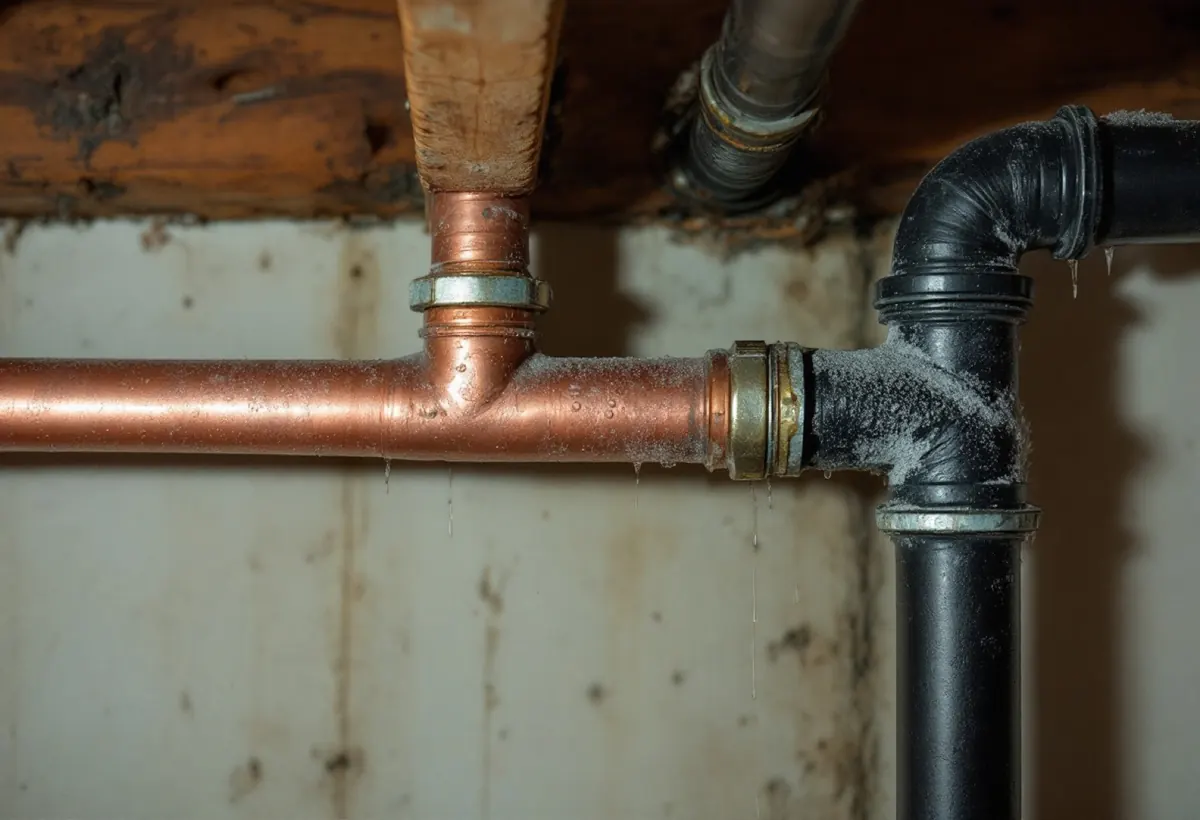
Because metal conducts heat and runs cold. Chapter 2 of EPA's mold course says that when warm, humid air contacts a cold surface, condensation may form, and lists leaking or condensing water pipes, especially pipes inside wall cavities, and condensation on uninsulated air conditioning ducts as hidden moisture sources. EPA's A Brief Guide to Mold, Moisture and Your Home tells owners to cover cold surfaces, such as cold water pipes, with insulation.
The trigger is the dew point of the room air. Solving the National Weather Service vapor pressure formula for 70 F air gives a dew point of about 37 F at 30% relative humidity, 45 F at 40%, 51 F at 50% and 55 F at 60%, per the calculation in the chart. Moving from EPA’s ideal floor to its 60% ceiling raises the temperature at which metal sweats by about 18 F.
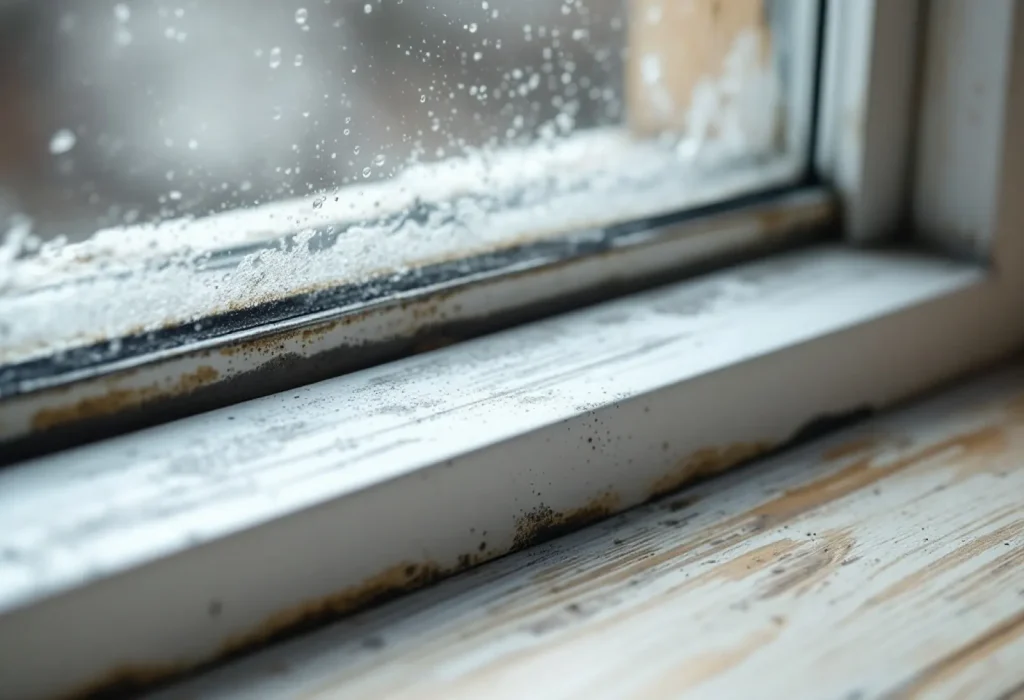
Window frames show the same physics in winter. a University of Utah window condensation study by Aksamija and colleagues ran about 600 simulations of 11 window systems at 70 F and 30, 50 and 60% indoor humidity and reports that in windows with non thermally broken or minimally thermally broken frames, condensation began along the interior edges of the frame. A warm edge spacer reduced condensation compared with an aluminum spacer, according to the study.
According to North Dakota State University Extension, homes should aim for about 40% relative humidity in winter, and the release notes that excess moisture on windows can be a breeding ground for mold. The dust in an aluminum window track plus that condensate is the whole recipe. Mold on window sills covers the sill and track.
Six metals in a house: what feeds the mold, where the water comes from, and whether it cleans
The last column applies Table 2 of EPA's school and commercial building guide, which lists non porous, hard surfaces (plastics, metals) with cleanup methods 1, 2 and 3 in all three size tiers: under 10 square feet, 10 to 100, and over 100. Method 4, discard, is never listed for metal in that table.
| Metal and where it is | What the mold feeds on | Where the water comes from | Cleanable? | Sources |
|---|---|---|---|---|
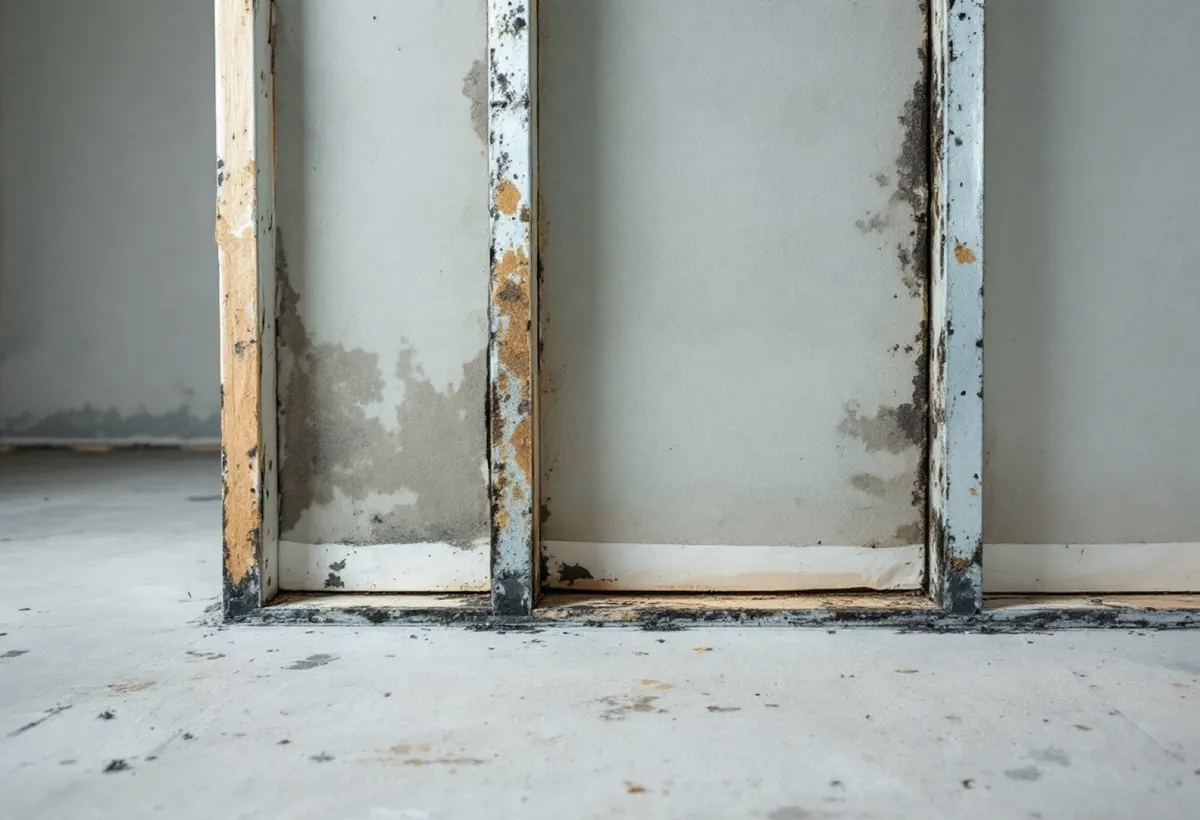
| Steel stud (galvanized light gauge framing) | Paper facing of the gypsum board fastened to it, dust | Humid air reaching cooled wall surfaces; perforated studs let air move between cavities | Stud: yes, damp wipe. Moldy wallboard: usually discard | MIL-STD-1250A Table VIII; EPA mold course ch. 1 (paper as food); Lstiburek 1992 |
| Aluminum window frame | Dust and residue in the track and glazing channel | Condensation at interior frame edges on non thermally broken frames | Yes: damp wipe, scrub, dry | Aksamija 2022 (Utah); NDSU Extension; EPA Table 2 |
| Galvanized sheet metal duct | Settled dust inside the duct | Condensation on uninsulated ducts; leaky duct seams | Bare metal: yes, per EPA. Fiberglass liner: replace | EPA air duct page; EPA mold course ch. 2 |
| Copper water pipe | Dust on the outside of a sweating cold line | Condensation on cold water lines | Yes. Copper slows fungi in lab tests, but dirt and coatings defeat it | Weaver 2010; EPA reg. 85340-1; EPA brief guide |
| Cast iron drain or radiator | Dust, old paint films | Condensing pipes in wall cavities and chases | Yes: nonporous, EPA methods 1 to 3 | MIL-STD-1250A 5.11.1; EPA mold course ch. 2; EPA Table 2 |
| Painted metal furniture, stainless bottle | Drink residue, skin oils, some paint films | Trapped rinse water in lids and seams | Yes, if every surface can be reached and dried | Bowdoin College; MIL-STD-1250A 5.11.1 |
The pattern across the rows: the metal is never the loss. What gets thrown out is the porous material touching it, which Chapter 3 of EPA's school and commercial building remediation guide describes as materials that may have to be discarded because molds will infiltrate porous substances and fill in empty spaces or crevices.
Does switching from wood studs to steel studs stop mold in a wall?
It removes one food source, the wood, and keeps the bigger one. Chapter 1 of EPA's mold course names paper, cloth and wood among the organic materials in buildings that mold can use as food, and standard gypsum board carries paper on both faces whichever stud it is screwed to.
a 1992 Florida case study paper by J.W. Lstiburek hosted by Oak Ridge National Laboratory documents what happens anyway. In a Tampa hotel finished in February 1989, rampant mold and mildew grew at the vinyl and gypsum board interface, and damage at interior party walls occurred with both the masonry block and steel stud walls. Replacing about 20% of the gypsum boards and wall coverings after the first summer did not hold: the problems reappeared in the second summer, the paper reports.
The paper traced the water to humid outdoor air pulled into the walls and condensing on cooled gypsum. In a Lakeland nursing home built in 1990 to 1991, perforated metal studs interconnected the wall cavities and helped that air travel. The steel was the path, not the food.
Does copper kill mold, and is EPA registration 85340-1 a mold claim?
Copper does slow fungi on a bare surface. Weaver, Michels and Keevil, Letters in Applied Microbiology 2010 inoculated copper (C11000) and aluminum coupons with Aspergillus, Fusarium, Penicillium chrysogenum and Candida albicans and reported increased die off on copper compared to aluminum, and that copper prevented germination of spores already present. The authors proposed copper in place of aluminum in air conditioning systems.
The EPA registration is narrower. EPA registration 85340-1, issued 15 October 2008, lets antimicrobial copper alloys claim to kill greater than 99.9% of bacteria within 2 hours, and its footnote names 5 test organisms, all bacteria, from Staphylococcus aureus to Pseudomonas aeruginosa. No mold appears on that label, and it says the product must not be waxed, painted, lacquered, varnished or otherwise coated and must be cleaned to keep working.
So a sweating copper cold line under a dusty basement ceiling can still carry growth in the dust film, and the 2010 abstract warns that culture alone may give false results when judging an antifungal surface. Mold on pipes covers cleaning and insulating the line.
Is mold eating my metal, or is that rust and bacteria?
Mostly the latter. Microbially influenced corrosion is real, but Videla and Herrera, International Microbiology 2005 notes that since the 1934 cathodic depolarization theory of von Wolzogen Kuhr and van der Flugt, corrosion of carbon steel in oxygen free settings involving sulfate reducing bacteria (SRB) has been the focus of most of the research in the field. Those are bacteria living in wet soil and water systems, not household mold.
Fungi do have one well known metal case. The same review lists biocorrosion of aluminum and its alloys by fungal contaminants of jet fuels as a case study, a setting where water sits under fuel in a tank for long periods. MIL-STD-1250A section 5.11.1 describes the mechanism as acid liberated by microbial growth.
On a garage shelf or a door frame, rust and mold on the same spot point to one water source, the condensation or leak EPA mold course chapter 2 describes, so the fix is drying the metal and treating the rust as a separate repair. Growth that wipes off with detergent and leaves sound metal behind was surface growth, which is what EPA’s chapter 3 damp wipe method expects on nonporous surfaces. Mold in the garage covers tools, shelving and doors.
Sheet metal ducts, AC coils, car bodies and metal roofs: what changes?
Ducts are where the metal versus liner split matters most. EPA's air duct cleaning page says treatment of mold contamination on bare sheet metal is much easier and that cleaning and treatment with an EPA registered biocide are possible, while once fiberglass duct liner is contaminated with mold, cleaning is not sufficient to prevent regrowth; EPA, NADCA and NAIMA all recommend replacing wet or moldy fiberglass duct material. The same page says steam cleaning should not be used on any kind of ductwork. Mold in air ducts has the inspection and cleaning steps.
Evaporator coils and their drain pans sit inside the air handler, and EPA mold course chapter 2 lists poorly draining condensate pans inside air handling units as a hidden moisture site; coil cleaning itself is HVAC work covered by The HVAC Brief.
In a car, the steel body is rarely where mold is found; it is the carpet, padding and seat foam over it, which EPA chapter 3 classes with porous materials. Mold in a car covers those. Condensation under metal roof panels is a roofing question for The Roofing Brief.
What kills mold on metal, and is bleach needed?
Detergent and water, then drying, per EPA's A Brief Guide to Mold, Moisture and Your Home, which also puts the do it yourself limit at about 10 square feet. Chapter 3 of EPA's school and commercial building remediation guide says the use of a biocide, such as chlorine bleach, is not recommended as a routine practice during mold remediation, and never to mix chlorine bleach with cleaners that contain ammonia because toxic fumes could be produced.
- Find and stop the water first. EPA’s brief guide says to dry wet items within 24 to 48 hours and keep humidity below 60%; insulate a sweating cold line before cleaning it.
- Damp wipe or scrub with water and detergent. EPA’s chapter 3 method 2 says mold can generally be removed from nonporous (hard) surfaces this way. Virginia Cooperative Extension says to clean surfaces with a cleaner appropriate to the material.
- Get to bare or sound paint. EPA chapter 3 says not to paint or caulk moldy surfaces because paint applied over mold is likely to peel; clean and dry first.
- Dry it completely. EPA chapter 3 says to dry hard surfaces quickly and thoroughly to discourage further growth.
- HEPA vacuum the area once dry. Method 3 in EPA chapter 3 covers final cleanup of settled dust, which on metal is the food layer.
For contractors: EPA Table 2 sets PPE and containment by the size tier, not by the material, so a metal surface over 100 square feet still calls for the large tier controls even though methods 1 to 3 are enough to clean it. Wallboard or liner removed from that metal goes out under method 4, double bagged in 6 mil polyethylene, per chapter 3. Bleach on metal is its own question. Does bleach kill mold covers it.
Health effects of mold exposure are outside the scope of this page. EPA’s mold pages and CDC cover them; ask a physician about any personal concern.
Questions people actually ask
What does mold look like on metal?
Usually spots or a fuzzy patch sitting in a film of dust or residue, often along the lower edge of a window frame, the underside of a cold pipe or a duct seam. Bowdoin College describes mold on metal as growing on accumulated dust, dirt, soap scum or food residue. If a detergent wipe takes it off and leaves sound metal, EPA’s chapter 3 damp wipe method has done its job.
Can black mold grow on metal?
Dark colored molds can grow in the dust film on metal like any other mold, because color does not change what they eat. MIL-STD-1250A lists metals as funginert, so the growth depends on dust, oils or paint film plus moisture. EPA’s Table 2 lists the same cleanup methods 1 to 3 for metals, set by area rather than by mold type: under 10, 10 to 100 and over 100 square feet.
Can mold grow on a metal water bottle?
Yes, in drink residue and trapped water, especially in the lid, gasket and straw. Bowdoin College lists food or drink residues as what mold on metal usually grows on. The stainless wall cleans like any hard surface; take the lid apart, wash with detergent and dry it open, since EPA advises drying items within 24 to 48 hours.
Can mold grow on glass?
Only on what coats it. MIL-STD-1250A section 5.11.2 says glass and ceramics are not in themselves funginutrient but the coatings used on optics often support fungal growth, and Bowdoin College groups glass with metal as surfaces where mold grows on dust and residue. Window glass condensation is the usual water source, per NDSU Extension.
Can mold grow on metal furniture?
On the dust, spilled food and some paint films on it, yes, mostly where it stays damp, such as patio furniture or chairs stored in a basement. MIL-STD-1250A section 5.11.1 warns that some protective finishes support fungi. A detergent scrub and full drying handles painted or bare metal; fabric cushions are porous and fall under EPA’s discard guidance.
Sources
- MIL-STD-1250A: Corrosion Prevention and Deterioration Control in Electronic Components and Assemblies, US Department of Defense, sections 5.11, 5.11.1, 5.11.2 and Table VIII, as reproduced by eMilSpec (Integrated Publishing). Retrieved 17 November 2026.
- Virginia Cooperative Extension: Mold, Henrico County office, Virginia Tech and Virginia State University. Retrieved 17 November 2026.
- Bowdoin College's housing mold guidance: Mold, Residential Life, Bowdoin College. Retrieved 17 November 2026.
- Chapter 1 of EPA's mold course: Mold Course Chapter 1, US EPA, last updated 18 February 2026. Retrieved 17 November 2026.
- Chapter 2 of EPA's mold course: Mold Course Chapter 2, US EPA, last updated 10 November 2026. Retrieved 17 November 2026.
- EPA's A Brief Guide to Mold, Moisture and Your Home, US EPA, last updated 18 February 2026. Retrieved 17 November 2026.
- Chapter 3 of EPA's school and commercial building remediation guide: Mold Remediation in Schools and Commercial Buildings Guide, Chapter 3, US EPA, last updated 29 April 2026. Retrieved 17 November 2026.
- Table 2 of EPA's school and commercial building guide: Mold Remediation in Schools and Commercial Buildings Guide, Chapter 5, US EPA, last updated 14 April 2026. Retrieved 17 November 2026.
- EPA's air duct cleaning page: Should You Have the Air Ducts in Your Home Cleaned?, US EPA, last updated 19 February 2026. Retrieved 17 November 2026.
- EPA registration 85340-1: Notice of Pesticide Registration and stamped labeling, Antimicrobial Copper Alloys, US EPA Office of Pesticide Programs, 15 October 2008. Retrieved 17 November 2026.
- Weaver, Michels and Keevil, Letters in Applied Microbiology 2010: Potential for preventing spread of fungi in air conditioning systems constructed using copper instead of aluminium, vol. 50, no. 1, pp. 18 to 23, University of Southampton (PubMed abstract 19943884). Retrieved 17 November 2026.
- Videla and Herrera, International Microbiology 2005: Microbiologically influenced corrosion: looking to the future, vol. 8, no. 3, pp. 169 to 180. Retrieved 17 November 2026.
- a 1992 Florida case study paper by J.W. Lstiburek hosted by Oak Ridge National Laboratory: Two Studies of Mold and Mildew in Florida Buildings, Thermal Performance of the Exterior Envelopes of Buildings conference papers, 1992. Retrieved 17 November 2026.
- a University of Utah window condensation study: Aksamija, Milosevic, Sanders and Blakeslee, Condensation Study of Windows, Proceedings of the Facade World Congress 2022, summary published 20 October 2022. Retrieved 17 November 2026.
- North Dakota State University Extension: Window Condensation Common Problem, news release, 10 January 2011. Retrieved 17 November 2026.
- the National Weather Service vapor pressure formula: Vapor Pressure calculator notes, National Weather Service El Paso office. Retrieved 17 November 2026.
- How this page was built is described in our methodology, and more mold pages are on the mold hub.
MIL-STD-1250A and the copper studies describe materials under defined conditions, not a guarantee that a metal item in a home stays clean. When a product is sold as mold resistant metal or antimicrobial copper, ask the seller which EPA registration number covers it and whether that label names any fungi or only bacteria.