The short answer
Attic mold removal cost typically runs $1,500 to $3,000 for a small localised area, $3,000 to $6,000 where a meaningful share of the roof sheathing is affected, and $6,000 to $10,000 or more for a full attic that also needs insulation removed and replaced. Correcting the ventilation that caused it adds roughly $500 to $2,500, and skipping that correction is the reason attics get remediated twice.
Key takeaways
- The cause is almost always ventilation, not a roof leak. Warm moist air from the house rises into a cold attic and condenses on the underside of the sheathing.
- Three culprits account for most of it: bath or dryer vents terminating inside the attic, blocked or insufficient soffit and ridge ventilation, and air leaks around recessed lights, hatches and top plates.
- The method differs from living-space work. Sheathing is cleaned in place, because removing roof sheathing means removing the roof.
- Contaminated insulation is removed and replaced. It is porous, it cannot be verified clean, and it is cheap relative to the labour around it.
- Encapsulation after cleaning is legitimate on sheathing. Encapsulation instead of cleaning is painting over the problem.
- Access and clearance drive labour more than area does. A four foot clearance attic in August is slow work at any square footage.
On this page
- The cause is ventilation
- The three usual culprits
- What it costs, by tier
- Why the method is different up there
- The insulation decision
- Encapsulation, used correctly
- Access and clearance drive the labour
- Fixing the airflow
- Air sealing is the other half
- How to read an attic quote
- Keeping it from coming back
- Questions people actually ask
Attic mould is the one remediation job where the cleaning is the easy part. The sheathing gets cleaned, the insulation gets replaced, and within two winters it can look the same again, because nothing about the reason it grew was touched. The quote worth accepting prices the airflow alongside the cleaning.
The cause is ventilation, not the roof
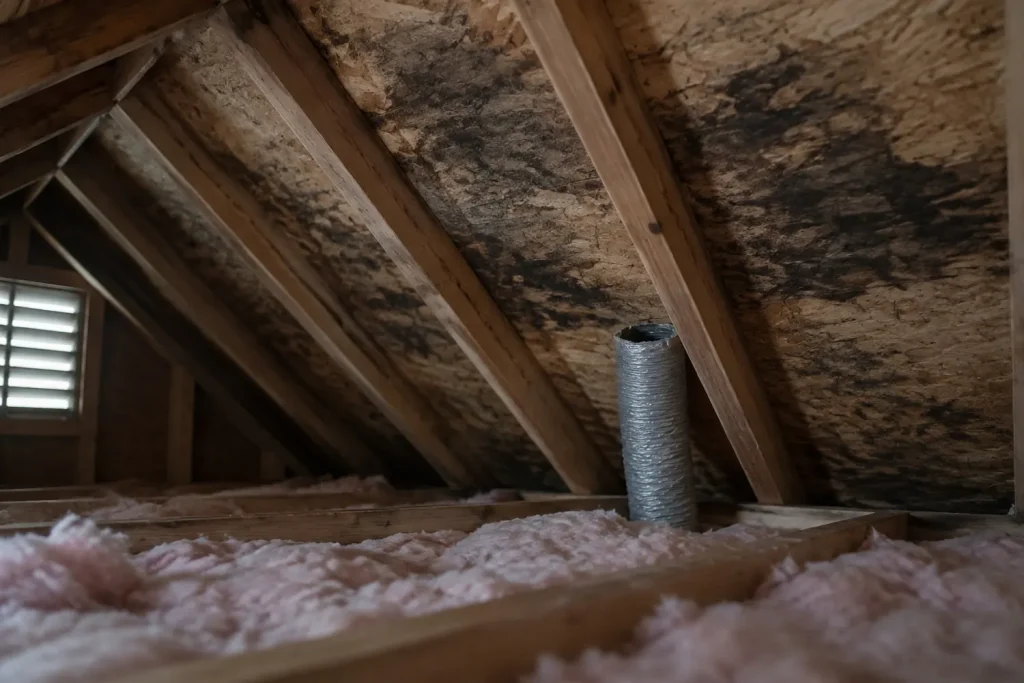
The instinct when growth appears on the underside of roof sheathing is that the roof is leaking. Occasionally it is, and a leak leaves a localised stain running down from a single penetration, valley or nail. Far more often the pattern is diffuse across a broad area of the north-facing slope or the whole deck, with nothing overhead to explain it. That pattern is condensation, and condensation is an airflow problem. Our guide to the signs of mold in an attic covers how to tell a leak from condensation.
The mechanism is simple. Warm air in a heated house holds more water vapour than cold air, it rises, and it escapes into the attic through every unsealed opening in the ceiling plane. There it meets the underside of the roof deck, which in winter sits close to outdoor temperature, reaches its dew point against that cold surface and condenses. Repeat that nightly for a season and the sheathing has a persistent moisture source.
EPA mold cleanup guidance states the controlling principle plainly: mould will not grow without moisture, and controlling moisture is what controls mould. On an attic that means the ventilation and the air sealing, not the cleaning.
How to tell condensation from a leak
| Observation | Points to condensation | Points to a roof leak |
|---|---|---|
| Pattern on the sheathing | Diffuse, across a broad area, often heaviest on the north slope and at the eaves where the deck is coldest. | Localised around a penetration, valley, chimney or fastener, with a run-down shape. |
| Frost or water in winter | Frost on the nail points and the deck on cold mornings, which melts and wets the wood during the day. | Water present during and after rain, regardless of temperature. |
| Relationship to the house below | Worst above bathrooms, kitchens, laundry rooms and over a hatch or recessed light cluster. | No particular relationship to what is underneath. |
| Seasonality | Winter problem in heating climates, appearing and receding with the season. | Follows rainfall rather than temperature. |
| Insulation condition | Damp or compressed in patches, sometimes with staining under the wettest deck areas. | A defined wet track from the entry point down to the ceiling. |
The three usual culprits
Three faults account for most of it, and all three are findable in half an hour with a torch.
Vents that terminate in the attic
A bathroom fan or a clothes dryer discharging into the attic instead of through the roof or a soffit is the most productive moisture source a house can have. A shower puts a substantial volume of vapour into the air and a dryer vents the water it just took out of a load of washing. Delivering either into a cold space is a humidification system aimed at the roof deck.
The failure is often subtle. A duct connected correctly can separate at a joint, or a flexible duct can be crushed under insulation or left with its end pointed at the deck. What looks from below like a working fan is exhausting above the ceiling.
Blocked or insufficient soffit and ridge ventilation
A vented attic works as a flow path: outside air enters low at the soffits, rises up the underside of the deck and exits at the ridge, carrying moisture out. Two things break it. Insulation gets pushed into the eaves during an upgrade and blocks the soffit intake, which is why baffles exist. Or intake and exhaust do not balance, usually plenty of ridge exhaust with almost no intake below.
Air leaks in the ceiling plane
Every unsealed opening between the heated house and the attic delivers moist air: recessed light housings, the hatch, plumbing and wiring penetrations through top plates, bath fan housings, the chase around a flue. Individually small and collectively large, they are why two identical houses on one street can have completely different attic conditions.
A bath fan that discharges correctly but is undersized, or is on a switch that gets turned off as soon as the shower ends, still leaves the moisture in the house, where it finds the ceiling plane. A timer or humidity-sensing switch is a small item that changes the load on the whole assembly.
What it costs, by tier
Attic mold removal cost sorts into tiers by how much of the deck is affected and whether the insulation is in scope, which is the biggest step change in the number.
| Tier | What is in scope | Typical range | What pushes it up |
|---|---|---|---|
| Small, localised | A defined area of sheathing, usually around one penetration or one cold corner. HEPA vacuum, treatment, clean-up. Insulation mostly stays. | $1,500 to $3,000 | Poor access, or a second area found once the insulation is moved. |
| Moderate sheathing coverage | A substantial share of the deck cleaned, partial insulation removal where it is contaminated or in the way, containment at the hatch. | $3,000 to $6,000 | Whether the whole deck ends up in scope once it is properly lit and inspected. |
| Full attic, insulation replaced | Whole deck cleaned and treated, all insulation removed and replaced, ventilation and air sealing usually done at the same time. | $6,000 to $10,000 or more | Attic size, insulation depth and type, disposal volume, and roof pitch. |
| Ventilation correction | Rerouting vents to the exterior, adding or unblocking soffit intake, fitting baffles, adding ridge or roof exhaust. | $500 to $2,500 | Whether roof penetrations are needed, and whether soffits have to be opened from outside. |
Why the insulation tier is a step, not a slope
The jump to the full-attic tier is larger than the extra square footage suggests, because removing insulation is a separate operation with its own equipment and disposal volume: a mobilisation, a machine, bagged waste going to a tip, then a second trade returning to blow new material in. Establish early whether it is in scope.
Our general mould remediation cost guide covers how containment, area and verification price on living-space work, and our inspection cost guide covers what an assessment should produce before any of this is quoted.
Why the method is different up there
In a living space the standard answer for a porous material with growth on it is removal. Roof sheathing is the exception, and it is an exception of pure practicality: the sheathing is the roof. Removing it means stripping the covering above, cutting the deck off the rafters and re-roofing the house, a project costing multiples of the remediation and not warranted for surface growth on sound wood.
What cleaning in place actually involves
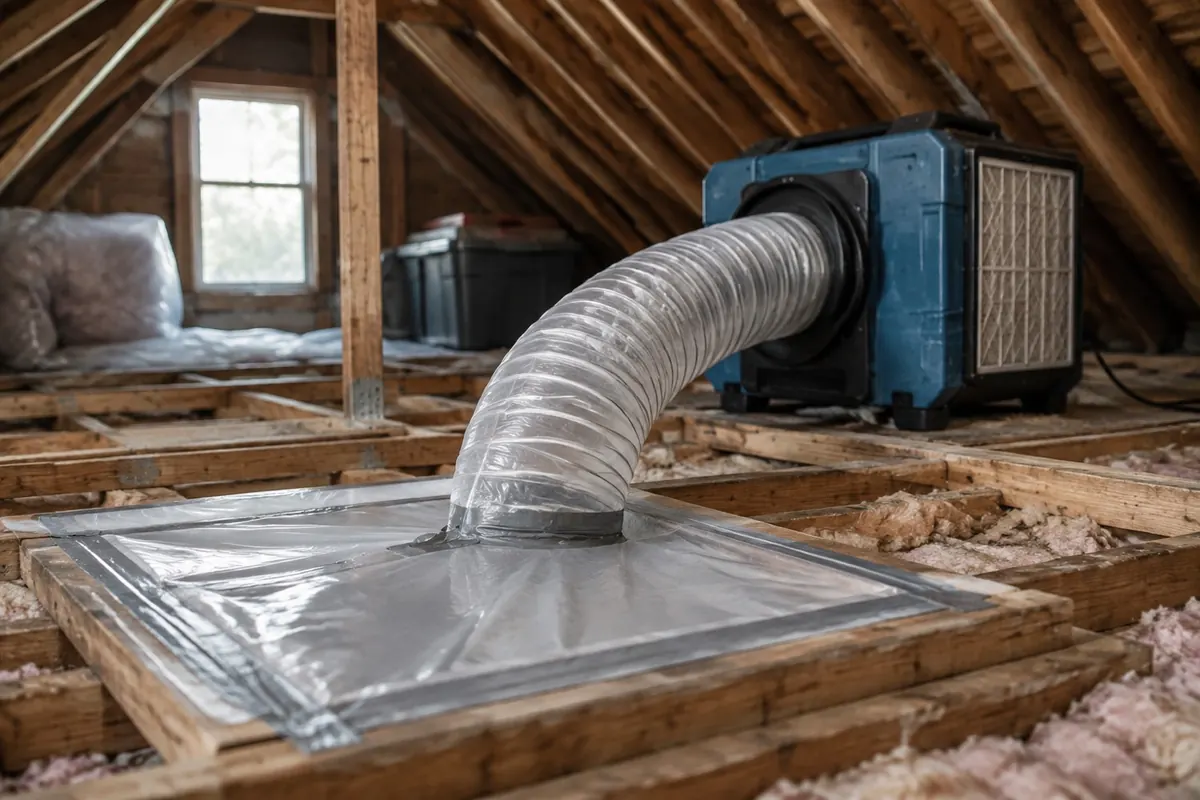
- Containment at the access point. The hatch is sealed and the attic held under negative pressure to the outside so nothing travels down into the house.
- HEPA vacuuming of the deck and framing before anything wet or abrasive is applied.
- Abrasive or chemical treatment of the surface, meaning soda or dry-ice blasting, wire brushing and hand sanding, or an applied antimicrobial. Blasting is fast on a large deck and leaves a lot of media to clean up; hand methods are slower but better controlled in a tight space.
- A second HEPA pass over the deck, the framing and everything the first pass dislodged.
- Optional encapsulant applied to the cleaned sheathing.
- Post-remediation verification, usually a documented visual inspection against criteria set before the work started, and sometimes sampling.
ANSI/IICRC S520 governs this work, and it applies the same principle as a water loss: a material is retained where it can be cleaned and the outcome verified, and removed where it cannot. Our remediation process guide walks through containment and verification in detail.
Staining is not the same as growth
Cleaned sheathing frequently keeps a dark stain in the grain. That is discolouration, not remaining growth, and chasing it removes sound wood for a cosmetic result on a surface nobody will see again. A contractor promising pristine sheathing is going to over-abrade the deck or paint it.
The insulation decision
Insulation is the porous material up there, so it follows the normal rule: contaminated porous material is removed and replaced rather than cleaned, because cleaning inside it cannot be verified.
| Insulation | Condition after a condensation problem | Usual call |
|---|---|---|
| Blown cellulose | Absorbs and compacts where the deck dripped on it, loses loft and does not recover it. | Remove and replace where wetted. Loft loss alone is a reason to replace. |
| Blown or batt fibreglass | Holds water in the batt and stays damp under the wet area, but is not itself a food source. | Remove where wetted or visibly contaminated. Dry undisturbed areas may stay. |
| Mineral wool | Sheds water better than the alternatives and recovers loft more readily. | Assess. More often retained than the other two. |
| Spray foam at the roof line | Changes the whole assembly: an unvented conditioned attic, where ventilation is not the fix and the analysis is different. | Specialist assessment. Do not treat it as a vented attic. |
| Vermiculite of unknown origin | May contain asbestos depending on its source, which is a separate regulated scope entirely. | Stop. Test before disturbing anything. |
Loose fill of uncertain age and origin in an older house is worth identifying before anyone starts vacuuming it out. Vermiculite can carry asbestos depending on where it was mined, and that turns an attic remediation into a regulated abatement with entirely different rules.
Replacing insulation is also an energy decision
Once insulation is coming out anyway, the replacement depth is worth deciding deliberately rather than matching what was there. Much older attic insulation sits below current recommended levels for its climate zone, and blowing deeper while the equipment is on site costs little against doing it later as its own job. The US Department of Energy, types of insulation sets out the material options.
Encapsulation, used correctly
Encapsulation means applying a coating, usually a pigmented sealer, to cleaned sheathing after the remediation is finished. On attic sheathing it is common and legitimate: it seals residual staining, gives a uniform surface against which any future growth is obvious, and adds a barrier where cleaning will never be easy again.
The problem is the version used instead of cleaning. Coating over existing growth traps it, leaves the material underneath intact, and does nothing about the moisture still arriving every winter night. It looks finished from the hatch and it is not. The sequence is worth confirming in writing.
| Step | Legitimate sequence | The shortcut version |
|---|---|---|
| 1 | Diagnose and correct the moisture source | Skipped |
| 2 | Contain the work area and HEPA vacuum | Skipped |
| 3 | Remove the growth by abrasive or chemical means | Skipped |
| 4 | Second HEPA pass and clean-up | Skipped |
| 5 | Verify against criteria set beforehand | Skipped |
| 6 | Apply encapsulant to the cleaned surface | This is the entire job |
Access and clearance drive the labour
Square footage is a weak predictor of price up here. What governs the hours is whether a person can work in the space at all.
| Access factor | Easy version | Hard version | Effect on the hours |
|---|---|---|---|
| Standing clearance at the ridge | Six feet or more, a person can work upright over much of the deck. | Three or four feet, everything is done kneeling or on the belly. | Large. Slow movement, frequent breaks and more of the deck reached awkwardly. |
| Roof pitch | A steep pitch gives volume and headroom. | A shallow pitch puts the deck close to the joists at the eaves, where the growth usually is. | Large at the eaves, which is exactly the area that matters. |
| Entry point | A pull-down stair or a walk-in door from a room. | A small ceiling hatch in a bedroom cupboard. | Every bag of insulation and every piece of equipment goes through that hole. |
| Decking or catwalk | Partial decking gives somewhere to stand and stage. | Bare joists with blown insulation between them. | Slower, and boards have to be laid to work safely. |
| Temperature on the day | A cool day or early morning work. | Summer heat, where an attic runs far hotter than outside. | Shorter working cycles, mandatory breaks, more days for the same area. |
| Obstructions | A clear deck. | Ductwork, an air handler, stored belongings, a knee-wall attic in sections. | Contents handling before the work starts, and areas reached one at a time. |
Fixing the airflow
This decides whether the money spent on cleaning was an investment or a deposit on doing it again. A vented attic needs intake low and exhaust high, in balance, with a clear path between them.
- Reroute every vent to the exterior. Bath fans and dryers terminate through the roof or out a soffit or gable, with a proper hood and a damper, and with rigid or well-supported duct that will not separate.
- Open the intake. Clear insulation out of the eaves and fit baffles so it cannot be pushed back in. Blocked soffits are the most common single ventilation fault and among the cheapest to correct.
- Balance intake against exhaust. Exhaust at the ridge with insufficient intake below cannot move air. Adding more exhaust to a starved attic makes it worse, because it pulls conditioned air up out of the house instead.
- Do not mix exhaust types carelessly. A ridge vent with powered or box vents on the same roof plane can short-circuit, drawing air in through one exhaust rather than up from the soffits.
- Insulate and seal duct runs passing through the attic, because an uninsulated duct is itself a cold condensing surface.
Unvented and conditioned attics are a different building
An attic insulated at the roof line with spray foam is deliberately unventilated and sits inside the building envelope. Adding soffit and ridge ventilation to one is not a fix, it is a fault. If growth appears there the questions are different: the air seal at the foam, the condition of the foam, and whether the space is conditioned as designed.
Air sealing is the other half
Ventilation removes moisture that arrives in the attic. Air sealing stops it arriving. The first without the second means running a ventilation system against a continuous supply of moist household air, which works badly and costs energy doing it.
| Leak | Why it matters | Typical fix |
|---|---|---|
| Recessed light housings | Each one is an open hole in the ceiling plane, and older types must not be buried in insulation. | Airtight rated housings, or sealed covers rated for the fitting. |
| Attic hatch or pull-down stair | Usually the single largest uninsulated, unsealed opening in the ceiling. | Weatherstripping plus an insulated cover box. |
| Top plate penetrations | Wiring and plumbing holes through the top of every interior wall, invisible under insulation. | Sealant or expanding foam at each penetration, before insulation goes back. |
| Bath fan housings | The housing itself leaks around its flange even when the duct is correct. | Sealed at the ceiling and at the duct connection. |
| Chases around flues and duct runs | Open vertical shafts straight from the basement to the attic. | Blocked and sealed with appropriate materials, fire-rated where a flue is involved. |
| Dropped soffits and bulkheads | Kitchen and bathroom bulkheads are often open to the attic from above. | Decked over and sealed before insulation. |
The natural time to do all of this is while the insulation is out. The ceiling plane is visible exactly once, and sealing it then costs a fraction of doing it as a standalone job later.
How to read an attic quote
Five questions separate a quote that will hold from one that has you back up there in two winters.
- What does it say the cause was? If the cause is not named, the quote is for cleaning, not for solving.
- Does it price the ventilation and air sealing? Either as part of the scope or as a clearly excluded item the homeowner is being told to arrange separately. Silence is the bad answer.
- Is the insulation in or out? The biggest single step in the price, and not one to discover halfway through.
- What is the cleaning method, and is encapsulation in addition to it or instead of it? The sequence matters more than the product name.
- What is the verification, and were the criteria written beforehand? Criteria agreed afterwards are not criteria.
Insurance is usually unhelpful here, and it is better to know that at the start. Condensation from inadequate ventilation is a maintenance condition rather than a sudden and accidental discharge, so it commonly falls outside cover, and many policies carry a mould sublimit in any case. A roof leak that caused the moisture may be a different conversation, which is another reason the cause determination is worth getting right and documenting.
Keeping it from coming back
After the corrective work, a short seasonal habit catches any recurrence while it is still an observation rather than a scope.
- Look in the attic in midwinter, on a cold morning. That is when condensation is visible as frost on the nail points and the deck. In July an attic with a winter problem looks fine.
- Check the eaves specifically. The deck is coldest at the eaves and the soffit intake is the thing most likely to have been re-blocked, particularly if anyone has been in the attic since.
- Confirm the bath fans still discharge outside at the exterior hood while the fan runs. Ducts separate.
- Watch the humidity in the house. A humidifier run hard through a heating season puts the moisture into the air that later ends up on the roof deck.
- Do not store things that block the flow path, particularly along the eaves.
The same moisture-first logic applies below the house as above it. Our crawl space encapsulation guide covers the equivalent decision at the bottom of the building. Our methodology sets out how figures here are sourced and labelled.
Questions people actually ask
How much does attic mould removal cost?
Typically $1,500 to $3,000 for a small localised area, $3,000 to $6,000 for meaningful sheathing coverage, and $6,000 to $10,000 or more for a full attic including insulation replacement, per published contractor price guides current in 2026. Ventilation correction adds roughly $500 to $2,500.
What causes mould in an attic?
Most commonly condensation rather than a roof leak. Warm moist air escapes the living space through the ceiling plane and condenses on the cold underside of the roof sheathing. The three usual faults are vents terminating in the attic, blocked or unbalanced soffit and ridge ventilation, and air leaks in the ceiling plane.
Does the roof sheathing have to be replaced?
Usually not. It is cleaned in place, because removing it means removing the roof covering and re-decking the house at several times the cost of the remediation. Replacement applies only where the wood has lost structural integrity, which is a rot question.
Is encapsulating attic mould a legitimate fix?
As a finishing step after cleaning, yes: it seals residual staining and gives a uniform surface against which future growth is obvious. As a substitute for cleaning, no.
Does insurance cover attic mould removal?
Often not. Condensation from inadequate ventilation is generally treated as a maintenance condition rather than a sudden and accidental event, and many policies carry a mould sublimit anyway. Growth traceable to a covered event such as a storm-damaged roof is a different conversation.
Do I have to replace the attic insulation?
Where it was wetted or contaminated, yes. Insulation is porous, so it follows the rule that contaminated porous material is removed rather than cleaned. Cellulose that lost its loft is worth replacing on performance grounds alone. Dry areas can often stay.
Will fixing the ventilation stop it coming back?
Fixing the ventilation and the air sealing together is what stops it. One without the other leaves the system fighting a continuous supply. EPA guidance is that controlling moisture controls mould, which on an attic means the airflow rather than the cleaning.
Sources
- EPA mold cleanup guidance. United States Environmental Protection Agency, on moisture control as the controlling factor in preventing growth, on removal rather than cleaning of porous materials, and on correcting the underlying water problem. Retrieved 23 September 2026.
- Institute of Inspection, Cleaning and Restoration Certification, ANSI/IICRC S520 Standard for Professional Mold Remediation. Containment, cleaning of retained structural materials, removal of porous materials that cannot be verified clean, and post-remediation verification. Sold by IICRC; we describe its framework.
- US Department of Energy, types of insulation. US Department of Energy, on insulation types. Retrieved 23 September 2026.
- Cost tiers are compiled from published contractor and aggregator price guides current in 2026. They are indicative rather than survey results; no contractor pricing survey was conducted.
- Ventilation, air sealing and clearance requirements near flues and heat-producing fittings are set by the local building code and the fitting manufacturer, and take precedence over general guidance here.