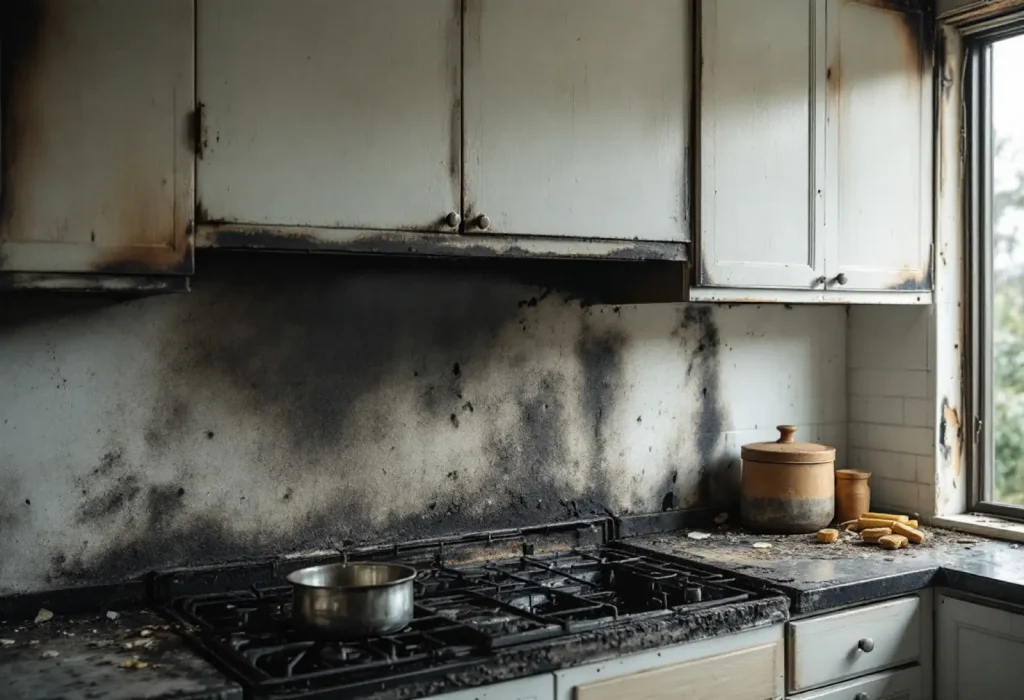
The short answer
Does homeowners insurance cover fire damage? Under the standard ISO HO-3 form, yes: the house, other structures, belongings and added living costs are insured against fire, up to limits and after a deductible. Coverage ends if any insured sets the fire, and vacancy beyond 60 days can put arson in dispute, so read your declarations and endorsements.
Which HO-3 clause answers each of these 6 fires?
Insurer explainers often stop at “yes, fire is a covered peril”. Progressive‘s, for one, cites no form language and carries a disclaimer that it refers to no specific policy. The table below takes six situations and maps each to the ISO HO 00 03 10 00 form, the sample the Insurance Information Institute publishes. Clause numbers are from that 10 00 edition, and newer ISO editions and carrier filings can differ, so match them to the form number on your declarations page.
| The fire | Clause that answers it | What decides it | Then |
|---|---|---|---|
| Kitchen fire you started by accident | Coverage A risk of direct physical loss; Coverage C peril 1, Fire Or Lightning; Coverage D if not fit to live in | Carelessness is not an exclusion in the form. Intentional Loss needs intent to cause a loss | Prompt notice; protect from further damage |
| A resident relative or other insured set it | Section I Exclusion A.8, Intentional Loss | “No insured” is entitled, even those who did not take part | Ask your state insurance department about innocent co-owner rules |
| Tenant commits arson | A tenant is not an “insured” unless a resident relative or minor in care, so A.8 does not reach the act | Form requires that you reside there. Rented unit in your two to four family home: Landlord’s Furnishings up to $2,500 per apartment | Whole house rented out falls outside that definition; ask about a dwelling fire or landlord policy |
| Neighbor’s house fire spreads to yours | Coverage A and B; Coverage C peril 1 and peril 7, Smoke | Civil authority order: Coverage D for no more than 2 weeks. Firebreak ordered during a fire is carved out of Exclusion A.9 | Your insurer can take an assignment to pursue the neighbor |
| Wildfire smoke, house still standing | Coverage A needs “direct physical loss”. Smog and smoke from agricultural smudging or industrial operations are excluded; wildfire is not named | Coverage C peril 7 needs “sudden and accidental” smoke damage | Fight is over proof of physical damage, covered below |
| Vacant house burns | Fire peril has no vacancy limit. Vandalism and its ensuing loss end after 60 consecutive days | A set fire may be argued as vandalism; that clause does not reach an accidental one | Also check you still meet “where you reside” |
What actually removes fire coverage: intent, neglect or fraud?
Three clauses do the work. Exclusion A.8, Intentional Loss, applies to “any act an insured commits or conspires to commit with the intent to cause a loss”, and it voids coverage for every insured. Condition Q, Concealment Or Fraud, does the same when any insured misrepresents a material fact, before or after the loss, so an inflated contents list can sink an honest fire.
Neglect is the misread one. Exclusion A.5 means neglect “to use all reasonable means to save and preserve property at and after the time of a loss”. It is about what you do when the fire starts and afterwards, such as leaving a broken window open to rain, not about old wiring beforehand. The form’s Reasonable Repairs coverage pays for measures taken solely to protect damaged property, and the first-days sequence is in what to do after a house fire. Old wiring raises a different clause: Coverage A excludes loss caused by wear and tear, then says any ensuing loss not otherwise precluded is covered, which is the sentence to raise if a worn part started the fire.
Does a house empty for more than 60 days lose fire coverage?
Not by the fire peril’s own words, though some summaries list vacant homes as a flat exclusion. In the ISO HO 00 03 10 00 form, the 60 consecutive day clock appears on glass breakage and on “vandalism and malicious mischief, and any ensuing loss caused by any intentional and wrongful act committed in the course of” it. Nothing in the fire language mentions vacancy. The older statutory text is harsher: N.Y. Insurance Law 3404 and Cal. Ins. Code 2071 both say the insurer is not liable while a building “is vacant or unoccupied beyond a period of” 60 consecutive days, unless otherwise provided in writing, and that text adds “unoccupied” where the HO-3 says only “vacant”.
The live dispute is arson by a stranger. In American Mutual Fire v. Durrence, an Eleventh Circuit panel in 1989 applied a 30-day vandalism clause to a Georgia house “evidently set by an unidentified arsonist”, empty but for a refrigerator, stove, washing machine and small table, with utilities off about 60 days. In Southern Trust v. Phillips, the Tennessee Court of Appeals in 2015 went the other way on a 30-day clause, holding that the policy “unambiguously provides coverage for fire and/or arson” at a vacant dwelling. Neither policy matches the 10 00 form, whose “ensuing loss” wording gives an insurer a further argument that a Tennessee-style policy did not, in our reading.
Before leaving a house empty, ask your agent three things in writing: which clause carries a vacancy clock, how the policy defines vacant if at all, and whether a vacancy endorsement or separate policy is available past day 60. Also check you still meet the form’s “residence premises”, the dwelling “where you reside”. A vacancy clause is not the only question once you have moved out: the proof of loss also asks you to state changes in title or occupancy during the policy term.
How much does each part of an HO-3 pay on a $400,000 house?
The percentages come from the HO-3 form and the dollar column is our arithmetic on an example $400,000 Coverage A. Coverages C and D carry no percentage in the form text; their limits are whatever your declarations page prints. Fire also reaches Coverage A differently from Coverage C. The house is insured against any direct physical loss unless excluded, while belongings need one of 16 named perils, and that difference is why smoke disputes read differently for walls and for sofas.
| Coverage or extra | Limit from the form | What the clause says |
|---|---|---|
| Coverage A, dwelling | Declarations; example $400,000 | Replacement cost without depreciation if insured to 80% or more of replacement cost |
| Coverage B, other structures | 10% of A: $40,000 | Does not reduce A. Excludes structures rented to non-tenants or used for business |
| Coverage C, belongings | Declarations | Named perils; fire is peril 1. Settles at actual cash value in the base form |
| Coverage D, loss of use | Declarations | Necessary increase in living costs, for the shortest time required to repair or for your household to settle |
| Debris removal | Extra 5% of the limit: $20,000 | Only when damage plus debris cost exceeds the limit |
| Ordinance or law | 10% of A: $40,000 | Increased cost from code enforcement |
| Trees and plants | 5% of A: $20,000 | $500 per tree or plant; fire is a listed peril |
| Fire department charge | $500 | No deductible. Not if you sit inside the responding district’s limits |
| Property removed | 30 days | Belongings moved out of danger are insured from any cause during that time |
Payout timing sits in the same document. Per the form, buildings are paid at replacement cost only under the 80% test above, and you have 180 days after the loss to say you will claim the additional amount if you first take actual cash value less recoverable depreciation. Mortgage lenders are named on building payments under the Mortgage Clause, which is why an insurance check can go through the mortgage company. Our loss of use coverage page handles living costs, and Coverage D’s period is not limited by the policy expiring.
If wildfire risk costs you the policy, what does a FAIR Plan cover?
The word wildfire does not appear in the HO-3 form: a wildfire is fire under peril 1 and under Coverage A. Non-renewal or an added endorsement can still change that, so read the declarations each renewal. California publishes year-by-year counts. The California Department of Insurance fact sheet shows FAIR Plan new and renewed policies rising from 141,391 in 2015 to 324,954 in 2023, up 130%, and from 1.6% to 3.7% of the residential market.
Be careful with non-renewal headlines. The department counted 788,485 non-renewed or canceled voluntary-market policies in 2023, but says past research shows 75% to 80% of non-renewals are initiated by policyholders. If those shares held in 2023, which the sheet does not state, insurers initiated roughly 157,697 to 197,121: that range is our arithmetic. A California insurer also cannot non-renew solely because a wildfire occurred in your area for one year after a declared emergency, in ZIP Codes within or adjacent to the perimeter, under Cal. Ins. Code 675.1(b)(1).
A FAIR Plan is not an HO-3 replacement. The department describes it as “basic fire insurance coverage” and says water damage, theft and liability need a separate wrap-around Difference-in-Conditions policy. In 2023, the department's county tables show 207,728 such policies against 324,954 FAIR policies, so about 117,226 fewer. Ask the plan or your broker which perils and which smoke wording apply, and ask your state insurance department what residual market exists outside California, since this sheet covers only that state.
Is wildfire smoke with no flames at the house covered?
This row has the least settled law: the findings in AB 1795, Chapter 240 cite “unsettled case law”, and our smoke damage insurance claim page covers how to run one. The California smoke task force report of March 2026 estimated more than 40,000 claims from the January 2025 fires, more than 13,000 of them for standing homes with smoke damage. It records cases going both ways: Gharibian v. Wawanesa (2025) found no coverage where debris from a fire half a mile away was “easily cleaned” and the owners cleaned it themselves, while Bottega v. National Surety (N.D. Cal. 2025) found direct physical loss on a policy naming smoke. Proof matters too: in Shirley v. Allstate (2020), four inspectors found no fire contamination and a reported smoke smell did not carry the claim.
California changed its rules in 2026. That act, chaptered 15 September 2026 and tied to AB 1642, Chapter 239, adds Insurance Code 2060.1 and 2060.2 for wildfire impact zones: a rebuttable presumption that smoke found in a surviving home came from that wildfire, an insurer inspection within 30 calendar days of notice if it chooses to inspect, and additional living expenses that continue until the home is cleared, subject to the limit. The FAIR Plan’s “permanent physical” test was held unlawful by a Los Angeles trial court in Aliff (June 2025), a non-binding ruling, and the department filed an enforcement action against the FAIR Plan on 31 July 2025 citing at least 418 violations. Section 2060.2 applies to claims occurring on or after its operative date, so ask the department whether yours falls under it.
California also sets floors on the living-cost clock. Under Cal. Ins. Code 2060(b), a covered loss tied to a declared state of emergency carries additional living expenses for at least 24 months, plus up to 12 more for delays beyond your control, and (c) requires at least two weeks for a civil-authority order in an emergency, where the form’s 2 weeks is a ceiling. Soot from a furnace is a different claim again: the form’s Smoke peril names “puffback”, and our puffback page covers it.
What must you do within 60 days to keep the claim alive?
Condition B of the HO-3 form lists the duties, and an insurer can refuse only where failing them is prejudicial to it. Give prompt notice, protect the property, and prepare an inventory showing quantity, description, actual cash value and amount of loss, with receipts attached. Then send a signed, sworn proof of loss within 60 days after the insurer asks, and expect possible examination under oath, which the form allows outside the presence of other insureds.
- Suit deadline: Condition G sets 2 years after the date of loss in this form. Ask your state insurance department or an attorney whether your state or endorsement changes it.
- Payment timing: Condition I pays 60 days after proof of loss and an agreement, judgment or appraisal filing. Ask the adjuster for any state rule that is shorter.
- Disputed amount: Condition E lets either side demand appraisal, with each appraiser chosen within 20 days. It settles amount, so ask whether your dispute is about amount or coverage first.
- Your own policy: ask your agent for the certified policy with all endorsements. Every clause on this page comes from a sample, and only that copy controls. The insurance hub links the rest of the claim steps.
Questions people actually ask
Does home insurance cover fire damage if I caused it by accident?
The HO-3 form does not exclude carelessness. Exclusion A.8 turns on an insured’s intent “to cause a loss”, so a pan left on the stove sits within peril 1 and Coverage A’s open wording. A claim can still shrink by your deductible and limits. Ask your carrier if any endorsement changes this, and whether a citation or criminal charge from the same event would affect the claim.
Does homeowners insurance cover a fire caused by old wiring?
Nothing in the HO-3 form‘s fire language asks how old the wiring was. Coverage A excludes loss caused by wear and tear, and the same section says any ensuing loss not otherwise precluded is covered, which is the wording to raise with an adjuster. Ask your carrier whether an underwriting condition on wiring was added at issue, since that would show on the endorsements.
Is a fire set by arson covered by homeowners insurance?
It turns on who set it. If any insured did, Exclusion A.8 removes coverage for all insureds under the HO-3 form. If a stranger or tenant did, the exclusion does not apply on its words, and the live question becomes vacancy beyond 60 days. Expect an investigation and possibly an examination under oath, which Condition B allows, and note that Condition Q voids coverage for material misstatements.
Does homeowners insurance pay to replace a detached garage after a fire?
Coverage B of the HO-3 form covers other structures up to 10% of Coverage A, which is $40,000 on a $400,000 house, without reducing the house limit. It excludes structures rented to someone who is not a tenant of the dwelling, and structures used for a business, with limited exceptions. Ask your agent to raise the limit if the garage would cost more to rebuild.
How long do I have to file a fire insurance claim?
The HO-3 form asks for “prompt notice” with no day count, and then sets clocks after that: proof of loss 60 days after the insurer’s request, 180 days to claim replacement cost after taking actual cash value, and suit within 2 years of the loss. Your state insurance department can say whether state law extends any of them, especially after a declared emergency.
Sources
- Insurance Services Office, Homeowners 3 Special Form, HO 00 03 10 00, sample published by the Insurance Information Institute, retrieved 2 November 2026.
- New York State via Public.Law, Insurance Law 3404, Fire insurance contracts, retrieved 2 November 2026.
- California Legislature via Public.Law, Insurance Code 2071, 675.1 and 2060, retrieved 2 November 2026.
- U.S. Court of Appeals, Eleventh Circuit, American Mutual Fire Insurance Co. v. Durrence, 872 F.2d 378, 3 May 1989, retrieved 2 November 2026.
- Court of Appeals of Tennessee, Southern Trust Insurance Co. v. Phillips, 10 June 2015, retrieved 2 November 2026.
- California Department of Insurance, Summary on Residential Insurance Policies and the FAIR Plan, 13 January 2025, retrieved 2 November 2026.
- California Department of Insurance, Residential Insurance Policy Analysis by County, 2020 to 2023, retrieved 2 November 2026.
- California Department of Insurance, Smoke Claims and Remediation Task Force Report, March 2026, retrieved 2 November 2026. Gharibian, Bottega, Shirley and Aliff are cited as that report describes them.
- California Department of Insurance, press release on legal action against the FAIR Plan, 31 July 2025, retrieved 2 November 2026.
- Digital Democracy (CalMatters), AB 1795, Smoke Damage Recovery Act, chaptered text and AB 1642 status, retrieved 2 November 2026.
- Progressive, Does home insurance cover fire?, retrieved 2 November 2026.
This page reads policy forms, statutes and regulator data and is not legal or insurance advice. It does not say what your policy pays: your declarations, endorsements and state law control. Your state insurance department and a licensed agent or attorney can answer for your claim, using the questions above; California’s consumer hotline is 800-927-4357. Method: how we source and check our figures.