The short answer
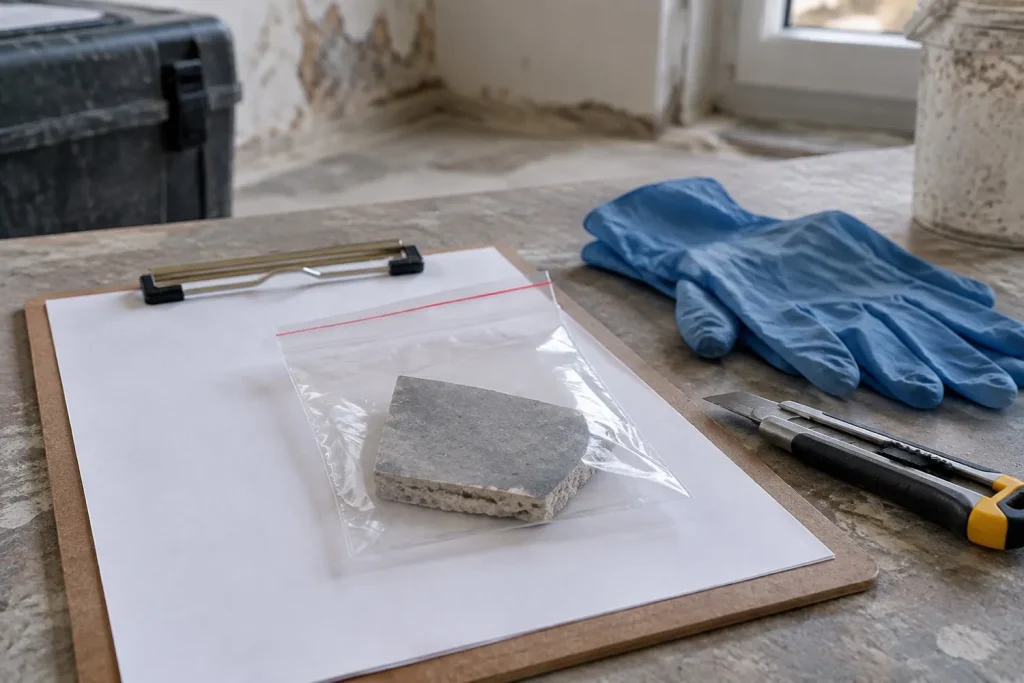
An asbestos testing kit is a sampling container plus prepaid laboratory analysis. The kit itself tests nothing: the laboratory does the work. Kit plus analysis typically costs $30 to $60 for a single sample, and standalone laboratory analysis runs roughly $25 to $75 per sample. Whether you may take the sample yourself depends on whether the material is friable and on where the building sits.
Key takeaways
- The kit is a container and a prepaid envelope. Every result you get comes from a laboratory, so the laboratory’s accreditation matters more than the brand on the box.
- Polarised light microscopy is the standard method for bulk building materials. Transmission electron microscopy is used for air samples and for confirming very low concentrations.
- Friable versus non-friable is the governing distinction. Friable material crumbles under hand pressure and releases fibres, which is why it is not a do-it-yourself sampling job.
- Do not sample friable or damaged material. Many jurisdictions also require an accredited professional for any sampling in commercial and public buildings.
- Accreditation for professional sampling is effectively universal across states: either the state operates an EPA-approved programme or federal requirements apply directly. EPA publishes per-state contacts.
On this page
- What this page covers, and what it does not
- What is actually in the kit
- Kit and laboratory pricing
- PLM, TEM and the other methods
- Laboratory accreditation
- Where asbestos was commonly used
- The date question, and why 1980 is not a line
- Friable versus non-friable
- When not to sample at all
- Who is allowed to take a sample
- Sampling procedure, where it is permitted
- Reading the laboratory report
- Questions people actually ask
An asbestos testing kit is one of the few products where the thing in the box does almost nothing and the service behind it does everything. The box holds a bag, a label and a prepaid mailer. The answer comes from a laboratory technician looking at your sample under a microscope. Understanding that split is what lets you judge whether a kit is a reasonable purchase or the wrong tool for your situation.
What this page covers, and what it does not
Scope boundary, stated deliberately. This page covers sampling procedure, material identification, laboratory method, cost and the accreditation framework. It does not cover health effects, disease, symptoms or medical risk, and it will not attempt to tell you what any exposure means for your health. Those are clinical questions, and they belong with a clinician and with federal health and occupational sources. For occupational exposure rules and controls, OSHA asbestos safety and health topic page is the authoritative federal starting point, and EPA asbestos laws and regulations covers the regulatory framework. If you have a health concern about a specific exposure, speak to a doctor.
We are explicit about that boundary because it changes what this page is useful for. If your question is whether a floor tile contains asbestos, how to get it analysed, what the analysis costs and whether you are permitted to take the sample yourself, this page answers it. If your question is about a medical outcome, this page is the wrong document and no amount of detail here would make it the right one.
What is actually in the kit
Retail kits differ mostly in packaging. The functional contents are consistent, and the analysis is the part you are buying.
| Component | What it is for | What it does not do |
|---|---|---|
| Sample bag or container | Holds the material sample and seals it so fibres do not escape in transit | Does not detect anything. It is a container. |
| Label and submission form | Records material description, sample location, date and requested analysis method | Not a chain-of-custody document in the formal sense unless the kit provides one. |
| Prepaid mailer | Ships the sample to the laboratory named by the kit vendor | Does not let you choose the laboratory or the method. |
| Prepaid analysis credit | Pays for one sample analysed by one method, usually PLM | Extra samples and other methods are charged separately. |
| Instruction sheet | Wetting, sampling technique, quantity needed, packaging | Cannot make sampling friable material safe or lawful. |
| Sometimes disposable gloves and a spray bottle | Basic handling and wetting to suppress dust release | Not respiratory protection, and not a substitute for it. |
The vendor’s laboratory is the actual product
Because every result comes from the laboratory, the question worth asking before buying is which laboratory the kit ships to, what accreditation that laboratory holds for the requested method, and what the reported detection limit is. A kit that does not name its laboratory is selling you an unknown. A laboratory that will take samples directly, without any kit, is frequently the cheaper route for more than one sample.
Colour-change and instant-read products
Products that promise an immediate on-the-spot asbestos reading without laboratory analysis should be treated with scepticism. Asbestos identification in bulk material is a microscopy problem: it depends on fibre morphology and optical properties observed under specific conditions. There is no consumer-level chemical indicator that substitutes for that, and the recognised methods in the regulatory framework are microscopy-based.
Kit and laboratory pricing
The bands below are compiled from published retail product listings and published laboratory price lists current in 2026. They are indicative rather than survey output. Bulk material analysis is the cheap end; air analysis by electron microscopy is several times the price and answers a different question.
| What you are buying | Typical price | Method | Notes |
|---|---|---|---|
| Retail kit, one bulk sample, analysis included | $30 to $60 | PLM | Convenient for a single question. Expensive per sample if you have several. |
| Standalone laboratory analysis, bulk sample | $25 to $75 per sample | PLM | Usually cheaper per sample, and you choose the laboratory. |
| Point counting, added to a PLM result | $20 to $50 extra per sample | PLM with point count | Used to quantify low percentages more precisely than visual estimation. |
| Rush or same-day turnaround | Commonly 1.5x to 3x the standard fee | Any | Worth it when a project is held up, otherwise not. |
| Air sample analysis by phase contrast microscopy | $15 to $40 per sample | PCM | Counts fibres, does not identify them as asbestos. Used for occupational monitoring. |
| Air sample analysis by electron microscopy | $75 to $250 per sample | TEM | Identifies and counts at low concentrations. The clearance method after abatement. |
| Professional survey of a building | $400 to $1,200 typical residential | Multiple | An accredited inspector, a sampling plan, and a written report rather than a single number. |
Why a survey can cost less than a pile of kits
A single question about a single material is what a kit is for. A renovation that will disturb flooring, a ceiling coating, pipe insulation and a section of cement sheet is four or five materials, each needing more than one sample to characterise properly. At that point the arithmetic turns: eight retail kits at $45 is $360 without a sampling plan, a report, or anyone accredited having chosen where the samples came from. A professional survey in the $400 to $1,200 band produces a document a contractor can work from.
PLM, TEM and the other methods
Four methods appear on laboratory price lists, and they are not interchangeable. Each is matched to a sample type and a question. Our guide to the types of asbestos explains how polarised light microscopy tells the minerals apart.
| Method | Full name | Sample type | What it answers |
|---|---|---|---|
| PLM | Polarised light microscopy | Bulk building material | Whether asbestos is present, which type, and an estimated percentage. The standard method for bulk materials. |
| PLM with point counting | Polarised light microscopy with point count | Bulk building material | A more precise quantification at low percentages, where a visual estimate sits near a regulatory threshold. |
| PCM | Phase contrast microscopy | Air, on a filter cassette | A count of fibres meeting a size definition. It does not identify them as asbestos, which is why it is a monitoring tool rather than an identification tool. |
| TEM | Transmission electron microscopy | Air on a filter, or bulk material for confirmation | Identifies and counts at very low concentrations, including fibres too thin for light microscopy. The method used for clearance air testing after abatement. |
| SEM | Scanning electron microscopy | Air or bulk, less commonly specified | Morphology and elemental analysis. Used in specific investigative situations rather than routine work. |
Why a negative on one sample is not a negative on the material
Asbestos content in building products was not uniform. Batch variation, patched repairs and multiple layers installed over decades all mean that one negative result describes the piece analysed rather than the whole installation. Professional sampling plans call for multiple samples across a homogeneous material area for exactly this reason, and a single retail kit result is a single data point about a single spot.
Laboratory accreditation
The National Voluntary Laboratory Accreditation Program, NVLAP, operated by the National Institute of Standards and Technology, is the accreditation to look for on bulk asbestos analysis. Laboratories holding it have been assessed against the relevant method requirements and participate in proficiency testing. Where a result may be used for a regulatory purpose, accreditation stops being a quality preference and becomes a requirement of the framework the result sits inside.
- Ask for the accreditation, by name and number. A laboratory that holds it will state it on the report without being asked.
- Check it covers the method you ordered. Accreditation is method-specific, so bulk PLM and airborne TEM are separate scopes.
- Check the report states a detection limit. A result reported as none detected means nothing without knowing the level below which the method cannot see.
- Keep the chain of custody. If the result will ever be used in a dispute, a claim or a disclosure, the paperwork linking the sample to the location and the date is part of the evidence.
Why detection limits matter on a negative result
PLM is a visual estimation method, and its practical reporting floor on bulk material is around one percent, which is also the concentration that appears as a threshold in the federal regulatory definitions summarised at EPA asbestos laws and regulations. A report saying no asbestos detected by PLM is therefore a statement about what PLM can see, not a proof of zero content. Where a result sits near a threshold and the consequence is expensive, point counting or electron microscopy confirmation is the normal next step.
Where asbestos was commonly used
Recognising candidate materials is most of the practical skill, because it tells you what is worth sampling and what is not. The products below are the ones that come up constantly in older buildings.
| Material | Where it appears | Friable when intact | Sampling note |
|---|---|---|---|
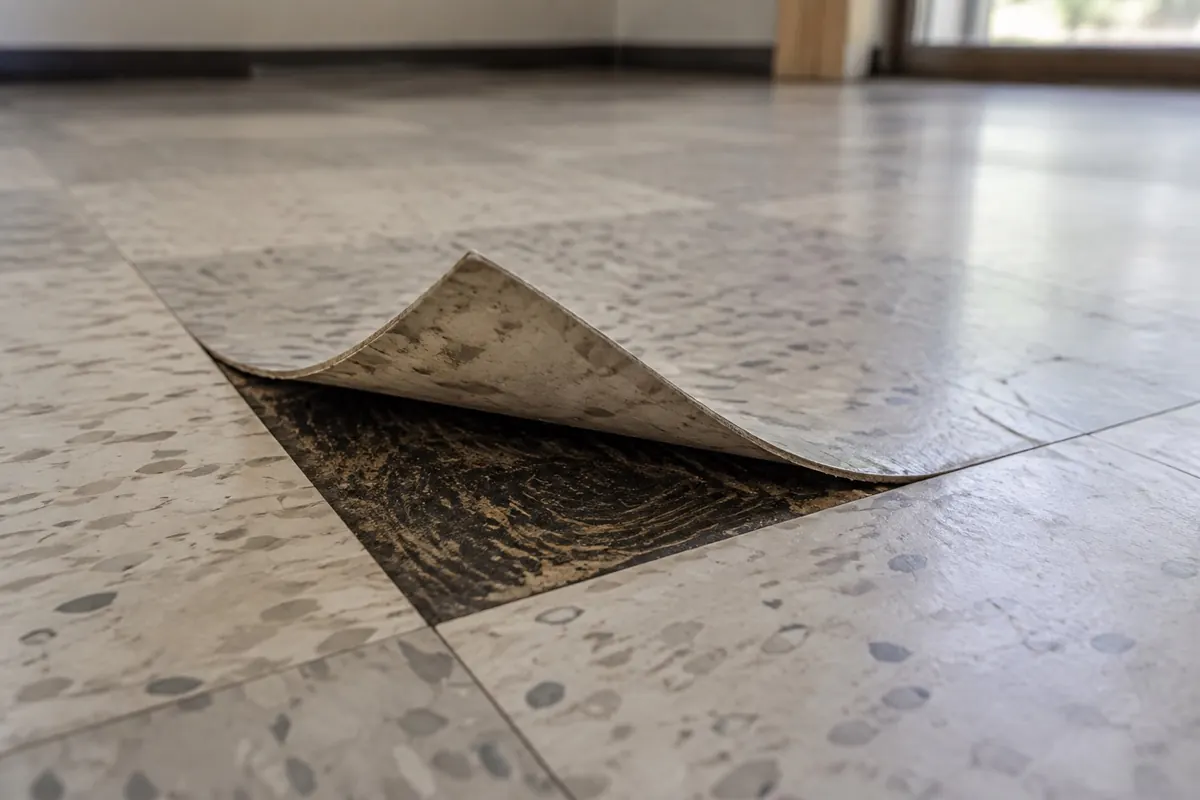
| Vinyl floor tile, 9 by 9 inch | Kitchens, hallways, basements, often under later flooring | No, bound in the tile matrix | The distinctive 9 by 9 inch dimension is itself a flag, because the size largely predates the later 12 by 12 inch standard. |
| Black bituminous adhesive under floor tile | The mastic bonding tile to subfloor, frequently asbestos-containing even where the tile is not | No while intact, yes if dried and crumbling | Sample separately from the tile. Two materials, two results. |
| Pipe and boiler lagging | Basements, boiler rooms, crawl spaces, riser shafts | Yes, commonly, especially where the jacket is damaged | Do not sample. This is the classic case for an accredited professional. |
| Textured coatings and decorative plaster | Ceilings and walls, sprayed or troweled finishes | Yes if the surface is friable or damaged | Frequently over large areas, so extent matters as much as content. |
| Cement sheeting, corrugated and flat | Roofing, siding, soffits, garage and outbuilding walls, flue surrounds | No while intact, yes once broken or weathered to a chalky surface | Breaking it to sample is exactly the wrong approach. Weathered sheet is a different proposition from intact sheet. |
| Vermiculite loft insulation | Attic and wall cavity fill, loose granular material | Yes, it is loose fill by nature | Do not disturb. Loose fill cannot be sampled without releasing material into the space. |
| Roofing felt, shingles and flashing cement | Roof build-ups, patch repairs, flashing details | No while intact | Multiple layers from different decades are common on one roof. |
| Gaskets, rope seals and fire door cores | Boilers, flues, older fire-rated doors | Varies, rope seals commonly yes | Small quantities, awkward locations, frequently missed in surveys. |
Two materials in one place is the commonest trap
The floor tile and adhesive case is worth stating on its own, because it catches people repeatedly. A 9 by 9 inch vinyl tile can test negative while the black mastic underneath tests positive, or the reverse. They are separate products, made by different manufacturers, with separate formulations. One sample of the tile answers one of the two questions. The same logic applies to a textured coating over a plaster base and to shingles over an older felt layer.
The date question, and why 1980 is not a line
Buildings constructed before roughly 1980 are the main population of concern, and that is a useful heuristic rather than a rule. Asbestos use in United States building products declined sharply through the late 1970s and 1980s under federal regulatory action, but it was never subject to a single complete ban covering all products. Some asbestos-containing products remained available, and existing stock continued to be installed after manufacture stopped.
| Construction period | Practical expectation | What follows |
|---|---|---|
| Pre-1950 | High likelihood in insulation, coatings and cement products | Assume presence until sampled. Survey before any disturbance. |
| 1950 to 1980 | The peak population of asbestos building products across flooring, coatings, cement sheet and lagging | Survey before renovation is the default rather than the exception. |
| 1980 to 1990 | Declining but not absent. Remaining stock and some product categories persisted | Do not assume clear on date alone. Sample candidate materials. |
| Post-1990 | Much lower likelihood in most product categories, not zero | Judgement call by material type and by import history. |
| Any period, after renovation | Older material can be present behind newer finishes | Age of the building matters less than the age of the specific layer you are about to disturb. |
The layer matters more than the building. A house built in 2005 can contain asbestos cement flue sheeting salvaged during construction, and a house built in 1930 can have had every candidate material replaced. What you are about to cut into is the question, not the date on the deed.
Friable versus non-friable
This is the distinction that governs everything else: whether you may sample, how the material is handled, what a removal costs, and which regulatory requirements attach. Friable material can be crumbled, pulverised or reduced to powder by hand pressure, and releases fibres when it is disturbed. Non-friable material holds fibres bound in a matrix such as vinyl, cement or bitumen.
| Attribute | Friable | Non-friable, intact | Non-friable, damaged |
|---|---|---|---|
| Physical test | Crumbles under hand pressure | Resists hand pressure, fibres bound in matrix | Matrix broken, weathered, delaminating or powdery |
| Fibre release when disturbed | Readily | Low while undisturbed | Behaves closer to friable, which is the point |
| Typical examples | Pipe lagging, sprayed coatings, loose fill insulation | Floor tile, cement sheet, intact mastic | Weathered cement sheet, cracked lagging jacket, dried crumbling mastic |
| Can an owner sample it | No | Sometimes, subject to jurisdiction and building type | Treat as friable. No. |
| Controls on removal | Full containment and negative air as the norm | Lower, but still regulated work practices | Escalates toward the friable requirement |
| Effect on cost | Materially higher because of containment | Lower | Higher than intact, because condition drives controls |
Condition can move a material across the line
A sheet of asbestos cement siding that has been on a wall for fifty years is not in the condition it left the factory in. Weathering erodes the cement matrix and leaves a chalky surface that releases material when brushed. The product category says non-friable; the condition in front of you may not. This is why assessments describe condition, not just material type, and why a survey from ten years ago is not a current description of a weathered exterior.
Why friability drives the price of everything downstream
Containment, negative air pressure and the associated work practices cost the same to establish whether the area is small or large. Friable material generally requires them; intact non-friable material often does not, or requires less. That single distinction is the largest line item in the difference between two abatement quotes on the same square footage. Our asbestos removal cost page sets out how that flows through to the numbers.
When not to sample at all
There are situations where the right action is to stop, leave the material alone and call someone accredited. This list is not cautionary padding: sampling the wrong material yourself creates the release it was meant to characterise.
- The material is friable. Pipe lagging, sprayed coatings, loose fill. Cutting into these releases fibres into the space you are standing in.
- The material is already damaged. Cracked, delaminating, water-stained, crumbling or weathered to a chalky surface. Condition has moved it across the line.
- It is a commercial, industrial, public or multi-unit building. Accredited sampling is commonly required, and a self-taken sample may be inadmissible for the purpose you need it for.
- A regulated project is planned. Demolition and renovation projects carry notification and survey requirements, and a kit result does not satisfy a survey requirement.
- You cannot reach it safely. Height, confined space, live electrical or mechanical plant. The asbestos is not the only hazard in a boiler room.
- It is loose fill insulation. There is no way to take a representative sample of loose granular material without disturbing the bulk of it.
- The result will be contested. Insurance, litigation, a sale disclosure or a landlord dispute all need a chain of custody and an accredited sampler behind the number.
The narrow case where a retail kit is a reasonable purchase: owner-occupied single family home, one intact non-friable material such as a 9 by 9 inch floor tile or a piece of intact cement sheet, you are the only person present, the result is for your own planning, and your jurisdiction does not require accredited sampling in that setting. Outside that, use a professional.
Who is allowed to take a sample
This is where people most often assume federal law does not reach them, and the structure of the framework is worth understanding precisely. Under the Asbestos Hazard Emergency Response Act and EPA’s Model Accreditation Plan, training and accreditation requirements for asbestos inspectors, management planners, project designers, abatement workers and supervisors are set federally. States either operate their own programme approved by EPA, or the federal requirements apply directly.
The practical consequence is that accreditation requirements are effectively universal across states. There is no state where professional asbestos inspection sits outside a framework. What varies is which body administers it, what the state adds on top, and which building categories are captured. EPA maintains a per-state contact list at EPA state asbestos contacts, and that is the correct place to start for any specific jurisdiction question rather than a general summary.
| Setting | Who may usually sample | What else attaches |
|---|---|---|
| School buildings | Accredited inspector. AHERA built the original accreditation framework around school inspections | Management plans, periodic surveillance and re-inspection requirements. |
| Public and commercial buildings | Accredited inspector in most jurisdictions | Survey before renovation or demolition, and notification requirements on regulated projects. |
| Multi-unit residential | Commonly treated as commercial, depending on jurisdiction and unit count | Tenant notification obligations may apply separately. |
| Owner-occupied single family home | Frequently the owner may sample intact non-friable material, jurisdiction permitting | Disposal is still regulated, and contractors working there have their own obligations. |
| Any workplace, including a home being worked on by a contractor | Employer obligations attach regardless of who owns the building | Workplace exposure controls sit with OSHA asbestos safety and health topic page. |
| Demolition or renovation of a regulated structure | Accredited inspector, and a thorough survey rather than spot sampling | Notification to the delegated authority before work begins. |
Disposal is regulated even where sampling is not
An owner permitted to sample a floor tile is not thereby permitted to put the removed tile in household waste. Asbestos-containing waste goes to a facility permitted to accept it, and the tipping fee and documentation are part of any removal cost. That obligation is independent of who took the sample, and it is one of the reasons a do-it-yourself removal saves less than people expect.
Licensing for removal is a separate question from sampling
Being permitted to sample says nothing about being permitted to remove. Abatement licensing, work practice requirements and notification thresholds are separate, and they are where most of the regulatory weight sits. Our state licensing review covers the comparable pattern on the mould side, where the variation between states is much wider because there is no equivalent federal accreditation backstop.
Sampling procedure, where it is permitted
Where sampling is lawful and the material is intact and non-friable, the procedure is about one thing: taking a representative piece without creating airborne material. The published guidance in federal sources is consistent on the principles below.
| Step | What it involves | Why |
|---|---|---|
| Stop any work first | No sanding, cutting, drilling or sweeping in the area before or during sampling | Mechanical disturbance is what releases fibres. Sampling into a dusty room defeats the purpose. |
| Shut down air movement | Turn off HVAC and fans, close the room | Prevents anything released from being distributed through the building. |
| Wet the sampling point | Light mist of water with a small amount of detergent | Suppresses dust release at the cut. This step is doing most of the work. |
| Take a small piece, through the full thickness | A piece through all layers of the material, not a surface scrape | Layered products differ by layer. A surface scrape can miss the asbestos-containing layer entirely. |
| Seal immediately | Into the container, sealed, then into a second bag | Double containment for transit. The container is the only control once it leaves your hands. |
| Seal the sampling point | Patch or tape over the spot where material was removed | Leaves the remaining material in a lower-release condition than you found it. |
| Label with location and date | Room, exact position, material description, date and who sampled | A result with no location is an unusable result, especially if a second sample follows. |
| Record what was cleaned up | Wet wipe the immediate area, dispose of the wipe with the sampling waste | Do not dry sweep or vacuum with a household machine. |
How many samples, and from where
Professional practice treats a homogeneous material area as the unit, and takes more than one sample from each, because content varies within a single installation. For an owner sampling one material for planning purposes, the working assumption should be that one sample characterises one spot. If the answer will drive a decision worth thousands of dollars, the cost difference between one sample and three is trivial against being wrong.
Layered assemblies need layered sampling
Flooring is the standard example. Tile, mastic, an older tile beneath, an older mastic beneath that, and a felt underlay is a realistic cross-section in a building that has been refloored twice. A sample that captures the top tile only answers about the top tile. Where the plan is to remove down to subfloor, every layer being disturbed is a separate material for sampling purposes.
Reading the laboratory report
The report is short and easy to misread. Five fields carry the meaning.
- Method used. PLM, PLM with point count, PCM or TEM. The method bounds what the result can say.
- Result per layer. A layered sample should be reported layer by layer. One combined figure for a multi-layer sample is less useful than it looks.
- Asbestos type. Chrysotile, amosite, crocidolite and the others are reported separately because they are different minerals with different regulatory treatment.
- Percentage, and how it was derived. Visual estimate or point count. Near a threshold, that difference decides the answer.
- Detection limit and none-detected language. None detected by the stated method is not the same statement as zero content, and a competent report is careful about the difference.
One further practical point. Keep the report. Where a positive result exists on a material that stays in place, that document becomes part of the management record for the building: what is there, where, in what condition, and when it was last assessed. It is also what a future contractor needs before opening the wall, and what a buyer’s surveyor will ask for. Our methodology sets out how we source and label the figures used on this page.
Questions people actually ask
Do asbestos testing kits actually work?
The kit is a container plus prepaid laboratory analysis, so the question is really whether the laboratory is any good. Analysis by an accredited laboratory using polarised light microscopy is a recognised method for bulk materials. What a kit cannot do is choose a representative sampling location, cover multiple materials, or make sampling friable material safe or lawful.
How much does asbestos testing cost?
A retail kit with analysis included typically runs $30 to $60 for one sample. Standalone laboratory analysis of a bulk sample runs roughly $25 to $75 per sample, air analysis by electron microscopy $75 to $250, and a professional residential survey $400 to $1,200. These are indicative bands compiled from published listings current in 2026.
Can I take an asbestos sample myself?
Sometimes, in an owner-occupied single family home, on material that is intact and non-friable, where the jurisdiction permits it. Do not sample friable or damaged material, and be aware that accredited sampling is commonly required in commercial, public, school and multi-unit buildings. EPA publishes per-state contacts for checking a specific jurisdiction.
What is the difference between friable and non-friable?
Friable material crumbles under hand pressure and releases fibres readily when disturbed, such as pipe lagging, sprayed coatings and loose fill insulation. Non-friable material holds fibres bound in a matrix, such as vinyl floor tile or cement sheet, and releases far less while it stays intact and undisturbed. Damage moves a non-friable material toward friable behaviour.
What is the difference between PLM and TEM analysis?
Polarised light microscopy is the standard method for bulk building materials and reports asbestos type and an estimated percentage. Transmission electron microscopy is used for air samples and for confirming very low concentrations, including fibres too thin for light microscopy, and it is the method used for clearance air testing after abatement.
Does a 1985 house need testing?
Possibly. Use before roughly 1980 as the main population of concern rather than a bright line, because United States asbestos use declined through regulatory action across the late 1970s and 1980s without a single complete ban on all products, and existing stock continued to be installed. The age of the specific layer you are about to disturb matters more than the age of the building.
What should I do if a sample comes back positive?
Do not disturb the material further, and get advice on whether management in place or removal is the appropriate response. Intact non-friable material in good condition is frequently managed rather than removed. If removal is the plan, licensed abatement and permitted disposal apply. If you have a health concern about an exposure, that is a question for a clinician and for the federal health and occupational sources, not for a cost guide.
Sources
- EPA asbestos laws and regulations. United States Environmental Protection Agency, on the federal regulatory framework including AHERA, the Model Accreditation Plan, NESHAP requirements and the regulatory definitions of friable and asbestos-containing material. Retrieved 23 September 2026.
- EPA state asbestos contacts. United States Environmental Protection Agency per-state asbestos contact list, cited for the point that states either operate an EPA-approved programme or federal requirements apply directly. Retrieved 23 September 2026.
- OSHA asbestos safety and health topic page. Occupational Safety and Health Administration, on workplace asbestos requirements, exposure controls and work practices. Retrieved 23 September 2026.
- National Voluntary Laboratory Accreditation Program, operated by the National Institute of Standards and Technology, cited as the accreditation to look for on bulk asbestos analysis.
- Kit prices, laboratory per-sample fees and survey pricing are compiled from published retail product listings and laboratory price lists current in 2026. They are indicative rather than survey results. We have not conducted a pricing survey; when we do, its sample and method will be published with it.
- Scope note: this page covers sampling procedure, material identification, laboratory method and regulation. It does not address health effects or medical risk, which are questions for a clinician and for federal health sources.