The short answer
What is asbestos? It is a commercial and regulatory name rather than one mineral: the fibrous forms of six naturally occurring silicate minerals, chrysotile from the serpentine group plus five amphiboles (crocidolite, amosite, anthophyllite, tremolite and actinolite). Their bundles split into thin, strong, heat resistant fibres, which is why, per the USGS, the United States used 803,000 metric tons of it in 1973 alone.
Key takeaways
- Asbestos is a trade and legal label. USGS calls it a generic designation for six commercially exploited mineral fibres, and EPA and OSHA write the same six names into regulation.
- Chemically it is two families: chrysotile, whose sheets curl into tubes, and the amphiboles, built from double chains of silicate.
- Chrysotile was 97.2% of the US tonnage tallied by mineral for 1900 to 2003, per the USGS.
- Most US asbestos was imported. Domestic mines produced the equivalent of about 10.5% of US use, according to USGS data, and the last one closed in 2002.
- Flooring was the largest US end use from 1965 to 2003, ahead of cement pipe and roofing, per USGS Circular 1255-KK.
- US use in 2025 was an estimated 50 tons, all in chlorine plant diaphragms, per the USGS.
On this page
Most pages ranking for this question answer a different one: what asbestos does to people. This page answers it as asked: what the word means to a regulator and a mineralogist, what the fibres are made of, where they were dug up, what they became, and where that material still sits. Every figure comes from the US Geological Survey, the eCFR or the EPA.
What this page does not cover. Health effects are outside its scope; for exposure, disease and cancer questions, read the EPA’s Learn About Asbestos page, the National Institutes of Health fact sheet or the CDC’s ATSDR ToxFAQs, and speak to a doctor.
The term in three sentences
| Lens | What asbestos means | Source |
|---|---|---|
| In law | Six named asbestiform minerals in EPA and OSHA rules, plus a 1% threshold that makes a product asbestos-containing material. | 40 CFR 763.83, 29 CFR 1926.1101 |
| In mineralogy | Fibrous habits of two silicate groups, serpentine and amphibole. The same minerals also grow in non-fibrous forms that are not asbestos. | USGS Open-File Report 02-149 |
| In commerce | The varieties that were mined and sold. USGS notes the term traditionally covers only commercially exploited varieties. | USGS Open-File Report 02-149, USGS Mineral Commodity Summaries 2026 |
The asbestos meaning in a dictionary and the asbestos definition a lab uses differ on one point: habit. Tremolite that grew as massive, non-fibrous crystals is tremolite; the same chemistry grown as bundles of separable fibres is tremolite asbestos. USGS lists the shared traits: bundles that separate easily, high tensile strength, length to diameter ratios from 20 up to 1,000 according to Open-File Report 02-149, and enough flexibility to be spun.
The legal definitions, side by side
The federal rules all name the same six minerals. They differ in the names used and in what each rule adds on top.
| Rule | How it defines asbestos | What it adds |
|---|---|---|
| 40 CFR 763.83 (EPA, schools) | Asbestiform chrysotile (serpentine), crocidolite (riebeckite), amosite (cummingtonite-grunerite), anthophyllite, tremolite, actinolite. | ACM means more than 1 percent asbestos. |
| 40 CFR 61.141 (EPA, NESHAP) | Asbestiform serpentinite (chrysotile), riebeckite, cummingtonite-grunerite, anthophyllite, actinolite-tremolite. | Friable and Category I and II nonfriable classes. |
| 29 CFR 1926.1101 (OSHA, construction) | The six minerals, including chemically treated or altered forms. | Presumed asbestos containing material (PACM). |
| USGS Mineral Commodity Summaries 2026 (USGS) | Silicate minerals made of bundles of separable fibres with high length to width ratios. | Chrysotile is the only type with significant use this century. |
Two points matter in practice. Every rule keys on the asbestiform variety, so a lab report that says tremolite is half an answer until it says asbestiform. And under 29 CFR 1926.1101, thermal system insulation and surfacing material in buildings constructed no later than 1980 are presumed asbestos until a survey rebuts it. The full vocabulary is on our asbestos containing material page.
What is in asbestos: serpentine and amphibole chemistry
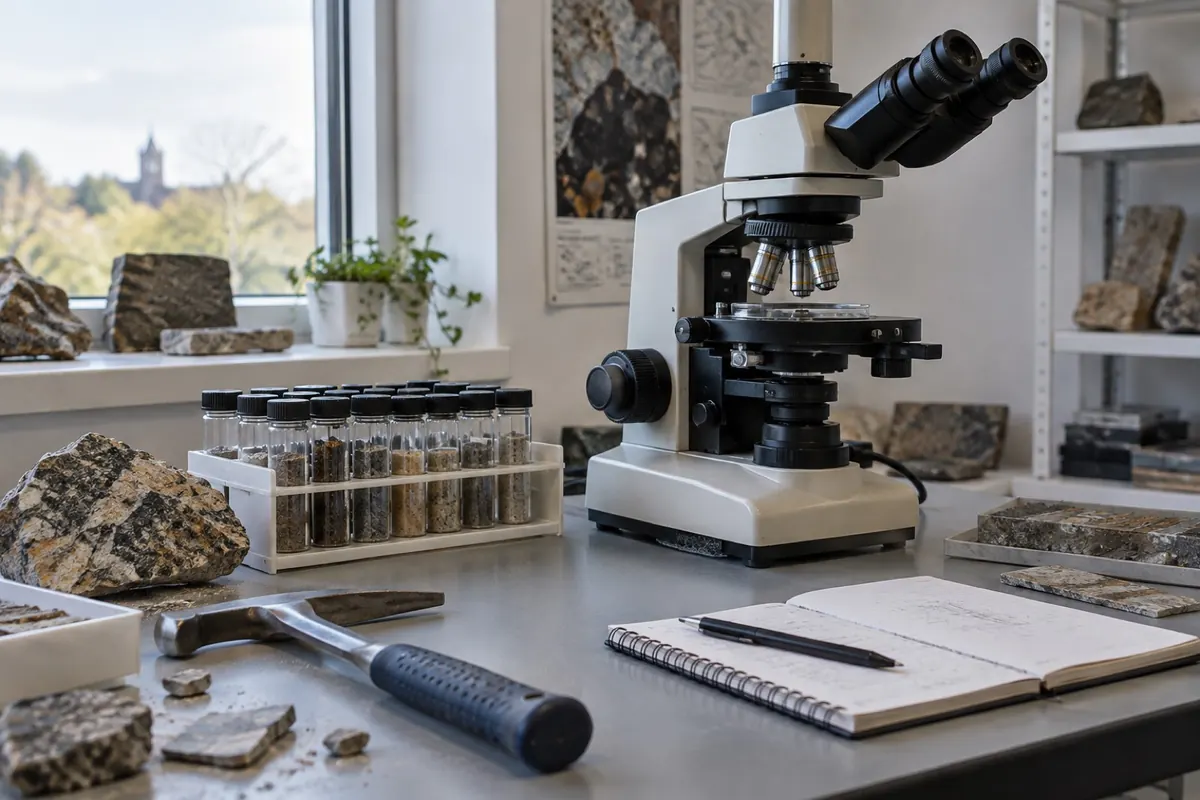
Every asbestos mineral is a silicate: silicon and oxygen tetrahedra bonded to metal ions and hydroxyl. The two families differ in how the tetrahedra are arranged, according to USGS Open-File Report 02-149.
In chrysotile they form sheets, with a magnesium hydroxide (brucite) layer between each sheet. The layers do not match in size, so they curl into a tube: a fibril about 20 to 50 nanometres across. In the amphiboles they form double chains placed back to back, and the crystal does not inherently grow as fibre. USGS says asbestiform amphiboles need specific growth conditions and occur in relatively low quantities.
| Mineral | Group and chemistry | End-member formula | US use, 1900 to 2003 |
|---|---|---|---|
| Chrysotile | Serpentine: hydrated magnesium silicate | Mg3Si2O5(OH)4 | 25,600,000 t |
| Amosite | Amphibole: iron silicate, some magnesium | Fe7Si8O22(OH)2 | 282,000 t |
| Crocidolite | Amphibole: complex sodium iron silicate | Na2Fe3Fe2Si8O22(OH)2 | 365,000 t |
| Anthophyllite | Amphibole: magnesium silicate, some iron | Mg7Si8O22(OH)2 | 90,000 t |
| Tremolite | Amphibole: calcium magnesium silicate | Ca2Mg5Si8O22(OH)2 | Not tallied |
| Actinolite | Amphibole: as tremolite, with iron | Ca2(Mg,Fe)5Si8O22(OH)2 | Not tallied |
Chrysotile dominates the record at 97.2% of the tonnage tallied by mineral, per the USGS Circular. How a lab tells the six apart is on our types of asbestos page.
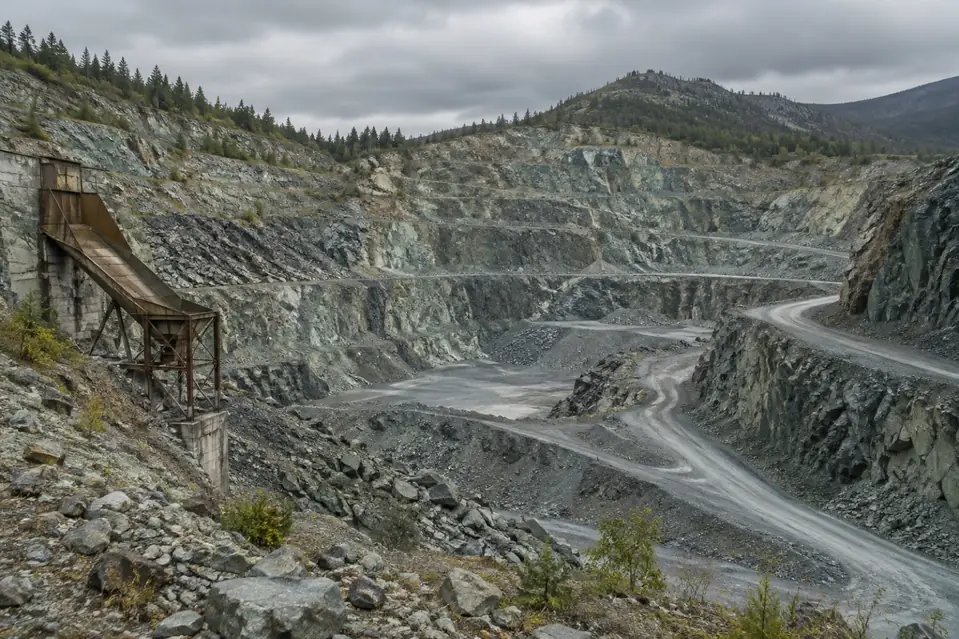
Where asbestos comes from: geology and mining
Asbestos is a mineral fibre that occurs in rock and soil, per EPA's Learn About Asbestos page. USGS describes chrysotile forming in ultrabasic rock that hot fluids first alter to serpentine and later partly recrystallize as fibre, usually in veins that cross cracks at right angles. South African crocidolite formed in banded ironstone, where mechanical stress appears necessary.
Ore grades are low. According to USGS Circular 1255-KK, about 5 percent asbestos is typical of large chrysotile deposits, and mill feed worldwide generally runs 2 to 10 percent. Most mining was open pit.
| State | What was there | Named properties |
|---|---|---|
| Vermont | Chrysotile in the serpentine belt running from Quebec into the Appalachians | Lowell (past producer) |
| California | Chrysotile, including a mass fibre deposit near Coalinga with content approaching 50 percent | Calaveras, Christie, Santa Rita (past producers) |
| Arizona | Chrysotile veins in serpentinized dolomitic limestone, Salt River and Sierra Ancha | El Dorado (past producer) |
| North Carolina, Georgia | Anthophyllite, mostly near Green Mountain, Yancey County, North Carolina | Mined in the past |
Output was small next to demand. Summing the annual data from USGS Data Series 140, US mines produced 3,308,594 metric tons from 1900 to 2002, about 10.5% of the 31,511,659 tons consumed from 1900 to 2022. The rest was imported; USGS describes Canada as the dominant world producer in the first half of the century. The last US mine closed in 2002, per the USGS Mineral Commodity Summaries 2026, the year DS140 records final output of 2,720 tons.
Where is asbestos found in nature? Not only at old mines. USGS has mapped reported natural occurrences from the geologic literature, region by region: 290 in California; 113 in Arizona, Nevada, Utah; 51 in Oregon and Washington; 48 in Colorado, Idaho, Montana, New Mexico, Wyoming. Sources: the USGS California occurrence report, USGS Southwest occurrence report, USGS Oregon and Washington report and USGS Rocky Mountain occurrence report.
What is asbestos used for? A century of US end uses
By 1958 asbestos was reported in about 3,000 applications, according to USGS Circular 1255-KK, thanks to its insulating, incombustible, reinforcing and friction properties. Construction and the automobile industry were the leading consumers.
Consumption peaked at 803,000 tons in 1973, per the USGS commodity summary, and the 2025 estimate is 99.99% lower. Summing data from the DS140 rows, 93.0% of all US use from 1900 to 2022 came before 1980, which is why buildings of that era hold it.
| End use | 1965 % | 1980 % | 2003 % | 1965 to 2003 % |
|---|---|---|---|---|
| Flooring | 25 | 19.5 | None listed | 22 |
| Cement pipe | 19 | 11.7 | None listed | 18 |
| Roofing | 9.9 | 6.7 | More than 80 | 12 |
| Friction products | 8.9 | 14.5 | None listed | 11 |
| Cement sheet | 6.9 | 6.4 | None listed | 6 |
| Unknown or other | 20 | 30.9 | About 17 | 18 |
Flooring took 21.6% of the 1965 to 2003 tonnage, according to Table 15. By 2003, according to the Circular, remaining US use was mostly asphalt roof coatings and sealants. Substitutes listed in the USGS Mineral Commodity Summaries 2026 include cellulose, glass, ceramic and aramid fibres, wollastonite and polypropylene.
Where asbestos is found today
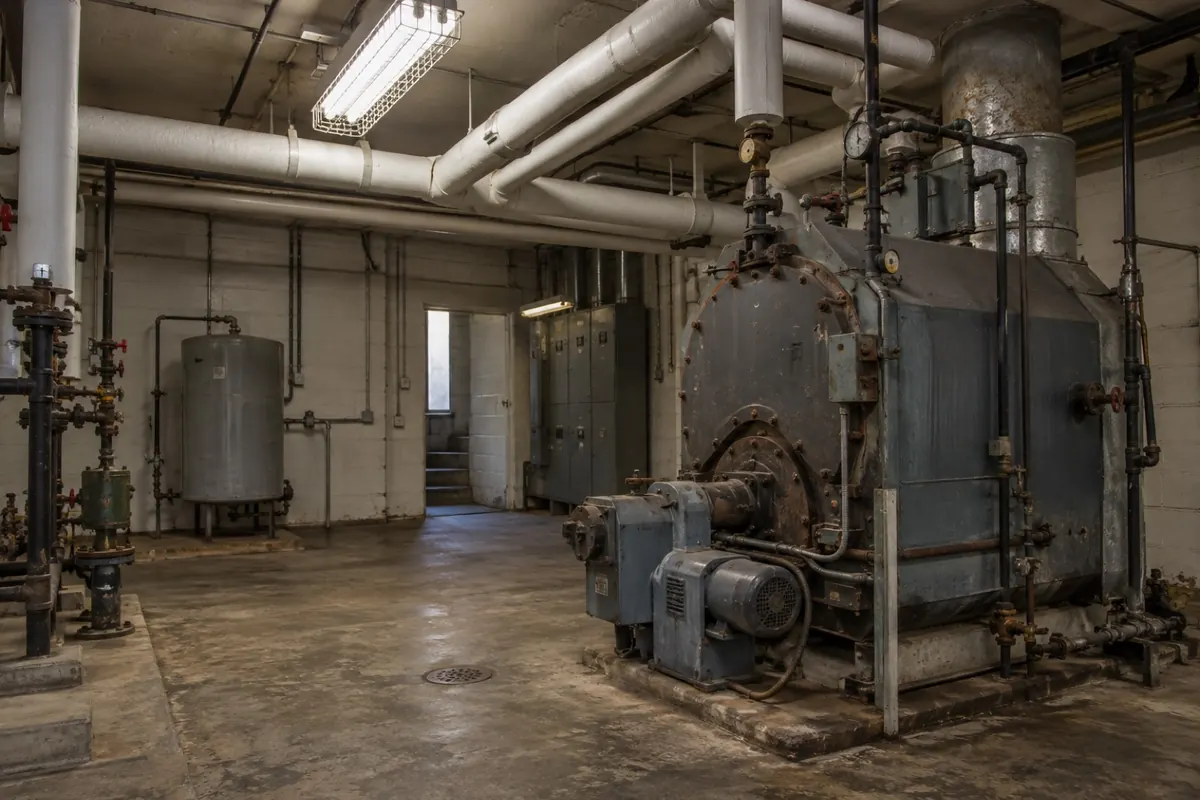
Most asbestos still in place sits in buildings from before the 1980s, the era that took the bulk of US use. EPA's Learn About Asbestos page lists vermiculite insulation, vinyl flooring and adhesives, roofing and siding shingles, textured paint and patching compounds, stove surrounds, pipe coverings, furnace insulation and gaskets.
| Material | Where | Regulatory bucket |
|---|---|---|
| Thermal system insulation | Pipes, boilers, tanks, ducts | PACM if built by 1980; Class I to remove |
| Surfacing material | Sprayed or troweled plaster, fireproofing | PACM if built by 1980; Class I to remove |
| Resilient flooring and mastic | Vinyl tile, sheet backing, adhesive | NESHAP Category I nonfriable |
| Asphalt roofing, cement siding | Roof and wall cladding | Category I (roofing); Class II to remove |
| Vermiculite insulation | Attic loose fill | EPA: treat as asbestos-containing |
| Gaskets and packings | Furnace doors, flanges | NESHAP Category I nonfriable |
Sight cannot settle any of these, which is why our guide to what asbestos looks like ends at sampling. Which homes and rooms are most likely to hold it is covered on houses with asbestos.
Is asbestos still legal?
Asbestos is still used in the US, but barely. The USGS Mineral Commodity Summaries 2026 puts 2025 use at about 50 tons, all from stockpiles, and says chloralkali plants have accounted for all domestic fibre use since no later than 2015. An unknown quantity still arrives inside imported products.
| Date | Event | Source |
|---|---|---|
| 6 April 1973 | EPA promulgates the asbestos NESHAP | EPA asbestos NESHAP overview |
| 2002 | Last US asbestos mine closes | USGS Mineral Commodity Summaries 2026 |
| May 2024 | Imports of raw asbestos fibre fully banned | USGS Mineral Commodity Summaries 2026 |
| 2025 | Use about 50 tons, all chloralkali diaphragms | USGS Mineral Commodity Summaries 2026 |
| 2029 and 2036 | Most chloralkali plants must switch by 2029, the rest by 2036 | USGS Mineral Commodity Summaries 2026 |
| Yearend 2037 | Sheet gaskets, the last permitted imported article, fully banned | USGS Mineral Commodity Summaries 2026 |
Material already in a building is a separate matter. The EPA homeowner guidance says material in good condition that will not be disturbed is usually best left alone; the rules mainly govern how it is handled when work disturbs it. The dated record of bans is on when asbestos was banned.
For contractors: why the definition decides the scope
On a water or fire loss in an older building, whether a material counts as asbestos under 29 CFR 1926.1101 decides the work class, the controls and the line item. The standard covers demolition, removal, renovation, repair, maintenance and spill cleanup, and its coverage turns on the nature of the work.
| Question on the job | What the rule says | What to keep in the file |
|---|---|---|
| Is it asbestos-containing? | More than 1% asbestos, per 1926.1101(b) | PLM report per layer, sample map |
| Can it be presumed? | TSI and surfacing built by 1980 are PACM; asphalt and vinyl flooring installed by 1980 is treated as ACM, per 1926.1101(k)(1) | Build date, or a survey that rebuts it |
| Which class of work? | Class I: TSI and surfacing removal. Class II: other ACM, such as floor tile, shingles, mastic. Class III: repair. Class IV: custodial | Class on the scope and daily log |
| Is it a NESHAP facility? | Excludes residential buildings of four or fewer units, unless part of a commercial or public project, per EPA | Unit count and project type |
Keep the lab report, sample map and inspector’s accreditation with the estimate: together they support any asbestos line. See our asbestos inspection page, our asbestos regulations page and the standards hub.
Questions people actually ask
What is asbestos and why is it treated as hazardous?
Asbestos is the regulatory name for the fibrous forms of six silicate minerals, chrysotile and five amphiboles. EPA says fibres may be released into the air when asbestos-containing material is disturbed or damaged, during use, repair, remodeling or demolition. Health effects are outside this page’s scope; EPA, NIH and CDC publish that guidance.
What is asbestos made of?
Silicate: silicon and oxygen bonded to metals and hydroxyl. Chrysotile is a hydrated magnesium silicate, Mg3Si2O5(OH)4, whose sheets curl into tubes. The amphiboles are double chain silicates carrying iron, magnesium, calcium or sodium; crocidolite is a complex sodium iron silicate, according to USGS Circular 1255-KK.
Where does asbestos come from?
It forms in certain rocks: serpentine altered by hot fluids for chrysotile, iron rich formations for crocidolite and amosite. US deposits were mined in Vermont, California, Arizona and North Carolina, but domestic mines supplied a small share of US use, per USGS data, and the last closed in 2002.
Where is asbestos found?
In nature, in serpentine and some amphibole bearing rock; USGS has mapped 290 reported sites in California alone. In buildings, EPA lists vermiculite insulation, vinyl flooring and adhesives, roofing and siding shingles, textured paint, pipe coverings, furnace insulation and gaskets, mostly from before the 1980s.
Is asbestos still used?
Very little. The USGS estimates 2025 US use at 50 tons, all in chloralkali plant diaphragms, which EPA rules require most plants to replace by 2029 and the rest by 2036. Imports of raw fibre were fully banned in May 2024, though some still arrives inside imported goods.
What products commonly contained asbestos, and what replaced it?
By tonnage the big US uses were flooring, cement pipe, roofing, friction products such as brakes, and cement sheet, per USGS Circular 1255-KK. USGS lists substitutes including calcium silicate, cellulose, glass, ceramic and aramid fibres, wollastonite and polypropylene, and for flooring, alternatives such as ceramic tile, vinyl compositions and wood.
How do I arrange asbestos testing during water damage work in an older building?
Stop before cutting or removing suspect material. OSHA presumes pipe and boiler insulation and sprayed or troweled surfacing in buildings built by 1980 contain asbestos, and treats asphalt and vinyl flooring installed by 1980 the same way, until tested. Have an accredited inspector sample each affected layer. Published lab fees are compared on our asbestos testing cost guide.
What regulations do asbestos removal companies follow?
Federally, OSHA’s construction standard, 29 CFR 1926.1101, for worker protection and work classes, and EPA’s asbestos NESHAP, 40 CFR Part 61 Subpart M, for inspection, notification and work practices on covered buildings. Schools fall under AHERA, and states add accreditation and notification rules of their own.
Sources
- USGS Open-File Report 02-149: R. L. Virta, Asbestos: Geology, Mineralogy, Mining, and Uses, USGS, 2002. Retrieved 18 October 2026.
- USGS Circular 1255-KK: R. L. Virta, Mineral Commodity Profiles: Asbestos, USGS, 2005. Tables 3, 15 and 18; Figure 3. Retrieved 18 October 2026.
- USGS Data Series 140: workbook ds140-asbestos-2022.xlsx, last modified 14 July 2023. Retrieved 18 October 2026.
- USGS Mineral Commodity Summaries 2026: asbestos chapter, February 2026. Retrieved 18 October 2026.
- USGS California occurrence report, USGS Southwest occurrence report, USGS Rocky Mountain occurrence report and USGS Oregon and Washington report: Van Gosen and co-authors, 2007 to 2011. Retrieved 18 October 2026.
- EPA's Learn About Asbestos page, US EPA, last updated 13 July 2026. Retrieved 18 October 2026.
- EPA homeowner guidance, EPA vermiculite guidance and EPA asbestos NESHAP overview, US EPA. Retrieved 18 October 2026.
- 40 CFR 763.83 and 40 CFR 61.141, eCFR, Title 40 issue of 15 October 2026. Retrieved 18 October 2026.
- 29 CFR 1926.1101 and 29 CFR 1910.1001, eCFR, Title 29 issue of 14 October 2026. Retrieved 18 October 2026.
- ATSDR ToxFAQs, CDC, linked only as the pointer in the scope note.
- Shares, ratios and period totals are our arithmetic on the USGS figures above. Our methodology sets out the standing rules.
This page explains definitions, geology and regulation, not advice about any building. For a specific building, use an accredited inspector and your state asbestos programme.