The short answer
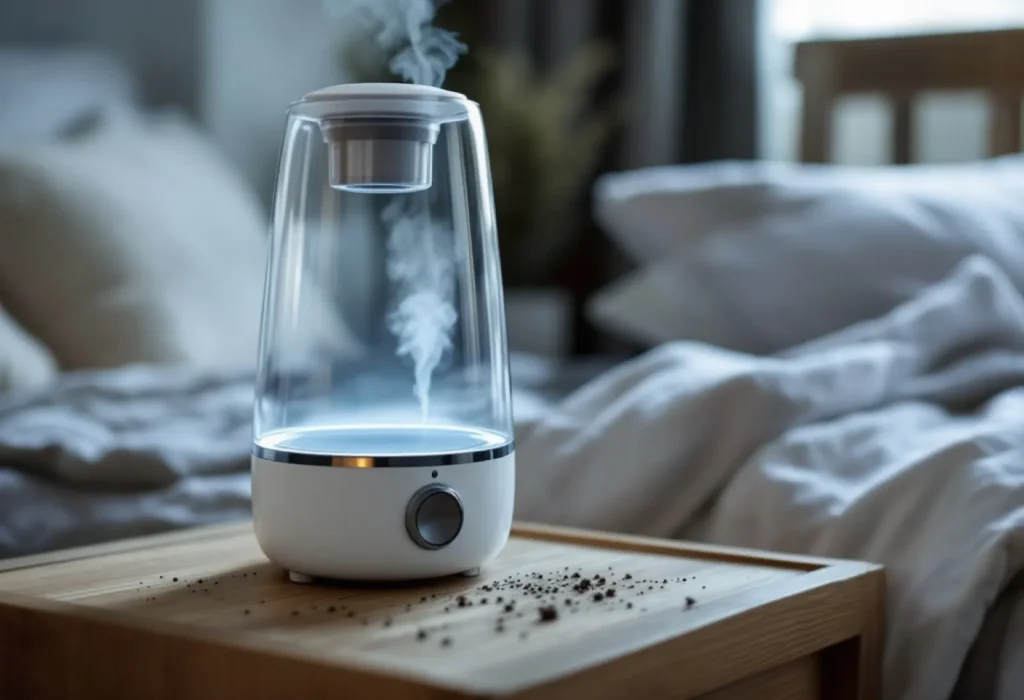
Mold in humidifier tanks shows up as black, green or grey specks and slimy film where water stands: the tank floor, the cap threads, the base chamber and any wick. Empty and dry the tank daily, and every third day scrub out film and scale with the cleaner your manual names or, failing that, 3 percent hydrogen peroxide as the EPA advises, then rinse several times.
Key takeaways
- The EPA’s routine is daily empty, wipe dry and refill, plus a full scrub every third day. The manuals read here set it weekly.
- Descale and disinfect are two separate steps. Honeywell says to do them in order to avoid harmful chemical interactions; the CDC says never mix bleach with other cleaners.
- Ultrasonic and impeller units throw tank contents into the room, according to the EPA. Evaporative and steam units disperse less.
- Pink slime is usually a bacterium, Serratia marcescens, according to NDSU Extension, not a mold.
- White dust is tap water minerals. Distilled water cuts it in ultrasonic units, but an electrode steam vaporizer needs minerals to boil at all.
- Keep the room at 30 to 50 percent relative humidity, per the CPSC. Condensation on the window means the unit is now a moisture source.
On this page
- What you are looking at in the tank
- Why the humidifier type changes the job
- Four manuals, side by side
- How to clean mold out of a humidifier
- Pink mold in a humidifier
- White dust from a humidifier
- The room: humidity targets and condensation
- Which situation are you in?
- For contractors: the humidifier as a moisture source
- Questions people actually ask
What you are looking at in the tank
A humidifier tank holds standing water at room temperature, which is why the CPSC Publication 5046 warns that bacteria and fungi often grow in the tanks of portable and console units. Not every deposit is growth, though. Scale, mineral dust and even black flecks in some steam units are normal by-products, and each one calls for a different fix.
| What you see | Where | What it most likely is | Source |
|---|---|---|---|
| Black, green or grey specks, fuzzy or slimy | Tank floor, cap threads, base chamber, around the float | Mold growth on a wet surface | CPSC 5046 |
| Film or scum on the water or tank walls | Water line, tank sides, exposed motor parts | May indicate bacteria or fungi | CPSC 5046 |
| Pink or orange slime | Cap threads, base corners, float | Usually Serratia marcescens, a bacterium | NDSU Extension |
| Hard white or tan crust | Tank floor, transducer, steam unit | Scale: minerals that settled out, a surface microbes grow on | CPSC 5046 |
| Fine white powder on furniture | Around the unit, on dark wood | Tap water minerals thrown out in the mist | EPA |
| Black particles, discoloured water | Bottom of a Vicks electrode steam vaporizer | Normal for that model, per Vicks; cleaned with soap and water | Vicks V150SGNL manual |
Colour does not change the method; location does, because some parts cannot go in water. Other colours have their own pages, such as white mold.
Why the humidifier type changes the job
The EPA's humidifier care page sorts portable units into four types, and the type decides how much of what grows in the tank ends up in the room. Ultrasonic and impeller units produce the greatest dispersions of both microorganisms and minerals; evaporative and steam units can grow microbes in a standing-water tank but disperse less, if any, into the air.
| Type | How it makes mist, per the EPA | Disperses tank contents? | Where growth collects |
|---|---|---|---|
| Ultrasonic | Ultrasonic vibration of a transducer | Greatest, microbes and minerals | Base chamber, transducer disc, float, tank cap |
| Impeller (cool mist) | High-speed rotating disk | Greatest, microbes and minerals | Reservoir and disk |
| Evaporative | Fan blows air through a wet wick, belt or filter | Less, if any; not expected to emit minerals | Wick and base tray |
| Steam vaporizer and warm mist | Heating element or electrodes boil the water | Less, if any; not expected to emit minerals | Reservoir; scale on the element or steam unit |
So a moldy ultrasonic unit deserves faster action than a moldy evaporative one. Furnace mounted units follow their maker’s instructions, says the EPA; for choosing a type, see cool mist versus warm mist on The HVAC Brief.
Four manuals, side by side
The EPA’s first instruction is to follow the manufacturer. Four public manuals disagree on the cleaner, the soak and what must never get wet.
| Model and type | Descale | Disinfect | Interval | Never do |
|---|---|---|---|---|
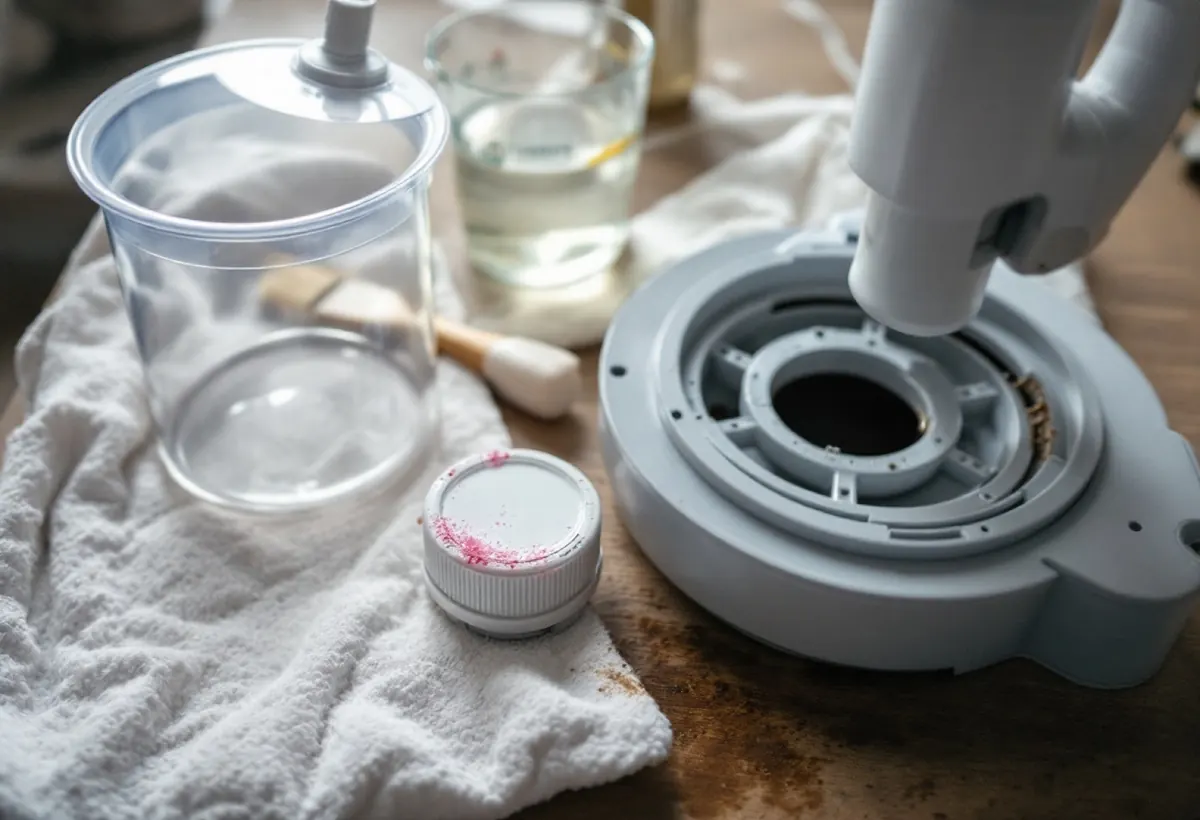
| Levoit Classic 100, ultrasonic | 237 mL (2 cups) distilled white vinegar in the tank, 15 to 20 minutes; soak cap and silencer too | None named; detergents banned, vinegar only | Weekly; change water daily | Immerse the base; dishwasher; detergents |
| Vicks V5100NS, ultrasonic | Undiluted white vinegar on surfaces, or 50/50, base soaked 1 hour | 1 tsp bleach per gallon in the tank, 20 minutes, shaken | Weekly; empty daily | Immerse the base; detergent; abrasives; touch the nebulizer |
| Honeywell HCM-350, evaporative | Wipe base, cap and tank with undiluted vinegar | 1 tsp bleach per gallon in the tank; wipe base; tank dishwasher safe | Not stated on the pages read | Clean with the filter in place; cap in dishwasher |
| Vicks V150SGNL, electrode steam | Steam unit in 4 inches of white vinegar, 10 minutes, flushed until no black particles | 1 tsp bleach per gallon in the reservoir, 20 minutes | Weekly; rinse daily | Disassemble the electrode unit |
| EPA default, any portable | Brush out scale, deposits and film | 3 percent hydrogen peroxide if the manual names nothing | Every third day; refill daily | Leave cleaner unrinsed |
Every manual that names bleach uses the same dose, one teaspoon per gallon, and every one says to rinse until the smell is gone. And the electronics are always off limits: Levoit and Vicks both forbid immersing the base, and Honeywell warns that cleaning with the filter in place will destroy it.
How to clean mold out of a humidifier
This is the order for a unit that already has visible growth, built from the documents above. Each step notes why it differs from the generic advice on our DIY mold remediation page, which is written for walls, not appliances such as a humidifier or a moldy coffee maker.
- Unplug, empty, and look before you scrub. Note whether growth is in the tank, the cap, the base chamber, the wick or on the transducer. Why this differs: the location decides whether a part can be soaked; on a wall you would simply clean the surface.
- Pull the wick or filter first. Why: Honeywell says cleaning with the filter in place destroys it, and its storage steps say to install a new filter before next use. A moldy wick is a replacement part.
- Descale with vinegar. Use the amount and soak in your manual, then brush the tank, cap and base. Why: per the CPSC, scale is a surface microbes grow on, so disinfecting over it leaves growth underneath.
- Rinse the vinegar out completely. Why: descaling and disinfecting must be separate; Honeywell orders them to avoid harmful chemical interactions, and the CDC says never to mix bleach with other cleaners.
- Disinfect with what the manual names. Bleach at one teaspoon per gallon for 20 minutes where the manual allows it; 3 percent hydrogen peroxide where it names nothing, per the EPA; vinegar only on a Levoit Classic 100. Why: whatever stays in the tank is misted, so the manual’s dose applies, not a wall-cleaning recipe.
- Clean the base by wiping, not soaking. Use a cloth or the supplied brush around the transducer and float; Vicks says not to touch its nebulizer with bare fingers. Why: the base holds the electronics.
- Rinse with several changes of water. Why: the EPA says residue would otherwise be misted into the room, which is specific to an appliance that makes aerosol from its own tank.
- Dry every part before refilling or storing. Why: Levoit says not to leave water in a unit unused for a week or longer, and the EPA says dry before storage and clean again after it.
Whether vinegar or bleach kills mold is a separate argument, covered on does vinegar kill mold and does bleach kill mold. Here the manual decides, not the chemistry.
| Step | Agent named | What it is for | Source |
|---|---|---|---|
| Descale | Distilled white vinegar, undiluted or 50/50 | Dissolves mineral scale | Levoit, Vicks, Honeywell |
| Disinfect | 1 tsp bleach per gallon of water | Treats the tank and reservoir surfaces | Vicks, Honeywell |
| Disinfect, default | 3 percent hydrogen peroxide | Used when the manual names no product | EPA |
| Never | Detergent | Banned on water parts by Levoit and Vicks | Levoit, Vicks V5100NS |
| Never | Bleach mixed with another cleaner | Can release dangerous vapours | CDC |
Pink mold in a humidifier
Pink or red film in a humidifier cap or base is most often Serratia marcescens. According to NDSU Extension, it grows in moist places where materials containing phosphorus or fatty substances collect, and it survives in standing water as the chlorine dissipates. That describes a humidifier tank refilled without emptying, and an activated carbon filter on the water line, which removes chlorine, may help it along.
NDSU says the stains come off easily with a cleanser containing chlorine bleach but the organism is hard to eliminate from a home, so it comes back unless the tank is emptied and dried daily. For pink growth on other surfaces, see the pink mold page.
White dust from a humidifier
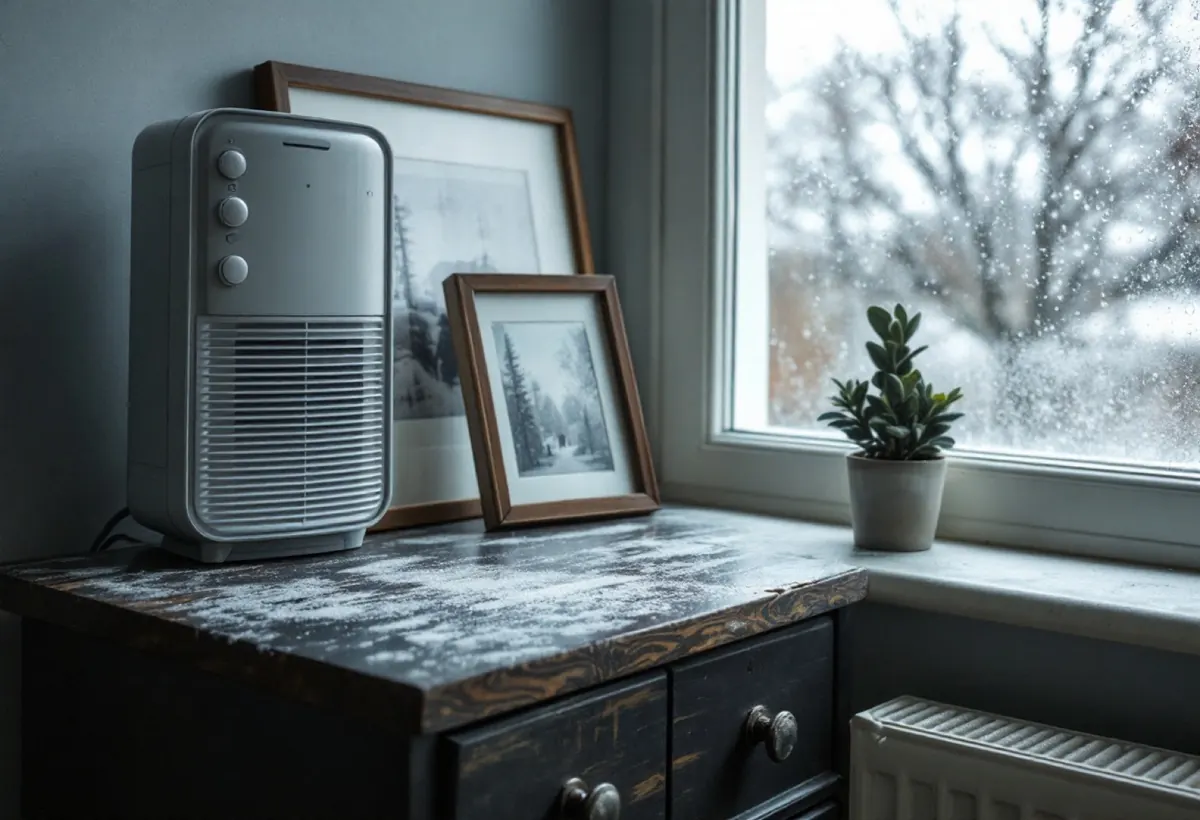
White dust is not mold. According to the EPA's humidifier care page, ultrasonic and impeller units are very efficient at dispersing minerals in tap water, which settle as a white dust; steam and evaporative units are not expected to disperse substantial minerals. The EPA’s stronger reason to cut tap water is scale, which it calls a breeding ground for microorganisms.
| Option | Effect, per the EPA and CPSC | Applies to |
|---|---|---|
| Bottled water labelled distilled | Lowest mineral content; distillation is the most effective method | Ultrasonic, impeller |
| Spring, artesian or mineral water | Not demineralized | Not a fix |
| Demineralization cartridge or filter | Only if supplied or recommended; white dust means it is not working | Models built for one |
| Tap water plus salt | Vicks says electrode units may need salt in soft water to steam | Vicks V150 steam vaporizer only |
The exception catches people out. An electrode steam vaporizer boils water by passing current through it, and the Vicks V150SGNL manual says to fill it with tap water and add a pinch of salt in soft water areas if it will not steam, because low mineral content is the reason the manual gives for a failure. Levoit, by contrast, recommends purified or distilled water and lists white dust as a sign to switch.
The room: humidity targets and condensation
The CPSC Publication 5046 advises keeping relative humidity between 30 and 50 percent, and warns that above 60 percent moisture can condense on surfaces where bacteria and fungi settle. The EPA's humidifier care page sets 50 percent as the ceiling for humidifier use, and EPA's brief guide to mold says to keep indoor humidity below 60 percent, ideally 30 to 50.
The EPA says that if water condenses on windows, walls or pictures, move the humidifier, lower its humidistat or run it less, and not to let carpet, drapes or tablecloths near it get damp.
Escalation triggers. The problem has left the appliance when growth appears on the window frame or sill near the unit, the carpet or floor under it stays damp, a hygrometer reads above 60 percent with the unit running, or growth returns soon after a full clean. Growth inside a base that cannot be immersed and cannot be reached is a reason to replace the unit. See mold on window sills and mold on carpet; a patch larger than about 10 square feet is the EPA’s limit for a do-it-yourself job.
Which situation are you in?
| Situation | Do this | Basis |
|---|---|---|
| Film or specks in the tank only | Full descale and disinfect, then daily empty and dry | EPA, CPSC |
| Growth on the wick | Replace the wick; clean the tray | Honeywell: filter destroyed by cleaning |
| Growth on the transducer or in a sealed base | Wipe per manual; if it cannot be reached, replace the unit | Levoit, Vicks: never immerse the base |
| Pink slime keeps returning | Daily empty and dry; bleach where the manual allows | NDSU |
| White dust on furniture | Distilled water or a cartridge; not a mold problem | EPA, CPSC |
| Black flecks in a Vicks steam unit | Weekly vinegar flush per manual; normal for that model | Vicks V150SGNL |
| Condensation or growth on windows or walls | Lower the setting, move the unit, measure RH | EPA, CPSC |
| Unit stored wet over summer | Clean, dry, clean again before use | EPA, CPSC |
For contractors: the humidifier as a moisture source
On a mold assessment a portable humidifier is a source to document, not equipment to clean. Record the EPA’s own triggers: condensation and damp absorbent materials near the unit.
| Record | Why an adjuster or client asks |
|---|---|
| Unit type, make, model and setting | Ultrasonic and impeller units disperse more, per the EPA |
| Room RH and temperature with the unit running and off | Ties the growth to the CPSC 60 percent condensation threshold |
| Photos of condensation, sill and carpet near the unit | Shows the moisture path the EPA describes |
| Distance from unit to the affected surface | Separates source moisture from a leak |
| Source control note in the scope | Remediation fails if the humidifier keeps running at the same setting |
Wet materials near the unit follow the usual rules on the mold hub.
What this page does not cover. Health effects of humidifier mist are out of scope; the EPA page cited here advises stopping use and contacting a physician if you believe a humidifier is affecting your breathing.
Questions people actually ask
How do you clean mold out of a humidifier?
Unplug and empty it, remove any wick, then descale with white vinegar using the soak in your manual and brush the tank, cap and base. Rinse, then disinfect separately, with bleach at one teaspoon per gallon for 20 minutes where the manual allows or 3 percent hydrogen peroxide as the EPA suggests. Rinse several times and dry every part.
How often should you clean a humidifier?
The EPA says to empty, wipe dry and refill portable humidifiers daily and clean them every third day. Levoit and Vicks manuals set a weekly clean with daily emptying. Clean and dry the unit before storage and again before first use.
Can I put vinegar or bleach in the humidifier water while it runs?
No. Every manual reviewed here uses vinegar and bleach as cleaning soaks and then says to rinse until the smell is gone, and the EPA says to rinse with several changes of water so chemicals are not released into the air. Levoit’s manual also warns against adding water treatment liquids.
What is the pink stuff in my humidifier?
Usually Serratia marcescens, a bacterium that NDSU Extension says grows in moist places where standing water has lost its chlorine. It wipes off with a bleach-containing cleanser but returns unless the tank is emptied and dried every day.
Why is my humidifier making white dust?
Minerals in tap water. The EPA says ultrasonic and impeller units disperse them efficiently, leaving white dust on surfaces. Use bottled distilled water or a demineralization cartridge your maker recommends. Electrode steam vaporizers are the exception and may need tap water to work.
Should I throw away a moldy humidifier?
Replace parts or the unit when the growth sits where cleaning cannot reach: a wick, which Honeywell treats as a replacement part, or a base chamber that Levoit and Vicks say must never be immersed. Growth that returns soon after a full, by-the-manual clean is another sign the unit has reached the end.
What humidity should a humidifier be set to?
Between 30 and 50 percent relative humidity, according to the CPSC, with the EPA saying not to exceed 50 percent. Measure with a hygrometer. If water condenses on windows or walls, the EPA says to lower the setting, move the unit or run it less.
Sources
- EPA's humidifier care page: Use and Care of Home Humidifiers, US Environmental Protection Agency, last updated 29 April 2026. Retrieved 31 October 2026.
- EPA's brief guide to mold: A Brief Guide to Mold, Moisture and Your Home, US EPA, last updated 18 February 2026. Retrieved 31 October 2026.
- CPSC Publication 5046: Dirty Humidifiers May Cause Health Problems, US Consumer Product Safety Commission, revision dated March 2012. Retrieved 31 October 2026.
- Levoit Classic 100 manual, Levoit, manual dated 23 March 2020. Retrieved 31 October 2026.
- Vicks V5100NS manual, Kaz Vicks use and care manual, care and cleaning page, via ManualsLib. Retrieved 31 October 2026.
- Vicks V150SGNL manual, Vicks Warm Steam Vaporizer use and care manual, hosted by Canadian Tire. Retrieved 31 October 2026.
- Honeywell HCM-350 manual and Honeywell HCM-350 manual, page 7, Honeywell cool moisture humidifier manual, via ManualsOnline. Retrieved 31 October 2026.
- NDSU Extension: Red Substance in Tub, Toilet Is Bacteria, Roxanne Johnson, NDSU Extension Service, 9 August 2010. Retrieved 31 October 2026.
- CDC's bleach guidance, US CDC, 24 April 2024. Retrieved 31 October 2026.
- Manual instructions are model specific; the models here were chosen because their manuals were publicly readable, not as recommendations. Our methodology sets out the standing rules.
Always follow the manual for your own model where it differs from anything on this page.