The short answer
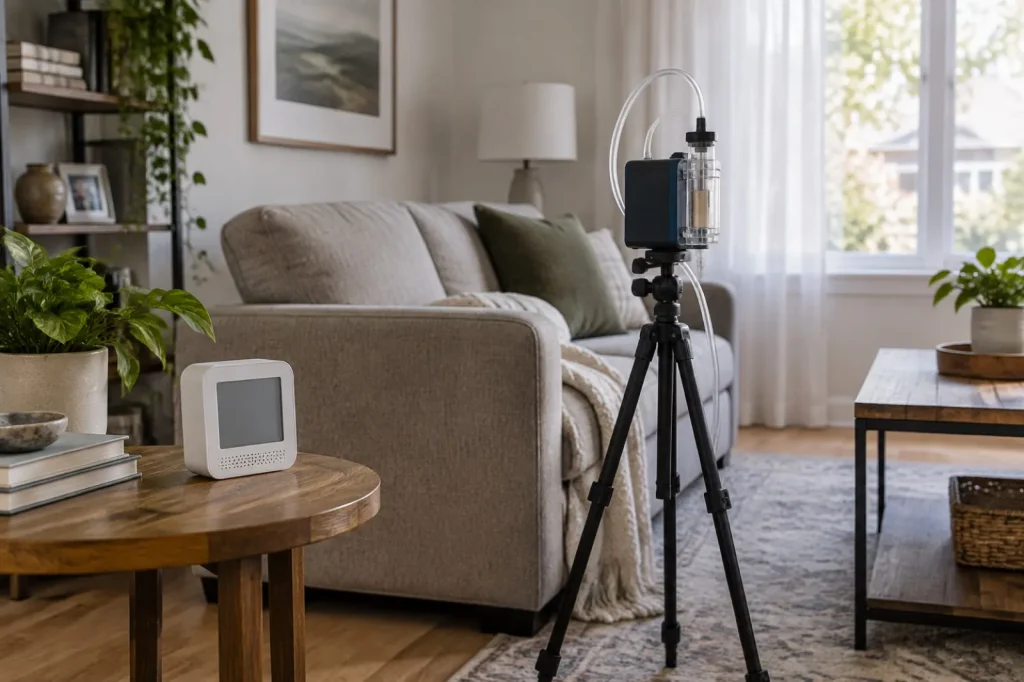
Indoor air quality testing measures specific pollutants in a building and holds each reading against a published reference value: EPA’s 4 pCi/L action level for radon, UL 2034 alarm points for carbon monoxide, EPA and WHO particle levels, WHO and California formaldehyde values, and EPA’s 30 to 50 percent humidity range. Carbon dioxide and mold have no indoor limit, so a good report explains what those numbers show.
Key takeaways
- There is no single indoor air standard. Each pollutant is judged against a different body’s number, mostly written for outdoor air or workplaces.
- ASHRAE says Standard 62.1 sets no CO2 limit. According to ASHRAE, 1,000 ppm marks roughly 16 cfm of outdoor air per person, not a hazard line.
- The WHO annual PM2.5 guideline of 5 µg/m³ is 1.8 times stricter than EPA’s 9.0 µg/m³ outdoor standard.
- Mold has no federal airborne limit, and EPA says sampling is usually unnecessary when growth is visible.
- According to HomeAdvisor, a typical professional test costs $303 to $616; Home Air Check lists mail-in kits at $205 to $495.
On this page
- What a professional assessment measures
- Pollutant, method, reference value, source
- Carbon dioxide: the limit that is not
- Particles: an outdoor yardstick
- Formaldehyde and other VOCs
- Radon, mold, carbon monoxide, humidity
- Home air quality test kits and monitors
- Who does the testing
- What air quality testing costs
- Which test fits your situation
- For contractors
- Questions people actually ask
Most pages ranking for this topic sell a kit. This one pairs each pollutant with its measurement method and the published number a result is compared with, and names who wrote that number. Where no number exists, it says so.
What a professional indoor air quality assessment measures
A professional assessment is an investigation first. The sequence below is the one the OSHA Technical Manual sets out for workplaces, and its comparison logic carries over to a house: sample outdoor air, return air, and complaint and non-complaint rooms. Radon, mold and particles are added when the building or the complaint points to them.
| Step | What is done | Why it matters |
|---|---|---|
| Interviews | Complaint pattern, HVAC upkeep, renovations | Tells the investigator where to sample |
| Walkaround | Ventilation survey, then indoor and outdoor sources | OSHA cites NIOSH finding ventilation the main cause in 52% of its investigations |
| HVAC check | Outdoor air intake at maximum and minimum flow | Separates ventilation from source problems |
| Screening | Direct-reading formaldehyde, CO2, CO and VOCs, plus temperature and humidity | Comparable across rooms |
| Follow-up | Validated lab methods for whatever screening flagged | Gives a defensible number |
The OSHA indoor air quality page says OSHA has no indoor air quality standards, and EPA’s air standards are written for outdoor air. If a tester says a home ‘fails’ an indoor standard, ask which one.
Pollutant, method, reference value, source
This is the table to keep. EPA protects outdoor air, OSHA protects workers over a shift, and WHO and California publish guidelines, not enforceable limits.
| Pollutant | How it is measured | Published reference value | Source |
|---|---|---|---|
| Carbon dioxide | Direct-reading sensor, logged while occupied | No limit in ASHRAE 62.1; OSHA workplace limit 5,000 ppm (8 h) | ASHRAE CO2 position document |
| PM2.5 | Particle counter or gravimetric filter | EPA outdoor 9.0 µg/m³ annual, 35 µg/m³ 24 h; WHO 5 and 15 | EPA NAAQS table; WHO 2021 air quality guidelines |
| Formaldehyde | Sorbent badge, lab analysis (NIOSH 2016) | WHO 0.1 mg/m³ (30 min); OEHHA 55 µg/m³ acute, 9 µg/m³ (8 h and chronic) | WHO indoor air guidelines; OEHHA REL table |
| Other VOCs | Canister, EPA Method TO-15 | No total VOC value; WHO covers single compounds only | WHO indoor air guidelines |
| Radon | Radon test device | Fix at 4 pCi/L or more; consider fixing at 2 to 4 | EPA radon action level page |
| Mold | Spore trap with outdoor control | No EPA or other federal limit | EPA mold testing page |
| Carbon monoxide | Direct-reading meter; UL 2034 alarm | Alarm windows at 70, 150, 400 ppm; OSHA 50 ppm (8 h); EPA outdoor 9 ppm (8 h) | UL Standards and Engagement; OSHA CO fact sheet; EPA NAAQS table |
| Relative humidity | Hygrometer or logger | Below 60%, ideally 30 to 50%, per the EPA; 20 to 60% in the OSHA manual | EPA moisture guidance; OSHA Technical Manual |
Carbon dioxide: the limit that is not one
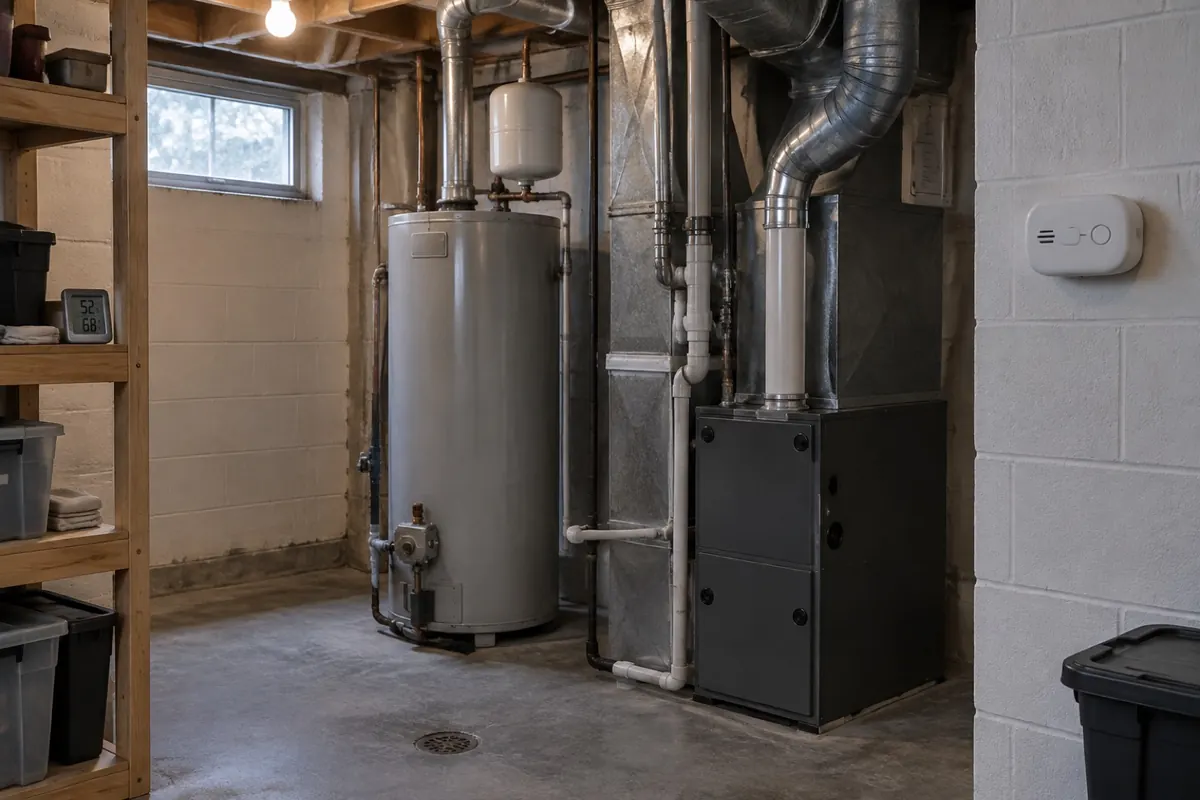
CO2 is the reading consumer monitors lead with and the one most often misread. The ASHRAE CO2 position document, approved on 12 February 2025, says that despite many statements to the contrary, Standard 62.1 does not provide a limit value for indoor CO2. According to ASHRAE, the 1989 edition did carry a 1,000 ppmv limit, removed later because it was misread; today that figure is at best an indicator of about 16 cfm of outdoor air per person.
One number cannot fit every room either. Per the position document, steady-state values under 62.1 run from about 1,000 ppmv in offices to above 2,500 ppmv in auditoriums, and CO2 is not a general indicator of indoor air quality. It works as a tracer: outdoor air reached 426 ppmv in 2024, according to ASHRAE citing NOAA, so a bedroom logging far above that overnight is telling you about air exchange, not about radon, CO or formaldehyde.
Particles: an outdoor standard used as an indoor yardstick
The EPA NAAQS table sets the primary PM2.5 standard at 9.0 µg/m³ as a three-year annual mean and 35 µg/m³ over 24 hours. The annual level dates from February 2024, and the EPA PM NAAQS page carries a March 2025 notice on reconsidering it. The WHO 2021 air quality guidelines recommend 5 and 15 µg/m³.
Neither is an indoor limit. The EPA indoor particle page lists cooking, candles, fireplaces, unvented heaters and smoking as indoor sources and says homes without strong sources should sit at or below outdoor levels. So read indoor PM2.5 beside a same-day outdoor reading.
Formaldehyde and other VOCs
Formaldehyde has health-based indoor reference values from both WHO and California. The WHO indoor air guidelines (2010) set 0.1 mg/m³ over 30 minutes, about 81 ppb at 25 °C on our conversion. California’s OEHHA REL table lists 55 µg/m³ acute and 9 µg/m³ for the 8-hour and chronic levels, about 7.3 ppb.
The CARB formaldehyde fact sheet names composite wood as a main source and notes that home kits can measure formaldehyde but cannot identify its source. Other VOCs are harder: the total (TVOC) many reports add has no recognised limit, and the EPA monitor guidance says most indoor pollutants lack accepted limits. Treat a VOC index as a trend.
Radon, mold, carbon monoxide and humidity
Radon
The EPA radon action level page says EPA recommends fixing at 4 pCi/L or more and considering a fix between 2 and 4, as no level is known to be safe. The EPA radon risk page puts the average home at 1.3 pCi/L. Fixes are in our radon mitigation guide. What a fix costs, from published prices, is in our guide to radon mitigation cost.
Mold
The EPA mold testing page says no federal limits exist for mold or spores and that sampling is usually unnecessary when growth is visible. Air results are read against an outdoor control, as our page on mold spores in air explains; test choice is covered in mold testing.
Carbon monoxide
According to First Alert, UL 2034 requires an alarm at 70 ppm to activate within 60 to 240 minutes. That lowest alarm point is 1.4 times OSHA’s workplace limit and 7.8 times EPA’s 8-hour outdoor standard, so a professional measures CO with a meter; the CPSC CO guidance still wants an alarm on every level.
Humidity
The EPA moisture guidance advises keeping relative humidity below 60%, ideally 30% to 50%: the cheapest number to log.
Home air quality test kits and monitors versus lab sampling
A home air quality test can mean a monitor, a mail-in kit, or a single radon or CO device. The EPA monitor guidance says there is limited information on how well some low-cost monitors detect pollutants indoors, that they detect only what they were built for, and that no indoor reference methods exist. Monitors show change; lab sampling gives a number you can show an adjuster. For mold specifically, our guide to at home mold test kits covers what each type can and cannot show.
| Option | What it measures | What you get | Main limit |
|---|---|---|---|
| Consumer monitor | PM2.5, CO2, VOC index, humidity | Continuous trend | Alerts set by the maker |
| Single-purpose device | Radon, or CO (UL 2034 alarm) | One clear threshold | Answers nothing else |
| Mail-in lab kit | Formaldehyde, VOCs, mold, dust | Lab report in 5 business days, per Home Air Check | Cannot identify the source, per CARB |
| Professional survey | CO2, CO, formaldehyde, VOCs, particles | Room-by-room comparison | Snapshot of one visit |
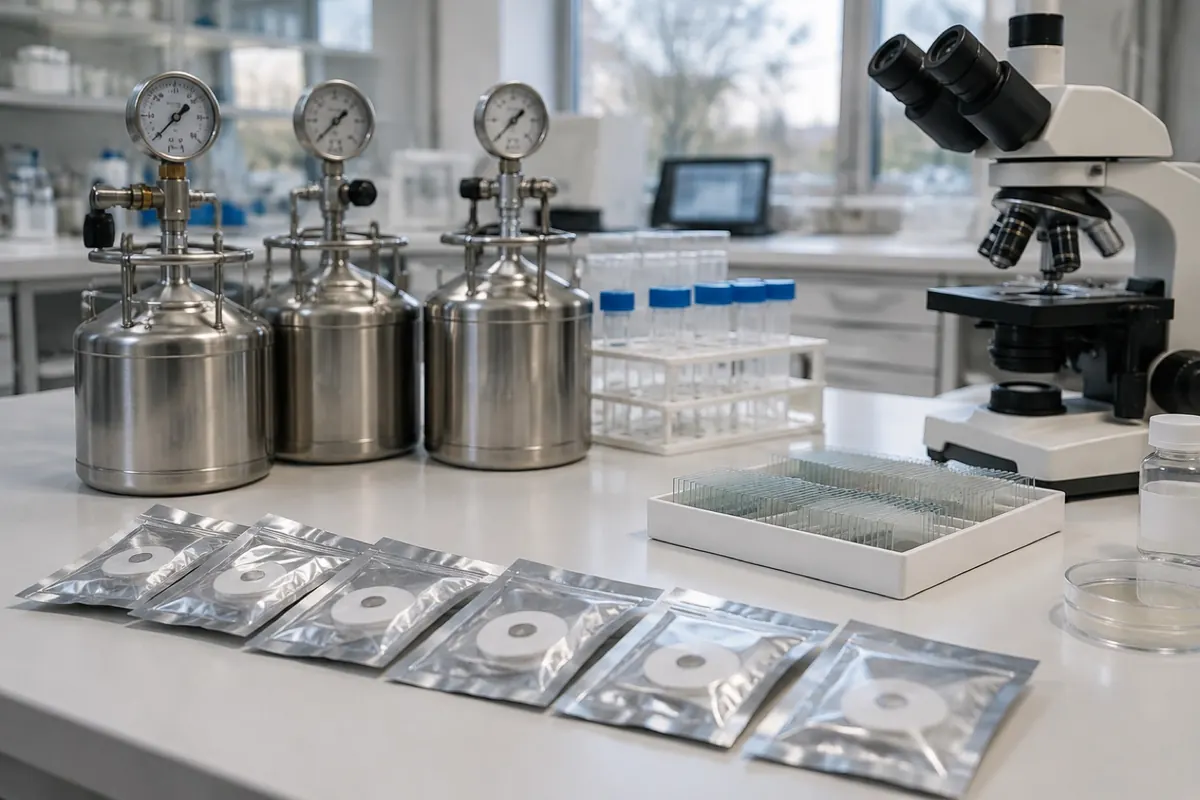
| Professional lab sampling | Badges, TO-15 canisters, spore traps | Defensible numbers | Costs more; days to weeks |
Who does indoor air quality testing
The person matters more than the instrument. The oldest credential is the Certified Industrial Hygienist; its issuer was founded in 1960 as the American Board of Industrial Hygiene and announced its new name in 2019, per the BGC history page. The BGC CIH requirements list 60 semester hours of science, 180 academic or 240 continuing-education hours of industrial hygiene, ethics coursework and an exam.
| Credential or role | Issued by | What stands behind it | How to check |
|---|---|---|---|
| CIH (Certified Industrial Hygienist) | Board for Global EHS Credentialing, formerly ABIH | Science and hygiene coursework, ethics, active practice, exam | BGC Verify Credentials |
| CIEC and CIE | American Council for Accredited Certification | CESB-accredited; CIEC engineering-related, CIE technician level | ACAC Find Certificants |
| IEP | No issuer: a role defined in ANSI/IICRC S500 | Education, training and experience | Ask which credential |
| State mold assessor licence | State agency, where one exists | Varies by state | State licence lookup |
| The laboratory | AIHA Laboratory Accreditation Programs | EMLAP (microbiology), IHLAP (industrial hygiene) | AIHA Find an Accredited Lab |
‘IEP’ needs a warning. The ANSI/IICRC S500 definition, quoted in a February 2026 IICRC S500 statement, describes someone with the education, training and experience to design a sampling strategy and interpret lab data. It is not a credential, so anyone can use the label. Some states license mold assessment; see our state mold licensing guide.
What air quality testing costs
HomeAdvisor reports, in a guide updated 19 June 2026, that an indoor air quality test averages $443. Lab fees are the floor under any quote: according to the EMSL 2026 price list, a formaldehyde badge costs $127 to $394 per sample, depending on turnaround.
| Item | Published price | Per the source |
|---|---|---|
| Typical indoor air quality test | $303 to $616 (average $443) | HomeAdvisor |
| Mold testing | $300 to $1,000 | HomeAdvisor |
| Radon testing | $150 to $800 | HomeAdvisor |
| VOCs, per sample | $200 to $300 | HomeAdvisor |
| Carbon monoxide testing | $100 to $200 | HomeAdvisor |
| Home over 2,500 sq ft | $500 to $1,000 | HomeAdvisor, by size |
| Mail-in kits | $205 to $495 | Home Air Check, four kits |
| Lab only: formaldehyde badge | $127 to $394 | EMSL, 2 week to 1 day |
| Lab only: TO-15 VOC scan | $366 to $1,148 | EMSL, 2 week to 1 day |
Two cheap items come first. According to HomeAdvisor, CO alarms cost $15 to $150, and a hygrometer costs less than one lab sample. Mold inspection fees are in our mold inspection cost guide.
Which test fits your situation
| If this is your situation | Test first | Who or what |
|---|---|---|
| Fuel-burning appliance, attached garage, or a CO alarm sounded | Carbon monoxide | Alarms per CPSC; a sounding alarm is an emergency, not a test |
| Never tested, or living space below grade | Radon | Owner test; fix at 4 pCi/L or more (EPA) |
| Water damage, musty odour, visible growth | Moisture and humidity first | IEP or CIH; mold air sampling rarely needed (EPA) |
| New cabinets, flooring or furniture | Formaldehyde, then VOCs | Lab badge; kit as a screen |
| Stuffy rooms, window condensation | CO2 and humidity | Monitor; read CO2 as ventilation |
| Wildfire smoke, wood stove, heavy cooking | PM2.5 in and out | Monitor plus outdoor data |
| Asbestos removal just finished | Clearance air samples | Accredited inspector and lab |
The order that saves money
- Write down the trigger: an odour, an alarm, a water event, a renovation. It decides the test.
- Rule out carbon monoxide and radon first: clearest thresholds, cheapest devices.
- Log humidity for a week. EPA says keep it below 60%.
- Look for moisture and growth before paying for a mold air sample.
- A trend needs a monitor; a dispute needs a lab.
- If you hire, ask for the credential, a written sampling plan, an outdoor control, the lab’s accreditation and the reference value behind each result.
- Re-test after the fix with the same method.
For contractors: air quality testing after water intrusion
On a water or mold job the air test usually belongs to someone else. ANSI/IICRC S500 puts sampling strategy and interpretation with the IEP, and an assessor independent of your firm avoids a conflict of interest. Your job is to make sure the report supports your scope, after the moisture mapping our water damage inspection guide describes.
| Report element | What it should show | Why it matters |
|---|---|---|
| Sampling plan | Locations, durations, outdoor controls | The first question asked of any air result |
| Method and lab | Named method and the lab’s AIHA accreditation | Makes the number defensible |
| Reference value | The published value used, with its source | Stops a guideline posing as a legal limit |
| Independence | Who sampled, and whether they bid the work | Keeps assessment apart from remediation |
| Clearance | Same method and locations after the work | Before and after must compare |
Asbestos has a hard federal clearance rule, for schools: under 40 CFR 763.90, removal is complete when, among other conditions, the average of five TEM air samples inside the work area is not statistically different from five taken outside. See our asbestos testing cost page and the standards hub.
What this page does not cover. It describes methods, reference values and prices, not health effects; for those, start with EPA’s indoor air quality pages and talk to a physician. HVAC equipment and filters are out of scope.
Questions people actually ask
How can I test my indoor air quality at home?
Start with the two devices that have clear thresholds: a radon test and a UL 2034 carbon monoxide alarm. Add a hygrometer, since EPA advises keeping humidity below 60%. A consumer monitor adds PM2.5 and CO2 trends. Use a lab kit or a professional for formaldehyde and VOCs.
Is indoor air quality testing worth it?
Yes, when there is a specific trigger: a water event, a renovation, new cabinets, an odour, or a dispute with a landlord or insurer. A general panel with no question behind it often returns numbers with no reference value. Radon and carbon monoxide checks are worth doing in every home.
What does an indoor air quality test check for?
A professional screening, as the OSHA Technical Manual describes it, covers carbon dioxide, carbon monoxide, formaldehyde, VOCs, temperature and humidity, compared with outdoor air. Particles, radon and mold are added when the building calls for them. Each reading has its own reference value.
What are signs of poor indoor air quality?
Look at the building: window condensation, humidity above EPA’s 60% ceiling, musty odours, visible growth, stale air in occupied rooms, a sounding CO alarm, or chemical odours after a renovation. Each points to a test. How a person feels is a question for a physician.
Who offers water damage restoration with mold removal and air quality testing?
Many restoration firms offer all three, but the assessment is best done by someone independent of the remediation. Look for a CIH (check through BGC) or an ACAC credential holder, check whether your state licenses mold assessors, and ask which AIHA-accredited lab will analyse the samples. We do not rank companies.
How do I get an air test after asbestos removal is finished?
Arrange clearance testing before the work ends, using an accredited inspector rather than the abatement crew. For schools, 40 CFR 763.90 requires a visual inspection, then five TEM air samples inside compared with five outside. Homes follow state and local rules; ask your state asbestos programme.
Sources
- ASHRAE CO2 position document, approved 12 February 2025. Retrieved 18 October 2026.
- EPA NAAQS table (updated 4 November 2025) and EPA PM NAAQS page, EPA. Retrieved 18 October 2026.
- EPA indoor particle page and EPA monitor guidance, EPA. Retrieved 18 October 2026.
- WHO 2021 air quality guidelines, WHO. Retrieved 18 October 2026.
- WHO indoor air guidelines, WHO Europe, 2010. Retrieved 18 October 2026.
- OEHHA REL table, revised October 2013. Retrieved 18 October 2026.
- CARB formaldehyde fact sheet, 1 May 2020. Retrieved 18 October 2026.
- EPA radon action level page and EPA radon risk page, EPA. Retrieved 18 October 2026.
- EPA mold testing page and EPA moisture guidance, EPA. Retrieved 18 October 2026.
- UL Standards and Engagement (12 May 2026), First Alert and the CPSC CO guidance. Retrieved 18 October 2026.
- OSHA CO fact sheet, OSHA indoor air quality page and OSHA Technical Manual. Retrieved 18 October 2026.
- BGC CIH requirements and BGC history page. Retrieved 18 October 2026.
- ACAC programme list and ACAC accreditation page. Retrieved 18 October 2026.
- IICRC S500 statement, 10 February 2026. Retrieved 18 October 2026.
- AIHA Laboratory Accreditation Programs. Retrieved 18 October 2026.
- HomeAdvisor (updated 19 June 2026), Home Air Check and the EMSL 2026 price list. Retrieved 18 October 2026.
- 40 CFR 763.90, Cornell LII; EPA introduction to indoor air quality, EPA. Retrieved 18 October 2026.
- Ratios and ppb conversions (25 °C) are our arithmetic. See our methodology.
Confirm current editions and prices with each publisher.