The short answer
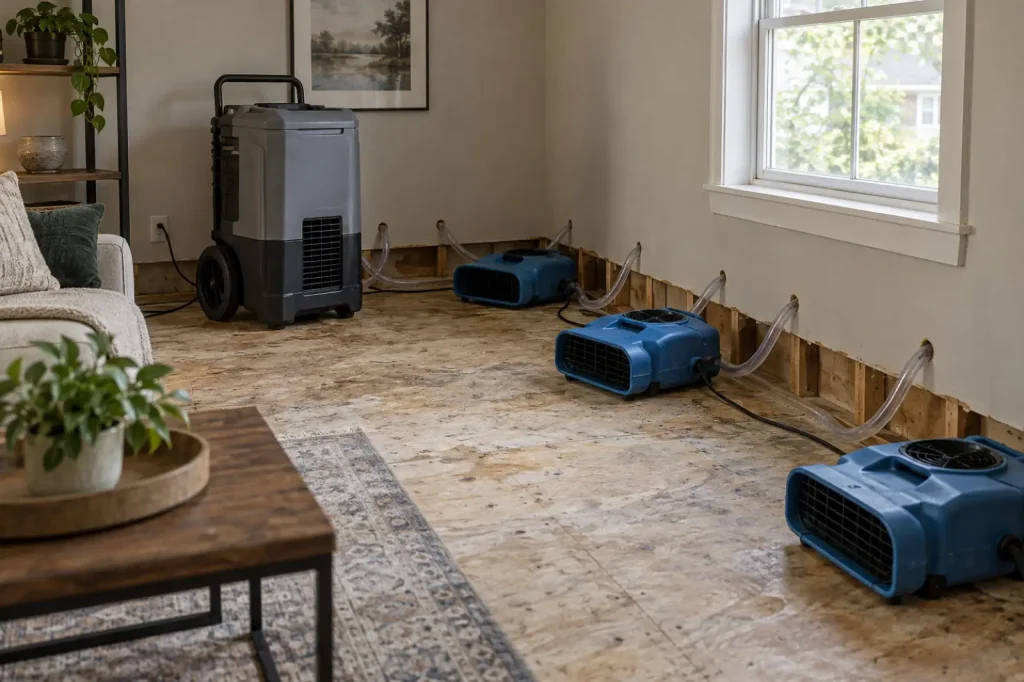
Structural drying is the controlled removal of water from building materials after a loss, using extraction, air movement, dehumidification and heat to keep the air drier than the wet materials. It is managed by psychrometric readings, sized by the class of water in ANSI/IICRC S500, and finished only when moisture readings meet a drying goal set from unaffected materials.
Key takeaways
- Drying runs on vapor pressure: water moves from wet material to air only while the material’s vapor pressure is higher than the air’s.
- Per the NWS formulas, air at 80 F and 60% RH holds about 92 grains of water per pound of dry air, with a dew point near 65 F.
- Per the IICRC factor sheet, the same 10,000 cubic feet needs 100 pints a day of LGR capacity at Class 1 and 250 at Class 3.
- Per published S500 summaries, air movers start at one per room plus one per 50 to 70 square feet of wet floor and one per 100 to 150 of wet upper wall and ceiling.
- Dry is a measurement: R&R Magazine quotes S500 defining the dry standard from unaffected material, and LSU AgCenter says appearance and elapsed time cannot tell you a material is dry.
On this page
What structural drying is
Structural drying is the part of a water job that takes water out of framing, subfloors, drywall, slabs and cavities rather than off surfaces. It follows extraction and sits inside the wider water mitigation scope. R&R Magazine on drying phases (2021) describes four phases: water extraction, air movement, dehumidification and temperature control, the last held at 75 to 90 F to speed evaporation.
The governing standard is ANSI/IICRC S500, fifth edition (2021), which IICRC lists as covering psychrometry and drying technology, equipment and structural restoration. Its text is sold, so this page works from published summaries. How long a dry takes is covered in our guide to how long water damage takes to dry; contamination categories are on our IICRC water categories page, and the rest of our water coverage is on the water hub.
Psychrometrics in four numbers
Psychrometrics is the study of moist air, and a drying technician needs four of its numbers. All four can be computed from temperature and relative humidity with the NWS vapor pressure formula and NWS mixing ratio formula; grains per pound follows because, according to NIST Handbook 44, one avoirdupois pound is exactly 7,000 grains.
| Number | What it tells you | Why a dryer cares |
|---|---|---|
| Relative humidity (RH) | Moisture as a share of what the air could hold at its temperature | Changes with temperature, so it cannot compare two rooms |
| Grains per pound (GPP) | Absolute moisture: grains of water per pound of dry air | The number to compare indoors, outdoors and the dehumidifier outlet |
| Dew point | Temperature at which the air’s moisture condenses | Any surface below it gets wet |
| Vapor pressure | The push water exerts as a gas, in hPa | Evaporation runs from higher to lower vapor pressure |
A worked psychrometric example
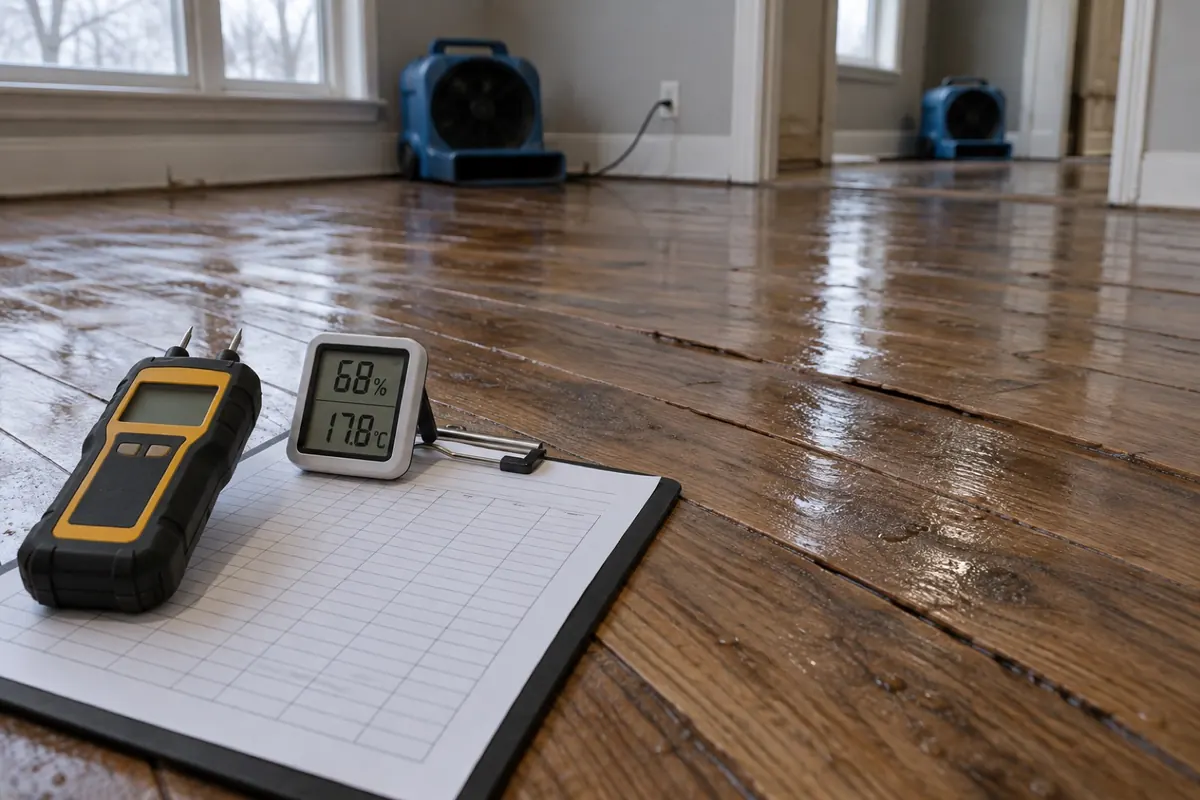
Take an affected room at 80 F and 60% RH, which according to the Dri-Eaz LGR 3500i spec sheet is the condition for its 170 pint AHAM rating. Every other condition below is an illustrative input, computed per the NWS formulas at an assumed 1,013 hPa station pressure.
| Condition | Temp | RH | GPP | Dew point | Vapor pressure, hPa |
|---|---|---|---|---|---|
| Affected room | 80 F | 60% | 92 | 65 F | 21.0 |
| Dehumidifier outlet (example) | 90 F | 25% | 52 | 49 F | 12.0 |
| Target room air | 70 F | 50% | 54 | 51 F | 12.5 |
| Humid summer outdoors | 85 F | 70% | 127 | 74 F | 28.8 |
| Cool spring outdoors | 50 F | 60% | 32 | 37 F | 7.4 |
What the numbers say
The outlet air is 40 grains drier than the room air entering the unit, which is the grain depression the LGR 3500i spec sheet says its controller displays. The humid summer air outdoors is 35 grains wetter than the room, so opening windows would add water. The cool spring air is drier in absolute terms even though its RH is the same, which is why GPP, not RH, decides whether to ventilate.
Now the material. Treating a wet surface as saturated at its own temperature, the usual simplification, the NWS formula gives 29.6 hPa at 75 F against 21.0 hPa in the room: an 8.7 hPa push. Warm that surface to 90 F and it rises to 48.2 hPa, a push of 27.2 hPa. That is the case for heat in drying, and it is why C&R Magazine says Class 4 may need substantial vapor pressure differentials. On the air side, according to LSU AgCenter, drying is slow to non-existent at 70% RH or higher, below 50% allows drying, and 30 to 40% is better.
Classes of water
Class measures how much evaporation the job will demand. It is separate from category, which measures contamination. Per Cleanfax on S500-2015 key terms (2016), the 2015 edition moved class definitions to a percentage of wet surface area plus the permeance and porosity of what got wet; per R&R Magazine in 2007, the earlier edition defined Class 2 by carpet and pad across a room and wicking under 24 inches.
| Class | Per the C&R summary of the 2021 edition | What it drives |
|---|---|---|
| Class 1 | Least water and evaporation; under 5% of porous materials affected | Light dehumidification, few air movers |
| Class 2 | Significant absorption; 5% to 40% of porous materials affected | Moderate air movement and dehumidification |
| Class 3 | Highest absorption; more than 40% of the area affected | Heaviest air movement and dehumidification |
| Class 4 | Deep water in low-evaporation materials or assemblies: plaster, wood, concrete, masonry, multilayer floors | Specialty methods, longer drying, larger vapor pressure differentials |
Equipment by class
The IICRC dehumidification factor sheet sets starting dehumidification by class. For refrigerant units, cubic feet divided by the chart factor gives pints per day, then divide by the unit’s AHAM rating. For desiccants, cubic feet times the class ACH divided by 60 gives CFM. Conventional refrigerant units carry no Class 4 factor.
| Class | Conventional factor | LGR factor | Desiccant | Air movers | Specialty systems |
|---|---|---|---|---|---|
| Class 1 | 100 | 100 | 1 ACH | Room plus floor ratio | None |
| Class 2 | 40 | 50 | 2 ACH | Room, floor and wall ratios | Wall cavities if wicked |
| Class 3 | 30 | 40 | 3 ACH | All ratios incl. ceiling | Cavities, ceilings |
| Class 4 | N/A on the sheet | 40 | 3 ACH | Ratios plus specialty | Injection, floor mats, heat |
Air movers, heat and cavity systems
Per Cleanfax on the S500 airmover update, describing S500 section 13.5.6.1, start with one air mover per affected room, then add one per 50 to 70 square feet of wet floor and one per 100 to 150 square feet of wet wall above two feet and ceiling; DocuSketch's air mover guide adds one per inset or offset over 18 inches and rounds fractions up. An alternative still quoted, one per 10 to 16 linear feet of wall, dates to the 2006 edition per R&R Magazine (2007). Wall cavities and floors get systems such as the Injectidry HP-PLUS; per the Injectidry HP-PLUS manual, it moves 120 CFM, positive or negative, through 3/16 inch injectors along up to 134 linear feet. The manual warns that positive pressure can spread dust or mold from a cavity and recommends inline HEPA filtration in suction mode; filtration itself is covered in what is an air scrubber.
| Unit | Type | Published rating | Xactimate code |
|---|---|---|---|
| Dri-Eaz LGR 3500i | LGR dehumidifier | 170 pints/day AHAM, 240 max, 400 CFM | WTRDHM>>>XXL |
| Dri-Eaz DriTec 4000i | Desiccant | 118 pints/day at 80 F 60%, 395 CFM process air | Not on 2019 sheet |
| Dri-Eaz Velo Pro | Air mover | 500 to 885 CFM | WTRDRY |
| Injectidry HP-PLUS | Cavity and floor system | 120 CFM, 134 linear feet | Not printed |
Sizing one room, start to finish
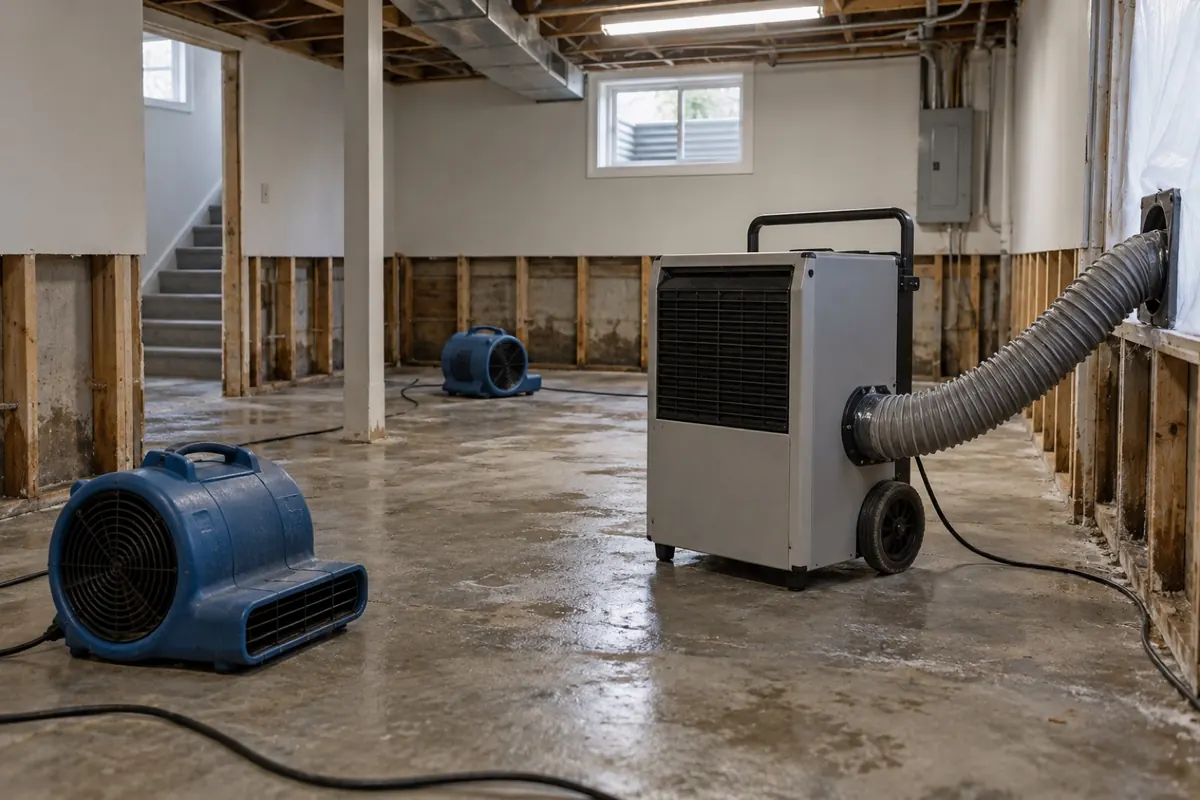
A 20 by 24 foot room with an 8 foot ceiling, Class 3: floor, walls and ceiling wet. Every figure below is arithmetic on the published ratios and ratings above.
| Step | Input | Result |
|---|---|---|
| Wet floor | 480 sq ft divided by 70 and by 50 | 7 to 10 air movers |
| Wet ceiling and walls above 2 ft | 1,008 sq ft divided by 150 and by 100 | 7 to 11 air movers |
| Air movers in total | Plus one for the room | 15 to 22 |
| LGR dehumidification | 3,840 cu ft divided by Class 3 factor 40 | 96 pints/day: 1 LGR 3500i |
| Or desiccant | 3,840 cu ft x 3 ACH / 60 | 192 CFM: 1 DriTec 4000i |
The ratios are a starting point, not a finish line. The count changes daily as readings come down, which is why the drying log matters more than the opening set-up.
Open or closed drying: a decision path
Per Cleanlink (2020), a closed drying system shuts doors and windows and dries with dehumidifiers; an open system uses drier outdoor air instead. A 2000 patent, US6161763, adds the risk: outside weather can change and slow the job. Work through it in order:
- 1. Measure GPP in the affected area and outdoors. Use temperature and RH; never compare RH alone.
- 2. Is outdoor GPP clearly lower? If not, as in the 127 grain summer example, close the building and dehumidify.
- 3. If it is lower, is it stable? Check the forecast; a front can reverse the advantage overnight.
- 4. Will incoming air chill surfaces below the room dew point? Condensation adds water back.
- 5. Re-check every visit. Switch systems when the numbers flip, and log why.
Drying goals, dry standards and moisture maps
Per R&R Magazine on acceptable dry (2021), S500 defines the dry standard as a reasonable approximation of a material’s moisture before the loss, and the drying goal as the target the restorer sets for the end of drying. The usual method is reading the same material in an unaffected area; according to the article’s author, within 10% of those readings is acceptable. Published targets exist for wood: according to NDSU Extension, wood should be under 15% moisture content before walls are closed, and LSU AgCenter gives 15% or lower.
Per Accuserve on moisture maps (2025), S500-2021 defines a moisture map as documentation showing how far water migrated, marking affected and adjacent unaffected areas; the article advises daily readings. Material decisions sit on companion pages: wet drywall and hardwood floor water damage.
For contractors: the file insurers read
An adjuster reviewing a dry is checking that equipment days match a calculation and that the finish matches the readings. Dri-Eaz prints Xactimate codes on its spec sheets, WTRDHM for dehumidifiers and WTRDRY for air movers, and our explainer on how Xactimate pricing works covers pricing.
| Record | What it contains | What it proves |
|---|---|---|
| Moisture map | Sketch, wet and dry boundaries, origin, chamber, category and class | Scope of the affected area |
| Dry standard readings | Same materials, unaffected areas, day one | The target was set before drying |
| Daily psychrometric log | Temp, RH and GPP: affected area, outlet, outdoors, unaffected | Equipment was working |
| Daily moisture log | Readings per point against the goal | Progress, and when to pull equipment |
| Equipment log | Units, placement, days on site | Each billed day ties to a unit |
| Photos and receipts | Conditions, temporary repairs, materials | Mitigation steps were reasonable |
The California Department of Insurance claims guide (2015) says policies may not cover ensuing damage if reasonable steps were not taken, and tells owners to save receipts. What a given policy pays is set by its wording; owners should read it and ask their state insurance department or a licensed professional. On credentials: the IICRC Applied Structural Drying page requires WRT first and is in person, and the ACAC structural drying certification page lists CSDS (8 years of field experience), CSDR (2 years) and CSRD, accredited by CESB.
Questions people actually ask
What are the two main types of drying methods?
In structural drying they are closed and open systems. Per Cleanlink, a closed system shuts the building and dries with dehumidifiers; an open system uses drier outdoor air. The choice turns on grains per pound: outdoor air helps only when it holds less moisture than the air inside. Separately, a material is either dried in place or removed.
How long does it take for water to cause structural damage?
EPA’s guidance is to dry water-damaged materials within 24 to 48 hours to prevent mold growth, the clock that matters most. Swelling and delamination depend on the material, and according to NDSU Extension flooded wood framing can take weeks to dry below 15% moisture content. Our guide to drying time covers durations by material.
What is applied structural drying?
It is the IICRC certification name for structural drying, ASD. Per the IICRC, it covers the efficient, timely drying of water-damaged structures and contents, requires the Water Restoration Technician certification first, and is taught in person. ACAC offers a separate CESB-accredited structural drying certification based on experience and an exam.
What are the three stages of drying?
Per R&R Magazine, the core sequence is water extraction, air movement to drive evaporation, and dehumidification to pull the evaporated water out of the air, with temperature control, held at 75 to 90 F, as a fourth phase. The order matters: extraction removes liquid water before any of it has to be evaporated.
What is GPP in water damage restoration?
Grains per pound: grains of water vapor per pound of dry air, where a pound is 7,000 grains according to NIST. Unlike relative humidity it does not change with temperature, so it compares the affected area, the dehumidifier outlet and outdoor air. Per the NWS formulas, air at 80 F and 60% RH holds about 92 GPP.
How many air movers do I need per room?
Per published summaries of S500, one per affected room, plus one per 50 to 70 square feet of wet floor and one per 100 to 150 square feet of wet wall above two feet and ceiling, plus one per inset or offset over 18 inches. The worked 20 by 24 foot Class 3 room above needs 15 to 22.
Sources
- ANSI/IICRC S500, fifth edition, 2021, product page; IICRC Applied Structural Drying page. Retrieved 11 October 2026.
- IICRC dehumidification factor sheet, revision 3.1.22. Retrieved 11 October 2026.
- C&R Magazine, Brendan Kimmel, 29 September 2025. Retrieved 11 October 2026.
- Cleanfax on S500-2015 key terms, Brandon Burton, 4 April 2016, and Cleanfax on the S500 airmover update, 6 January 2016. Retrieved 11 October 2026.
- DocuSketch's air mover guide, Barret Hall, 29 June 2026. Retrieved 11 October 2026.
- R&R Magazine, 2007, Jim Holland, 23 August 2007; R&R Magazine on drying phases, Jayson Ottensman, 3 November 2021; R&R Magazine on acceptable dry, Josh Woolen, 3 June 2021. Retrieved 11 October 2026.
- Accuserve on moisture maps, Ed Jones, 18 November 2025. Retrieved 11 October 2026.
- NWS vapor pressure formula and NWS mixing ratio formula, National Weather Service. Retrieved 11 October 2026.
- NIST Handbook 44, Appendix C, 2023. Retrieved 11 October 2026.
- LSU AgCenter, FAQs after gutting a flooded home, and NDSU Extension, Flood Recovery: Dry Out Before Rebuilding. Retrieved 11 October 2026.
- EPA's mold guide, chapter 2 and chapter 4, US EPA, updated 8 September 2026. Retrieved 11 October 2026.
- Dri-Eaz LGR 3500i spec sheet, Dri-Eaz DriTec 4000i spec sheet, Dri-Eaz Velo Pro page and Injectidry HP-PLUS manual. Retrieved 11 October 2026.
- Cleanlink, Heather Larson, 28 July 2020, and US patent 6161763 (2000). Retrieved 11 October 2026.
- California Department of Insurance claims guide, September 2015; ACAC structural drying certification page. Retrieved 11 October 2026.
- Psychrometric values and equipment counts are computed from the formulas and ratings above. Our methodology sets out the standing rules.
Ratios and factors are starting points from published summaries of S500, not substitutes for the standard or for daily readings. Policy coverage depends on each policy’s wording.