The short answer
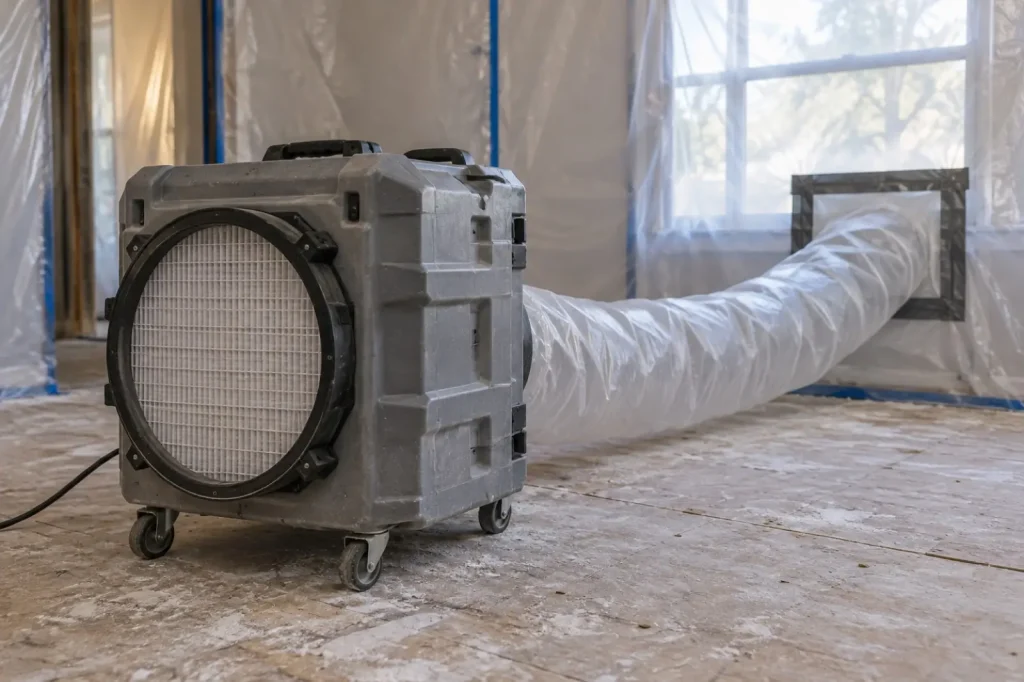
What is an air scrubber? In restoration and abatement it is a portable fan box that pulls room air through pre-filters and a HEPA filter, which EPA describes as capturing 99.97% of 0.3 micron particles, either recirculating it or exhausting it outdoors to hold a work area under negative pressure. HVAC sellers use the same name for in-duct ionising or UV devices, which are a different product.
Key takeaways
- Two unrelated products share the name: a HEPA filter on a fan, and an in-duct ioniser or UV module that EPA links to ozone and other byproducts.
- HEPA has a federal definition: at least 99.97% efficiency against a 0.3 micrometer aerosol, per the Department of Energy’s DOE-STD-3020-2015.
- Size by volume. Per the IICRC formula, cubic feet times ACH divided by 60 gives CFM, so a 2,400 cubic foot room needs 240 CFM for 6 air changes an hour.
- The federal figures found for this page are OSHA’s, for asbestos: at least 4 air changes an hour and minus 0.02 inches of water in a negative pressure enclosure.
- Published prices for named 550 to 750 CFM units ran from $545 to $1,349; daily rentals from $95 to $217, per the listings below.
- Per the CARB regulation, every indoor air cleaning device sold in California, in-duct units included, must emit no more than 0.050 ppm ozone.
On this page
Search results blend a contractor’s machine and a furnace accessory. This page takes the restoration machine first, then the HVAC product. Drying equipment is covered in our structural drying explainer, and the rest of our water coverage sits on the water hub.
Two products, one name
The restoration air scrubber is what Dri-Eaz and Abatement Technologies sell to contractors. The IICRC calls it an air filtration device, or AFD, and rental yards often list it as a negative air machine.
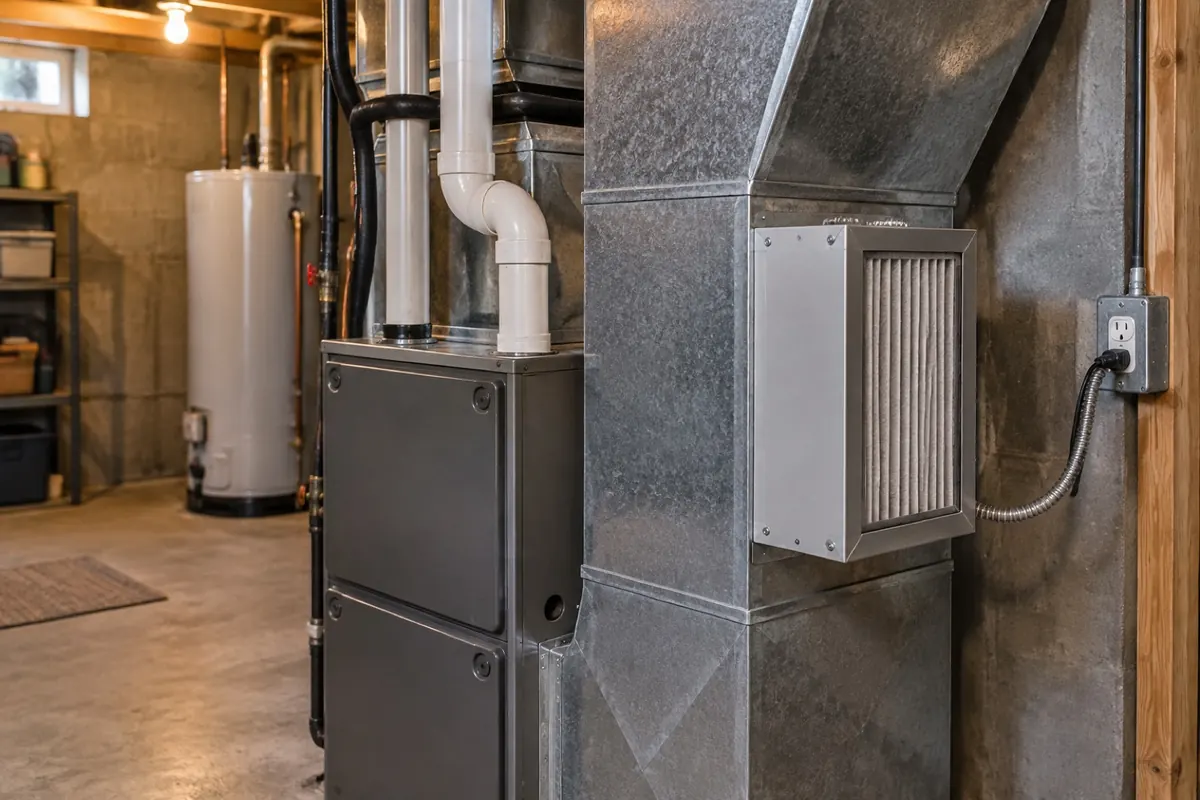
The HVAC air scrubber is a module fitted into ductwork. Collins Comfort Masters, an HVAC contractor ranking for this query, describes its version as specially coated tubes with UVC lighting that create negative ions. Those claims are the seller’s own.
| Feature | Restoration air scrubber | HVAC ‘air scrubber’ |
|---|---|---|
| Location | Portable, on the work-area floor | Fixed inside the duct |
| Method | Fan, pre-filters, HEPA filter | Ions, UV, coated surfaces or oxidation |
| Runs | Continuously, own motor | Only with the HVAC blower |
| Negative pressure | Yes, when ducted outdoors | No |
| California ozone test | Exempt if filtration only | Must certify at 0.050 ppm or less |
What makes it HEPA
HEPA is a defined term. Per the Department of Energy filter specification, DOE-STD-3020-2015, a HEPA filter is a throwaway, extended-medium dry filter in a rigid casing with a minimum efficiency of 99.97% against a 0.3 micrometer test aerosol. EPA's HEPA explainer credits that definition to DOE, and OSHA’s asbestos standard, 29 CFR 1926.1101(b), uses the same threshold.
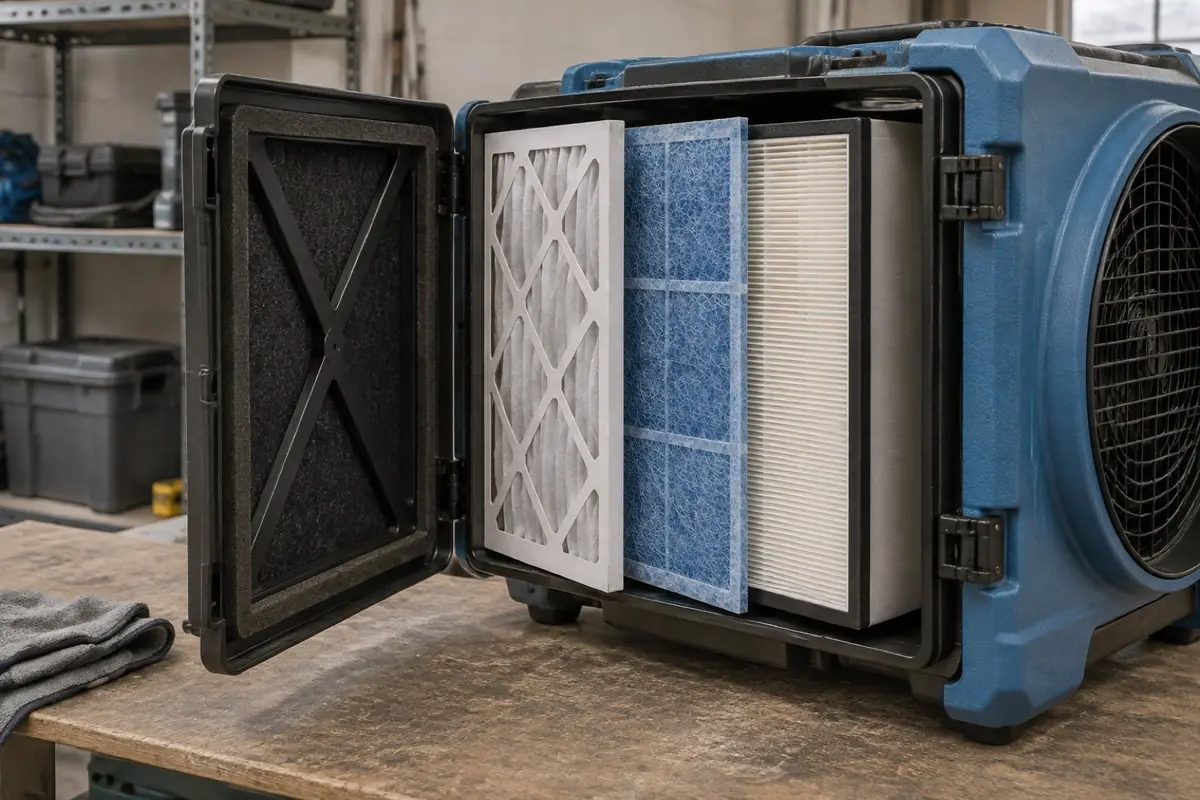
Filters sit in airflow order: a coarse fibre or mesh pre-filter, a pleated or MERV 8 pre-filter, an optional activated carbon stage for odour, then the sealed HEPA cartridge, per the Abatement Technologies and Dri-Eaz pages cited below. The pre-filters exist to stop drywall dust loading the HEPA early. Some makers print stronger figures: according to the Dri-Eaz DefendAir HEPA 700 product page, its filter captures 99.99% at 0.1 micron, a different test point.
Negative air or recirculating
The same box runs two ways. Recirculating, it filters room air and returns it to the same space, cutting the particle load without changing pressure. Ducted outdoors, it exhausts more air than leaks back, so the work area sits below the rest of the building and air leaks inward through every gap.
EPA's mold remediation guide, chapter 3 says a containment must be kept under negative pressure relative to surrounding areas, using a HEPA-filtered fan unit exhausted outside, with adequate makeup air. Its field check: the polyethylene should billow inwards on all surfaces. The chapter recommends limited containment for 10 to 100 square feet of mold and full containment above 100 square feet.
How much negative pressure
EPA gives no pressure figure for mold. The federal number is for asbestos: 29 CFR 1926.1101(g)(5)(i)(A) requires at least minus 0.02 column inches of water relative to outside pressure, about 5.0 pascals using the factor in NIST Handbook 44, Appendix C. The non-mandatory Appendix F to 1926.1101 describes manometer monitoring and smoke tubes at every opening. Mold work runs under ANSI/IICRC S520 (fourth edition, 2024) and state rules; the S520 text is sold, so its figures are not quoted here.
Sizing by air changes per hour
The IICRC dehumidification and AFD formula sheet gives the formula for desiccant dehumidifiers and notes it also works for AFD calculations: cubic feet times air changes per hour, divided by 60, equals total CFM. Divide by the unit’s CFM and round up.
Worked example, per the IICRC formula: a 20 by 15 foot room with an 8 foot ceiling holds 2,400 cubic feet, so 4 air changes an hour needs 160 CFM and 6 needs 240. Per the same IICRC arithmetic, a 30 by 40 foot containment with a 9 foot ceiling is 10,800 cubic feet; 6 air changes needs 1,080 CFM, or 2 PRED750 units at their published 750 CFM peak.
Abatement Technologies rates the same way: per the Abatement Technologies PRED750 page, the unit covers 7,500 cubic feet at 6 ACH, and 750 times 60 divided by 7,500 is 6. Rated CFM is a peak; duct runs and loaded filters deliver less.
| Space | Cubic feet | CFM at 4 ACH | CFM at 6 ACH | 750 CFM units at 6 ACH |
|---|---|---|---|---|
| Bathroom, 8 x 10 x 8 ft | 640 | 43 | 64 | 1 |
| Bedroom, 12 x 14 x 8 ft | 1,344 | 90 | 134 | 1 |
| Living room, 20 x 15 x 8 ft | 2,400 | 160 | 240 | 1 |
| Basement, 30 x 40 x 8 ft | 9,600 | 640 | 960 | 2 |
| Containment, 30 x 40 x 9 ft | 10,800 | 720 | 1,080 | 2 |
For asbestos the floor is regulatory: 29 CFR 1926.1101(g)(5)(i)(A)(2) requires at least 4 air changes per hour, and Appendix F to 1926.1101 suggests replacing the enclosure volume every 5 to 15 minutes, or 4 to 12 air changes. For mold, the protocol or state rule sets it. More air changes buy time, as CDC Table B.1 shows.
Named units, side by side
| Unit | CFM | Filter stages | Amps | Weight | Duct |
|---|---|---|---|---|---|
| Dri-Eaz DefendAir 400 | 400 | Cloth pre-filter, HEPA | 2.2 | 29 lb | 12 in |
| Dri-Eaz DefendAir HEPA 700 | To 700 | MERV 8, HEPA, carbon option | 3 | 41 lb | 14 in |
| Abatement PRED750 | 200 to 750 | Fibre, pleated, HEPA, carbon option | 1.9 | 35 lb | n/l |
| Abatement PAS2400 | 700 to 2,100 | Fibre, pleated, HEPA, carbon option | 15 A supply | n/l | n/l |
| XPOWER X-3580 | 600 | Two mesh, carbon, HEPA | 2.8 | 32.8 lb | n/l |
| XPOWER X-2580 | 550 | Two mesh, carbon, HEPA | 2.8 | 23.6 lb | n/l |
Static pressure separates contractor units from shop units: per the Dri-Eaz page the HEPA 700 holds 3.0 inches of water, and per Abatement the PAS2400 lifts 5.5 inches, which keeps airflow up through a long duct. Per the PRED750 page, five units can share one 15 amp circuit.
Purchase and rental prices
| Unit | Published price | Seller |
|---|---|---|
| XPOWER X-2580 (550 CFM) | $545 | Hydrobuilder |
| XPOWER X-3580 (600 CFM) | $1,048 | Hydrobuilder |
| Abatement PRED750 (750 CFM) | $1,218 | Mini Split Systems Direct |
| Dri-Eaz HEPA 700 (700 CFM) | $1,349 | Clean Freak |
| Rental firm | Day | Week | Four weeks or month | Listing notes |
|---|---|---|---|---|
| Cal-West Rentals, California | $95 | $275 | $550 | Dri-Eaz F284, 500 CFM; four-week rate; filters extra |
| Vandalia Rental, Ohio | $217 | $217 | $462 | DefendAir HEPA 500 (F284); monthly rate; daily and weekly rates printed identically |
| Tend Industrial Supplies, Maryland | $125 | $350 | $750 | Rates printed with a plus sign; monthly rate; pre-filter $18, charcoal $32 |
Long rentals are cheap per day, which is why frequent users buy. Filters are a separate line: Cal-West says its rates cover the unit only, and Tend prices a pre-filter at $18 and a charcoal filter at $32, according to its page. Our water damage restoration cost guide shows where equipment sits in a full job.
The HVAC “air scrubber”, ionisers and ozone
EPA's Residential Air Cleaners technical summary (third edition, 2018) reports that PCO, or photocatalytic oxidation, units have been shown to generate formaldehyde, acetaldehyde, nitrogen dioxide and carbon monoxide; that plasma units can form particles, ozone and formaldehyde; and that many electronic air cleaners, including duct-mounted ionisers, uncoated UV lamps and products advertising ions or plasma, can generate high amounts of ozone. An in-duct device also only works while the fan runs.
The EPA's Guide to Air Cleaners in the Home adds that research has not shown plasma, PCO or UV can remove gases effectively in portable home units. EPA's page on ozone generators sold as air cleaners says no federal agency has approved ozone generators for occupied spaces, and that ionisers remove particles less effectively than HEPA filters or electrostatic precipitators.
The CARB limit
The CARB air cleaner regulation, 17 CCR 94800 to 94807 bars the sale of any indoor air cleaning device not certified to emit an ozone concentration of 0.050 ppm or less. The definition covers devices fitted to a duct, and the amendments effective 1 October 2020 gave in-duct units 24 months to comply. Units using only mechanical filtration, which is what a HEPA scrubber is, are exempt from the ozone test. EPA’s summary notes that outside California no US rule requires ozone from air cleaners to be measured and disclosed.
| Body | Ozone figure | Applies to |
|---|---|---|
| CARB | 0.050 ppm | Any indoor air cleaner sold in California |
| FDA | 0.05 ppm | Indoor medical devices |
| EPA | 0.08 ppm | Outdoor 8-hour standard, as listed |
| OSHA | 0.10 ppm | 8-hour worker average |
| NIOSH | 0.10 ppm | Not to be exceeded |
Out of scope. This page does not cover the health effects of ozone, mold or asbestos. EPA describes ozone as a lung irritant on its ozone generator page; for health questions see EPA, CDC or NIH and a medical professional.
A HEPA scrubber is not an ozone generator, and ozone odour work is a separate process, covered in our guide to getting smoke smell out of a house.
Air scrubber against air purifier
Per EPA's Residential Air Cleaners technical summary, consumer purifiers are rated by clean air delivery rate: a CADR of 250 for dust equals adding 250 cfm of clean air, and the AHAM room-size label targets an 80 percent particle reduction.
| Question | Air scrubber | Air purifier |
|---|---|---|
| Rated by | CFM | CADR, on the AHAM label |
| Ducting, negative pressure | Yes | No |
| Duty | Job sites, daisy-chained | Quiet, occupied rooms |
| Best for | Containment, demolition dust | Everyday room air |
Neither fixes the cause: EPA’s air cleaner guide says they do not address the cause of mold and musty odours. The scrubber is a control used while the source is removed, as our mold remediation process guide sets out.
Which situation are you in
| Situation | Scrubber? | Mode | Governing guidance |
|---|---|---|---|
| Clean water loss, drying | Optional | Recirculating | Contractor judgement |
| Mold, 10 to 100 sq ft | Usually | Negative, limited containment | EPA chapter 3, state rule |
| Mold, over 100 sq ft | Yes | Negative, full containment | EPA chapter 3, state rule |
| Asbestos, negative pressure enclosure | Yes, by rule | Negative, 4 ACH minimum | OSHA 1926.1101(g)(5) |
| Smoke cleanup | Usually | Recirculating, carbon stage | Contractor judgement |
| Homeowner wants cleaner air | No | CADR-rated purifier | EPA air cleaner guide |
Five checks before you switch it on
- 1. Is it HEPA? Per the DOE definition that means 99.97% at 0.3 micrometer, not ‘HEPA-type’.
- 2. Recirculate or exhaust? To stop spread to other rooms, duct it out and provide makeup air.
- 3. Did you do the arithmetic? Cubic feet times ACH over 60, divided by unit CFM, rounded up.
- 4. Can you prove the pressure? A manometer reading, or poly billowing inward plus a smoke check.
- 5. Are the pre-filters fresh? Loaded ones cut real airflow.
For contractors: scope, records and the line item
The equipment line carries Xactimate code WTRNAFAN, per the Dri-Eaz HEPA 700 page; how such lines are priced is explained in how Xactimate pricing works. Asbestos jobs, where an enclosure must meet OSHA’s numbers, are priced on our asbestos removal cost page, and in-duct questions usually surface on duct cleaning scopes.
| Record | What to capture | Why it is asked for |
|---|---|---|
| Unit list | Model, rated CFM, asset number | Ties each billed day to a machine |
| Sizing sheet | Dimensions, ACH target, CFM arithmetic | Shows the count was calculated |
| Set-up | Mode, exhaust point, makeup air | Negative air must exhaust safely |
| Pressure log | Manometer or smoke checks, timed | OSHA Appendix F monitoring, for asbestos |
| Hours and filters | Daily hours, filter changes by stage | Filters are often billed separately |
Questions people actually ask
Do air scrubbers really work?
A restoration air scrubber works as well as its filter and airflow. Per the DOE definition, HEPA means at least 99.97% efficiency against a 0.3 micrometer test aerosol, and CDC’s Table B.1 shows 6 air changes an hour removes 99.9% of airborne particles in about 69 minutes in an ideal room. In-duct ionisers are a different product with a weaker evidence base, per EPA’s 2018 technical summary.
Is it safe to be in a room with an air scrubber?
A HEPA scrubber is a fan and a filter and adds nothing to the air, which is why California exempts filtration-only devices from ozone testing. The caution is for devices that make ozone: EPA says no federal agency has approved ozone generators for occupied spaces. Inside a mold or asbestos containment, the work itself sets the protective equipment required.
Which is better, an air purifier or an air scrubber?
They do different jobs. A purifier is rated by CADR for quiet use in an occupied room, as EPA’s technical summary explains. A scrubber is rated by CFM, can be ducted to create negative pressure, and is built for job sites. For everyday home air choose a CADR-rated purifier; for containment or demolition dust, a scrubber.
When should you use an air scrubber?
Whenever work will put particles in the air that must not reach the rest of the building: mold removal, asbestos abatement, demolition of wet drywall or smoke cleanup. EPA’s mold guide calls for negative pressure in containments, and OSHA requires HEPA-exhausted air with at least 4 air changes an hour in a negative pressure enclosure for Class I asbestos work.
What is an HVAC air scrubber?
A module installed in ductwork that uses ions, UV light, coated surfaces or photocatalytic oxidation instead of a HEPA filter. EPA’s 2018 technical summary reports PCO units have been shown to generate formaldehyde and other byproducts, and that many ionising devices can generate ozone. In California each one must be certified at or under 0.050 ppm ozone.
How much does it cost to rent an air scrubber?
Per the rate pages found for this article, portable HEPA units rent for $95 to $217 a day at Cal-West Rentals in California, Tend Industrial Supplies in Maryland and Vandalia Rental in Ohio, with four-week or monthly rates of $462 to $750. Filters are usually extra, so ask before the unit leaves the yard.
Sources
- DOE-STD-3020-2015, US Department of Energy, June 2015, and EPA's HEPA explainer, updated 13 January 2026. Retrieved 11 October 2026.
- 29 CFR 1926.1101 and Appendix F to 1926.1101, OSHA. Retrieved 11 October 2026.
- EPA's mold remediation guide, chapter 3, US EPA, updated 29 April 2026. Retrieved 11 October 2026.
- IICRC dehumidification and AFD formula sheet, revision 3.1.22. Retrieved 11 October 2026.
- ANSI/IICRC S520, fourth edition, 2024; product page only. Retrieved 11 October 2026.
- CDC Table B.1, Guidelines for Environmental Infection Control. Retrieved 11 October 2026.
- EPA's page on ozone generators sold as air cleaners, updated 19 February 2026. Retrieved 11 October 2026.
- EPA's Residential Air Cleaners technical summary, third edition, August 2018. Retrieved 11 October 2026.
- EPA's Guide to Air Cleaners in the Home, updated 1 October 2026. Retrieved 11 October 2026.
- CARB air cleaner regulation, 17 CCR 94800 to 94807. Retrieved 11 October 2026.
- NIST Handbook 44, Appendix C, 2023. Retrieved 11 October 2026.
- Manufacturer pages: Dri-Eaz DefendAir 400 product page, Dri-Eaz DefendAir HEPA 700 product page, Abatement Technologies PRED750 page, Abatement Technologies PAS2400 page. Retrieved 11 October 2026.
- Retail listings: Hydrobuilder XPOWER X-2580 listing, Hydrobuilder XPOWER X-3580 listing, Mini Split Systems Direct PRED750 listing, Clean Freak Dri-Eaz HEPA 700 listing. Retrieved 11 October 2026.
- Rental rate pages: Cal-West Rentals, Vandalia Rental, Tend Industrial Supplies. Retrieved 11 October 2026.
- Collins Comfort Masters, quoted as the seller’s own description. Retrieved 11 October 2026.
- Sizing figures and the pascal conversion are arithmetic on the figures above. Our methodology sets out the standing rules.
Specs and prices are set by each seller and change. Confirm current figures, and follow your remediation protocol and state rules for containment work.