The short answer
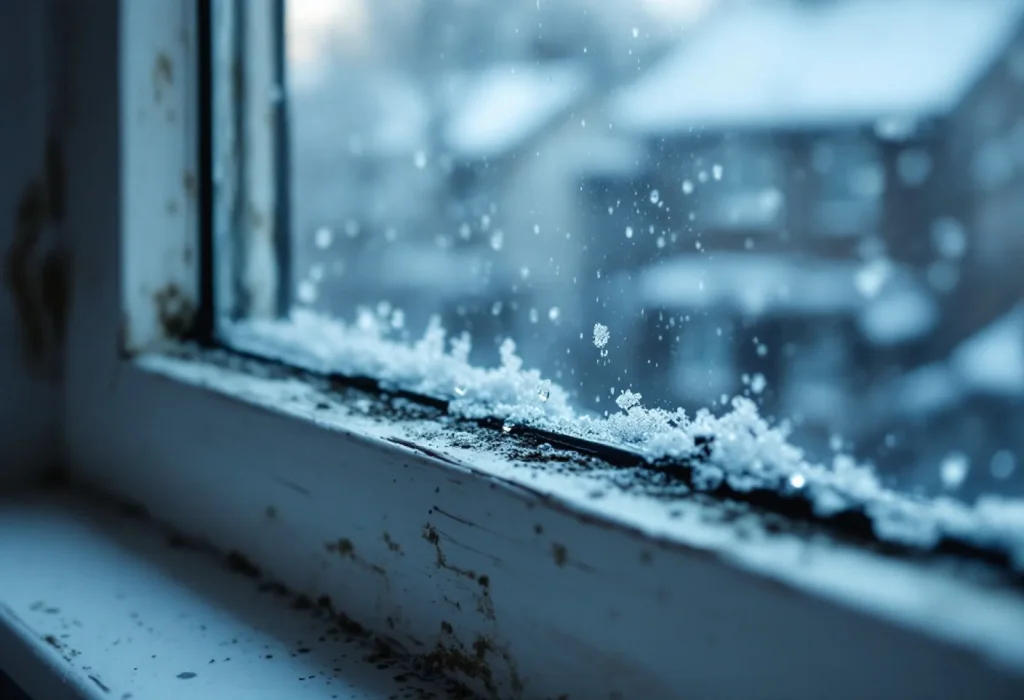
Does mold grow in winter? Yes, indoors. A house heated to about 70 F sits inside the 41 to 104 F surface band that ASHRAE Standard 160 used for mold risk, and winter adds water on cold surfaces. According to a calculation from NRC Canada window data, single glass at 20 F outdoors starts to sweat above about 24% indoor humidity. Outdoors, cold and snow cut airborne spores.
Why does a 70 F house grow mold when it is 10 F outside?
Mold on a wall responds to the temperature and humidity at that surface, not to the weather report. The version of ASHRAE Standard 160 analysed, per the USDA Forest Service field study, set its mold check at a 30 day average surface humidity of 80% whenever the 30 day average surface temperature sits between 5 C (41 F) and 40 C (104 F). A room heated to 68 or 70 F is inside that band all winter.
Winter changes where the water lands: on the coldest surface warm room air can reach. The University of Minnesota Extension bulletin CD-FO-3567 lists what that condensation leads to: wet sills, damp walls, mold, wet insulation, wood rot and corrosion of metal, and it names the bathroom as the room with the worst condensation.
The EPA guide to mold and moisture gives the target that matters in January: keep indoor humidity below 60%, ideally 30% to 50%, and dry anything wet within 24 to 48 hours. Per the NRC Canada data below, even 30% is too much for single pane glass below about 25 F outside.
At what indoor humidity does a window sweat at 30, 20, 10 and 0 F?
NRC Canada Building Digest CBD-4 (A. G. Wilson, April 1960) states the rule plainly: condensation forms on inside glass whenever the glass surface falls below the room’s dew point. Its Table I gives that surface temperature for a 70 F room. This page converts those surface temperatures to a room humidity with the National Weather Service vapor pressure formula: the humidity at which the glass sits exactly at the dew point is the vapor pressure at the glass divided by the vapor pressure of 70 F air.
Read the chart as a ceiling. Per the calculation, at 30 F outside, single glass sweats above 33% and double glass above 60%. At 10 F, per the same arithmetic, the ceilings fall to 18% and 46%, and at 0 F to 13% and 41%. At 20 F, double glass carries 2.2 times the humidity single glass can, by this calculation.
Compare that with the EPA range of 30% to 50%: single glazing cannot hold the bottom of it below roughly 25 F outside without wet glass. NRC reports the same limit: with single glass, humidities above 25% cannot be carried below 20 F outside without excessive condensation.
| Glazing and outdoor temperature | Maximum RH per the NRC table | This page’s calculation | Difference |
|---|---|---|---|
| Single glass, 20 F | 24% | 24% | none |
| Single glass, 0 F | 12% | 13% | +1 point |
| Double glass, 20 F | 53% | 53% | none |
| Double glass, 0 F | 41% | 41% | none |
How we counted. Inside surface temperatures are NRC Canada’s for a 70 F room with natural convection indoors and a 15 mph wind outdoors. Values at 30 F and 10 F are straight-line interpolations between NRC’s 40 F and 0 F rows. The NWS formula is the over-water form, so on glass below 32 F it runs about 1 point above NRC; frost forms there. Low-e glass will differ: ask the window maker for its condensation resistance rating.
Which glass, and which part of the window, gets wet first?
Wind matters nearly as much as glazing. In NRC’s table, a single pane at 0 F outdoors sits at 17 F on the inside face in a 15 mph wind and at 35 F in calm air, while triple glass holds 54 F to 56 F. Every one of those surfaces is colder than the 70 F room, which is why a north or windward window fogs first.
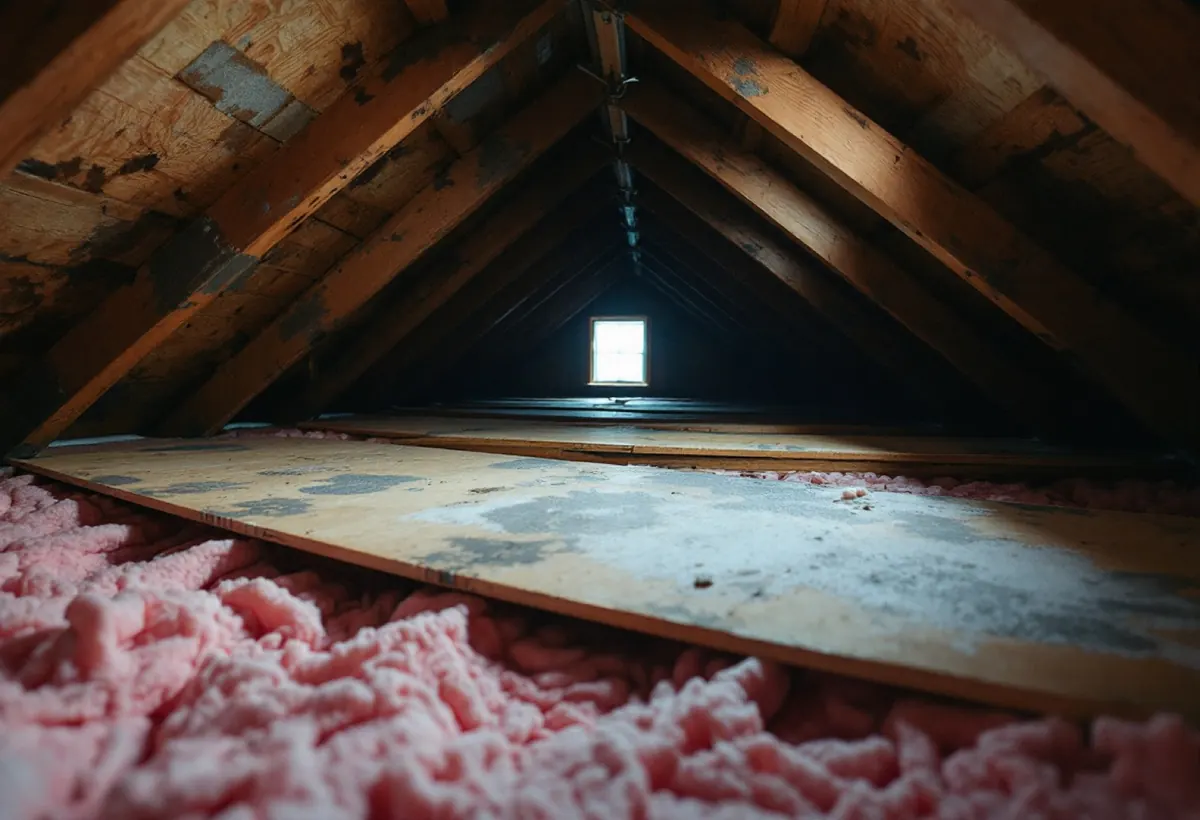
The bottom of the pane goes first. NRC Canada explains that convection inside a double unit makes the air space several degrees colder at the bottom than at the top, so condensation on double windows usually starts at the lower edge, exactly where water then runs onto the sill and the stool. Window stools also block room air from the lower glass, which lowers its temperature further, per the same digest.
Metal frames are the other cold path. According to NRC, CBD-4 puts the thermal conductivity of aluminum at about 800 to 1,400 times that of wood, so an aluminum frame that runs from inside to outside without a thermal break can frost while a wood sash beside it stays dry. Wet wood sills and the paint film on them are what mold eats; cleanup steps for that spot are in our guide to mold on window sills.
Why does frost build on attic sheathing in January, and what does the code say about bath fans?
An attic above the insulation is close to outdoor temperature, so the roof deck underside is the coldest wood in the house. Two things deliver indoor vapor to it. The first is a bath or kitchen fan that ends in the attic. Section M1501.1 of the residential code, as adopted in Seattle in 2021, reads: “Air shall not be exhausted into an attic, soffit, ridge vent or crawl space.” The only exception is a whole-house attic fan in a dwelling with a private attic.
The Building America Solution Center guide from the US Department of Energy tells owners to climb up and check: each fan should have one duct that runs to a dampered roof cap or a soffit or wall vent with an air sealed connection, because exhaust dumped into an attic or crawlspace “can cause mold growth and damage to the wood”. The second path is air leakage. The University of Minnesota bulletin says holes for wires, pipes, ducts and light fixtures must be sealed so humid air cannot leak through the ceiling into the attic.
The USDA Forest Service field study (Glass, Gatland, Ueno and Schumacher, ASTM STP 1599, 2017) reports Chicago roofs monitored from October 2013 to June 2014 under a 22 C, 50% humidity interior: visible mold grew on the cavity side of the OSB in two roofs whose ridge sheathing ran warmer in winter, which the authors tie to interior air leakage carrying heat and moisture to the ridge.
For what attic mold looks like once the frost melts, see our guide to the signs of mold in an attic. Roof ventilation and ice dam detail belong to the roofing trade and are covered at theroofingbrief.com.
Can mold grow inside a wall all winter? What a 2003 to 2004 sheathing test found
The same USDA Forest Service paper re-examines three south facing test walls built at Washington State University’s Natural Exposure Test Facility in Puyallup, Washington (Climate Zone 4C), differing only in interior vapor control: polyethylene, a smart vapor retarder, or latex paint on gypsum board. Per the paper, the rooms behind them were held at 21 C and 50% to 55% humidity.
According to the paper, surface humidity on the sheathing peaked in winter in all three walls and stayed at or near 100% all winter in the paint only wall, whose OSB moisture content ran well above 30%. Its computed mold index rose steadily through the winter and peaked at 3.4 in March, and mold was seen on the cavity side of the OSB in spring 2004. The polyethylene and smart retarder walls, per the same data, peaked at about 16% and 12% moisture content and grew none.
Per the paper, growth built through the winter to a March peak. The authors also found the simple 30 day rule in ASHRAE Standard 160 too strict, failing walls that grew no mold, which is why the standard moved to a mold index model.
Where does winter mold show up first? 10 hot spots and the source for each
Each row below is a place a named public source identifies as cold, wet or both in a heated winter house, with the reason that source gives. Check them in this order on the first cold snap below 20 F, when the chart above says window glass starts to sweat at the lowest room humidity.
| Hot spot | Why it gets wet in winter | Source |
|---|---|---|
| Bottom edge of window glass | Coldest glass; convection in double units chills the lower edge | NRC CBD-4 |
| Aluminum frames without a thermal break | About 800 to 1,400 times the conductivity of wood | NRC CBD-4 |
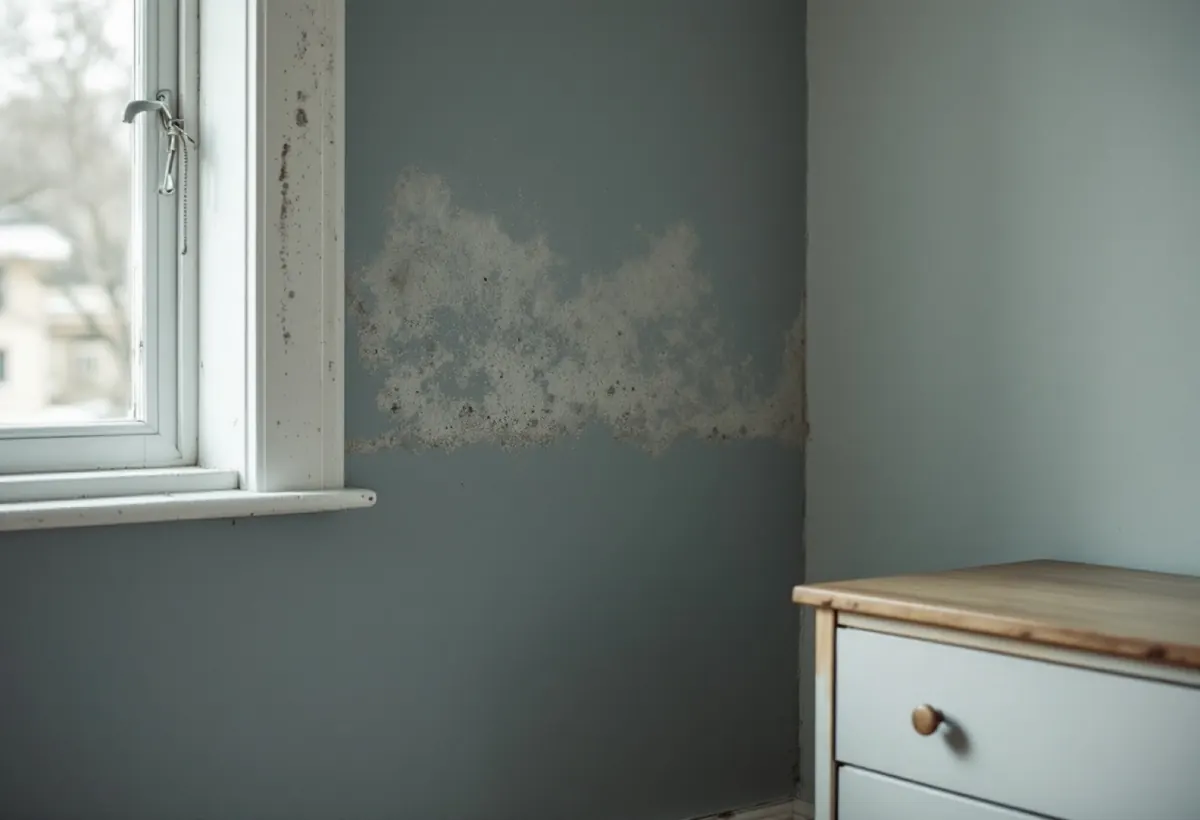
| Outside corners of rooms | Cold on two exterior faces, poor warm air circulation | UMN CD-FO-3567 |
| Wall behind furniture on an exterior wall | EPA lists it as a place where condensation forms | EPA |
| Bathroom walls, ceiling and window | Highest humidity in the house; worst condensation | UMN CD-FO-3567 |
| Underside of attic roof sheathing | Fan ducts or ceiling leaks deliver indoor vapor; M1501.1 bans attic discharge | Residential code M1501.1 |
| Bedrooms under a night setback thermostat | Cooling air and no furnace circulation overnight | UMN CD-FO-3567 |
| Cold water pipes | EPA advises insulating them to stop condensation | EPA |
| Portable humidifier tank | Standing water; EPA says empty daily, clean every third day | EPA |
| New house closed up in late fall | Built-in moisture of lumber, plaster, paint and concrete | UMN CD-FO-3567 |
The University of Minnesota bulletin adds a timing note: windows commonly steam up in the first sudden cold of late fall, while the house still holds damp fall moisture, and running ventilation fans several hours a day usually corrects it.
Does freezing weather kill mold, or does it just wait for spring?
A common rule of thumb says a hard freeze cleans out a damp attic. The building science model points the other way. In the mold index model now used with ASHRAE Standard 160, as the USDA Forest Service field study describes it, conditions turn unfavorable when the surface drops below 0 C, and the index then declines at a rate set by how long conditions stay unfavorable and by a material-specific decline coefficient, with pine sapwood as 1. The index falls gradually; it does not reset to zero when the surface freezes.
The USDA Food Safety and Inspection Service makes the same point for food: most molds prefer warmer temperatures, but they can grow at refrigerator temperatures too. For the temperatures that do kill mold, and why heat treatment still leaves dead growth to remove, see what temperature kills mold. Whether drying alone stops it is answered in does mold die when it dries out.
Are there fewer mold spores in the outdoor air in winter?
Yes, in cold climates. In a year-round air sampling study in Waterloo, Ontario through 1992 (Li and Kendrick, International Journal of Biometeorology, 1995), mean temperature was the most important weather factor for airborne fungi, ahead of minimum and maximum temperature, wind, humidity, rain and snow, and total fungal spores were positively related to temperature.
Snow lowered counts two ways in that 1992 study: it washed spores out of the air, and it kept spores on the ground covered so they could not be lifted again. The authors call the effect of snow negative on most airborne fungi, with Epicoccum and Alternaria the exceptions they flag for further study.
That matters if someone samples the air in January. An outdoor control sample taken over snow in Waterloo-type conditions starts low, so the indoor result is being compared with a seasonal minimum. Ask the inspector what date and weather the outdoor sample was taken in, and read the comparison in our guide to mold testing with that in mind.
Which humidifier setting keeps winter windows dry: 30, 40 or 50 percent?
The EPA humidifier fact sheet sets the ceiling: do not humidify above 50% relative humidity. The chart above sets a lower one for cold glass. At 10 F outside, the calculation gives 46% for double glass and 18% for single glass, so in a hard cold spell the window, not the EPA ceiling, is the limit. According to its prevention list, the University of Minnesota bulletin says to lower humidity toward the bottom of its 30% to 50% range in very cold weather and to use condensation on the windows as the signal.
Two settings from that bulletin fit together, according to the bulletin: if a ventilation humidistat is set at 50%, the humidifier humidistat must be set at 40% or lower, or the fans will run constantly. A hygrometer costs $10 to $50 at a hardware store, according to EPA, and reading it beside the coldest window is a better check than the dial on the humidifier.
The tank is its own winter source. EPA says to empty, wipe dry and refill portable units daily, clean them every third day, and use low mineral water such as distilled water. Cleaning steps are in our guide to mold in a humidifier, and the full humidity threshold picture is in what humidity does mold grow. Furnace mounted humidifiers belong to the HVAC trade and are covered at thehvacbrief.com. More winter and moisture guides sit in our mold hub.
Out of scope: this page covers buildings, not health. For health questions about mold, start with the EPA guide to mold and moisture and a doctor.
Questions people actually ask
Does mold grow in the cold or the heat?
Both, within limits. The ASHRAE Standard 160 check analysed by the USDA Forest Service applied between 41 F and 104 F surface temperature, and USDA’s food safety service says molds can grow at refrigerator temperatures. Warmth speeds growth, but a heated house at 68 to 72 F is warm enough all winter; the limit indoors is surface moisture, not temperature.
Does a cold house make mold worse?
Often, yes. Cooler room air raises relative humidity at the same vapor content and makes every exterior surface colder. The University of Minnesota bulletin explains that a night setback lets house air cool with little circulation, which increases condensation risk, especially in bedrooms where breathing adds moisture. Its fix is a timer that runs the furnace fan several times an hour, or leaving the heat on overnight.
What temperature does mold grow at in a house?
Ordinary room temperatures. The ASHRAE Standard 160 check covered 5 C to 40 C (41 F to 104 F) at the surface, and the mold index model treats surfaces above 0 C with high enough humidity as favorable. Thermostat settings between 60 F and 75 F all fall inside that range, so temperature alone does not protect a heated room.
Does mold grow in dry areas in winter?
Not on surfaces that stay dry. EPA says that in most cases mold will not grow if wet materials are dried within 24 to 48 hours, and recommends indoor humidity below 60%. According to this page’s NRC based calculation, a room at 25% feels dry while single glass at 10 F outside is wet, because that glass sweats above about 18%.
Does mold go away on its own after winter?
No. In the Puyallup test wall in the USDA Forest Service paper, the mold index peaked at 3.4 in March and then declined only slowly as the sheathing dried in warmer weather, and visible mold was still found that spring. Drying stops further growth; the growth already there has to be cleaned or removed.
Sources
- NRC Canada Building Digest CBD-4, A. G. Wilson, National Research Council of Canada, “Condensation on Inside Window Surfaces”, originally published April 1960 (MIT hosted copy), Tables I and II. Retrieved 20 November 2026.
- National Weather Service vapor pressure formula, National Weather Service, El Paso office, saturation vapor pressure and relative humidity formulas. Retrieved 20 November 2026.
- University of Minnesota Extension bulletin CD-FO-3567, Peterson and Hendricks, “Humidity and Condensation Control in Cold Climate Housing”, Minnesota Extension Service, 1988. Retrieved 20 November 2026.
- EPA guide to mold and moisture, United States Environmental Protection Agency, last updated 18 February 2026. Retrieved 20 November 2026.
- EPA humidifier fact sheet, United States Environmental Protection Agency, “Use and Care of Home Humidifiers”. Retrieved 20 November 2026.
- USDA Forest Service field study, Glass, Gatland, Ueno and Schumacher, “Analysis of Improved Criteria for Mold Growth in ASHRAE Standard 160 by Comparison with Field Observations”, ASTM STP 1599, 2017, USDA Forest Service Treesearch 55524. Retrieved 20 November 2026.
- Section M1501.1 of the residential code, Seattle Residential Code 2021, Chapter 15, Seattle Department of Construction and Inspections (IRC text with local amendments). Retrieved 20 November 2026.
- Building America Solution Center guide, “Look at Exhaust Fans for Venting to Outside”, Pacific Northwest National Laboratory for the US Department of Energy. Retrieved 20 November 2026.
- a year-round air sampling study in Waterloo, Ontario: Li and Kendrick, “A year-round study on functional relationships of airborne fungi with meteorological factors”, International Journal of Biometeorology 39:74 to 80, 1995, hosted by the Connecticut Agricultural Experiment Station. Retrieved 20 November 2026.
- USDA Food Safety and Inspection Service, “Molds on Food: Are They Dangerous?”, United States Department of Agriculture (archived copy). Retrieved 20 November 2026.
- Window condensation thresholds are arithmetic on the NRC surface temperatures and the NWS formula, computed when this page was built and checked against NRC’s printed values. Our methodology sets out the standing rules.
Thresholds are for the center of glass in a 70 F room with no sun; the bottom edge of a window, a cooler room or a coated glass unit will differ.