The short answer
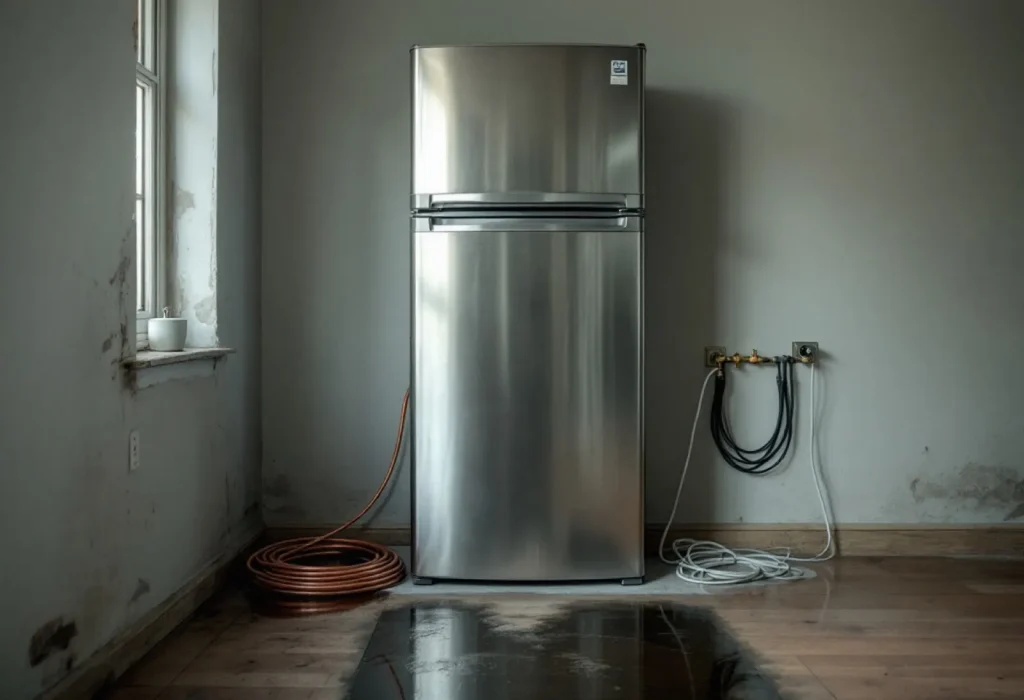
Refrigerator water line leak damage usually starts as a slow drip at a 1/4 inch fitting that runs for weeks behind and under the fridge, soaking the subfloor before any water shows at the front. One drip a second is about 8.2 gallons a day; a snapped line can run near the 0.4 gallons a minute GE gives for flushing. Policies treat those two leaks differently.
Why does a fridge water line leak for weeks before anyone sees it?
Three things keep the water out of sight. The line is always under house pressure: the GE Appliances manual 49-1000472 says the supply line is under pressure at all times and sets the icemaker supply between 40 and 120 psi. The line is long and coiled: the Frigidaire installation sheet for model FFHI2131Q sizes it as the distance to the house pipe plus 7 feet (2.1 meters) and has the installer coil the spare, about 2 1/2 turns, behind the cabinet so the fridge can roll out. And the leak points sit at floor level behind a cabinet that is rarely rolled out.
A weeping compression nut or a pinhole in a kinked coil releases drops, not a spray. The drops run down the wall, collect under the refrigerator, and follow the floor seams and the subfloor outward. The first sign at the front is often a cupped board or a soft spot at the toe kick, which is the last place the water reaches, as the section drawing shows.
The valve end fails too. Frigidaire’s sheet for model FFHI2131Q says “Do not use a self-piercing shut-off valve”, and GE’s manual tells buyers to confirm a saddle type valve complies with local plumbing codes before buying one. A line leaking at the valve on the wall drips straight down behind the fridge, out of sight from the kitchen. A dishwasher supply line fails the same way under a cabinet, covered on our dishwasher leak water damage page.
Plastic, copper, braided steel or PEX: what do GE, Frigidaire and Samsung say in writing?
Guides online give plastic lines a fixed lifespan in years. The maker documents read for this page do not. They rank the materials and set pressure limits, and not one of the 4 documents gives a replacement interval in years. GE adds a line that matters for any claim: “This water line installation is not warranted by the refrigerator or icemaker manufacturer.”
| Line material | What the maker document says | Supply pressure stated | Replacement interval | Source |
|---|---|---|---|---|
| Copper, 1/4 inch OD | Recommended. GE lists its own copper kits; Frigidaire says use copper; Samsung’s recommended kit is copper with a compression nut and ferrule | GE 40 to 120 psi; Frigidaire 30 to 100 psi; Samsung 30 psi minimum | None stated | GE Appliances manual 49-1000472; Frigidaire installation sheet for model FFHI2131Q; Samsung US support |
| Plastic tubing | GE approves only the tubing in its own Universal Water Line kits and warns certain plastics “will crack or rupture with age”; Frigidaire says plastic “is more likely to leak”; Samsung says a plastic kit “is not recommended” and must have the molded bulb end | Same house supply as copper | None stated | GE Appliances manual 49-1000472; Frigidaire installation sheet for model FFHI2131Q; Samsung US support |
| Braided stainless steel connector | Smart Choice sells a 6 foot braided line for professional installation, with the instruction not to reuse old compression nuts or sleeves and not to overtighten | Not stated in the kit sheet | None stated | Smart Choice kit 5304510068 instructions |
| PEX house supply | The same kit ships a 1/4 inch PEX sleeve and says not to use the brass sleeve on PEX | Not stated in the kit sheet | None stated | Smart Choice kit 5304510068 instructions |
Read across the rows and the pattern is plain: copper is the default in all 3 refrigerator documents, plastic draws warnings from all 3, and braided steel appears only as an aftermarket kit. Frigidaire’s own kit 53039117950 ships 25 feet of copper tubing. Fitting and replacing the line is plumbing work, which our sister site theplumbingbrief.com covers.
How much water can a 1/4 inch line release in an hour, a day and a week?
No maker publishes a leak rate, so this table works from three published rates. EPA WaterSense puts a faucet dripping once a second at more than 3,000 gallons a year. GE tells owners to run 2 gallons through the dispenser, about 5 minutes, which is 0.4 gallons a minute through the same 1/4 inch line. Samsung’s check is 3/4 cup in under 10 seconds, at least 0.28 gallons a minute.
| Leak modelled as | Published basis | 1 hour (gal) | 24 hours (gal) | 3 days (gal) | 7 days (gal) |
|---|---|---|---|---|---|
| One drip per second | EPA WaterSense: more than 3,000 gallons a year | 0.3 | 8.2 | 25 | 58 |
| Samsung dispense check rate | Samsung US support: 3/4 cup in under 10 seconds (0.28 gal/min) | 17 | 405 | 1,215 | 2,835 |
| GE flush rate | GE Appliances manual 49-1000472: 2 gallons in about 5 minutes (0.4 gal/min) | 24 | 576 | 1,728 | 4,032 |
The spread is the point. At one drip a second a leak puts about 58 gallons under the fridge in a week, spread across a floor nobody stands on. At the GE rate, 24 gallons would leave the line in the first hour. The Washington regulator example of a sudden loss, an ice maker line that snaps and sprays, is the second case; the first is the gradual leak that filed forms exclude.
What does the water do to hardwood, laminate, vinyl plank and the subfloor under a fridge?
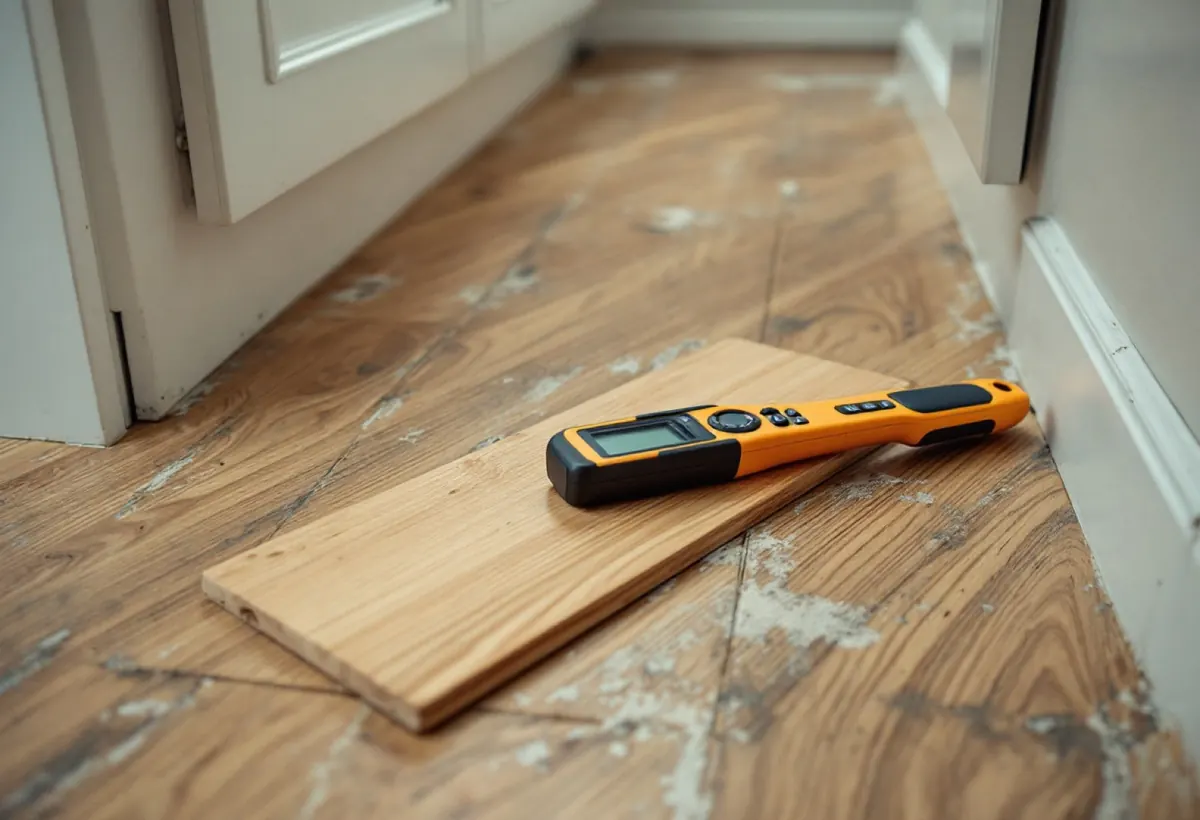
EPA Table 1, water damage cleanup lists drying actions by material. For wood surfaces it says to remove moisture immediately and dry with dehumidifiers, gentle heat and fans, and to “use caution when applying heat to hardwood floors.” For linoleum, ceramic tile and vinyl it adds: “Check to make sure underflooring is dry.” Both instructions point at the layer a slow fridge leak reaches first.
- Solid hardwood falls under EPA’s wood surfaces row, with its caution on heat. Board by board drying and repair are on the hardwood floor water damage repair page.
- Laminate is not named in EPA’s table, so treat the joints and the underlayment as the places to check. Swelling and replacement are on the laminate floor water damage page.
- Vinyl plank falls under EPA’s vinyl row, so the check is the underflooring, not the top surface. Lifting and drying are on the water under vinyl plank page.
- Plywood or OSB subfloor is the underflooring EPA tells readers to check. Drying and replacement are on the subfloor water damage page.
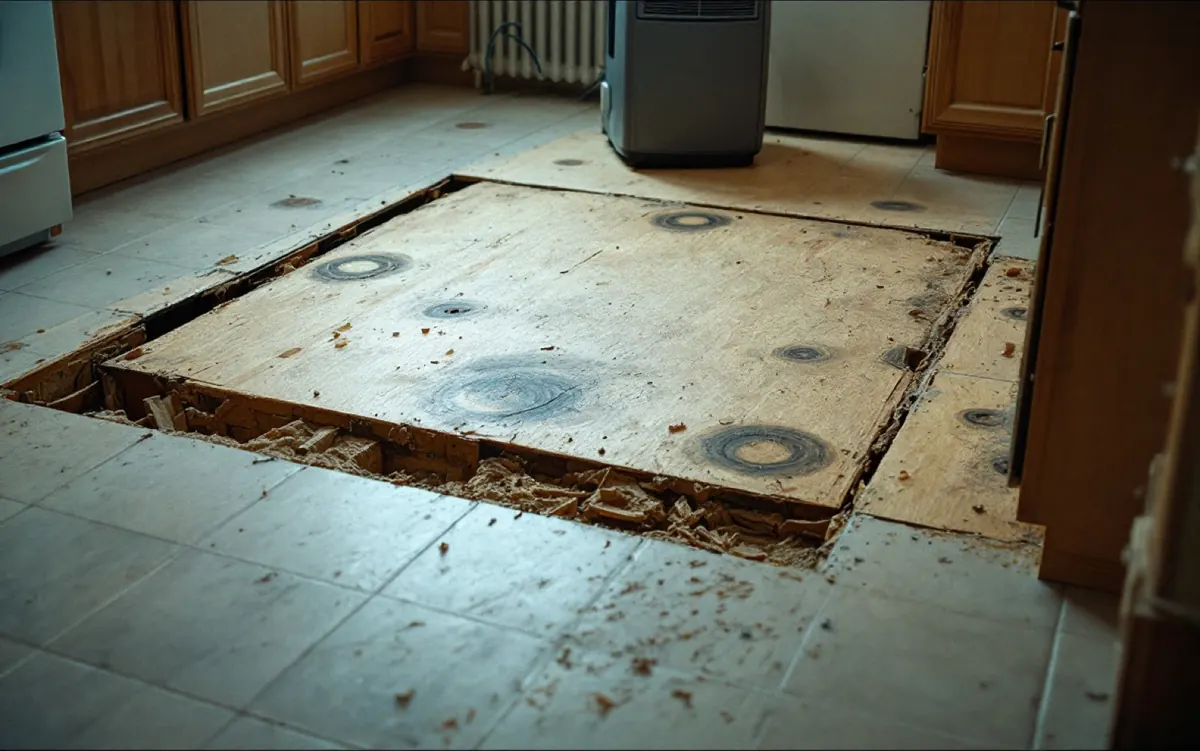
Timing matters as much as material. The EPA mold and moisture guide says to dry water damaged areas and items within 24 to 48 hours to prevent mold growth, and EPA Table 1, water damage cleanup notes that mold may grow even when materials dry within 48 hours. A leak found after weeks has passed that window in the subfloor, even if the finish floor looks dry.
Is it the water line, or is the fridge leaking from underneath with no line at all?
Fridges without a water line leak too, from the defrost system. Samsung UK leak guidance names a blocked defrost drain as a cause: “Food particles or other debris can easily get caught in the defrost drain”, and the water then leaks out or freezes over. The same page says the cabinet should tip slightly backwards, set with the 2 front legs, so condensation runs to the drip pan underneath.
| Clue | Points to the supply line | Points to the defrost drain or drip pan |
|---|---|---|
| Water stops when the shutoff valve is closed | Yes | No change |
| Fridge has no water line connected | Ruled out | Yes |
| Ice or water inside the freezer floor | Unlikely | Yes: Samsung UK cites a frozen drain |
| Wet copper or plastic tubing at the wall valve | Yes | No |
The valve test is the cleanest: close the shutoff at the wall and dry the floor. If water keeps appearing over the next 24 hours with the valve closed, the defrost drain or drip pan is the likelier source; if it stops, the supply line or its 2 fittings are the suspect. Frigidaire’s sheet uses the same 24 hour window, telling installers to check for leaks again 24 hours after installation.
Will an insurer read it as a sudden discharge or as weeks of seepage?
Filed policy wording draws the line by time. The Safeco form HOM-7030/EP 1/09, posted on the Oklahoma Insurance Department site, covers “Accidental discharge or overflow of water or steam from within a plumbing, heating, air conditioning or automatic fire protective sprinkler system, or from within a household appliance” for personal property, and excludes for the dwelling “continuous or repeated seepage or leakage of water or steam … which occurs over a period of weeks, months or years.”
The same form adds two lines that fit a fridge line leak closely. If water damage is not otherwise excluded, it covers “the cost of tearing out and replacing any part of the building necessary to repair the system or appliance.” And: “We do not cover loss to the system or appliance from which water or steam escaped.” Form HOM-7030 is one insurer’s edition dated 1/09; the wording in any other policy can differ.
Regulator guidance uses the fridge itself as the example. The Washington Office of the Insurance Commissioner lists “An ice-maker line on your refrigerator that snaps and sprays water all over your kitchen floor” as a sudden, accidental leak, and lists “A leaky pipe behind a wall or under the floor” and “Damage that develops over more than a couple of days” as gradual leaks insurers usually do not cover, “even if you had no way of knowing they started.” Evidence of how long the water sat, such as tide rings in the subfloor, is explained on the old vs new water damage page.
This page cannot say what a given policy pays. Ask the insurer in writing for 3 things: the policy form number and edition, the exclusion or peril it is applying, and the period it believes the leak ran and the evidence for it. Then take the letter to the state insurance department consumer line, which in Washington is the Office of the Insurance Commissioner, or to a public adjuster or property insurance attorney.
What to do in the first 48 hours after finding water under the fridge
- Close the 1/4 turn shutoff at the wall, or the house main if the wall valve itself is leaking.
- Unplug the fridge before pulling it out if water has reached the outlet or cord; water near a receptacle is covered on the water in electrical outlet page, and any repair there is an electrician’s work.
- Photograph the line, both fittings, the floor under the footprint and the toe kick before anything is moved or discarded, with the date visible in the file data.
- Keep the failed line or fitting: form HOM-7030 does not cover the system or appliance the water escaped from, but the part is the evidence of how it escaped.
- Start drying inside the 24 to 48 hour window EPA gives, and get moisture readings in the subfloor, not only the surface.
Claim practice follows the same clock: the Washington Office of the Insurance Commissioner says insurers usually cover sudden leaks “if you report them to your insurer quickly and follow their recommendations for fixing the leak,” so the call to the insurer belongs on day 1 alongside the drying.
Questions people actually ask
Is a fridge leaking water dangerous?
It can be. Water on a kitchen floor is a slip hazard, water near the outlet behind the fridge is an electrical hazard for an electrician to assess, and EPA says to dry wet areas within 24 to 48 hours to prevent mold. The hidden risk is the subfloor, which can stay wet for weeks under a slow drip.
Does the refrigerator warranty cover damage from a leaking water line?
Check the warranty for your model, but do not assume it. GE’s manual 49-1000472 states that the water line installation is not warranted by the refrigerator or icemaker manufacturer and tells installers to follow the steps to minimize the risk of expensive water damage. Ask the maker in writing whether a factory part failed.
How often should a refrigerator water line be replaced?
None of the 4 maker documents read for this page gives an interval in years. GE warns that certain plastics crack or rupture with age, Frigidaire says plastic is more likely to leak, and the Smart Choice kit says not to reuse old compression nuts or sleeves, so replacing a plastic line with copper is the makers’ preference.
Can a refrigerator water line freeze and burst?
Yes, where it runs through cold space. GE says not to install icemaker tubing where temperatures fall below freezing and, for long absences when the temperature can drop below freezing, to have a qualified service technician drain the system to prevent flooding. Safeco form HOM-7030 excludes freezing damage while a dwelling is vacant unless reasonable care was used.
Why does my new fridge line leak at the fitting?
Overtightening and reused parts are the two causes the documents name. Samsung warns that over-tightening the nut will cause a leak, and the Smart Choice kit says not to reuse old compression nuts or sleeves. Frigidaire says to tighten any connection that leaks after opening the valve and to recheck in 24 hours.
Sources
- GE Appliances manual 49-1000472, GE Appliances, Owner’s Manual and Installation Instructions, Pub. No. 49-1000472 Rev. 6 (01-24), water line section and vacation instructions; copy hosted by a Canadian appliance retailer. Retrieved 17 November 2026.
- Frigidaire installation sheet for model FFHI2131Q, Frigidaire, Installation Instructions P/N A01278401, top mount refrigerator. Retrieved 17 November 2026.
- Smart Choice kit 5304510068 instructions, Smart Choice 6 foot Stainless Steel Refrigerator Water Line Kit, pn 5304510068, May 2017. Retrieved 17 November 2026.
- Samsung US support, Samsung Electronics America, “Connect and install the water line to your Samsung refrigerator”. Retrieved 17 November 2026.
- Samsung UK leak guidance, Samsung UK, “What should I do if I suspect my Samsung fridge freezer is leaking water?”. Retrieved 17 November 2026.
- EPA WaterSense, United States Environmental Protection Agency, Fix a Leak Week page, last updated 13 March 2026. Retrieved 17 November 2026.
- EPA mold and moisture guide, United States Environmental Protection Agency, A Brief Guide to Mold, Moisture and Your Home, last updated 18 February 2026. Retrieved 17 November 2026.
- EPA Table 1, water damage cleanup, United States Environmental Protection Agency, Mold Remediation in Schools and Commercial Buildings, Table 1, last updated 8 September 2026. Retrieved 17 November 2026.
- Safeco form HOM-7030/EP 1/09, Safeco Homeowners Policy, as posted by the Oklahoma Insurance Department. Retrieved 17 November 2026.
- Washington Office of the Insurance Commissioner, “Leaks, water damage, and mold”. Retrieved 17 November 2026.
- Gallon figures are arithmetic on the published rates above, computed when this page was built, and labelled as calculations. Our methodology sets out the standing rules.
This page describes maker instructions, filed policy wording and regulator guidance. It is not advice on any policy or claim; read your own policy and your model’s manual. Browse more water topics in the water hub.