The short answer
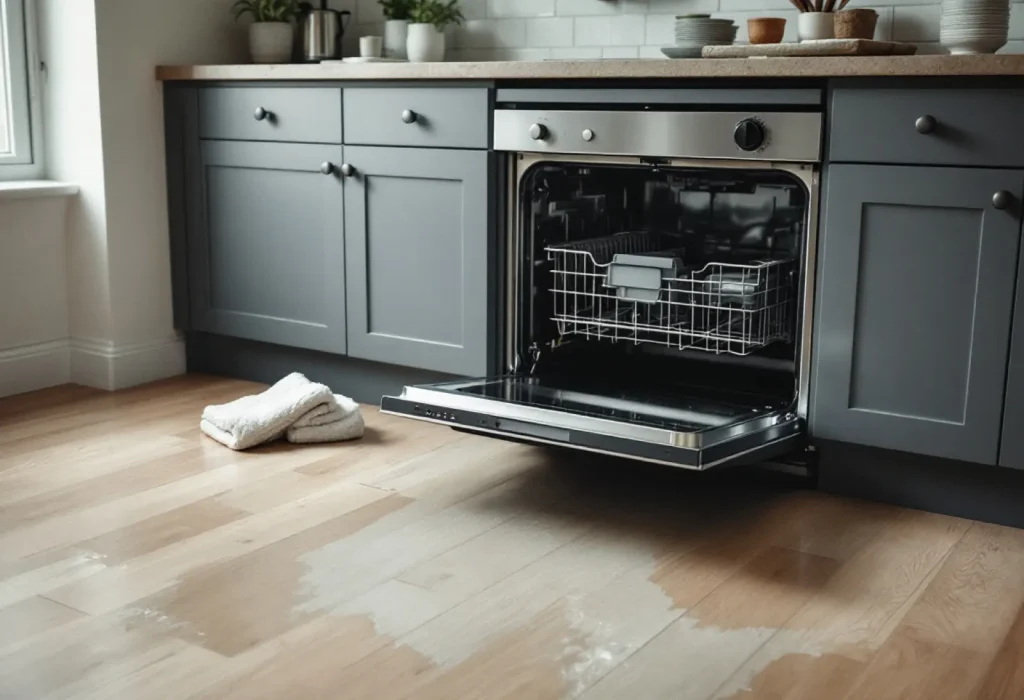
Dishwasher leak water damage usually spreads where you cannot see it: under the machine to the subfloor below the toe kick, sideways into the sink base cabinet bottom, and through floor seams to the ceiling below. A broken supply line is clean Category 1 water; drain and tub discharge is gray Category 2. EPA says to dry wet materials within 24 to 48 hours.
Where does the water go once it leaves the dishwasher?
Down and sideways, in that order. A built in dishwasher sits in a cabinet opening at least 24 inches wide per the Bosch dishwasher installation instructions, with its hot water supply valve and drain connection under the sink next door. Water that escapes the tub or a hose lands on the floor under the machine first, behind the toe kick, where nobody looks.
From there it has four exits. It runs forward and shows as a film at the toe kick; it follows the hoses through the side opening into the sink base, where a particleboard bottom panel soaks it up; it drops through the seams of plank, laminate or tile into the plywood or OSB subfloor; and once the subfloor is saturated it reaches the joist bays and the ceiling below. The EPA Table 1 water damage guidance tells you to check that underflooring is dry even when vinyl, linoleum or tile looks dry, which is the whole problem with a dishwasher leak.
A stain on a basement or lower floor ceiling directly below the kitchen is often the first sign. By then path 3 has done its work. What to open and dry in the wood layer is set out on our page about subfloor water damage.
Door gasket, supply line, drain hose or pump: where does each leak show up?
Where the water is, and when it appears, points to the part. The supply side is under constant pressure: the Bosch dishwasher installation instructions specify a hot water supply between 7.25 and 145 psi, so a weeping supply fitting keeps going with the dishwasher switched off. The drain side only carries water when the pump runs, so a drain hose leak arrives in bursts a few times per cycle.
| Leak source | When it leaks | Where the water shows up | Water category |
|---|---|---|---|
| Door gasket or door pushed open | During a wash only | Front edge of the door, floor directly in front; little or nothing behind the toe kick | Category 2 (dishwasher discharge) |
| Hot water supply line or its fitting | Any time the valve is open, cycle or not | Under the machine and in the sink base along the supply line; steady, can run for days | Category 1 (domestic supply line) |
| Inlet valve where the supply line connects | Any time, if it leaks at its seals | Under the machine, showing first at the toe kick | Category 1 (domestic supply line) |
| Drain hose, clamp or disposal connection | During the drain part of each cycle | Sink base cabinet floor, under the drain loop; pulses, not steady | Category 2 (dishwasher discharge) |
| Pump, sump or cracked tub | During wash and drain | Under the center of the machine; reaches the subfloor first | Category 2 (dishwasher discharge) |
That split answers the common question of water leaking from a dishwasher when it is not in use: a pool that grows overnight, with the machine idle, comes from the pressurized supply side, not the door or the drain. Close the hot water valve under the sink, the line Bosch says should deliver about 120 F water, and watch whether the pool stops growing. The supply line repair itself is plumbing, covered by our sister site theplumbingbrief.com.
Water at the front edge of the door during a wash is often not a failed part at all. The Bosch dishwasher instructions for use warn that projecting items can push the door open during a program and let water leak out around it, and that liquid detergent can seep from a closed dispenser. The Bosch dishwasher installation instructions add two installation causes: hoses that fold or kink when the machine is pushed into the cabinet, and Teflon tape on fittings, which they warn can cause leaks and damage floors or cabinetry.
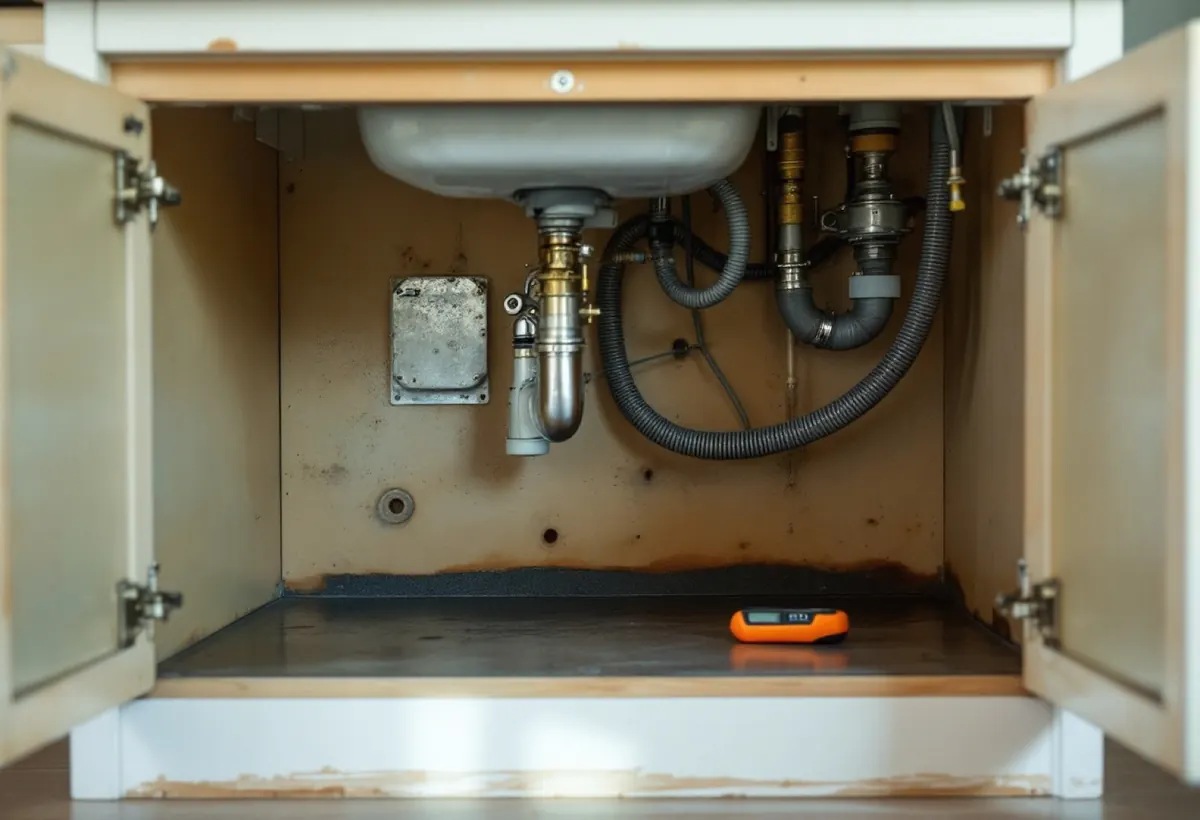
Found water under the dishwasher: what to do in the first hour?
- Close the hot water valve under the sink, then stop any cycle that is running.
- Cut power at the breaker before touching the machine: the Bosch dishwasher installation instructions call for a dedicated circuit with a 15 or 20 amp breaker. The CDC disaster safety guidance says to turn off power at the main breaker if electrical equipment is wet, and to call an electrician if reaching it means standing in water.
- Pull the toe kick panel and photograph the floor under the machine and the sink base before mopping, with the time visible.
- Take moisture readings at the toe kick, the cabinet bottom and a dry spot across the kitchen, so the 24 to 48 hour EPA window has a starting point.
- Leave fans off until you know which side leaked, per the EPA rule on water that is not known to be clean.
Pulling the machine out is how the subfloor gets checked. The Bosch dishwasher installation instructions fix it to the countertop or cabinet sides with mounting brackets and warn that hoses can fold, kink or break while it is pushed back in, then call for a 15 minute test cycle to check for leaks. That reinstall and test belongs to whoever does the appliance repair.
Is dishwasher leak water clean Category 1 or gray Category 2?
It depends on which side of the machine it came from. The Northern Arizona University Water Damage Restoration Guideline, written to the IICRC S500 standard, lists appliance malfunctions involving domestic water supply lines among its Category 1 clean water examples, and lists discharge from dishwashers or washing machines among its Category 2 gray water examples. Water that has been through the tub with food soil and detergent is gray water; water from a split supply hose that never entered the tub is clean water.
Clean water does not stay clean. The same guideline says Category 1 water may deteriorate as it dissolves or mixes with soils and as time passes, and that gray water left untreated for longer than 48 hours may change to Category 3. A slow leak found weeks later under a dishwasher, in a cavity full of crumbs and grease, is not treated as clean water by a restorer, whatever the source.
The category changes the drying method. EPA Table 1 water damage guidance says fans should not be used before determining that the water is clean or sanitary, and that personal protective equipment and containment are required by OSHA where water is contaminated with sewage or chemical or biological pollutants. The full category system, with the Class 1 to 4 drying loads, is on our page about IICRC water categories.
What moisture reading means the subfloor under a dishwasher is still wet?
Compare against dry wood in the same house, not a fixed number. According to Table 13.2 of the USDA Forest Service Wood Handbook, Chapter 13, interior woodwork and flooring in most of the United States should sit at an average of 8% moisture content, 6 to 10% for individual pieces, with averages of 6% in the dry southwest and 11% on the damp, warm coast. A subfloor reading near the dishwasher that is well above a reading taken across the kitchen is still wet.
The upper benchmarks come from the USDA Forest Service Wood Handbook, Chapter 14: according to the handbook, fully air dried wood usually holds no more than 20% moisture content and gives a reasonable margin of safety against fungal damage, while serious decay occurs only above the fiber saturation point, 30% on average. Plywood that has soaked under a dishwasher for weeks can sit above that line, which is when soft spots in front of the machine start.
For finished hardwood, the Northern Arizona University Water Damage Restoration Guideline sets a tighter dry standard; per the guideline, every affected board within 2.5% of a control reading elsewhere on the same floor, with no more than 1% difference between the top and bottom quarter inch, in a room held at 50% relative humidity at 70 F. How many days a kitchen subfloor typically needs to reach those numbers is set out on our page on how long water damage drying takes.
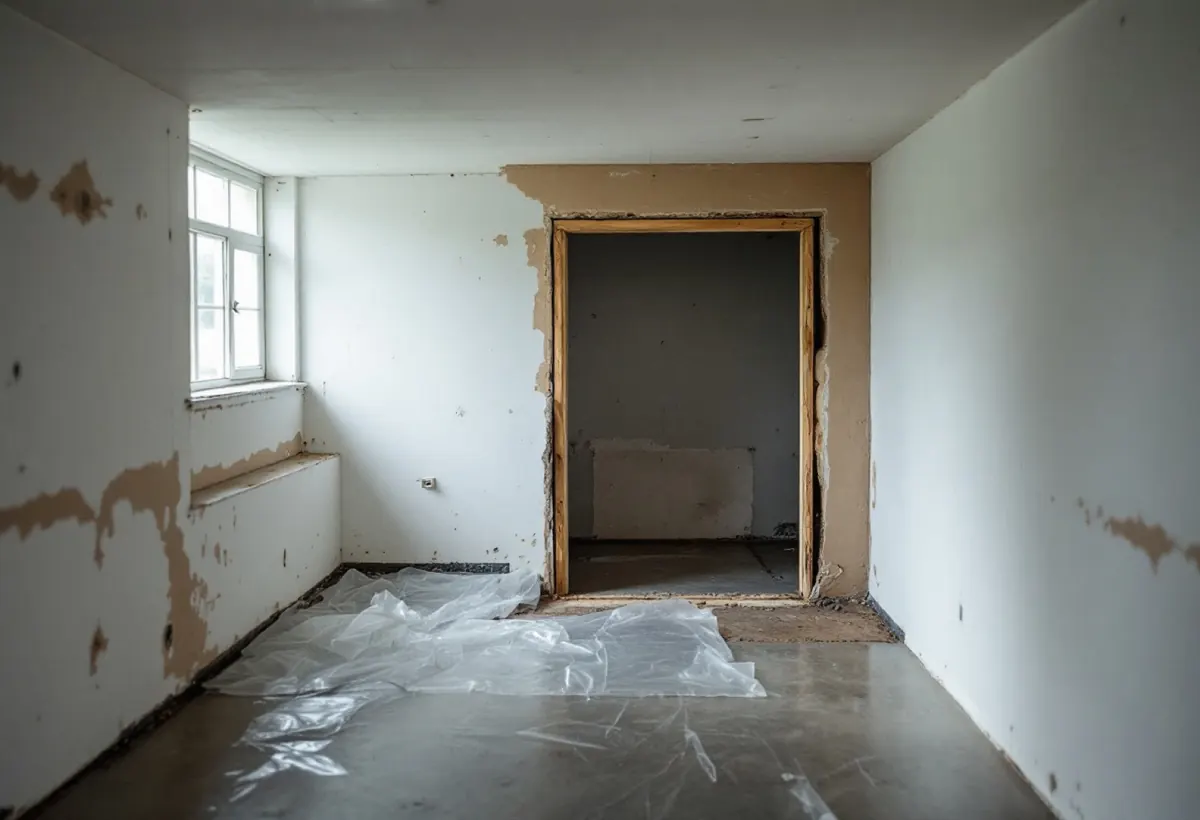
Toe kick, sink base, ceiling below: what is dried and what gets cut out?
Each layer the water touched has its own rule. The EPA Table 1 water damage guidance rules are written for clean water and assume action within 24 to 48 hours; the Northern Arizona University Water Damage Restoration Guideline adds the drywall clock and the insulation rule. Read the table from the machine outward.
| Material | Dried in place when | Removed when |
|---|---|---|
| Plywood or OSB subfloor | Dehumidifiers, gentle heat and fans once the water is known to be clean (EPA wood rule) | Still soft, or decayed above 30% for weeks (Wood Handbook) |
| Particleboard cabinet bottom (sink base) | Not addressed by EPA Table 1 or NAU | Swollen or crumbling panel; see the cabinets page |
| Hardwood strip floor | Dry to within 2.5% of a control reading (NAU) | Not dried to that standard; cupping is a separate repair |
| Vinyl, linoleum, ceramic tile | Damp wipe, then confirm the underflooring is dry (EPA) | Underflooring still wet; lift to dry it |
| Drywall on the wall behind or the ceiling below | Dry in place if no swelling, seams intact (EPA), drying started in 48 h, dry in 72 h (NAU) | Swollen, seams open, or outside the NAU clock |
| Insulation in the ceiling below | Never dried and reused (NAU) | Any wet fiberglass or cellulose: discard (EPA) |
The sink base cabinet is where most dishwasher losses become a replacement job, because many are built from particleboard that swells along cut edges and does not shrink back. Neither EPA nor the NAU guideline gives a particleboard rule, so the decision rests on the panel itself: what to check, and when a box can be saved, is on our page on water damaged cabinets.
If the leak ran down an exterior or plumbing wall behind the machine, the drywall test above applies there too, and wet insulation inside the wall comes out under the NAU rule. How to find and open a wet wall cavity is on our page about water damage in walls. Mold growing inside the machine itself, on the gasket or in the filter, is a different job, covered on mold in a dishwasher.
How much water can one dishwasher cycle put on the floor?
Not much per cycle, which is why the damage hides. Under 10 CFR 430.32(f), a standard size dishwasher made since 30 May 2013 may use no more than 5 gallons per cycle, and one made on or after 23 April 2027 no more than 3.3 gallons, 1.7 gallons less. A door or drain leak loses a fraction of that each run.
A small loss repeated every evening is the classic dishwasher pattern: a cup or two per cycle that soaks into the subfloor between runs and never pools where anyone sees it. The supply side is the exception. A split supply line is not limited to the cycle volume at all; it delivers whatever the house plumbing pushes at up to 145 psi until the valve under the sink is closed.
Sudden overflow or slow drip: which side of the policy line is a dishwasher leak?
Regulator guidance draws the line on timing, not on the appliance. The Washington Office of the Insurance Commissioner names a dishwasher that unexpectedly overflows during a wash cycle, and a supply line bursting beneath the sink, as examples of sudden and accidental leaks that insurance usually covers when reported quickly. The same page says most policies do not cover gradual leaks, including damage that develops over more than a couple of days, even if you had no way of knowing the leak started.
That is the hard case for dishwasher losses, because a door or drain leak of a cup per cycle is gradual by nature. Ask the insurer or your agent three questions in writing: whether your form has a continuous or repeated seepage or leakage exclusion and over what number of days it applies; whether resulting mold is covered and at what sublimit; and whether the policy treats the cost of opening the floor to reach the leak differently from the damage itself. Send the photos and moisture readings from the first hour. If the answer conflicts with the form text, your state insurance department’s consumer line handles complaints. Policy wording patterns are set out on our page does homeowners insurance cover water damage.
More water damage pages, sorted by source and material, sit in the water damage hub.
Questions people actually ask
What happens if dishwasher water leaks under your floor and is left?
The subfloor stays wet between cycles and climbs toward the 30% fiber saturation point, according to the USDA Wood Handbook the level above which serious decay occurs. Before that, the sink base panel swells, finish flooring cups or lifts, and stains reach the ceiling below. EPA says to dry wet materials within 24 to 48 hours to prevent mold growth.
Why is my dishwasher leaking water when it is not running?
Only the supply side holds water when the machine is idle. The hot water line runs at 7.25 to 145 psi under the Bosch installation specification, so a weeping fitting, supply hose or inlet valve leaks day and night. Close the valve under the sink; if the puddle stops growing, the leak is on the supply side, which is Category 1 water under the NAU guideline.
Can I put a fan under the dishwasher to dry it?
Not until you know where the water came from. EPA Table 1 says fans should not be used before determining that the water is clean or sanitary, and the NAU guideline lists dishwasher discharge as Category 2 gray water. Supply line water is Category 1. Once the source is known, EPA pairs fans with dehumidifiers and gentle heat for wet wood.
Do I have to pull the dishwasher out to check for damage?
Usually, because the subfloor under the tub is hidden. Bosch installation instructions fix the machine to the countertop or cabinet sides with brackets and route the drain hose at least 33 inches (84 cm) off the floor through the sink base. Removing the toe kick gives a first look at the front; a reading taken at the back needs the machine out.
How do I tell an old dishwasher leak from a new one?
Look at the materials, not the puddle. Swollen particleboard edges, dark staining on plywood and a ceiling ring below point to repeated wetting. A subfloor reading well above the 6 to 10% interior range, per the USDA Wood Handbook Table 13.2, with no fresh water on top, also points to a slow leak. Under Washington insurance regulator guidance, damage that develops over more than a couple of days is treated as gradual.
Sources
- Northern Arizona University Water Damage Restoration Guideline, Northern Arizona University, Water Damage Restoration Guideline, written to the IICRC S500 Standard and Reference Guide for Professional Water Damage Restoration: Category 1 and 2 examples, the 48 hour rule, drywall, hardwood and insulation dry standards. Retrieved 17 November 2026.
- EPA Table 1 water damage guidance, U.S. Environmental Protection Agency, Mold Remediation in Schools and Commercial Buildings, Chapter 4, Table 1: Water Damage, Cleanup and Mold Prevention. Retrieved 17 November 2026.
- EPA brief guide to mold and moisture, U.S. Environmental Protection Agency, A Brief Guide to Mold, Moisture and Your Home. Retrieved 17 November 2026.
- 10 CFR 430.32(f), Code of Federal Regulations via Legal Information Institute, Cornell Law School, Energy and water conservation standards: dishwashers. Retrieved 17 November 2026.
- USDA Forest Service Wood Handbook, Chapter 13, USDA Forest Service, Forest Products Laboratory, Wood Handbook (FPL GTR 282), Drying and Control of Moisture Content and Dimensional Changes, Table 13.2. Retrieved 17 November 2026.
- USDA Forest Service Wood Handbook, Chapter 14, USDA Forest Service, Forest Products Laboratory, Wood Handbook (FPL GTR 282), Biodeterioration of Wood. Retrieved 17 November 2026.
- Bosch dishwasher installation instructions, BSH Home Appliances, Bosch dishwasher installation instructions (document 9002059336): drain hose height and length, supply pressure, circuit, test cycle. Retrieved 17 November 2026.
- Bosch dishwasher instructions for use, BSH Home Appliances, Bosch dishwasher instructions for use (document 9001720275): door and detergent leak notes. Retrieved 17 November 2026.
- Washington Office of the Insurance Commissioner, Washington State Office of the Insurance Commissioner, Leaks, water damage, and mold. Retrieved 17 November 2026.
- CDC disaster safety guidance, Centers for Disease Control and Prevention, Natural disasters and severe weather: safety. Retrieved 17 November 2026.
- The leak path diagram and the leak source table combine the rules and installation geometry above; columns marked as our reading are inferences, not quoted lines. Our methodology sets out the standing rules. All sources opened 17 November 2026.
This page describes published guidance, standards and regulator examples; it does not say what any reader’s own policy pays or replace an on site moisture assessment. Repairs to the dishwasher, its supply line and its electrical connection belong to an appliance technician, a plumber and an electrician.