The short answer
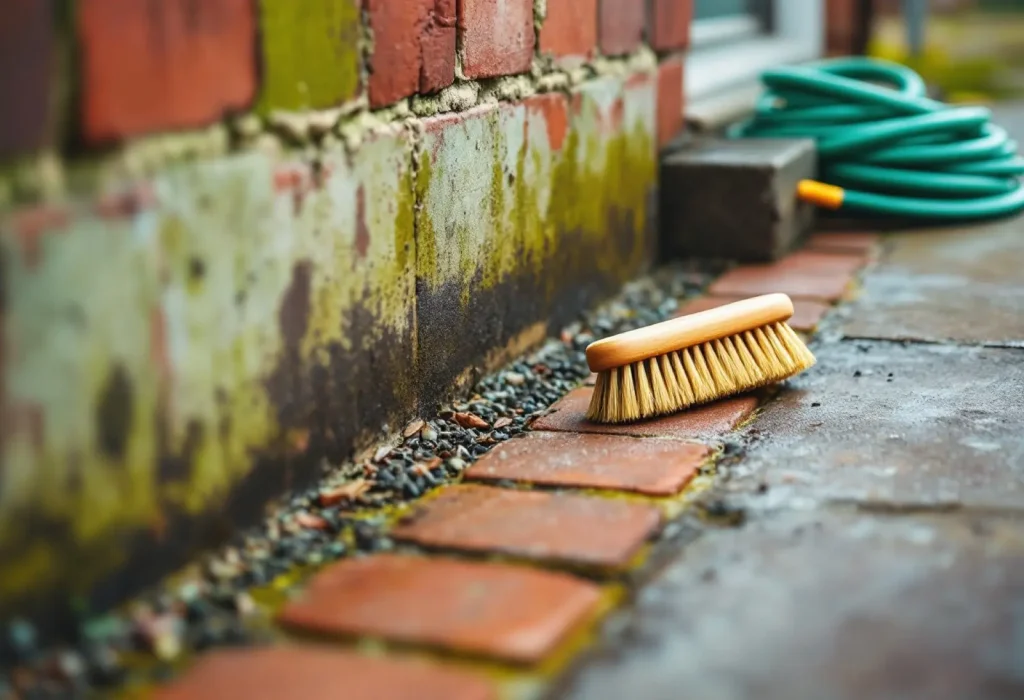
Mold on brick comes off with water, a natural bristle brush and, if that fails, a diluted cleaner, not a pressure washer turned up high. The Brick Industry Association caps rinse pressure at 400 psi and rules out unbuffered muriatic acid; the National Park Service says start at 100 psi or below. Fix the moisture source first, or the growth returns.
Is it mold, algae, lichen or efflorescence on your brick?
The GSA procedure for masonry starts at the same step every cleaner should: determine the type of stain, algae and lichens or mold and mildew, because the federal method differs for each, per the GSA biological growth procedure. Growth form separates them better than color: Extension puts algae anywhere from green to black and lichen from gray-green to orange-red.
| Growth | What it looks like | Texture test | Where on the wall | Source |
|---|---|---|---|---|
| Green algae | Usually green, can run blue-green to black | Some algae look moist or slimy; no lobes | Any moist, shady site | University of Maryland Extension |
| Lichen | Gray-green to bright orange-red patches | Crusty like flat paint, or raised leaf-like lobes; crusty kinds grip tightly | Rock, bark and other hard surfaces | University of Maryland Extension; Missouri Department of Conservation |
| Moss | Usually green | Raised plant growth, not a flat film | Colonizes bare rock and brick; moist, shady sites | University of Maryland Extension |
| Mold or mildew | Black, gray, white or other colors; EPA says molds come in many | No published texture rule; GSA treats it as a stain to bleach | Any surface that stays damp, inside or out | EPA's Brief Guide to Mold, Moisture and Your Home; GSA biological growth procedure |
| Efflorescence (not a growth) | White crystals or a horizontal tide line | Salt crystals drawn from the ground, not organisms | About 1 to 3 ft above grade where rising damp evaporates | NPS Preservation Brief 39 |
A lichen is a fungus and an alga living together, not a plant, and crustose lichens can look like a quick squirt of flat spray paint, per the Missouri Department of Conservation. A moist, slimy green film matches the University of Maryland description of algae rather than mold; the green growth guide covers that look-alike indoors.
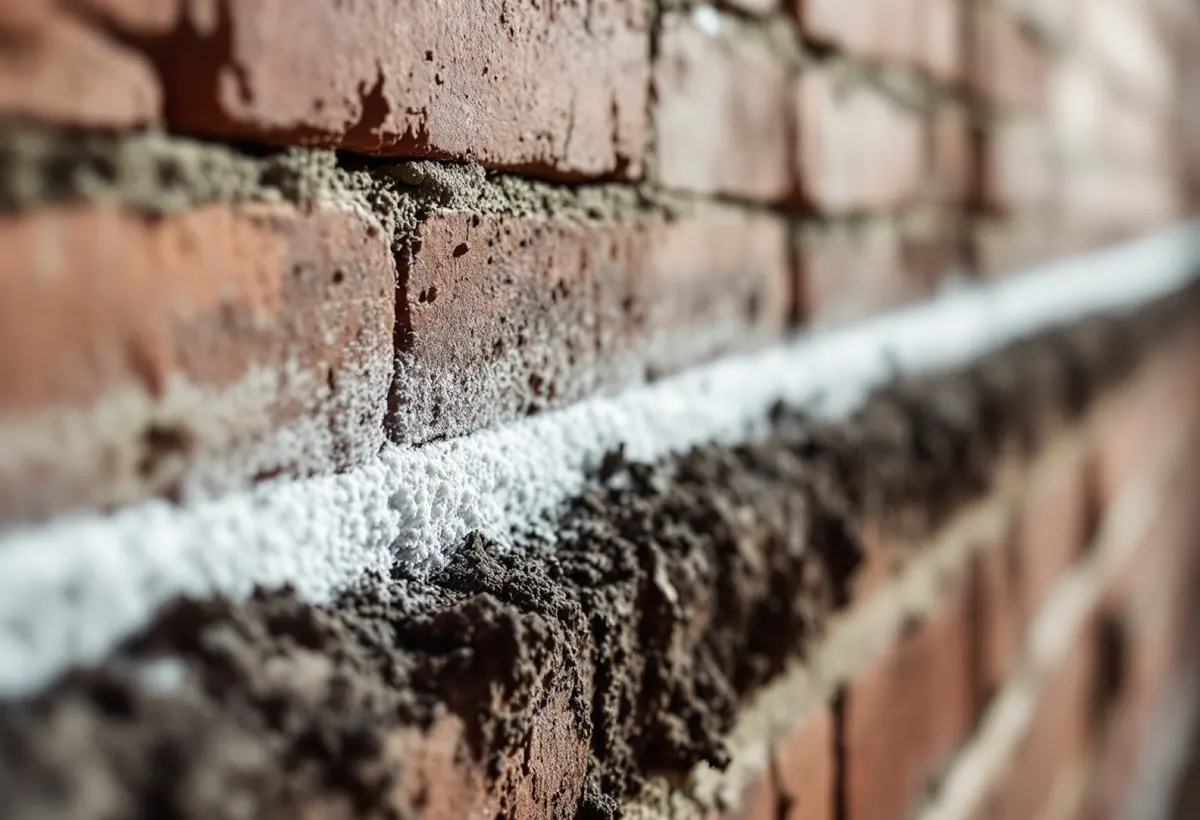
White fuzz versus white salt is the classic brick question, and the water drop and crumble test lives on the white mold page. If it is salt, NPS Brief 39 reads it as a sign of capillary moisture, not something a biocide can fix.
Why does mold keep growing on the same bricks?
Growth on masonry is usually an indication that there is excess moisture in or around the masonry, and the growths attract moisture to the surface and hold it there, per the GSA biological growth procedure. The same procedure says lichens and mosses produce oxalic acid that can damage certain historic masonry, which is why it says to remove them rather than leave them.
NPS Preservation Brief 39 traces most damp masonry to five sources, starting with above grade exterior water and below grade ground water. Capillary rise leaves a whitish tide mark about 1 to 3 feet above grade, and the brief’s first fixes are cheap ones: slope the grade away, carry downspout water well away, and reduce splash-back onto the foundation.
Mortar is meant to be the exit. NPS Preservation Brief 2 requires repointing mortar to be softer and more vapor permeable than the brick, and shows a wall where hard portland cement mortar trapped water until the brick faces popped off. A wall repointed with mortar harder than its brick can stay wet longer, and growth follows the wet.
Which cleaning method fits your brick and mortar?
Brick Industry Association Technical Note 20 sets the order for any cleaning: water only, then mild detergents, then one-step chemical cleaners, then two-step chemical cleaners, and says to select the gentlest effective method. The matrix below applies that order to each brick and mortar type the sources treat separately.
| Brick and mortar | Growth | Start with | If water and brush fail | Pressure limit | Source |
|---|---|---|---|---|---|
| Red or red flashed brick, sound mortar | Algae, moss, lichen outside | Scrape thick growth with a knife blade, soak with water 30 minutes, scrub with a natural bristle brush | Masonry biocide per label; for moss and lichen in paving joints, bleach and water 1 to 1 | Rinse 100 to 400 psi, fan tip 25 to 50 degrees, at least 12 in away | BIA Technical Note 20; GSA biological growth procedure |
| Red or red flashed brick | Black or gray mold and mildew | Detergent and water scrub, then dry completely | GSA mix: 1 qt of 5% bleach, 3 qt warm water, 3 oz TSP, 1 oz powdered detergent; or 1 part ammonia to 3 parts water, never both | Apply at 50 psi or less; rinse with a garden hose; never above 400 psi | GSA biological growth procedure; BIA Technical Note 20 |
| White, tan, buff, gray or other light brick | Any growth | Water, then detergent | No unbuffered muriatic acid; light units are more prone to acid burn | 400 psi cap at the nozzle tip | BIA Technical Note 20, Table 1 |
| Sand-finish or surface-coated brick | Any growth | Water and a scrub brush with light pressure | Cleaning solution only for stubborn spots, after a trial patch | No pressure washer: BIA says pressurized water is not recommended | BIA Technical Note 20, Table 1 |
| Glazed brick | Any growth | Soft sponge or brush with plenty of water; detergent if needed | Proprietary cleaners only after asking the brick and cleaner makers | No abrasive powders, no metal tools or brushes | BIA Technical Note 20, Table 1 |
| Historic soft brick or lime mortar (pre-1930 mortar can be pure lime and sand) | Algae and lichen | Spigot pressure water, soak, natural bristle brush | No chemicals without a preservation review; never muriatic acid, which dissolves lime mortar | Spigot pressure (GSA); start at 100 psi or below, generally no higher than 300 to 400 psi (NPS) | GSA biological growth procedure; NPS Preservation Brief 1; NPS Preservation Brief 2 |
| Colored mortar joints | Any growth | Mild detergent solution | Many colored mortar makers advise against chemical cleaners; unbuffered acids bleach colored mortar | Set by the brick type | BIA Technical Note 20 |
| Interior or basement brick | Mold | Detergent and water scrub, dry completely | EPA: a biocide such as chlorine bleach is not recommended as routine practice | Hand scrub; EPA gives no psi figure for indoor work | EPA's Brief Guide to Mold, Moisture and Your Home |
Two rules cut across every row. NPS Preservation Brief 1 says hydrochloric (muriatic) acid can dissolve lime-based mortar, damage brick and leave chloride deposits, and BIA Technical Note 20 lists unbuffered muriatic and hydrofluoric acid as do-not-use. Both also say never use metal brushes, which NPS warns can abrade the surface and leave particles that stain.
How much water pressure can brick take: 100, 400 or 1,500 psi?
Less than most pressure washers deliver. Brick Industry Association Technical Note 20 says do not exceed 400 psi measured at the nozzle tip unless the brick manufacturer permits it, with a stainless steel 25 to 50 degree fan tip held at least 12 inches from the brick.
| Source | Step | Published pressure |
|---|---|---|
| BIA Technical Note 20 | Apply cleaning solution by tank sprayer | 30 to 50 psi maximum |
| BIA Technical Note 20 | Prewet the wall and the brickwork below | Less than 100 psi |
| BIA Technical Note 20 | Rinse | 100 to 400 psi; never higher than 400 psi at the nozzle unless the brick maker permits |
| NPS Preservation Brief 1 | Start any water wash | 100 psi or below, even a garden hose |
| NPS Preservation Brief 1 | Raise only if needed | Generally no higher than 300 to 400 psi |
| GSA biological growth procedure | Algae and lichen, sound dense masonry | 100 to 400 psi |
| GSA biological growth procedure | Algae and lichen, softer masonry | Standard spigot pressure |
| GSA biological growth procedure | Rinse after a proprietary biological cleaner | About 400 to 1,500 psi, 40 to 60 degree fan |
NPS Preservation Brief 1 gives the field check: grains of stone or sand in the runoff on the ground mean the pressure is too high. It also shows a late 19th century row house where high-pressure rinsing left a horizontal line of abrasion across the bricks, damage no later cleaning removes.
Bleach, ammonia or vinegar: what do masonry sources allow?
They disagree on strength, so the table keeps each recipe separate instead of blending them. BIA Technical Note 20 gives a 1 to 1 bleach mix only for moss and lichen in paving joints; the GSA biological growth procedure cuts bleach to one part in four for mold and mildew and adds TSP and detergent.
| Source | Target | Published mix |
|---|---|---|
| BIA Technical Note 20, paving section | Moss and lichen in joints, damp or shady | Bleach and water mixed 1 to 1, or a proprietary biocide |
| BIA Technical Note 20, organic growth | Moss, algae, lichen on brickwork | Household bleach, ammonium sulfate or weed killer per furnished directions; no ratio given |
| GSA biological growth procedure | Mold and mildew on masonry | 1 qt of 5% sodium hypochlorite bleach in 3 qt warm water, plus 3 oz TSP and 1 oz powdered detergent; keep wet until the stain bleaches |
| GSA biological growth procedure | Mold and mildew, bleach-free option | 1 part ammonia to 3 parts water; never mixed with chlorine bleach |
| GSA biological growth procedure | Algae and lichen | Water and brush only; no chemicals without a preservation officer’s review |
| NPS Preservation Brief 1 | Biological growth | Low-pressure water, a non-ionic detergent if needed, natural or synthetic bristle brush |
| EPA's Brief Guide to Mold, Moisture and Your Home | Mold indoors | Detergent and water; chlorine bleach not recommended as routine practice |
The GSA caution is printed in capitals: do not mix ammonia with chlorine bleach, because a poisonous gas results, and EPA's Brief Guide to Mold, Moisture and Your Home says the same of any cleaner that contains ammonia. GSA also says TSP is banned in some states, naming California, so check local rules before buying it. The bleach and mold page covers what bleach does and does not do on porous surfaces.
Vinegar is acetic acid, and none of the masonry cleaning sources read for this page lists it for biological growth. BIA Technical Note 20 names white vinegar only for manganese stains and for haze from polymeric paver sand, NPS uses acetic acid as a mild neutralizing wash after alkaline cleaners, and BIA warns that unbuffered acids bleach colored mortar. On lime mortar or light brick, test any acid first; the vinegar and mold page has the general evidence.
How big should a test patch be, and how long before you judge it?
NPS Preservation Brief 1 says a test area can start as small as 6 square inches in an inconspicuous spot and grow to a square yard or more, taking in several bricks and mortar joints. Each material and finish on the wall gets its own test.
- Size: about 20 sq ft on larger jobs, per BIA Technical Note 20, which notes trial cleaning is not common on small residential projects.
- Judge it dry: inspect brick and mortar after the area has dried, usually in about one week, per BIA; NPS says only after the masonry has dried completely.
- Weathering: NPS calls a full year ideal and at least a month or two acceptable before final evaluation.
- Temperature: BIA prefers water methods only at 40°F or above until the wall is dry, ideally above freezing for 7 days after; chemical cleaners work better at 50°F or above.
- Chemicals: NPS says never below 40°F (4°C) and generally not below 50°F.
NPS adds a timing rule for fall work: a masonry wall may take over a week to dry, so no water cleaning for several days before the first average frost date, because water frozen inside brick causes spalling and cracking, per NPS Preservation Brief 1.
Mold on interior or basement brick: what changes indoors?
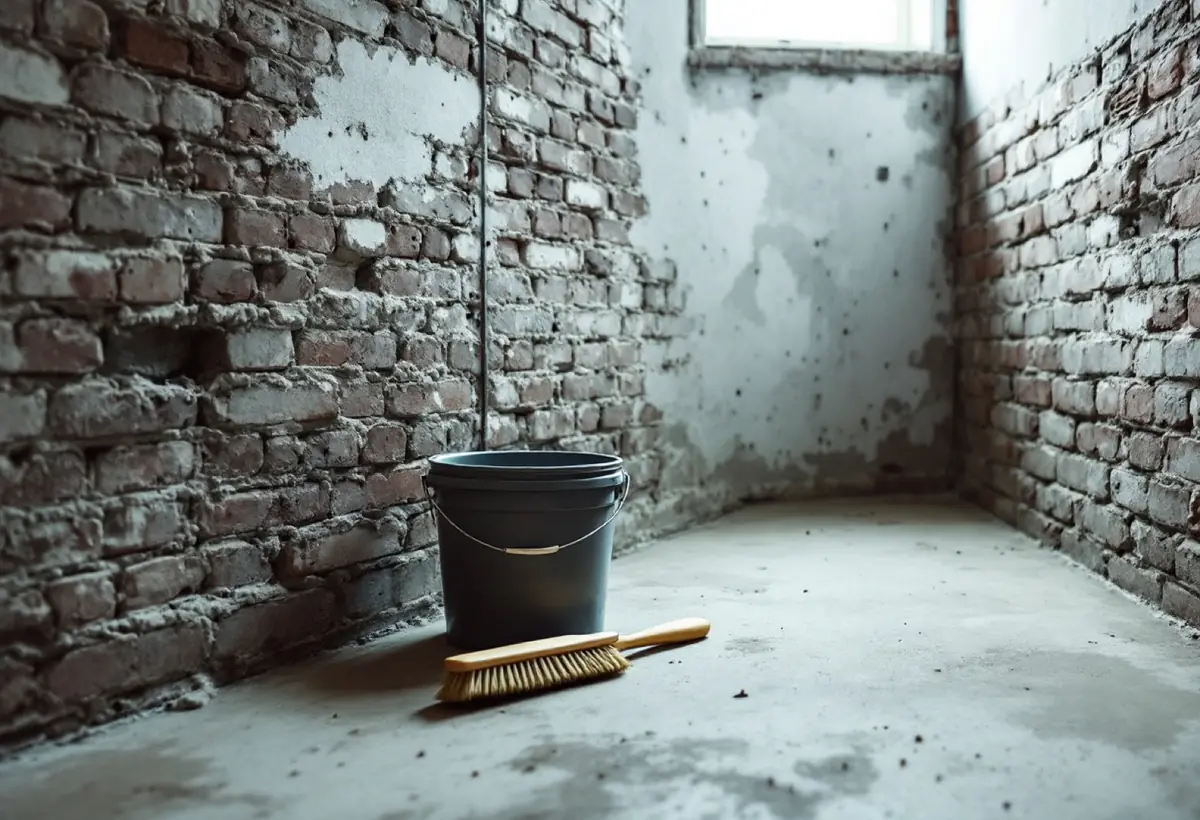
Indoors the size rule comes from EPA mold cleanup page: under about 10 square feet, roughly a 3 ft by 3 ft patch, most owners can clean it themselves; above that, EPA points to its schools and commercial buildings guide. Scrub hard surfaces with detergent and water and dry completely.
The moisture rules are the same as for any room. EPA says dry wet materials within 24 to 48 hours and keep humidity below 60%, ideally 30 to 50%, per EPA's Brief Guide to Mold, Moisture and Your Home. It also says not to paint or caulk moldy surfaces. The basement mold guide covers the room as a whole.
NPS Preservation Brief 39 warns against the reflex fix for a damp basement brick wall: sealing the inside face with cement parging or vinyl coverings increases the pressure differential and forces capillary moisture higher up the wall. Exterior grading and drainage come first, and the basement waterproofing cost guide prices those options.
Poured walls and slabs behave differently from brick and mortar, with no joints to act as the exit path NPS Brief 2 describes. That surface has its own page on mold on concrete.
For contractors: which spec lines keep a brick job from damaging the wall?
- Saturate the area and the brickwork below before any solution goes on, and keep it wet to the final rinse; BIA Technical Note 20 says dry brick absorbs the cleaner and can show white scum or vanadium and manganese stains.
- Never let solution dry on the wall; in hot weather BIA says work small or shaded areas.
- Protect windows, doors and metal frames: BIA warns acid solutions can pit metal and stain limestone and cast stone trim.
- Mix in rubber or polyethylene buckets, not metal, and do not start a second treatment until the first is rinsed away, per the GSA biological growth procedure.
- With a proprietary biological cleaner, GSA specifies a 50 psi flood coat from the top, 5 to 30 minutes of dwell, a rinse from the bottom up, and at least 24 hours of drying.
- Hold operators to the tested settings: NPS Preservation Brief 1 names nozzle type, distance and gallons per minute as variables that change the result as much as psi.
Note the wall’s mortar before quoting a repoint after cleaning. NPS Preservation Brief 2 records that mortar in buildings from 1873 to 1930 runs from pure lime and sand to many lime and portland cement blends, so a single bagged mix is not a safe default.
Out of scope: this page covers identifying and cleaning growth on brick, not health effects. For those, start with EPA's Brief Guide to Mold, Moisture and Your Home, which notes dead mold may still cause allergic reactions and must be removed, not only killed.
Questions people actually ask
What does black mold look like on bricks?
Dark spots or staining on courses that stay damp, but color cannot settle it. EPA says molds come in many colors, and University of Maryland Extension says algae, usually green, can range from blue-green to black. Lichen grips tightly in crusts or lobes; algae can look moist or slimy. Only a lab sample confirms mold, and the cleaning steps are the same either way.
Is mold common in brick homes?
Brick itself is masonry, not food, but mold grows wherever a surface stays wet. NPS Preservation Brief 39 lists rain, ground water, plumbing leaks, household moisture and construction water as the five common sources. Brick houses with poor grading, short downspouts or splash-back on the lowest courses stay damp longest, and that is where growth appears first.
Can I seal or paint brick to stop mold coming back?
Not over live growth: EPA says not to paint or caulk moldy surfaces. NPS Preservation Brief 1 also says a water-repellent coating is not recommended on historic masonry as a way to prevent biological growth, and that some coatings may encourage it. Fix drainage first; a sealer on a wall that still takes in ground water can trap it.
How long should brick dry after cleaning?
Longer than it looks. NPS Preservation Brief 1 says a masonry wall may take over a week to dry, BIA Technical Note 20 judges a trial area after about one week, and the GSA procedure sets a minimum of 24 hours after a biological cleaner rinse. Avoid water cleaning in the days before the first average frost date.
Can I use a wire brush on moldy brick?
No. NPS Preservation Brief 1 says never use metal brushes, which abrade the surface and leave metal particles that stain the masonry. The GSA procedure calls for stiff natural bristle brushes, and BIA Technical Note 20 bans metal tools on glazed brick. A natural or synthetic bristle brush plus water does most of the work.
Is mold on brick bad for the wall?
It can be. The GSA procedure says growths attract moisture to the masonry surface and hold it there, which can lead to more serious problems, and that lichens and mosses produce oxalic acid that can damage some historic masonry. NPS Preservation Brief 1 adds that water frozen inside brick causes spalling and cracking.
Sources
- Brick Industry Association Technical Note 20, Cleaning Brickwork, Brick Industry Association, Reston, Virginia, August 2018. Retrieved 17 November 2026.
- NPS Preservation Brief 1, Assessing Cleaning and Water-Repellent Treatments for Historic Masonry Buildings, Robert C. Mack and Anne Grimmer, National Park Service, November 2000. Retrieved 17 November 2026.
- NPS Preservation Brief 2, Repointing Mortar Joints in Historic Masonry Buildings, Robert C. Mack and John P. Speweik, National Park Service, October 1998. Retrieved 17 November 2026.
- NPS Preservation Brief 39, Holding the Line: Controlling Unwanted Moisture in Historic Buildings, Sharon C. Park, National Park Service, October 1996. Retrieved 17 November 2026.
- GSA biological growth procedure, Removing Biological Growth from Exterior Masonry and Stucco, U.S. General Services Administration historic preservation technical procedures, page last updated 5 June 2025. The live gsa.gov page returned 404 on 17 November 2026; read from the Internet Archive snapshot of 18 January 2026. Retrieved 17 November 2026.
- EPA's Brief Guide to Mold, Moisture and Your Home, United States Environmental Protection Agency, last updated 18 February 2026. Retrieved 17 November 2026.
- EPA mold cleanup page, United States Environmental Protection Agency, last updated 4 June 2026. Retrieved 17 November 2026.
- University of Maryland Extension, Lichen, Algae, and Moss on Trees, Home and Garden Information Center, updated 27 February 2023. Retrieved 17 November 2026.
- Missouri Department of Conservation, Lichens field guide, Missouri Department of Conservation. Retrieved 17 November 2026.
- The cleaning matrix, pressure chart and wall cross-section are compiled from the sources above; no figure was estimated. Our methodology sets out the standing rules, and the mold hub lists related guides.
Cleaning chemicals carry label directions that override general guidance. On a historic or listed building, ask the State Historic Preservation Office which methods it accepts before any chemical or pressure cleaning.