The short answer
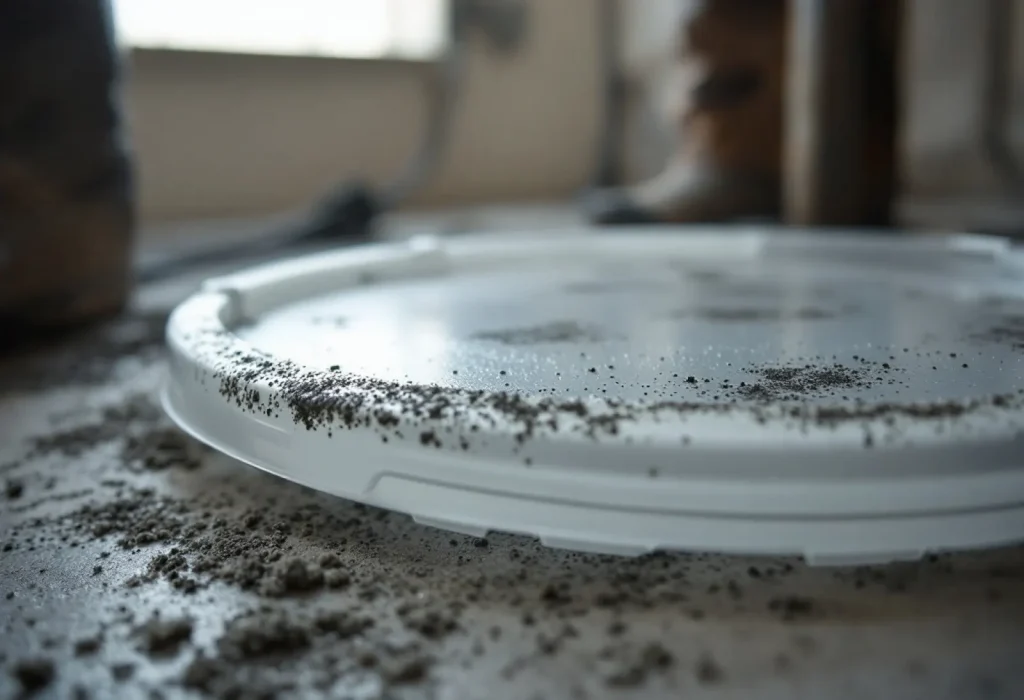
Yes, and the key to can mold grow on plastic is the film on top: on most plastics mold feeds on dust, dirt, soap scum and food or drink residue, not the polymer. ASTM G21 states the polymer itself usually resists fungi, and it is additives such as plasticizers that feed them. Hard plastic can be scrubbed clean; moldy foam and sealant with growth inside usually cannot.
What is mold eating on a plastic cup, bin or shower curtain?
Water first, then food. EPA's What are molds? page says that all molds need water or moisture to grow, and Chapter 1 of EPA's mold course says mold does not need a lot of water and can grow on virtually any organic substance, naming paper, cloth, wood, plant material and soil. Polyethylene, polypropylene and rigid PVC are not on that list, which is why a dry, clean plastic tub stays bare for years.
Plastic in daily use is rarely clean. Bowdoin College's housing mold guidance explains that mold seen on plastic, vinyl, glass or metal is usually growing on an accumulated organic material like dust, dirt, soap scum, food or drink residues. A lunch box, a bath toy or the lip of a drinking bottle collects exactly that layer, and EPA’s mold course chapter 2 adds the water: when warm, humid air meets a cold surface, condensation may form. Chapter 2 of EPA's mold course sets indoor relative humidity below 60 percent.
The exceptions are plastics that carry their own food. ASTM G21, the standard practice for fungal resistance of synthetic polymeric materials, says in section 4.1 that the polymer portion is usually fungus resistant and that plasticizers, cellulosics, lubricants, stabilizers and colorants are the components responsible for fungus attack on plastic materials, according to the ASTM G21-15(2021)e1 summary. Soft vinyl, foam and sealant are where that matters.
Clean or throw away: six household plastics by what feeds the mold
The table sorts plastics by backbone, following Mohanan and colleagues, Frontiers in Microbiology 2020, which groups PE, PS, PP and PVC as plastics whose backbone is built only of carbon atoms and puts PET and polyurethane among polymers with hydrolysable ester bonds that are more susceptible to biodegradation. The last column applies EPA’s rule that nonporous surfaces are wiped or scrubbed and porous materials with growth may have to be discarded.
| Plastic and typical item | Chemistry that matters | What the mold feeds on | Evidence | Clean or discard |
|---|---|---|---|---|
| Polyethylene (PE): bins, bags, milk jugs, cutting boards | Carbon only backbone, hydrophobic | Surface film only | Mohanan 2020: fungi depolymerized PE after pretreatment | Clean: detergent, scrub, dry |
| Polypropylene (PP): food tubs, lids, bath toys | Carbon only backbone | Surface film; water trapped in seams or toy cavities | Mohanan 2020 groups PP with PE, PS and PVC | Clean if every surface can be reached and dried; discard if not |
| Rigid PVC: pipe, window and siding profiles | Carbon only backbone, little or no plasticizer | Surface film, condensation | Mohanan 2020; ASTM G21 4.1 on the polymer portion | Clean |
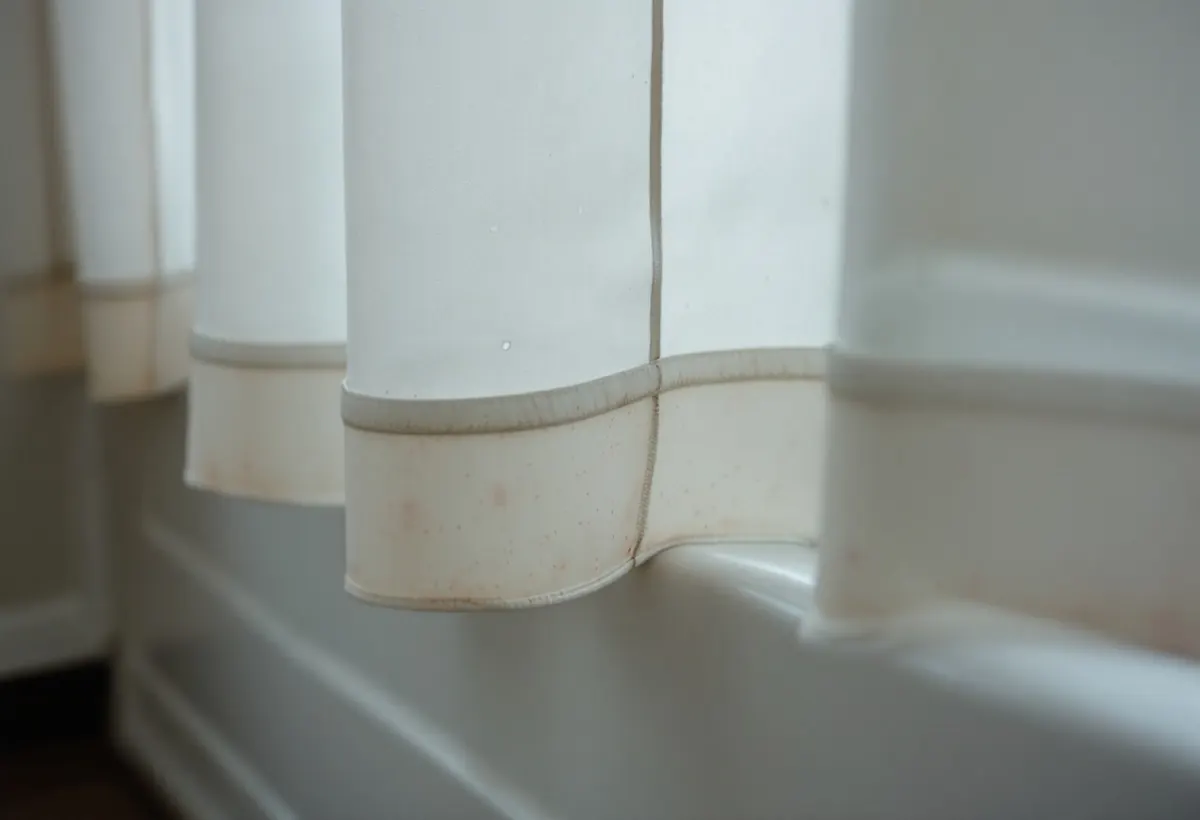
| Flexible PVC (pPVC): shower curtains, vinyl liners, tubing | Plasticizer such as DOA | Plasticizer plus soap scum | Webb 2000: A. pullulans grew on pPVC as sole carbon source | Clean early; discard if stained after cleaning or stiff |
| Polyurethane (PUR) foam: sponges, cushions, padding | Ester and urethane bonds; open cells | Polymer itself plus trapped residue | Russell 2011: two Pestalotiopsis microspora isolates grew on PUR as sole carbon source | Discard if moldy: porous, per EPA |
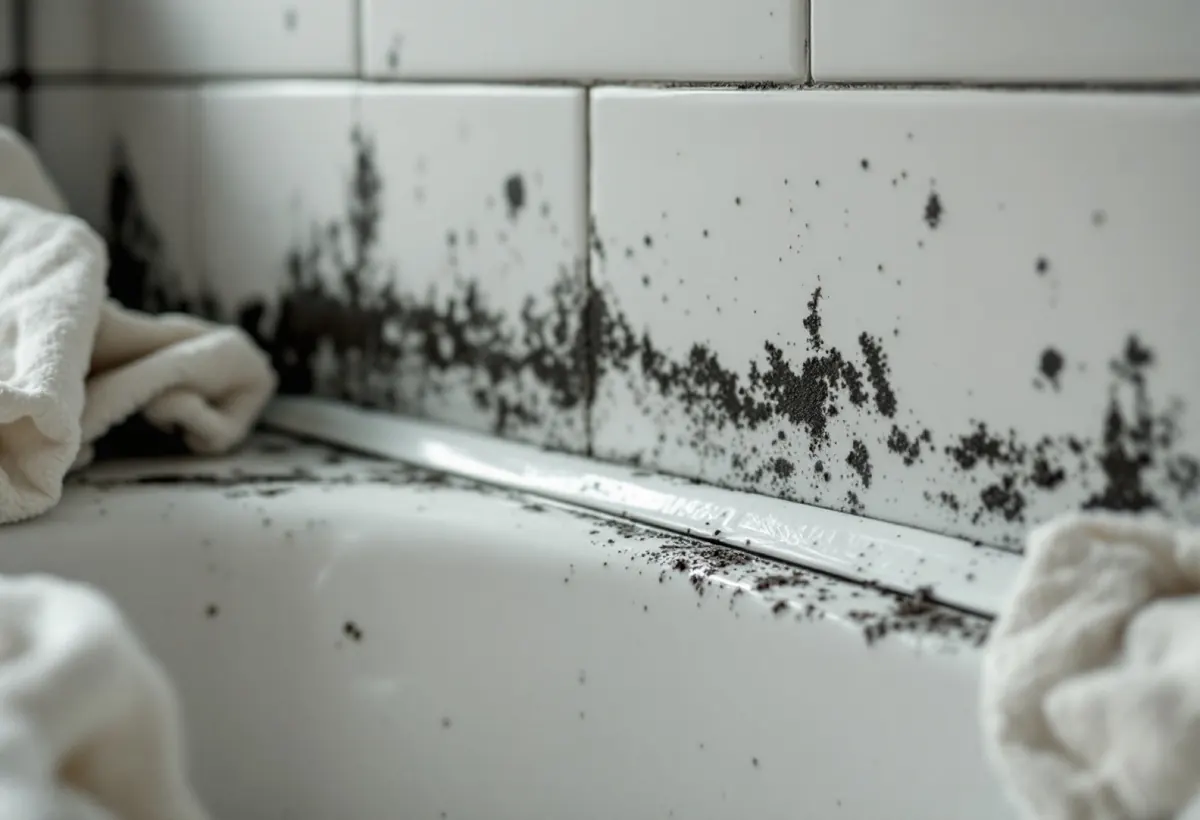
| Silicone sealant: tub, shower and sink joints | Silicone plus fillers and fungicide | Residue first, then the sealant body | Ahn 2024: fungicide sealants fell to rating 2 after a 4 week 50 C soak | Surface growth: clean. Grown in: cut out and reseal |
Why foam and sealant break the pattern: Chapter 3 of EPA's school and commercial building remediation guide says mold can generally be removed from nonporous (hard) surfaces by wiping or scrubbing with water and detergent, while porous materials that are wet and moldy may have to be discarded. Open cell foam is porous, and growth inside a sealant bead sits below the surface a cloth reaches.
Does the mold go into the plastic, or stay on top?
On hard plastic it stays on top. The sketch shows the three cases the table describes: a residue film on PE, PP or rigid PVC; plasticizer inside flexible PVC that fungi can use; and the open cells of polyurethane foam, which Chapter 3 of EPA's school and commercial building remediation guide would class with porous materials.
Section 4.2 of ASTM G21 lists what an attack looks like on plastics: surface attack, discoloration and loss of optical transmission, then removal of plasticizers and other additives, increased stiffness and changes in weight and dimensions, according to the ASTM G21-15(2021)e1 summary. A clear bin that stays cloudy or a vinyl curtain that turns stiff after cleaning is showing those effects.
Can a fungus digest the plastic itself, not just the dirt?
For two plastic families, yes, in a lab. Russell and colleagues, Applied and Environmental Microbiology 2011, from a Yale University team, screened endophytic fungi for the ability to break down polyester polyurethane and found two Pestalotiopsis microspora isolates that used it as their only carbon source, with and without oxygen. The authors traced the activity to a serine hydrolase enzyme.
Webb and colleagues, Applied and Environmental Microbiology 2000 left plasticized PVC containing the plasticizers dioctyl phthalate and dioctyl adipate (DOA) outdoors for up to 2 years. Aureobasidium pullulans colonized it between weeks 25 and 40; by week 95 yeasts led at 1,000 colony forming units per cm2 against 390 for Aureobasidium, per the paper. In the lab every A. pullulans strain tested grew on the intact pPVC as its sole carbon source, broke down DOA and caused weight loss.
Polyethylene and polypropylene are a different story. Mohanan and colleagues, Frontiers in Microbiology 2020 attributes their resistance to high molecular weight, very hydrophobic surfaces and strong carbon to carbon bonds, and says over 90 bacteria and fungi are known to degrade petroleum based plastics, mostly in vitro. Fungi such as Aspergillus and Fusarium were shown to depolymerize PE after some forms of pretreatment, so the spots on a PE storage bin in a damp basement point to residue and condensation, not the bin being eaten.
What does ASTM G21 test, and how is a plastic rated 0 to 4?
ASTM G21-15(2021)e1 covers the effect of fungi on molded and fabricated articles, tubes, rods, sheets and film. Section 4.1 tells labs to test under conditions favorable for attack, which the ASTM summary reports as 2 to 38 C and 60 to 100% relative humidity. Section 4.4 warns that results are often poorly reproducible, so the greatest deterioration seen is reported.
The test details below come from Ahn and colleagues, Journal of the Korea Institute of Building Construction 2024, which ran ASTM G21 side by side with two other methods. The paper reports five organisms: Aspergillus niger ATCC 9642, Talaromyces pinophilus ATCC 11797, Chaetomium globosum ATCC 6205, Trichoderma virens ATCC 9645 and Aureobasidium pullulans ATCC 15233, incubated for 4 weeks at 28 C and 85% humidity on a nutrient salt agar that the authors call an incomplete medium, one that is not rich in nutrients.
| ASTM G21 rating | Observed growth | Share of surface |
|---|---|---|
| 0 | No growth | 0% |
| 1 | Traces of growth | under 10% |
| 2 | Light growth | 10 to 30% |
| 3 | Medium growth | 30 to 60% |
| 4 | Heavy growth | 60% to complete |
A lean medium means the five fungi grow well only where the specimen or its additives feed them, which is the question the standard asks. Ahn and colleagues, Journal of the Korea Institute of Building Construction 2024 notes the cost: in their test 5 of 6 silicone sealants rated 0 under ASTM G21, including a plain oxime sealant with no fungicide, so the method separated products poorly.
Does mildew resistant silicone still mold after a 4 week hot soak?
It loses most of its edge. Ahn and colleagues, Journal of the Korea Institute of Building Construction 2024 reports making 6 silicone sealants, alkoxy and oxime cure, each plain or with about 0.5% propiconazole or tebuconazole, then rated growth under the newer KS F ISO 21265 method before and after soaking specimens in 50 C water for 4 weeks, a step the authors propose for judging long term resistance.
After the soak all 4 fungicide sealants rated 2, the same as the plain oxime sealant, and the oxime tebuconazole product went from 0 to 2, per the paper. The plain alkoxy sealant rated 4 both times. A bathroom joint labelled mold resistant is a slower start, not a permanent barrier.
Once growth is inside the bead, cleaning stops working. sealant maker OTTO-Chemie distinguishes primary attack, where mold grows only in organic deposits on the sealant surface, from secondary attack, where it grows into the sealant, which must be removed mechanically and replaced; according to the same page, continuous relative humidity over 70% is a cause. Steps for the tub line are on the shower page. Mold in the shower covers them.
Shower curtains, washer gaskets, fridge seals: which plastic, which fix?
Each of these is a wet plastic part with a residue film, and each has its own page with item specific steps. A PVC or vinyl shower curtain is the flexible PVC row of the table, with soap scum on top of the plasticizer. Shower curtain mold covers when to wash and when to replace one.
Where a front load washer door seal stays wet with detergent residue between loads, it matches the Bowdoin College description of growth on soap scum and residue. Mold in the washing machine has the cleaning cycle and gasket steps. A refrigerator door seal that picks up food residue sits next to a cold surface, the condensation pattern EPA’s chapter 2 course describes. Mold in the refrigerator covers them, and the dishwasher filter and door seal are on mold in the dishwasher.
A five step path for a moldy plastic item
The path combines Table 1 of EPA's school and commercial building guide, the Alabama Department of Public Health and EPA's A Brief Guide to Mold, Moisture and Your Home. EPA’s brief guide puts the do it yourself limit at about 10 square feet of mold; a single storage bin or curtain is well under it.
- Is it hard and solid all the way through? PE, PP, rigid PVC, a hard bin or cup: EPA Table 1 says to vacuum or damp wipe non-porous, hard surfaces with water and mild detergent, allow to dry and scrub if necessary. Go to step 4.
- Can you reach and dry every surface? A toy that squirts water, a bottle with a narrow neck, a straw or a lid gasket holds water where a brush cannot reach. If not, discard it.
- Is it foam, fabric backed, or is growth inside a sealant bead? EPA’s guidance says porous materials that are wet and moldy may have to be discarded; sealant with growth inside is cut out and replaced.
- Clean and dry. The Alabama Department of Public Health says to scrub non-porous surfaces with hot water and a non-ammonia detergent, rinse, and optionally disinfect with a bleach solution that is never mixed with ammonia. Dry fully.
- Fix the water. EPA says to dry wet items within 24 to 48 hours and keep indoor humidity below 60 percent, ideally 30 to 50 percent. If the item molds again, discard it.
Bleach is optional on plastic, not required: EPA’s brief guide names detergent and water for hard surfaces, and the bleach question for each surface type is covered separately. Does bleach kill mold sets out where it works and where it does not. Discarded items go in a sealed bag; for larger jobs Chapter 3 of EPA's school and commercial building remediation guide specifies double bagging in 6 mil polyethylene sheeting before disposal as ordinary construction waste.
Health effects of mold exposure are outside the scope of this page. EPA’s mold pages and CDC cover them; ask a physician about any personal concern.
Questions people actually ask
Should I throw away plastic with mold on it?
Not if it is hard plastic you can reach and dry. EPA’s school and commercial guide says mold can generally be removed from nonporous surfaces by wiping or scrubbing with water and detergent. Throw away foam, items with hidden cavities that stay wet, and any piece that molds again within weeks of a full clean and 24 to 48 hour dry.
What does mold look like on plastic?
Usually spots or a fuzzy layer sitting in the residue film, often along seams, lids and rims where water collects. ASTM G21 section 4.2 lists the effects fungi have on plastics as surface attack, discoloration and loss of optical transmission, so a clear bin can stay cloudy or stained after the growth itself is wiped away.
What surfaces will mold not grow on?
None is immune if it stays wet and dirty: Bowdoin College notes that mold on glass, metal, plastic and vinyl grows on dust, soap scum and food residue. EPA’s What are molds? page says all molds need water or moisture to grow, and the Alabama Department of Public Health says surface mold on hard plastic, concrete, glass, metal and solid wood can usually be cleaned.
Can mold grow on plastic water bottles?
Yes, on the drink residue and trapped water rather than the bottle wall. Bowdoin College lists food or drink residues as what mold on plastic usually grows on. Narrow necks, straws and lid seals hold water a brush cannot reach; EPA advises drying items within 24 to 48 hours, so wash, take the lid apart and air dry open.
How do you remove mold from plastic without bleach?
Scrub with detergent and water and dry completely, as EPA’s brief guide says for hard surfaces. The Alabama Department of Public Health specifies hot water and a non-ammonia detergent, then a rinse, and treats bleach as an optional extra step that must never be mixed with ammonia. Drying matters more than the cleaner.
Can mold grow on plastic toys?
Yes, especially bath toys and squeeze toys that hold water inside. The outside is hard plastic that EPA’s Table 1 says can be damp wiped with water and mild detergent, but the cavity cannot be scrubbed or dried within EPA’s 24 to 48 hour window, so a toy with growth inside is discarded.
Sources
- EPA's A Brief Guide to Mold, Moisture and Your Home, US EPA, last updated 18 February 2026. Retrieved 16 November 2026.
- EPA's What are molds? page, US EPA, last updated 14 January 2026. Retrieved 16 November 2026.
- Chapter 1 of EPA's mold course: Mold Course Chapter 1, US EPA, last updated 18 February 2026. Retrieved 16 November 2026.
- Chapter 2 of EPA's mold course: Mold Course Chapter 2, US EPA, last updated 10 November 2026. Retrieved 16 November 2026.
- Chapter 3 of EPA's school and commercial building remediation guide: Mold Remediation in Schools and Commercial Buildings Guide, Chapter 3, US EPA, last updated 29 April 2026. Retrieved 16 November 2026.
- Table 1 of EPA's school and commercial building guide: Mold Remediation in Schools and Commercial Buildings Guide, Chapter 4, US EPA, last updated 8 September 2026. Retrieved 16 November 2026.
- ASTM G21-15(2021)e1: Standard Practice for Determining Resistance of Synthetic Polymeric Materials to Fungi, ASTM International store summary of scope and significance. Retrieved 16 November 2026.
- Ahn and colleagues, Journal of the Korea Institute of Building Construction 2024: Assessment of Fungal Growth Resistance in Silicone Sealants According to Test Methods, vol. 24, no. 1, pp. 43 to 53. Retrieved 16 November 2026.
- Russell and colleagues, Applied and Environmental Microbiology 2011: Biodegradation of polyester polyurethane by endophytic fungi, vol. 77, no. 17, pp. 6076 to 6084, Yale University. Retrieved 16 November 2026.
- Webb and colleagues, Applied and Environmental Microbiology 2000: Fungal colonization and biodeterioration of plasticized polyvinyl chloride, vol. 66, no. 8, pp. 3194 to 3200. Retrieved 16 November 2026.
- Mohanan and colleagues, Frontiers in Microbiology 2020: Microbial and Enzymatic Degradation of Synthetic Plastics, vol. 11. Retrieved 16 November 2026.
- Bowdoin College's housing mold guidance: Mold, Residential Life, Bowdoin College. Retrieved 16 November 2026.
- the Alabama Department of Public Health: Mold, Indoor Air Quality, Alabama Department of Public Health, last updated 13 May 2021. Retrieved 16 November 2026.
- sealant maker OTTO-Chemie: Causes for mould attack, OTTO-Chemie technical page. Retrieved 16 November 2026.
- How this page was built is described in our methodology, and more mold pages are on the mold hub.
Laboratory results show what fungi can do to a polymer under test conditions, not how long a household item lasts. When buying sealant or vinyl sold as mold resistant, ask the maker which test method (ASTM G21 or KS F ISO 21265) and which rating the claim rests on, and whether it was measured after water immersion.