The short answer
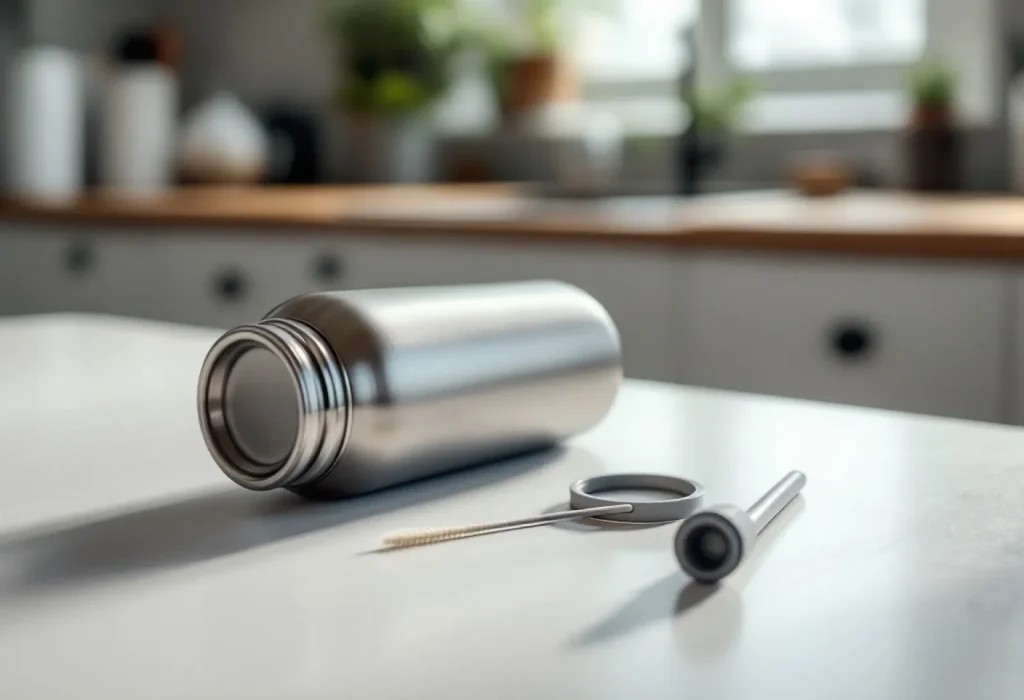
Mold in water bottle lids, straws and gaskets can usually be cleaned off rather than thrown out. Take off the gasket, straw and any bite valve, scrub each in hot soapy water with a bottle or straw brush, soak it the way the maker prints, and dry it fully with the cap off, since EPA says no mold grows without moisture. Replace a part where growth returns in a spot you cannot reach.
Clean it or replace it: which bottle parts can be saved?
The answer turns on whether the moldy spot comes apart. Hard, nonporous parts clean the way EPA's Brief Guide to Mold, Moisture and Your Home describes for any hard surface: scrub with detergent and water, then dry completely. A soft part with growth inside, or a groove you cannot reach with a brush, is the one to replace.
- Spots on a gasket, straw, bite valve or cap that comes off: remove the part and wash it separately. Owala tells owners to pull the spout gasket out by its tab and clean it on its own.
- A gasket or O ring that is twisted, warped or torn: CamelBak says to pop a twisted ring back into place but to contact its warranty department when the ring is permanently warped or broken. The Lifefactory guide warns that missing, worn or misaligned gaskets cause leaks.
- A silicone bite valve with a split slit: CamelBak warns that forcing a brush through the slit can tear the silicone, and it sells bite valves as separate replacement parts.
- Growth that comes back after cleaning in a part that cannot be taken apart: replace that part. Our plastic page uses the same rule, that an item which molds again after cleaning goes out.
- Spots on the inside steel or Tritan wall of the bottle body: this is the most cleanable surface on the bottle, because a bottle brush reaches all of it.
None of the four maker documents read for this page, from Nalgene, CamelBak, Owala and the Lifefactory stainless line, prints a replacement interval in months for a whole bottle or a gasket. They print conditions instead: broken, warped, worn or leaking. The Lifefactory guide’s 5 year limited warranty, issued by Thermos L.L.C., excludes ordinary wear and tear, so a tired gasket is normally a parts purchase, not a claim. Why the polymer itself rarely feeds mold is covered on the can mold grow on plastic page.
Where is the mold hiding: lid gasket, straw, bite valve or threads?
Most bottle mold is not on the wall you can see. The Lifefactory stainless bottle care guide says residual liquids can become trapped between lid parts, container parts, gaskets and straws, and the University of Alabama at Birmingham names rubber sealing parts, straws and lids with crevices as the places that trap moisture. The diagram marks eight of those zones on one composite straw lid bottle.
The table maps each part to the reason it stays wet and to what the maker’s own care page prints for it, across 4 makers. Where a cell says the maker does not state something, no figure was found in the documents listed under Sources, and none has been supplied.
| Part | Why it stays wet | Cleaning the maker prints | Replace when | Source |
|---|---|---|---|---|
| Lid gasket or O ring | Sits in a groove under the cap that never sees air while the lid is on | Lifefactory: remove the gasket, wash all parts separately, dry completely before reassembling. CamelBak: check the black rubber ring inside the cap is not twisted | Warped, broken, missing or leaking | Lifefactory stainless bottle care guide; CamelBak care and cleaning page |
| Spout gasket on a chug or straw lid | Small seal behind the spout cover traps drink in a closed pocket | Owala: remove with the pull tab and clean separately; a distilled white vinegar soak helps break up buildup | Not stated by the maker | Owala FAQ |
| Straw | Long narrow bore holds a film of water after a rinse | Owala: dishwasher silverware bin. CamelBak: pull the straw from the cap; top rack or warm soapy water | Not stated by the makers | Owala FAQ; CamelBak care and cleaning page |
| Silicone bite valve | Slit stays closed and wet between sips | CamelBak: top rack or hand wash; deeper clean in a glass jar with a drop of mild soap or a tablespoon of bleach, shake 30 seconds, soak about 15 minutes | Torn slit; CamelBak sells replacement valves | CamelBak care and cleaning page |
| Lid crevices and slide mouthpiece | Hinges and channels drain slowly | Owala: sponge or straw brush for the nook and smaller spaces; lids top rack. CamelBak: Podium caps top rack, bottles by hand | Not stated by the makers | Owala FAQ; CamelBak care and cleaning page |
| Cap and neck threads | Rinse water and grit sit in the grooves | CamelBak: check the threads for dirt or grit and scrub them | Threads cracked so the cap will not seal | CamelBak care and cleaning page |
| Inner wall and floor of the body | Last sips pool on the floor; drink residue films the wall | Nalgene: very warm water with a few drops of bleach, 2/3 full, shake, sit 1 hour, scrub, rinse. Lifefactory: warm soapy water, no bleach on any part | Growth returns after cleaning | Nalgene FAQ; Lifefactory stainless bottle care guide |
| Sealed insulated wall | Factory sealed; not a cleanable surface | Lifefactory: do not use tools or devices to force a container open | Dents or loss of insulation are a warranty or replacement question, not a cleaning one | Lifefactory stainless bottle care guide |
What do Nalgene, CamelBak, Owala and Lifefactory print about bleach, vinegar and the dishwasher?
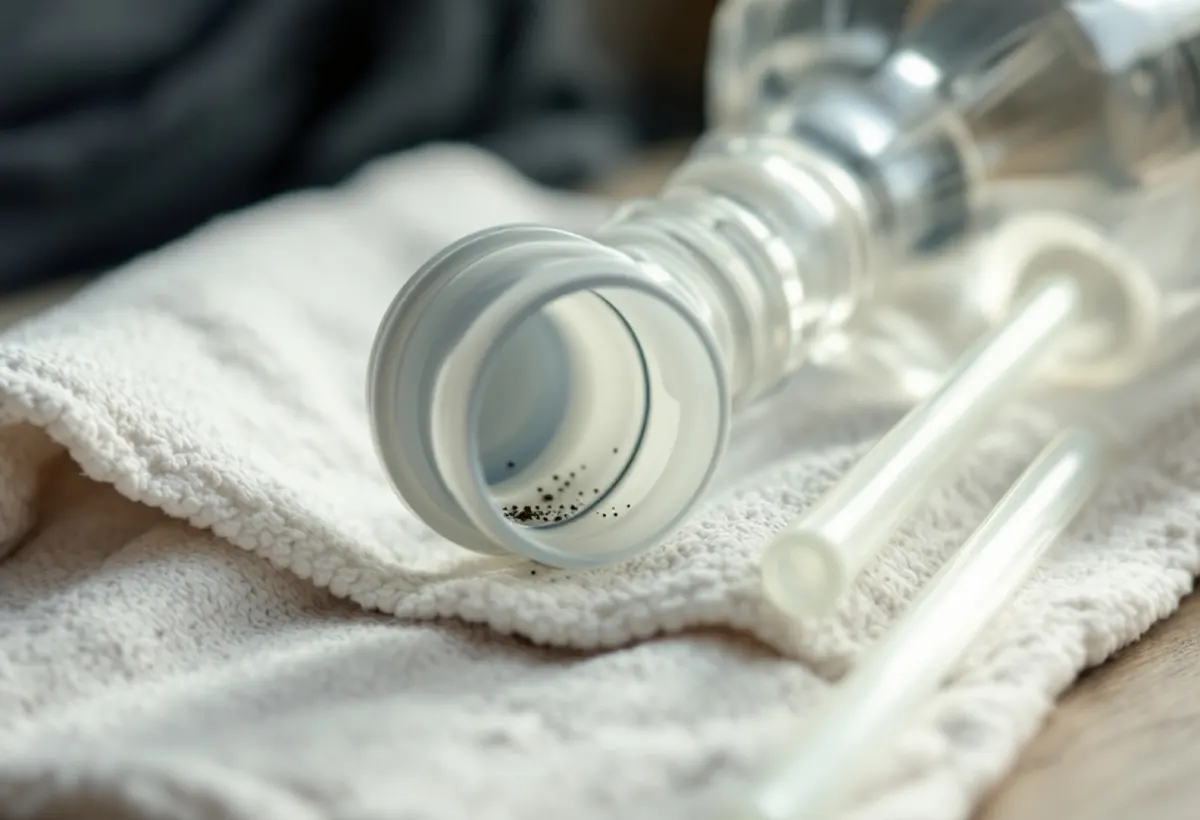
The 4 makers disagree, and the disagreement tracks the material. Nalgene and CamelBak print a bleach step for plastic bottles and silicone parts; Owala’s FreeSip instructions and the Lifefactory stainless guide rule bleach out. The table shows each maker’s wording side by side rather than blending it into one rule.
| Maker and line | Dishwasher | Bleach | Vinegar | Drying | Source |
|---|---|---|---|---|---|
| Nalgene (Tritan Renew bottles) | All bottles, top rack, away from the heating element | A few drops in very warm water, 1 hour sit | Not mentioned | Air dry fully with the cap completely removed; store cap off | Nalgene FAQ |
| CamelBak (eddy, Chute, Podium) | Most bottles yes; Podium bottles by hand, caps top rack | A tablespoon in a jar of water for the valve, straw and cap, about 15 minutes | Not mentioned | Shake dry | CamelBak care and cleaning page |
| Owala (stainless and Tritan) | Lids top rack; straws silverware bin; stainless cup by hand; Tritan all parts top rack | No harsh chemicals such as bleach, in its FreeSip instructions for use | Distilled white vinegar soak for lid buildup | Not stated | Owala FAQ |
| Lifefactory stainless vacuum bottle | Top rack, but hand washing recommended | No bleach or chlorine cleaners on any part | Not mentioned | Dry completely before reassembling | Lifefactory stainless bottle care guide |
Two maker rules matter for mold. The Lifefactory stainless bottle care guide says not to leave contents in the bottle longer than 24 hours and to wash all parts as soon as possible after each use. CamelBak’s cleaning tablet label says not to drink water that still contains a tablet, so a tablet soak ends with a rinse. Where bleach is allowed, EPA's Brief Guide to Mold, Moisture and Your Home says never to mix chlorine bleach with cleaners that contain ammonia, because toxic fumes can form.
How dirty do bottles get between washes? Two studies, 29 and 76 samples
No peer reviewed study found for this page, in PubMed or the 2 journals cited below, counted mold in home drinking bottles. The two that counted microbes measured bacteria, which is the closest published evidence for how fast a neglected bottle fouls.
Oliphant, Ryan and Chu, 2002, in the Canadian Journal of Public Health, sampled water from students’ personal bottles at a Calgary elementary school. The paper reports that the Canadian drinking water guideline was exceeded for total coliform in 13.3% of 75 samples, for fecal coliform in 8.9% of 68, and for heterotrophic bacteria in 64.4% of 76.
Tabaco, Heacock and Shaw, BCIT 2018 swabbed the mouthpieces of 29 in use stainless steel bottles plus one new control. According to the paper, bottles cleaned within a day averaged 162 CFU per 100 square cm at the 24 hour read against 293 for bottles cleaned within a month, about 1.8 times higher. At the 72 hour read, rinsed only bottles averaged 532 against 342 for soap and water, a gap of 190 CFU.
Read the chart with the paper’s own caveats. None of the differences reached statistical significance, and the authors report a power of 7.1% for the cleaning frequency test, meaning 29 bottles were too few to settle the question. The survey side is telling: 59% of owners said they cleaned their bottle about once a week, 69% used soap and water, and none used a sanitizing step, according to the paper.
Is stainless steel easier to keep mold free than Tritan plastic?
Neither material feeds mold well on its own; the film on top does. EPA's What Are Molds? page says all molds need water or moisture to grow, and a bottle supplies both water and a drink residue film, on steel and on Tritan alike, which is why both makers’ guides still call for soap and a brush. Why bare steel is not fungal food is set out on the can mold grow on metal page.
The practical difference is what each of the 4 makers lets you use. Owala puts its Tritan cups in the dishwasher top rack but asks for stainless cups to be washed by hand in warm soapy water, and the Lifefactory guide warns that abrasive cleaners dull a steel finish. Tritan bottles from Nalgene and Owala take the dishwasher; Nalgene also prints a bleach soak for them. A glass bottle was not covered by any maker document read for this page.
If you replace a bottle, material choice has a second published data point. Cooper, Kendig and Belcher, Chemosphere 2011 found no detectable bisphenol A migrating into water from Tritan copolyester, uncoated stainless steel or aluminium lined with EcoCare, while epoxy lined aluminium bottles released 0.08 to 1.9 mg per litre depending on the maker.
Does boiling a lid or a vinegar soak kill what is growing in it?
Boiling is not a step any of the four makers print, and Owala rules it out: its FreeSip instructions for use say do not microwave, freeze or boil. Heat does kill mold spores on a temperature and time curve, and a part that its maker allows to be boiled can use that data, but for a lid whose maker says no, the maker’s instruction governs. The temperature and minute figures are on the does hot water kill mold page.
Vinegar has a narrower record than its reputation. Owala prints a distilled white vinegar soak only to break up buildup in places a brush cannot reach. According to Rogawansamy and colleagues, 2015, vinegar at 4.0 to 4.2% acetic acid inhibited Penicillium chrysogenum but not Aspergillus fumigatus in a disc test on agar. The study detail is on the does vinegar kill mold page.
Why does mold come back a week after cleaning, and how should a bottle dry?
Because the bottle was reassembled wet. EPA’s mold guidance says that when wet items are dried within 24 to 48 hours, in most cases mold will not grow; EPA's Brief Guide to Mold, Moisture and Your Home also says no mold grows without water. A cap screwed onto a damp bottle keeps the gasket groove and the threads wet for days.
- Nalgene: let the bottle air dry fully with the cap completely removed, then store it with the cap off in a cool, dry place.
- Lifefactory: wash all parts separately and dry completely before reassembling, then check the gasket is seated.
- CamelBak: after the bite valve soak, rinse and shake dry; for storing a hydration reservoir it says to air dry it so no moisture is trapped inside.
- UAB: clean ideally daily, or every few days for a bottle not used each day, and let it air dry completely before the next use.
The University of Alabama at Birmingham step list, published 11 March 2024, ends with a sanitizing step using a bleach solution or a commercial sanitizer made for food contact surfaces. That step only applies where the bottle’s maker allows it; for the Owala FreeSip and the Lifefactory stainless line, the maker says no bleach. Appliance tanks that hold water the same way are covered on the mold in coffee maker page.
Out of scope: this page covers cleaning and parts, not what drinking from a moldy bottle may do. For that question, EPA's Brief Guide to Mold, Moisture and Your Home has a section on whether mold can cause health problems, FDA's safe food handling page covers kitchen hygiene, and a clinician can answer for a specific person.
More cleaning and prevention pages sit in the mold hub.
Questions people actually ask
What causes mold in a water bottle?
Water plus residue plus time with the cap on. EPA says no mold grows without water or moisture, and the BCIT survey of 29 bottle owners found 59% cleaned weekly and none sanitized. A cap screwed on while the gasket groove is still wet keeps that spot damp until the next fill.
Is black mold in a water bottle different from white or green mold?
Not for cleaning purposes. EPA notes that molds come in many colors and shows both white and black growth on one page, and UAB describes bottle mold as green, black or white, fuzzy or slimy. Color does not change the method: take the part off, scrub, rinse, dry, and replace a soft part that stays stained.
What is the pink slime in my water bottle?
Pink or orange film gets its own page, because what it is differs from green or black growth: pink mold. In a bottle it collects in the same 8 wet zones shown in the diagram above, and the disassemble, scrub and dry routine printed by CamelBak, Owala and Nalgene applies to it too.
How often should you wash a reusable water bottle?
UAB’s guidance is ideally daily, or every few days for a bottle not used every day. The Lifefactory stainless guide says to wash all parts as soon as possible after each use and not to leave contents in the bottle longer than 24 hours.
Can a stainless steel water bottle go in the dishwasher?
Only if the maker’s printed rule says so, and 3 makers differ. CamelBak says its stainless bottles are dishwasher safe; Owala puts lids on the top rack but asks for stainless cups to be hand washed; the Lifefactory guide says top rack safe but recommends hand washing so every gasket and lid part gets cleaned.
How do you clean mold out of a water bottle mouthpiece?
Pull the mouthpiece or bite valve off the lid. CamelBak’s method is the dishwasher top rack, or a glass jar of water with a drop of mild soap or a tablespoon of bleach, shaken for 30 seconds and soaked about 15 minutes, then rinsed. Do not force a brush through a silicone slit.
Sources
- Lifefactory stainless bottle care guide, Care and Use Guide, Stainless Steel Vacuum Insulated Beverage Bottle, Lifefactory, warranty issued by Thermos L.L.C. Retrieved 21 November 2026.
- Owala FAQ, Owala, frequently asked questions on cleaning, dishwasher use and instructions for use. Retrieved 21 November 2026.
- Nalgene FAQ, Nalgene Outdoor, How do I clean my Nalgene bottle and storage answers. Retrieved 21 November 2026.
- CamelBak care and cleaning page, CamelBak, Care and Cleaning, bottles, bite valves, reservoirs and cleaning tablet label. Retrieved 21 November 2026.
- University of Alabama at Birmingham, UAB News, Drink water, not mold: five steps for a cleaner water bottle, 11 March 2024. Retrieved 21 November 2026.
- Tabaco, Heacock and Shaw, BCIT 2018, Bacterial growth in personal stainless steel water bottles: how often should you clean your bottle?, BCIT Environmental Public Health Journal, 2018, doi 10.47339/ephj.2018.55. Retrieved 21 November 2026.
- Oliphant, Ryan and Chu, 2002, Bacterial water quality in the personal water bottles of elementary students, Canadian Journal of Public Health 93(5):366 to 367, via PubMed. Retrieved 21 November 2026.
- Cooper, Kendig and Belcher, Chemosphere 2011, Assessment of bisphenol A released from reusable plastic, aluminium and stainless steel water bottles, Chemosphere 85(6):943 to 947, via PubMed. Retrieved 21 November 2026.
- Rogawansamy and colleagues, 2015, An evaluation of antifungal agents for the treatment of fungal contamination in indoor air environments, International Journal of Environmental Research and Public Health 12(6), via PubMed. Retrieved 21 November 2026.
- EPA's Brief Guide to Mold, Moisture and Your Home, United States Environmental Protection Agency, last updated 18 February 2026. Retrieved 21 November 2026.
- EPA's What Are Molds? page, United States Environmental Protection Agency, last updated 14 January 2026. Retrieved 21 November 2026.
- FDA's safe food handling page, U.S. Food and Drug Administration, content current as of 5 March 2024. Retrieved 21 November 2026.
- The ratio and gap in the study section are arithmetic on the published means, computed when this page was built. Nothing on this page was tested by us. Our methodology sets out the standing rules.
Care instructions change and differ by model. Check the manual or care page for your exact bottle before using bleach, boiling water or a dishwasher.